Time for Another Moment of Zen

Appropriate, given today’s anniversary.
The Smallest Minority on earth is the individual. Those who deny individual rights cannot claim to be defenders of minorities. – Ayn Rand
Time for Another Moment of Zen
Appropriate, given today’s anniversary.
Forty Years Ago:

(Updated to a larger, complete image.)
After Six Days, a Response!
Last Monday I invited Examiner columnist Marc Rubin to debate the topic of gun control, since he had proclaimed that he had proven irrefutably that “the 2nd amendment has nothing to do with an individual right to own a gun.”
This afternoon he sent me a reply via email.
My response will be forthcoming, but I though I’d give y’all a heads-up first.
UPDATE – 10:04 PM: this is taking longer than I’d anticipated. I’m only about halfway through Rubin’s “irrefutable” article, and I’m having a wonderful time, but I have to get to bed. Hopefully tomorrow!
Checking the referral log this morning before I head out to the range, I noticed I’d had a visitor from South Africa by way of a Google search. He hit two pages, the second of which was my essay “A Mistake a Free People Get to Make Only Once”
Here’s what that brought him (her?) here:
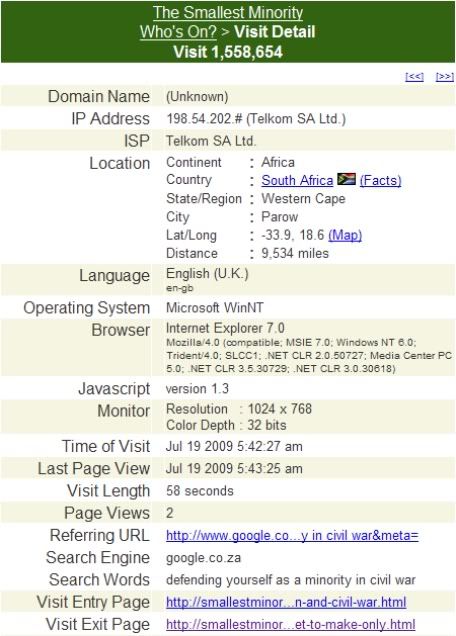
(Click to embiggen.)
Quote of the Day
In 1920, England was the safest industrialized society on Earth. In fact, it was by far the safest society of any sort on Earth. Through a series of gun control laws, England has become by far the most violent society on Earth.
Australia’s politicians were so eager to follow England’s lead that they let a certifiably insane man loose – and gave him his guns back. When the shots stopped, 35 people were dead and 21 were wounded. Today, Oz is clearly the second most violent industrialized society on Earth.
Now, New Zealand wants to get in on the fun. Their politicians are changing the rules for firearms possession, making it harder to keep and bear arms. That will make criminals feel safer, with the inevitable increase in violent crime. Which will result in a demand for more “gun controls.” And finally New Zealand will most likely be in the same situation England and Australia were in before it.
— Extranos Alley – Defining Insanity
It’s not just the gun control laws. In the case of the Anglosphere, gun control is just one of the symptoms of a flawed philosophy that forces its people to spiral down an ever-more-dangerous path of compelled helplessness.
This philosophy was perhaps best expressed recently by James Bowman (author, I believe, of Honor: A History) in a Weekly Standard piece from April, Harm’s Way: The roads in Britain are paved with good intention, itself a review of Theodore Dalrymple’s (pen name of Anthony Daniels) latest book Not with a Bang but a Whimper: The Politics and Culture of Decline. In it, Bowman excerpts a bit from the book, and then expands:
The many hypocrisies and deceptions on which the New Labour coalition was built are typified by the system of criminal justice with which, in his prison job, Daniels had an intimate acquaintance. Citing the work of a whistle-blowing policeman named David Fraser, he compares the British police to
a nearly defeated occupying colonial force that, while mayhem reigns everywhere else, has retreated to safe enclaves, there to shuffle paper and produce bogus information to propitiate its political masters. Their first line of defense is to refuse to record half the crime that comes to their attention, which itself is less than half the crime committed. Then they refuse to investigate recorded crime, or to arrest the culprits even when it is easy to do so and the evidence against them is overwhelming, because the prosecuting authorities will either decline to prosecute, or else the resultant sentence will be so trivial as to make the whole procedure (at least nineteen forms to fill in after a single arrest) pointless.
The real question is, why isn’t this clearly appalling state of affairs a scandal in Britain? I think the answer is that the media consensus there–and to a large extent here–includes certain core principles, such as that crime is caused by something other than criminals and that imprisonment is society’s shame, rather than that of the incarcerated, which can only be protected by maintaining these hypocrisies and deceptions, and with them, the illusion that nothing can be done about most crime. Therefore, the media are complicit in pretending that these problems don’t exist–because they shouldn’t exist.
(My emphasis.) And along with that comes the inability to differentiate between “violent and predatory” and “violent but protective.”
And that’s insanity.
 That’s ParaUSA’s new GI Expert entry-level 1911. The specs are:
Caliber: .45 ACP
Barrel: 5 inches, stainless steel
Twist: 1 in 16 inches, left-hand
Action: Single-action, Semi-automatic
Sights: Dovetail Fixed, 3-White Dot
Receiver: Carbon Steel
Trigger: Medium length
Hammer: Skeletonized Spur
Magazine: 8-round with removable base pad (two provided with pistol)
Overall Length: 8.5 inches
Height: 5.75 inches
Weight: 39 ounces
Finish: Covert Black Para Kote™
Stocks: Checkered Polymer
Safeties: Slide Lock, Internal Firing Block, Grip
Additional Features: Lowered and flared ejection port, beveled magazine well, flat mainspring housing, grip safety contoured for spur hammer
MSRP: $599
I handled one at the NRA convention. It looks like a good, solid piece with just enough enhancements to make it a great shooter.
Remember, THIS GUN WILL BE FIRED AT THE RENDEZVOUS. We’ll try to clean it up a bit before we pass it on to the winner!
Soldier’s Angels is running the on-line ticket sales ($10 each, no limit!), and there is also a chance to win a four day training course from the Front Sight Firearms Training Institute worth $2,000!
The winner need not be present to win.
(But you ought to be anyway!)
It is up to the online raffle ticket purchaser to verify that they can
legally receive and own this pistol where they live, and the winner
must be a resident of the United States. If they cannot legally own this
pistol, they are automatically disqualified from the raffle, and there
is no substitution or other prize to be awarded. All decisions are
final. Raffle tickets sold at the Rendezvous, and raffle tickets sold
online will be combined in the drawing.
Important: To win a gun in the raffle, make sure you can legally own it
before you buy a ticket.
On-Line ticket sales END on Friday Sept. 4th. at midnight!
If you want to win one of the many, many other prizes being given away, you either have to attend, or you’d better know someone who is! 😉
Major kudos to Kerby Smith and Para USA for helping me with this, and Mr. Completely for running the Rendezvous!
RENDEZVOUS!
Mr. Completely has an excellent slide show up, created by True Blue Sam, The Travelin’ Man that I just had to steal:
[youtube https://www.youtube.com/watch?v=P1933EPNUIY&hl=en&fs=1&rel=0&w=425&h=344]
Yeah, it’s pretty much like that! Only with more food, drink, and talk!
I LOL’d
I’ve been accused of worshipping Ayn Rand, probably because the name of this blog comes from Atlas Shrugged, and I’ve quoted her numerous times, yet I am not a Randian / Objectivist, and I did find this flow-chart funny when I found it at AR15.com. YMMV:
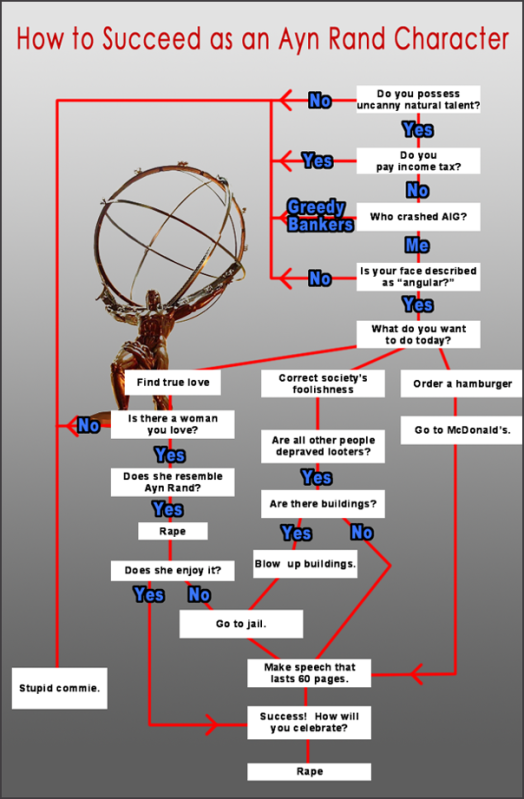
I’ve said what I had to say on Rand’s capacity as a novelist here, It doesn’t differ much from that chart.
Armed Man in Grocery Store
No one injured or even frightened. Shopping completed without incident.
That is all.
You can do anything with it, except drill for it or burn it.
I don’t recall hearing about this in the media when it was released. I wonder why that is?
Reston, VA – North Dakota and Montana have an estimated 3.0 to 4.3 billion barrels of undiscovered, technically recoverable oil in an area known as the Bakken Formation.
A U.S. Geological Survey assessment, released April 10, shows a 25-fold increase in the amount of oil that can be recovered compared to the agency’s 1995 estimate of 151 million barrels of oil.
Technically recoverable oil resources are those producible using currently available technology and industry practices. USGS is the only provider of publicly available estimates of undiscovered technically recoverable oil and gas resources.
New geologic models applied to the Bakken Formation, advances in drilling and production technologies, and recent oil discoveries have resulted in these substantially larger technically recoverable oil volumes. About 105 million barrels of oil were produced from the Bakken Formation by the end of 2007.
The USGS Bakken study was undertaken as part of a nationwide project assessing domestic petroleum basins using standardized methodology and protocol as required by the Energy Policy and Conservation Act of 2000.
The Bakken Formation estimate is larger than all other current USGS oil assessments of the lower 48 states and is the largest “continuous” oil accumulation ever assessed by the USGS. A “continuous” oil accumulation means that the oil resource is dispersed throughout a geologic formation rather than existing as discrete, localized occurrences. The next largest “continuous” oil accumulation in the U.S. is in the Austin Chalk of Texas and Louisiana, with an undiscovered estimate of 1.0 billions of barrels of technically recoverable oil.
“It is clear that the Bakken formation contains a significant amount of oil – the question is how much of that oil is recoverable using today’s technology?” said Senator Byron Dorgan, of North Dakota. “To get an answer to this important question, I requested that the U.S. Geological Survey complete this study, which will provide an up-to-date estimate on the amount of technically recoverable oil resources in the Bakken Shale formation.”
The USGS estimate of 3.0 to 4.3 billion barrels of technically recoverable oil has a mean value of 3.65 billion barrels. Scientists conducted detailed studies in stratigraphy and structural geology and the modeling of petroleum geochemistry. They also combined their findings with historical exploration and production analyses to determine the undiscovered, technically recoverable oil estimates.
USGS worked with the North Dakota Geological Survey, a number of petroleum industry companies and independents, universities and other experts to develop a geological understanding of the Bakken Formation. These groups provided critical information and feedback on geological and engineering concepts important to building the geologic and production models used in the assessment.
Five continuous assessment units (AU) were identified and assessed in the Bakken Formation of North Dakota and Montana – the Elm Coulee-Billings Nose AU, the Central Basin-Poplar Dome AU, the Nesson-Little Knife Structural AU, the Eastern Expulsion Threshold AU, and the Northwest Expulsion Threshold AU.
At the time of the assessment, a limited number of wells have produced oil from three of the assessments units in Central Basin-Poplar Dome, Eastern Expulsion Threshold, and Northwest Expulsion Threshold.
The Elm Coulee oil field in Montana, discovered in 2000, has produced about 65 million barrels of the 105 million barrels of oil recovered from the Bakken Formation.
(Bold emphasis is mine.)
From the FAQ page:
Why isn’t this information concerning the Bakken Formation on front page news?
In April 2008, when the USGS released the assessment of undiscovered, technically recoverable oil and gas resources of the Bakken Formation, there was a press release which was distributed to the media. The individual media organizations make the decision about what stories to publish. When the USGS assessment was released, news articles were done in several news avenues including the New York Times, the Associated Press, and Oil and Gas Journal.
In other words, “It doesn’t fit the agenda.”
Why aren’t we drilling in the Bakken Formation?
Oil has been produced from the Bakken Formation since the 1950’s and, as of December 2008, cumulative oil production from the Bakken Formation totaled about 149 million barrels (up from 135 million barrels in September 2008).
That wasn’t the question. Why isn’t the area infested with drill rigs? Answer: Congress.
Does the Bakken Formation contain more oil than Saudi Arabia?
There is no certain method to determine the exact volume of oil that is contained in the Bakken Formation or any formation. The Bakken Formation oil resource is much different than the oil resources of Saudi Arabia. The Bakken oil resource is what we refer to as a “continuous” or unconventional resource, whereas the oil resources being produced in Saudi Arabia and other Middle Eastern countries are conventional resources. Continuous or unconventional resources require more technical drilling and recovery methods that are much more costly and the oil recoveries per well are commonly much lower than in a conventional resource accumulation. However, the estimate of technically recoverable oil in the Bakken Formation is larger than all other current USGS oil assessments of the lower 48 states and is the largest “continuous” oil accumulation ever assessed by the USGS.
A “continuous” oil accumulation means that the oil resource is dispersed throughout a geologic formation rather than existing as discrete, localized occurrences, such as those in conventional accumulations. The next largest “continuous” oil accumulation in the U.S is in the Austin Chalk of Texas and Louisiana, with an undiscovered estimate of 1.0 billions of barrels of technically recoverable oil.
“Yes.”
What are some of the problems with drilling in the Bakken Formation?
Oil is produced from the Bakken Formation shale in a manner that is a refinement of traditional oil field practice. Traditional oil fields produce from rocks with relatively high porosity and permeability, so oil flows out fairly easily. In contrast, the Bakken Formation is a relatively tight formation consisting of low porosity and permeability rock, from which oil flows only with difficulty. To overcome this problem, wells are drilled horizontally, at depth, into the Bakken and then water and other materials (like sand) are pumped downhole at high pressure (called hydrofracturing) to create open fractures, creating artificial permeability in these tight rocks. The oil can then flow more easily out of these fractures and tight pores. Traditional oil fields regularly employ hydrofracturing and non-vertical wells have also long been drilled. The technique has been fine-tuned for use in the Bakken and other similar tight continuous reservoirs.
“It costs more per barrel.”
Will the oil in the Bakken Formation free us from depending on foreign oil?
It is hard to determine if the Bakken Formation oil could offset other sources of oil A number of logistical and economic factors affect current and future production, and oil deposits are typically produced for many decades. For these reasons, the USGS does not make forecasts about the future potential of a resource to resolve national energy needs.
“It could, if we had the national will to exploit it. See the question above on ‘why isn’t this front page news?'”
“Peak Oil” my aching ass. More expensive oil, yes. But there’s a LOT we haven’t tapped yet. As the easier stuff taps out and the price goes up, other energy technologies will become more attractive, but the “more difficult to extract” oil will become economically feasible.
If we can keep the modern Luddites from putting us all back in the middle ages.