The Other Side of the Global Warming Debate.
(Yes, there is one.)

Al Fin has three videos up you really ought to watch if you’re interested in the question, and not convinced that the “Anthropomorphic Global Warming” skeptics are all paid off by by Big Oil.

The videos run not quite three hours in total. The first is a Canadian Broadcasting Corporation documentary entitled Doomsday Called Off. The second is the UK’s Channel 4 documentary The Great Global Warming Swindle, and the third is a CNN production by Glenn Beck, Exposed: The Climate of Fear.

Well worth your time.

Oh, and no commercials!

“Having a gun changes everything”.

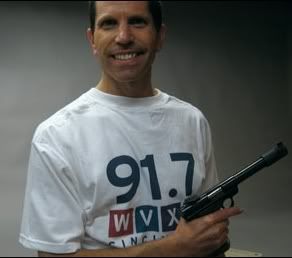
Last Friday I noted that NPR’s Weekend America program would be featuring a segment on a guy with a gun. I didn’t get a chance to listen to it on the air, but sure enough it’s available as a podcast at their website now. I took some time to listen to it today. Interestingly enough, it’s accompanied by the original letter to NPR that spawned the piece, and some pictures of the subject. If you don’t want to take the time to listen (it runs right at five minutes) or if you don’t have RealPlayer, I’ve transcribed the audio below. I’ll reproduce the letter and a couple of the pictures here, too, for posterity. Here’s the letter from Eric:

My first firearm. It was a Ruger Mark 2 semiautomatic target pistol and with it I learned to shoot at the oldest continuously-operating handgun club in the United States. I was interested in self defense but my experiences at the revolver club led me into the world of competitive shooting and joining the NRA. I had always had suspicions about the motives and practices of the NRA but I wanted to join so that I could compete in NRA sanctioned matches (where the best shooters compete). I came from an upper middle class family from White Plains, NY. Guns were strictly forbidden by mom and dad. My two sisters had no interest in guns, and even I didn’t like riflery at Boy Scout camp.

Learning to shoot a deadly weapon with skill (I became the #5 shot in Ohio in Olympic 10 meter air pistol, and was co-winner of the revolver club’s handicap pistol league in my first year) put me in a strange position: how could I explain my activities to my family who was hostile with my new found interest. My personal politics had never been “conservative” and many of the people I socialize with are anti-gun to say the least.

Well, I’ve learned to separate the wheat from the chaff as far as what the NRA claims to be true and correct. I’ve become more confident in defending myself and in defending my gun rights to those who are hostile toward them. This is tough since I associate with a lot of Unitarians and academics (my wife teaches at a university).

All this has led to much soul searching and a better understanding of what I believe in regarding self-defense and the right of the people to have the power that is represented by guns.

I’d be happy to expand on any of this at your request.

Now, Eric didn’t want to be identified (as the following transcript notes) but he gave everybody enough information to identify him in about thirty seconds of Google searching, I think – but no matter. Here’s the transcript:

Desiree Cooper: Last year more than nineteen billion catalogs were mailed out, so as you all pour over those slick pages this weekend, I want you to ask yourself this question: “Is this purchase really going to change your life?” Over the past weeks we’ve been asking about purchases that have changed your lives, and no matter where you made the purchase or how, we want to know what happened when you finally brought it home.

For one story we’re going to the Midwest where we’ll meet Eric – now he doesn’t want us to give his last name or the city where he lives, but this weekend Eric will be spending some time with a purchase that changed his life: a gun. And like a lot of guys, he got into them at an early age.

Eric: When I was a kid I was in Cub Scouts, and I had this idea, as I’m sure that a lot of little boys do, that it was gonna be – and I remember the fantasy totally clearly – um, there were gonna be hula dancers; really, really good lookin’ hula dancers. And machine-guns. (Laughs) I don’t know. I was a little boy! I guess too much action TV. Of course Cub Scouts had absolutely nothing to do with that. There were no guns or anything with Cub Scouts. (Ukelele music in the background.)

Eventually, um, what I wanted to do was get a pellet gun, and actually I went out and I just bought one. Um, and I brought it home, and you know, and I still remember my mom screaming “IT’S AN INSTRUMENT OF DEATH!” (Laughs) Which, of course, you could kill somebody, but boy, it’d be really hard to kill somebody with it – so guns were just like this foreign, you know, virus.

The first firearm that I bought was a Ruger Mark II bull-barrel pistol. And the club where I was taught how to shoot shot a specific type of target shooting called Bullseye, and, um, I became the fifth best shooter in the state. And, um, I was really proud of that. And, um, it was really, really a lot of fun.

I mean there really is a perception that people who are gun enthusiasts are by nature socially conservative, and, um, that’s it. I come from a completely different background. Um, I’m very independent. And the thing about guns and, you know, in terms of my friends, some friends were interested. Uh, other friends I could really clear out a room, you know, if I brought up the subject.

I learned really fast that it just wasn’t something you talked about.

I don’t think there’s any question, it has made me much more cognizant of the ethics and the morality of self defense. The only time you would ever produce a firearm in an act of self defense is when you fear for your life. That’s it. And I never really had to come to grips with the idea that I might actually have to do that until I bought a gun. And then it became a very, very important quest for me to get as much knowledge about “what am I gonna do with this thing?”

Having a gun changes everything.

I can’t meditate. I have a “monkey mind” as the Buddhists would say. I just think about too many things. Um, the only time I’ve ever been able to really focus on my breathing and on relaxation for any period of time has been during shooting. When I have that task, I relax, and I focus, and I visualize shooting a lot when I can’t shoot. Gentle breaths. The arms raised. And then my finger moves to the trigger. And the squeeze is timed with the breathing. I bring in a breath, and then I begin my squeeze. And I have to complete the firing of the gun before I run out of air. And the fun thing about shooting sometimes is that’s when I listen to NPR. (Laughs. NPR theme plays in the background.)

You know, we’re all running around like crazy, you know, for a lot of us on the weekend, but when you get to the shooting range – everything stops. And for a lot of us who do things fast, fast, fast, fast, it’s a time to slow down. (Segment ends.)

I’m not going to comment on the fear, the disease parallel, the social pariah identification, I’m not even going to comment on the self-realization that came about from his purchase of a firearm. I’ll leave that to you, my gentle readers. I’m just going to post the two pictures of the subject with one quick comment afterward:

OH MY GOD! HE’S GOT AN ASSAULT RIFLE!!! (Looks like a match-legal pre- post-ban, too.)

Interesting that no one at NPR said anything about that. I wonder what else didn’t make the cut?

The Humanitarian with the Guillotine

Of all tyrannies, a tyranny exercised for the good of its victims may be the most oppressive. It may be better to live under robber barons than under omnipotent moral busybodies. The robber baron’s cruelty may sometimes sleep, his cupidity may at some point be satiated; but those who torment us for our own good will torment us without end, for they do so with the approval of their consciences. – C.S. Lewis

Personally, I’m interested in keeping other people from building Utopia, because the more you believe you can create heaven on earth the more likely you are to set up guillotines in the public square to hasten the process. – James Lileks

No essay tonight, this being Halloween, and my job being to hand out candy to the kids, but in the spirit of this day I want to forward on an essay written in 1943 by Isabel Paterson, The Humanitarian with the Guillotine, which I stumbled across today. It’s fairly long, but worth your time, I think. Here’s a taste:

Most of the harm in the world is done by good people, and not by accident, lapse, or omission. It is the result of their deliberate actions, long persevered in, which they hold to be motivated by high ideals toward virtuous ends.

This is demonstrably true; nor could it occur otherwise. The percentage of positively malignant, vicious, or depraved persons is necessarily small, for no species could survive if its members were habitually and consciously bent upon injuring one another. Destruction is so easy that even a minority of persistently evil intent could shortly exterminate the unsuspecting majority of well-disposed persons. Murder, theft, rapine, and destruction are easily within the power of every individual at any time. If it is presumed that they are restrained only by fear or force, what is it they fear, or who would turn the force against them if all men were of like mind?

And one more:

When a humanitarian wishes to see to it that everyone has a quart of milk, it is evident that he hasn’t got the milk, and cannot produce it himself, or why should he be merely wishing? Further, if he did have a sufficient quantity of milk to bestow a quart on everyone, as long as his proposed beneficiaries can and do produce milk for themselves, they would say no, thank you. Then how is the humanitarian to contrive that he shall have all the milk to distribute, and that everyone else shall be in want of milk?

There is only one way, and that is by the use of the political power in its fullest extension. Hence the humanitarian feels the utmost gratification when he visits or hears of a country in which everyone is restricted to ration cards. Where subsistence is doled out, the desideratum has been achieved, of general want and a superior power to “relieve” it. The humanitarian in theory is the terrorist in action.

The woman was harsh – and tends a bit towards hyperbole – but the points she makes are good ones.

Bleg for a Good Cause

Back on Memorial Day I put up a list of worthy charities and invited you to contribute to whatever charity met your particular criteria. I chose Soldier’s Angels, based on what I’d heard and read about them. I’m glad I did.

The guest of honor at this year’s Gunblogger’s Rendezvous was Maj. Chuck Ziegenfuss. Major (then Capt.) Ziegenfuss was commander of Charlie Company, 2nd Battalion, 34th Armor in Iraq when he was the victim of an IED in June of 2005. The Major was also a blogger, and still is, running From My Position… On the Way!, so many of us knew about his story, but not much of the details. After our dinner, Maj. Ziegenfuss gave us those details of his experience of being essentially blown to pieces by a buried 80mm mortar round, the reaction of his men, the trip home, and the ongoing recovery from his injuries. I am not going to relate it here, because that’s not what this post is about.

This post is about Soldier’s Angels and Project Valour-IT.

When Chuck woke up in Walter Reed, a woman was in his room, a woman that was not his wife. A woman that he didn’t know. That woman was Kathleen Bair, a Soldier’s Angels volunteer who made sure that someone was with him when he woke up, and that someone stayed with him until his wife could arrive. Kathleen did anything she was asked within the realm of possibility – no forms to fill out, no red tape, no idiotic questions. When Chuck said that he’d like to have a laptop so he could continue blogging, Kathleen called him from her home that night. She was on eBay, bidding on a used laptop. Would the unit she was bidding on meet his needs?

As Chuck explained, he was loaded to the eyeballs on painkillers at the time. Anything sounded fine. As it turned out, the laptop was fine. It was Chuck that out of spec. As he explained it, the explosion had mangled his left hand, severing his pinky finger and damaging nerves. His right hand had been shielded from the blast, mostly, by his M4 carbine, but that thumb had been blown off and lodged in his thigh. The reattachment surgery had gone well, but he had only one functioning finger at the time. This brought “hunt and peck” to an entirely new level.

Chuck knew about Dragon Naturally Speaking speech-recognition software, and asked his readers – slowly and painstakingly – for a copy. He got one overnight via his Amazon.com wishlist. A few minutes spent loading and then “training” the software to his voice, and he was high-speed, low-drag blogging again.

As he explained during is talk to us, that’s when inspiration struck. How many people actually write anymore? During WWII, Korea, even Vietnam, “candy-stripers” or Red Cross volunteers used to go around VA hospitals to write letters for wounded soldiers by dictation. Not any more. And when was the last time a soldier actually wrote a letter on paper? The media was electronic now. Email, instant-messaging, blogging, chatrooms, bulletin boards were all the ways the modern soldier communicated with friends and family. Something else Chuck noticed: when he was online, either reading or writing, he tended not to notice the pain of his injuries. He even asked to have the level of his medication reduced so that it didn’t affect his mental state as much.

There is, he explained, a fine line between “enough” pain meds and “too much.” Too much medication does keep the patient comfortable, but it slows the healing process. Too little medication leaves the patient in such pain that again, healing is slowed. But when all you have to do is lay in bed and watch four channels of bad TV or read a six-month old magazine for the fifth time, your pain tends to occupy your thoughts.

But not when your mind is engaged in something interesting.

Chuck’s epiphany was that there must be other soldiers – many of them – injured like he was who could use a laptop with speech-recognition software to access the internet. He discussed it with Kathleen Bair and another blogger he corresponded with, and Project Valour-IT was born as a subsidiary of Soldier’s Angels. The project recently gave out its 2,000th laptop. Through the donations of just the few of us who came to the Rendezvous, we collected enough money to provide another laptop for an injured soldier.

So here’s the deal: Last year a competition was put on to raise money for this very worthy cause. Money was raised in the name of each of the branches of the armed forces, though the money all goes in the same pot, and it makes no difference which branch a wounded soldier belongs to when it comes to receiving a laptop. It’s strictly for bragging rights.

The competition for this year is now open. The target for each branch is $60k, and the first one to meet it, wins.

(BTW, the Navy won last year.)

Project Valour-IT isn’t going to get a $1.4m windfall from Rush Limbaugh, and I doubt seriously Harry Reid will try to polish his reputation by being a donor, but I’m asking my readers to pony up whatever they can spare. This is a tax-deductible donation to a cause you know is good, and to a cause where 70% of the money you give isn’t used to cover “overhead.”

Since I got back from the Rendezvous I put up a Soldier’s Angels link on the sidebar. Tonight I’m adding a Project Valour-IT link as well.

If you support the troops, please help support these troops.

UPDATE: Excellent post on the fundraiser competition at Argghhh!

“Supporting” the Troops.

In a comment here in response to a post on why I am not a conservative, Markadelphia took exception to another comment on language manipulation. To wit:

“Something I’ve noticed about Leftists is that they seem to think they can somehow change a concept or even reality itself by simply changing the word used to describe that concept.”

I have noticed this about about “conservatives” as well. In fact, I think the right side of the aisle is much more adept and effective at manipulating language. If you are against the war in Iraq, then you must not support the troops.

I ran across this OpinionJournal piece today, courtesy of Instapundit, that pretty much says it all on that topic.

When I tell people that Evan has joined the Army, their reactions are almost always the same: their faces freeze, they pause way too long, and then they say, “I’m so sorry, I’m so sorry for you.” I hang my head and look mournful, accepting their sympathy for the worry that lives in me. But as it dawns on them that Evan wasn’t drafted, as Vietnam still clings to my generation, their expressions become quizzical, then disbelieving. I know what they’re thinking: Why in the world would any kid in his right mind choose to enlist when we’re in the middle of a war? I begin telling them the story, desperate to assure them it wasn’t arrogant patriotism or murderous blood lust that convinced him to join.

Arrogant patriotism or murderous blood lust – obviously the only two reasons anyone would join the military. Or, as James Taranto notes, lack of a good education.

Bet if you ask her, though, she “supports the troops.”

I don’t believe that most people who are against the war in Iraq are like this woman, but I believe it of every single marcher at the anti-war rallies who carries a Code Pink sign.

Quote of the Day.

An email link from Robb of Sharp as a Marble brought me to this Protein Wisdom post on Britons seeking foreign alternatives for their National Health Service when major surgery is needed. Read the whole post, but here’s the QotD:

Of course, none of this will stop the push for socialized medicine in the US, because if there’s one thing progressives excel at it is convincing themselves that any failure of ideology is attributable to the failure of the person or persons leading it — and that all that is required for Utopian policy to prove truly viable is the right kind of leaders: confident and brilliant (by their own lights) elitist bureaucrats who will resist the corrupting influences that “free market types” are always arguing are inherent to such systems.

Gee. Remind you of anyone?

“Be consoled that you are winning the battle.” – Pt. II

That’s a quote from journalist Laura Washington in an email to me concerning the current status of the gun control battle.

Bear with me here, it’s a pertinent quote.

Back in December of 2005 while listening to NPR one Saturday afternoon, I heard a plea from the editors of Weekend America, which I wrote about that very day. At their website, WeekendAmerica.publicradio.org, they had posted this:

Early next year, we’ll take on the hot-button topic of guns and gun control. No doubt, you probably have a few questions of your own. We’d like to hear from you.

I invited my readers to respond. I certainly did. Ever since I’ve been getting weekly emails from them, telling me what will be on the upcoming show.

As far as I know, they never did run that piece on the topic of gun control.

But they’ve got an interesting one coming up this weekend! Get this:

Buy a Gun. Find Peace.
The first firearm Eric bought was a Ruger MK II pistol. It changed his life. According to Eric, owning the gun has made him think long and hard about the responsibility. And believe it or not, owning a firearm has brought calm to his life. Shooting at the range helps him take a step back from his hectic life and breathe deeply — it’s almost zen.

That sounds remarkably like the comparison Emily Yoffe made in another NPR piece between shooting and yoga.

We are winning the battle. This does not mean, however, that we can pack up and go home now. It ain’t over. It’s never going to be over. The price of liberty is eternal vigilance.

I think I’ll try to listen to the show this weekend. If I miss it, I’m sure that segment will be available as a podcast.

I Am NOT a Conservative


Or: “Language Manipulation” is a Very Old Tool

Since the last couple of major posts have been, at least partially, about the comment threads here at TSM, I want to make what I feel is an important point that is glossed over by the modern vernacular. As I noted previously, when I find someone who says something better than I can, I let them, so the majority of this post will be other people’s words – but they’re important words.

The first is a quote from the introduction to David Hackett Fischer’s Albion’s Seed: Four British Folkways in America:

We Americans are a bundle of paradoxes. We are mixed in our origins, and yet we are one people. Nearly all of us support our Republican system, but we argue passionately (sometimes violently) among ourselves about its meaning. Most of us subscribe to what Gunnar Myrdal called the American Creed, but that idea is a paradox in political theory. As Myrdal observed in 1942, America is “conservative in fundamental principles . . . but the principles conserved are liberal, and some, indeed, are radical.”

I think Myrdal was on to something there.

The second quote will be a long one. It is from the introduction to Milton Friedman’s Capitalism and Freedom, first published in 1962. Note the date of the quote contained within this excerpt:

It is extremely convenient to have a label for the political and economic viewpoint elaborated in this book. The rightful and proper label is liberalism. Unfortunately, “As a surprise, if unintended compliment, the enemies of the system of private enterprise have thought it wise to appropriate its label” (Joseph Schumpeter, History of Economic Analysis New York: Oxford University Press, 1954, p. 394), so that liberalism has, in the United States, come to have a very different meaning than it did in the nineteenth century, or does today over much of Continental Europe.

As it developed in the late eighteenth and early nineteenth centuries, the intellectual movement that went under the name of liberalism emphasized freedom as the ultimate goal and the individual as the ultimate entity in the society. It supported laissez faire at home as a means of reducing the role of the state in economic affairs and thereby enlarging the role of the individual; it supported free trade abroad as a means of linking the nations of the world together peacefully and democratically. In political matters, it supported the development of representative government and of parliamentary institutions, reduction in the arbitrary power of the state, and protection of the civil freedoms of individuals.

Beginning in the late nineteenth century, and especially after 1930 in the United States, the term liberalism came to be associated with a very different emphasis, particularly in economic policy. It came to be associated with a readiness to rely primarily on the state rather than on private voluntary arrangements to achieve objectives regarded as desirable. The catchwords became welfare and equality rather than freedom. The nineteenth-century liberal regarded an extension of freedom as the most effective way to promote welfare and equality; the twentieth-century liberal regards welfare and equality as either prerequisites of or alternatives to freedom. In the name of welfare and equality, the twentieth-century liberal has come to favor a revival of the very policies of state intervention and paternalism against which the classical liberal fought. In the very act of turning the clock back to seventeenth-century mercantilism, he is fond of castigating true liberals as reactionary!

The change in the meaning attached to the term liberalism is more striking in economic matters than in political. The twentieth-century liberal, like the nineteenth-century liberal, favors parliamentary institutions, representative government, civil rights, and so on. Yet even in political matters, there is a notable difference. Jealous of liberty, and hence fearful of centralized power, whether in governmental or private hands, the nineteenth-century liberal favored political decentralization. Committed to action and confident of the beneficence of power so long as it is in the hands of a government ostensibly controlled by the electorate, the twentieth-century liberal favors centralized government. He will resolve any doubt about where power should be located in favor of the state instead of the city, of the federal government instead of the state, and of a world organization instead of a national government.

Because of the corruption of the term liberalism, the views that formerly went under that name are often labeled conservatism. But this is not a satisfactory alternative. The nineteenth-century liberal was a radical, both in the etymological sense of going to the root of the matter, and in the political sense of favoring major changes in social institutions. So too must be his modern heir. We do not wish to conserve the state interventions that have interfered so greatly with our freedom, though, of course, we do wish to conserve those that have promoted it. Moreover, in practice, the term conservatism has come to cover so wide a range of views, and views so incompatible with one another, that we shall no doubt see the growth of hyphenated designations, such as libertarian-conservative and aristocratic-conservative.

Partly because of my reluctance to surrender the term to proponents of measures that would destroy liberty, partly because I cannot find a better alternative, I shall resolve these difficulties by using the word liberalism in its original sense – as the doctrines pertaining to a free man.

Friedman doesn’t come out and say it, but what he described was the co-opting of a term by the forces of socialism. This co-option was described by Friedrich Hayek in The Road to Serfdom in 1944, Orwell in his 1984 in 1949, and Eric Hoffer in The True Believer in 1951. But the point of this post is that Friedman was right. “Conservatism” isn’t a satisfactory alternative. I am against the War on (Some) Drugs™, against the criminalization of abortion, in favor of gay marriage (but less sanguine about adoption into such pairings). I am unconcerned about what two (or more) consenting adults do sexually in the privacy of their own homes, and even less concerned about any devices those adults may use to stimulate their sexual organs, but I think pedophiles should be shot and their bodies disposed of in the nearest dumpster. I think far too many “environmentalists” in actuality hate humanity, and are disillusioned socialists looking for another attractive mass movement to attach themselves to. So too for far too many animal “rights” activists.

I am NOT a conservative. And “liberals” are NOT liberal. Nor are they “progressive,” except as the term pertains to income tax rates.

Idealists Without Illusions


(or so they have convinced themselves)

Since mid-March of this year this blog has been visited by and commented on by Markadelphia, as I noted below in the post The Mystery of Government. Mark was first attracted here by comments I left at his blog Notes from the Front on a post about the Zumbo incident, Great Bunch a Guys. It was a civil, if short, comment thread, and in my last comment to him there, I said this:

Having perused your site I can see that we’re not at all on the same plane philosophically or politically, so I’m going to disagree with you on a lot of things. This is good, because you learn much more arguing your case with someone who disagrees with you than you do preaching to the choir.

If you want a discussion, I’ll be more than happy to provide it. I don’t throw ad hominems, and I provide research and citations to support my positions. It’s a lot of work. I expect the same in return. “I feel” or “I believe” isn’t enough. “This is what I believe, and here is why I believe it” constitutes a valid argument.

Though that invitation was to discuss the topic of gun control specifically, Markadelphia declared himself at least somewhat converted on that topic in a later post, which I will quote from here, but not link to quite yet:

It just so happened that when I wrote a column about the Jim Zumbo deal a while back, a blogger by the name of Kevin Baker came to the defense of the gun lobby. He posted some comments here that made me think and, I must admit, altered my view. I came to the realization that, while I will never get off on guns, they are, in fact, a personal liberty just as anything else is in this country and if I am going to be against things like the Patriot Act, then I have to be against gun control. Besides, it’s not guns that are the problem anyway. It’s Americans that are the problem. And Americans like Kevin, and the others that post on his site, are very responsible gun owners.

He wrote on here:

I’m going to disagree with you on a lot of things. This is good, because you learn much more arguing your case with someone who disagrees with you than you do preaching to the choir.

I agree completely. You know that I love all of you but the most interesting discussions are when PL, Crab, Dave, Sarge, the rev, and joe Anonymous get in the mix. I believe with all of my heart and soul that raising the level of debate in this country gets people to think. That’s why I think it IS polite to talk about politics. Preaching to the choir is a fucking bore and I would have shut down this site long ago if we didn’t have the wonderful ragers we have had here.

So, it was with that spirit I began posting on his blog…the only other blog I post on regularly other than this one. I really felt like if we could come together on the gun thing maybe there could be other things on which we could find common ground. I was buoyed by Kevin’s (and others that post there) intelligence, unbiased interpretation of facts and law in regards to the gun issue so I really felt there might be some hope.

That’s not the heart of that post, but it’s the part pertinent to this essay at this point. I will return to it forthwith.

It is true that you learn more from people who disagree with you than those who echo your beliefs. Sometimes, however, what you learn is only a reinforcement of your beliefs. Markadelphia is a self-confessed liberal, and, from the tone and content of the majority of his comments here, insofar as I can tell he is at minimum a closet socialist – someone who won’t quite admit it to themselves. Just one example:

There is a pervasive, Randian view on Communism on this blog, though….

He says that like it’s a bad thing. 😉

With the sole exception of gun control, Markadelphia has exhibited every characteristic of the stereotypical urban Leftist (big “L” on purpose) . I’m not complaining! Since he started commenting, the traffic here is up and the comment threads have been generally interesting, informative, and refreshingly free of invective and insult. While Mark argues that everyone is ganging up on him, and we’re all just a part of the right-wing echo-chamber, the fact remains that his posts have inspired some very insightful, thought-provoking comments, and I appreciate that.

But as to Mark himself, I think the attraction is wearing off, and I want to speak as to why that is.

My normal blogging style is the essay. Some idea inspires me to write; some thing(s) I’ve read generally ruminate in my mind until they jell into a coherent theme about which I will ramble for five or six thousand words or more. The ongoing discussion threads here are just that kind of thing. Some recent comments from The Mystery of Government:

Nothing kills the urge to debate in me faster than realizing I could be arguing the other guy’s position better than he’s doing it. Absent the possibility of changing someone’s mind, either my opponent’s or the audience’s, the good I get out of it is practicing; if I could be doing better talking to myself, why bother? – LabRat

We’ve been trying to talk sense to Mark, to lead him to water, but he just can’t drop his loaded ways of thinking, his overloaded “meanings” of words (to mean what he wants them to, no more and no less). Perhaps we’ve gone too far.

I’m tired of it right now – He’s left tons of questions I’ve tried to ask him unanswered, and shown he can’t see the world but through his view, he’s incapable of trying to see it through any other lens, which means he fails to understand. – Unix-Jedi

You don’t answer his questions because you plainly don’t like the answers to his questions. You spend endless barrels of ink dancing around the answers, but as I stated before, you just can’t get the peanut butter out of your jaws. You spend time by the fortnight pounding your keyboard here, and so your available time is not the issue.

Yet again, Mark, you are a phony, and nothing more. You don’t fool anyone here….

No, Mark, you are not a slave to anyone in any way except to your own inability to admit it when you are shown to be wrong. – DJ

These kinds of comments have been getting more common of late. Markadelphia has made several comments pertaining to what he sees as Conservative groupthink here as well. What has all of this reminded me of? Reasonable People – the essay I wrote back in December of 2005. Specifically, I was reminded of an essay I quoted extensively from, Dr. Bob Godwin’s How I Cured Myself of Leftism. Once again (big excerpt):

At this point in time, I am more inclined to think of leftism as an intellectual pathology rather than a psychological one (although there is clearly considerable overlap). What I mean is that it is impossible to maintain a priori that a conservative person is healthier or more emotionally mature than a liberal. There are plenty of liberals who believe crazy things but are wonderful people, and plenty of conservatives who have the right ideas but are rotten people. However, this may be begging the question, for it is still puzzling why people hold beliefs that are demonstrably untrue or at the very least unwise.

One of the problems is with our elites. We are wrong to think that the difficulty lies in the uneducated and unsophisticated masses–as if inadequate education, in and of itself, is the problem. As a matter of fact, no one is more prone to illusions than the intellectual. It has been said that philosophy is simply personal error on a grandiose scale. Complicating matters is the fact that intellectuals are hardly immune to a deep emotional investment in their ideas, no less than the religious individual. The word “belief” is etymologically linked to the word “beloved,” and it is easy to see how certain ideas, no matter how dysfunctional–for example, some of the undeniably appealing ideas underpinning contemporary liberalism–are beloved by those who believe them. Thus, many liberal ideas are believed not because they are true, but because they are beautiful. Then, the intellectual simply marshals their intelligence in service of legitimizing the beliefs that they already hold. It has long been understood by psychoanalysts that for most people, reason is the slave of the passions.

Underneath the intellectual’s attachment to the dysfunctional idea is a more insidious fear that their entire intellectual cathedral, carefully constructed over a lifetime, will collapse in ruins. Religious people are not as prone to this same fear, because they accept it that their religion is ultimately based on a leap of faith. One can see how this is playing out, for example, in the intelligent design debate that has philosophical materialists frothing at the mouth. Intellectuals live under the illusion that their system is based solely on facts and logic, which is easily disproved, even with regard to mathematical knowledge (for example, Godel’s theorems prove that there is no formal system that does not contain assumptions unwarranted and unprovable by the system). For most intellectuals, understanding actually precedes knowledge. In other words, they have a certain feeling about the world, and then only pay attention to knowledge that confirms that feeling-based view.

But wait! We’re not done!

As Jonah Goldberg has observed, “Like many spiritual movements, liberalism emphasizes deeds and ideals over ideas. As a result, when liberals gather there’s a revivalist spirit in the air, with plenty of talk about fighting the forces of evil and testifying about good deeds done.” The philosopher Eric Voegelin coined the phrase “immanentizing the eschaton” to describe the messianic liberal impulse to remake mankind and to create heaven on earth. Goldberg cites several examples, such as “the spiritual nature of the environmental movement; the quasi-messianic treatment of Martin Luther King Jr.; Bill Clinton’s invocation of ‘covenants’ with the American people; Hillary Clinton’s ‘politics of meaning,’ which claimed to redefine what it meant to be a human being in the postmodern world — all of these are examples of what Voegelin would describe as the neo-Gnostic effort to make the hereafter simply here.” Similarly, “It should be no surprise that Hillary Clinton justified her Senate candidacy on the claim that she was more ‘concerned’ about the issues than her opponent. And of course her husband won the presidency by arguing he was better at ‘feeling’ pain.”

At the same time, for the person who is not under the hypnotic psycho-spiritual spell of contemporary liberalism, it is strikingly devoid of actual religious wisdom or real ideas. As such, it is driven by vague, spiritually infused ideals and feelings, such as “sticking up for the little guy,” or “war is not the answer.” On the other hand, conservatism is not so much based on ideas, but on simply observing what works, and then generalizing from there. It is actually refreshingly free of dogma, and full of dynamic tension. For example, at the heart of conservatism is an ongoing, unresolvable dialectic between freedom and virtue. In other words, there is a bedrock belief in the idea that free markets are the best way to allocate scarce resources and to create wealth and prosperity for all, but a frank acknowledgment that, without a virtuous populace, the system may produce a self-centered, materialistic citizenry living in a sort of degenerate, “pitiable comfort.” Thus, there is an ongoing, unresolvable tension between the libertarian and traditional wings of the movement.

There is no such dynamic tension in liberalism. Rather, it is a top-down dogma that is not dictated by what works, but by how liberals would like reality to be. This is why liberalism must be enforced with the mechanism of political correctness, in order to preempt or punish those who deviate from liberal dogma, and see what they are not supposed to see.

What reminded me of that piece? This comment by Markadelphia:

I know I have been evoking Kennedy a lot here but basically if you want to sum up the way I feel about government, this is it.

“I am an idealist without illusions.”

Having read his comments here since mid-March, that line literally caused me to laugh out loud, and the memory of Bob Godwin’s diagnosis tickled at the back of my brain until it surfaced today. (Read the rest of Bob’s piece – I excerpted probably two-thirds of it. When I find someone saying something better than I can, I let them.)

The complaints of almost every critic of Markadelphia here have centered around his inability to do more that talk about what he feels and what he believes – without being able to debate about what does or does not work. He embodies “sticking up for the little guy” and “war is not the answer” (at least not war in Iraq). Everywhere in his comments he constantly emphasizes ideals over ideas, intention over results, rosy projection over historical record, and is constantly called on the carpet over it. He repeatedly misuses language, but accuses his opponents of “framing the debate” and using “conservative language manipulation,” but when his errors are pointed out to him – often emphatically – he acknowledges them and continues the misuse. Perhaps most frustrating of all, one of his apparently favorite tactics is comparing apples and oranges; in that latest comment thread he equates slavery and commerce. Previously he has called the U.S. an “empire” – and had the term explained to him specifically. Hasn’t stopped him.

But what really inspired this essay? That blog post of Markadelphia’s that I quoted from at the beginning of this piece – a post that absolutely disproves his “idealist without illusions” assertion. From Sept. 11, 2007, A Profound Divide, and this quote that illustrates exactly what I’m talking about:

Six years ago our country stood as one. Every American stood together proud and strong, not weak and bickering like we are now. The world, aside from the usual crazies, was markedly pro-American and they had our backs. People loved us and we loved each other.

He really believes that. It is a key talking-point of the Left. As I pointed out to him in the comments, that unity was an illusion (and Steven Den Beste said it better than I could, so I let him), but the facts don’t affect his belief, his personal reality.

Markadelphia is an idealist, yes, a self-admitted one. But he is so full of illusions about how the world is and how the world works that it is literally impossible to reach him. As Bob Godwin spelled out plainly, Markadelphia lives under the illusion that the Left’s system is based solely on facts and logic, and he believes that mankind can somehow be remade if only the right people were put in charge. Their ideas are so beautiful, they must be true, never mind all the previous failures, all the evidence of history. He cannot acknowledge these facts, for doing so risks the collapse of the entire cathedral of belief. Instead, if he can just get enough others to believe, the world can be remade!

And therefore Markadelphia is the poster-boy for the modern Left – idealists full of illusions.

(And Mark, if I haven’t offended you too much, may I suggest you read all eleven pieces of Neo-Neocon‘s A Mind is a Difficult Thing to Change? Start at the bottom and work your way up.)