Here We Go Again!.
And Something Tells Me This One’s NOT a Fan!

I’ve had another visitor from a British University server. Thirteen page views in about 18 minutes. Either a speed-reader or someone who was only skimming. Methinks this visitor wasn’t a friendly. Check the out-click:

Buh-bye! Come back and visit again when you have more time!

What’s My Metric?

In a comment to Oh, I Thought I’d Answered That, Joe Huffman misunderstands the point of the post:

Then your measure of how our ideals are better is, in essence, a vote of sorts. That so many want to be here, that our armies were not feared when they marched into a conquered city.

And my devils advocate response is, “What makes you think voting proves anything?”

Joe had asked by what scale I measured the superiority of the Western, particularly American philosophy. Err, no, Joe. It’s not voting that’s the metric, it’s the pursuit of happyness.

Joe says:

I want a number or set of numbers. I want science to answer the question of what type of society is best. Using this measure we can more easily compare and perhaps explore new society types that have not yet been tried.

The best number I can come up with is a measurement of the ability of of individuals to pursue their happiness.

I remember seeing a sentence carefully painted in large blue block letters on the white wall of an Assemblies of God church building: “Happiness is Submission to God”. Here in America, if that’s what floats your boat… On the vacuous side, “He who dies with the most toys – WINS!” America is the place where you get to pursue your happiness, and its success – spiritual, material, financial, medical, and all other metrics – is all related to that. People achieve the most when free to pursue their personal desires. I thought the quote from Dinesh D’Souza’s piece was the key, which is why I put it first.

It’s not what people vote to come to, it’s what they do once they’re here. Check the numbers.

My 2¢ On the Kerry Kerfuffle.

Everyone else has had something to say, and on top of that, everyone is entitled to my opinion, so here goes:

Initially, all I saw was the YouTube video clip of Kerry’s idiotic statement. My immediate response was the same as pretty much everyone who was not an apparatchik of the Democrat Party – he was insulting the intelligence and education of the troops serving in Iraq.

It was not until later that I heard the context of the comment, specifically what he had said immediately prior to the insertion of his foot into his mouth past the knee. I’ve searched the interweb high and low for the sentences that preceeded those words,and haven’t found them, which I find fascinating in itself. However, this afternoon on the way home I was listening to the local Christian radio station – they carry the Hugh Hewitt show. Their newscast, which I have no reason to doubt, related that just prior, Kerry had made comments about having just been in Texas, and other comments about Bush having lived there. Given that preface, I can believe that he unintentionally left out one, critical word: “us.” As in:

“You know, education, if you make the most of it, you study hard, you do your homework and you make an effort to be smart, you can do well. If you don’t, you get us stuck in Iraq.”

Arrogant as he is, I don’t think even Kerry would deliberately say something that stupid in a speech, in front of cameras.

It was, I think, a Freudian slip. I’m convinced that he thinks that way, and that’s what caused the slip. Given what he’s said in the past, I don’t think he respects military personnel at all.

On top of that, the intended joke was the height of lame. The thing that came immediately to mind after his first protestations of meaning the joke as an insult to Bush was, “So, if you don’t study hard, do your homework, and make an effort to be smart, you get to be a two-term President?” Who’s he insulting there?

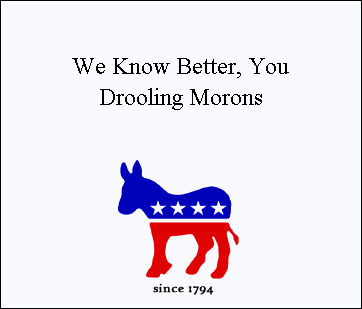
No, either way John Kerry is merely exhibiting what I see as the overwhelming condescension the Democrat party holds towards those who disagree with it:

“So VOTE FOR US!”

UPDATE: Via Dr. Sanity:

Don’t Look Now…

…or you’ll miss it.

I saw the link to this story on Instapundit (yes, again) this morning, but an email from reader Lee made me read the story a bit closer. I admit I missed it the first time, too.

Prof. Reynold’s excerpt goes:

On one wall of the plaza is a sculpture of a lunch counter with several people sitting at it. It’s so very life-like that in nice weather people routinely sit down on the empty stools to eat their lunches at the counter. There is no plaque to explain the sculpture.

It’s a story about the Wichita, Kansas drugstore lunch counter where, in 1958, groups of black youths sat in protest, day after day waiting to be served. It’s an excellent article.

But Lee notes this as the important part:

The store tried to wait them out by ignoring them. They kept coming back and sitting there, silently, day after day, waiting to be served. On one occasion three police officers tried to coerce and intimidate the teenagers to leave, and succeeded. But they came back, and the police did not return. They were breaking no law, only a store policy, and the store was not willing to challenge them directly.

A group of local white toughs came by trying to intimidate them. The police were called to break it up but left immediately without challenging the whites, saying they had instructions to keep their hands off. After an emergency phone call a group of local black men arrived, armed, to defend the protesters. The white youths retreated, leaving the store.

As Lee said in his email, “Buried near the end of the fifth paragraph is the single word “armed” that is so very important here.” Amen.

“Liberty is an inherently offensive lifestyle.”

Living in a free society guarantees that each one of us will see our most cherished principles and beliefs questioned and in some cases mocked. That psychic discomfort is the price we pay for basic civic peace. It’s worth it.

It’s a pragmatic principle. Defend everyone else’s rights, because if you don’t there is no one to defend yours. – MaxedOutMama

Via Instapundit, Six Meat Buffet brings you It’s Jihad, Charlie Brown.

My favorite line:

“It really isn’t such a bad little bomb. It just needs a little hate.”

Fatwah to follow, I’m sure.

Atheists and Anti-theists


Or: “Brights?” Don’t Make Me Laugh!

You know, I sometimes hesitate to write these pieces. Partially because they’re the ones that draw 100+ comments, and partially because they generally serve only to piss some people off. However, it’s a topic that I find pretty fascinating, and (given the 100+ comments) others obviously do too.

I noted recently that Rev. Donald Sensing had written a piece entitled Can Atheism Be Justified?. I greatly respect Rev. Sensing – in fact it was to him I addressed an Important Question. I said then, and I believe now, that Rev. Sensing is one of the not-so-common deep thinkers in the blogosphere. The Reverend’s essay begins:

Dinesh D’Souza writes,

A group of leading atheists is puzzled by the continued existence and vitality of religion.

What an interesting thing for atheists to ponder. In the modern day one either has to accept some kind of deistic understanding of the origin of the universe or an evolutionary understanding that excludes any sort of deity from contributing to the origin of the universe and all contained therein. I am not saying that one must either be religious or non-religious, for the dichotomy is true even for adherents of non-deistic or nature religions. Either deity (or deities) had a hand in existence itself, or it/they did not.
So why would a deity-denying atheist be puzzled that religion is thriving? If evolution as they describe it is true, then religion is itself a product thereof. Not only that, but Judaism is an evolutionary product, so is Christianity, so is Islam, so is Buddhism, so is Shamanisn, so is … well, you get the idea.

And so is the theory of evolution itself. And astrology. And tarot-card reading. And medical science. And faith healing. And everything else. So why do materialists single out religion as a particularly puzzling thing to exist? Why religion and not, say, athletics or stamp collecting or consumption of alcohol?

See what I mean? Cuts right to the quick of it, doesn’t he?

I took some time to read D’Souza’s column. In it, he references Richard Dawkins, Daniel Dennett, and E.O. Wilson – all of whom I have linked to or quoted myself in Why I Am an Atheist. D’Souza’s arguments for why religion is popular and atheism is not are (in my opinion) irrefutable. Example:

(I)magine two groups of people — let’s call them the Secular Tribe and the Religious Tribe — who subscribe to one of these two views. Which of the two is more likely to survive, prosper and multiply? The religious tribe is made up of people who have an animating sense of purpose. The secular tribe is made up of people who are not sure why they exist at all. The religious tribe is composed of individuals who view their every thought and action as consequential. The secular tribe is made up of matter that cannot explain why it is able to think at all.

Should evolutionists like Dennett, Dawkins, Harris and Wilson be surprised, then, to see that religious tribes are flourishing around the world? Across the globe, religious faith is thriving and religious people are having more children. By contrast, atheist conventions only draw a handful of embittered souls, and the atheist lifestyle seems to produce listless tribes that cannot even reproduce themselves.

Oooh! Ouch! (Truth hurts, or so they say.) And that last paragraph on the fact that secular societies are not breeding while religious ones are is a telling one. D’Souza, too, turns the question around most effectively in his last paragraph:

My conclusion is that it is not religion but atheism that requires a Darwinian explanation. It seems perplexing why nature would breed a group of people who see no purpose to life or the universe, indeed whose only moral drive seems to be sneering at their fellow human beings who do have a sense of purpose.

This is a question I’ve fielded here in comments on more than one occasion.

But bear with me a few more minutes.

In this month’s issue of Wired magazine, editor Gary Wolf looks into The Church of the Non-Believer, and it’s a very interesting exposé. Wolf starts off with fire and brimstone (sorry about the mixed-metaphors.):

MY FRIENDS, I MUST ASK YOU AN IMPORTANT QUESTION TODAY: Where do you stand on God?

It’s a question you may prefer not to be asked. But I’m afraid I have no choice. We find ourselves, this very autumn, three and a half centuries after the intellectual martyrdom of Galileo, caught up in a struggle of ultimate importance, when each one of us must make a commitment. It is time to declare our position.

This is the challenge posed by the New Atheists. We are called upon, we lax agnostics, we noncommittal nonbelievers, we vague deists who would be embarrassed to defend antique absurdities like the Virgin Birth or the notion that Mary rose into heaven without dying, or any other blatant myth; we are called out, we fence-sitters, and told to help exorcise this debilitating curse: the curse of faith.

The New Atheists will not let us off the hook simply because we are not doctrinaire believers. They condemn not just belief in God but respect for belief in God. Religion is not only wrong; it’s evil. Now that the battle has been joined, there’s no excuse for shirking.

You know, I sort of understood that there was a battle going on, but I hadn’t before realized just how virulent it was. I’ve repeatedly stated that I’m a small “a” atheist. I guess that makes me “noncommittal” in the war on faith. Actually, that’s not completely accurate. I found this quote somewhere, but I failed to link to the source:

Consider the two statements:

“I don’t believe there is a God.”

“I believe there is no God.”

One has a belief, the other does not. The latter is the position of what’s thought to be the true atheist (though the nomenclature is screwed up, because atheist should really mean no theistic beliefs, e.g. asexual, or amoral, and antitheist is the word we should use for someone we currently term an atheist).

I’m an atheist. They are ANTItheists.

I’ll stop here for the moment. Please read the entire, quite excellent Wired piece. There will be a discussion later.

Oh, and it runs just a bit over 7,000 words. I don’t want to hear how long-winded I am anymore! 😉

I Wonder What He (or She) Was Studying?.

Checking Sitemeter, I found that I’d had a visitor this morning who’d spent considerable time here:

He or she spent 76 minutes reading 22 pages, the last of which was March of the Lemmings, and then they exited to go to Publicola’s volunteer firearms instructors list.

Seeing that this visitor came from the servers at the University of Lancaster, in Blackpool, England, I have to wonder if this was someone doing detailed research on America’s gun-nuts for a paper on gun control? Unfortunately, this visitor left no comments nor dropped me an email, so I’ll just have to wonder.

But I can hope I gave them something to think about.

UPDATED to add: They’re Baaaaack!:

They started back at March of the Lemmings and have proceeded on through to Is the Government Responsible for Your Protection? Pt. II

Hello, mystery person! If you have any specific question, please drop me an email. The address is over on the left sidebar. Hope you’ve enjoyed your visits!

Oh, I Thought I’d Answered That…

Joe Huffman writes a response to the überpost, and begins with this devil’s advocate question:

(Kevin) says:

But the ideas of Western civilization in general, and the American philosophy in specific have proven themselves superior.

“Superior” on what scale? How is it that you measure that superiority? By the scale used by Muslims we are arrogant, decadent, and sinful. We drink alcohol. Our women, who are the tools of Satan, are allowed to tempt men with exposed skin in public are allowed to attend schools. We charge interest on the loaning of money. We do not pray to Allah. We tempt the youth of the faithful to desert that which is holy and become sinful. We have succumbed to Satan. Our power is not proof of our superiority. It is proof of the bargain we have made with the Prince of Darkness.

The Germans in the late 30’s had a “noble goal” as well–“purification” of the human race. A similar argument could be made of the Japanese in the same time frame.

Who are you to say Western civilization is superior? By what measure and how have you determined that measure is superior?

As I say in my piece, I believe there is one fundamental right – a man’s right to his own life (or a woman to hers.) This is the core of Lockean philosophy, and the measure of liberty in any society is how well the government of that society protects that right and its corollaries, though in practice none do it (or can) perfectly. The utopian vision of the anarcho-capitalists is a society that does so, perfectly, by not having a government at all. But this is only a dream, because you can never get a group of three or more people who will agree on what all of the corollary rights are, and there will always be people who will go along to get along. During a phone conversation last night with Publicola, I mentioned that I wanted to use a quote in the überpost, but I wasn’t able to work it in anywhere. It’s another Heinlein quote:

You can never enslave a free man, the most you can do is kill him.

Too many people are not free even in their own minds. That’s one of the reasons coercive societies work, and utopist societies don’t.

But on to Joe’s specific question, how do I measure Western civilization’s superiority? By this:

In America your destiny is not prescribed; it is constructed. Your life is like a blank sheet of paper and you are the artist. This notion of being the architect of your own destiny is the incredibly powerful idea that is behind the worldwide appeal of America. Young people especially find the prospect of authoring their own lives irresistible. The immigrant discovers that America permits him to break free of the constraints that have held him captive, so that the future becomes a landscape of his own choosing.

If there is a single phrase that captures this, it is “the pursuit of happiness.” As writer V. S. Naipaul notes, “much is contained” in that simple phrase: “the idea of the individual, responsibility, choice, the life of the intellect, the idea of vocation, perfectibility, and achievement. It is an immense human idea. It cannot be reduced to a fixed system. It cannot generate fanaticism. But it is known [around the world] to exist; and because of that, other more rigid systems in the end blow away.”

And this:

When soldiers from any other army, even our allies, entered a town, the people hid in the cellars. When Americans came in, even into German towns, it meant smiles, chocolate bars and C-rations. — Stephen Ambrose

Western philosophy in general, and the American philosophy in particular, best protects the right of its citizens to their own lives. As a result of this, America has become the superpower that it is. It draws those who understand that they are free, and “blows away” more rigid systems, generally without having to fire a shot.

But we are not perfect. This blog and many like it stand as testament to the fact that even nominally free governments constantly arrogate power, and are loath to surrender any they have taken. The only thing that can slow this (I don’t think it can be stopped) is the resistance of their citizens. If enough of those citizens understand that they are free, then the predation of government can be limited, but if too many are ignorant or apathetic their eventual enslavement is highly likely.

And I’m not putting on a tinfoil hat here and blaming the Trilateral Commission or the Bilderburgers or the Skull and Bones Society or any other shadowy group. I’m with Justice Louis Brandeis here:

The greatest dangers to liberty lurk in the insidious encroachment by men of zeal, well meaning but without understanding.

And Robert J. Hanlon:

Never attribute to malice that which is adequately explained by stupidity.

Or, in this case, ignorance and apathy. (Ignorance is curable. Stupidity is organic.)

Joe continues in his essay:

Paraphrasing Greg Hamilton here: In the eyes of Muslims what Osama Bin Laden has to say about the West is as inherently obvious, once articulated, to them as the superiority of Western civilization is to us.

True. Once again, two incompatible philosophies are now fighting it out for domination. The question is open as to which will win, since our side has an internal component that is trying to tear it down from the inside. That component is made up of those who are not Lockean in philosophy, and who see that philosophy as hypocritical and false:

The State (in Germany) and the Emperor (in Japan) were what the individual existed to serve. Hence, we were “playing by their own rules” by killing civilians in our efforts to defeat the Germany state and the Emperor of Japan. And even then it is clear that many had serious qualms about the actions taken. We weren’t blind to the hypocrisy of suspending our principles. It was a reluctant pragmatic concession to reality not mapping perfectly to our theory of individual rights.

Our “suspension of principles,” our hypocrisy, is the spike on which our internal opponents attempt to spindle Lockean philosophy. This was the point of the überpost. We must understand that the ideals of Lockean philosophy must yield to objective reality when objective reality rears its ugly head.

All societies are defined by their philosophies, and their philosophies are, in effect, shared delusions. When placed in conflict, objective reality highlights the flaws in those philosophies, and makes them obvious. If the society will not recognize the flaws and take pragmatic steps to counter their effects, that society will most probably be on the losing side of the conflict. AFTER the conflict that society can once again resume its suspended belief, or it can continue on in some changed form. Americans dropped firebombs on German cities and firebombs and nuclear weapons on Japanese cities, killing tens of thousands of innocent children. Then we helped rebuild Japan and Germany into economic powerhouses – powerhouses that far better protect the rights of their citizens than the old societies did.

The point of the whole rights discussion has been one of pragmatism vs. absolutism. Islam is an absolutist religion. So is communism/socialism. The American belief in individual rights tends very hard towards absolutism, but it has been flexible and pragmatic enough to survive the Civil War and two World Wars without deforming too far. Western culture is being attacked from within and without by absolutists who accuse it of falseness because of the fact that we have acted against the absolute requirements of our stated creed. Unless we believe as a society that what we fight for are ideals – things worth believing in – and not self-evident, absolute, positive, unquestionable, fundamental ultimates, then we run the risk of losing the conflict because we won’t make the pragmatic concessions necessary to survive.

UPDATE: Right as Usual comments.