Glenn Reynolds linked to a Salon.com piece by Nina Burleigh:
“I cringed as my young son recited the Pledge of Allegiance. But who was I to question his innocent trust in a nation I long ago lost faith in?”
Who, indeed? Reader Wagner James Au, who sent the link, writes: “My question is, why do anti-war liberals get so offended when people question their patriotism, when they spend so much time questioning it themselves?”
I read her piece, Country Boy, and my response to it was, almost literally, a RCOB.
Ms. Burleigh and I have worldviews so divergent that we might as well be of different species. There is no common ground upon which we could even begin to attempt rapprochement. And what bothers me most of all is that I see the land that we both live in becoming more and more divided between people like her, and people like me.
Let me fisk, for it is about the only thing I can do to purge myself of the emotions her piece inspired in me:
Country Boy
I cringed as my young son recited the Pledge of Allegiance. But who was I to question his innocent trust in a nation I long ago lost faith in?
By Nina Burleigh
Apr. 17, 2006 | When people give directions to the upstate New York hamlet of Narrowsburg, they always refer to the big red brick schoolhouse at the stoplight. Narrowsburg Central Rural School has been on the hill on School Street since 1929, educating four generations of local children.
Hardly anybody in town remembers a time when the campus — with its white doors, sloping green lawn, and Stars and Stripes snapping in the breeze — was not there. But last year, bankrupted by local fiscal mismanagement and the woes of the post-9/11 New York state economy, the little school was shuttered. When the last student skipped out of its double doors in the summer of 2005, janitors moved in with packing tape and boxes from a nearby egg farm to empty the classrooms. Among the pupils left behind was my son, a member of the last kindergarten class.
Our family first arrived in Narrowsburg in 2000, as city people hunting for a cheap house. For barely $50,000 we were able to buy the “weekend house” we thought would complete our metropolitan existence.
“Metropolitan existences” apparently come, without question, with “weekend houses?”
But soon after we closed on the home, we moved to Paris, spurred by the serendipitous arrival of a book contract. When our European idyll ended after two years, and with tenants still subletting our city apartment, we moved into the Narrowsburg house. After growing accustomed to the French social system — with its cheap medicine, generous welfare, short workweek and plentiful child care — life back in depressed upstate New York felt especially harsh. We’d never planned to get involved in the life of the town, nor had it ever occurred to us that we might send our son to the Narrowsburg School. But suddenly we were upstate locals, with a real stake in the community.
So, France is idyllic? I guess the Burleigh family (assuming they all use a common last name, which I find highly unlikely) left France prior to the, shall we say, recent unpleasantness the French have experienced. Cheap medicine and generous welfare? Paid for by those who actually work during that short workweek? France has an unemployment rate of between 9 and 10% (depending on your source), but its rate for the 26-and-under crowd is in excess of 22%. I guess Nina didn’t have to go shopping for a job during her two-year idle, er idyll.
Nothing like being insulated from reality to put rose-colored glasses on one’s outlook, is there?
In the fall of 2004, we enrolled our son in kindergarten at the Narrowsburg School. The school’s reputation among our friends, other “second-home owners,” was not good. “Do they even have a curriculum?” sniffed one New York City professor who kept a weekend home nearby. Clearly, Narrowsburg School was not a traditional first step on the path to Harvard.
Coming from a New York City professor, my first reaction is that he felt the hicks wouldn’t introduce Marxism until the second grade.
As far as I could tell, though, no one besides us had ever set foot inside the building.
No one in her circle that is.
When my husband and I investigated, we were pleasantly surprised. The school had just been renovated and was clean, airy, cheerful. The nurse and the principal knew every one of the 121 children by name. Our son would be one of just 12 little white children in a sunny kindergarten class taught by an enthusiastic woman with eighteen years’ experience teaching five-year-olds.
Isn’t that special! “Twelve little white children!”
I’m sure she felt properly guilty about that.
Still, for the first few months, we felt uneasy. Eighty of Narrowsburg’s 319 adults are military veterans and at least 10 recent school graduates are serving in Iraq or on other bases overseas right now.
In other words, “These people are not like us!“
The school’s defining philosophy was traditional and conservative, starting with a sit-down-in-your-seat brand of discipline, leavened with a rafter-shaking reverence for country and flag.
Imagine that! Requiring children to sit down in their seats! The Neaderthals!
Every day the students gathered in the gym for the “Morning Program,” open to parents, which began with the Pledge of Allegiance, followed by a patriotic song, and then discussion of a “word of the week.” During the first few weeks, the words of the week seemed suspiciously tied to a certain political persuasion: “Military,” “tour,” “nation” and “alliance” were among them.
No, indeed. These people are NOT LIKE US!
But it wasn’t until our boy came home with an invitation in his backpack to attend a “released time” Bible class that my husband and I panicked.
PANICKED. Her word.
She and her husband are panicked by an invitation to a BIBLE CLASS.
Now, I make no bones about being an atheist (small “A”), but panic? What about the great Liberal openness? The dedication to embracing diversity?
As long as, I suppose, the diverse don’t include, you know, actual Christians.
We called the ACLU and learned this was an entirely legal way for evangelicals to proselytize to children during school hours. What was against the law was sending the flier home in a kid’s backpack, implying school support. After our inquiry, the ACLU formally called the principal to complain. She apologized and promised never to allow it again. While we were never identified as the people who dropped the dime to the ACLU, there was clearly no one else in the school community who would have done so — and the principal never looked at us quite as warmly again.
And why should she? The Burleighs contacted the ACLU (which probably doesn’t have a Narrowsburg branch office) rather than the principal directly.
Another characteristic of the Left – having other people fight their battles for them.
Shortly afterward, another parent casually told me that she wanted to bring her daughter’s religious cartoon videos in to share with the class, but couldn’t because “some people” might object.
Here I’m not sure if the other parent was trying to pass a message, or hadn’t been informed by the Great Christian Cabal that the Burleighs were Satan incarnate yet.
When we later learned that the cheery kindergarten teacher belonged to one of the most conservative evangelical churches in the community, we were careful not to challenge anyone or to express any opinion about politics or religion, out of fear our son would be singled out.
You mean like Liberals do when they outnumber Conservatives?
That’s called “projection.”
Instead, to counteract any God-and-country indoctrination he received in school, we began our own informal in-home instruction about Bush, Iraq and Washington over the evening news.
The kid is FIVE YEARS OLD.
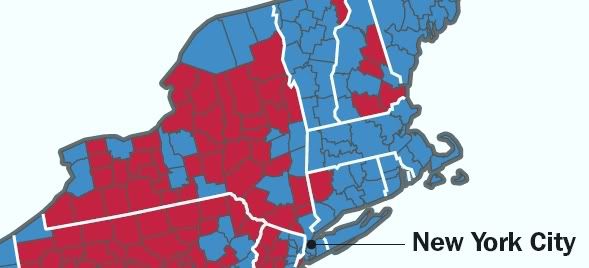
Politically, Narrowsburg is red dot in a blue state.
What planet is this woman from? According to this map (PDF) of the red vs. blue counties in the 2004 Presidential election, New York is well over half red.
A “red dot in a blue state” my aching sphincter.
But that, too, is a characteristic of the Left – what they perceive is reality. Don’t confuse ’em with the facts.
It is not named for any small-town frame of mind, but for the way the Delaware River narrows at the edge of town, then widens into a serene, lakelike eddy that at twilight mirrors the lights of town and the ranch-style houses on the flats. The towering pines along the river are nesting spots for bald eagles that soar year-round in pairs above Main Street and swoop down into the river to sink their talons into trout sighted from a hundred feet up. That year, driving to school every morning along the water, my son and I witnessed the wind gradually scrape away the bright foliage, snow fall, and the ground freeze. In the white, leafless months, we could see the entire span of the Delaware River valley from the car, a long arc of pastoral perfection.
If you knew nothing else of the world, if you were just 5 or 6 or 10 years old, and this place was your only America, you wouldn’t have any reason at all to question the Narrowsburg School’s Morning Program routine. Hand over heart, my son belted out the Pledge with gusto every morning and memorized and sang “The Star-Spangled Banner.” I never stopped resisting the urge to sit down in silent protest during the Pledge. But I also never failed to get choked up when they sang “America the Beautiful.”
“I never stopped resisting the urge to sit down in silent protest during the Pledge.”
They’re not anti-war – they’re the other side.
But it’s OK, because “America the Beautiful” makes her choke up.
Listening to their little voices, I felt guilty for being a non-believer. When I was 5 years old, in 1965, did I understand what my lefty parents were saying about the Kennedy assassination, Watts and dead-soldier counts?
Apparently not, but it was enough to warp you into the woman you are today!
Who was I to deprive my son, or his eleven kindergarten chums, of their faith in a nation capable of combining “good with brotherhood?” In a 5-year-old’s perfect world, perhaps such places should exist.
But you didn’t let that stop you from counteracting any God-and-country indoctrination he received in school, by beginning your own informal in-home instruction about Bush, Iraq and Washington over the evening news!
That November, at the school’s annual Veterans Day program, the children performed the trucker anthem “God Bless the USA” (one of the memorable lines is “Ain’t no doubt I love this la-aand, God bless the USA-ay!”), as their parents sang along. About a dozen local veterans — ancient men who had served in World War II, and men on the cusp of old age who had served in Korea and Vietnam — settled into folding chairs arranged beneath the flag. When the students were finished singing, the principal asked the veterans to stand and identify themselves. Watching from the audience, I wondered if anyone would speak of the disaster unfolding in Iraq (which was never a word of the week).
Wait for it…
No one did. The men rose and stated name, rank and theater. Finally, a burly, gray-bearded Vietnam veteran rose and said what no one else dared. After identifying himself, he choked out, “Kids, I just hope to God none of you ever have to experience what we went through.” Then he sat down, leaving a small pocket of shocked silence. No one applauded his effort at honesty. On the contrary, the hot gym air thickened with a tension that implicitly ostracized the man, and by extension — because we agreed with him — me and my husband.
No one repudiated the Iraq war. No one applauded the hope that these children be spared the need to go to war (or be spit on when they come back).
Not even the Burleighs.
That’s another characteristic of the Left – complete unfamiliarity with people who have served in the military.
I have relatives who served in WWII, Korea, and Vietnam. I work with Vietnam veterans. NO ONE I know who has ever been in combat has ever suggested that they thought it would be a wonderful, uplifting experience for the next generation.
War sucks. People die. Often horribly. But if you ask them whether what they did was worth it, they – almost to a man – say “yes.” No one hopes that the next generation will see war. Expressing that sentiment is universal, and in no way requires applause for validation.
A “small pocket of shocked silence”? I doubt it seriously. Oh, I’m sure she interpreted it that way, but that’s not what it was. It was silent agreement. But Burleigh does not understand Red New York. It’s an alien environment to her.
After all, these people are religious!
A month later, just before Christmas, my son and I drove together into New York City with bags of children’s clothes and shoes that he and his sister had outgrown. The Harlem unit of the National Guard was putting on a Christmas clothing drive for Iraqi children. On the way into the city, I tried to explain to my son what we were doing, and — as best I could — why. As we crossed the George Washington Bridge and the Manhattan skyline spread out below us, I began to give him a variation on the “Africans don’t have any food, finish your dinner” talk. I wanted him to understand how privileged he was to live in a place where bombs weren’t raining from the sky. It was a talk I’d tried to have before, but not one he’d ever paid much attention to until that day, trapped in the back seat of our car.
In simple language, I told my son that our president had started a war with a country called Iraq. I said that we were bombing cities and destroying buildings. And I explained that families just like ours now had no money or food because their parents didn’t have offices to go to anymore or bosses to pay them. “America did this?” my son asked, incredulous. “Yes, America,” I answered. He paused, a long silent pause, then burst out: “But Mommy, I love America! I want to hug America!”
Out of the mouths of babes…
A month after the Christmas outburst, the first rumors that all was not well with the school began circulating. Fiscal mismanagement, high fuel and retirement costs, and the depleted state economy had created a huge and unexpected cash shortfall for the tiny district. The parents at Narrowsburg School soon had a figure: It was going to cost just over $600,000 to keep their school open for another year. Chump change in Washington and New York City, but impossible to collect in a town where the median family income is barely $45,000.
But NYC denizens can afford to come to the town and drop $50k on a “weekend home.”
By late June 2005, the little school’s fate was sealed. To my surprise I found I was deeply sorry about it.
The patriot-ization of our son was thorough enough to survive the summer. He decorated his birthday cookies with red, white and blue sugar, and in his summer camp program, when doing arts and crafts, those were the colors of paint he favored. “I made the stars red, white and blue — like the flag!” he exclaimed, holding a paper mobile he’d strung together.
Now it has been almost a year since my son scampered down the steps of Narrowsburg Central Rural School for the last time. We’ve since returned to the city, driven back to urban life more by adult boredom than our children’s lack of educational opportunities. Our son is enrolled in a well-rated K-5 public school on Manhattan’s Upper West Side;
I’m sure it has a curriculum.
not surprisingly, the Pledge of Allegiance is no longer part of his morning routine. Come to think of it, and I could be wrong, I’ve never seen a flag on the premises.
Of course not. That would be provincial.
But no one should question their patriotism.
My husband and I realized, though, that Narrowsburg did more than mold our boy into a patriot. He can, it turns out — despite the warnings of other city parents — read at a level twice that of his new peers.
Amazing how that “sit-down-in-your-seat brand of discipline” contributes to, you know, LEARNING.
Since we returned to the city, he has learned how to ride a bike, long for an Xbox, practiced a few new swear words and, somehow, learned the meaning of “sexy.” He has pretty much stopped favoring red, white and blue.
The kid is what, six? And she considers learning “a few new swear words” and understanding the meaning of “sexy” to be positive. So too, no longer “favoring red, white, and blue.”
But don’t question her patriotism. She tears up at “American the Beautiful.”
How soon childish national pride is shed, I sometimes think now, and not a little wistfully.
Ah, yes. National pride is childish. No country is better than any other, and we mustn’t make judgments. (But America is always wrong)
Just don’t question her patriotism.
Only once it was gone did I realize that, after our initial discomfort, my husband and I had begun to see our son’s patriotism as a badge of innocence. His faith was a reminder to us that the reason we are devastated by the war in Iraq and the Bush presidency is that we too love America. We too want to believe in its potential for good and brotherhood.
BULLSHIT.
Love America? You don’t understand America. You denigrate America. You protest it, spit on it, defecate on it. It’s a foreign fucking country to you.
You want it to be FRANCE, with its idyllic cheap medicine, generous welfare, short workweek, plentiful child care, and expansive socialism.
That’s not America. Nor is it sustainable, as the French are unwilling to learn, but will.
Our family now visits the Narrowsburg house only on weekends and holidays. Sometimes we pass the stately red brick school building, so recently renovated with thermal windows and elevators for the disabled, a town landmark for 75 years. The flag still flies there, but the doors are padlocked and the windows are black.
But at least they don’t hold Bible study there anymore.
Ms. Burleigh, move back to France. We won’t miss you.
UPDATE: Burleigh gets hate mail. Like I said at the top of the post, Ms. Burleigh and I have worldviews so divergent that we might as well be of different species. There is no common ground upon which we could even begin to attempt rapprochement. Therefore I did not forward this piece to her. I knew in advance it would be useless.