In Praise of Prejudice

The Arizona legislature has passed a bill and put it on Gov. Brewer’s desk that protects persons, businesses or legal entities from prosecution for exercise of their conscientious objection to government mandates due to sincerely held religious belief.  To wit:  Christians can, without legal threat, deny services to openly gay people.

Hell, I think it’s a terrific idea!  And it shouldn’t be limited to just religious beliefs!
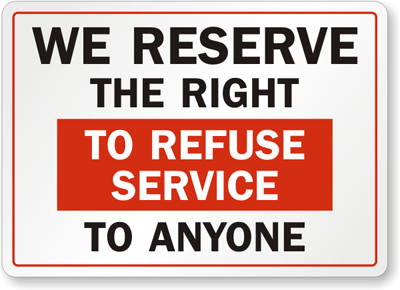

I think persons,  businesses and legal entities should be able to deny services to anyone for any reason without fear of legal entanglement.  The less .gov butts into people’s business, the better, as far as I’m concerned.  Want to deny services to people because they’re black?  Fine!  Jewish?  Go right ahead!  Physically disabled?  Knock yourself out. Cismale gendernormatives?  If you can spell it, sure!

The function of government should not be to punish people for acting on their fervently held beliefs.  It’s function should be to ensure that potential customers are made aware up front who a person, business or legal entity will refuse service to.

They already do that in a tiny way under Arizona Revised Statute §4-229, which states:

A. A person with a permit issued pursuant to section 13-3112 may carry a concealed handgun on the premises of a licensee who is an on-sale retailer unless the licensee posts a sign that clearly prohibits the possession of weapons on the licensed premises. The sign shall conform to the following requirements:

1. Be posted in a conspicuous location accessible to the general public and immediately adjacent to the liquor license posted on the licensed premises.

2. Contain a pictogram that shows a firearm within a red circle and a diagonal red line across the firearm.

3. Contain the words, “no firearms allowed pursuant to A.R.S. section 4-229”.

A sign like this:
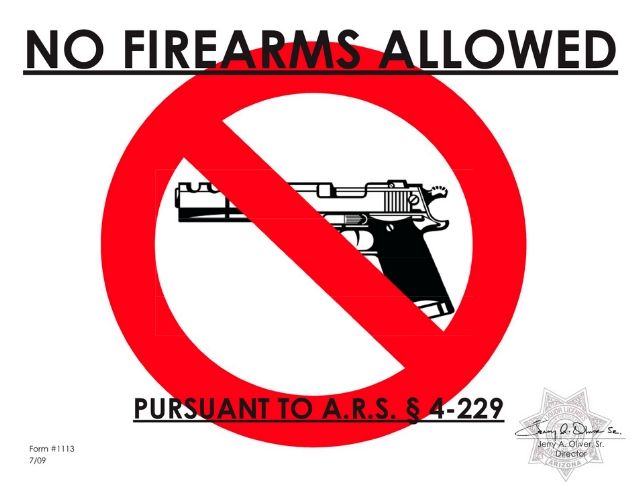
So, the legislature should simply extend this logic to whatever other prejudices there are out there and require signage to advise potential customers where they’re not wanted.  Something like this, for instance:

Or this:


That way everyone will know right up front what kind of bigots they will be dealing with, and can decide for themselves whether or not they want to spend their money there. No hurt feelings, no lawsuits.

Just Like a Skipping Record

(For those who remember records.)

Ten years ago I wrote The ACLU Hasn’t Changed Its Tune, quoting then-President Nadine Strossen from a Reason interview:

Reason: So why doesn’t the ACLU challenge gun-control laws on Second Amendment grounds?

Strossen: We reexamine our positions when people come forward with new arguments. On the gun issue, I instituted a reexamination a few years ago in response to a number of things, but the most important one was an article by Sanford Levinson at University of Texas Law School that summarized a wave of new historical scholarship. Levinson’s argument was that in the 18th century context, a well-regulated militia meant nothing other than people in the privacy of their homes.

So we looked into the historical scholarship there and ended up not being persuaded. The plain language of the Second Amendment in no way, shape, or form, can be construed, I think, as giving an absolute right to unregulated gun ownership. It says, “A well-regulated militia being necessary to the security of a free state, the right to bear arms shall not be infringed.” Certainly, when you have the notion of “well-regulated” right in the constitutional language itself, it seems to defy any argument that regulation is inconsistent with the amendment.

Putting all that aside, I don’t want to dwell on constitutional analysis, because our view has never been that civil liberties are necessarily coextensive with constitutional rights. Conversely, I guess the fact that something is mentioned in the Constitution doesn’t necessarily mean that it is a fundamental civil liberty.

Mentioned. MENTIONED in, not just the Constitution, but the Bill of Rights.

Nah. Doesn’t mean anything.

Then we had D.C. v Heller and McDonald v. Chicago. And the ACLU?

The ACLU interprets the Second Amendment as a collective right. Therefore, we disagree with the Supreme Court’s decision in D.C. v. Heller. While the decision is a significant and historic reinterpretation of the right to keep and bear arms, the decision leaves many important questions unanswered that will have to be resolved in future litigation, including what regulations are permissible, and which weapons are embraced by the Second Amendment right that the Court has now recognized.

So much for “reexamin(ing) our positions when people come forward with new arguments.”

My original piece still stands. And the ACLU is cordially invited to kiss my ass.

Choose Your Own Crime Stats

Ran across this last night:

[youtube https://www.youtube.com/watch?v=Ooa98FHuaU0?rel=0]
A bit simplistic (it is, after all, a six-minute YouTube video), but it hits all the high points.  QotD:

So what I find astonishing about these numbers is that nobody’s talking about it.  We have a 50% reduction in violent crime over the last twenty years, yet no one is taking credit for it.  I find it pretty astonishing, I mean, it’s unbelievable.  Does it not play into their fear agenda?

Three Felonies a Day,

I recently finished reading Harvey Silverglate’s Three Felonies a Day:  How the Feds Target the Innocent.

Here’s another example of what he was writing about.  Read the whole thing, but here’s an excerpt:

…every incentive that we put in place as a company was designed to encourage people to achieve their goals. All these incentives had the caveat that the goals must be achieved while obeying the law. Now that may sound simple, but in virtually every meeting every day people discuss their goals and how they will achieve them. They almost never discuss accounting law. In a sales forecast meeting, you will often hear, “What can we do to get this closed by the end of the quarter?” You never hear, “Will the way we made the commitment comply with Statement of Position-97-2 (the critical software accounting rule)?”

Beyond that, U.S. accounting law is extremely difficult to understand and often seems illogical and random. For example, the law in question with respect to stock options, FAS 123, is filled with paragraphs such as this:

“This Statement does not specify the measurement date for share-based payment transactions with nonemployees for which the measure of the cost of goods acquired or services received is based on the fair value of the equity instruments issued. EITF Issue No. 96-18, “Accounting for Equity Instruments That Are Issued to Other Than Employees for Acquiring, or in Conjunction with Selling, Goods or Services”, establishes criteria for determining the measurement date for equity instruments issued in share-based payment transactions with nonemployees.”

And that is the clear part.

Here’s Ayn Rand once again on the topic:

There is no way to rule innocent men. The only power any government has is to crack down on criminals. When there aren’t enough criminals, one makes them. One declares so many things to be a crime that it becomes impossible for men to live without breaking the law. Create a nation of lawbreakers and then you can cash in on the guilt. Now that’s the system! – Atlas Shrugged, 1957

As others have observed, Rand wrote a cautionary tale. It seems more every day that it’s being used instead as an instruction manual.

Quote of the Day – Edward Snowden Edition

In the end the Obama administration is not afraid of whistleblowers like me, Bradley Manning or Thomas Drake. We are stateless, imprisoned, or powerless. No, the Obama administration is afraid of you. It is afraid of an informed, angry public demanding the constitutional government it was promised — and it should be.

But given our media, the public won’t be informed, and being uniformed the public won’t get angry, so no worries!