Off to a Good Start!.
New blogger Banana Fufu links to my post Yes, I’m Still Alive with a slight revision to the speech Bush ought to make.
I have to admit, it’s a pretty good change. And there’s some good gun porn, too!
The Smallest Minority on earth is the individual. Those who deny individual rights cannot claim to be defenders of minorities. – Ayn Rand
Off to a Good Start!.
New blogger Banana Fufu links to my post Yes, I’m Still Alive with a slight revision to the speech Bush ought to make.
I have to admit, it’s a pretty good change. And there’s some good gun porn, too!
The Price of Free Corn.
The Ninth Stage reprints a classic tale of the slippery slope. (Via Jed.)
None of Your F@&^ing Business!.
I wish I could do the Spock eyebrow thing when I say “Fascinating!”
I was checking the Violence Policy Center website to see if they had any reaction to today’s Parker decision, and came across their latest “analysis,” A Shrinking Minority: The Continuing Decline of Gun Ownership in America (a PDF file). The report tells us what the title does, apparently guns just aren’t popular in America any more. So says the General Social Survey, which the Violence Policy Center tells us:
…is conducted by the National Opinion Research Center (NORC) at the University of Chicago. Begun in 1972, the GSS completed its 26th round in 2006. According to NORC, “Except for the U.S. Census, the GSS is the most frequently analyzed source of information in the social sciences” and is “the only survey that has tracked the opinions of Americans over an extended period of time.”
So much for the GSS’s bona fides.
Y’all know how much I love the VPC’s graphics. Well, here’s the centerpiece of this report:

Yes, according to the GSS:
During the period 1972 to 2006, the percentage of American households that reported having any guns in the home has dropped nearly 20 percentage points: from a high of 54 percent in 1977 to 34.5 percent in 2006.
While at the same time:
In a June 2006 press release, National Shooting Sports Foundation (NSSF) President Doug Painter states that “…gun sales and ownership in our country continue to rise.” The NSSF is the self-described “trade association for the shooting, hunting and outdoor industry.” In the release, the NSSF adds without attribution, “The number of American households with at least one firearm is now estimated at nearly 47.8 million.” According to the U.S. Bureau of the Census, in 2005 there were an estimated 108,819,000 households in America. Using NSSF’s figures, 43.9 percent of American households have a gun — more than nine percentage points higher than the most recent NORC household gun ownership figure.
I don’t see what the VPC’s problem is, then. Obviously the NSSF is lying and it appears that since gun ownership is declining on its own, there’s no need to pass legislation banning handguns, “semi-automatic assault weapons” etc. The “gun culture” is going away!
Except, it doesn’t seem to be. I mean, President Clinton wouldn’t lie to us, would he? In a February 4, 2000 White House press release he announced:
Handguns Account for Nearly Half of All New Gun Sales – About 2 Million Per Year. Fifty years ago, handguns represented only one out of every 10 new gun sales. Now they account for more than four out of 10.
Um, if two million a year represents, say 45% of all annual gun sales, then that puts the total annual gun sales (carry the one…) at about 4.4 million per year. And that’s just new gun sales. As I’ve noted many times before, guns are durable goods. A gun made 100 years ago can certainly be perfectly functional today, and many are.
Now, I certainly believe that those of us who collect guns are building bigger collections, after all, I’ve got (mumble mumble…) guns myself and my wife insisted that I buy the bigger model gun safe because “You’ll fill it up eventually.” But do I believe that all of those guns each year are going into the collections of a shrinking number of aging geezers like me?
I do not.
According to the General Social Survey FAQ site, about 3,000 people are interviewed for their survey, and about 75% of them respond. It’s not a telephone survey, either. You’ll note, also, that after the 1998 survey the response rate dropped to about 70%, so right off the bat about 30% of the people they go to interview now tell the interviewers (in effect) “F$%# off!”
Gee, I wonder what the gun ownership rate in that demographic is?
Second, the VPC, Brady Center et al. have been striving for decades to convince people that “Guns are bad, mmmkay?” This, despite the fact that since 1986 the number of states with “shall issue” concealed-carry legislation has increased from 6 to 37 (and Alaska has gone from no carry to unrestricted.) People, somebody had to be buying those millions of “pocket rockets” and they weren’t all prior gun owners. Perhaps the best illustration of what I’m talking about here comes from NPR contributor and gun convert Emily Yoffe, the “Human Guinea Pig,” in her Slate piece Guinea Get Your Gun: How I Learned to Love Firearms:
So anathema are guns among my friends that when one learned I was doing this piece, he opened his wallet, silently pulled out an NRA membership card, then (after I recovered from the sight) asked me not to spread it around lest his son be kicked out of nursery school.
Ye gods. As fellow blogger and activist Joe Huffman has noted, in many areas – specifically the “blue states” and metropolitan centers – the gun bigots have made gun owners into “gun niggers.” Hell, newspapers seem to think that concealed-carry permit holders are the equivalent of sex offenders. It happened again just today.
So where are all those guns going? Well for one thing, I think the National Opinion Research Center has its head up its collective posterior when it says:
Some have speculated that the 9/11 terrorist attacks undermined support for the regulation of firearms, arguing that fear of terrorism increased the public desire for firearms for self-defense. However, this was not the case. (E)xcept for a small bulge in handgun applications in September-October, 2001 which had already started to subside by November, there was no increase in firearm purchases in response to the 9/11 attacks.
What about after Katrina? A LOT of people figured out fast that the government wasn’t responsible for their protection – was, in fact inimical to it in some cases. (Just ask Patricia Konie and her attorney Ashton O’Dwyer).
So, given this “decades-long slow motion hate crime” perpetrated against gun owners, is it any surprise that people either decline to answer, or (dare I say it) lie when asked whether their home contains a firearm? I mean, if you fear that your toddler might be evicted from nursery school because daddy owns a pistol…
So go ahead, VPC, Brady Center and all the other Joyce Foundation sponsored gun ban control safety organizations; convince yourselves that the number of gun owners in the U.S. is dropping precipitously. Pat yourselves on the back for the outstanding (*cough*) job you’re doing.
I really enjoy watching you splutter like Sylvester the Cat every time a new piece of gun-control legislation goes down in flames, or gun-rights legislation passes with a veto-proof margin, or, as also happened today, a gun-rights court decision stands.
UPDATE: I swear, I wrote this piece before I ever saw this.
UPDATE II: D’OH! Instapundit link fixed. I need a vacation….
UPDATE III: Woohoo! Instalanch!
No Wailing nor Gnashing of Teeth… Yet.
It appears that the District Court of Appeals for Washington, D.C. has denied in a 6-to-4 vote to re-hear Parker v. D.C. en banc. This is good news – they won’t be overturning the three-judge panel 2-1 decision that rejected Washington’s draconian gun laws. Eugene Volokh has the details. A quick check of the major news outlets shows that pretty much nobody else does. As Eugene notes, the City will now almost definitely file an appeal to the Supreme Court, and
…the petition will likely be filed in mid-August. That would mean the Supreme Court will decide in late September whether to hear the case — and if it does agree to hear the case (“grant cert”), it will hear it in early 2008, with a decision handed down by early July of 2008.
Which would put it right before the November election.
Want to bet that gun control will be a major topic in the next Presidential election?
Me neither. I expect the court to deny certiorari and dodge the question once more. I could be wrong, though.
UPDATE: SCOTUSBlog thinks otherwise.
UPDATE II: Now that I’m home and had a chance to read some details, I’m quite surprised to learn that Circuit Judge Karen LeCraft Henderson was one of the bench who voted against the en banc rehearing. She was the dissenting opinion in the original case. Judge Silberman, who wrote the original opinion, is a Senior Circuit judge and was not able to vote on the en banc rehearing, nor (as I understand it) would he have been able to sit on the bench for the case.
Judge Henderson’s vote could have made it 5-5, and while that wouldn’t have altered the result (a majority has to agree to re-hear), it would have been a political talking point (“Look how divided the Court is!”) So the $64k question is, “Why?” Did she believe that a rehearing would have simply delayed the inevitable? Did she just want to dodge the question and kick the problem upstairs? Has she been convinced (after the fact) that the majority was right, after all?
Inquiring minds want to know…
Bear in mind, though, that even if SCOTUS hears Parker, there’s no guarantee it will be decided A) in the favor of an individual right, much less B) be “incorporated” against infringement by the states under the 14th Amendment. That question was deliberately not raised by the plaintiffs in Parker, and is well established precedent in Cruikshank and Presser.
Which is why I fully expect denial of cert.
Good Luck to You, Whoever You Are…
Provided with no additional commentary, here is a screenshot of a recent hit on TSM by a visitor using Google to find something specific:
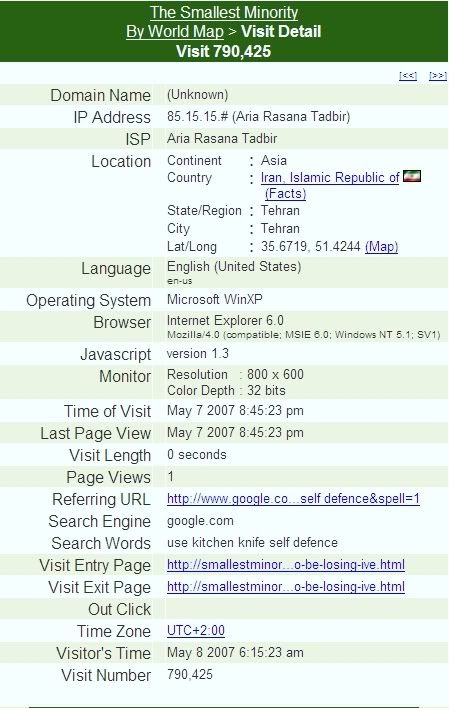
The post they went to was this one. I doubt it was what they were looking for, though.
James, Arizona Wants You!.
James Lileks reports in today’s Bleat that the management of the Star Tribune has decided that his talents are best used not in writing a daily or even weekly humor column, but instead in covering “straight local news stories.” The news has draw a lot of blog attention.
Now, granted, James has himself strongly recommended that local newspapers do local coverage. Local, local, local. Section “A” should be local, and section “B” should be national and international, he has said. That does not mean that James’ talents are best utilized as a beat reporter. You wouldn’t expect the Miami Herald to put Dave Barry on assignment doing “straight local news stories,” would you?
James recently dropped his longstanding contract with Newhouse News Services because of the speed of today’s world. A piece that he wrote a week ago might no longer be relevant by the time Newhouse placed it. I have no doubt, however, that he will be receiving offers from other outlets for his services.
Which brings me to Arizona. On more than one occasion, James has made noises about moving to Arizona – the Prescott vicinity if I recall correctly. Apparently his wife’s family lives in the area.
C’mon down, James. We’d love to have you as a neighbor.
Dan of Jackalope Pursuivant concurs – with a link to a pertinent Lileks piece, and another link to another Arizona blogger who wants to make the invite official. Suggestion: Don’t forget to mention Jasper in that invite!
Insty points today to an interesting New York Times piece, A Liberal Case for Gun Rights Helps Sway Judiciary. It’s interesting enough that I’m not going to fisk it so much as expand upon it:
In March, for the first time in the nation’s history, a federal appeals court struck down a gun control law on Second Amendment grounds. Only a few decades ago, the decision would have been unimaginable.
Only a few decades before that and that same decision would have been a foregone conclusion.
There used to be an almost complete scholarly and judicial consensus that the Second Amendment protects only a collective right of the states to maintain militias. That consensus no longer exists — thanks largely to the work over the last 20 years of several leading liberal law professors, who have come to embrace the view that the Second Amendment protects an individual right to own guns.
Err, no. There was a scholarly and judicial consensus that the Second Amendment protected only the rights of white men – perhaps the most blatant example of this attitude being exhibited in Florida’s 1941 Watson v. Stone decision, where one of the concurring judges wrote:
I know something of the history of this legislation. The original Act of 1893 was passed when there was a great influx of negro laborers in this State drawn here for the purpose of working in turpentine and lumber camps…. [T]he Act was passed for the purpose of disarming the negro laborers and to thereby reduce the unlawful homicides that were prevalent in turpentine and saw-mill camps and to give the white citizens in sparsely settled areas a better feeling of security. The statute was never intended to be applied to the white population…. [I]t is a safe guess to assume that more than 80% of the white men living in the rural sections of Florida have violated this statute…. [T]here has never been, within my knowledge, any effort to enforce the provisions of this statute as to white people, because it has been generally conceded to be in contravention of the Constitution and non-enforceable if contested.
This quote is excerpted from a Robert Cottrol and Raymond Diamond Chicago-Kent Law Review paper available here. A shorter version of this quote appears in the Amicus Curae brief filed on behalf of Parker et al. by the Congress of Racial Equality (CORE).
In those two decades, breakneck speed by the standards of constitutional law, they have helped to reshape the debate over gun rights in the United States. Their work culminated in the March decision, Parker v. District of Columbia, and it will doubtless play a major role should the case reach the United States Supreme Court.
Laurence H. Tribe, a law professor at Harvard, said he had come to believe that the Second Amendment protected an individual right.
“My conclusion came as something of a surprise to me, and an unwelcome surprise,” Professor Tribe said. “I have always supported as a matter of policy very comprehensive gun control.”
The first two editions of Professor Tribe’s influential treatise on constitutional law, in 1978 and 1988, endorsed the collective rights view. The latest, published in 2000, sets out his current interpretation.
Which the paper leaves out, but I will not since it’s one of my favorite quotes:
Perhaps the most accurate conclusion one can reach with any confidence is that the core meaning of the Second Amendment is a populist / republican / federalism one: Its central object is to arm ‘We the People’ so that ordinary citizens can participate in the collective defense of their community and their state. But it does so not through directly protecting a right on the part of states or other collectivities, assertable by them against the federal government, to arm the populace as they see fit. Rather the amendment achieves its central purpose by assuring that the federal government may not disarm individual citizens without some unusually strong justification consistent with the authority of the states to organize their own militias. That assurance in turn is provided through recognizing a right (admittedly of uncertain scope) on the part of individuals to possess and use firearms in the defense of themselves and their homes — not a right to hunt for game, quite clearly, and certainly not a right to employ firearms to commit aggressive acts against other persons — a right that directly limits action by Congress or by the Executive Branch and may well, in addition, be among the privileges or immunities of United States citizens protected by §1 of the Fourteenth Amendment against state or local government action.
It makes me feel good every time I read it – especially the part about the Fourteenth Amendment.
Several other leading liberal constitutional scholars, notably Akhil Reed Amar at Yale and Sanford Levinson at the University of Texas, are in broad agreement favoring an individual rights interpretation. Their work has in a remarkably short time upended the conventional understanding of the Second Amendment, and it set the stage for the Parker decision.
The earlier consensus, the law professors said in interviews, reflected received wisdom and political preferences rather than a serious consideration of the amendment’s text, history and place in the structure of the Constitution. “The standard liberal position,” Professor Levinson said, “is that the Second Amendment is basically just read out of the Constitution.”
It had to be, otherwise you couldn’t selectively disarm different groups.
The Second Amendment says, “A well regulated militia, being necessary to the security of a free state, the right of the people to keep and bear arms, shall not be infringed.” (Some transcriptions of the amendment omit the last comma.)
If only as a matter of consistency, Professor Levinson continued, liberals who favor expansive interpretations of other amendments in the Bill of Rights, like those protecting free speech and the rights of criminal defendants, should also embrace a broad reading of the Second Amendment. And just as the First Amendment’s protection of the right to free speech is not absolute, the professors say, the Second Amendment’s protection of the right to keep and bear arms may be limited by the government, though only for good reason.
Time for another of my favorite quotes, or part of one, this time from 9th Circuit Court Judge Alex Kozinski from his dissent to the decision to deny an en banc rehearing of California’s Silveira v. Lockyer “Assault Weapons Ban” case:
Judges know very well how to read the Constitution broadly when they are sympathetic to the right being asserted. We have held, without much ado, that “speech, or…the press” also means the Internet…and that “persons, houses, papers, and effects” also means public telephone booths….When a particular right comports especially well with our notions of good social policy, we build magnificent legal edifices on elliptical constitutional phrases – or even the white spaces between lines of constitutional text. But, as the panel amply demonstrates, when we’re none too keen on a particular constitutional guarantee, we can be equally ingenious in burying language that is incontrovertibly there.
It is wrong to use some constitutional provisions as springboards for major social change while treating others like senile relatives to be cooped up in a nursing home until they quit annoying us. As guardians of the Constitution, we must be consistent in interpreting its provisions. If we adopt a jurisprudence sympathetic to individual rights, we must give broad compass to all constitutional provisions that protect individuals from tyranny. If we take a more statist approach, we must give all such provisions narrow scope. Expanding some to gargantuan proportions while discarding others like a crumpled gum wrapper is not faithfully applying the Constitution; it’s using our power as federal judges to constitutionalize our personal preferences.
Amen.
The individual rights view is far from universally accepted. “The overwhelming weight of scholarly opinion supports the near-unanimous view of the federal courts that the constitutional right to be armed is linked to an organized militia,” said Dennis A. Henigan, director of the legal action project of the Brady Center to Prevent Gun Violence. “The exceptions attract attention precisely because they are so rare and unexpected.”
Scholars who agree with gun opponents and support the collective rights view say the professors on the other side may have been motivated more by a desire to be provocative than by simple intellectual honesty.
So say the intellectually dishonest…
“Contrarian positions get play,” Carl T. Bogus, a law professor at Roger Williams University, wrote in a 2000 study of Second Amendment scholarship. “Liberal professors supporting gun control draw yawns.”
If the full United States Court of Appeals for the District of Columbia Circuit does not step in and reverse the 2-to-1 panel decision striking down a law that forbids residents to keep handguns in their homes, the question of the meaning of the Second Amendment is almost certainly headed to the Supreme Court. The answer there is far from certain.
That too is a change. In 1992, Warren E. Burger, a former chief justice of the United States appointed by President Richard M. Nixon, expressed the prevailing view.
“The Second Amendment doesn’t guarantee the right to have firearms at all,” Mr. Burger said in a speech. In a 1991 interview, Mr. Burger called the individual rights view “one of the greatest pieces of fraud — I repeat the word “fraud” — on the American public by special interest groups that I have ever seen in my lifetime.”
Even as he spoke, though, the ground was shifting underneath him.
Here’s one of the things I find really irritating. Yes, Burger said what is attributed to him here, but no one seems to be willing to give any context or background on his comments. The interview referred to was for Parade magazine – the tabloid included in most Sunday newspapers. Here’s what else he said in an essay in that magazine:
Americans also have a right to defend their homes, and we need not challenge that. Nor does anyone seriously question that the Constitution protects the right of hunters to own and keep sporting guns for hunting game any more than anyone would challenge the right to own and keep fishing rods and other equipment for fishing — or to own automobiles.
Where, I must ask, does the Constitution say anything about defending ones home or hunting? And what makes Justice Burger the exclusive authority? He was one of nine Justices on the bench. If Samuel Alito John Roberts were to say in an interview that the Second Amendment definitely protects an individual right, does the fact that he holds the Chief Justice’s chair give him some power that the other Justices lack? Granted, Burger made his speech and gave his interview after he retired, but thankfully he never “constitutionalized his personal preferences” on this topic while he sat on the bench.
In 1989, in what most authorities say was the beginning of the modern era of mainstream Second Amendment scholarship, Professor Levinson published an article in The Yale Law Journal called “The Embarrassing Second Amendment.”
“The Levinson piece was very much a turning point,” said Mr. Henigan of the Brady Center. “He was a well-respected scholar, and he was associated with a liberal point of view politically.”
In an interview, Professor Levinson described himself as “an A.C.L.U.-type who has not ever even thought of owning a gun.”
And that piece is available all over the web. I highly recommend that you read it if you have not. It’s a very rare exhibit of intellectual honesty in print.
Robert A. Levy, a senior fellow at the Cato Institute, a libertarian group that supports gun rights, and a lawyer for the plaintiffs in the Parker case, said four factors accounted for the success of the suit. The first, Mr. Levy said, was “the shift in scholarship toward an individual rights view, particularly from liberals.”
He also cited empirical research questioning whether gun control laws cut down on crime; a 2001 decision from the federal appeals court in New Orleans that embraced the individual rights view even as it allowed a gun prosecution to go forward; and the Bush administration’s reversal of a longstanding Justice Department position under administrations of both political parties favoring the collective rights view.
Filing suit in the District of Columbia was a conscious decision, too, Mr. Levy said. The gun law there is one of the most restrictive in the nation, and questions about the applicability of the Second Amendment to state laws were avoided because the district is governed by federal law.
“We wanted to proceed very much like the N.A.A.C.P.,” Mr. Levy said, referring to that group’s methodical litigation strategy intended to do away with segregated schools.
Professor Bogus, a supporter of the collective rights view, said the Parker decision represented a milestone in that strategy. “This is the story of an enormously successful and dogged campaign to change the conventional view of the right to bear arms,” he said.
Correction: “conventional view” among members of the government – not the citizenry.
The text of the amendment is not a model of clarity, and arguments over its meaning tend to be concerned with whether the first part of the sentence limits the second. The history of its drafting and contemporary meaning provide support for both sides as well.
The Supreme Court has not decided a Second Amendment case since 1939. That ruling was, as Judge Stephen Reinhardt, a liberal judge on the federal appeals court in San Francisco acknowledged in 2002, “somewhat cryptic,” again allowing both sides to argue that Supreme Court precedent aided their interpretation of the amendment.
Still, nine federal appeals courts around the nation have adopted the collective rights view, opposing the notion that the amendment protects individual gun rights. The only exceptions are the Fifth Circuit, in New Orleans, and the District of Columbia Circuit. The Second Circuit, in New York, has not addressed the question.
Linda Singer, the District of Columbia’s attorney general, said the debate over the meaning of the amendment was not only an academic one.
“It’s truly a life-or-death question for us,” she said. “It’s not theoretical. We all remember very well when D.C. had the highest murder rate in the country, and we won’t go back there.”
What?!?! D.C. had the highest murder rate in the country with the ban in place! It traded off with Chicago several times. There’s no reason to assume that it can’t “win” that dubious position once again.
Here’s a bet I’m more than willing to make: End the ban. Allow residents of D.C. to possess firearms for their own defense again. At worst, criminal homicide in D.C. will remain unchanged. The rate will not go up.
The decision in Parker has been stayed while the full appeals court decides whether to rehear the case.
Should the case reach the Supreme Court, Professor Tribe said, “there’s a really quite decent chance that it will be affirmed.”
I certainly hope so. But if the D.C. Circuit court overturns, I fully expect SCOTUS to deny cert. and dodge the question for another few years.
“…self-immolating neolithic goatherds….”
I swear, one of these days I’m going to take some vacation just so I can go through Tam’s archives and glean it for her outstanding quotable lines, which I’m then going to publish as a post of my own. One of today’s posts is a perfect example, Dear God, I actually miss the commies…. The thing is, the whole post is quotable, not just a pithy line or two. Excerpt:
(The Soviets have) been replaced by our new foes, as depressing a lot as one could imagine: self-immolating neolithic goatherds drunk on a theology that makes the most ignorant snake handler in the backwaters of the Ozarks look like a regular Thomas Aquinas by comparison.
Hie thee hence.
Yaaaay! Rachel Lucas Will Be Posting Again!.
Amazingly, Bill Whittle has posted twice since his last essay, and in the most recent he informs us that:
I’ll close this small update with a little tease: We need all the help we can get. To this end, I have called upon Miss Rachel Lucas — a voice of clarity and humor long and deeply missed around here — to be the first of many guest writers here, and she agreed.
For those of you unfamiliar, Rachel is the blogger who first got Bill to blog, and she has a dry, wicked wit all her own. She has been sorely missed.
In the post immediately previous to that one, I think Bill might have been referring to me:
Just after the “publication” of SEEING THE UNSEEN, Part 2, I saw a comment somewhere that mentioned I was back and that we could all expect Part 3 sometime in December.
It’s funny because it’s true.
Heh. 😉
A Post Repeat.
Read this AJC story about the murder of Kathryn Johnston by three of Atlanta’s finest. Read it carefully.
Then read my October, 2003 piece It is Not the Business of Government. Pay careful attention to the quotes that it begins with.
Nothing’s changed, and nobody’s learned a thing.