There are 10 types of people in this world, those who understand Binary, and those who don’t.
On this day nine10 years ago, I hit “Publish” on the inaugural post here at TSM. Blogger says this is the 5493rd post since I began, and Sitemeter says (as I type this) that the site has been visited 2,977,292 times. The single most popular post by a huge margin is, alas, not one of my überposts, but a YouTube video.
Someone elses’s YouTube video. The video of the .950 JD Jones rifle. As of this writing it has been viewed 459,203 times since I posted it on January 11 of this year. It’s still drawing about a thousand hits a day.
So much for my ego.
But now I want to talk about the relatively recent past.
Back in 2007 there was The Great Zumbo Incident™®© in which, as Tam put it,
On Friday evening, a gunwriter who was apparently tired of his 42-year career put his word processor in his mouth and pulled the trigger.
For those of you who were not around back then, Jim Zumbo was a well-respected writer and television personality for The Outdoor Channel. Hunting is his specialty, and he was self-admittedly “not a gun guy.” Well, on Friday February 16 Jim Zumbo wrote a blog post after a long, frustrating day of coyote hunting in which he bashed AR-15 pattern rifles (calling them “terrorist” rifles) and recommended that they be banned (his word) “from the prairies and woods.”
The reaction from both sides was swift and immediate. Our side won. In less than a full week, Zumbo’s advertisers dropped him like a hot rock and the Outdoor Network let him go. He has since won his way back into the industry with a sincere apology and an honest reckoning of the magnitude of his error, but that’s not what’s important here. During the kerfuffle and its aftermath, I went trolling for sites that defended Zumbo, and challenged his supporters with facts.
One of them followed me home.
Fellow blogger Markadelphia started commenting here in February of 2007 and quickly became a favorite.
A favorite piñata. Threads where Markadelphia commented would have discussions from dozens to literally hundreds of comments long. I’ve had exchanges with The Loyal Opposition™ before, but Markadelphia inspired enough posts to garner a hall of fame on the left sidebar.
Alas, nothing lasts forever (even though it seemed like it some times) and Markadelphia left his last comment here at TSM in late September of 2010 in this truly epic comment thread (574 comments!) that (as I understand it) will vanish from the aether when Haloscan/Echo pulls the plug sometime soon. Gone, but as the sidebar attests, not forgotten.
And apparently he hasn’t forgotten me, either. Early last week I received an email from someone who lurks over at Markadelphia’s blog. It appears that Mr. ‘Delphia fixates on me and TSM. He even refers to me as “Cult Grand Wizard“! It’s kind of like having your own stalker, but he doesn’t leave comments here or send me emails. I don’t know if I should be touched or creeped out, really, but the subject of the heads-up email was a post by Mark concerning how the school system in which he works teaches about Communism: Despite Reality, They Can’t Let Go. An excerpt:
I had lunch with an old friend and colleague last week who teaches 7th grade Social Studies at the junior high that my daughter will be attending next year. As we were talking shop, she told me that she was at the point in the year when she begins her unit on the Communist Revolution in China. Like many teachers around the state, she uses the film To Live in support of this unit to illustrate what happened in China during that time.
The film tells the story the Chinese Civil War, The Great Leap Forward, and The Cultural Revolution as seen through the eyes of one family. It’s a gut wrenching piece that several students always have difficulty with due to its stark and very accurate portrayal of the horrors of communism. If you haven’t seen the film, I highly recommend it. I’ve used it many times myself in class.In fact, the film is so critical of Communism, that it has been banned in China. My colleague’s entire unit takes this same critical approach as well. Twelve and thirteen year old kids in her class (and around the state as it is a Minnesota standard) see with their own eyes exactly what happens under totalitarian regimes.As she told me of some of the reactions (some students have to cover their eyes or leave the room during some parts of the film), I began to think about the complaints from the right (in particular right wing blog pundits like Kevin Baker), that communism is soft pedaled in schools. Or that the teachers themselves are communists and indoctrinating our children into becoming little maoists. Given the fact that my colleague and many like her have taught this same unit for the last 15 years or more, I simply don’t get from where this paranoia arises. It’s just not true.
Well, I’ve watched a film or two at Markadelphia’s recommendation, and this one is available from Netflix, so I put it in my queue and watched it this evening with my wife.
“The horrors of Communism”? I don’t think so.
The protagonist of the film has a rough life, to say the least. After the end of WWII, he loses what little is left of his family fortune by gambling, his pregnant wife leaves him with their young daughter in tow, he begs on the street. His wife returns to him with daughter and new son in tow when she concludes that his gambling days are behind him, then he becomes the master of a traveling shadow-puppet show to support the whole family. He is shanghai’d into the nationalist Chinese army, and then into the People’s Liberation Army with two friends from the same home town. Released from the Army he returns home to his family to find that his mother has died and his daughter is now a mute and almost completely deaf from a high fever. The man to whom he lost his family fortune and mansion to is executed by the People’s Liberation Army as a reactionary when he didn’t want to give up the mansion, and instead burned it to the ground. His young son dies when the District Chief (his war buddy) accidentally kills him by knocking a brick wall down on him with his government-issue car. Later, his daughter dies from a hemorrhage after childbirth when all of the doctors are locked up because they’re accused of being capitalists, and all that’s left are young, arrogant students who don’t know what to do in the face of a medical crisis.
Yeah, that’s pretty bad, but it doesn’t rise to the level of “horror.” The only death he doesn’t blame on himself is the death of the man he lost the family mansion to. His son died not because of Communism, but because he didn’t keep him home when he was called to go work at “smelting steel” at the school. His daughter didn’t die because the doctors were all locked up – they got one out with the help of his son-in-law. No, his daughter died because he bought the doctor (who hadn’t eaten in three days) food, and the doctor gorged himself sick on it and was unable to save her. None of this was the fault of Communism, it was just bad luck.
Now, I understand that this film was made in Communist China, and the director had to soft-pedal it as much as possible. According to Wikipedia,
The film was banned in mainland China by the Chinese State Administration of Radio, Film, and Television due to its critical portrayal of various policies and campaigns of the Communist government. Zhang Yimou was also banned from filmmaking for two years.
Obviously, it offended somebody in power, but not enough to get him jailed. (They do that to bloggers you know.) But “horror”? We’re talking seventh graders here, twelve, thirteen and fourteen year-olds. Hell, most of them have probably seen Saw and all of its sequels. This is a slightly sad film, at most.
Mao’s policies killed tens of millions. There’s a little lip-service given to the fear of being accused of counter-revolution or capitalism, but not a hint that people were dying in the millions. Food is always plentiful, even during Mao’s Great Leap Forward, when tens of millions starved to death. In the film the protagonist’s son dies in that accident during The Great Leap Forward. From Professor R.J. Rummel’s Democide site:
Beginning in May 1958, slogans, exhortations, drum-beating mass meetings, mobilized the whole country in a “Great Leap Forward.” The Party hastily built workshops and factories, reportedly half-a-million in Hopei Province alone in less than two months. It erected Iron smelters throughout the country side; 1,000,000 by October, involving 100,000,000 Chinese. It ordered the communes, and “encouraged” millions of urban families, to contribute pots, pans, cutlery, and other iron and steel possessions for smelting. Peasants had to work day and night, fourteen or sixteen hours or more, on these projects.
This is accurately portrayed in the film.
And production statistics zoomed. But top Party officials soon realized that local authorities had falsified the statistics. What factories and workshops produced was often worthless junk; much of the iron produced in backyard furnaces was impure and unusable slag.
All of this demolished Chinese living conditions. In a pre-1937 survey of 2,727 households spread around 136 different areas of China, the average food consumption of each adult male was 3,795 calories. In 1956, official sources reported the daily individual food consumption as less than 2,400 calories–an astounding 37 percent drop. In 1957, according to official statistics, rice production was 82,000,000 tons. This reduced to 340 grams (12 ounces) per person per day; and considering the better rations of officials, soldiers, and agents, the ordinary person got less than 320 grams, as refugees reported, or under half the normal daily calories needed. Although there were nearly 150,000,000 fewer people in 1936, the rice production then was about the same as in 1957. Predictably, in 1956 and 1957 there was famine in certain districts.
Then there were the many the Party murdered during this collectivization period. As best we can estimate, the collectivization and the “Great Leap Forward,” as well as the campaigns against “rightists,” probable cost about an additional 5,550,000 Chinese lives.
This is not all this economic model, supposedly vastly superior to the free market, cost these poor people. The worst was yet to come. The effects of collectivization and the “Great Leap” were disastrous. Already in 1959, the negative effects on public welfare evident in previous years were multiplying. For example, Honan Peasant’s Daily, a provincial newspaper, disclosed that many peasants died from overwork or malnutrition that summer. During two summer weeks, 367,000 collapsed and 29,000 died in the fields. Other papers revealed that over a similar period 7,000 so died in Kiangsi, 8,000 in Kiansu, and 13,000 in Chekiang.
This is not portrayed in any way, shape or form. I have to wonder, does Markadelphia and/or his old friend and colleague teach about this?
The peasant was trapped by these conditions. With the Party forbidding the peasant from leaving his commune or work place, he could only rebel. From 1959 to 1960, the peasant rose up in arms in at least five of China’s provinces, rebellions that the military could not subdue for over a year. It was reported that in Honan and Shantung “members of the militia stole weapons, set up roadblocks, seized stocks of grain, and engaged in widespread armed robbery.” In 1959, rebellions took place over a large area in Chinghai, Kansu, and Schechwan; and during the same year Chinese, Hui, and Uighur forced laborers rebelled together and destroyed trucks, mines, bridges, and tunnels.But all this was part of the buildup to the worst famine in world history. According to the demographer John Aird in an U.S. Bureau of the Census study, during the late 1950s and early 1960s possibly as many as 40,000,000 people starved to death. However, the demographer Ansley Coale, using official Chinese data and adjusting for underreporting of vital statistics, concluded that 27,000,000 died, which is more in line with other estimates. This massive death toll is as though every person in Texas and Virginia in 1999 starved to death.This famine was largely the result of failed communist policies and the grandest, most ambitious, most destructive social engineering project ever: the total communization and nationalization of an agriculture system involving over half-a-billion human beings and its reduction to military-like central planning and administration, and the vast and hurried “Great Leap Forward.”A wide-scale drought there was, affecting 41 percent of the farmland in 1959 and 56 percent from 1960 to 1961. This doubtlessly triggered the Great Famine and might have caused a million or so deaths had it happened in the 1930s under the corrupt Nationalist regime. But now the agricultural system was in such disarray and social policies were so counterproductive that the greatest of all famines was inevitable.This, added to privation and famine, was enough for some people. More so than in 1959 and 1960, peasants resort to armed rebellion. During 1961 and the following year in southern China, there was continuous guerrilla warfare, and Fukien Province, across from Taiwan, also saw a serious armed uprising. A former army officer, a Colonel Chung, led some 8,000 peasants to attack the militia and loot granaries in Wuhua. During 1961 alone, official sources admit that resistance included 146,852 granary raids, 94,532 arsons, and 3,738 revolts. In addition, according to General Hsieh Fu-chih, the Minister of Security, there were 1,235 assassinations of party and administrative cadres.
This isn’t in the film either.
Shelter is portrayed as always available, even if it’s poor and shoddy. Medicine and medical care are scarce, but hardly non-existent. The most damning scene is the death of the protagonist’s daughter at the hands of incompetents brought on by anti-capitalist zeal during Mao’s Cultural Revolution, but even there the protagonist blames himself. There’s a lot of cult-of-personality footage about the Cult of Mao that’s probably pretty creepy to a teenager, but again, “horror”? I don’t think so.
So on the strength of one film purported to illustrate “the stark and very accurate portrayal of the horrors of communism” Markadelphia rests his case that schools don’t really teach socialism to young heads full of mush. Then can he explain this?
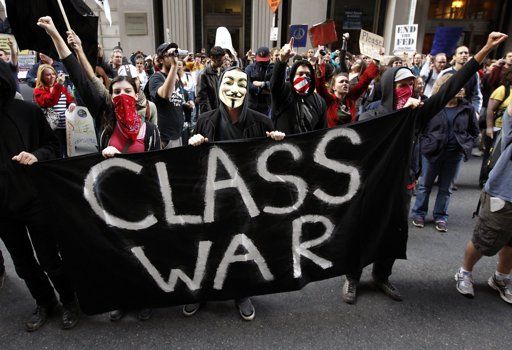
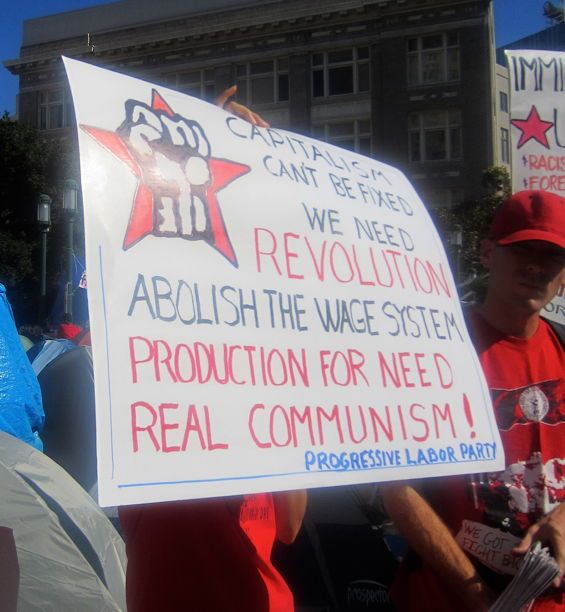



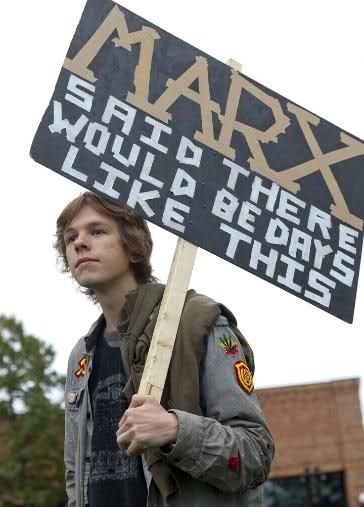
Or this young valedictorian’s 2010 graduation speech? Has Markadelphia forgotten the threads in which it was illustrated to him the various Schools of Education in which Paolo Friere’s “Critical Pedagogy” is front-and-center in the curriculum? What, they pick it up by reading Das Kapital or Quotations from Chairman Mao for fun?
I want to close with one thing further. In the comments to this post, Markadelphia insists that he was “voted off the island,” that is, my commenters voted “2-1” for him to stop commenting here. I call bullshit. Where is this thread? It certainly wasn’t here. When I was forced to switch from Haloscan/Echo to Disqus, the earlier 50,000 comments didn’t come along, but I know for a fact that Markadelphia’s last comments here were in that epic 574-comment thread, and there’s no “vote” in that one. Here’s Mark’s comment in its entirety:
You weren’t voted out – you left because you couldn’t take the heat.
The vote was 2-1. Go back and read the thread. I promised I would abide by the majority’s decision. It was a post about the Constitution being eroded.
And, really, I can take anything anyone on there throws at me, especially given the fact that most of it is completely wrong.
Of course, there is the issue (and a sad one at that) of the slide into dementia that is going on over there both by the host and the commenters. I admit to having some reticence at picking on people who have a disability. I don’t make it a habit of making fun of people who are so clearly deranged on a number of levels.
Link that thread, Markadelphia. I want to read that. I never voted for you to leave. In fact, I have said on repeated occasions that I would never ban you because you’re such a marvelous example of type. For instance, you try to take the moral high ground by proclaiming “I admit to having some reticence at picking on people who have a disability. I don’t make it a habit of making fun of people who are so clearly deranged on a number of levels” but a quick sample shows an average of three posts a month linking directly here (not that I actually see any traffic from you), and those posts include comments like “Cult Grand Wizard.”
Keepin’ it classy and consistent! That’s Markadelphia!
If nothing else did, nearly three years of Markadelphia illustrated to me why it is I spend the time I do blogging. SOMEBODY has to counter the derangement.
So here’s to nine years of The Smallest Minority. If I can irritate one person that much, I’m doing my job!
UPDATE: My most abject apologies. Mea culpa, mea culpa, mea maxima culpa. Markadelphia did indeed comment one more time after that thrashing linked above, in my September 17, 2011 post Yes. Yes, I Do. Only 149 comments in that one. I’m only 50 and my memory is already fading. And it does appear he was correct – two votes to leave vs. one vote to stay.
Wow. I guess he forgot my standing vote to stay, which would have made it a tie at 2-2.
So, Markadelphia, I apologize for my error. You were indeed correct.
About that single point.