Violent & Predatory vs. Violent but Protective

Rachel Lucas has a post with 259 comments (at the time of this posting) on the topic of British compelled helplessness, the loss of their aggressive edge, and their inability to distinguish violent-and-predatory from violent-but-protective. Many of the comments are, of course, infuriating.

Example:

I’m one of those idiots who think we’d all be a lot safer without so many knives around. And it seems the police in the UK (not a bunch of woolly liberals on the whole) agree with me, as they’ve fairly regularly held knife amnesties with the intention of making the streets safer.
At the end of the day, it’s a legitimate philosophical difference – am I safer with there being far fewer guns around to shoot me with, or is the proliferation of guns a price worth paying as long as one of those guns is in my hand and I’m trained to use it? I prefer the former option, and I suspect I always will.

I understand a little better each day Samuel Adams:

If ye love wealth better than liberty, the tranquility of servitude than the animating contest of freedom, — go from us in peace. We ask not your counsels or arms. Crouch down and lick the hands which feed you. May your chains sit lightly upon you, and may posterity forget that ye were our countrymen!

UPDATE: And here’s the clincher, from the source of the initial quote:

I think this is another crucial aspect of the cultural difference between the US and countries like Britain with strict gun controls. You see, I believe in liberty as well – and the cornerstone of that is the freedom to live and the freedom from fear. Freedom that can only be safeguarded by a gun in my hand and the sharpness of my physical reflexes is a very poor quality, one-dimensional freedom. The widespread possession of deadly weapons by others is therefore a severe infringement of my personal liberty. And, yes, I am being utterly serious.

“Freedom from fear.” And where have we heard that before?

Another commenter answered that plea as well if not better than I could:

OvertheCliff Says:

Scotgo: I think this is another crucial aspect of the cultural difference between the US and countries like Britain with strict gun controls. You see, I believe in liberty as well – and the cornerstone of that is the freedom to live and the freedom from fear.

This might be the whole reason this thread is as long as it is. Thank you, Scotgo, for pointing out that liberty, to you, means “freedom from fear.”

Now if I can ask you to please take a moment and think that through.

Freedom that can only be safeguarded by a gun in my hand and the sharpness of my physical reflexes is a very poor quality, one-dimensional freedom.

As opposed to “freedom” that can only be safeguarded by the state, you mean?

Again … please think this through. You seem like a very intelligent person. I’m confident that you can work your way through this. Furthermore, I’m confident that when you do, your eyes will open like Paul on the proverbial road to Damascus.

The widespread possession of deadly weapons by others is therefore a severe infringement of my personal liberty. And, yes, I am being utterly serious.

I feel very sure this cognitive dissonance you’re experiencing is the result of you not applying your considerable intellect to this issue.

Scotgo, we’re not smarter than you. But we’re more free. In fact, we’re more free than you have ever imagined being, considering what you just said.

Not only more free that he’s ever imagined, more free than he can ever possibly understand.

And I note that the UK isn’t particularly “free of fear” even in its (*cough*) “disarmed” state.

If Ten Percent is Good Enough for Jesus . . .


(It Oughta Be Enough For Uncle Sam)

Ray Stevens, 1993:

Now, I’d just like to say a few words right here about taxes

I pay another man to do my taxes
On account of it’s just one more deduction I can take
But the postman brought my W2 this mornin’
And this year they’re claimin’ a third of all I make

Now I’m just as patriotic as the next man
And you know I love that Red, White, and Blue
So, I’ll help to pay this risin’ “cost of freedom”
But I’ll be danged if I’m gonna change my point of view

Because every time the bureaucrats run out of money
Well Congress socks it to the workin’ man
And I don’t think it’s one bit funny
When they take so much of my money
And do things with it I don’t understand

I don’t know why they feel they gotta squeeze us
But I’ll tell you just exactly where I stand
I believe if ten percent is good enough for Jesus
Well, it ought to be enough for Uncle Sam

Now, some of them folks that we’ve been sendin’ off to Congress
Think that all they’ve got to do is spend and spend
But, you know, you can’t run a family, much less a country,
with more money goin’ out than comin’ in

And that ole debt just keeps on gettin’ bigger
And we’re all gonna have to pay, so don’t you laugh
‘Cause one day soon you might just look down at your paycheck
And figure out that they done started takin’ half

Because every time the bureaucrats run out of money
Well Congress socks it to the workin’ man
And I don’t think it’s one bit funny
When they take so much of my money
And do things with it I don’t understand

I don’t know why they feel they gotta squeeze us
But I’ll tell you just exactly where I stand
I believe if ten percent is good enough for Jesus
Well, it ought to be enough for Uncle Sam

I said if ten percent is good enough for Jesus
Well, it ought to be enough for Uncle Sam
Seemed appropriate.

Quote(s) of the Day and a Book Review

Quote(s) of the Day and a Book Review

I’ve finished Neil Strauss’s Emergency: This Book Will Save Your Life. Some more memorable quotes from it:

As I was standing around the fire one evening, cooking fish that an instructor had taught me how to gut, I found myself immersed in a conversation with the marines.

A younger marine, Luke, was speaking. He had close-cropped black hair, thin lips, and small, sparkling brown eyes. “This is going out on a limb, but I think there will be a revolution in America in the next hundred years.”

“Where’s it going to come from?” I asked.

“Me,” he said without smiling. He paused, then explained. “If you ask anyone in the military, they hate the government. They have all these rules that hold us back and put our lives in danger.”

“If we followed the rules of engagement,” an enormous older marine named Dave added, “We’d be dead.”

—

Cogito ergo armatum sum — I think, therefore I am armed.

—

Of course, now that I’m stockpiling, the first thing all my friends will probably do when there’s a disaster is run to my house.

I suppose they’ll make an excellent source of protein.

Why do I keep making these jokes? Is there a half-truth somewhere in there?

I used to fear being the eaten. Now I fear being the eater.

—

On the way to (EMT) class one night, I say a motorcycle lying on the shoulder of the highway with a man slumped next to it. Every car blew past, paying him no attention. I pulled onto the shoulder, called 911, unzipped my bugout bag, grabbed the emergency first-aid kit, and raced to his side. He wasn’t badly hurt, so I pressed a two-by-four-inch piece of gauze against his arm to stop the bleeding, then secured the gauze with a roller bandage while waiting for the paramedics

Something in me was beginning to change. I’d never stopped to help a stranger before. I’d always assumed someone else would do it – and better than I could.

—

Unlike what the survivalists, the PTs, Lord of the Flies and Sigmund Freud had led me to beleive, it seemed that tragedy also had the power to bring out the best in people. Not just the fire-fighters and police officers who worked around the clock. Not just the local businesses that brought truckloads of supplies for neither monetary nor marketing gain. But even the victims themselves tried their best to help one another.

They might have behaved differently if their lives were still in danger, resources were scarce, and they had to compete to survive. But once they were safe, it seemed that people’s first instinct was to look after one another and support their community. Maybe I needed to revise my Fliesian philosophy. If people were animals, then like most animals, they were essentially harmless most of the time – unless they felt threatened. That’s when they became vicious.

Strauss spends the first half of the book learning to be self-sufficient, independent, and above all, safe. But along the way, he learns an important lesson – surviving by yourself is a hell of a lot harder than surviving in a group. In attempting to “network,” he becomes a certified EMT, and joins the California Emergency Mobile Patrol. And he learns something else – something most “survivalists” I think, never do. I won’t quote the last few paragraphs of the book, because – well, just because.

Don’t buy the book expecting it to be a “how-to” manual for budding survivalists. It is not. It is the story of one man’s journey from milquetoast to self-sufficient individual, one not disconnected from the modern world, but enthusiastically a member of it, while still capable of surviving without it.

It was worth the price, and the time.

First Amendment? You Don’t Need No Stinkin’ First Amendment!

First Amendment? You Don’t Need No Stinkin’ First Amendment!

THIS should give every blogger the warm fuzzies:

Blogger claims police search of home was threat

Police officers accused of drunken driving. A female officer’s alleged promiscuity and infidelity. A commander whose critics labeled his son a child molester.

Jeff Pataky said he uses negative complaints and anonymous tips to fuel his blogging crusade against Phoenix police. A headline on his Web site suggests rewards would be provided for “dirt” on police indiscretions.

Pataky, a former software sales and marketing executive who now focuses his energy shoveling content on www.badphoenixcops.com, said he believes his online criticism of the department – along with past criticisms of police investigations – led officers to serve a search warrant at his home last week.

Police officials said Wednesday that a Phoenix detective prompted the investigation after complaining about harassment, though they declined further comment.

Pataky said he felt the investigation was a response to a lawsuit he filed on Monday in U.S. District Court saying he was maliciously prosecuted by police in 2007 after his ex-wife accused him of harassment, a case later dropped. In his lawsuit he’s asking for an unspecified amount for damages. City officials declined to comment on pending litigation.

Pataky’s blog is known in law-enforcement circles for its off-color language that, according to the blogger, is aimed at Phoenix Police Chief Jack Harris, Maricopa County Andrew Thomas and other public officials.

“Too bad. They need to get over it,” Pataky said. “They are held to a higher accountability.”

Pataky said he edits the blog and works with four or five people who receive tips from a variety of sources, including sworn and retired officers.

Investigators confiscated computer material and other items from Pataky’s north Phoenix home, which he considered a threat to quit writing.

“We have heard internally from our police sources that they purposefully did this to stop me,” Pataky said. “They took my cable modem and wireless router. Anyone worth their salt knows nothing is stored in the cable modem.”

Phoenix Assistant Chief Andy Anderson said the harassment case is unique because of the connection to an unaccredited grassroots Web site. He said the blog is one part of the case, though he did not provide specifics of the ongoing investigation.

“This isn’t about the blog,” Anderson said. “That’s just where the investigation led.”

Police also served a separate search warrant at the home of former homicide Detective David Barnes, one of the investigators on the “Baseline Rapist” case.

Barnes was demoted from the homicide unit to patrol after he went public one year ago with claims of mismanaged evidence at the city’s crime lab.

Mark Spencer, president of the Phoenix Law Enforcement Association, said he was concerned about questionable probable cause to enter Barnes’ house. The union, which claims no affiliation with Pataky’s blog, will represent Barnes through the internal investigation.

More here.

Quis custodiet ipsos custodes?

UPDATE: Say Uncle has links to more details on this incident.

Do it Again, Only HARDER!

Well, FOX News has had the temerity to expose the “Mexican Canard” for what it is – a lie.

This, of course, makes no difference to The Other Side:

Tom Diaz, senior policy analyst at the Violence Policy Center, called the “90 percent” issue a red herring and said that it should not detract from the effort to stop gun trafficking into Mexico.

“Let’s do what we can with what we know,” he said. “We know that one hell of a lot of firearms come from the United States because our gun market is wide open.”

I don’t know how I missed this before, but the UK’s Guardian newspaper printed a piece last August that I wish I’d seen then. No matter, now’s as good a time as any:

Firearms: cheap, easy to get and on a street near you
From drug dealing to settling playground squabbles, firearms offences are rising

Duncan Campbell
The Guardian, Saturday 30 August 2008


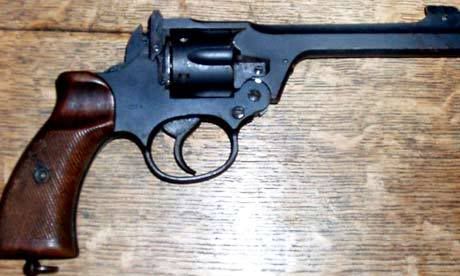
The gun shown here, a Webley, is up for sale in London for £150, one of hundreds of such weapons that are easily and cheaply available on the streets of the UK’s big cities, a Guardian investigation can reveal.

The variety of weapons on offer in Britain is extensive and includes machine guns and shotguns, as well as pistols and converted replicas. A source close to the trade in illegal weapons contacted by the Guardian listed a menu of firearms that are available on the streets of the capital.

“You can get a clean [unused] 9mm automatic for £1,500, a Glock for a couple of grand and you can even make an order for a couple of MAC-10s,” he said. “Or you can get a little sawn-off for £150. They’re easy enough to get hold of. You’ll find one in any poverty area, every estate in London, and it’s even easier in Manchester, where there are areas where the police don’t go.

This, of course, after the British government banned almost all handguns in 1996, and 162,353 were turned in by their legally registered owners.

The illegally possessed ones stayed where they were. You can bet those are the places “the police don’t go” – having ceded them to the criminal class.

“People who use shotguns tend to be lower down the pecking order. There is less use of sawn-off or full length shotguns, and if a criminal wants street cred, he wants a self-loading pistol, a MAC-10 or an Uzi submachine gun.”

Sawed-off shotguns & rifles and fully-automatic weapons were banned in the UK back in 1937.

How’s that working out, fellas?

This week a man who ran a “factory” for converting replica weapons into working guns was jailed for life. Police believe the products of Grant Wilkinson’s workshops were used in more than 50 shootings, including eight murders. His speciality was turning legally purchased MAC-10s into weapons that could fire live rounds, an increasingly common practice.

According to David Dyson, a leading firearms consultant, it is possible to learn through the internet how to make a firearm, given a degree of skill, and converted deactivated weapons also feature in shootings.

Why not? Pakistanis do it without the aid of the Internet.

But it is the arrival of eastern European weapons that, alongside a homegrown industry in converting them, has contributed to the firearms glut.

(My emphasis.) As I have noted previously, the argument you hear most often by The Other Side is that “lax gun laws” in adjacent jurisdictions are the reason that “reasonable gun control” laws don’t, you know, actually work. It’s too easy, they say, for people to just drive across the state, county, or city line and buy what they’re prohibited from having where they live.

The UK is a FREAKING ISLAND, one with uniform, draconian gun laws – gun laws that the Million Mommies said they wanted to implement here, and THEY CAN’T KEEP THE GUNS OUT.

“There has been an influx from eastern Europe and particularly from Poland, and there are also a lot coming in from people who have served in Afghanistan and Iraq,” said the source. “In Liverpool docks, you can put in an order for 10 guns and some grenades and they’ll say OK and two weeks later, they will be there – and they are straight goers.”

Gee, do you think the Mexican cartels are coming across our border to place orders for grenades and antitank rockets? Or do they just go to the docks in Puerta Vallarta or Ensenada, or Guaymas, or . . . Well, you get the picture.

According to Dyson, the latest “weapon of choice” is a Russian 8mm Baikal self-defence pistol, originally used for firing CS gas. “They are legally sold in Germany and won’t fire a bullet but they can be converted by removing the partially blocked barrel, and replacing it with a rifled barrel,” he said. “After other small alterations, it can then fire 9mm bulleted ammunition. The replacement barrel is longer than the original, and is threaded so that it will accept a silencer, which is commonly sold as part of the package.

“There are hundreds of these floating around and hundreds have been seized,” he said. “They look the part as they are based on the Russian military Makarov pistol. If you are a 20-year-old drug dealer and you want a gun, that is what you will get and it will cost about £1,000 to £1,500.”

Which is, what, a day’s income if you’re selling drugs?

“The trends in firearms are driven by the suppliers,” said Dyson. “About two years ago, a supplier brought back hundreds of German-made revolvers, blank-firing pistols which can be bought legally in Germany. They were then converted and new cylinders made. They could then be sold for £700 to £800 when the supplier would have bought them for €60 and spent about £30 on converting them.”

Supply and Demand. Economics 101.

Sad that so many can’t learn it.

Home Office data shows that gun crime is up since last year, despite the recent doubling of sentences for possessing or supplying firearms. There were 9,803 firearms offences in England and Wales in the year to March 2008 with most in London, Manchester and the West Midlands.

Most buyers are involved with drug dealing, the source said. Some are used to rob other dealers in crimes that go unreported, others are used as protection while a deal is under way. “Someone will have a tool and there is always one guy in a posse willing to use it. They will have one guy who doesn’t give a fuck.

“Everyone wants to be a gangster now, mainly the kids. You have five or six in a little crew and one of them will be carrying. They want handguns – shotguns are too big and bulky. The sawn-off doesn’t look so good but use a machine gun and you get known as a heavy guy. They have them just to be a chap on the street, to pose. Some of them walk around all day with a .38. It’s 16-year-olds at it and it’s getting like America, silly as it sounds.”

In terms of nationalities, the influx of eastern European criminals has changed the balance of power. “Who’s using the guns? The [Jamaican] Yardies’ value for life was so minimal that they thought nothing of killing people,” said the source. “We don’t like them, they have no moral code. But it’s the Russians and the Polish and Albanians around now. They are bullies. They want to take over the flesh business. The Russians are cold-hearted fuckers. What they have been doing is following the card boys [who put cards advertising prostitutes in phone booths in central London] and then taking the girls hostage, armed if need be.”

Force a nation into compelled helplessness, and the wolves will come. It’s a certainty. Keep reading.

Detective Chief Inspector Colin Sutton, who has investigated some of London’s most high profile shooting murders, said he believed the age of offenders was getting younger, and sometimes guns seemed to be used for the slightest reason.

“Playground squabbles are now being settled with guns,” he said. “And drug dealers are taking a policy decision to get youngsters to carry guns.”

He said guns could be purchased for a few hundred pounds in many parts of London. “You can hire a gun for a period and, if the gun has already been used for a murder, the going rate comes down.”

While the conviction of Wilkinson was seen as a breakthrough, it is accepted that with the increased traffic between Britain and eastern Europe, stemming the flow of weapons remains an almost impossible task.

Gee, ya think?

“Guns are always available,” said Dyson. “You can go to the former Soviet Union, or countries with less stringent regulations than ours, and although British Customs have their successes, many guns appear to be smuggled into the UK.”

Amnesties for people to hand over weapons are greeted with scepticism by criminals. “The gun amnesties are meaningless,” the source said. “All you get handed in are guns from boys who wanted to be gangsters and then got a job or someone whose mother found it in their bedroom. If I had a gun, I wouldn’t take part because, if I got pulled, what would I say – ‘Oh, I’m just on my way to the amnesty.’ Also if it gets out that you’ve given in your tool, people will think you’re a wrong ‘un.”

Few professional criminals would keep guns on their premises. “Only silly people keep it in their homes. Normally, you have a ‘keeper’ a couple of miles away and some of them have been at it for 20 years. It’s best to have an old fellow with no previous or a woman. You keep the ammunition separate because you’ll get a much heavier sentence if you have them together.”

When guns are moved from place to place, a young woman is often used as the courier because there is less risk of her being stopped and searched.

What is not in dispute is the devastating effect that the casual use of a gun over a minor argument can have on dozens of people. In December 2006, Sean “Stretch” Jenkins, 36, an amiable, 6ft 8in window-cleaner from south London, was shot dead at a party in Carshalton. His killer was a cocaine dealer called Joseph Greenland, a volatile man with a quick temper, who had apparently taken offence at something Jenkins said. The men had earlier been at a boxing night at Caesar’s in Streatham, where there had been some fighting outside the ring. Greenland had left the party, driven home in his Range Rover, picked up a gun and returned to kill Jenkins in front of at least five witnesses, who were warned not to talk.

None of the immediate witnesses gave evidence against Greenland, who had a reputation for threatening to “annihilate” anyone who crossed him, but there were traces of his DNA on a cigarette end and a wine glass at the party and his bragging about the shooting was to be his downfall. His recourse to a gun, for no other reason than some perceived slight, left Jenkins’s six-year-old son without a father and saddened a wide network of friends and family. Greenland was jailed for life last week and will have to serve 30 years before he can be considered for parole.

“We got what we wanted,” said the victim’s mother, Maureen Jenkins, of the verdict and sentence last month. “I went to the cemetery and said, ‘Well, boy, I can put you to rest’.”

The detectives investigating the killing and the prosecution team that secured Greenland’s conviction were “marvellous”, she said. “I shed tears every day and I probably will till the day I die. Why do these people have to kill for nothing? If they want to kill people, why don’t they join the army?

Sweet bleeding jeebus. If there was ever a more textbook example of someone who cannot distinguish “violent and predatory” from “violent but protective, “ I doubt I’ll ever find it.

You don’t ever think a shooting will happen in your life. It’s all down to guns, just guns.”

The Guardian’s source said that guns were becoming a first rather than a last recourse. “A gun used to be used as a mediator; now everything is revolved with a gun. It’s brought the heat on everyone. Before you would get a two [years jail sentence], now it’s a five. It’s getting like the US now, like The Wire. It’s like a prediction of what will happen here. I think they all think they’re playing Grand Theft Auto. It’s madness out there.”

And The Other Side here wants to force us into compelled helplessness, because (they say) it’ll make us safer.

I don’t fucking think so.

Quote(s) of the Day

On the near-simultaneous reference by Michael Bane and Glenn Reynolds, I ordered a copy of Emergency: This Book Will Save Your Life, by Neil Strauss. I’m about halfway through it at the moment, and I have to say that so far it’s been fascinating, especially since Mr. Strauss is about my polar opposite from a political perspective. His interpretation of the world is, naturally, colored by his worldview, but a lot of what he says is pretty interesting. Here are just a few quotes from the book so far:

Our society, which seems so sturdily built out of concrete and custom, is just a temporary resting place, a hotel our civilization checked into a couple hundred years ago and must one day check out of. It’s an inevitability tourists can’t help but realize when visiting Mayan ruins, Egyptian ruins, Roman ruins. How long will it be before someone is visiting American ruins?

—

One of the most unsettling things about Adolf Hitler is that he wasn’t an imperialist, like Napoleon or William McKinley. He wasn’t just trying to subjugate other countries. His goal was to cleanse them, to wipe out the so-called weak races and speed the evolution of the human species through the propagation of the Aryan race. And for seven years, he got away with it. Few of the most brutal periods in medieval history – from the sack of Rome to the early Inquisition – were as coldly barbaric as what happened in our supposedly enlightened modern Western civilization.

And though I left the (Holocaust) museum with the reassuring message that the world stood up and said “never again” to genocide, it only took a minute of reflection to realize that it happened again – immediately. In the USSR, Stalin continued to deport, starve, and send to work camps millions of minorities. As the bloody years rolled on, genocides occurred in Bangladesh in 1971, Cambodia in 1975, Rwanda in 1994, and in Bosnia in the mid 1990s.

All these genocides occurred in ordinary worlds where ordinary people went about ordinary business. The Jews were integrated into every aspect of the German social and professional strata before the Holocaust. The entire educated class in Cambodia – teachers, doctors, lawyers, anyone who simply wore glasses – was sent to death camps. And as Philip Gourevitch wrote in his book on the Rwandan massacre, “Neighbors hacked neighbors to death in their workplaces. Doctors killed their patients, and schoolteachers killed their pupils.”

—

So what I ultimately learned at the Holocaust Museum was not “never again,” but “again and again and again.”

—

The lesson of Katrina wasn’t that the United States can’t protect its own. It was that no country can protect its own.

No place is safe, and no government can guarantee the well being of its citizens.

—

The fears of Americans change over time. In late 1999, we feared the collapse of our computer system. Then it was terrorist attacks. Then it was our own government. Then it was global warming. Today it’s economic collapse. Fear, it seems, is like fashion. It changes every season. And even though threats like terrorism persist to this day, we eventually grow bored of worrying about them and turn to something new. Ultimately, though, every fear has the same root: anxiety about the things we take for granted going away.

Let me add to the list:

Nuclear holocaust / nuclear winter

Population bomb / world famine

Peak Oil / energy crisis

Etc., etc., etc.

Although a gun can’t do much harm in a locked box in a plane’s cargo hold, I had no idea it was this easy to fly with a firearm. It was the first time since I began this journey that I discovered a freedom I didn’t know I had, rather than a new restriction.

—

Nearby, a group of (Gunsite) students and instructors were making fun of Democrats, gun control laws, and anyone from California. “There’s no constitutional amendment that’s been more crippled and regulated than the Second Amendment,” a competitive shooter was saying about the right to keep and bear arms.

After eavesdropping a while, I began to realize that all my life I’d been a hypocrite. As a journalist I’d always supported the right to free speech, but been opposed to guns. However, by playing favorites with the amendments, it wasn’t the founding father’s vision of America I was fighting for – it was just my personal opinion.

So far it’s been an interesting read. Given the path that Strauss has detailed through the first half, I’m a little concerned as to where he’s eventually headed, but I’ll soldier on to the end and report what I find.

Oh, and given that first excerpt, you might find this interesting: Future Present