Well, DUH!

Reuter-Rooter reports: U.S. most armed country with 90 guns per 100 people. This according to the Small Arms Survey, 2007 coming out in September. Per the report, we 300 million Americans own some 270 million of the estimated 875 million small arms that exist worldwide. We apparently are buying about 4.5 million of the estimated 8 million new guns rolling off production lines each year, worldwide. Even better, the number of guns estimated to be in private hands worldwide is only 650 million, so we own over 40% of them. The other 225 million are held by police and military forces. And best yet, “Only about 12 percent of civilian weapons are thought to be registered with authorities.”

Yeah, baby!

Our closest competitor? India with 45 million privately held arms, but a population of over a billion. Per capita, Yemen comes in second with 61 guns per hundred population. How big is Yemen? About the size of Connecticut? Many of theirs, I would bet, are full-auto capable AK-47s. I bet they’d be amazed to know what they would be worth over here – if they could just sell them legally.

It is the gun-controller’s mantra that “the number of guns” is the cause of violent crime. This report reminds me once again of the conclusion of the 1983 report of a meta-study of gun control research, Under the Gun: Weapons, Crime and Violence in America:

The progressive’s indictment of American firearms policy is well known and is one that both the senior authors of this study once shared. (My emphasis.) This indictment includes the following particulars: (1) Guns are involved in an astonishing number of crimes in this country. (2) In other countries with stricter firearms laws and fewer guns in private hands, gun crime is rare. (3) Most of the firearms involved in crime are cheap Saturday Night Specials, for which no legitimate use or need exists. (4) Many families acquire such a gun because they feel the need to protect themselves; eventually they end up shooting one another. (5) If there were fewer guns around, there would obviously be less crime. (6) Most of the public also believes this and has favored stricter gun control laws for as long as anyone has asked the question. (7) Only the gun lobby prevents us from embarking on the road to a safer and more civilized society.

The more deeply we have explored the empirical implications of this indictment, the less plausible it has become. (My emphasis.) We wonder, first, given the number of firearms presently available in the United States, whether the time to “do something” about them has not long since passed. If we take the highest plausible value for the total number of gun incidents in any given year – 1,000,000 – and the lowest plausible value for the total number of firearms now in private hands – 100,000,000 – we see rather quickly that the guns now owned exceed the annual incident count by a factor of at least 100. This means that the existing stock is adequate to supply all conceivable criminal purposes for at least the entire next century, even if the worldwide manufacture of new guns were halted today and if each presently owned firearm were used criminally once and only once. Short of an outright house-to-house search and seizure mission, just how are we going to achieve some significant reduction in the number of firearms available?

Now, substitute “270,000,000” for the “100,000,000” in that last paragraph and ask yourself the same question. And here’s part of that conclusion that I have not previously quoted:

To members of the gun subculture who have been around guns all their lives and have owned and used guns as long as it has been legal for them to do so, the indictments of gun control advocates must appear to be incomprehensible, if not simply demeaning. We should not be surprised to learn that they may resent being depicted as irresponsible, nervous, potentially dangerous, prone to accidental or careless firearms handling, or as using their firearms to bolster sagging masculine self-images. Of course, from their viewpoints, they have none of these characteristics and in all likelihood resent being depicted as a demented and bloodthirsty lot when they are only guilty of embracing a set of rather traditional, rural, and masculine values. Indeed, one can only begin to understand the virulence with which gun control initiative(sic) are opposed in these quarters when one realizes that what may be at stake is a way of life.

Again, I repeat: Well, DUH!

Like Water Off a Duck’s Back

Say Uncle pointed to a Chicago Sun-Times op-ed yesterday by columnist and journalism professor Laura Washington. I won’t reproduce the whole piece, but here’s a taste:

Gun lovers disarm control advocates

August 27, 2007
LAURA WASHINGTON Sun-Times columnist

It looks like the petulant, gun-toting NRA stalwarts have won the first round.

Last time, I used this space to ask where you stand on the issue of gun control. A torrent of e-mails later, it’s clear: Gun-control advocates were outgunned, four to one.

The gun lovers were legion, robust and vitriolic. Many of you told me to go places where the sun doesn’t shine and the temperature is way too hot. Yet, if you believe public opinion polls, that reaction is an anomaly. For instance, last April, ABC News polled adults nationwide, and asked: “Do you favor or oppose stricter gun control laws in this country?” Sixty-one percent favored them, 36 percent were opposed, and 3 percent were “unsure.”

CBS News asked, “In general, do you feel the laws covering the sale of handguns should be made more strict, less strict, or kept as they are now?” Two-thirds of respondents nationwide opted for “more strict.”

What is the problem with the advocates of gun control? Why are their voices not being heard? They are consistently cowed and overmatched. Gun violence is out of control, yet the gun lovers are ascendant.

You think we’ve got problems now? Just listen to Mike Huckabee, the former Arkansas governor and Republican presidential aspirant. At a recent Conservative Political Action Conference, he bragged, “I’m not a newcomer to the NRA,” the New York Times reported on its political blog. “I was the first governor to have a conceal-carry permit, so don’t mess with me.”

Huckabee, mind you, recently made a flashy second-place showing in the Iowa presidential straw poll.

Do you want to be standing in line for gas, popcorn or a gallon of milk and find yourself next to someone who’s packing heat? If he takes the White House, we can all go shopping for embossed leather holsters and pearl-handled pistols. I’ll be looking to accessorize that with rhinestone-studded boots.

You know, the usual Reasoned Discourse™ we’ve come to expect from our opposition. Please, RTWT. (And yes, I do know about the Zogby poll.)

Instead of fisking her piece, I thought I’d drop her a nice email (and copy the paper’s letters-to-the-editor while I was at it. What the hell, worth a shot.) Here’s what I sent:

Ms. Washington:

I read with interest your op-ed in the online edition of the Sun-Times, and I had some comments to make. I hope that you will see this epistle in the volume of email I am sure has been forthcoming since your little jeremiad was published. Provoking an outpour of response was, I am sure, one of your intentions. Let me apologize in advance (though it is not really my place) for those who will shower you with invective and vitriol. We on the side of the right to arms have been fighting against a decades-long slow-motion hate crime,1 and it tends to wear on our patience. I understand such responses, but I cannot countenance them.

I am eternally fascinated by people who see themselves as “gun control advocates.” I find them fascinating because they epitomize to me the phrase “cognitive dissonance.” The fact that you write from Chicago, one of the epicenters of “common-sense gun control” only adds to my fascination.

Cognitive dissonance has been defined thus:

“When someone tries to use a strategy which is dictated by their ideology, and that strategy doesn’t seem to work, then they are caught in something of a cognitive bind. If they acknowledge the failure of the strategy, then they would be forced to question their ideology. If questioning the ideology is unthinkable, then the only possible conclusion is that the strategy failed because it wasn’t executed sufficiently well. They respond by turning up the power, rather than by considering alternatives. (This is sometimes referred to as ‘escalation of failure’.)”2

Or, as I phrase it, “The philosophy cannot be wrong! Do it again, only harder!” We see this behavior in gun control advocates all the time. There’s always a “loophole” to blame. Always a “next step.” But “gun control” never improves crime rates, never reduces homicide rates. Never. Gun control advocates always – without exception – predict “blood in the streets” and “wild West shootouts” when “shall issue” concealed-carry legislation makes progress in state legislatures, but this never happens. Never. Somehow this data fails to make a dent in the “gun control” mindset. The strategy constantly fails, but the ideology cannot be questioned. Do it again, only harder!

Ms. Washington, you note in your piece: “(I)t seems the gun control advocates have been outmatched. Abigail Spangler acknowledges as much. Spangler is the founder of ProtestEasyGuns.com, a Virginia-based group that has been spearheading a slew of anti-gun protests around the nation.

“Gun control activists, she wrote me, ‘are TRYING HARD but they are seriously affected in state after state by lack of funding and contributions.” She recently met, she says, with the leader of Virginia’s only gun control group. “He says they may not even be able to afford any lobbyist at all soon in Virginia!'”

Ms. Washington, the citizenry will offer an opinion to anyone. Opinions are free. But activism costs money – and the anti-gun side has shown that the hearts and wallets of the general public are not really into it. Ask any hundred random people on the street if they favor stricter gun laws and most likely the majority will say “yes.” Ask them what the current gun laws are, and they won’t be able to tell you. Gun rights activists can. The gun control side of the argument has been supported for decades with money from foundations, perhaps the largest contributor being the Joyce Foundation. Look them up. Those of us who believe in the right to arms are the true grass-rooters, and there are far more of us than the mere four million that the NRA claims as members. As someone once put it so pithily: “Poor Lefties; they’ve been playing on astroturf so long that they don’t know grassroots even when fed a mouthful of divot.” 3

Ms. Washington, our side is winning because we can see reality. We are not blinded to a flawed ideology. The ideology you operate under is expressed best as “Guns are baaad, mmmmkay?” This ideology springs from an inability or unwillingness to see a difference between “violent and predatory” and “violent but protective.” You see only “violence” and violence offends you. From this inability you mistake the tools of violence to be the cause of violence, and from that error comes the desire to eradicate the tools. But this does not address the actual cause. In other words, “Gun control is what you do instead of something.”4

When disaster strikes and civil society breaks down, when the government proves unmistakably that it cannot protect everyone, everywhere, all the time, then some people have an awakening – and they go to a gun store or a Wal-Mart and try to buy a gun.

And that’s when they discover just what the gun laws really are.

And many become gun-rights activists because, as one woman put it when she found out she had to wait a week for a gun while being stalked by an ex-boyfriend, “I’ve been against guns and violence my whole life.”5 She and those like her were responsible for that interminable week wait. She finally understood the difference between “violent and predatory” and “violent but protective,” and wanted protection – which the law denied her for a full week.

Some of us are “gun lovers,” Ms. Washington. I am, unashamedly. But many, many more simply want to be able to choose how to defend ourselves. That is a choice you wish to deny us out of a belief in a flawed ideology that you cannot bring yourselves to recognize.

I’d love to discuss this topic with you further, but I seriously doubt you’ve bothered to read this far.

Thank you for your attention, however much of it I was able to garner.

(Footnotes not in original).

Somewhat to my surprise, she replied:

Dear Mr. Baker,

Thanks for your comments on the gun control column. I appreciate you taking the time to share your thoughts.

Be consoled that you are winning the battle. And yes, I did read your entire letter.

Best, Laura

=================================================================
Laura S. Washington
Ida B. Wells-Barnett University Professor
DePaul University
Contributing Columnist, Chicago Sun-Times
Senior Editor, In These Times

The fact that she responded was surprising. The content was not.

I sent her a short reply:

Dear Laura:

Thank you for your gracious reply, and for taking the time our of your obviously busy schedule to read my missive.

Water off a duck’s back, eh?

My sincere condolences,

Kevin

But wait! There’s more! Phelps had a beautiful response of his own that I hope he sent to her. I urge you not to miss it.

Footnotes:

1Dr. Michael S. Brown
2Steven Den Beste
3Tamara K
4Say Uncle
5Seraphic Secret

Credit where credit is due.

UPDATE: Commenter Kevin P. notes that he maintains (an EXCELLENT) Wikipedia page on the Joyce Foundation and their funding efforts. Way to go, Kevin!

Cognitive Dissonance

It raises its head once again. To quote Steven Den Beste:

When someone tries to use a strategy which is dictated by their ideology, and that strategy doesn’t seem to work, then they are caught in something of a cognitive bind. If they acknowledge the failure of the strategy, then they would be forced to question their ideology. If questioning the ideology is unthinkable, then the only possible conclusion is that the strategy failed because it wasn’t executed sufficiently well. They respond by turning up the power, rather than by considering alternatives. (This is sometimes referred to as “escalation of failure”.)

Or, as I put it:

The philosophy cannot be wrong! Do it again only harder!

We have some new stories coming out of the petri dishes of the UK Commonwealth.

Let’s start with this one:

Victims and offenders get younger

By Philip Johnston
Last Updated: 7:01am BST 24/08/2007

Periodically, there is a national outcry about guns on our streets. It reached a climax 20 years ago this week when Michael Ryan shot and killed 16 people, including his mother, wounded 15 others, then killed himself.

The massacre in Hungerford led to a ban on the ownership of semi-automatic centre-fire rifles.

In 1996, the murder of 15 children and their teacher at a school in Dunblane, Scotland, led to a complete ban on handguns.

Yet since then, the number of crimes involving guns has risen.

In 1996, there were 14,000 recorded offences in which firearms were reported to have been used. In 2005/6, the last period for which figures are available, there were 21,500.

Although the numbers dying through shooting is roughly similar, 50 victims in 1996 and last year, attempted murders and woundings are up 50 per cent.

Britain now has some of the toughest gun laws in the world – yet they did not prevent the appalling events in Croxteth.

Ergo: the strategy failed.

But the ideology cannot be wrong!

Yesterday, Gordon Brown said the Government was “working urgently” to tackle gun crime. But if previous laws have made little difference why should new ones?

The past year has seen another avalanche of legislation. The Government introduced a minimum five-year sentence for possessing an illegal firearm. They made it an offence to possess an air weapon or imitation firearm in public without legal authority or reasonable excuse.

The Violent Crime Reduction Act 2006 made it illegal to manufacture or sell imitation firearms that could be mistaken for real firearms. It also strengthened sentences for carrying imitation firearms, and created tougher manufacturing standards so imitations cannot be converted to fire real ammunition.

The Home Office boasted: “We’re cutting off the supply of firearms into the country.”

“Do it again, only HARDER!

But the guns are already here; and they are increasingly easy to get. Home Office research indicated that an imitation firearm could be bought for £20 and a shotgun for £50. A military-quality handgun will go for around £1,000. An automatic weapon sells for between £800 and £4,000.

Think about that. Gun control supporters here object to our pointing out the failure of DC’s draconian gun ban (there were seven homicides in DC last week, at least five of which were by firearm), or Chicago’s handgun ban to have any positive effect on the level of gun crime in those cities. They blame “lax gun control laws” in the surrounding areas for the influx of guns into those cities. However, England has all the laws that the Brady Campaign et. al think are “common sense”: “may-issue” ownership licensing with full background check and character references, “safe storage” requirements with surprise inspection powers by the State, restrictions on the amount and type of ammunition permit holders can possess, a complete ban on “military style” semi-automatic rifles, a complete ban on handguns, the whole nine yards. More importantly, the UK is an island – there are no neighbors just across the state or county line with “lax gun laws” that allow an easy flow of illicit guns. You’ve got to smuggle them in through the ports of entry, or by boat. Yet gun prices are barely above American retail, and fully-automatic weapons can cost less than a handgun.

But does anybody learn from this? Hardly. Washington D.C. is going to the Supreme Court to prevent its bans from being overturned. The city of Philadelphia is currently experiencing a tremendous increase in homicides, so two city council members are suing the state legislature so that Philadelphia can pass its own gun control laws, and activist lawyer Michael Coard wants to sue the NRA for influencing the Pennsylvania state legislature into passing preemption laws.

There’s more to that piece, and I recommend you read it, but let’s move on to the next story that covers the slaying of an 11 year-old boy in Liverpool:

Former detective: It is a gangland culture

Albert Kirby, Former Detective Superintendent, Merseyside Police, on the problem of gun crime in Liverpool:

“Like other areas of Liverpool, Croxteth has become increasingly more difficult to police over the years due to the gang type culture and the reluctance of people living in the area either to come forward and give either evidence or information about those involved in the gang culture, drugs and crime groups.

“It is the same throughout the city. Once upon a time it used to be fists on the street corner. Then they started to use any sort of weapons – hammers or axes. Now the readily availability of fire arms has opened up a whole new ball game.

But licensing, registration, “safe storage” and outright bans are supposed to prevent “ready availability,” aren’t they? That’s what the ideology says!

“Fire arms can be obtained very cheaply and after they have been used criminals can dispose of them because they are so cheap – a handgun can be bought for about £25 a time.

Yet the earlier piece said a “military quality” handgun would go for about £1,000. What are these, cheap “Saturday Night Specials”? Just so you know, at current exchange rates, £25 is $50 US.

“Fire arms are so readily available that you can go out on the street, make the necessary enquiries and come up with them. It is that easy.

Ergo: the strategy failed.

“The legislation that came in after the Dunblane shooting in 1996 has been utterly and totally ineffective. It was a waste of space. With the borders disappearing in Europe there are no checks on firearms coming in from abroad. They come from Eastern Bloc countries, recommissioned firearms, and a steady flow coming out of the world’s conflict zones.

See! See! It’s the fault of neighboring states with lax gun laws!

Oh, wait…

“Merseyside Police have done a tremendous amount of work to recover firearms. But bearing in mind the amount of firearms that are available it is very difficult.

“For a lot of these kids, it is a status symbol to them. In the sixties they would have the drainpipe trousers and the slicked hair, and then the mods and rockers in the 1970s with their crash hats.

“Now guns are like a status symbol: ‘If you diss me I will shoot you because I have got a gun’. It is part of the culture, it is a gangland culture.

“Croxteth is a poor area. I would think there are a lot of unemployed people there. In that area drugs are just prolific.

So are guns. Cheap guns.

“This poor lad was in the wrong place at the wrong time. These people have been feuding and the poor guy has got in the way. What justification can these people have to shoot an 11-year-old boy who has not done any harm to anyone. He comes from a decent family.

“Where do we go from here? Firstly, we have to change the street culture which accepts guns. That will be a long-term issue – like tackling anti-social behaviour.

With what? Judicious application of ASBOs?

“Secondly, these incidents will continue to happen unless people are willing to come forward as witnesses.

Even though you cannot/will not protect them from retaliation, and they cannot protect themselves.

“The system in the judicial process is so good now at protecting identities. People have to learn to have faith in the system.

You’re going to protect the identities of the witnesses? How? Relocate them to Australia? The people have an abiding faith in the system. They believe faithfully that it’s not going to do squat to help them. They have reason to believe that.

“Thirdly, the courts are so woeful. These people hate going to prison. Scousers have an expression that they can do it standing on their head. But standing on their head gets harder as they get older.

“The courts should say that if someone is sentenced for an offence, and a firearm is used, even if it is a replica, that person are going to prison for a long time.”

They may say it, but as you said, the courts are woeful, and your prisons are overcrowded already.

No wonder there’s no trust.

Finally we travel far across the pond to Australia, to the little town of Roseville, a Northern suburb of Sydney in New South Wales where a new gun shop has opened:

Residents irate over gunshop permit: what do we tell our children?

What a fascinating question!

UP IN arms would accurately describe the incensed reaction of Roseville residents to news that a gunshop is to open in their midst.

Last night hundreds were expected to pack a community hall to protest against the approval granted by Ku-ring-gai Council, apparently without notification to those who may have an opinion about such an enterprise.

Andrew Peter, a gun enthusiast and coffee shop owner from Bondi Junction, made an application last month to turn an old printing shop into a sporting goods and firearms store. One of the main reasons for his decision was the estimated 1300 firearm owners who live in the area.

I’m curious as to how much territory “in the area” covers.

The shop is opposite a community hall that runs a preschool centre. It is also near a bus interchange used by schoolchildren, and some neighbouring businesses say the approval, although legal, is inappropriate.

Lisa Warrand is one of dozens of parents who fear the worst: the potential for an armed hold-up and shootout, or merely having to explain to children who walk past every day why a shop sells guns. (My emphasis.)

“Roseville has five churches and no pubs. People buy in this area because they want a more family-focused area,” she said yesterday. “We teach children about how bad guns are and yet we are being put into a position where we have to explain why there is a man in the car park carrying a gun bought across the road.” (My emphasis.)

Sally Cochrane runs the Zest hairdressing salon a few doors away. She concedes that the chances of a hold-up are slim but says it is a risk that should rule out the shop from the neighbourhood. “Children and guns don’t mix. It’s as simple as that, and if there is a robbery then it could be disastrous. I accept that this man has a right to open his shop and to sell guns, but not here.”

Rob Hudspith disagrees. He owns the bicycle shop nearby and says the biggest mistake was that no one was given details of the application by the council.

“If they didn’t have a legal obligation, then they had a moral one,” Mr Hudspith said. “Personally, I don’t have any problems, but there is an inherent fear of firearms, and who can blame people for being worried?” (My emphasis.)

A council spokesman said the approval was assessed under State Government planning laws. The business would have to comply with strict laws covering handling, storage and safety.

The Liberal MP for Davidson, Jonathan O’Dea, backs the residents, denying it is nimbyism.

The Shooters Party accuses Mr O’Dea of stirring up trouble by instigating a survey of residents. Mr Peter says he is willing to compromise with extra security to ensure residents feel safe. “Sure, I understand their feelings and I’m happy to talk to them about their concerns, but they don’t have anything to worry about.” (My emphasis.)

There’s the ideology, ladies and gentlemen: “GUNS ARE BAD, mmmkay?” Its root is the belief that all violence is bad; the inability to differentiate between “violent and predatory” and “violent but protective” that leads to the totemic belief that the tools of violence are the cause of violence. The outcome of that flawed ideology is licensing, registration, restriction, bans, confiscation… and rising violent crime.

But cognitive dissonance prevents people from questioning the ideology. The result is escalation of failure, and a complete inability to implement any kind of successful strategy. As Say Uncle put it, “Gun control is what you do instead of something.”

Newsflash!. Still Not Enough “Gun Control” In England!

No, I’m not kidding:

Thugs ‘using spent shells’

Chris Osuh
7/ 8/2007

DEADLY ‘dum-dum’ bullets are being made by criminals using spent shells from shooting ranges, a leading gun crime campaigner has claimed.

A “leading gun crime campaigner” who wouldn’t recognize a “dum-dum” bullet if one hit her in the ass, I imagine.

Lucy Cope of Mothers Against Guns said thugs in cities like Manchester are loading guns with home-made bullets designed to explode on impact and cause greater damage.

Right! Now they’re explosive bullets!

Ms Cope, whose son was shot dead outside a London nightspot in 2002, wants the government to introduce a law that requires shooting ranges and licensed gun holders to return spent shells before they can buy more ammunition.

Er, wait…

The cartridge cases or the “bullet tips,” as Ebay calls them? And does this have anything to do with barrel shrouds? Regardless, her answer is the same-old same-old: Pass a new law making it even more difficult to be a law-abiding gun owner.

She said the M.E.N. gun murder statistics were `horrific’, and said a DNA database of licensed firearms and the banning of replicas would help tackle a `serious epidemic’ of gun crime.

Um, I’ve already pretty thoroughly debunked the concept of “gun DNA,” but that never stops these people. The last sixty attempts didn’t improve the situation? It’s worse now? The philosophy cannot be wrong! It had to be the implementation that was at fault! Do it again, only harder! Magical thinking is their MO. Or, if you wish to be less charitable: insanity.

The campaigner described gun criminals as urban terrorists, and said mandatory 10-year sentences for possessing a firearm would curb their activities.

Because mandatory 5-year sentences don’t?

Manchester campaigner Raymond Bell said unsolved murders helped fuel a cycle of revenge.

No, it’s just that criminals can’t turn to the “justice” system when they’re ripped off or shot, so they have to handle it themselves.

“Some young people see relatives shot dead and the crime go unsolved,” he said. “Then, because they can get access to guns, they are taking their own justice.”

Uh, wait. THEY CAN GET ACCESS TO GUNS?!?!? That’s UNPOSSIBLE®! Guns are outlawed or very strictly controlled!

Aren’t they?

Mr Bell, of the group Carisma, said better relations between the police and the community in inner city neighbourhoods was key to tackling an `epidemic’ of killing.

Actually arresting and jailing known perps qualifies as “better relations” doesn’t it?

Mistrust

Mr Bell said: “Some officers on the ground are antagonising the youths. We need a force that reflects the community, but that won’t happen while there is a climate of mistrust.”

No, I guess not. Arresting and jailing known perps qualifies as “antagonizing the youths,” it seems.

Meanwhile, Moss Side councillor Roy Walters urged people with information about unsolved crimes to talk to the police. He said: “The community is hurt more with every young death. But there are people in the community who know who has committed these crimes.

And if they go to the police, the “antagonized youth” will then threaten the witnessess – or worse – and the cops will do nothing. And the witnesses know it.

So not much gets solved.

“If they come forward, the police will do everything in their power to protect them.”

“Everything in their power” being pretty much limited to handing out ASBOs, if that much.

Khan Moghal, of Manchester Council for Community Relations, said it could take years to end the tit for tat gun culture.

Here’s a hint: It won’t end. At best, only the technology will change. And the volume of violence.

He said: “Big communities have these problems.

“There was a time when these gangs were allowed to flourish and they have maintained a link – it’s become a generational thing and it’s not easy to just root it out.”

He added: “If you can get rid of the perpetrators, you can end the spiral, because it will give people a breathing space.”

Damned straight. But you’re not “getting rid of the perpetrators.” You’re still doing silly shit like blaming the few remaining legal gun owners for the violence that you do dick-all about because anything positive in that direction is considered “antagonizing the youth.”

(“Unpossible” – a registered trademark of Say Uncle. Used with permission. Or at least forgiveness.)

Holy Sh!7!.

I knew ammo prices were climbing, but this is ridiculous!

As I mentioned previously, the new Kimber Ultra CDP II works beautifully with hardball, but not with my pet handload. Well, I don’t reload hardball – economically it just didn’t make sense. I could spend the same amount of money that commercial hardball ammo would cost and shoot premium bullets, or I could buy el cheapo hardball bullets and load them, but why bother?

Well my wife wants to try the new Kimber out, so I needed some hardball. I went down to the local “Caveman’s Warehouse” (as she calls it) and looked at what was available in “bulk” .45. Blazer was the cheapest (aluminum cases, non-reloadable). Next cheapest was UMC.

$79.99/250 rounds! That’s $0.32 per shot!

David Codrea wants us all to buy ammo on August 28 in counterprotest to a planned Brady event. I’m not sure I can afford to!

The Munchkin Wrangler Gets Published!.

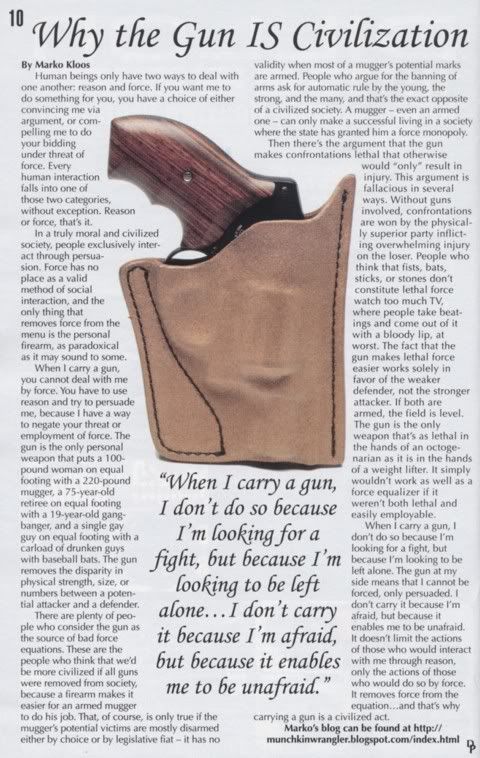
I hadn’t seen this reported on any of the other gun blogs, but Marko Kloos has had his essay Why the Gun is Civilization published in the September issue of Dillon Precision’s Blue Press – their monthly catalog/magazine.

Too cool! That piece made it around the blogosphere (often unattributed, occasionally misattributed.) He got credit, and the URL of his site is also given at the bottom of the article. Congratulations, Marko. You killed some trees!

Edited to add: Of course, I’ve had something to say on the topic myself, but it wouldn’t fit on a single 5×7″ page….

This is What Licensing and Registration are For

And it’s why I will never register my firearms (and why I’m still not too happy about having to get government permission to carry concealed.)

A lot of blogs were talking about the news from Taxachusetts last week when they reported that gun permit renewals were down 25% over the last six years, and 30% in Boston.

Gun permits drop 25% in Bay State

Culture shift, fees are cited

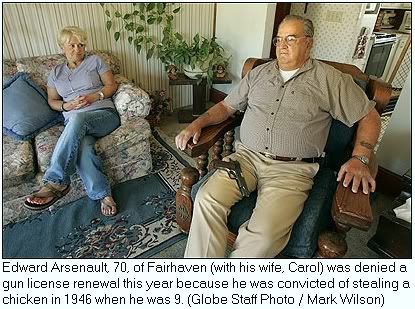
Normally I don’t include the photos from these stories, but in this case, I will:

Obviously Massachusetts has taken a page from Maryland’s playbook. Continuing:

The number of licensed gun owners in Massachusetts has declined by more than a quarter in the past six years, a falloff driven by restrictive laws, higher licensing fees, and cultural change, according to police officers and gun owners.

The drop is especially dramatic in the eastern part of the state and in urban areas. The number of licensed gun owners fell at least 30 percent in Boston, Springfield, Quincy, Fall River, and Waltham. It dropped at least 20 percent in more than 220 of the state’s 351 communities.

The number of licensed owners climbed in about 40 mostly smaller communities in the central and western parts of the state. It also rose in a handful of eastern suburbs and cities, such as Weston and Brockton, according to data from the state’s Criminal History Systems Board, which tracks licensed gun owners.

Overall, the number of people in Massachusetts with a license to carry a weapon has declined from about 330,000 to about 240,000 from 2001 to 2007. Over the past three years, the number of licensed owners has declined by 15,000.

While some law enforcement officials praise the decline, police, politicians and antigun advocates caution that there are still plenty of illegal guns on the streets, contributing to a steady pace of violence.

Well THERE’S a shocker.

I’ve said it before, I’ll say it again: These laws can disarm only one group – the law-abiding. Note that the piece blames part of the decline on “cultural change.” They’re correct. I’m willing to bet that many gun owners are leaving. Let me quote The Geek with a .45 on his 2003 decision to depart from New Jersey for the (relative) freedom of Pennsylvania:

We’ll be starting the house hunt after the first of the year. With the miniGeeks, we need a bigger place anyway, and shortly, this will all be a bad dream.

The thing is, I don’t think that’ll be the happy end of the story. I think the story is just beginning to be told.

As I mentioned to Kim, there is a hidden exodus that you won’t read about in the papers:

“People are moving away from certain states: not because they’ve got a job offer, not because they want to be closer to family, but because the state they are living in doesn’t measure up to the level of freedom they believe is appropriate for Americans. We are internal refugees.”

The fact that things have gone so far south in some places that people actually feel compelled to move the fuck out should frighten the almighty piss out of you.

Ten or fifteen years ago, I would’ve dismissed that notion, that people were relocating themselves for freedom within America as the wild rantings of a fringe lunatic, but today, I’m looking for a real estate agent.

It is a symptom of a deep schism in the American scene, one that has been building bit by bit for at least fifty, and probably more like seventy years, and whose effects are now visibly bubbling to the surface.

Just open your eyes and take a long look around you.

If you’re an informed firearms enthusiast, you know how much has been lost since 1934.

Even if you lay aside gun rights issues, let me ask you some questions.

No, on second thought, let’s save the 50 questions for another posting, for now, lets just ask one:

When was the last time you built a bonfire on a beach, openly drank a beer and the presence of a policeman was absolutely no cause for concern? Hmmm?

I can’t help but wonder if Mr. Edward Arsenault wishes he’d joined that “hidden exodus” some time ago. His right to own a firearm rests only on the whim of a licensing board.

Still, regardless of the fact that these laws disarm only the law-abiding, the opposition sticks to its endless mantra that it’s the number of guns that’s responsible for the carnage:

“Fewer firearms on the street makes life safer for everyone,” said Robert F. Crowley, Quincy’s police chief. “The average citizen who has a gun 24-7 I don’t believe has the experience, knowledge, and training to know when and if they should use a firearm.”

To paraphrase somebody, your belief does not negate my rights.

Many attribute the drop to a 1998 state law, the Massachusetts Gun Control Act, and subsequent changes, which dramatically changed the gun licensing landscape by increasing fees and making it more difficult for people with old legal problems to renew their license.

It now costs $100 for a six-year license for a handgun, shotgun, or rifle. It costs $25 for a six-year permit for a chemical repellent, with no renewal fee. A lifetime permit for a rifle used to cost $2. It can take about two months to get a license.

“People come in to renew and are shocked it’s $100,” said Keith MacPherson, deputy police chief in Waltham.

The power to tax is the power to destroy. As I have also noted, this is how it worked in England, as well. Make legal gun ownership expensive and onerous and the number of legal owners will decline. Increase the onerousness, and the decline will increase. It’s not worth the hassle to most people for whom guns are just (at best) recreational devices used about as often as a tennis racket. (Got one of those in your closet?) Once the number of legal owners declines far enough, the rest of the population becomes apathetic towards protecting the right to arms – and that right, for all practical purposes, ceases to exist. It’s $100 every six years now? Why not make it $100 annually? And you can only apply to renew on each third Wednesday of the month between 8:00 AM and 4:00PM (but not between 12:00 and 1:00). You must appear in person with a notarized copy of your birth certificate (a new copy for the file each year.) Certified check or money order only, and it must be for the exact amount – which will change by a few cents each year. Processing fees, you understand.

What, that’s not a “reasonable restriction”? Says who?

Other New England states do not appear to have experienced a similar drop, although comparisons are hampered because permitting and records differ widely.

Limited data show that the number of nonresident permits have increased by more than half in Maine and have more than doubled in New Hampshire since 2000 and 2001, respectively. Pistol permits are down slightly in Rhode Island and are up slightly in Connecticut.

“We saw a big increase after 9/11,” said Sergeant William Gomane of Maine’s State Police.

Right, when some people figured out that they were responsible for their own protection. But it didn’t really sink in with the majority of the population.

The law in Massachusetts was changed in 1998, and in later years, so that anyone convicted of a violent felony is disqualified from ever obtaining a state license. Those convicted of a misdemeanor or a nonviolent felony are also disqualified for five years following conviction or release. People convicted of assault and battery on family members, or crimes involving drugs or guns, are also disqualified.

This is an expansion of U.S. Code Title 18, Chapter 44, Section 922 (g) (1) in which anyone “who has been convicted in any court of, a crime punishable by imprisonment for a term exceeding one year” no longer has a right to arms. Note that you don’t have to actually receive a sentence of more than one year, the charge just has to be one that can result in a sentence of more than one year.

Apparently stealing a chicken at age 9 qualifies.

It makes you wonder what else does, too, doesn’t it?

“A slew of people are now prohibited,” said Dennis Collier, a police captain in Revere.

You betcha!

Even before the new law, license applications were filed with local police chiefs, who have some discretion for granting or denying licenses. For instance, a person whose state and local background check shows he or she has been on trial for violent crimes, but not convicted, can be denied a license by the chief.

With even tighter restrictions, some gun owners have been infuriated, considering it an unjust and a transparent attempt to deny honest hard-working residents their right to own a gun.

But not infuriated enough to cause them to do a Marvin Heemeyer. Not yet, anyway.

Edward Arsenault, 70, of Fairhaven, was turned down for his license renewal earlier this year because he had been convicted in juvenile court of stealing a chicken from a chicken coop when he was 9 years old, in 1946.

Arsenault said he barely remembers the incident.

Seeing as it happened only sixty years ago, I can’t imagine why he would have problems remembering it. It should have been seared, seared into his memory! Obviously someone with that kind of mental defect should be denied access to something as dangerous as a firearm!

“I have no problem with gun control or background checks, but let’s not get ridiculous,” said Arsenault, a gun license owner since the 1980s. “Something done when someone is 9 years old carries over until they are 70? We’re not talking about robbing a bank; we’re talking about stealing a chicken.”

No, we’re talking about guns – a talisman of evil to some people, and a reminder to others that some of us still believe in the concept of personal sovereignty. Remember, “when dealing with guns, the citizen acts at his peril.” Here’s a hint, sir: It’s already gone way past ridiculous, because people like you “have no problem with gun control.”

But you do now, don’tcha?

He appealed the ruling to New Bedford District Court in April and won, at least partly thanks to Fairhaven Police Chief Gary Souza, who testified on his behalf. It was the first time in more than four years on the job that Souza stood up for someone who had been denied a license, he said.

In Boston, the number of licensed owners fell from 7,577 in 2001 to 4,374 this year, a drop of 42 percent. In the same period, gun licenses in Cambridge dropped 25 percent to 782; 71 percent to 484 in Brookline, and 33 percent to 1,150 in Newton, state records show.

“We’re pleased that the number of gun owners has decreased in our city, but the real issue is illegal guns, and we need more laws to deal with illegal guns in our cities,” Mayor Thomas M. Menino of Boston said in a statement.

No, Mayor Menino, the real issue is violent criminals, not the tools they use.

But it’s so much easier to blame an inanimate object, isn’t it?

Mayor James E. Harrington of Brockton, a member of Mayors Against Illegal Guns, a national organization, said that while it is good fewer firearms are around, the bigger problem is guns that make their way to the street illegally. He would like more restrictions on bulk out-of-state sales of guns by dealers.

What, he wants to make it super-duper illegal? I assume he’s talking about multiple handgun sales. Handguns that can’t be sold to someone from out of state? And that multiple purchases of which are reported – by law – to the BATF? (Which seems to do fuck-all with the information.)

What “more restrictions” would he like? I love these vague ideas that the gun-control people keep touting.

John E. Rosenthal, founder of nonprofit Stop Handgun Violence, said the drop in ownership is primarily because of the law, but might also be because of increased awareness of gun safety and violence. Maybe “moms who are the primary caregivers are concerned about guns in the home and maybe they are influencing the men in the home,” Rosenthal said.

Right. Sure. It’s the “civilizing influence” of nurturing mothers.

The drop did not surprise Andrew Arulanandan, a spokesman for the 4-million-member National Rifle Association.

He attributed the reduction to higher fees. “When you add additional taxes on any universe of people, there are going to be people who are forced to give up whatever pursuit that is being taxed. The victims here are the people with limited means and not the criminals. The criminals won’t stand in line to . . . pay the tax.”

They don’t stand in line at “gun buybacks” either.

Don Hunt, owner of Hunter’s Trading Post, a gun shop in Weymouth, thinks the dropoff is partly because of negative media stories, which he said poison young people’s minds toward firearms.

“This is not a gun sport friendly state,” he said.

And it’s getting less friendly by the month, too.

It’s all part of the plan.

Attitudes toward firearms vary widely. Many people in rural areas and in the western part of the state enjoy hunting and guns.

In Chester, nestled in the foothills of the Berkshires, “the joke is, you don’t live in Chester unless you own a gun,” said Police Chief Ronald Minor. The town of 1,300 has about 185 licensed gun owners. Owning a gun “is like second nature, like having a car,” Minor said. “It’s just a different way of life.”

Well, they’d better get used to the idea of not owning a gun when the overwhelming majority of their mostly-urban neighbors decide that there is no right to arms worth protecting, and their civil masters in the legislature – who know pretty much where every legally-owned firearm in the state is – demands they give them up.

And are then surprised by the fact that the “illegal guns” are still out there, and in ever-increasing numbers.

I Found Ted Kennedy’s Safe!.

A while back I fisked Sen. Ted “The Swimmer” Kennedy‘s Senate testimony on “armor piercing” ammunition. During his oration on the evils of such ammunition, he let loose with this unforgettable utterance:

Another rifle caliber, the 30.30 caliber, was responsible for penetrating three officers’ armor and killing them in 1993, 1996, and 2002. This ammunition is also capable of puncturing light-armored vehicles, ballistic or armored glass, armored limousines, even a 600-pound safe with 600 pounds of safe armor plating.

Er, what??

I’ve always wondered where that particular non sequitur came from. Now I think I know. Watch this YouTube video (the sound goes out of time with the image towards the end)

[youtube https://www.youtube.com/watch?v=i9lMViBr6d8&w=425&h=350]

Pay particular attention starting about 6:45. That’s when they shoot a “600 pound safe.”

Suffice it to say, they weren’t using a .30-30, and the ammunition they were using wasn’t manufactured by Hi-Vel. Nor can your average civilian purchase Mk 211 Mod 0 .50 BMG rounds.

Not that that made any difference to (hic!) Teddy.

Or the VPC for that matter.

(h/t: Sebastian)

Quote of the Day

From the Harvard Law Bulletin, Summer 2007 edition article “Lawyers, Guns and Money”:

No gun-control strategy with any chance of surviving the political process would have a significant effect on overall gun violence or crime, (Harvard Law Professor Mark) Tushnet believes. To say so publicly would be the boldest and most honest stand that a major politician or candidate could take, he adds.

First runner up, from the same piece:

In the past 20 years, several prominent legal scholars known for liberal views, including Professor Laurence Tribe ’66, have come to believe that the Second Amendment supports the individual-rights view. In the 2000 edition of his treatise “American Constitutional Law,” Tribe broke from the 1978 and 1988 editions by endorsing that view. Other liberal professors, including Akhil Reed Amar at Yale Law School and Sanford Levinson at the University of Texas at Austin, agree.

“My conclusion came as something of a surprise to me, and an unwelcome surprise,” Tribe said in a recent New York Times interview. “I have always supported as a matter of policy very comprehensive gun control.”

Intellectual honesty will sometimes lead you places you’d rather not go.

Now, to repeat something I’ve quoted several times before. From the conclusion of a 1983 meta-study of all the available research on gun control legislation at that time, authors James Wright and Peter Rossi wrote in Under the Gun: Weapons, Crime and Violence in America:

The progressive’s indictment of American firearms policy is well known and is one that both the senior authors of this study once shared. This indictment includes the following particulars: (1) Guns are involved in an astonishing number of crimes in this country. (2) In other countries with stricter firearms laws and fewer guns in private hands, gun crime is rare. (3) Most of the firearms involved in crime are cheap Saturday Night Specials, for which no legitimate use or need exists. (4) Many families acquire such a gun because they feel the need to protect themselves; eventually they end up shooting one another. (5) If there were fewer guns around, there would obviously be less crime. (6) Most of the public also believes this and has favored stricter gun control laws for as long as anyone has asked the question. (7) Only the gun lobby prevents us from embarking on the road to a safer and more civilized society.

The more deeply we have explored the empirical implications of this indictment, the less plausible it has become. We wonder, first, given the number of firearms presently available in the United States, whether the time to “do something” about them has not long since passed. If we take the highest plausible value for the total number of gun incidents in any given year – 1,000,000 – and the lowest plausible value for the total number of firearms now in private hands – 100,000,000 – we see rather quickly that the guns now owned exceed the annual incident count by a factor of at least 100. This means that the existing stock is adequate to supply all conceivable criminal purposes for at least the entire next century, even if the worldwide manufacture of new guns were halted today and if each presently owned firearm were used criminally once and only once. Short of an outright house-to-house search and seizure mission, just how are we going to achieve some significant reduction in the number of firearms available?

Professor Tushnet just restated those two paragraphs with a simple observation: There is no politically acceptable legislation that can be passed that will have any significant effect on gun violence or crime in this country. This is why our opponents try everything to avoid having to submit to the political process. This is why their referendums almost always fail, and badly. This is why they have taken to the courts to achieve their ends, still unsuccessfully as exhibited by these quotes from several decisions dismissing such suits:

“In the view of this Court, the City’s complaint is an improper attempt to have this Court substitute its judgment for that of the legislature, which this Court is neither inclined nor empowered to do.”

“In substance, the City and its Mayor opt to engage in efforts at arbitrary social reform by invoking the process of the Judicial Branch of Government, where apparently the City perceives, but fails to allege, irreversible failures in the appropriate Legislative Branch(s) of Government…. The City should not be permitted to invoke the jurisdiction of this Court to overlay or supplement existing civil and criminal ‘gun’ statutes and processes (either state and federal) by means of a series of judicial fiats which, when taken together, would only create a body of ‘judge made gun laws’.” – Special Judge James J. Richards, Lake Superior Court, County of Lake, City of Gary v. Smith & Wesson, Cause No. 45D05-005-CT-243, slip op. 7 (Ind. Super. Ct. Jan. 12, 2001).

“The County’s request that the trial court use its injunctive powers to mandate redesign of firearms and declare that the appellees’ business methods create a public nuisance, is an attempt to regulate firearms and ammunition through the medium of the judiciary…. The County’s frustration cannot be alleviated through litigation as the judiciary is not empowered to ‘enact’ regulatory measures in the guise of injunctive relief. The power to legislate belongs not to the judicial branch of government but to the legislative branch.” – Judge J.J. Fletcher, District Court of Appeal of Florida, Third District, Penelas v. Arms Technology, Inc., 778 So.2d 1042, 1045

“Although this public nuisance lawsuit is brought by the Attorney General on behalf of the State of New York – while the Hamilton action was one initiated by private parties for negligent marketing – both were brought against handgun manufacturers and sellers. Plaintiffs attempt here to widen the range of common-law public nuisance claims in order to reach the legal handgun industry will not itself, if successful, engender a limitless number of public nuisance lawsuits by individuals against these particular defendants, as was a stated concern in Hamilton (96 NY2d at 233). However, giving a green light to a common-law public nuisance cause of action today will, in our judgment, likely open the courthouse doors to a flood of limitless, similar theories of public nuisance, not only against these defendants, but also against a wide and varied array of other commercial and manufacturing enterprises and activities.

“All a creative mind would need to do is construct a scenario describing a known or perceived harm of a sort that can somehow be said to relate back to the way a company or an industry makes, markets and/or sells its non-defective, lawful product or service, and a public nuisance claim would be conceived and a lawsuit born. A variety of such lawsuits would leave the starting gate to be welcomed into the legal arena to run their cumbersome course, their vast cost and tenuous reasoning notwithstanding. Indeed, such lawsuits employed to address a host of societal problems would be invited into the courthouse whether the problems they target are real or perceived; whether the problems are in some way caused by, or perhaps merely preceded by, the defendants completely lawful business practices; regardless of the remoteness of their actual cause or of their foreseeability; and regardless of the existence, remoteness, nature and extent of any intervening causes between defendants lawful commercial conduct and the alleged harm.” – from the appeals court decision upholding the dismissal of New York v. Sturm Ruger et. al.

“Knives are sharp, bowling balls are heavy, bullets cause puncture wounds in flesh. The law has long recognized that obvious dangers are an excluded class. Were we to decide otherwise, we would open a Pandora’s box.”

“The city could sue the manufacturers of matches for arson, or automobile manufacturers for traffic accidents, or breweries for drunken driving. Guns are dangerous. When someone pulls the trigger, whether intentionally or by accident, a properly functioning gun is going to discharge, and someone may be killed. The risks of guns are open and obvious.

“We hold that the trial court properly dismissed the city’s complaint. The city’s claims are too remote and seek derivatively what should be claimed only by citizens directly injured by firearms. The city cannot recover municipal costs. We overrule its assignment of error and affirm the judgment of the trial court.” – Judge Ralph Winkler, Ohio 1st District Court of Appeals in the decision upholding dismissal of Cincinnati’s lawsuit.

What we have is a stalemate in which one side (with the singular exception of the Violence Policy Center) will not admit to its endgame, which is obvious to those of us on the opposing side who are paying attention. Constantly we are told that “the number of guns” is the problem. Not culture, not revolving-door prisons, not poverty, not “the War on (some) Drugs,” not anything but “the number of guns.” As Say Uncle has pithily stated, “Gun control is what you do about crime instead of something.” Yet we are also constantly told that our opponents don’t want to ban anything. Well, except for “Saturday Night Specials.” Or “Pocket Rockets.” Or “.50 Caliber Sniper Rifles.”

But nothing short of a real ban, and its accompanying confiscation, can actually reduce “the number of guns.”

In the hands of the law-abiding.

And that’s not politically achievable. Nor does it seem to be achievable through the courts. (And, as we’ve seen with England, it wouldn’t help anyway – but then it’s not my philosophy, it’s theirs.) So short of that their tactics have become: “We don’t want to ban guns, we just want to make possessing them so legally and financially burdensome that people will voluntarily give them up.” Do that long enough and what wasn’t politically achievable eventually becomes possible, because the people who used to know better – we gun owners, the “gun lobby” – become overwhelmed by those who have never so much as seen a firearm other than in the hands of a government employee or a criminal thug.

After all, it worked in England!

Not on my watch.

Validation from the Left

Happy 4th of July to everyone. This will be my last post on TSM for a while, as I’ll be out of town without internet access for several days. Others have done a creditable job of writing patriotic holiday posts, so I will forbear doing so in order to write this one. (Warning! 5,900+ words follow.)

Joe Huffman put up another of his “Quote of the Day” posts this morning which reinforced for me something I wrote back in April. Joe’s quote is this:

Emotion is what wins arguments, and there is a tremendous amount of emotion among those fighting to reduce gun violence — there always is when someone gets hurt or must go through the tragedies that we experience in this country as a result of gun violence.

That is important emotion, and it will do more for the argument for stronger gun laws than any facts or figures ever will.

We have to show legislators the human side of this issue, too, and force them to base their own decisions and policies off of that emotion…

I went to the Gun Guys site (no link – on purpose) and ran down the piece referred in it. It’s a excerpt from Emory University Professor of Psychology Drew Westen’s book The Political Brain: The Role of Emotion in Deciding the Fate of the Nation.

The piece I wrote? Gun Banners Have to Use Emotion…

Let’s see what Mr. Westen had to say:

Despite Large Majorities, Democrats Are Chicken on Gun Control

Right off the bat, Mr. Westen bases his entire essay on an incorrect hypothesis – that Democrats are chicken about “gun control.” Let’s see what he has to say to bolster his erroneous thesis:

On April 16, Seung-Hui Cho, a senior at Virginia Tech University in Blacksburg, Virginia, carried two semiautomatic pistols onto campus and killed 32 people. It was the deadliest shooting in modern American history.

The following week, a nation listened in horror as witnesses recounted stories of how they had barricaded desks against their classroom doors to keep the psychotic young man from entering, only to hear him spend a round of ammo, drop the spent clip, and reload in seconds.

Democratic leaders offered the requisite condolences. But that’s all they offered. They didn’t mention that the Republican Congress had let the Brady Act, which banned the sale of semiautomatic weapons, sunset in 2004.

True to form, a lie within the first three paragraphs. A blatant, unapologetic, bald-faced LIE. A lie, so far as I am concerned, deliberately written so as to inspire anger in the reader. Remember, this is an excerpt from a published book, and a piece also published in American Prospect. I thought these people had editors?

While most of my regular readers are aware of the facts, let me state them plainly for those who may come here and read this that don’t: The bill Mr. Westen refers to is not “the Brady Bill.” It’s the 1994 “Assault Weapons Ban” that wasn’t. That law did not “ban the sale of semiautomatic weapons.” It banned the sale of a small number of specific firearms – mostly rifles – and some semiautomatic firearms with certain specific features. Semiautomatic firearms were still perfectly legal to sell, and sell they did. I happen to own a “post-ban” semi-automatic AR-15 rifle I had legally custom built during the period that law was in effect.

What that law most emphatically did not do was place any restrictions whatsoever on the types of firearms used by Seung-Hui Cho – a Glock Model 19 9mm semiautomatic handgun and a Walther P22 semiautomatic handgun. While the law did affect the availability of new “standard capacity” 15-round magazines for the Glock, it did not affect the availability of used ones. At this point I am unsure whether Mr. Cho used 15-round or post-ban 10-round magazines in his shooting spree, but realistically it hardly matters. No, the point here was to lie to the reader, and induce strong emotion. In addition, from the reports I’ve seen Mr. Cho had only two magazines for each weapon, so he hardly was able to constantly “drop the spent clip, and reload in seconds.” He had to stop and reload the magazines, too – a relatively slow process. But this fact detracts from Mr. Westen’s narrative.

Continuing:

They didn’t mention that in the decade or so after the passage of that act, 100,000 felons lost their right to bear arms, but not a single hunter lost that right.

Unless, of course, some of those felons were, you know, hunters too.

Instead, the Democrats ran for political cover, waiting for the smoke to clear.

This wasn’t the first time Democrats scattered when threatened with Republican gunshots. They were silent as the Beltway sniper terrorized our nation’s capital a month before the midterm elections of 2002. And they have been silent or defensive on virtually every “wedge” issue that has divided our nation for much of the last 30 years. When the Republicans tried to play the hate card again in 2006, this time under the cover of immigration reform, Democrats scrambled to pull together a “policy” on immigration, instead of simply asking, “What’s the matter, gays aren’t working for you anymore?”

What I find really interesting here is just who’s “playing the hate card.” Apparently (according to Mr. Westen) the Rethuglicans hate gays and brown people, as that’s the only conceivable reason they would support or oppose legislation on those topics. I’d say that’s “hate speech” on the part of Mr. Westen, myself, but what do I know? I’m one of those oppressive white conservative types who likes guns.

So how did we find ourselves where we are today, with an electorate that has finally figured out that the once larger-than-life Wizard of Terror was nothing but a projection on a screen — and an opposition party that can’t seem to find its heart, its brain, or its courage, and instead wonders what’s the matter with Kansas?

And most importantly, how do we find our way back home?

***

Visions of Mind

Behind every campaign lies a vision of mind — often implicit, rarely articulated, and generally invisible to the naked eye. Traces of that vision can be seen in everything a campaign does or doesn’t do.

The vision of mind that has captured the imagination of Democratic strategists for much of the last 40 years — a dispassionate mind that makes decisions by weighing the evidence and reasoning to the most valid conclusions — bears no relation to how the mind and brain actually work. When strategists start from this vision of mind, their candidates typically lose.

Mustn’t. Lose. Self. Control… BWAHAHAHAHAHAHA! “Weighing the evidence and reasoning to the most valid conclusions”??? We’re talking about legislators here – a group of people at best only tenuously tethered to reality! Regardless of which side of the aisle they sit on.

Democrats typically bombard voters with laundry lists of issues, facts, figures, and policy positions, while Republicans offer emotionally compelling appeals, whether to voters’ values, principles, or prejudices. As a result, we have seen only one Democrat elected and reelected to the White House since Franklin Delano Roosevelt (Bill Clinton, who, like Roosevelt, understood how to connect with voters emotionally) and only one Republican fail to do so (George Bush Senior, who ran like a Democrat and paid for it).

G.H.W. Bush lost for one reason and one reason only: “Read my lips. No new taxes.” Had it not been for that, I believe, not even Ross Perot would have derailed his re-election. Note also that, while Bill Clinton did win twice, neither time did he win a majority of the vote. He might have been able to “connect with voters emotionally,” but he didn’t reach most of them.

Our brains are nothing but vast networks of neurons. Of particular importance for understanding politics are “networks of associations” — bundles of thoughts, feelings, sounds, images, memories, and emotions that have become linked through experience. People can’t tell you much about what’s in those networks, or about what’s likely to change them (which happen to be the central determinants of voting behavior). They can’t tell you because they don’t have conscious access to them, any more than they can tell you what’s going on in their pancreas. And if you ask them, they often get it wrong.

In polls and focus groups, voters told John Kerry’s consultants that they didn’t like “negativity,” so the consultants told Kerry to avoid it. To what extent those voters just didn’t know the power of negative appeals on their own networks, or didn’t want to admit it, is unclear. What is clear is that George W. Bush won the election by spending 75 percent of his budget on negativity against a candidate whose refusal to fight back projected nothing but weakness in the face of aggression — precisely the narrative Bush was constructing about Kerry.

Oh, please. “I actually did vote for the $87 billion dollars before I voted against it” had nothing to do with that image? “Christmas in Cambodia“? Even über-lefty blogger Markos Moulitsas understood how bad a candidate John “Reporting for Duty” Kerry was, and said as much in his 12/24/04 piece What the Hell Happened

Of course, there’s a silver lining to all of this. A Kerry presidency would’ve been an unmitigated disaster, with a hostile congress, budget woes, the mess in Iraq, etc. Not a good time to be in charge.

Actually, I think it’s remarkable he got as many votes as he did, because I think a lot of people understood what an unmitigated disaster a Kerry presidency would have been. But no, according to Mr. Westin, it’s all because George W. Bush (more likely Karl Rove) spent 75% of his campaign money on “negative ads.”

The American electorate are such mindless sheeple.

Continuing:

If you start with the assumption of a dispassionate mind — of voters who weigh the utility of each candidate’s stand on a range of issues and calculate which candidate has the greater utility — you inevitably turn to pollsters as oracles to divine which issues are up, which are down, and which are best avoided. The vision of the dispassionate mind represents public opinion in one dimension — a straight line, from up to down, high to low, pro-choice to anti-abortion, anti-gun to pro-gun.

But this is a one-dimensional rendering of three-dimensional data. If you start with networks, you think very differently about campaigns, from the way you interpret polling data to the way you handle the wedge issues that have run Democratic campaigns into the ground for decades. On virtually every contentious political issue — abortion, welfare, gay marriage, tax cuts, and, yes, guns — polls show a seemingly “mixed” pattern of results, with the electorate endorsing what seem like contradictory positions. The vast majority of Americans support gun regulations but also support the right to bear arms. So are Americans pro-gun or anti-gun?

The majority is pro-gun, Mr. Westen. They’re anti-CRIME.

That’s the wrong question. And it inevitably leads Democratic strategists to the wrong answer: “Take the issue off the table — it’s radioactive.”

This kind of one-dimensional thinking fails to appreciate that voters may be of two minds about an issue. The same issue often activates two or more networks that lead to different feelings in the same person (e.g., concern about guns in the hands of criminals, and support for the rights of law-abiding citizens to protect their families), and different groups of voters may have radically different associations to the same thing (whether to guns, gays, abortion, or immigrants). Unfortunately, these are just the kinds of issues that arouse the most passion and, hence, have the biggest impact on both voting and get-out-the-vote efforts. And they are generally the issues Democrats try to avoid.

If you cede the contentious issues, you cede passion to the other side. And given that people vote with their “guts,” if you cede passion, you ultimately concede elections.

Wait… wait. NRA membership: approximately 4 million. Brady Campaign membership: ?? Who’s ceding what? It’s a numbers game, Mr. Westen. And people don’t like being lied to (see paragraph 3 above.) They really don’t like it when they realize they’ve been manipulated. But that’s what you’re advocating here, isn’t it? For our own good, no? Because you know better than the voter, and they should just do what you tell them without complaint, no?

Republicans go straight for these gut issues, and they now have the confidence that they can do so even when support for their position is in the range of 30 percent, as is the case with their absolutist stance on abortion (that abortion is murder and should be illegal under all circumstances) and guns (that the right to bear arms is inviolable, no matter what the death toll). Democrats usually don’t contest them, the public never hears a compelling counternarrative, and public opinion gradually shifts to the right.

WHAT? You mean all that television time, all those prime-time episodes of Law & Order and CSI Paducah where gang-bangers buy full-auto weapons from eeeeevil neo-Nazi licensed gun dealers, and Desperate Housewives accidentally (?) shoot their lovers, and all the news coverage of 19 year-old “children” gunned down doesn’t count as “compelling counternarrative”?

I’m shocked, shocked I tell you!

If you understand how networks work, you understand that candidates should never avoid anything — particularly when the other side is talking about it. Doing so gives the opposition exclusive rights to the networks that create and constitute public opinion.

***

Hunting for principles

If ever there was an issue on which Americans are of two minds, it is guns. Most Americans believe in the Second Amendment, but most Americans also support a host of restrictions on gun sales and ownership. In the 2004 pre-election Harris poll, slightly more than half of Americans reported favoring stricter gun laws, but far fewer — only one in five — wanted to relax the current laws. (When Harris framed the question more specifically in terms of handguns, the percentages became even more lopsided, closer to 3-to-1 in favor of stricter regulations.) Only a small majority, however, supports tougher gun regulations, and many of these people are clustered in large urban areas and on the coasts. This is one of those mixed pictures that lead Democratic strategists to run for the hills.

The point so often (always) left out here is that so few people actually know what the existing restrictions on gun sales and ownership are. By far the best current example comes from this piece at Seraphic Secret:

“I can’t believe I’m here. I’ve been against guns and violence my whole life.”
“Did Ned threaten you, physically, I mean?”
“Said I belong to him and no one else. That’s about it. But I know what he means.”
“What did the police say?”
“The last cop, as he was leaving, whispered for me to get a gun.”

I tell her that owning a gun isn’t sufficient. She has to take safety classes, self-defense classes. She has to know what she’s doing. I grab NRA brochures from the counter, make her promise that she’ll sign up as soon as she gets her gun in ten days.

“Ten days?” she cries.

“First you have to take a test, here in the store, a written test. They’ll give you a booklet to study from. Then you get a certificate making you eligible to buy a weapon in California. After you purchase the gun there’s a ten-day waiting period until you take possession.”

“But why?”
“Background check. To make sure you’re not a felon, a psychopath, an illegal immigrant, a terrorist, a drug addict; it’s the law.

And because people like her have “been against guns and violence” – and in support of “stricter gun laws” – their whole lives.

Revelations like this come as a shock quite often when people finally understand who it is that’s responsible for their protection.

Al Gore epitomized Democrats’ discomfort with guns in an exchange with Bush in their second presidential debate in 2000:

Moderator: So on guns, somebody wants to cast a vote based on your differences, where are the differences?

Gore: … I am for licensing by states of new handgun purchases … because too many criminals are getting guns. There was a recent investigation of the number in Texas who got, who were given concealed-weapons permits in spite of the fact that they had records. And the Los Angeles Times spent a lot of ink going into that. But I am not for doing anything that would affect hunters or sportsmen, rifles, shotguns, existing handguns. I do think that sensible gun-safety measures are warranted now.

Look, this is the year — this is in the aftermath of Columbine, and Paducah, and all the places in our country where the nation has been shocked by these weapons in the hands of the wrong people. The woman who bought the guns for the two boys who did that killing at Columbine said that if she had had to give her name and fill out a form there, she would not have bought those guns.

Behind this response we can hear the whirring of the dispassionate mind — the gratuitous reference to the Los Angeles Times, the reference to Columbine without offering an evocative image. But what is most striking about this response is the lack of any coherent principle that might explain why Gore would place restrictions on new handguns but not on old ones. (Are the existing ones too rusty to kill anybody?) Nor does he justify why he is excluding hunting rifles, although the viewer can infer (correctly) that he wants to get elected.

Bush couldn’t respond to the most powerful part of Gore’s response, about the woman who had handed the guns to the Columbine shooters. So after reiterating his opposition to requiring gun purchasers even to show photo identification, he switched to a “culture of life” message (aimed at activating anti-abortion networks under the cover of guns) and a “culture of love” message (suggesting that somewhere out there there’s a child longing to be told he’s loved — which would presumably prevent massacres like Columbine). Bush’s message was not only cognitively incoherent; it was actually lifted from a phenomenally moving eulogy Gore had delivered at Columbine.

True to the dispassionate vision of the mind, Gore failed to mention that he had been at Columbine. With all their debate preparation, his campaign strategists never realized that the vice president’s best weapon on guns was that magnificent eulogy, in which he artfully invoked “that voice [that] says to our troubled souls: peace, be still. The Scripture promises that there is a peace that passes understanding.”

Bush presented Gore with a golden opportunity to personalize the issue, to put the face of a child on it. With a response like the following, he would have placed in bold relief the extraordinary indifference implicit in Bush’s response and the extremism of the conservative narrative Bush was embracing:

Governor, I walked with those shocked and grieving parents, teachers, and children at Columbine; I shed tears with them; and I delivered a eulogy that Sunday by their graveside. I remembered with them the heroism of their beloved coach and teacher Dave Sanders, who bravely led so many to safety but never made it out of the building himself. I remembered with them a young girl named Cassie Bernall, whose final words were “Yes, I do believe in God.”

I just told you how the woman who bought the guns that took the lives of Dave Sanders and Cassie Bernall wouldn’t have done it if she’d just had to fill out a form and show a photo ID. And you still can’t feel for Coach Sanders’ wife and children, who’ll never wrap their loving arms around him again? You still can’t weep for Cassie’s parents? You still think it’s sensible to require someone to show a photo ID to cash a check but that it’s too much to ask that they show an ID to buy a handgun?

Americans do have a clear choice in this election. And it is about a culture of life. They can do something to honor the lives of those who died that day at Columbine. Or they can vote for a man who, as governor of Texas, signed a law allowing people to bring guns into church.

Right. Texas, where seven defenseless people were shot dead in a church in 1999. Boy, those “gun free zones” really do make people safer, don’t they? That law allowed the law abiding to legally carry a defensive firearm. It did nothing to help or inhibit the shooter that day.

But to people who see firearms as totems of evil, it doesn’t matter who has the firearm (unless they wear a uniform and collect a government paycheck). Guns are bad, mmmmkay?

Although most Americans were much closer to Gore than Bush on guns in the 2000 Harris poll, they thought Bush was stronger on gun control. Although Kerry had hunted all his life,

“Can I get me a huntin’ license here?”

Bush was the overwhelming choice of American sportsmen, even though he’d purchased his Crawford ranch as a prop only two years before running for president — something Democrats never thought to mention in two presidential campaigns. Nor did they mention, as James Carville and Paul Begala have pointed out, that Bush had stocked his ranch’s man-made lakes with fish because the river running through it was too polluted.

These are just the kinds of facts and images that win elections. And they are just the kinds of facts and images that should win elections, because they tell where a candidate really stands, not just where he stands for photo ops.

This is precisely the kind of information that informs the emotions of the electorate.

Then why didn’t it?

***

Gunning for common ground

To understand the poll numbers on guns in three dimensions, you have to consider the different associations the word “gun” evokes in urban and rural America. If you prime voters who have grown up in big cities with the word “gun,” you are likely to activate a network that includes “handguns,” “murder,” “mugging,” “robbery,” “killing,” “crime,” “inner-city violence,” “machine guns,” and “criminals.” If someone in New York City is packing a piece, he isn’t hunting quail.

No, but that someone might be Margaret Johnson, a resident of Harlem who defended herself from a mugger with her .357 Magnum. Or Ronald Dixon, a resident of NYC who shot an intruder in his child’s bedroom.

You don’t hear much about these people because it’s so damned hard and expensive to get a permit to possess a firearm in New York – unless you’re famous or politically connected. Of course, that difficulty doesn’t seem to affect the criminals….

But now suppose we prime a group of voters — let’s make them men — in rural America with precisely the same word, “gun.” This time, the associations that come to mind include “hunt,” “my daddy,” “my son,” “gun shows,” “gun collection,” “rifle,” “shotgun,” “protecting my family,” “deer,” “buddies,” “beer,” “my rights” — and a host of memories that link past and future generations. A voter who lives in a rural area knows that if an armed intruder enters his house, it could take a long time before the county sheriff arrives. The notion of being defenseless doesn’t sit well with southern and rural males, whose identity as men is strongly associated with the ability to protect their families.

An idea apparently stripped from the metrosexual urban male?

Just askin.’

There are some voters you just can’t win. As my colleagues and I discovered when we scanned the brains of partisans during the last presidential election, roughly a third of Americans’ minds won’t bend to the left no matter what you do or say (roughly the percent who continue to support Bush). But southern and rural voters are not unambivalent in their feelings toward guns. Rural voters have no fondness for what happened at Columbine or Virginia Tech, and they have little genuine affection for handguns or automatic weapons. If the National Rifle Association scares them into supporting semiautomatics for felons and teenagers with its slippery-slope argument about “taking away your guns,” the fault lies as much with the Democratic Party, which has put such a powerful safety lock on its own values that no one knows where Democrats really stand — on this or virtually any other moral issue.

Ah, more fearmongering! “Supporting semiautomatics for felons and teenagers.” Yes, this is exactly what the NRA is doing! As opposed preventing the goverment from taking my private property in violation of the Second Amendment, which is what the Left (and Mr. Westen) is advocating.

When a party finds itself courting potentially winnable voters who have seemingly incompatible associations, the first task of its strategists should be to look for two things: areas of ambivalence and ways of bridging seemingly unconnected networks to create common ground. The areas of ambivalence on guns are clear, but Democrats should be searching for the common ground that connects left to right on guns. One of the most powerful “bridging networks” revolves around law and order. A central appeal of conservative ideology is that it emphasizes the protection of law-abiding citizens. Those in the cities who want gun control for the protection of their families and those in the countryside who decry the lawlessness of the cities share the same concern: the freedom and safety of law-abiding citizens. Democrats should also connect the dots between the extremist message of the NRA and another powerful network: terrorism. You can’t fight a war against terrorists if you grant them unrestricted access to automatic weapons on your own soil.

Err, I’m sorry, but isn’t this exactly the strategy advocated by the Violence Policy Center in 1988? Aren’t they the ones who published a white paper on banning “assault weapons” which included this passage:

It will be a new topic in what has become to the press and public an “old” debate.

Although handguns claim more than 20,000 lives a year, the issue of handgun restriction consistently remains a non-issue with the vast majority of legislators, the press, and public. The reasons for this vary: the power of the gun lobby; the tendency of both sides of the issue to resort to sloganeering and pre-packaged arguments when discussing the issue; the fact that until an individual is affected by handgun violence he or she is unlikely to work for handgun restrictions; the view that handgun violence is an “unsolvable” problem; the inability of the handgun restriction movement to organize itself into an effective electoral threat; and the fact that until someone famous is shot, or something truly horrible happens, handgun restriction is simply not viewed as a priority. Assault weapons — just like armor-piercing bullets, machine guns, and plastic firearms — are a new topic. The weapons’ menacing looks, coupled with the public’s confusion over fully automatic machine guns versus semi-automatic assault weapons — anything that looks like a machine gun is assumed to be a machine gun — can only increase the chance of public support for restrictions on these weapons.

There’s a lot more, but that’s the gist of it. “Get them to vote our way through the exploitation of fear – and to hell with the facts.” This is precisely what Mr. Westen is advocating with his language of “granting (terrorists) unrestricted access to automatic weapons on your own soil.” Lying to inspire fear. It’s not like this is a new idea.

This convergence of networks suggests a simple, commonsense, principled stand on guns that Democrats could run with all over the country:

Our moral vision on guns reflects one simple principle: that gun laws should guarantee the freedom and safety of all law-abiding Americans. We stand with the majority of Americans who believe in the right of law-abiding citizens to own guns to hunt and protect their families. And we stand with that same majority of Americans who believe that felons, terrorists, and troubled teenagers don’t have the right to bear arms that threaten the safety of our children. We therefore support the right to bear arms, but not to bear arms designed for no other purpose than to take another person’s life.

As someone once said, if the guns I own were “designed for no other purpose than to take another person’s life,” then all of them are defective. I own an M1 Garand – a weapon designed by a government employee and described by General Patton as the “greatest battle implement ever devised.” Was it designed for “no other purpose than to take another person’s life”? Should I be allowed to “bear” that arm? I own a 1911-pattern semi-automatic pistol, the sidearm issued to our military for over fifty years. What about it? I own an AR-15 carbine, another semi-automatic firearm that most police departments currently issue to their patrol officers. In fact, many departments issue the fully-automatic M-16 version. Are the police issued arms that have the sole purpose of “taking another person’s life”?

Facts are pesky things, aren’t they? Emotion is so much easier to manipulate.

***

Shooting blanks

At Virginia Tech, we witnessed another Terri Schiavo moment, when Democrats could have asserted a progressive moral alternative to an extremist narrative of the far right. But once again, they cowered in the corner, hoping to convince the American public that they’re almost as right as the Republicans. Unfortunately, you never win elections by being almost as principled as the other side. If only one side is talking about its values, its candidate — not the moral runner-up — will win over voters.

With the polls strongly at their backs, Democrats had a historic opportunity to turn the Republicans’ indifference to the suffering at Virginia Tech into a moral condemnation, and to put every Republican in Congress on record as caring more about the blood-soaked dollars of the NRA than about the lives of our children.

Isn’t this more “hate speech”? Rethuglicans are “indifferent” to suffering? The NRA’s “blood-soaked dollars”? I’m personally pretty pissed off at Virginia Tech spokesman Larry Hincker, who applauded that school’s “no guns on campus” policy on the grounds that it made people feel safe, when in fact it made them all defenseless.

Instead, they turned tail and ran, fearing they’d be branded as “anti-gun” and pushed down the slippery slope the NRA has used to pick them off at the ballot box for years: “They want to take away your gun.”

Because, in fact, you want to take away our guns. The ones you define as “designed for no other purpose than to take another person’s life.”

That would be pretty much all of them, I think.

But you only have to worry about getting branded and being pushed down slippery slopes if you’re playing checkers while the other side is playing chess — worrying about their next move when you should be anticipating six moves ahead. Democrats didn’t do what they knew was the right thing because of their concerns about the political fortunes of red-state Democrats like Heath Shuler in North Carolina.

Wait! Wrong metaphor. Not checkers, not chess, but three-card-Monty. What, precisely, Mr. Westen, is “the right thing”?

Could it be “taking away our guns”?

Could it be anything else?

But they wouldn’t have had to worry — and they would have picked up a lot of “security moms” and plenty of dads — if they had simply put Shuler in front of the camera, flanked by a couple of pro-gun Democrats like Montana Senator Jon Tester, with a hunting rifle over his left shoulder and an M-16 over his right, armed with a simple message:

This [pointing to the gun on his left] is a rifle.
This [the gun on his right] is an assault weapon.
People like you and me use this one [left] to hunt.
Criminals, terrorists, and deranged teenagers use this one [right] to hunt police officers and our children.
Law-abiding citizens have the right to own one of these [left].
Nobody has the right to threaten our kids’ safety with one of these [right].
Any questions?

Yes, I have a few. Isn’t the one on the left a “long-range sniper rifle”? Why are our police armed with the one on the right? And where can I buy a new M16? They’ve been off the market since 1986. A used one costs in excess of $16,000. That is, if you live in a jurisdiction that will allow you to own one, and you can jump through all the legal hoops – background check, permission of your local head of law-enforcement, $200 transfer tax – to qualify.

Once again, facts are pesky things, aren’t they?

If you can’t speak the truth and win elections, you need to learn another language. The language that wins elections is the language of the heart.

And here’s the heart of it. Translation: If the truth doesn’t work, lie. Lie big. The bigger the better. And go on the offensive. Change the subject when challenged on your lies, but never back down from the lies. Make the lies bigger, because you’ve got to lie in order to frighten the idiot sheeple in the direction you want them to go.

Risking invocation of Godwin’s Law, does that remind you of anything?

Let me finish with the conclusion reached by James D. Wright and Peter H. Rossi in their 1983 meta-study of gun control laws, Under the Gun: Weapons, Crime and Violence in America – a cold, factual assessment of gun control:

The progressive’s indictment of American firearms policy is well known and is one that both the senior authors of this study once shared. This indictment includes the following particulars: (1) Guns are involved in an astonishing number of crimes in this country. (2) In other countries with stricter firearms laws and fewer guns in private hands, gun crime is rare. (3) Most of the firearms involved in crime are cheap Saturday Night Specials, for which no legitimate use or need exists. (4) Many families acquire such a gun because they feel the need to protect themselves; eventually they end up shooting one another. (5) If there were fewer guns around, there would obviously be less crime. (6) Most of the public also believes this and has favored stricter gun control laws for as long as anyone has asked the question. (7) Only the gun lobby prevents us from embarking on the road to a safer and more civilized society.

The more deeply we have explored the empirical implications of this indictment, the less plausible it has become. We wonder, first, given the number of firearms presently available in the United States, whether the time to “do something” about them has not long since passed. If we take the highest plausible value for the total number of gun incidents in any given year – 1,000,000 – and the lowest plausible value for the total number of firearms now in private hands – 100,000,000 – we see rather quickly that the guns now owned exceed the annual incident count by a factor of at least 100. This means that the existing stock is adequate to supply all conceivable criminal purposes for at least the entire next century, even if the worldwide manufacture of new guns were halted today and if each presently owned firearm were used criminally once and only once. Short of an outright house-to-house search and seizure mission, just how are we going to achieve some significant reduction in the number of firearms available? (Pp. 319-320)

Yup. Facts are pesky. Emotion’s all they’ve got.

I’ll be back in a while. Thanks for visiting.