More on Prof. Saul Cornell

I received an excellent email tonight from one Antonio Ciaccia, with a pointer to his just-published piece in the Ohio State Sentinel on Professor Saul Cornell. You remember the good Professor? He’s the scholar that wrote the op-ed I fisked last month, and then the reply to it that I, er, took exception to a couple of days later.

Well, Mr. Ciaccia has done a bit of an exposé on Prof. Cornell, entitled Something’s Fishy at the John Glenn Institute. Mr. Chiaccia’s email was as follows:

Hello sir, I couldn’t help but notice your work on Saul Cornell. I am a student at Ohio State University, and I have recently done some research of my own on Dr. Cornell. I write for a watchdog student newspaper here on campus. I have found that Cornell’s name seems to pop up everywhere on pro-gun sites for his work with Bellesiles and his own personal op-eds. Yet despite most press, too many are still guessing on whether this guy is anti or not. Well, your answer is hopefully here.

Mr. Ciaccia, after reading Prof. Cornell’s op-ed, it was blindingly apparent where he stood. But your piece is outstanding work, and I congratulate you for it.

For my readers, here’s an appetizer:

Picture this: a public policy institute at Penn State University is awarded money to establish an abortion research center. The money to establish the center is donated by the Christian Coalition, and the appointed director of the center has written op-ed pieces in the past about how abortion is comparable to murder. Then the center releases documents authored by its director that discuss the interpretation of the Constitution that could forbid abortion all together.

Does this sound like a reliable source for fair research?

While the above scenario is fictitious, a very similar situation has arisen at Ohio State, thanks to our very own Second Amendment Research Center (SARC). In March 2003, the John Glenn Institute created SARC to “promote informed discussion of an important policy issue and stimulate interest in history as a dynamic field relevant to current policy issues.” The director of the center, Dr. Saul Cornell, a Constitutional historian, was chosen to shed light on the difficult topic of gun policy.

It just gets better. Go read.

The “Inherent Pathology” of a Gun Culture

or “Why We Don’t Trust Gun Controllers”

I’ve got a copy of Prof. Saul Cornell’s book Whose Right to Arms Did the Second Amendment Protect? (used, via ABE) in the mail, but the next book I’m going to get is Abigail Kohn’s Shooters: Myths and Realities of America’s Gun Cultures. I’ve been considering getting a copy for a while, but Reason Magazine has a review of the book up in the current edition, and that’s sealed the deal for me.

I found this excerpt of that review particularly telling, though:

From “public health” articles proposing gun control as a cure for the “epidemic” of gun violence to highly regarded sociologists who argue that gun research should be informed by “moral principles” rather than hard facts, she confesses her surprise at the ill-informed and often tendentious research conducted by academics. Kohn’s own research for Shooters, some of which appeared in this magazine (“Their Aim Is True,” May 2001), elicited predictable responses. One colleague said she was performing a “social service by researching ‘such disgusting people.'” Another said that unless Kohn acknowledged the “inherent pathology” of gun enthusiasm, she was disrespecting victims of gun violence.

A quote from the earlier Reason piece by Ms. Kohn:

There was a time when I would not have wanted to touch a gun of any kind, much less spend part of an afternoon riding the back of a rocking mechanical pony and blazing away at a series of targets with revolvers, rifles, and shotguns. But that improbable picture is the culmination of a journey that took me from the ivory towers of academia to the shooting ranges of Northern California. Bluntly, I was surprised by what I found there. As a practicing anthropologist, I had set out in search of gun crazies, but what I found were regular folks — enthusiasts who relate to their guns in generally socially positive ways. These people are usually ignored by most media accounts of America’s “gun culture.” What follows is the story of how I came to make that discovery, and some brief sketches of the sorts of people who make up America’s much-maligned and misunderstood gun culture. Or, perhaps more accurately, America’s gun cultures.

Nice to know what some of them really think of us while they claim they only want to implement some “common-sense” regulations. And another example of people fearing what they don’t understand – and why, if we’re going to save our “gun culture” we need to be taking non-shooters out shooting.

(I thought it was Freud who stated that fear of weapons was a sign of mental aberration?)

UPDATE: I’m reminded by Denise of The Ten Ring of an op-ed first pointed to by SayUncle. The University of Conneticut’s Daily Campus printed a piece entitled Gun-nuts have no real excuse in their Feb. 1 edition. Money quote:

At first glance, the term “gun nut” would appear to be nothing more than an ad hominem against the more enthusiastic weapon owners of this country. However, as one reads the literature espoused by gun nut organizations, the reasoning behind this term becomes startlingly clear. Gun nuts are called as such because they are incontrovertibly insane.

The “gun enthusiasts are insane” meme is hardly a figment of Reason‘s imagination, and apparently the author, one Robert Schiering, hangs around a lot of people like OSU Associate Professor Saul Cornell.

Professor Saul Cornell Responds, and So Do I

Here is his reply to my earlier piece, complete and unedited:

Thanks for the e-mail.

Here is my quick response to the points raised on the blog. Scholarship and the Courts for the entire 20th century adopted the collective rights theory. The Senate Committee reflects the political clout of the gun rights movement, not the state of the law or scholarship in 1982. Quoting dicta from the most infamous case in American history is hardly a strong case for an individual rights consensus in the 19th century. The fact that Tribe changed his mind before the most recent scholarship debunking the standard model appeared does not tell us much. Tribe is hardly an expert on early American history. The dissent in the 9th Circuit was not the majority view, and Kozinski is a bit odd to say the least. I have never denied the existence of an individual rights tradition, but I think the evidence strongly suggests that it was weak at the Founding, got stronger over the 19th century, but never supplanted the two alternative models– the collective rights view, and what I call the civic rights view. Of course, since I am not an originalist none of this really matters. Moreover, with 240 million guns in America and without an individual right written into the 2nd Amendment why all the fuss. I believe the issue is very interesting, but at the end of the day it really hardly matters in terms of the politics and public policy debate. Guns are part of the fabric of American culture and are not going away so the question is can we take a few common sense steps to reduce gun violence or not. The slippery slope arguments have it backwards. What we have is an upward struggle to achieve modest regulations.

Hope this helps

Saul Cornell
Director, Second Amendment Research Center, John Glenn Institute
Associate Professor Of History
Fellow Law, Policy, and Social Science
Moritz College of Law

Oh, indeed, it helps.

I’m glad that you admit up front that you are not an originalist. It is obvious from your writing, but stating it explicitly is certainly helpful. For those unfamiliar with the term, an “originalist” is one who believes that the Constitution is not a “living document,” and that interpretation of it should be based on the original understanding of the text as it was proposed and ratified. Justice Antonin Scalia is an originalist, for instance. Therefore if the Constitution is found to be outdated in any of its parts, it should be altered by amendment, rather than by mere legislation or judicial interpretation. In other words, even if the legislature should pass a law that appears to be a good idea, but is in violation of the Constitution as originally understood by those who ratified it, it should be the duty of the Judiciary to strike such law down as unconstitutional until such time as the Constitution has been amended to correct the error. Further, the power of the Judiciary is restricted to striking down unconstitutional law, and not creating law. That power is left to the legislative and executive branches.

There’s good reason for this. The Constitution is a mechanism designed to restrict and constrain the power of the federal government. The tripartite system is engineered to ensure that expansion of power of any one branch can be checked by the power of either other branch, and that even two branches together can be restrained by the remaining one. The Founders knew the dangers of democratic forms of government, and did their best to build a corruption-resistant, but robust and functional structure. However, we humans are persistent creatures, and given time, even the best structures can be destroyed. And we’ve had lots of time.

You are not quite correct in your statement that “Scholarship and the Courts for the entire 20th century adopted the collective rights theory” as the Committee of the Judiciary report indicates, since it was published in 1982. Sanford Levinson’s Yale Law paper The Embarrassing Second Amendment was published in 1989. The gun control scholarship was crumbling towards the end of the century. The U.S. v Emerson decision was published on October 16, 2001.

You pooh-pooh the Senate report as “reflect(ing) the clout of the gun rights movement,” but I would suggest that the nearly 120 years of gun control prior to that report reflected the clout of a combination of racism, growing statism, and the exploitation of what Stalin termed “useful idiots.” The gun rights movement was growing during that period precisely because of the infringements resulting from this triumvirate.

It is good that you apparently acknowledge, however, that prior to the 20th century, neither scholarship nor the courts held any such belief strongly, because it is there that your rejection of originalism becomes a prerequisite for accomplishing your current goals without actually having to attempt the “slow and uncertain process of amending the Constitution.”

I’ve never understoond the rejection of originalism in the pursuit of a single-minded goal. Alan Dershowitz, Harvard Law School’s Felix Frankfurter Professor of Law is quoted as saying:

Foolish liberals who are trying to read the Second Amendment out of the Constitution by claiming it’s not an individual right or that it’s too much of a public safety hazard, don’t see the danger in the big picture. They’re courting disaster by encouraging others to use the same means to eliminate portions of the Constitution they don’t like.”

Professor Levinson, in The Embarrassing Second Amendment wrote:

(I)f one does accept the plausibility of any of the arguments on behalf of a strong reading of the Second Amendment, but, nevertheless, rejects them in the name of social prudence and the present-day consequences produced by finicky adherence to earlier understandings, why do we not apply such consequentialist criteria to each and every part of the Bill of Rights? As Ronald Dworkin has argued, what it means to take rights seriously is that one will honor them even when there is significant social cost in doing so. If protecting freedom of speech, the rights of criminal defendants, or any other part of the Bill of Rights were always (or even most of the time) clearly costless to the society as a whole, it would truly be impossible to understand why they would be as controversial as they are. The very fact that there are often significant costs–criminals going free, oppressed groups having to hear viciously racist speech and so on–helps to account for the observed fact that those who view themselves as defenders of the Bill of Rights are generally antagonistic to prudential arguments. Most often, one finds them embracing versions of textual, historical, or doctrinal argument that dismiss as almost crass and vulgar any insistence that times might have changed and made too “expensive” the continued adherence to a given view. “Cost-benefit” analysis, rightly or wrongly, has come to be viewed as a “conservative” weapon to attack liberal rights. Yet one finds that the tables are strikingly turned when the Second Amendment comes into play. Here it is “conservatives” who argue in effect that social costs are irrelevant and “liberals” who argue for a notion of the “living Constitution” and “changed circumstances” that would have the practical consequence of removing any real bite from the Second Amendment.

As Fred Donaldson of Austin, Texas wrote, commenting on those who defended the Supreme Court’s decision upholding flag-burning as compelled by a proper (and decidedly non-prudential) understanding of the First Amendment, “[I]t seems inconsistent for [defenders of the decision] to scream so loudly” at the prospect of limiting the protection given expression “while you smile complacently at the Second torn and bleeding. If the Second Amendment is not worth the paper it is written on, what price the First?” The fact that Mr. Donaldson is an ordinary citizen rather than an eminent law professor does not make his question any less pointed or its answer less difficult.

Being an “ordinary citizen” myself, I find myself in strong agreement with him. Another “ordinary citizen,” Bill Whittle, wrote in his essay Freedom:

We as a nation suffer an appalling number of handgun-related deaths each year — perhaps 11,000 of them. The number is not important; each is a personal tragedy and those lives can never be replaced.

If we attempt to reduce this horrible number by banning handguns, we are taking away the property of a person who has broken no laws by a government whose legitimacy is determined by a document that specifically allows that property, namely guns.

Destroy that trust by punishing the innocent, by pulling a plank from the Bill of Rights, and the contract between the government and the people falls apart. Once the Second Amendment goes, the First will soon follow, because if some unelected elite determines that the people can’t be trusted with dangerous guns then it’s just a matter of time until they decide they can’t be trusted with dangerous ideas, either. Dangerous ideas have killed many millions more people than dangerous handguns – listen to the voices from the Gulag, the death camps, and all the blood-soaked killing fields through history.

You may object that you do not wish to ban handguns, that you only pursue “a few common sense steps.” Perhaps so. But you also asked, “why all the fuss”? And you said, “I believe the issue is very interesting, but at the end of the day it really hardly matters in terms of the politics and public policy debate.”

This is what all the fuss is about, at least from my perspective. Alan Dershowitz sees it. Sanford Levinson sees it. Fred Donaldson, Bill Whittle and I see it. That’s what all the fuss is about, and it matters a great deal.

You, an historian, have taken it upon yourself to distort history – something that you yourself claim is unacceptable. You claim that the Justice department’s recognition of the “standard model” of the Second Amendment is somehow “well beyond” a “living document” re-interpretation. I’m sorry, Professor, but if you actually believe that you’re delusional, and if you know better you’re a bald-faced liar. I honestly cannot tell which.

You object that Laurence Tribe is “hardly an expert on American history,” yet he doesn’t have to be – you gloss right over the fact that he’s an acknowledged expert on Constitutional law. You protest that he “changed his mind before the most recent scholarship debunking the standard model appeared.” The simple answer to that? ASK HIM. And what scholarship would that be? Michael Bellisiles’ thoroughly discredited book Arming America? Or your upcoming book Armed in the Holy Cause of Liberty: Guns and the American Constitution?

You object to my citation of Dred Scott because it’s “the most infamous case in American history” – but it was infamous because it denied fundamental enumerated civil rights to blacks, not because Chief Justice Taney didn’t know and accurately list what those rights WERE.

You protest that Justice Kozinski is “a bit odd to say the least.” Really? Why? Because he’s an originalist sitting on the 9th Circuit? Because when the Supreme Court overturns a 9th Circuit decision, Kozinski is almost always one of the dissenters to the original decision? Because Kozinski writes clearly and eloquently enough that “ordinary people” can understand him? You object to my citing Justice Kozinski because his opinions are in the minority, but you don’t note that in the case I cite he wasn’t alone. Justices Pregerson, Gould, Kleinfeld, O’Scannlain and Nelson also dissented. Are they also “a bit odd”? Justice Kleinfeld’s slightly drier dissent was joined by Kozinski, O’Scannlain, and Nelson. He said:

I respectfully dissent from our order denying rehearing en banc. In so doing, I am expressing agreement with my colleague Judge Gould’s special concurrence in Nordyke v. King, and with the Fifth Circuit’s opinion in United States v. Emerson, both taking the position that the Second Amendment secures an individual, and not collective, right to keep and bear arms.

The panel opinion holds that the Second Amendment “imposes no limitation on California’s [or any other state’s] ability to enact legislation regulating or prohibiting the possession or use of firearms” and “does not confer an individual right to own or possess arms.” The panel opinion erases the Second Amendment from our Constitution as effectively as it can, by holding that no individual even has standing to challenge any law restricting firearm possession or use. This means that an individual cannot even get a case into court to raise the question. The panel’s theory is that “the Second Amendment affords only a collective right,” an odd deviation from the individualist philosophy of our Founders. The panel strikes a novel blow in favor of states’ rights, opining that “the amendment was not adopted to afford rights to individuals with respect to private gun ownership or possession,” but was instead “adopted to ensure that effective state militias would be maintained, thus preserving the people’s right to bear arms.” It is not clear from the opinion whom the states would sue or what such a suit would claim were they to try to enforce this right. The panel’s protection of what it calls the “people’s right to bear arms” protects that “right” in the same fictional sense as the “people’s” rights are protected in a “people’s democratic republic.”

Our circuit law regarding the Second Amendment squarely conflicts with that of the Fifth Circuit. It is inconsistent with decisions of the Supreme Court that have construed the Second Amendment and phrases within it. Our circuit has effectively repealed the Second Amendment without the democratic protection of the amendment process, which Article V requires.

The panel decision purports to undertake historical analysis. Historical context has its uses in understanding the context and purposes of any law, constitutional or legislative, but like legislative history, the use of history is subject to abuse. Where the historical scholarship is partial and tendentious, relying on it becomes like relying on legislative history: “entering a crowded cocktail party and looking over the heads of the guests for one’s friends.”

Much of the panel decision purports to be an attempt to figure out what the word “militia” means in the Second Amendment. But the panel’s failure to cite the contemporaneous implementing statute defining the term demonstrates the tendentiousness of its analysis. The statute defining the militia, which in substance provides that the “militia” consists of all adult male citizens without regard to whether they are in any state or federal military service, has been subsequently altered to expand its coverage, but the federal militia statute remains in effect. Besides overlooking the statute, the panel somehow failed to notice that the United States Supreme Court, in United States v. Miller, held that the term “militia” in the Second Amendment meant, and means, “all males physically capable of acting in concert for the common defense.” We are an inferior court, bound by this holding of the Supreme Court.

The panel opinion swims against a rising tide of legal scholarship to the contrary, relying heavily on a single law review article that claims “keep and bear” means the same thing as “bear,” which itself means only to carry arms as part of a military unit.”

About twenty percent of the American population, those who live in the Ninth Circuit, have lost one of the ten amendments in the Bill of Rights. And, the methodology used to take away the right threatens the rest of the Constitution. The most extraordinary step taken by the panel opinion is to read the frequently used Constitutional phrase, “the people,” as conferring rights only upon collectives, not individuals. There is no logical boundary to this misreading, so it threatens all the rights the Constitution guarantees to “the people,” including those having nothing to do with guns. I cannot imagine the judges on the panel similarly repealing the Fourth Amendment’s protection of the right of “the people” to be secure against unreasonable searches and seizures, or the right of “the people” to freedom of assembly, but times and personnel change, so that this right and all the other rights of “the people” are jeopardized by planting this weed in our Constitutional garden.

This decision was published on May 6, 2003. Has the scholarship changed that much in less than two years? Has there been another law review article that claims that “keep and bear arms” means only “to carry arms in military service” since then?

Justice Kleinfeld also, like Professors Dershowitz and Levinson, Mr. Donaldson, Mr. Whittle and myself, recognizes that what the 9th Circuit has done is strip one of the ten amendments from the Bill of Rights by judicial fiat. By “judicial activism.” I happen to live in the 9th Circuit. I don’t like being told that I have no individual right to arms when I can read the history, both legal and legislative, and know better.

You protest that the “slippery slope” arguers “have it backwards,” that with 280 million guns in America they aren’t going to go away. I’m sorry, but we’ve seen what eighty years of progressive “common sense gun control” has done to England. That is the “slippery slope,” and they seem to be gaining significant speed down it.

We’ve read the literature of the gun control groups. Their entire existence is based on the belief that “the number of guns” in America is responsible for the level of carnage. How else do they expect to reduce that carnage without reducing “the number of guns”? And who can they take those guns from? Only the law-abiding. And how will they accomplish this? The same way it was done in England – by passing incrementally more restrictive, obnoxious, expensive, and irritating laws on acquisition, possession, use, and storage. Then, because none of these laws will result in traceable improvements in gun crime levels, (I refer you to the recent National Academy of Science report on the efficacy of gun control laws in actually, you know, controlling gun violence. Here’s a hint – no studies done to date show that any “gun control” laws have been effective in reducing gun violence.) we will be told that “we need to plug the loopholes” and stronger laws are needed. Laws like licensing and registration, and inspection for “safe storage” compliance. Laws, I’ll remind you, that criminals will simply ignore or be immune to.

You state that all you want is to “take a few common sense steps to reduce gun violence.” Unfortunately, I cannot trust you. You have demonstrated either a willingness to lie, or an ability to delude yourself into believing what is obviously not true. Further, you’ve demonstrated a willing activism to convince others of your delusion or your lies in the furtherance of your ends. You may pat yourself on the back for your actions because “its all in a good cause,” but what you are participating in is the cultivation of that weed in our Constitutional garden, in pulling that plank from the Bill of Rights, with no concern for the result of that. It’s alright by you, because you’re not an originalist, so “none of this really matters.”

But it matters to me and people like me, and that is why there is a “big fuss.”

I hope this helps.

UPDATE, 2/7: As of this writing, Professor Cornell has not replied to this piece. Nor do I expect him to, really.

It’s Either “Society’s” Fault, or the Gun’s

Reader Jeff Dege linked to a follow-on story about the slaying of New York actress and playwright Nichole duFresne. It seems the police have apprehended her nineteen year-old killer, and (surprise!) he has a significant record and a violent past.

A violent explosion waiting to happen

Accused murderer Rudy Fleming’s troubled past includes guns, gangs, jail, emotional disturbances

Wednesday, February 02, 2005
By MELISSA ANELLI
STATEN ISLAND ADVANCE

An emotionally troubled teen with gang affiliations and a death wish may have pulled the trigger on his life last week, when he allegedly answered a young actress’ comment with a mortal gunshot to her chest.

The senseless shooting may be the end of a downward spiral for Rudy Fleming, 19, who could face life in prison if convicted of murdering Nicole duFresne, an aspiring actress and playwright from Brooklyn.

His descent also may have pulled down Tatianna McDonald, 14, of Ocean Avenue, Brooklyn, said to be his girl friend.

She was arrested yesterday and charged with second-degree murder and robbery in connection with duFresne’s death after being taken to the 73rd Precinct stationhouse in Brooklyn by her mother.

At least Ms. McDonald’s mother understands the difference between right and wrong and is willing to make her daughter face up to it.

Fleming, who grew up in the West Brighton public housing complex, labeled a member of the Bloods gang by neighbors and police documents, led a young life checkered by crime and violence — one that couldn’t be fixed by the correction system.

That’s because the “correction system” isn’t. It’s warehousing for criminals, and that’s about it.

In records of his first arrest, which call Fleming emotionally disturbed, he appears tormented, his only statement after pointing a loaded gun at officers in 2001 being, “You should have shot me. You should have shot me. I want you to kill me. I want to die.”

Given his subsequent actions, perhaps they should, but hindsight is always 20/20. However…

He was imprisoned for over two years in connection with the scary incident — to “ensure that he learns his lesson well,” said the prosecuting attorney who asked for the sentence.

Except the “lessons” he learned were probably how to be a better thug, and how, even in prison, the authorities cannot protect inmates from brutalizing each other, nor can they keep drugs out of what are supposed to be secure facilities.

WEST BRIGHTON KID

In 1991, Gertrude Fleming ushered then-6-year-old Rudy, four siblings and a cousin through the doors of a tattered West Brighton housing project building on the 700 block of Henderson Avenue, police sources said.

The high-rises smell of urine and takeout food, and face a church whose door bears this sign: “No Weapons Allowed In Building!!!”

And in “gun-free” NYC, just how much compliance do you think that sign inspires?

The family lived crammed into a second-floor apartment, their door facing a long and dank hallway.

Fleming’s mother still lives in the project.

What a sterling example of how well the “War on Poverty” has worked! Just about as well as the “War on (some) Drugs.”

When a reporter informed her, two days ago, that her son was in trouble, she reacted casually, as if she had been waiting for such news. But when told the charge was murder, Mrs. Fleming retreated into her apartment.

Yesterday, she remained secluded, only shouting through the blue metal door that she didn’t want to speak to anyone.

Her son Nicky, convicted of assault in 2002, is serving a six-year term in upstate Alden, N.Y.

Which reminds me of Bill Cosby’s questions of just a few weeks ago, “I am talking about these people who cry when their son is standing there in an orange jumpsuit. Where were you when he was 2? Where were you when he was 12? Where were you when he was 18 and how come you didn’t know that he had a pistol? And where is the father?” All good questions. No good answers.

Rudy Fleming hasn’t returned to West Brighton since his first arrest, but the gloomy building where he used to live is home to many thoroughly unsurprised residents. Yesterday, they offered vague shoulder shrugs and heard-it-before sighs when presented with the news.

“It’s not abnormal around here, that’s for sure,” said a woman named Mona. Looking resigned, she ticked off a list of those she knew in the area who had been killed, including her nephew.

“It needs to stop,” she said.

Yes, it does, and I’ve written about it before. But it won’t as long as it keeps being treated as a War on Drugs problem or a War on Guns problem, or even a War on Poverty problem. It’s a failure of the society to address the realities of “violent and predatory” versus “violent but protective.” Once again I’m reminded of Heinlein’s “History and Moral Philosophy” lecture explaining that human beings have only the moral sense that is instilled in them, and that education is normally done by older males. In this case, as Heinlein wrote in 1959,

These juvenile criminals hit a low level. Born with only the instinct for survival, the highest morality they achieved was a shaky loyalty to a peer group, a street gang. But the do-gooders attempted to ‘appeal to their better natures,’ to ‘reach them,’ to ‘spark their moral sense.’ Tosh! They had no ‘better natures’; experience taught them that what they were doing was the way to survive.

And Rudy and his brother apparently learned only that low morality.

Only Fleming’s neighbor, “Breezy,” registered surprise.

“Shocking,” he said.

Fleming was usually unflappable, he said.

“He was chill,” Breezy said. “I knew him to do stupid s—, but not stupid s— like that.”

GUN ARREST

At Susan Wagner High School, sources said, Fleming was given several superintendent’s suspensions — usually for grave infractions — and he was subsequently transferred to Port Richmond High School.

Again, straight from Heinlein:

“Back to these young criminals — They probably were not spanked as babies; they certainly were not flogged for their crimes. The usual sentence was: for a first offence, a warning — a scolding, often without trial. After several offenses a sentence of confinement but with sentence suspended and the youngster placed on probation. A boy might be arrested may times and convicted several times before he was punished — and then it would be merely confinement, with others like him from whom he learned still more criminal habits. If he kept out of major trouble while confined, he could usually evade most of even that mild punishment, be given probation — ‘paroled’ in the jargon of the times.

“This incredible sequence could go on for years while his crimes increased in frequency and viciousness, with no punishment whatever save rare dull-but-comfortable confinements. Then suddenly, usually by law on his eighteenth birthday, this so-called ‘juvenile delinquent’ becomes an adult criminal — and sometimes wound up in only weeks or months in a death cell awaiting execution for murder.”

He had singled me out again. “Suppose you merely scolded your puppy, never punished him, let him go on making messes in the house … and occasionally locked him up in an outbuilding but soon let him back into the house with a warning not to do it again. Then one day you notice that he is now a grown dog and still not housebroken — whereupon you whip out a gun and shoot him dead. Comment, please?”

“Why … that’s the craziest way to raise a dog I ever heard of!”

“I agree. Or a child. Whose fault would it be?”

“Uh … why, mine, I guess.”

“Again I agree. But I’m not guessing.”

Neither am I.

In May 2001 he was issued a ticket for disorderly conduct outside his brother’s apartment in the West Brighton Houses, in a building on the 1000 block of Castleton Avenue.

Six months later, then 16, he brandished a loaded .380 high-point semi-automatic pistol at truancy officers in the basement of St. Peter’s R.C. Church, New Brighton.

The gun incident prompted the Truancy Reduction Alliance to Contact Kids (T.R.A.C.K.) program, which helps round up hooky players, to require officers to use metal detectors and physical searches for weapons before transporting any student.

Officers managed to talk the gun away from Fleming. While they were doing so, he admitted at a later parole hearing, he “had a little accident in my pants.”

Convicted of gun possession and sent to Washington Correctional Facility in Comstock, N.Y., after two years Fleming said at a parole hearing that he wanted to get out and start his own business, perhaps become a masseuse.

“You are a young guy. You should be going to college, not sitting here in prison like a jerk,” an officer said to him at the meeting. “You could be a doctor, lawyer, or any of the fine professions. … You don’t have to live this life.”

And here was the “appeal to his better nature” – a “better nature” that he didn’t have because no one had ever taught it to him.

He was denied parole, the report noting that “there is a reasonable probability that you would not live and remain at liberty without violating the law.”

But under state law, Fleming was granted a conditional release in June — required after an inmate completes six-sevenths of a sentence, provided there are no major infractions on his or her record.

His release was conditioned upon treatment, said Scott Steinhardt, spokesman for the NYS Division of Parole, though he declined to specify what type.

Had Fleming been required to serve his entire sentence, he would have been released in November 2004 with no restrictions, Steindhardt said.

“He was not a [parole] board release, and that’s important,” Steinhardt said.

Meaning “It’s not our fault he killed someone!”

At the time of last week’s shooting, Fleming held a job at a Manhattan restaurant, had a curfew and appeared to his parole officer to be getting his life on track: All his reports were positive.

I’ll bet.

But Breezy said he saw Fleming about a month ago at a Bronx bar. Fleming liked women and getting high, Breezy said, and that night looked to be enjoying himself.

“Getting high” is apparently “positive.”

STREET SHOOTING

The violent elements of Fleming’s life came together early Thursday morning, as he prowled the streets of the Lower East Side with four other young men and two girls.

And a .357.

They encountered Ms. duFresne, her fiance, Jeffrey Sparks, and another couple, Scott Noth and Mary Ann Gibson, who had just left a bar.

Fleming pistol-whipped Sparks and grabbed Ms. Gibson’s purse, witnesses said.

“What are you going to do, shoot us?” Ms. duFresne is said to have remarked.

Fleming responded by firing his .357 Magnum revolver once into her chest.

She was pronounced dead later that morning.

Fleming was picked up by police at the Staten Island Ferry terminal in St. George late Sunday.
Sources say he had another emotional episode when he was arrested for the killing, an echo of the “EDP” (emotionally disturbed person) mark of his first arrest.

This time Fleming complained that he was sick, banged his head against a wall and said he was dizzy. Police said they didn’t believe him, but he was brought to a hospital for a psychiatric evaluation.

Fleming is now being held without bail on murder, robbery and assorted charges. The gun and a scarf he was allegedly wearing at the time were found in his godfather’s Manhattan apartment, where he had been staying.

Yesterday prosecutors said life imprisonment without parole or the death penalty were the likely possible outcomes for the young man.

In pictures of him being transported to a holding facility, Fleming, his head against the window of a police vehicle, is apparently crying, his death wish perhaps granted.

It’s a difficult lesson to learn, and one that we as a society seem completely unprepared to face, but the kids being produced by these conditions are, as Theodore Dalyrmple illustrated in The Frivolity of Evil, not recoverable. We don’t have the resources in this society to make a dent in the problem once these kids reach their teens. No society does. Ms. duFresne’s death is the result of decades of bad social policy, but it is Rudy Fleming’s crime. It was his decision. It was not his fault that delinquent adults were never there to instill a moral sense in him before he reached adulthood, but now that he’s an adult, he must live with – or die by – the results of his actions, and people like Ms. duFresne and her loved ones must suffer from the failure of society to instill a moral sense in these abandoned, vicious children.

Dept. of They Never Ever Stop:

Ravenwood commented on, well, actually ripped on this op-ed column on the PittsburgLive.com site by “associate professor of history and director of the Second Amendment Research Center at the John Glenn Institute at Ohio State University” Mr. Saul Cornell. Ravenwood reveals that the “Second Amendment Research Center” is funded by the Joyce Foundation, a group dedicated to “meaningful reforms” and providing “a model for gun policy nationwide.” Denise of The Ten Ring also waxed eloquent on the topic.

Now it’s my turn.

Taking a bite out of the 2nd

By Saul Cornell
Sunday, January 30, 2005

The Department of Justice decided to revise the Second Amendment.

Really? I thought they had decided to make a plain statement of meaning, not a revision. I haven’t noticed any change in the wording as it is archived. As I see it, the Dept. of Justice has merely done a scholarly analysis of the meaning of the Second Amendment and concluded what the 1982 Report of the Subcommittee on the Constitution of the Committee of the Judiciary of the United States Senate said:

The Second Amendment right to keep and bear arms therefore, is a right of the individual citizen to privately possess and carry in a peaceful manner firearms and similar arms. Such an “individual rights” interpretation is in full accord with the history of the right to keep and bear arms, as previously discussed. It is moreover in accord with contemporaneous statements and formulations of the right by such founders of this nation as Thomas Jefferson and Samuel Adams, and accurately reflects the majority of the proposals which led up to the Bill of Rights itself.

It would seem the Dept. of Justice’s report is hardly a revision. But that’s how Prof. Cornell sees it:

It has produced a 100-page memo designed to give activist judges a historical pretext for striking down existing gun laws.

Now THIS is RICH! Given the fact that “activist judges” are responsible for the current state of judicial affairs concerning the Second Amendment!

Up until just prior to the Civil War, the Supreme Court held that the Second Amendment protected an individual right of citizens, a right outside of militia service, to “keep and carry arms wherever they went,” as I detailed in The Blog that Ate Poughkeepsie. In fact, Chief Justice Taney stated in the majority decision of Scott v. Sanford:

(Citizenship) “would give to persons of the negro race, who were recognized as citizens in any one State of the Union, the right to enter every other State whenever they pleased, singly or in companies, without pass or passport, and without obstruction, to sojourn there as long as they pleased, to go where they pleased at every hour of the day or night without molestation, unless they committed some violation of law for which a white man would be punished; and it would give them the full liberty of speech in public and in private upon all subjects upon which its own citizens might speak; to hold public meetings upon political affairs, and to keep and carry arms wherever they went. And all of this would be done in the face of the subject race of the same color, both free and slaves, and inevitably producing discontent and insubordination among them, and endangering the peace and safety of the State.” (My emphasis)

That’s a pretty fair listing of the “rights of the People” as protected by the Bill of Rights against infringement by government. These rights were so inviolate that the Court decided that blacks, free or not, could not be citizens because to grant them that status would thereby confer those rights – irrespective of membership in a “well regulated militia” – upon them. It was not until AFTER the Civil War that “activist judges” declared that the Second Amendment protected only against infringement of this right by Congress in U.S. v. Cruikshank, thereby violating the expressed intent of Congress and the People in the passage of the 13th and 14th Amendments because the Justices just couldn’t BEAR to see black citizens exercise their legal right to keep and bear arms.

Let’s make sure we understand each other here: “Activist judges” means judges who, as 9th Circuit Court Justice Alex Kozinski put it, “constitutionalize” their “personal preferences.” That’s what the Courts have been doing to the Second Amendment now for decades – all in the name of “public safety.” The same argument the Brady Bunch, et al. use today.

Let’s continue:

Rewriting the Bill of Rights has been pawned off as nothing more than a return to the original understanding of the amendment. Yet this revisionist interpretation has nothing to do with the original.

Reads the Second Amendment: “A well regulated Militia, being necessary to the security of a free State, the right of the people to keep and bear Arms, shall not be infringed.” The department’s revised Second Amendment contends the right of individuals to keep and carry guns shall not be infringed.

The Department of Justice has erased the preamble, which states the purpose of the amendment, to create a “well regulated Militia.” The revision goes well beyond the idea of interpreting the Constitution as a living document that must respond to changing times. In effect, Justice believes it can expunge language that it finds inconvenient and substitute language more ideologically suitable in its place.

We’re supposed to take associate Prof. Cornell’s word as an authority that this is what the Amendment really means. I find it hugely ironic that he is now claiming that what’s being done is not only a “living document” revision, but “goes well beyond” such revision. Let me quote a perhaps more competent (and less biased) authority, Laurence Tribe, Tyler Professor of Constitutional Law at Harvard and author of the text American Constitutional Law from which this quote is taken:

Perhaps the most accurate conclusion one can reach with any confidence is that the core meaning of the Second Amendment is a populist / republican / federalism one: Its central object is to arm ‘We the People’ so that ordinary citizens can participate in the collective defense of their community and their state. But it does so not through directly protecting a right on the part of states or other collectivities, assertable by them against the federal government, to arm the populace as they see fit. Rather the amendment achieves its central purpose by assuring that the federal government may not disarm individual citizens without some unusually strong justification consistent with the authority of the states to organize their own militias. That assurance in turn is provided through recognizing a right (admittedly of uncertain scope) on the part of individuals to possess and use firearms in the defense of themselves and their homes — not a right to hunt for game, quite clearly, and certainly not a right to employ firearms to commit aggressive acts against other persons — a right that directly limits action by Congress or by the Executive Branch and may well, in addition, be among the privileges or immunities of United States citizens protected by §1 of the Fourteenth Amendment against state or local government action.

Laurence Tribe is hardly a right-wing gun-nut. He was one of Al Gore’s lawyers during Bush v. Gore in 2000, and is a decided lefty. Or let me quote more fully from Justice Kozinski in his dissent to the decision to deny an en banc rehearing of Silviera v. Lockyer, which seems to take a quite opposite position to Professor Cornell:

Judges know very well how to read the Constitution broadly when they are sympathetic to the right being asserted. We have held, without much ado, that “speech, or . . . the press” also means the Internet…and that “persons, houses, papers, and effects” also means public telephone booths….When a particular right comports especially well with our notions of good social policy, we build magnificent legal edifices on elliptical constitutional phrases – or even the white spaces between lines of constitutional text. But, as the panel amply demonstrates, when we’re none too keen on a particular constitutional guarantee, we can be equally ingenious in burying language that is incontrovertibly there.

It is wrong to use some constitutional provisions as springboards for major social change while treating others like senile relatives to be cooped up in a nursing home until they quit annoying us. As guardians of the Constitution, we must be consistent in interpreting its provisions. If we adopt a jurisprudence sympathetic to individual rights, we must give broad compass to all constitutional provisions that protect individuals from tyranny. If we take a more statist approach, we must give all such provisions narrow scope. Expanding some to gargantuan proportions while discarding others like a crumpled gum wrapper is not faithfully applying the Constitution; it’s using our power as federal judges to constitutionalize our personal preferences.
The able judges of the panel majority are usually very sympathetic to individual rights, but they have succumbed to the temptation to pick and choose. Had they brought the same generous approach to the Second Amendment that they routinely bring to the First, Fourth and selected portions of the Fifth, they would have had no trouble finding an individual right to bear arms.

Justice Kozinski here perfectly illustrates “judicial activism” as it relates to the Second Amendment. Or how about 9th Circuit Justice Jay Gould’s dissent to the en banc rehearing of Nordyke v King?

An “individual rights” interpretation, as was recently adopted by the Fifth Circuit in United States v. Emerson, consistent with United States v. Miller, is most consistent with the text, structure, purposes,and history of the Second Amendment, as well as colonial experience and pre-adoption history. It also reflects what I consider to be the scholarly consensus that has recently developed on the question of how to best interpret the Second Amendment. We should recognize that individual citizens have a constitutional right to keep and bear arms, subject — in the same manner as all other core constitutional rights — to certain limits. Thereafter, the chips will fall where they may, and decisions in due course will clarify what is and is not constitutionally permissible regulation, and the further standards for addressing it.

These are justices sitting on the bench of the most liberal Appeals court in the nation, citing legal precedent and historical documentation that associate Professor of History Cornell claims don’t exist:

Although gun rights advocates have tried to claim that bearing arms did not have a military connotation at the time the Second Amendment was ratified in 1791, they have never been able to provide a body of evidence to support their claims. The only evidence they have produced is a single text written by the losing side in the original debate over the Constitution.

I beg your pardon? I refer you, once again, to the Report of the Subcommittee linked above, and how about this page from UCLA law professor Eugene Volokh? Or the 5th Circuit Court of Appeals decision in U.S. v. Emerson? There are REAMS of scholarship showing that the “bearing arms” language in the Second Amendment did not restrict “the right of the People to Keep and Bear Arms” to milita service only, else Laurence Tribe would not have reached the conclusion he did.

Remember, Prof. Cornell is writing an opinion piece for a newspaper. He doesn’t have to be right, he just has to be convincing. The ill-informed who read this piece think “Hey, he’s an authority, he must be right.” That’s why his side has to keep repeating the big lies.

To continue:

Substituting the ideas of the losers for the winners turns history into a science-fiction fantasy, in which one might as well argue that the patriots lost the American Revolution, or the South won the Civil War.

Except we’re winning. The original meaning that existed after the American Revolution, the meaning that was stripped by the Courts after the Civil War, is being slowly restored.

For better or worse, the real Second Amendment links the right to bear arms with a well-regulated militia. If Americans want to change this language it will have to be by the slow and uncertain process of amending the Constitution.

And here he simply lies. The “real Second Amendment” has never been linked to militia service in the Supreme Court, and only in the lower courts by (apparently deliberate) misinterpretation of the 1939 U.S. v Miller decision. Again, quoting Justice Kozinski:

The able judges of the panel majority are usually very sympathetic to individual rights, but they have succumbed to the temptation to pick and choose. Had they brought the same generous approach to the Second Amendment that they routinely bring to the First, Fourth and selected portions of the Fifth, they would have had no trouble finding an individual right to bear arms. Indeed, to conclude otherwise, they had to ignore binding precedent. United States v. Miller, 307 U.S. 174 (1939), did not hold that the defendants lacked standing to raise a Second Amendment defense, even though the government argued the collective rights theory in its brief. The Supreme Court reached the Second Amendment claim and rejected it on the merits after finding no evidence that Miller’s weapon – a sawed-off shotgun – was reasonably susceptible to militia use. We are bound not only by the outcome of Miller but also by its rationale. If Miller’s claim was dead on arrival because it was raised by a person rather than a state, why would the Court have bothered discussing whether a sawed-off shotgun was suitable for militia use? The panel majority not only ignores Miller’s test; it renders most of the opinion wholly superfluous. As an inferior court, we may not tell the Supreme Court it was out to lunch when it last visited a constitutional provision.

Yet that’s what most of the Appeals Court decisions Professor Cornell bases his worldview on have done. But he depends on the overwhelming majority of the public not understanding any of the history, legal or otherwise, and simply accepting his appeal to authority. It is the gun control side that needs to pursue the “slow and uncertain process of amending the Constitution” but it never even tries that path. Instead they try to pass unconstitutional laws, and failing that they try to legislate from the bench. Now that even that course is failing, they once again are attempting to deceive an ignorant public in order to anger and panic them. This way they can pursue the legislative angle, or possibly influence those “activist judges” who are willing to constitutionalize their personal preferences.

Professor Cornell concludes:

Distorting the past for ideological reasons is unacceptable, in the cause of either gun rights or gun control.

On this I concur fully. But I recognize that it is Professor Cornell and his ilk that have been “distorting the past for ideological reasons” for decades, and now they realize they’re losing, and they’re getting desperate.

I said previously that I started this blog to give me a place to be an advocate for individual rights – a place to voice my views and to hopefully help educate a populace that too often hasn’t been told what their rights are supposed to be under the system of government we’re supposed to be living in. This is a perfect example. Professor Cornell’s piece will reach a lot more people than my rebuttal will, but I will reach some, and so will Ravenwood, and so will The Ten Ring, and so will others. Individually and together we have a voice denied to us previously, and that voice is at least in part responsible for the fact that we are winning the war of ideas, at least on this particular battlefield. Not only that, but we’re winning because people are able to read the historical record for themselves and draw their own conclusions, no longer restricted to the opinions of “authorities” like associate professor Saul Cornell.

(Edited to add: I sent the Professor a link to this piece. His email address is [email protected]. If he responds, I’ll publish it.)

UPDATE – 2/3: Professor Cornell has responded. I’ll post the response and my reply as soon as I can. This piece will require some time, though, so be patient.

Further Update: The response is up here.

“Ballistic Fingerprinting” a Failure? Do it Some More, Only Harder!

That didn’t take long. According to this AP Wire story in the San Jose Mercury News that’s precisely what Maryland’s gun control groups recommend:

Report Suggests Repealing Ballistics Law
BRIAN WITTE
Associated Press

BALTIMORE – A law requiring Maryland State Police to collect ballistics information from each handgun sold in the state has not aided a single criminal investigation and should be repealed, a state police report has concluded.

About $2.5 million has been spent on the program so far. Col. Thomas E. Hutchins, the state police superintendent, said he would prefer spending the money on proven crime-fighting techniques.

Maryland was the first state to adopt a ballistic fingerprinting law in April 2000. New York is the only other state to have such a database.

The Maryland law requires gun manufacturers to test-fire handguns and send a spent shell casing from each gun sold in the state to police. The casing’s unique markings are entered into a database for future gun tracing.

“The system really is not doing anything,” Hutchins said. “The guns that we find at crime scenes may not necessarily be the ones sold in Maryland, so there’s nothing to compare it to anyway.”

Sanford Abrams, vice president of the Maryland Licensed Firearms Dealers Association, added that the system only leads police to the person who bought the gun, when many guns used in crimes have been stolen.

The report also pointed to shortcomings in how ballistics information is sent to authorities. In one case, a gun dealer test-fired guns, rather than the guns’ manufacturer, according to the report.

Gun-control groups favor ballistic fingerprinting systems, saying they are effective crime-fighting tools. Leah Barrett, executive director of CeaseFire Maryland, said state police are not using the database enough.

She said scrapping the state program could deal a setback to better ballistics imaging. “I think it’s a real tragedy because other states are looking at New York and Maryland to see how we succeed with this,” she said.

Uh, right. You’re not succeeding, Ms. Barrett. And you’re not succeeding because the fundamental philosophy is WRONG. “Using the database” more (otherwise known as “throwing more money at it”) won’t help. (Otherwise known as “escalation of failure.”) Even saying that illustrates that you don’t understand what the hell you’re talking about.

Two systems are in use. Both have been in service several years. Neither one has provided a clue leading to a conviction. Both have cost million$. But the gun control groups say “they are effective crime-fighting tools.”

Effective at what?? Certainly not at “crime-fighting.”

And what’s with Hutchens? The guns that we find at crime scenes may not necessarily be the ones sold in Maryland, so there’s nothing to compare it to anyway.” The idea behind “ballstic fingerprinting” was to identify an unknown gun from cartridge cases found at a crime scene. Did he misspeak? Was he misquoted? Or was this more deliberate obfuscation?

I ought to send my piece below to Brian Witte. Maybe then he’ll get a clue.

Why Ballistic Fingerprinting Doesn’t (and Won’t) Work

…aside from the fact that calling it “gun DNA” doesn’t make it so.

Well, the news of Maryland’s Integrated Ballistics Identification System database being a failure has made the rounds of the blogosphere. Kim commented on Wedneday, so did Say Uncle (with an Instalanche). Triggerfinger, Keith Devens, and No Quarters, did too. The Geek with a .45 gives a link to the actual report in a PDF file (graphic, rather than text file, though,) and Irons in the Fire commented on that.

I’ve been pretty busy, but I had a chance to read the report yesterday, and it’s an interesting expansion on the other reports I’ve read. There are two from California’s ballistic imaging feasibility study, and the original Maryland study. All of these reports reference New York’s system, but I have yet to find a study of that system specifically.

The general consensus of all of the blog pieces was a sarcastic “big freaking surprise!” which is understandable given our stated biases. The response from the gun confiscation, er, control, um, SAFETY groups was a bit more muted. JoinTogether didn’t make a peep, as far as I could tell. No press release from the Brady Campaign. Ditto for the Violence Policy Center. But one thing that struck me, as immersed in this topic as I am, was this comment at Say Uncle:

I am fairly green, could you explain why the idea would not work.
I can see their problem of the guns not being indexed, but would it would seem that that could be solved by indexing all the guns.

Several respondents made a valiant effort to explain the problems inherent in the system, but a couple of paragraphs is insufficient. Like most controversial topics, there’s a whole lot of “there” there, and no simple two- or even ten-sentence response is enough. Sometimes I forget that a lot of people don’t have the basic information I’ve accumulated over the last ten years. (Generally not, though, which is one reason my posts – like this one – tend to the Den Bestian in length.)
So here, in some detail, is a dissertation on just some of the problems with the concept of “ballistic fingerprinting” as a crime-fighting tool.
First, let’s see what the gun confiscation, er, control, um, SAFETY groups have to say. The Brady Campaign has a web page on the promises of ballistic fingerprinting. I won’t quote the whole thing, but they do state the following:

When a gun is fired, identifying marks are made on the bullets and cartridge casings. Those marks, called ballistic fingerprints, are as unique as human fingerprints – no two firearms leave the same marks. The marks are also reproducible – every time a gun is fired it leaves identical marks. The uniqueness and reproducible qualities of ballistic fingerprints can provide a critical tool to law enforcement for solving gun crimes by rapidly identifying the specific weapon that was used in a crime.

That’s the basic idea they’re selling. The VPC says, surprisingly, nothing that I can find concerning ballistic fingerprinting – possibly because they outspokenly agitate for a handgun ban and may see ballistic fingerprinting as a step backward. The Coalition to Stop Gun Violence has a web page on the topic, and a full report on the wonders of ballistic fingerprinting. Interestingly, both the Brady Campaign and the CSGV hang a lot of weight on how ballistic fingerprinting could have aided in the capture of Muhammed and Malvo in the D.C. Sniper killings. The CSGV says this:

In October 2002, the world watched helplessly as the Washington, D.C., area experienced a sudden rash of gun violence. Seven shootings, six of which were fatal, occurred in just two days in various D.C.-area suburbs. Investigators recovered bullets from some of the shootings and examined them under a microscope. Unique, microscopic markings indicated that the bullets had been fired from the same gun. A sniper was on the loose.

In retrospect, the microscopic markings on the bullets that police recovered early in the investigation provided strong evidence about the killers’ identities. Those markings, and similar markings left on cartridge cases that were recovered later, constituted a unique “ballistic fingerprint” of the specific gun the snipers used. If police could have identified the make, model and serial number of the snipers’ gun from its ballistic fingerprint, they could have used that information to access the existing crime gun trace system. That, in turn, would have led them directly to the Tacoma, Wash., gun store where the snipers had acquired the Bushmaster XM15 assault rifle they used to murder 10 people in the D.C. region while terrorizing millions more.Unfortunately, because there is no existing, comprehensive system linking ballistic fingerprints to the guns that produced them, the evidence police recovered so quickly could not help them identify the killers.

The Brady Center says much the same:

In the Maryland sniper shootings, police rapidly matched bullet fragments from each victim to prove that the same gun was used in all of the shootings. The technology to match bullets to firearms is known as “ballistic fingerprinting.” It worked and provided police with important crime leads. But what was missing, what police desperately needed, was a nationwide database of the ballistic fingerprint of every gun before it is sold so that police could determine not just that the bullets came from the same gun, but which specific gun – manufacturer, model, serial number – the bullets were fired from. That would have helped police trace the sniper after the very first victim.

Of course, it’s all the NRA’s fault that there’s no such database:

Because of opposition from the gun lobby and the National Rifle Association (NRA), efforts to expand ballistic fingerprinting to include all new guns have been blocked in Congress and state legislatures. Ballistic fingerprinting technology is proven and reliable. What is lacking is the political will for politicians to stand up to the gun lobby and establish a comprehensive ballistics database that would help law enforcement solve more gun crimes and catch more gun criminals.

Here’s the problem, though. What they say (and this is overwhelmingly true for these groups) is only partly (in this case, minimally) true. There’s a whole lot of information they neglect, gloss over, bury, and avoid.

Let’s look at what the current ballistic fingerprint (I’m going to abbreviate it BF from now on) databases are attempting. In Maryland’s and New York’s, all new handguns sold in these states must be provided from the manufacturer with one or two fired cartridge cases. When the gun is sold, those cases are forwarded to the proper ballistics lab along with the serial number, make and model of the handgun. Supposedly no direct information about the purchaser is included, but you can imagine how long that would actually last. The NRA’s primary objection to BF is that it’s backdoor gun registration.

Anyway, the cartridge cases are then entered into the BF database by being digitally imaged by a trained ballistics technician, and those images are linked to the make, model, caliber and serial number of the firearm. Then, if any spent casings are found at a crime scene, that recorded information will be available for comparison with the evidence collected. The BF database will be searched by a sophisticated program looking for a match. What does the software look for? Well, as the Brady Center explained, it looks for those “unique markings” – markings “as unique as human fingerprints.”

The only problem is, they’re not.

The first feasibility study done for the California legislature explained:

As bullets and cartridge cases are expelled from a firearm, microscopic markings are left on the bullets and the cartridge cases from the firing pin, ejector, barrel and other internal mechanisms of the firearm. These marks are unique to each firearm and are substantially reproduced each time the firearm is fired. The size, shape and location of these marks can be used to establish a smaller pool of firearms that share characteristics for comparison purposes. The individual nature of these marks can be used to conclusively identify a specific firearm as having fired a particular bullet or cartridge case. Ballistics imaging is often referred to as “ballistic fingerprinting” or “ballistic DNA.” Unlike DNA, which cannot be altered, some markings made by firearms may change over time with normal wear and tear of a firearm. Some preliminary studies suggest that some firearms marks may change rapidly during a “break-in” period of unknown length. Others state that marks on cartridge cases do not change, but that marks on bullets, especially lead bullets, do.

So, right off the bat you can see that the “uniqueness” isn’t so unique. Fingerprints, short of physical damage to the pad of a person’s finger, don’t change, but the markings produced on a cartridge case can – and from simple wear. Further, those changes may occur rapidly during the early use of the firearm, yet the baseline cartridge cases provided to the ballistics lab are one of if not the very first rounds fired from the gun.

But there are other problems as well. The technical evaluation portion explains:

When a cartridge is fired in a firearm, force of ignition will cause the firearm to leave various identifying marks on the cartridge case. These marks can be class, sub-class or individual characteristics. Class characteristics are features that indicate a restricted group source and result from design factors. Sub-class characteristics are features made during the course of manufacturing that further restrict the group source. On a fired cartridge case, sub-class characteristics can be mistaken for individual characteristics. Individual characteristics are those marks that serve to uniquely identify the cartridge case to only one gun. These marks can be made on different parts of the cartridge case by various parts of the firearm.

The firearm examiner can use any of these marks for identification; however, in most cases the areas used for identification are the following: breech face marks, firing pin impressions, extractor or chamber marks. For automated imaging, the only areas used for analysis are the firing pin impressions, breech face marks, and ejector marks. These are the marks that are typically repeatable and amenable to routine imaging. In most cases the firing pin may not leave sufficient detail for analysis and most examiners rely on the breech face marks.

That’s important to remember: the software that is going to search through the BF database is pretty much limited to firing pin impressions, breech face marks, and ejector marks. BUT, there are problems with even these marks:

The detail of these breech face impressions is dependent on cartridge chamber pressure and the type of breech face manufacture/condition. Lower pressure cartridges are not expected to consistently produce decent breech face impressions. Dirt or lead build up on the breech face can reduce the detail of breech face impressions.

No wear and tear involved, this is dependent strictly on the pressure generated by the ammo being fired and/or by how dirty the gun is. The cartridge cases provided to the ballistics lab are fired from a brand-new, pristinely clean gun. But what if the gun is dirty? And you can bet the ammunition used by a perp won’t be the same ammo used by the factory to provide the baseline cases.

Another variable in the production of breech face marks is the type of ammunition used. The detail left on a cartridge case is also dependent on the cartridge chamber pressure, bullet weight and the hardness of the primer. On some occasions, these can vary to such an extent that an examiner will not be able to identify test 1 to test 2 when different ammunition is used in the same gun. One of the cardinal rules in firearm examination is to test fire the gun with similiar ammunition as the evidence ammunition if at all possible.

But when you’re comparing to the baseline cartridge cases provided by the gun manufacturer, you don’t have that option. If a trained forensic ballistics technician can’t ID a case, what chance does a piece of software have? To give some idea of the variability, the report included this image of breechface marks on different manufacturer’s ammunition fired from the same gun:

Quite a difference, no?

Here’s the thing the gun confiscation, er, control, um, SAFETY groups skip right over in their gushing endorsement of BF: the use of ballistic matching in forensics isn’t a case of trying to match a cartridge case to an unknown firearm, it’s a case of matching a suspected crime gun to a crime scene. The cops will have a gun they suspect was used in a crime. A ballistics technician will take the gun, which is contemporary with the crime, and carefully fire several rounds through it, possibly with different lots and brands of ammunition. Then those fired cases will be compared by the software looking for possible matches, or “hits.” When the software finds a case or cases it determines are close, a technician will then do the final comparison manually.

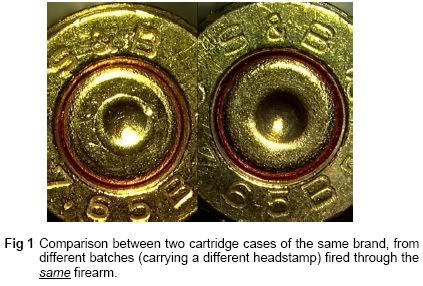
The difference, once again, is that the gun is already in police hands, and that gun provides multiple cases from similar ammunition to that found at the crime scene. With Maryland’s and New York’s IBIS systems, what they’re trying to do is exactly backwards. All the ballistics technician has is one or more crime scene cases, and all he has to compare those cases to is an electronic database of two cases from each new handgun sold. The chance that the crime scene ammunition is of the same manufacture as the baseline is slim, and the same loading? Infinitesimal. For example, in 9mm alone, one of the most “popular” calibers used by criminals, Federal offers eleven different loads. Winchester offers twelve. Remington offers fourteen. Then there’s CCI/Speer, Fiocci, Wolf, Black Hills, and many others, not to mention military surplus, commercial reloads, and even handloads. Even if you have ammunition from the same manufacturer, different loads will leave different marks, as the report noted: The detail left on a cartridge case is also dependent on the cartridge chamber pressure, bullet weight and the hardness of the primer.” Here’s an example of two 7.65 (.32 Auto) Sellier & Bellot cases from the same gun using two different lots of the same load:

S&B only makes one load for the .32 Auto, with a 73 grain full metal jacket projectile. Again, quite a difference, no? Do those look like “identical marks” that are “unique as human fingerprints”? And these two cartridges were fired from the same gun probably on the same day. What happens if there’s two or three years between the sample case and the crime scene case? The gun used in the crime could be new, or it could be twenty years old. The ballistics technician has no way of knowing, because he’s looking for the gun, not trying to tie a specific gun to a crime.

In addition, the cases from the suspect gun are being checked against a relatively small database of known crime scene evidence, not against a vast database of cases from every new handgun sold into circulation:

(S)ome firearms will reproduce (marks) well with sufficient detail, while some firearms will vary in their reproducibility depending on the cartridges used. Firing pins can be relatively smooth and nondescript. In such cases, these smooth firing pin marks can serve primarily as a class characteristic indicator. Even when they have gross features such as in the Bryco, these could be class or sub-class characteristics. An exception is the Glock firearm with its characteristic firing pin drag and aperture marks. This is one of the reasons that cartridge case examinations frequently involve the examination and comparison of other unique marks such as chamber marks, ejection port marks, ejector marks, and rimfire anvil marks. The impressions are not only dependent on the hardness of the primer, but also on how well the primer seats in the local cartridge case. In smaller databases these issues may not be significant, but with a large database using newly manufactured firearms, these differences can prove significant.

(Underlining in the original, other emphasis mine.) I won’t go into the technical specifics of this problem. If you want to know, read the report, Appendix A, but the concept shouldn’t be hard to grasp. Instead of searching for a nail in a haystack, you’re looking for a needle in a hay field. And with a million new handguns entering the market each year, that field just keeps getting bigger and bigger. Not to mention the 60+ million handguns already in circulation that aren’t in the database. Not as simple as the Brady Bunch makes it sound, is it?

But wait! There’s MORE!

The initial feasibility report spawned a later independent study report that expanded on the issues brought up. You see, the BATF was quite hurt by some of the statements made and took exception to the naysayers in California’s Department of Justice, so a follow-on study was done to answer the items the BATF objected to. That report was written by Dr. Jan De Kinder, Ballistics Section Head of the National Institute for Forensic Science, in the Department of Justice for Belgium. (I guess they really wanted an unbiased observer.) Dr. De Kinder was a little less enthusiastic about how “unique” those markings were, as he stated in his introduction:

A ballistic imaging database system is based on the following premise: When a gun is fired, it may leave distinguishing marks on the fired bullet and cartridge case. A searchable database with images of such marks from all guns sold could be a valuable investigative tool. Such a database would permit linking of evidence bullets or cartridge cases back to the gun that fired them. Evidence found at a shooting incident would be scanned and compared to all entries in the database. Ideally, the system would provide investigators with the serial number of the firearm. The serial number can lead the investigators to the registered owner. The database could be called a “ballistic fingerprinting” database. If created, California’s ballistic fingerprinting database would quickly grow to be very large. More than 100,000 fired cartridges from new pistols would be added to it annually.

Not as definitive as the Brady Center at all. Dr. De Kinder also explains how successful the initial tests were:

The AB1717 Evaluation was designed to test the performance of the IBIS™ system for the anticipated large database of new firearms. The experiment used 792 Smith & Wesson model 4006 semi-automatic pistols for this purpose. Each pistol was test fired using at least two cartridges of Federal brand ammunition and other ammunition. One of the test fired Federal cartridge cases for each of the pistols was registered into the database.

The duplicate Federal cartridge cases from fifty of these pistols were selected at random and compared with the database. The system ranks how well each entered mark matches the evidence. The higher the ranking the more similar the stored image is to the evidence’s mark. For the system to be successful, the correct gun should be listed in the top few ranks. The results show that 38 % of the fifty pistols were not listed in the top 15 ranks. The same experiments was repeated with ammunition of a different brands. In this case 62.5 % of the pistols were missed and not listed in the top 15 ranks. These results will be discussed in light of the investment in terms of equipment and personnel needed to set up a ballistic fingerprinting database. In fact, the trends in the obtained results show that the situation worsens as the number of firearms in the database is increased.

The supporters of a BF database insist that the “unique fingerprint” will work to allow an automated system to identify the serial number of a gun used in a crime, but in controlled laboratory experiments it does not. And bear in mind, the ammunition tested was all from the same lot of Federal .40S&W caliber cartridges. The sample database had only 792 firearms all of the same make and model. This is the most ideal condition. Read the entire report if you’re interested. (And if you’ve slogged this far down this dissertation, you must be interested!)

Now, I’ve discussed the problems involved in the BF database concerning only the ammunition used and normal wear, but what about alterations to the firearm, whether intentional or innocent? Dr. De Kinder stated:

Whereas the BATF sees altering a firearm as a non-issue, it is a real problem: Any reduction in the potential of ‘hits’ such as caused by alteration to a firearm is of concern when evaluating the usefulness from a technical point of view of a ‘gun sales database’.

It certainly would be if a BF database were known to be in use. Remember, the marks an automated system compares are the breechface, firing pin, and ejector marks. Does this bring anything to your attention? It should. Those marks are pretty much limited to semi-automatic handguns. Revolvers don’t leave ejector marks. In fact, unless a perp reloads his revolver and drops the empty brass, a revolver doesn’t leave cases at a crime scene at all – but revolvers are included in the database. So if you limit yourself to semi-auto handguns, how hard is it to change those marks?

Not hard at all. Take a Dremel tool and polish the breechface. Install a new firing pin. Grind just a little bit on the ejector with a stone or a file. If you want to get really creative, buy a new slide from Brownell’s or from Numrich. After all, the part of the gun that carries the serial number is the frame. The slide is just another part. But it’s the part that leaves the marks. If you’re a professional criminal, why not? Or just use an older gun that won’t be in the database. There’s millions of them.

And that brings up another question: How old are guns used in crime? The gun confiscation, er, control, um, SAFETY groups seem to imply that guns leave the gun shop and then are immediately used in a crime. Both the Brady Bunch and the CSGV cite the D.C. Sniper case as the ideal in which a BF database could have collared a criminal, leaving aside the facts:

A) The gun used was a rifle and not a handgun. (TWO million new rifles enter circulation annually, as opposed to only ONE million handguns.)

B) The evidence collected at the crime scenes wasn’t cartridge cases but projectiles, and the system doesn’t track projectiles. Muhammed and Malvo did their shooting from inside a vehicle. The cartridge cases went with them when they escaped the crime scene.

C) The condition of the projectiles recovered (mostly jacket fragments and bullet bases) was enough to verify that the same gun was used, and that’s about it. I’m pretty sure they did it more through metallurgical analysis than rifling marks. Certainly not enough of the bullets survived to have positively ID’d a firearm out of a huge database of firearms.

And, finally,

D) The gun was stolen, so even if they could have ID’d the weapon, all it would have told them was what gun shop it came from.

(Not exactly the whiz-bang tool it’s played up to be, is it?)

Dr. De Kinder discussed the firearm age question, known in the business as “time to crime”:

The time to crime (TTC) is an important parameter that can be used to reduce the size of the ballistic fingerprinting database. If this parameter drops down in a relatively short time period, the firearms which were sold long before the average TTC have a negligible chance of being used in crime. In other words, it allows one to minimize the retention time of the data in the ballistic fingerprinting database without losing a substantial amount of its performance.

In the Crime Gun Trace Reports 2000 from the ATF, average TTC are mentioned per age of the offender and type of firearm. The following results are obtained for semiautomatic pistols (4.5 years), revolvers (12.3 years), rifles (7.0 years), shotguns (7.6 years) and other firearms (7.1 years). The nationwide average TTC for all firearms for all ages of offenders is 6.1 years. As this study averages over the whole U.S.A., regional differences can be expected. The study particularly mentions Stockton, CA (9.2 years); San Jose, CA (9.0 years); Anaheim, Long Beach and Santa Ana (8.0 years) and Oakland, CA (8.0 years) as cities where the median time-to-crime is much longer than the overall city average. As all these cities lie within California, one can expect the average TTC for the State of California to be higher than the national value. More detailed data is required to determine correctly the median TTC for pistols in California.

It would appear, then, that guns fresh off the showroom floor don’t end up being used in a crime all that often.

So, let’s review.

I: The system is limited to new handguns.

II: The system is limited to two cartridge cases per handgun.

III: Those cases are fired from the gun when it is brand-new and immaculately clean.

IV: Pretty much only semi-automatic handguns are going to leave cartridge cases at crime scenes, so the inclusion of revolvers seems a moot point.

V: Wear and tear from normal use can affect the markings left on the cartridge case, and such wear may be significant during the “break-in” period.

VI: Very few guns used in crime are anywhere near new.

VII: How dirty the firearm is can also affect the markings left on the case.

VIII: The ammunition used will dramatically affect the markings left on the case.

VIX: The automated system is pretty much limited to comparing the breechface, firing pin, and ejector marks.

IX: These marks can be altered quite simply, by wear and tear, by normal maintenance, by dirt and crud, or with specific intent.

X: As the size of the database goes up, the ability of the automated system to get a “hit” goes down.

XI: The size of the database will grow dramatically each and every year.

XII: In initial testing using a tiny database of identical firearms and ammunition from one lot, the success rate of the automated comparison system was less than 66%. When different ammunition was used, the success rate fell to well below 50%.

If you didn’t know any of this initially, then I can understand why Say Uncle’s commenter wondered why the idea didn’t work. It seems so simple. It’s a fingerprint. It’s “Gun DNA.”

But it’s not. Just like the gun SAFETY groups aren’t what they say either. And here’s the final nail in the coffin, from the last report that inspired all that commentary:

The MD-IBIS Program has collected and imported 43,729 cartridge cases into the system as of 9/7/04. It has incurred 208 criminal investigations leading to six (6) “hits” or matches. It should be reiterated at this point that the IBIS system does not make the match. It provides a means of narrowing the field of search. The examination by a competent Firearms Examiner on a known versus questioned basis provides the actual conclusion of a match. The estimated cumulative cost of the MD-IBIS Program to date is $2,567,633. The cost per “hit” value is $427,939, or approximately $60 per gun sold. None of the “hits” has been used in a criminal trial, and five (5) of the six (6) did not work according to the manner in which the system was designed. It actually functioned in reverse. The gun was already present. Although these hits may be interpreted by some as being in line with the Mission of the DSP, the mission accomplishment and cost effectiveness of the Program has not been demonstrated. The MD-IBIS Program has not lead to the solution or expediency of an investigation that could not have been accomplished by other traditional sources.

(T)o further review and evaluate MD-IBIS, a series of blind proficiency tests were given. The tests were designed to test the ultimate purpose of the Program. The double-blind tests (unknown to examiners and supervisors) began in July 2003. The basic design of the tests were to emulate actual situations involving the finding of spent cartridge cases and submit them to the Forensic Sciences Division/Firearms Toolmarks Unit for examination. Guns known to be included in the MD-IBIS Database were test fired and the cartridge cases collected. These cartridge cases were submitted as evidence in bogus criminal cases. There have been four blind proficiency tests submitted to date. There were no “hits” associated with any of the submitted proficiency tests.

The bottom line of this report is that the MD-IBIS System has failed to demonstrate the bottom line of the 1st report. The MD-IBIS Program, for all its good intentions, has not proven to be a time-saving tool for the Firearms Examiner or an investigative enhancement to the criminal investigator. It has simply failed in the Mission and Vision concepts originally established for the Program. Fiscal resources for the MD-IBIS program would be well spent in other Forensic Sciences Division programs…

“It has simply failed in the Mission and Vision concepts originally established for the Program.”

So in addition to being useless, it has the extra added bonus of being expensive. The MD-IBIS report also notes that New York’s system has been equally successful (i.e., a complete failure) but it’s cost New York taxpayers over eight million dollars so far. According to this link, the price is nearly $16 million. It would appear that throwing more money at the problem doesn’t help.

So the reaction I expect? The philosophy cannot be wrong. Try it again, ONLY HARDER!!All four ballistic database reports are available here:

Feasibility of a California Ballistics Identification System

AB1717 report – Technical Evaluation: Feasibility of a Ballistics Imaging Database for All New Handgun Sales

Maryland State Police Forensics Division IBIS report

MD-IBIS Progress Report #2

The OC Shooter’s Page on Ballistic Fingerprinting – very comprehensive.

See also my earlier piece, Spin, Spin, Spin.

(Like this wasn’t long enough already…)

UPDATE, 1/19: This is probably the most linked and most viewed piece I’ve written to date. Thanks to everyone who has commented and pointed readers this way (though I’m surprised I haven’t seen a single hate-bomb out of the two thousand or so who’ve read this.) One commenter over at Chicago Boyz made an observation that I would have included in the body of this piece if it weren’t already so long:

I’ve long since concluded that the gun controlers don’t really expect measures like these to “work”, in the sense of lowering crime, or aiding the police. The inconvenience and cost to gun owners is what they’re aiming for. In the long run, if they can make gun ownership enough of a hassle, the number of gun owners in the next generation will decline, and perhaps we’ll lose enough political clout that they can get the outright ban they really want.

But that’s not a motive they can openly admit, and still hope to get the programs enacted.

To which I replied:

Brett Bellmore hit the nail on the head – the purpose is not to build a useful tool for crimefighting, the purpose is to make it more difficult for individuals to aquire and keep firearms. The effort is, and the gun control groups state this implicitly, to reduce the number of guns, because they ALL blame “the number of guns” in circulation for the level of gun violence we have here.

The British did a yeoman’s job of making gun ownership an onerous privilege to exercise, then used the rules under which that privilege is exercised to remove whole classes of firearms…

From the law-abiding subjects. The criminals, however, still have access to pretty much anything they want.

Note this passage from the second Maryland report:

The Vision of the MD-IBIS Program was to have it fully performing in three to five years. This was to include the amassing of some 30,000 database images per year. This projection fell and was embarrassingly overstating. The actual acquisition of cartridge case numbers was about 36% of the estimation. The main reason for this drop-off appears to be from the reduction of handgun sales in Maryland after the passage of the law.

Now, did those sales actually disappear, or did they go black-market? Did this law really reduce the influx of handguns into Maryland by nearly two-thirds, or did it make a whole bunch of Marylanders (choose to become) instant criminals?

UPDATE: As of 2015 Maryland scrapped their IBIS system.
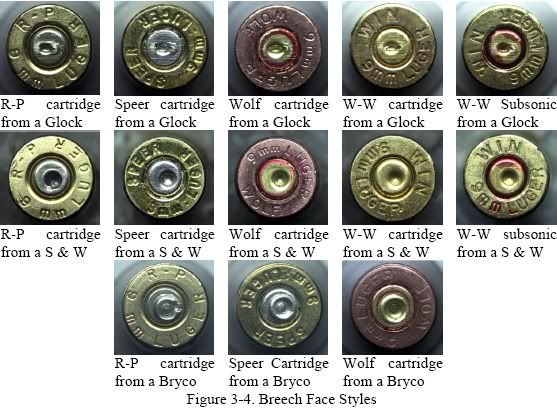
I Will Not Register. Ever.

South Africa has apparently chosen to create a huge new population of criminals by revising their licensing and registration laws, reports the Cape Times earlier this month.

Gun licence chaos looms, say owners

Fatima Schroeder
January 06 2005 at 06:48AM

Firearms dealers say that there is no way the government can hope to re-register the millions of legal guns in the country in the four years from January 1 that it has given itself.

Adding to the load will be the thousands of new gun licence applications that will be made to the Central Firearms Registry this year.

Well, apparently not, as it appears that the overwhelming majority of new license applications are being denied.

Since Monday, the 2.8-million firearm owners across the country could apply to renew licences for their 4.5-million firearms.

The Firearms Control Act, implemented in July, makes it compulsory for applicants to have a training test to gain a proficiency certificate before applying for a competency certificate. People must have a competency certificate before they may apply for a licence.

More of those “common-sense” rules, right?

According to gun dealers, only one firearm licence has been issued in the past six months.

So much for the “thousands of new licenses.”

Of concern is that gun owners who do not have their licences renewed would be in possession of illegal firearms – a criminal offence.

Otherwise known as a “GOTCHA!” Disarm yourself or be a felon. No need for a door-to-door search. You know who was licensed, if they haven’t turned in their registered firearms, go lock ’em up!

Andrew Soutar, chairman of the South African Firearm Dealers Association, said that many gun dealers had gone into liquidation.

The Central Firearms Registry had processed 69,000 licence applications a year until March last year under the old laws, which entailed less complicated procedures, he said.

At this rate, he calculated that it would take about 65 years to renew licences.

A law that’s impossible to implement? That’s no reason not to do it! While you’re at it, let’s repeal gravity!

Responding to a request by the Cape Times, Pretoria police communications official Mohlabi Tlomatsana released figures that showed more than 10,000 licences had been issued between July and November last year.

Tlomatsana acknowledged that the figure included applications made before the new law came into force.

Asked how many of those licences had been approved under the new act, he responded five hours later, saying that processing the request was “time-consuming”.

Asked how many competency certificates had been issued in the last six months of last year, Tlomatsana said the question was “academic”.

Gun dealers claim the police are reluctant to give the figures sought by the Cape Times as only one licence has been issued under the new act.

Can’t imagine why they’d be closed-mouthed about it, then. Can you?

The South African Firearm Dealers Association completed a countrywide survey shortly before Christmas and 80 dealers responded saying they had not been informed of any licence approvals or issuing of competency certificates since the new law had been implemented.

The owner of Cavendish Guns, Dusty Millar, said applicants had battled to get firearm licences because the government had not put proper systems in place before implementing the law.

He said that because of the dearth of ranges and accredited trainers, applicants had struggled to obtain competency certificates in the six months after the law came into effect.

Millar said this was harming the firearm industry and six dealers in Cape Town had closed down since July 1.

“People are getting illegal firearms because it is more difficult to get a licence.”

Fr. Guido Sarducci’s Five Minute University course in Economics: “Supply and-a Demand. That’s it.” Supply always meets demand.

Osman Shaboodien, an instructor at Buccaneer Guns, shared Millar’s sentiments.

“I don’t think there’s one dealer who hasn’t suffered because of the new act. But it’s not all doom and gloom. It’s starting to look better purely because the training procedures are coming through.”

Right. AFTER a large number of dealers have been put out of business, and the law guarantees that thousands of people currently licensed will be unable to renew.

But “it’s starting to look better.” For a government that wants to disarm its citizens.

If, however, the handling of applications for new licences did not improve, many firearm dealers would have to close down, Shaboodien said.

In a letter to the Cape Times, the Democratic Alliance’s spokesperson on safety and security, Roy Jankielsohn, said the act could hit firearm owners and dealers as well as the tourism, film and private security industries.

Tlomatsana denied that only one approval had been issued under the new act, and said the procedures had been put in place.

The renewal deadlines are:

Those born between January1 and March 31 can apply during 2005;

Those born between April 1 and June 30 can apply during 2006;

Those born between July 1 and September 30 can apply during 2007; and

Those born between October 1 and December 31 can apply during 2008.

Meanwhile gun owners were responding positively to the 90-day firearms amnesty and had been handing guns in at police stations around the country, officials said.

While the police are not yet able to say what types of illegally held guns were being surrendered, they said people were taking advantage of the amnesty.

People with unlicensed firearms or ammunition can hand them in at any police station without fear of prosecution.

I’d LOVE to see a list of what gets turned in. The last time England tried it they got an anti-aircraft machinegun and some hand grenades.

Safety and Security Minister Charles Nqakula said the amnesty would run from January 1 to March 31, during which time the police would accept items brought in by people who no longer wished to be illegally in possession of them.

This particularly relates to people who have inherited or have been given firearms for which they do not have licences, people who may have kept ammunition after getting rid of a gun, or even security companies or other businesses that may have outdated equipment in their possession.

I will not license. I will not register. Period.

Birchwood, Wisconsin is Not Hungerford, England

By now certainly everyone has heard of the shooting of eight people in Wisconsin by a hunter armed with an SKS rifle. Six of the victims are now dead, two are in critical condition.

It took the Violence Policy Center about one day to start dancing in the blood of the slain so that they could rev-up their campaign to renew and strengthen an “Assault Weapon Ban.” Remember what the VPC had to say during the original fight to get a ban enacted:

Although handguns claim more than 20,000 lives a year, the issue of handgun restriction consistently remains a non-issue with the vast majority of legislators, the press, and public. The reasons for this vary: the power of the gun lobby; the tendency of both sides of the issue to resort to sloganeering and pre-packaged arguments when discussing the issue; the fact that until an individual is affected by handgun violence he or she is unlikely to work for handgun restrictions; the view that handgun violence is an “unsolvable” problem; the inability of the handgun restriction movement to organize itself into an effective electoral threat; and the fact that until someone famous is shot, or something truly horrible happens, handgun restriction is simply not viewed as a priority. Assault weapons – just like armor-piercing bullets, machine guns, and plastic firearms – are a new topic. The weapons’ menacing looks, coupled with the public’s confusion over fully automatic machine guns versus semi-automatic assault weapons – anything that looks like a machine gun is assumed to be a machine gun – can only increase the chance of public support for restrictions on these weapons.

Yes, the VPC is truly interested in protecting the police and public. By disarming the public. The law-abiding part, anyway. “Assault weapons” first, “sniper rifles” later, handguns after that, and other weapons when they’ve accomplished those goals.

The new VPC piece linked above states:

So far in 2004, at least six law enforcement officers have been slain by SKSs.

Obviously this trend is horrible! So they want further SKS importations stopped and they want SKS rifles – and anything else they consider to be an “assault weapon” – banned.

Well, I’m sorry for the officers, their families and loved ones, but how about a little perspective? According to the Bureau of Justice Statistics the number of officers slain in the line of duty – just like general violent crime figures – has been declining for the last decade. See these graphs:

The total number of deaths has been in continuous if not steady decline (not including the 72 officers killed in the World Trade Center attack, September 11, 2001). The supposed scourge of “assault weapons” hasn’t caused a sudden upswing in the statistics, either, as the VPC inadvertently illustrated in their paper “Officer Down.” This chart shows the number of officers slain with what the VPC labels “assault weapons” – including the SKS, M1 Carbine, and Mini-14 rifles which were excluded from the 1994 AWB – over the period of 1998 through 2001. Compare that to the FBI graphs.

The implication the VPC wants to make is that if those weapons had not been available, those officers would not have died.

But do you really believe that?

Had Chai Soua Vang been armed with a lever-action Marlin chambered for the .44 Magnum cartridge, would he have been any less lethal?

The VPC wants to use this crime to do what the British did in 1988 after a licensed gun owner by the name of Michael Ryan used a legally possessed semi-auto AK-47, an M1 Carbine, and a Beretta 9mm handgun to kill 17 people and wound an additional 15 in Hungerford, Berkshire, England before taking his own life. Parliament, with the outcry of the British public lubricating the wheels of legislation, shoved through the 1988 Firearms (Amendment) Act that banned all semi-automatic centerfire rifles and most semi-auto shotguns. Banned as in “turn them all in.”

Bear in mind, however, this followed literally decades of ever-increasingly restrictive laws and regulations on firearm possession. Licensing and registration were already facts of life. “Proof of need” was a prerequisite for acquiring a firearm. Letters of reference and membership in a shooting club, too. According to this site:

For a number of years prior to the Hungerford massacre many police chiefs had pursued a policy of reducing the numbers of certificates to the absolute minimum. The policy was often overt, the Police Review of October 1982 published an article which described this policy:

There is an easily identifiable police attitude towards the possession of guns by members of the public. Every possible difficulty should be put in their way. No documentation can be too rigid, no security requirement too arbitrary, which prevents guns coming into the hands of criminals.

In short, after England had enacted pretty much every law the Brady Center claims is “commonsense,” Michael Ryan still killed 17 people and wounded 15 more. So they banned “assault weapons.” And every legally owned, legally registered one was turned in.

In 1996 in Dunblane, Scotland, Thomas Hamilton took five legally owned, properly registered handguns to a school and killed 16 children and their teacher, wounding eleven more. So England banned handguns, and every legally owned, legally registered one was turned in.

These “commonsense” laws did have another effect. At the time of the Hungerford massacre there were only 160,000 people in England licensed to own rifles and handguns, and 840,000 licensed to own shotguns (and there must have been significant overlap in the two populations.) This is out of a population of perhaps 45 million, or, at best, an ownership rate of less than 2.5% of the population. The latest statistics show that there are now 118,612 firearm certificates and 561,762 shotgun certificates on issue in England and Wales. That’s nearly a one-third reduction in people legally licensed to possess firearms since 1988. Legal ownership has fallen to less than 1.4% of the population. Yet the rate of firearm involved crime there continues to climb.

There haven’t been any more mass-murders by firearm, but that’s of little comfort to the families of Charlene Ellis, 18, and Latisha Shakespeare, 17 who were gunned down by someone with a submachinegun in Birmingham in January of last year. Two other young women were wounded in that attack.

Fully automatic weapons were banned in England in 1937.

Such public enthusiasm for banning guns does not exist here. At best guess, one quarter of our population owns a firearm. It’s a guess because the overwhelming majority of us do not have to register our firearms. The VPC constantly touts that the majority of Americans support an “assault weapons ban,” but that the eeeevil NRA has a stranglehold on the Congress. Both are possibly true, but it’s also certain that the majority of the public – even the gun-owning public – does not understand the implications of a ban, while the NRA certainly does.

For example, from today’s New York Times:

“This is not a gun you go deer hunting with,” said Lawrence Keane, senior vice president and general counsel of the National Shooting Sports Foundation, the gun industry trade association.
The reason the SKS is not used by hunters, Mr. Keane said, is that it is designed for combat soldiers and is therefore underpowered for killing an animal like a deer with a single shot, the goal of good hunters.
“The ethics of hunting are you don’t want the animal to suffer needlessly,” Mr. Keane said. Mr. Keane said he suspected that the man accused of the Wisconsin killings was not a trained hunter, since with the SKS he was carrying, he would have had to shoot a deer several times to kill it.

Surely Mr. Keane should know that the 7.62×39 Russian cartridge the SKS fires is approximately equal in power to the venerable .30-30 Winchester – a cartridge possibly responsible for the harvesting of more deer in the United States than any other? Surely Mr. Keane should know that the pointed bullet profile of the 7.62×39 round yeilds better downrange ballistics than the flat-pointed bullets used in the .30-30? Surely Mr. Keane should know that the average SKS rifle is more than capable of holding “minute of deer” accuracy out to 100 yards or more? And surely Mr. Keane should know that the SKS rifle is inexpensive and highly reliable – both of significant interest to new hunters?

The SKS is a perfectly adequate (and popular) deer rifle, yet a member of a group that supposedly supports gun rights plays directly into the hands of those interested in banning firearms.

We are often our own worst enemy.

But Birchwood is not Hungerford, and the U.S. is not England.

And we will not blame the gun for the action of the shooter, no matter how much the VPC et al. would like to stampede us into doing that.

UPDATE, 11/24: As I predicted, the Brady Center ran with Lawrence Keane’s quote from the New York Times in a press release yesterday:

The SKS rifle apparently used by the hunter to kill six other hunters in Wisconsin Sunday wasn’t banned under the Federal assault weapons ban that expired September 13, but it should be banned for civilian use. Designed for use in war, even the gun industry admitted yesterday that it’s not intended for hunting.

It may, in fact, be the first time the official spokesman for the National Shooting Sports Foundation has admitted that any military-style semiautomatic assault rifle is inappropriate for hunting. Lawrence Keane, senior vice president of the group, went further, and even told the New York Times that the SKS isn’t a humane weapon for hunting deer. “The reason the SKS is not used by hunters, Mr. Keane said, is that it is designed for combat soldiers and is therefore underpowered for killing an animal like a deer with a single shot, the goal of good hunters,” The Times wrote. “‘The ethics of hunting are you don’t want the animal to suffer needlessly,’ Mr. Keane said.

“Prior to the expiration of the assault weapons ban, the industry’s spokespersons were unified in describing these types of weapons as perfectly normal for use by hunters. It was one of the industry’s main arguments for letting the ban expire.

Since the ban’s expiration, high-profile crimes involving assault weapons have already become more commonplace. Plano, Texas police are searching for members of a bank robbery gang that have opened fire on police with AK-47s, and that same weapon is believed to be the weapon of choice of a killer or killers who have shot eight people in West Palm Beach, Florida.

Thank you so much, Mr. Keane for being an ignorant idiot.

FURTHER UPDATE: The Wisconsin State Journal, in an unsigned editorial (natch) regurgitates the Brady/VPC talking points in a call to (natch) renew the AWB and make it stricter. Now there’s a shocker. But get this error:

Americans already own an estimated 100 million guns of all types.

Err, no. About 260 million of all types. About 100 million handguns. Sheesh. I thought newspapers had editors?