Saul Cornell has a Protégé?

The wonders of academia.

Dave Kopel reports at The Volokh Conspiracy on more revisionist history requiring deliberate omission and erroneous interpretation of written documentation.

Shades of Michale Bellesiles – only this is done in an amici brief to the Supreme Court. Bellesiles is actually cited, as though Arming America had never been disproven, and Bellesiles disgraced for his academic malpractice.

Once again, Clayton Cramer has done the heavy lifting on the history.

These people have absolutely no shame.

Another Debate Invitation Refused

I swear, you’d think I intimidate them or something. Reader Bob gave me a link to a web page that asked the question What Ever Happened to Gun Control? Like its disappearance as a political topic was a bad thing.

I questioned the author, an economist who writes on heath-care topics, on some of her “statistics,” and I invited her not once, not twice, but three times to discuss the topic of gun control either publicly or privately.

She declined. Oh well.

But the subject of this post comes from another comment posted at that site. One “robertdfeineman” wrote:

A couple of years ago I posted a diary about gun control where I suggested treating it as a public health issue. As I recall I defined several classes of gun control issues:

1. Accidental injury
1a. by children
1b. by adults
2. Injury in the course of a crime
3. Injury in the course of a domestic disturbance
4. Injury caused by a mentally unbalanced individual
5. Suicide

I asked those who opposed gun control to select any category of their choosing and suggest what steps should be taken to lessen the rate of injury.

As you have discovered vitriol was quickly forthcoming, however useful suggestions – none.

Even the example of Canada isn’t able to bring any sanity to the discussion. Canada has a fairly high level of gun ownership (mostly sports and hunting), but has a much lower level of misuse. There seems to be no discussion of why this is so.

Without getting too deep into the American psyche there just seems to be a vocal core of gun supporters who are motivated by something deeper than rational arguments. As with most such inexplicable attitudes it is likely that it has its basis in a deep seated fear, of what isn’t clear.

As simple observation will show other advanced countries, that don’t permit the same freedom of gun ownership and use, are not overrun by people in black helicopters, nor by crazed gangs or druggies, nor by criminals threatening home and family. Whence the insecurity?

Given that the US is in a fortress mentality mode (personal Hummers, gated communities, domestic surveillance, etc.) expecting rationality about guns seems unlikely for the immediate future.

Coming from a guy who apparently believes that the world is suffering from overpopulation and resource shortages (I guess he’s never heard of Paul Erlich and The Population Bomb), he seems to believe that capitalism is outmoded and needs to be replaced by a “steady-state” economy (AKA “zero-sum” – the model every socialist system has based its economic system on).

Quelle suprise.

But I thought I’d take a shot at providing some useful suggestions without vitriol.

Here we go:

1. Accidental injury
1a. by children
1b. by adults

The answer to this is obvious, ongoing, and highly successful.

Education, education, education.

And it’s obviously been working for quite some time, too. Accidental death and injury by firearm in this country is at an all-time low, and has been declining ever since we started collecting statistics. This despite the fact that 3-4 million new firearms are added to the total in private hands in this country each and every year. It doesn’t require new (and dubious) safety features on guns, it doesn’t require free trigger locks to be given away by government agencies, it simply requires education – and the firearms industry and the NRA are doing apparently a damned good job.

Which is more than can be said for the Brady Campaign or the Violence Policy Center.

Doubt me? Do you doubt the Centers for Disease Control?

Total accidental gunshot deaths by year:

1981 – 1,871 (Crude rate, 0.82/100,000)
1982 – 1,756
1983 – 1,695
1984 – 1,668
1985 – 1,649

1990 – 1,416
1991 – 1,441
1992 – 1,409
1993 – 1,521
1994 – 1,356
1995 – 1,225

2000 – 776
2001 – 802
2002 – 762
2003 – 730
2004 – 649
2005 – 789 (Crude rate 0.27/100,000)

The actual incidence of death by accidental gunshot wound has dropped 58%. The rate has dropped by 67% (the overall population has gone up over the same period.)

Over the period between 1981 and 2005 (25 years) the number of firearms in the U.S. has increased by approximately 100,000,000. Yes, that’s right, one hundred million, of which about 40 million were handguns. Over that same period the number of states with “shall-issue” concealed-carry laws has increased from eight (8) to 35 (now 37). The number of “no issue” states has declined from 15 to two.

I don’t know about you, but I call that “improvement.”

Topic: 2. Injury in the course of a crime

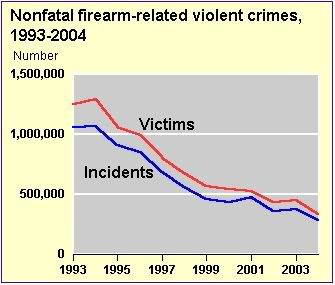
Well, for one thing, since 1990 the number of deaths and injuries from criminal assault have been declining rapidly to levels not seen since the 1960s. Homicide, highly variable over the nation’s history, has dropped dramatically, according to this Bureau of Justice Statistics chart:

Non-fatal attacks are down significantly, too:

What caused this? Well it wasn’t “gun control” by any indication. The only “gun control” law passed during this period was the 1994 “Assault Weapon Ban” (that wasn’t), but in 2005 even the New York Times admitted:

Gun crime has plummeted since the early 1990’s. But a study for the National Institute of Justice said that it could not “clearly credit the ban with any of the nation’s recent drop in gun violence.”

Research for the study in several cities did show a significant decline in the criminal use of assault weapons during the ban. According to the study, however, that decline was offset by the “steady or rising use” of other guns equipped with high-capacity magazines – ammunition-feeding devices that hold more than 10 rounds.

So, should one conclude from this that “high-capacity magazines” lead to a decrease in overall violent crime?

The first thing that leads to a decrease in injury in the course of crime is to reduce crime. How? Well, it would appear that a good economy helps. Of course, incarcerating more than 1% of the population might be contributing factor, too. I’ll leave that up to you to decide whether that’s a good thing or not. But how about defense with a firearm of your own?

Only about 29% of criminal assaults involve a perpetrator with a firearm, and even if they are so armed, defending yourself with your own firearm has proven to be the most likely way to escape without injury. That is, if you believe Gary Kleck’s analysis of Bureau of Justice Statistics National Crime Victimization survey data. Kleck’s study indicates that defending yourself with a firearm reduces your chances of injury below any other method, including not resisting at all.

Topic 3. Injury in the course of a domestic disturbance

That’s a tough one. Congress passed a law that is supposed to disarm anyone who has received so much as a ticket for misdemeanor domestic violence. Of course, like the Brady background check, the law has been equally effective at actually disarming dangerous people – that is “not at all.” Generally, in this situation on party or the other may get a restraining order, but these have proven to be nothing more than tissue paper. Reciprocal restraining orders only guarantee that the one who is willing to kill is ensured of a defenseless victim, and then a knife will do as well as a gun. Here I’m going to have to admit defeat, and state plainly that I see no way to legally, constitutionally, affect this problem.

Strike one!

Topic 4. Injury caused by a mentally unbalanced individual

Again, a law has been passed that supposedly disarms people who have been adjudged mentally imbalanced or a danger to themselves or others. Again, as the Virginia Tech massacre proved, the effectiveness of this law is less than stellar. Too, there is the doctor-patient relationship which is supposed to be legally sacrosanct, the fear being, of course, that if doctors can be compelled to report about their patients to the legal authorities, some (perhaps many) would refuse to seek help at all.

Personally, I’m convinced that the recent (last decade or two) upswing in rampage killing / suicides is due to the use of anti-depressants that have a bad effect on a tiny percentage of the people who use them. That percentage is so small as to be statistical noise, but it has resulted in the deaths of a significant number of people. What to do about it? I don’t know. It’s a Catch-22 situation, and again, the best I can hope for is that someone law-abiding and armed can end any such situation before the perpetrator decides he’s finished.

Topic 5. Suicide.

I have already considered this one in great detail. Basically, my conclusion is that while Americans do use firearms in large proportion to commit suicide, firearms are not the cause of their decision to end their own lives. America is on the low end of the scale for nations with relatively high GNPs, ranking below Norway, Germany, Sweden, Japan, Switzerland, France, Austria, Denmark and Finland for suicide rates. The leading method of suicide varies with each nation, but it appears that if you really want to kill yourself (as opposed to a “cry for help”) you find a way. This is especially true among young people, as evidenced by Australia’s youth suicide problem. For no apparent reason, in Australia the leading method of suicide of young men changed from firearms to asphyxiation by hanging. There were no gun laws passed during the period during which this occurred to account for the shift.

A study of the Brady 3-day waiting period found that it reduced the number of suicides by firearm among people 55 and older, but that it didn’t affect any overall suicide rate. In other words, people that might have used a firearm found another, equally effective method.

My conclusion here is that the appearance of firearms being a cause of suicide is an illusion. If all firearms disappeared tomorrow, the rate of suicide would be essentially unchanged.

So in answer to your questions:

1: We’ve tremendously reduced accidental death and injury through education, even with a massive increase in the number of firearms in curculation. Perhaps if we want to affect this particular problem even more, we should be teaching firearm safety education in schools alongside sex education.

2: We’ve greatly reduced death and injury due to criminal acts over the recent decade, without any notably effective new firearms legislation. The “Assault Weapons Ban” didn’t seem to have any effect, and the worst thing you can say about the massive increase the number of states that have passed “shall-issue” concealed carry laws is that those laws might not have been responsible for any of the reduction in crime.

3: Injury in domestic disturbances has also decreased, but nowhere near as much as with other types of violent crime, and here I admit defeat. In a nation founded on the concept of individual sovereignty and individual rights, I really don’t see where we can affect this particular problem except by allowing the threatened parties to be armed in their own defense, and the law just isn’t written that way.

4: Mentally unbalanced people deciding to commit suicide and taking strangers, coworkers, or loved ones along with them present the same problem. The only thing I can think of here is for those coworkers or loved ones to pay attention to the situation and try to get obviously disturbed people into mental health care. Unfortunately, given the same rights as everyone else, this does not seem to be effective.

5: The suicide problem appears to be one of false perception. Yes, a lot of Americans who choose to end their own lives choose to do it by means of a firearm, but that doesn’t mean that they wouldn’t find another way if access to a firearm was denied to them. If “gun access” caused suicide, America’s suicide rate would far exceed any other nation in the world.

But perhaps instead of considering the beam in America’s eye, our neighbors to the North should consider the one in their own. Even our Roger Ebert has recognized that, while Canadians don’t murder each other as often as Americans do, their violent crime rate far exceeds our own.

Maybe Canada needs more guns.

UPDATE: See More “Reasoned Discourse”

Nate Sends an Open Letter to College Students.

And it’s a good one. Quote of the Day:

So, how can you, the college student, as an individual and as a group, change the circumstances of the violence you face on campus and in a bigger sense, citizens face everyday in their daily lives whether it be at the shopping mall or at lunch at Wendy’s? You can accept that your protection is your responsibility and then you can choose to be prepared to face potential violence and prepared to stop the violence when it presents itself.

I’ve been saying that for quite some time.

Go read the whole thing.

Want to Spend Some Quality Time?.

Matt Carmel of Constitution Arms emailed me this morning. He has compiled all of the Heller amici briefs into a single searchable database, available as a zipped download at www.constitutionarms.com/heller/heller.zip. If you have the latest version of Adobe Acrobat Reader (available here) you can search all of the briefs for any word or phrase. There’s also an excel spreadsheet that I can’t open because I don’t have Excel loaded on my home computer, but the Adobe documents are great in and of themselves. He reports that it took him about 80 hours to build the documents, and I believe him!

If you’re interested in this case, this is a very useful tool.

Human Reconstruction, the Healing of Souls, and the Remaking of Society

From Hugh Hewitt’s seventy minute interview with Jonah Goldberg discussing his new book Liberal Fascism: the Secret History of the American Left from Mussolini to the Politics of Meaning:

Hugh Hewitt: Jonah, at the risk of doing something that will have program directors across the United States screaming at me, I want to talk about Rousseau. This may in fact be the first time…

Jonah Goldberg: (laughing)

HH: …ever on talk radio that Rousseau has been brought up. But I don’t know how you get to fascism unless you cover Rousseau to the French Revolution, and then on to the branches in Europe and America. And basically, it’s Rousseau’s radicalism which unleashed the whirlwind on the West.

JG: Right, I mean, and there are two ways to talk about this. There’s the intellectual history, which I think is what you’re getting at, where basically it goes French Revolution… the French Revolution, I argue, is the first fascist revolution. It merges nationalism with populism. It tries to replace God with the state. You have these intellectual revolutionaries who use terror and violence to remake society and start over at year zero. They create a secular religion out of politics, where they change the traditional Christian holidays to state holidays. And all of this gets replayed in Nazi Germany, and fascist Italy, and in the Soviet Union. But I think there’s an important point to be made, which is that this, it’s not necessarily that the fascists of Nazi Germany were inspired by Rousseau, it’s that the same thing was happening again, that they were following the same sort of Rousseauian path. And Rousseau, as a philosopher, he basically gives word to a desire that beats in every human heart, to create a tribe out of society, to create, to impose this notion of the general will, where anybody who deviates from what the collective thinks he should do is a heretic or a traitor, to sanctify politics. And that’s what inspired the French revolutionaries. That’s what they took from Rousseau. And in many ways, that’s what people like Mussolini and Hitler took from the French Revolution, is this same sort of burning desire to create a religion of the state. And we see the same thing that happened in the French Revolution replay itself in Germany, and to a lesser extent, replay itself in fascist Italy.

HH: And you know, it’s the same temptation over and over again, and it’s one abroad in the land right now, which is why I want to pause on this, which is Rousseau believed that man was good, you know, that the state came along, or that society came along and screwed things up, but that actually, that men were innately good. And that’s simply not a conservative view, Jonah Goldberg. It’s anti-conservative. It’s also anti-theology in most senses.

JG: Right. I mean, I think the fundamental difference, the difference that defines the difference between American, Anglo-American conservatives and European welfare states, leftists or liberals, is Locke versus Rousseau. Every philosophical argument boils down to John Locke versus Jacques Rousseau.

HH: Yup.

JG: Rousseau says the government is there, that our rights come from the government, that (they) come from the collective. Locke says our rights come from God, and that we only create a government to protect our interests. The Rousseauian says you can make a religion out of society and politics, and the Lockean says no, religion is a separate sphere from politics. And that is the defining distinction between the two, and I think that distinction also runs through the human heart, that we all have a Rousseauian temptation in us. And it’s the job of conservatives to remind people that the Lockean in us needs to win.

I emphasized those bits because I believe they are at the heart of the difference between the Left and the Right in this country and the world. Hugh Hewitt is accurate in his assessment that Rousseau believed that man was inherently good, and that society – more accurately “civilization” – was at fault for the corruption of Man’s nature. You see it most explicitly in the mythos of primitive tribal cultures being “at one with nature” (as opposed to modern civilizations “rape” of it,) and so on. It is the belief that if Man was just restored to his inherent goodness, we would all live in a fair and free society where each would give according to his abilities and would receive in accordance to his needs.

But as Tony Woodlief once put it (I paraphrase), anyone who espouses a belief in the inherent Goodness of Man has never stood between a toddler and the last cookie.

Jonah mentions that Hillary Rodham in her commencement address at Wellesly in 1969 said this:

What does it mean to hear that 13.3% of the people in this country are below the poverty line? That’s a percentage. We’re not interested in social reconstruction; it’s human reconstruction.

She didn’t want to fix society, she wanted to fix humanity. Michele Obama tells us:

We have lost the understanding that in a democracy, we have a mutual obligation to one another, that we cannot measure our greatness in this society by the strongest and richest of us, but we have to measure out greatness by the least of these, that we have to compromise and sacrifice for one another in order to get things done. That is why I’m here, because Barack Obama is the only person in this race who understands that, that before we can work on the problems, we have to fix our souls. Our souls are broken in this nation.

Yes, you see, society has altered us from our inherent goodness, and if we could just…

If we can’t see ourselves in one another, we will never make those sacrifices. So I am here right now, because I am married to the only person in this race who has a chance of healing this nation.

I guess “fixing our souls” is a form of “human reconstruction.” Michele Obama believes that her husband has that power, the ability to “heal the nation” by “fixing our souls” and returning us to our inherent goodness. She continues:

We say we’re ready for change, but see, change is hard. Change will always be hard. And it doesn’t happen from the top down. We do not get universal health care, we don’t get better schools because somebody else is in the White House. We get change because folks from the grass roots up decide they are sick and tired of other people telling them how their lives will be, when they decide to roll up their sleeves and work. And Barack Obama will require you to work. He is going to demand that you shed your cynicism, that you put down your division, that you come out of your isolation, that you move out of your comfort zones, that you push yourselves to be better, and that you engage. Barack will never allow you to go back to your lives as usual, uninvolved, uninformed.

What hubris.

But it is Rousseauian. As Donald Sensing put it, both parties now lurching Leftward

have a foundational philosophy that is the same:

America is a problem to be fixed, and Americans are a people to be managed.

Slightly altering that sentiment, Americans are a problem to be fixed, and America is a society to be managed.

Neither side has chosen a Lockean candidate for the office of President. John McCain has stated that he believes that rights are essentially creations of government. On the question of free speech, he said on Don Imus’s radio program:

I would rather have a clean government than one where quote First Amendment rights are being respected, that has become corrupt. If I had my choice, I’d rather have the clean government.

“Quote ‘First Amendment rights.'” He says this as a Senator who must swear this oath upon assuming office:

I do solemnly swear (or affirm) that I will support and defend the Constitution of the United States against all enemies, foreign and domestic; that I will bear true faith and allegiance to the same; that I take this obligation freely, without any mental reservation or purpose of evasion; and that I will well and faithfully discharge the duties of the office on which I am about to enter: So help me God.

But the First Amendment apparently doesn’t count – which makes one wonder which other parts of the Constitution he’s willing to put “scare quotes” around.

Still, McCain doesn’t seem interested in fixing humanity, just legislating for our better behavior. It is Hillary and Obama that worry me the most, as they are uncomfortably close to the levers of power, and their philosophical counterparts may hold sway in both houses of Congress after the next election.

Donald Sensing continued in his piece:

A friend of mine emigrated here from Romania after Ceaucescu’s regime fell. He told me the other day that Americans are over-regulated. Think about that; a man coming from a communist country believes that Americans are over-regulated. It chills.

A long time ago Steven Den Beste observed in an essay, “The job of bureaucrats is to regulate, and left to themselves, they will regulate everything they can.” Celebrated author Robert Heinlein wrote, “In any advanced society, ‘civil servant’ is a euphemism for ‘civil master.’” Both quotes are not exact, but they’re pretty close. And they’re both exactly right. Big government is itself apolitical. It cares not whose party is in power. It simply continues to grow. Its nourishment is that the people’s money. Its excrement is more and more regulations and laws. Like the Terminator, “that’s what it does, that’s all it does.”

I do not believe Bush’s domestic policies are in the best interests of our long-term freedom. I do not think that Bush’s domestic legacy will, in the long run, be good for the country.

Hence I cannot urge anyone to vote for Bush in 2004.

Which is not to say that I endorse any of the Democrats running for president; they are more strident big-government activists than Bush, and won’t protect us from terrorism to boot. So I feel caught between the devil and the deep blue sea.

I predict that the Bush administration will be seen by freedom-wishing Americans a generation or two hence as the hinge on the cell door locking up our freedom. When my children are my age, they will not be free in any recognizably traditional American meaning of the word. I’d tell them to emigrate, but there’s nowhere left to go. I am left with nauseating near-conviction that I am a member of the last generation in the history of the world that is minimally truly free.

As Tam put it yesterday, things have gotten worse:

If you’ll excuse the geeky metaphor, we’ve come to the Kobayashi Maru election scenario.

The founding philosophical document of this nation, the Declaration of Independence, is absolutely Lockean. The founding legal document of this nation is Locke’s philosophy made law.

And now we’ve abandoned Locke for either Rousseau or… I don’t know what, but it isn’t Locke. Jonah Goldberg concluded on the Locke/Rousseau topic:

(I)t is a natural human desire to want to recreate that sort of religious, spiritual tribal feeling. And we constantly are looking for it in our politics. The problem is it’s fool’s gold. You can never get it. And so we constantly are following these false prophets. And that’s why in my view, all of these people who sell this stuff… Marxism was essentially selling this, that we’re going to create a Heaven on Earth. Fascism was doing a thousand year Reich. All of these guys sell the same thing. That’s why I think they’re all reactionary, because they’re all trying to recreate this feeling that we got when we lived in caves. And the only true radical, revolutionary, inspiring revolution of the last thousand years was the Enlightenment Revolution of Locke, Rousseau, the American founding, which said our rights come from God, and that government is our servant, not our master.

But it will become our master, because we’ll let it in our desire to chase false prophets who can heal our souls, reconstruct humanity, remake society and create Heaven on Earth.

UPDATE: Read this associated post by the Geek from Election Eve of 2006, too.  (Link broken.)

For that matter, re-read my own Tough History Coming from November of 2005.

“…as if it were something ominous.”

Megan McArdle links to this CNN story that reports:

Steven Kazmierczak had been taking three drugs prescribed for him by his psychiatrist, the Northern Illinois University gunman’s girlfriend told CNN.

Jessica Baty said Tuesday that her boyfriend of two years had been taking Xanax, used to treat anxiety, and Ambien, a sleep agent, as well as the antidepressant Prozac.

The first question I had upon hearing about the shooting was “I, for one, wonder if the shooter was on anti-depressants.”

Megan doesn’t see it that way:

This is being reported as if it were something ominous, perhaps the cause of the tragedy. This seems a little much. It’s not exactly shocking to find out that people who go on shooting sprees are often depressed, anxious types with difficulty sleeping.

Megan seems to be missing the point. This kind of rampage murder/suicide was extremely rare. It has since become something that occurs two, three, or four times a year. Everybody asks “what changed?” Most seem to blame “the number of guns” or “gun availability,” but the fact of the matter is that “gun availability” has never been the issue – guns have always been available. Some people blame violent video games, but there doesn’t seem to be a correlation there.

The one thing that seems to be consistent is that the shooters are often on (or recently off of) medications like Prozac. According to this NY Times piece:

Over the years, the antidepressant Prozac and its cousins, including Paxil and Zoloft, have been linked to suicide and violence in hundreds of patients. Tens of millions of people have taken them, and doctors say it is almost impossible to tell whether the spasms of violence stem in part from drug reactions or the underlying illnesses.

Tens of millions. Well, gee, how many “rampage shootings” did the U.S. (or the world, for that matter) see prior to the widespread use of these drugs, and how many do we see now? And if these drugs affect only 1/100 of 1% of people this way, that’s 1,000 out of every 10,000,000.

So yes, Megan, many of us are wondering if Prozac wasn’t a contributor to Kazmierczak’s decision to murder a bunch of college students and then kill himself. The correlation seems to point in that direction.

Quote of the Day.

“There is something about a Republican that you can only stand him just so long; and on the other hand, there is something about a Democrat that you can’t stand him quite that long.” Will Rogers

Found at my boss’s blog. (I didn’t know he had one until today!)