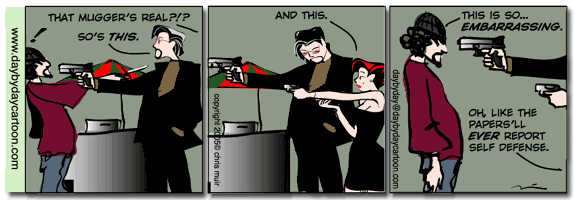
And There Will Be Chocolate Rivers, and Fluffy Bunnies…

I’ll be honest with you, I’m about burned out. I now fully understand Toren Smith’s reason for pulling the plug on The Safety Valve. It’s fatigue. The idiotarians never give up. Shine the light of fact on them, and they may scurry away like cockroaches, or they might just stand and stare like deer into headlights, but you can’t get through to them. Their vision of utopia precludes any attempt to make them face reality, up to and including a severe beating about the head and shoulders with a ClueBat. It’s exhausting. Especially when they’re paid to be idiotarians, and we in the real world have to earn a living and refute them on our own time.

I’ve been wanting to write an essay on reproductive rates in societies for about a week, inspired by Mark Steyn’s recent piece “It’s the Demographics, Stupid,” but burnout has prevented me from doing so. It’s a hard piece. It needs lots of thought and research, and I just haven’t been up to it. But refuting idiotarian op-eds? That’s pretty much a no-brainer (though time consuming). The problem is, they never stop, and there’s only so much time available. But I found one today courtesy of KeepAndBearArms.com that I couldn’t pass over. From the San Francisco Chronicle (where better?) comes this classic piece of utopian bilge, “And That’s the Trouble: The gun debate, personalized”, by Chronicle writer Kevin Fagin. Let us begin:

My first real memory of a gun is from when I was 8, standing in a Nevada salt flat with my mother leaning over my right shoulder, folding my hand around the oh-so-smooth butt of a .22-caliber revolver. It was the gun she always kept under the car seat.

I squeezed off a shot at a rusty soda can 30 feet away, and the explosion in my ear and puff of sand alongside the can sent a shiver right to my toes.

“You’ll get it, don’t worry. You need to learn how to shoot this,” my mother said, patting my head. “You never know how you might need it someday.”

She was right. I did learn how to shoot, and I did need a gun someday … several somedays. And I came to respect the way a gun could save my life.

So, your mother gave you, at age eight, a useful skill. A skill that you’ve actually used.

I also came to hate guns for the ways they have just as easily, just as coldly, unthinkingly, devastated life around me and come close to ending my own life time and again.

Um, what? Guns have “coldly, unthinkingly, devastated life around” you? Well, guns are cold (unless recently fired) and unthinking, but they are also inanimate objects, not voodoo talismans. In case you hadn’t noticed, someone needs to operate the gun, unless it loads itself, aims itself, and pulls the trigger itself.

First problem, Mr. Fagin: your hatred is (typically) misdirected. Like a lot of people, you blame the tool because it’s easier than trying blaming the person. Blaming the person requires you to accept that people are responsible for their actions – even you, yourself. Personal responsibility is scary, for some.

Let’s continue and see more examples of Mr. Fagin’s denial of this annoying little piece of reality:

And I’ve come to believe guns have no logical, meaningful place in the lives of most ordinary people.

I’ve come to believe differently. What makes your belief more valid than mine? You’re paid to write and I’m an amateur? You’re a journalism school graduate and I only have a Professional Engineer license? How does that work, exactly?

There are plenty of Americans who have had the same relationship with this deadly little dealer of instant death. You could say the same thing about the country as a whole. It’s a dysfunctional relationship, and there’s not even a remotely easy way to fix it.

No, there’s not. Especially if you keep blaming the gun for the problem, and not the shooter. That’s never going to get you anywhere. There’s dysfunction, all right, but it isn’t in the machines, it’s in a tiny percentage of the users. So of course, we should take guns away from all the users, right? No?

I’m not talking here about guns in the context of casual can-plinking, or deer hunting, both of which are plenty of fun (Bambi lovers, chill) and don’t threaten anything if done right. I’m talking about the stuff that makes America the Wild West barbarian outpost which people from other countries shake their heads about. I mean the real gun stuff that happens when you’re staring life in the face, not being chauffeured to Congress past the rabble so you can blather Second Amendment platitudes and cash your NRA lobby checks.

Ah, yes. A literary three-fer. The obligatory “Wild West” reference (See Ravenwood’s Law), a shot (pun intended) at the eeeeevil NRA, plus a genuflection to the “shooting sports” crowd to dissuade them from thinking that their guns might be at risk. Oh no! This, of course, after having stated that “guns have no logical, meaningful place in the lives of most ordinary people.” What, the unspoken message is that “recreational shooters” aren’t “ordinary people”? That they’re somehow a special class? An elite not held to societal norms?

Anybody besides me see the dissimulation here?

Apparently the majority of British recreational shooters never did. Too late now.

Let me elaborate.

Please do. Should be fascinating.

One relative of mine was blown away when he and his brother played stick-em-up in the family barn; they didn’t know the shotgun was loaded.

And whose fault was that? Your mother taught you to shoot a .22 revolver – for defensive purposes, no less – at age eight. Did she teach you the four simple rules of gun safety at the same time?

  1. All guns are always loaded!
  2. Never let the muzzle cover anything you are not willing to destroy!
  3. Keep your finger off the trigger until your sights are on the target!
  4. Always be sure of your target, and what’s behind it!

Why did no one teach these four simple rules to your relative’s brother? Why did they treat a shotgun as a toy? Why is that relative’s death the fault of the gun and not the fault of the brother, or the adult the gun belonged to? Here’s another case of blaming the object and not the actor.

Another was nearly blasted in half when a robber shot him through his front door.

And the robber (and I assume murderer, since “nearly blasted in half” would suggest a fatal wound) bears no responsibility for loading, aiming, and shooting the gun? It’s the gun’s fault?

A cousin lost use of her arm for years after being shot in the Marin County Courthouse shootout of 1970; the judge’s head was blown off as he sat next to her.

Who loaded, aimed, and pulled the trigger of that gun?

Those were the things I experienced, but didn’t see. Other times guns cut closer.

In college in San Jose, I had to chase off attackers with a Luger 9mm semiautomatic when I lived alongside two warring gangs that promised to rub me out for telling the cops they shot holes in my windows and ripped off my car tires and gas.

So, your mother’s training was useful, no? You had a gun, you defended yourself with that gun, and you didn’t shoot anyone. (“Chase off” implies no one was hit, does it not?) What, your gun was defective? Were you a lousy shot? Or were you a responsible person, properly exercising your rights and responsibilities?

Years later, I had to replace that long-lost Luger with a .25-caliber semiautomatic when I was a young police reporter on a small-town newspaper and got a drug dealer mad at me.

I’d written a story about how this coke pusher kept squirming out of charges because the witnesses against him disappeared with each case. He told me to stop writing about him. When I gave him my Journalism 101 lecture about the First Amendment and wrote again, he stomped into my newspaper office.

“You’re dead, f — ,” he said, jamming his face close to mine. His rapsheet already included a juvenile sentence for murder and two assault convictions with knives and a shotgun. The local police commander shook his head when I asked what he could do to protect me. “Better get a gun, son,” he said.

What?!? The drug dealer had an assault conviction for (mis)using a knife? And another for (mis)using a shotgun? And the police didn’t tell you to “let the professionals handle it – you’re not qualified”? I’m shocked, I tell you! Shocked!

My dad’s .25 was under my pillow the next night, after I’d spent the afternoon blasting at targets. At 2 a.m. someone came slamming on my door, and I sat in the living room with the gun pointed straight ahead, screaming, “‘Bring it on, f — !” at the door. Whoever was outside screamed back, “You’re dead!” I yelled back again; this went on awhile, and then he went away.

Another successful defensive gun use. Again no one was injured. And you used your Second Amendment right to bear arms in defense of yourself and the state to protect your First Amendment right to freedom of speech.

Interesting how that works, isn’t it?

Did either of these defensive gun uses get reported in your newspaper? Just curious.

By the way, good thing the drug dealer didn’t hurl a Molotov cocktail through your living room window, wasn’t it? Once with a knife, once with a shotgun, arson would have made a trifecta. I suppose then you’d have blamed the manufacturer of the bottle, the beverage maker who originally filled it, the gasoline retailer, the refiner, and the textile maker who made the rag used as the wick? The drug dealer would, of course, bear no responsibility for the act itself. That is your thinking, is it not?

No doubt: I would have fired.

Good thing you didn’t. A .25 probably would have just pissed him off. He’d have likely come back with that Molotov.

Just as I might have in other situations over the years when gangsters I was trying to interview stuck pistols in my guts or to my head, or when my wife was robbed at gunpoint in Berkeley.

Berkeley? That bastion of the Liberal Left? It’s inconceivable! You need to deal with a better class of people.

And that’s the trouble.

If none of us had had guns — most particularly, those handy little handguns — all these confrontations would have simply involved yelling, fists or perhaps knives.

Really? Other weapons would be better than guns, like, fr’instance, knives? Well, knives are contact-distance weapons, but I’d rather be able to dissuade someone from out of reach. I’m not particularly fast – bad knee – so running really isn’t an option for me. I’m 43, overweight and out of shape (well, round is a shape), so I’m not going to be faster or stronger than, say, an fit twenty-year old mugger. Or one hyped up on Meth. I probably wouldn’t have an advantage over him in a scuffle, and I certainly wouldn’t if he were armed with the ubiquitous “blunt instrument” like a piece of rebar or a baseball bat and my only weapons were foul language and my fists. And if you think I want to stand and trade knife-strokes with him, you’re out of your freakin’ mind.

Still, I’m a pretty big guy. I have a major advantage over a 5′-nothing 99-lb. woman in the same situation. At least I have a chance to overpower an attacker.

But we’re both in the same boat if there’s more than one attacker. We lose. With a pistol, however, we have at least a chance.

In Great Britain, about 150 people die by handgun every year. In the U.S.? It’s about 29,000. I’ve lived in both places, and let me tell you, your radar for — and encounters with — danger are so drastically reduced across the water that they are nonexistent by comparison.

Really? Is that so? You’ve lived there, so you’re an expert?

First, Great Britain has never had a high homicide rate, even before 1920 when our two nations shared identical gun control laws – that is, none. Their homicide rate has traditionally been about 5% of ours, by all methods, including firearms.

I’m not going to check Mr. Fagin’s assertion that “about 150 people die by handgun every year” in Great Britain, I’m just going to point out to him that all handguns are BANNED in Great Britain, the ban went into effect in 1996, and since the ban was implemented the number of people dying by handgun wound has trended up. According to a 2003 BBC report, the number of crimes committed with handguns there has doubled since the ban.

Boy, that was effective, huh?

Here’s a handy little graph from the BBC that shows gun crimes in England & Wales since 1982:
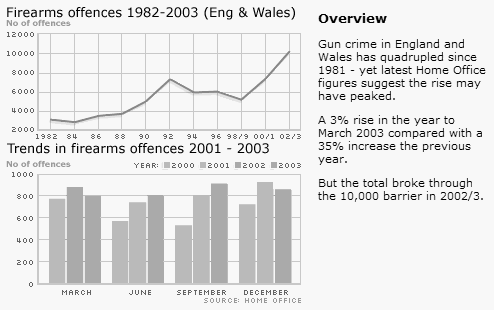
“Gun crime” has quadrupled since 1981. Most of it (58%) is committed with handguns. They hope it’s levelling out, but nobody really knows yet.

It’s utopic as hell to say “if none of us had guns,” but that little “150 people die by handguns every year” admission indicates that isn’t going to happen, ever. What Great Britain has done since 1920 in a death-by-a-thousand-cuts strategy, is to disarm its victim pool. It hasn’t done a thing to its criminal pool. That’s gotten larger and more violent.

While violent crime in America has been on a roller coaster, it has for the last eleven years been on a steep decline. This decline has included the crime of homicide. At the same time, the number of guns in circulation, including “those handy little handguns” has been going up here by a few million a year. Moreover, the number of states with “shall issue” concealed-carry laws has reached 35, and two states have no permit requirements for concealed carry at all. In each of these states, allowing responsible people to carry guns for self-defense has not resulted in “blood in the streets” and a revival of the “Wild West.” Violent crime has gone down, in some cases faster than in neighboring states that don’t allow concealed-carry. So much for blaming the guns.

Meanwhile, in Great Britain violent crime has been climbing dramatically since about 1955, while the number of (legally owned) guns has been increasing only slightly, and handguns have been made illegal. Somehow that decline hasn’t affected gun availability to the criminal class. In 2002 the Telegraph reported that gun crime had tripled in already crime-ridden London, and had skyrocketed in other cities as well.

The number of people robbed of personal property at gunpoint rose by 53 per cent in the Metropolitan Police area between April and November last year, compared to the same period in 2000, a rise from 435 victims to 667.

London and other inner city areas, including Birmingham, Manchester and Nottingham, have increasingly suffered from gun crime, mostly perpetrated by young men and fuelled by rows in the lucrative crack-cocaine market.

Police chiefs now fear that a younger generation of street criminals will graduate from stealing mobile phones at knifepoint to using guns to commit street robberies.

The two trends have already overlapped in the Metropolitan area. As well as the increase in gun-point muggings, aggravated burglaries involving guns rose from 101 in April to November 2000 to 153 in the period last year.

Senior officers at Scotland Yard and in a number of inner city forces fear that indiscriminate gun violence will increase as school-age thugs grow up to copy their elders and carry the kind of weapons previously seen in gangland warfare.

Some have suggested that Britain is witnessing the kind of cocaine-fuelled violence which surfaced in America in the 1980s. Cocaine, particularly from the Jamaican connection, now floods into Britain, generating violence and providing a ready source of crack.

Ballistics experts warn that firearms are now cheap and easily available. The discharge of guns in non-gangland crimes, such as muggings, is still relatively rare.

Apparently, Mr. Fagin, you didn’t live in any of those areas.

So, they’ve got a lot of guns, but they’re unlikely to actually pull the trigger. But how many guns do they have? Hard to say, but one estimate is at least three million on the black market. That’s a lot for a country with a population of about 55 million.

There’s that problem again: blame the gun, or blame the criminal? They’ve got the guns, they use the guns in crimes, but they rarely pull the trigger.

So is it the gun, or the gunner?

Absolutely, if you’re a law-abiding citizen and some predator is pointing a barrel at you, you want a barrel of your own to end the argument. But as plain as the blood on the floor every day in America, that’s a perpetual tit-for-tat that will always be awful.

Mr. Fagin, it beats the alternative of being unarmed against predators. You make the mistake of lumping violent but protective in with violent and predatory. You see only violent. You seem to believe that A) disarming us will disarm them, and B) disarming them will make them less dangerous. Your only evidence of this is a comparison to Great Britain, which has never had a high homicide rate, regardless of weapons.

One more time, with feeling: That comparison isn’t valid.

The only way to fix this hideously dysfunctional relationship we in this country have with guns is to treat it like you would any other: End it before you wind up murdered.

Nobody’s saying this will be easy. The important things never are.

So let me get this straight: The law-abiding gun owners should “end our dysfunctional relationship” with guns “before (we) end up murdered.” Right. Disarming ourselves will protect us.

Worked for Great Britain, right? Oh, wait….

Would you have given up that Luger? That .25 Automatic? Would that have made you safer?

What you’re asking is for the responsible people to disarm. Britain’s done that to its population, and it hasn’t made them safer. Clayton Cramer has an excellent piece illustrating the failure of that approach in his essay “The Failure of British Gun Control” (a PDF file, six pages.) Excerpt:

In the period 1981-96, as American crime rates fell, British crime rates rose. Britain now has higher rates of robbery, assault, burglary, and motor vehicle theft than the United States.

By 1995, England & Wales had 1.4 times the robbery rate of the U.S.; more than twice the assault rate of the U.S.; and nearly double the U.S. burglary rate.

He’s got all the footnotes and reference. Things there have not improved since 1995. Quite the opposite, in fact.

Mr. Fagin, you might have lived there, but I’m going to assume you lived in the crime equivalent of Fargo, North Dakota. The crime was there, you just weren’t exposed to it. No one bashed you over the head for your cell phone, a relatively common crime in London. No armed gangs invaded your home – a “hot burglary,” a much more common occurence in Great Britain than in the U.S. You were neither victim of or witness to a physical assault by a gang of “hoodies” who would record the “happy slapping” attack on a cell-phone camera for replay on the internet.

Good for you. But don’t tell me how much safer Great Britain is. Your chances of getting shot dead there are much lower. Your chances of being a violent crime victim are much greater.

And don’t make me go into the demographics of murder victims here. I don’t have that kind of time.

But given your personal experience, you want all of us to embrace your utopic vision of a gun-free world and disarm.

Here’s an idea: The criminals and idiots go first. Then we “casual can-plinking, or deer hunting” sport shooters won’t have to, will we?

Your mother apparently had a firm grasp on reality. What the hell happened to you?

(This piece burned 3.5 hours. And could still stand some editing.)
England, Gun Controllers, and the “Aggressive Edge”

Just a quick one, as this has been making the rounds of the gun blogs. It seems that the producers have chosen Daniel Craig as the next Bond; James Bond. IMDB’s bio says:

Daniel Craig was born in 1968 in Chester, England. He grew up in Liverpool, England and moved to London, England when he was 16. Here, he trained at the National Youth Theatre and graduated from the prestigious Guildhall School of Music and Drama (early 1990s). He made his film debut with The Power of One (1992) in 1992 as Sergeant Botha.

Quote from The Power of One attributed to the character of Sgt. Botha:

I was branded an idiot by everyone I knew!

How… poetic.

It seems that Mr. Craig is not likely to actually receive a “License to Kill” since he hates firearms:

New Bond: I hate guns
By This is London
25 October 2005

Daniel Craig will have a problem playing the new James Bond – because he hates guns.

The actor will wield 007’s famous Walther PPK in the movie Casino Royale.

But he revealed in OK! magazine: “I hate handguns. Handguns are used to shoot people and as long as they are around, people will shoot each other.

“That’s a simple fact. I’ve seen a bullet wound and it was a mess. It was on a shoot and it scared me. Bullets have a nasty habit of finding their target and that’s what’s scary about them.”

He should see what a shotgun can do.

However, this reminded me of an earlier piece I wrote, Americans, Gun Controllers, and the “Aggressive Edge” which discussed the making of – and the casting for – the movie Aliens:

The first (special feature) section on pre-production talked about the fact that the film was shot in England, mostly at Pinewood Studios, but this little bit piqued my interest:

Mary Selway, UK casting for Aliens:

“It was INCREDIBLY hard to do, because, um, James kept saying, ‘State of the art firepower. They’ve got to be incredibly, sort of on the cutting edge of American military…’

“So, what often happens here when American actors come to live in England, they become a bit Anglicized, and they don’t… they lose that really, sort of aggressive edge if you like, that this sort casting required.”

She said it, I didn’t.

Immediately after Ms. Selway’s piece:

Gale Anne Hurd – producer.

“I think we probably went through 3,000 people before we could even consider bringing anyone over from the United States.”

Hmmm… They went through 3,000 “Anglicized” people and couldn’t get enough aggressive ones?

I have to believe that there are more than 3,000 British actors they could have gone through, but I guess casting an American in the role of James Bond just wouldn’t have been cricket.

But at least then they could have found one that wasn’t a GFW.

“…Reason to Suspect ‘It is Drug Related’ “

Are you going to join in the Great Wal*Mart Ammo Day Buy? Well, I said we wanted to see what happened. This might give some of us a clue. (Check the date – 11/5/2002) Reader Carl sent me this news story (link appears to be broken due to age, but the players are real – see below):

Who bought 1,000 rounds of 9 mm ammo?

Mary Jo Denton
Herald-Citizen Staff

November 05, 2002
When someone bought 1,000 rounds of 9 mm ammunition at a Cookeville store recently, clerks became suspicious.

So did police after they received information about the purchase.

The ammo appeared to be headed for use in drug related crimes, according to Capt. Nathan Honeycutt of the Cookeville Police Department.

That was last week, and investigation into the matter continues today, with one man under arrest so far, but not for having the large quantity of powerful bullets.

A thousand 9mm rounds? That’s a decent weekend for some of us.

Last Friday, federal, regional, and local officers executed a search warrant and arrested Vernon Thomas Mendoza, 25, of Buffalo Valley Road, Cookeville.

He is facing “a variety of federal charges, including possession of a handgun by a convicted felon and possession of methamphetamine for resale,” Capt. Honeycutt said.

Well good on ’em, then. But how did they know about Mr. Mendoza?

Meanwhile, the search for where the ammunition wound up continues, and detectives are hot on the trail, he said.

With the information they first received last week about the ammo purchase, police detectives set up an undercover investigation which included the federal Alcohol, Tobacco, and Firearms agency, working with the 13th District Drug Task Force, and Detective Lt. Doyle McClain and Detective Sgt. Carl Sells.

“We are still trying to find out where this much ammunition was going, and we have some very good leads now,” Capt. Honeycutt said today. “In fact, we have a pretty good idea of where it is and more arrests are pending.”

He said 9 mm ammunition of the type bought “is the most likely thing that goes into automatic weapons commonly used by criminals.”

Wait… I thought automatic weapons were strictly regulated by the 1934 National Firearms Act? And that kept them out of the hands of criminals. But now they’re “commonly used by criminals”?

Oh. You mean semi-automatic weapons. Well why didn’t you say so?

“And to buy that much at one time is very unusual, so that is why it raised the suspicions of the store and of the police,” Honeycutt said.

It might be unusual in Cookeville, but it’s pretty damned common most places. When I buy .45ACP it’s by the thousand round case. I guess these guys would have had little kittens if they’d found out about my recent purchase of 768 rounds of .30-06, in Garand clips on bandoleers, shipped in evil .50 caliber ammo cans!

While it is not necessarily illegal to possess such ammunition in that quantity, detectives working this case have reason to suspect “it is drug related,” he said.

Not necessarily illegal! How nice! I guess my cabinet full of reloaded ammo isn’t necessarily illegal either? Or all the loose projectiles, various powders, primers and empty cases?

He said the “behavior” of the buyer, as well as the quantity of the purchase figured into the suspicion raised.

I can imagine what bothered the clerks. The guy comes up and says “I need a thousand rounds of 9mm and six cases of Sudafed. And hurry up, I’ve got things to do!”

“Our detectives did not wait for somebody to get hurt, but took a proactive stance and moved to track down this ammunition,” Honeycutt said.

The arrest of Mendoza was the first result, and more arrests are expected, he said.

When the officers and DTF and ATF agents arrived at Mendoza’s residence last Friday about 11 a.m., they found him there with his girlfriend, and he was arrested without incident, Honeycutt said.

But he made no statements, Honeycutt said.

Allegedly, he had a handgun and methamphetamine, and his arrest was based on those items.

But the officers did not find the 1,000 rounds of ammunition.

“So it is still a very, very active investigation,” Honeycutt said this morning.

He praised the work of the Cookeville Police detectives and the “excellent cooperation” of the ATF and the Drug Task Force.

Mendoza was taken to Nashville, where he will be arraigned in federal court.

Published November 05, 2002 12:12 PM CST

I didn’t find any follow-ups on this story, but in checking, I did find this golden oldie:

Killing of family dog unfolds on videotape

By LEON ALLIGOOD
Staff Writer

Review finds officers acted properly in stopping car

Three minutes and seven seconds tells the story of a dog named Patton.

The dog, which was shot at close range Jan. 1 by a Cookeville policeman during a felony traffic stop, belonged to the James Smoak family of Saluda, N.C. At the time, the Tennessee Highway Patrol suspected the Smoaks — James, his wife, Pamela, and his stepson, Brandon Hayden — were involved in a Nashville-area robbery.

Yesterday, the Tennessee Highway Patrol acknowledged there was no robbery, just a calamitous mix-up in communications between dispatchers working for two separate patrol offices. This failure to communicate led to the shooting of the Smoaks’ dog, an incident that was preserved on videotape by a dashboard camera in a patrol car.

Even so, the THP officers did not act inappropriately by making the felony stop, according to an internal investigation.

“Our investigation has found that our troopers on the scene that night — Trooper David Bush, Trooper Jerry Phann and Lt. Jerry Andrews — did have probable cause to conduct what in police terms is called a ‘felony stop’ of a motorist,” said Beth Tucker Womack, spokeswoman for the Department of Safety. The THP is part of the Safety Department.

A felony stop is ordered when the occupants of a car are thought to have been involved in a crime.

Likewise, the Cookeville Police Department’s internal investigation determined that its officers, who were providing backup for the troopers, “performed their duties according to training and policy,” said department spokesman Capt. Nathan Honeycutt.

You can read the rest at the link.

I wonder how many BATF agents are going to be tied up investigating a nearly-simultaneous purchase of tens of thousands of rounds of ammunition of various calibers? Or how long it will take Wal*Mart to shut down ammo sales on Nov. 19?

Quote of the Week:

Eric S. Raymond is posting again:

Of course, one could argue that Big Media is simply taking its cue from the Democratic Party. (Yes, I know one of those is a wholly-owned subsidiary of the other, I just can’t keep straight which one is on top.) If Republicans are beating the stuffings out of you in every election, it couldn’t be because you have no program beyond screaming “George Bush is eeeeevil!” and licking the anus of the Designated Victim Group Of The Week.

Some have a way with words, others not have way.

PreCISELY!

I was listening to Hugh Hewitt‘s radio show on the way home yesterday. On Wednesday afternoons he has “The Smart Guys” on, Erwin Chemerinsky (from the left), law professor at USC, and John Eastman (from the right), law professor at Chapman University. Well, yesterday Hugh was asking them both about their opinions of the appointment of Janice Rogers Brown. Hugh’s producer Duane Patterson runs the blog Radioblogger and has the transcript. Chemerinsky whined about how “out of the mainstream” Brown was:

I think it’s sad. I think Janice Rogers Brown is pretty much as far to the right on the political spectrum as you’re going to get for a federal Court of Appeals. She said that she believes the social security program is unconstitutional.

That’s just a set-up for what’s coming, though, because a few minutes later we got this exchange:

John Eastman: You know, I mean, it’s just so preposterous, I don’t even know where to begin. The reason Chuck Schumer is so upset about this, is Justice Brown is the kind of judge who will, you know, adhere to the Constitution. And when the members of the legislature, even the exalted Chuck Schumer hismelf, want to take actions that is not authorized by the Constitution, she’ll be willing to stand up and do her duty, and strike it down. That’s not an arrogance, that’s what the judges are there for, to adhere to the Constitution, and not to let the legislature roll over them and do whatever they want. You know, it really is preposterous. We’ve turned this upside down. The judges that do exactly what they’re supposed to do are demonized, and those that take a powder and let the legislature get away with every abuse, every extension of power imaginable, are touted at the cocktail circuit.

Erwin Chemerinsky: I think what Senator Schumer is saying, and is absolutely right, is that Janice Rogers Brown’s repeated statements that she believes that the New Deal programs like social security are unconstitutional, is truly a radical view. That’s not a judge who wants to uphold the Constitution. That’s a judge who wants to shred the last eighty years of American Constitutional law. Janice Rogers Brown saying she believes that the Bill of Rights should not apply to the states, would undo the last seventy years of Constitutional law. That’s not a judge who wants to follow the law. That’s a judge who wants to make the law in her own radical, conservative views.

John Eastman: Hang on, here, because Erwin…there’s a wonderfully subtle change in your phraseology that demonstrates what’s going on here. You said she won’t follow the Constitution, and then you said it’s because she won’t follow the last seventy or eighty years of Constitutional law. What happened seventy or eighty years ago that changed the Constitution? There was not a single amendment at issue in the 1930’s that changed the Constitution. Some radical, federal programs were pushed through. Some radical judges, under pressure, finally signed on them, and the notion that we can’t question that unconstitutional action that occurred in the 1930’s, and somehow that defending that unconstitutionality is adherent to the rule of law, is rather extraordinary. There are scholars on left and right that have understood that what went on in the 1930’s was…had no basis in Constitutional law, or in the letter of the Constitution itself.

THANK you, John Eastman for smacking down Chemerinsky when he so richly deserved it. Game, set, match.

And thanks to Duane Patterson for transcribing that spanking. (There’s quite a bit more, if you’re interested.) It made my day!

Want to Know How Far We’ve Come?

Go watch the video that Seattle’s NBC affiliate KING5 did on this year’s Boomershoot. Lots of pictures of people shooting, even evil black rifles, and not a hint of negativity. The piece opens with:

One weekend a year the quiet of rural Idaho is blown to smithereens, by gun-toting, target shooting, explosion loving… regular folks.

And then they show some of them! They even get the reporter on camera shooting a target, and the anchor at the conclusion of the piece states:

Boomershoot organizers say that no one has ever gotten hurt blowing anything up there. The same cannot be said about the bowling balls. If you want to find out more about it, and I have to tell you it looks like a heck of a lot of fun, go to King5.com.”

No fear-mongering here. It’s a great video, about four and a half minutes. I bet King5 got some pretty vicious hate mail about it. They are in Seattle, after all.

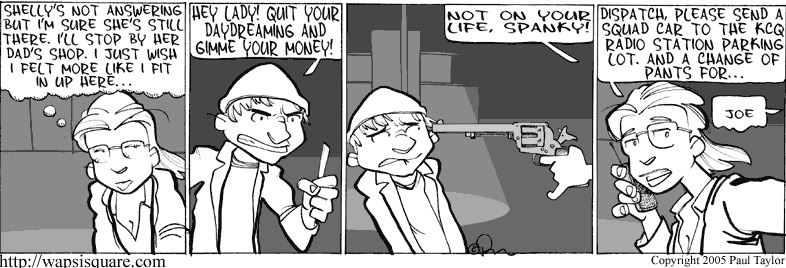
It’s a Cartoon Meme!.

First, Wapsi Square from February 24,

Read the next few day’s worth, too. Very good!

And now today’s Day by Day!

I bet the next couple of days will be GREAT!

Somehow, though, I don’t think you’ll be seeing a positive portrayal of concealed-carry in Doonesbury, much less Cathy.

But still, I’m encouraged!

That’s Because You WEREN’T LISTENING

I love the internet. The interconnectivity. The eidetic memory. The instant recall, complete with footnotes.

Instapundit delivers a smackdown to St. Louis Post-Dispatch editorialist Sylvester Brown Jr.’s latest piece, where Mr. Brown states:

I’ve noticed that comedian Bill Maher has been doing a bit of reaching out himself lately. Several times on his show, “Real Time with Bill Maher,” he’s encouraged more conservatives to join his audience. Maher’s even conceded that his criticism of President George W. Bush’s activities in Iraq may have been at least partly wrong.

“Look, on the long-range, big picture of getting the freedom-and-democracy ball rolling in the Middle East, maybe these guys had it right,” Maher said on his show Friday.

Sounds to me like Maher’s buying into the bait-and-switch rhetoric of the Bush clan. Maybe I would, too, if they were straight shooters. But, before the Iraq invasion, the rallying cry was against an “axis of evil” and “weapons of mass destruction.” I don’t recall any prewar speeches about delivering democracy to the Middle East.

Ah, Mr. Brown, accusing the “Bush clan” of lying when it is YOU who are at fault for not listening, as Glenn and some of his readers point out.

Perhaps you should try removing the blinders and the earplugs, and listen to what the “Bush clan” acutally says rather than what gets through the media filter, eh?

If I recall correctly, the protests against Bush’s call to “deliver democracy to the Middle East” was (and I paraphrase) that ‘the wogs weren’t up to it, and didn’t want it anyway.’

Edited to add: Oh, and this reminds me of a July, 2004 post that drew some attention when Steven Den Beste linked to it for this cartoon:

The Internet = Total Recall

The No-Nuance President

Instapundit relates an excerpt from a BBC reporter Justin Webb’s “Tour Diary” concerning President Bush’s visit to EUnuchistan, er, Europe.

The president is wonderfully un-European – refreshingly so in the view of those of us who have worked in Brussels.

He is unsmooth. He stumbles over his sentences. He uses short, plain, sometimes almost babyish words, while the sophisticated multilingual Euro crowd prefer obfuscatory long ones.

And he gets a clear message across, like it or not. He has no need of spin.

It was interesting that on the White House bus back into town, the journalists did not need to compare notes or discuss the president’s words and what they meant.

On the other hand, for Chirac and Schroeder there was a discussion that would have made an old-style Kremlinologist blush. . . .

Some people think Schroeder said one thing about Nato and some think he actually meant another. Others claim that Chirac really believes Schroeder wanted to say… etc etc.

Welcome to Europe, Mr Bush.

He’s wonderfully non-politician. Last February the Washington Post‘s Richard Cohen did a piece, Bush’s War on Nuance where this characteristic was stated plainly:

To satisfy the hallowed journalistic tradition that there must be two sources for almost anything, I offer you Sen. Joseph R. Biden Jr. (D-Del.) and Candy Crowley of CNN. They both are on record as having George Bush say that he doesn’t do nuance. “Joe, I don’t do nuance,” the president supposedly told the senator. As for Crowley, she heard it this way: “In Texas, we don’t do nuance.” If these two sources don’t suffice, I offer you the 7,932 words that make up the text of the president’s interview with Tim Russert. There ain’t a nuance anywhere in the whole mess.

And he hasn’t changed. Cohen, however, wasn’t as approving as the Brit.

What a difference a year – and three elections – makes.

Edited to add:

I was also reminded (again) of this old Sacramento Bee piece, French puzzle over why U.S. got so angry from May of 2003, and this quote that shall live in infamy:

“What is a little disconcerting for the French is an American president who seems to be principled,” said Jean Duchesne, an English literature professor at Condorcet College in Paris. “The idea that politics should be based on principles is unimaginable because principles lead to ideology, and ideology is dangerous.”

The thing that Justin Webb and his fellow-travellers seem to be reacting to is President Bush’s principled behavior, something they’re totally unfamiliar with when it comes to politicians.

Ideology seems to be working pretty good.

But then again, success is dependent on the ideology, isn’t it?

UPDATE: Sperari has an associated post, Instinct vs. Understanding vs. Meandering.

FEAR,

The Philosophy and Politics thereof:

Another interesting week has gone by, with various bits and pieces aggregating in my consciousness for analysis and synthesis. On Tuesday I found a Reason magazine review of cultural anthropologist Abigail Kohn’s book Shooters, with reference to her earlier Reason piece Their Aim Is True. The pertinent quote from the book review was this:

Kohn’s own research for Shooters, some of which appeared in this magazine (“Their Aim Is True,” May 2001), elicited predictable responses. One colleague said she was performing a “social service by researching ‘such disgusting people.'” Another said that unless Kohn acknowledged the “inherent pathology” of gun enthusiasm, she was disrespecting victims of gun violence.

Kohn herself admitted in her earlier piece:

Our initial attempt to meet local militia members took us to a shooting range in the Bay Area, where we assumed local militia meetings would be held. We went on a Tuesday night, fully expecting the range to be seething with radical political activity. Why else would people congregate at a shooting range, if not to meet other like-minded, potentially dangerous right-wing gun nuts?

Also I found a Feb. 1 piece in the UConn Daily Campus entitled Gun nuts’[sic] have no real excuse by one Robert Schiering that proclaimed:

At first glance, the term “gun nut” would appear to be nothing more than an ad hominem against the more enthusiastic weapon owners of this country. However, as one reads the literature espoused by gun nut organizations, the reasoning behind this term becomes startlingly clear. Gun nuts are called as such because they are incontrovertibly insane.

In not much of a stretch, Rep. Patrick Kennedy on Tuesday cosponsored a bill to ban .50 BMG caliber rifles, stating, according to CNS:

“Any policy maker who, on the one hand, says that they are for combating terrorism but, on the other hand, will not back this legislation, backed by Representative Moran, to me has a lot of explaining to do,” Kennedy said “In fact, I think it would be the definition of insanity to say that.”

It’s important to understand this: We call ourselves “gun nuts” – embracing the label thrust upon us by the ignorant, anti-gun bigots – but many of them really believe it. We’re “potentially dangerous” because we like guns.

I think that’s something most gun owners don’t really grasp. I know it initially took me a while to get my mind around the idea. Last January there was a multi-blog discussion about concealed-carry that inspired my essay TRUST. Blogger Barry of Inn of the Last Home began the discussion, saying on the subject of concealed-carry:

If I were to take a live, armed weapon and carry it on my person, in public, it would eat away at my sanity just as if it were emitting lethal radiation. To know that I carried an instrument of sure and certain death on my person, available and ready to be pulled out and used at a moment’s notice to possibly kill…a child. A homeless person. An innocent.

That stirred up quite a controversy, but he later tried to clarify:

I would feel uncomfortable carrying a loaded weapon. Very uncomfortable that I would possibly have the means to end a person’s life within arm’s reach. That doesn’t mean I’m going to do it, or would ever be tempted. Just that fact makes me uncomfortable.

I also would feel uncomfortable knowing that anyone on the street, in the theatre, at a restaurant, at the supermarket could be carrying a loaded gun on their person. And here’s why – despite training, despite temperament, despite the best of intentions: I don’t trust you. That’s simply it, I don’t trust you. I don’t trust a person who is not a licensed law enforcement officer of some kind – someone who, by virtue of their job, I would assume they have proper gun training – to carry a weapon. You may be a great person, love your kids, go to church, would never pull a gun in anger at another person – you may be supremely confident of that fact in your own mind, but I’m not. To me, you would be just as likely to be the one sticking up the fast-food clerk as the one defending him, or – in your possibly untrained and excited state – could be the one who with the best of intentions attempts to intervene but misses and hits someone else. Or you could be the one who gets pissed off at me in traffic and, instead of the flipping me the finger you pop off a few rounds at my back window.

I’m not concerned whether there are documented cases of this happening – I am afraid that they will, when more and more people are allowed to carry concealed weapons.

Last Thursday, Feb. 3, Marine Lt. Gen. James Mattis offended the sense and sensibilities of a good portion of the public when he proclaimed “it’s fun to shoot some people.” The reaction was predictable. Congressman Pete Stark, (D-CA) put out a press release stating:

Last week, United States Marine Corps Lieutenant General James Mattis made public comments that were unbecoming of a military officer. As quoted in numerous newspaper articles and media broadcasts, Lt. General Mattis told a San Diego, California audience of 200 civilians that “It’s fun to shoot some people.” Referencing combatants in Afghanistan he added, “You know, guys like that ain’t got no manhood left anyway. So it’s a hell of a lot of fun to shoot them.”

Lieutenant General Mattis has no doubt served his country with courage and distinction as an officer in the United States Marine Corps. It is, nonetheless, inexcusable that, as a high-ranking officer of the US military, he would make these callous and insensitive remarks that denigrate the value of human life.

That was relatively mild. Juan Cole said:

T.E. Lawrence, “Lawrence of Arabia,” was tortured and almost driven mad when he realized he got a thrill from shooting a man dead. His sadistic pleasure in killing Ottoman troops in Syria seems to have been wrought up with his rape by an Ottoman officer who thought him a Circassian Jordanian rather than a British secret agent. At one point he writes in Seven Pillars of Wisdom about how beautiful the dead Ottoman soldiers looked in the moonlight, lined up straight, after a battle.

Just as few priests are pedophiles, few soldiers are sadists. Mattis has brought dishonor on the US Marine Corps with his words. Killing is never appropriately called “fun.” I think he should resign.

You see, enjoying the practice of violence is “sadistic” and “racist.” Insane, in other words.

There are a lot more examples, but I’m sure most of you have seen ones like this or worse. However, I’ve read some military history, and I’ve read the current military blogs by some of the guys on the front lines pulling triggers, like Armor Geddon and A Day in Iraq. They like what they do, or they wouldn’t have chosen to do it.

Apparently, they’re insane too.

Or are they?

A while back I wrote a three-piece essay on the difference between violent and predatory and violent but protective, and their antithesis, pacifism. The pacifist culture, I wrote,

…doesn’t really distinguish between violent and predatory and violent but protective – it sees only violent. Their worldview is divided between violent and non-violent, or passive. There is an exception, a logical disconnect if you will, that allows for legitimate violencebut only if that violence is committed by sanctioned officials of the State. And even there, there is ambivalence. If violence is committed by an individual there is another dichotomy: If the violence is committed by a predator, it is the fault of society in not meeting that predator’s needs. The predator is the creation of the society, and is not responsible for the violence. He merely needs to be “cured” of his ailment. If violence is committed by a defender, it is a failure of the defender to adhere to the tenets of the pacifist society. It is the defender who is at fault because he has lived by the rules and has chosen to break them, and who must therefore be punished for his transgression.

And God help you if you admit that you enjoy exercising violence, for any reason. It’s a sign of mental illness, you know.

Finally this week, the D.C. Appellate Court upheld the District Court conclusion in Seegars v. Ashcroft. This was a suit to overturn Washington D.C.’s draconian gun ban. The courts, both the District and Appellate, essentially dodged the Second Amendment question by claiming that the appellants had no standing to bring suit. (Triggerfinger has a good collection of links to blog commentary on the decision.) This is just the latest in a long, long series of decisions and denials in which the courts have dodged and avoided addressing the true meaning and implications of the Second Amendment. The Supreme Court has done a yeoman’s job of that since its 1875 Cruikshank decision, the 1886 Presser v. Illinois decision, and finally the 1939 Miller decision. Lower court misinterpretation of Miller, backed by the two previous cases has put us where we are today. Only the 5th Circuit in Emerson actually had the intestinal fortitude to buck decades of bad precedent, and then, with a clear dichotomy between the 5th and 9th Circuits, the Supreme Court denied certiorari to the appeals of both Emerson and Silveira, leaving the question in legal limbo – again.

Gun rights supporters often wonder why that is – why is it that almost no one in government is willing to do what’s (to us) obviously right?

Because they’re AFRAID.

Gun owners represent about one quarter of the adult population of the country, and if I had to hazard a guess, I’d say somewhat less than half of those are active shooters. A signifcant majority of gun owners, in fact, are in favor of many forms of gun control. Why? FEAR. Like Barry, they don’t trust their fellow citizens. “I’m OK Mack, but I don’t know about YOU.” There’s a very large portion of the population, both gun owning and not, that holds the belief Barry does:

I don’t trust a person who is not a licensed law enforcement officer of some kind – someone who, by virtue of their job, I would assume they have proper gun training – to carry a weapon.

But this is fear born of two sources: ignorance, and sensationalism. The majority in this country are like Abigail Kohn was; ignorant, fearful, and naive when it comes to firearms as she describes herself. They are made fearful of them largely because of the media, where “if it bleeds, it leads.” I and many others have documented the monumental ignorance and anti-gun bigotry in the media (such as Ravenwood‘s recent skewering of a news report informing readers that the Bristol CT police department just up-gunned from 9mm to 40mm handguns. That’s a change in bore diameter from 0.355″ to over 1.5″. They would have apparently decided that grenade launchers are needed, if the report had been accurate.) We’ve noted the media’s fervent willingness to report criminal acts nationwide, while burying defensive gun uses on page D-24 of the local fishwrap. This is apparently because everybody knows that guns are only useful for criminal homicide.

And there’s the philosophical rub.

Our culture says that killing is wrong, and that being willing to kill is just as wrong. Yet we have that mental dichotomy that makes it OK if and only if the actor is a sanctioned official of the State. It has even lead to a linguistic dodge: States and their actors use force – individuals use violence. But either way, human beings end up dead or injured. Sure, it’s OK to kill someone in self-defense, but to prepare for that possibility is evidence of mental instability or at least criminal tendencies, unless you’re one of the anointed. That “logic” is the basis behind laws disarming citizens, brought to its (il)logical extreme in the UK where no one can legally carry anything considered an “offensive weapon,” or risk arrest. Note: there are no “defensive” weapons. If it’s a weapon, it’s “offensive.” The same illogic rests behind “proportional response” and “duty to retreat” laws.

Yet our system of government is one based on trust. I’ve quoted Bill Whittle before, I will do it here again, from Freedom:

This, to my mind, is the fundamental difference between the Europeans and the U.S.: We trust the people. We fought wars and lost untold husbands and brothers and sons because of this single most basic belief: Trust the people. Trust them with freedom. Trust them to spend their own money. Trust them to do the right thing. Trust them to defend themselves. To the degree that government can help, great – but TRUST THE PEOPLE.

Criminals, and criminal regimes ranging from The Brow-Ridged Hairy People That Live Among the Distant Mountains all the way through history to the Nazis and the Soviets, have and will conspire to take by force what they cannot produce on their own. These people must be stopped. The genius of the 2nd Amendment is that it realizes that these people could be anybody – including the U.S. Army. That is why this power, like the other powers, is vested in the people. Nowhere else in the world is this the case. You can make a solid argument that the United States is, by almost any measure, the most prosperous, successful nation in history. I’m not claiming this is because every American sleeps with a gun under the pillow – the vast majority do not. I do claim it is the result of a document that puts faith and trust in the people – trusts them with government, with freedom, and with the means of self-defense. You cannot remove that lynchpin of trust without collapsing the entire structure. Many observers of America never fully understand what we believe in our bones, namely, that the government doesn’t tell us what we can do – WE tell THOSE bastards just how far they can go.

Obviously a lot has changed over the decades and centuries. Industrialization and the growing urbanization of America has reduced the average American’s exposure to firearms, and high crime rates – especially in those urban areas – has caused much of the fear I illustrated at the beginning of this post. But since I’m quoting older bits with abandon in this essay, let me dredge up another one. I’ve referenced this letter to Kim du Toit several times on this blog, but that’s because it is so pertinent to the philosophy that I espouse. In this case, the relevant portion is this:

Being armed goes far beyond simple self-protection against thugs or even tyrants — it’s an unequivocal and unmatched lesson that you are politically and morally sovereign; that you, and not the state, are responsible for your life and your fate. This absolute personal sovereignty is the founding stone of the Republic. “A well-regulated militia” (where the militia is “the whole people”) isn’t just “necessary to the security of a free state” because it provides a backup to (and defense against) the police and the army. More importantly, keeping and bearing arms trains sovereign citizens in the art of freedom, and accustoms us to our authority and duty.

As Eric S. Raymond wrote:

“To believe one is incompetent to bear arms is, therefore, to live in corroding and almost always needless fear of the self — in fact, to affirm oneself a moral coward. A state further from ‘the dignity of a free man’ would be rather hard to imagine. It is as a way of exorcising this demon, of reclaiming for ourselves the dignity and courage and ethical self-confidence of free (wo)men that the bearing of personal arms, is, ultimately, most important.”

We need to get our heads around the idea that, by being armed for the defense of ourselves and the State, we are feared by those around us who don’t understand that they are responsible for their own protection, and those whose own philosophies are pacifistic.

It isn’t the people willing to be violent-but-protective who are mentally unbalanced, but those who cannot and will not recognized that violence exists whether they want it to or not, and that being unprepared and unwilling to face it will not make it go away. (Read the piece by Rev. Sensing I referenced in Violence and the Social Contract for a more in-depth discussion on pacifism.)

There is one and only one way to overcome this fear, and that is familiarity. Abigail Kohn described her experience:

There was a time when I would not have wanted to touch a gun of any kind, much less spend part of an afternoon riding the back of a rocking mechanical pony and blazing away at a series of targets with revolvers, rifles, and shotguns. But that improbable picture is the culmination of a journey that took me from the ivory towers of academia to the shooting ranges of Northern California. Bluntly, I was surprised by what I found there. As a practicing anthropologist, I had set out in search of gun crazies, but what I found were regular folks — enthusiasts who relate to their guns in generally socially positive ways. These people are usually ignored by most media accounts of America’s “gun culture.”

“Refugee,” the author of that letter to Kim du Toit said:

To those of you who grew up with guns, I expect that what I’m about to say will seem painfully obvious. But I came to class late, and what I learned there is still fresh and vibrant.

I thought, all my life, that I couldn’t own a gun safely, that no one could, really. Guns were dangerous and icky. Even after I realized that the Second Amendment was not quite the shriveled, antiquated appendix I’d been taught, for a couple of years or so I still wobbled around with the training-wheel comfort of believing that while not all gun owners were necessarily gap-toothed red-necked fascist militia whackos, I myself ought not to own firearms. I was too clumsy and careless, and guns were still dangerous and icky.

Just before 9/11 I woke up to how quickly my liberty was eroding, and in a fit of anger and defiance started saving for a handgun while training with rentals. (Thanks to Harry at Texas Shooters Range here in Houston.) When I actually bought one (to the horror and confusion of my friends and family), having it around the house, carrying it in my car, talking about it, showing it off, and of course shooting and maintaining it, taught me what I could not learn from books, magazines, classes, or even Usenet:

It taught me that freedom takes practice.

A while back I did two pieces on Emily Yoffe, a Slate columnist and contributor to NPR who, as part of her continuing series “Human Guinea Pig” had taken the challenge to learn to shoot. In her Slate piece she related the following:

So anathema are guns among my friends that when one learned I was doing this piece, he opened his wallet, silently pulled out an NRA membership card, then (after I recovered from the sight) asked me not to spread it around lest his son be kicked out of nursery school. My entire experience with guns consisted of a riflery class at summer camp back when Millard Fillmore was president, and an afternoon 20 years ago shooting at tin cans with a friend.

It was not easy finding an instructor willing to take on a reporter who lived in the District. Looking for help, I called Gary Mehalik, director of communications of the National Shooting Sports Foundation, who offered to get me a setup in which a laser is inserted into a pistol, which I could then shoot into a specially equipped laptop computer that would track my accuracy. I worried that at the end of a day of typing on my computer, I would become addicted to shooting it—a journalist’s version of Elvis blasting his television when he saw performers he didn’t like. Then Mehalik realized he couldn’t send me the laser-equipped pistol: “As a D.C. resident, you of course are not allowed to use a firearm.”

She got her first exposure to anti-gun bigotry, and her first exposure to asinine gun laws – but she also exposed her own prejudice – being worried about becoming “addicted to shooting.” But her first actual shooting experience was an eye-opener:

The ammo itself made me uneasy, as if it could explode on contact, and I fumbled as I tried to load the shotgun. The first few shots didn’t go well. I could hear my blood pumping in my ears, and I realized that when you close both eyes as you pull the trigger, your clay target will fall to the ground intact. I slowed my breath, forced myself to keep one eye opened, and miraculously hit the thing. In the end I blasted 11 out of 25. Ricardo was thrilled and so was I. I felt even better about myself when, after I made Ricardo shoot a box of ammo, he hit only two more targets than I did.

I also transcribed her NPR interview with Alex Chadwick where Yoffe explained her reason for learning to shoot, which was similar to Abigale Kohn’s:

Well, guns are a big issue right now and I’m… I thought, I’ve gotta understand the rest of the country a little better. And, so I went to see if an absolute gun novice can learn to be a decent shot.

By the end of her experience, she’d been changed:

Chadwick:

So, how did you take to shooting, and are you any good? Could you hit the target?

Yoffe:

I’m darned good. What can I say? Everything has been a disaster in Human Guinea Pig, but I was hitting that thing, at.. My instructor Ricardo Royal put a paper plate out there, and I took his Sig-Sauer P226 9mm with a Crimson Trace laser grip…

Chadwick:

Huh?

Yoffe:

…and “Paper plate, make my day” I was hitting it.

Chadwick:

You sound like you actually know what that thing was. Is that a handgun or a bazooka?

Yoffe:

It’s a semiautomatic pistol.

Chadwick:

Oh.

It was the conclusion of the interview, though, that I found most pleasing:

Chadwick:

Ok, Emily. You know, you gave up being Mrs. D.C., you passed on being a street musician, you’re no longer a phone psychic. Are you actually going to be a shooter? Are you going to get a gun?

Yoffe:

Well, I live in Washington, D.C., which kind of precludes this. Un, unless I’m a criminal, of course. But I am thinking of taking my family out and having us all have a great time blasting at targets. I’ve also become… I see movies now in a different way. I look at people shooting in movies and think “There’s no follow-through there, you’re not gonna hit that person. You don’t know what you’re doing!”

Emily Yoffe hasn’t grasped the citizenship aspect of gun ownership, I think, though both Abigale Kohn and “Refugee” have. What she has done, as they have, is lost her fear.

While the total number of guns in America climbs by two to three million annually, the number of gun owners has been declining. If we wish to retain our right to arms, we’re going to have to address that. I offer to take novices shooting on the left column of this blog. James Rummel of Hell in a Handbasket does it as a vocation. Kim du Toit’s site, A Nation of Riflemen is dedicated to inspiring new shooters, and he gets letters from them. Publicola offers a list of us and other people willing to do the same.

We need more.

The only answer to fear is information and experience, and we need to be doing a better job, because the media is a difficult force to overcome. As I write this, my wife is watching MSNBC Investigates – Dark Heart, Iron Hand, and the topic is “Rampage Killers.” According to host John Seigenthaler, a rampage killing occurs in the United States some thirty times a year. The subject right now is the 1991 Luby’s cafeteria massacre in Killeen Texas. The subject before it was the 1984 San Ysidro, California McDonald’s massacre. In both stories there is much description of people cowering defenseless as they wait to be cold-bloodedly shot to death before the police can arrive.

In the Luby’s story, there is no mention of Suzanne Gratia-Hupp. There is no mention of defensive gun useage by anyone other than a law-enforcement officer.

But the blame for these rampage killings is placed on “the proliferation of firearms” and insane white men who enjoy violence and collect guns.

UPDATE 2/14: Jed at Freedomsight has an post on pretty much the same topic, Selling Fear and the Psychology of Gun Control, and Gunner at No Quarters has another sad example of gun phobia. Posse Incitatus points out a piece from June of last year on The Fear of Responsibility that dovetails nicely into the theme of this essay. He links in that to my also related piece Americans, Gun Controllers, and the “Aggressive Edge”. Good catch. He also has a new post on the topic, advising that the “public face” of the gun-rights movement needs to be that of Gary Cooper’s “Marshal Will Kane” in High Noon, rather than DeNiro’s “Travis Bickel” in Taxi Driver. But there’s that dichotomy again – authorized, responsible agent of the State vs. slavering untrustworthy civilian gun-nut. How many media images do we have of average, everyday people as responsible gun owners, anyway?

I think he missed the point. If we want to take the “nut” out of “gun nut,” image is irrelevant. We can’t overcome decades of propaganda. Only personal experience matters.

UPDATE 2/15: Denise of The Ten Ring is not so sanguine about the “take a novice shooting” suggestion as a cure, and with personal experience as evidence. She may have a very valid point. She notes, too, that my invitation has only garnered three takers to date. I’ve been passive about it. I’m going to have to become an active recruiter, I guess.

Additional update: Posse Incitatus objects to my “Will Kane / Travis Bickel” comparison.

UPDATE 2/16: James Rummel comments.