Quote of the Day – Constitution Edition

In the comments to Saturday’s QotD, reader Crotalus left this:

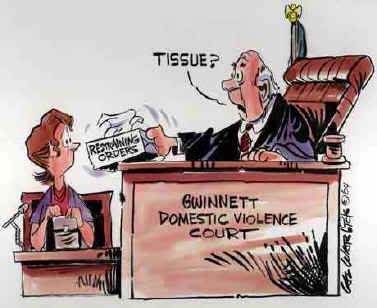
Come to think of it, our Constitution is a restraining order as well, and those in power treat it the same way that common criminals treat standard restraining orders.

I hadn’t really thought about it in just that way before, but he’s right. The purpose of a constitution in a Constitutional Republic is as a restraint on the powers of government, and since power corrupts and attracts the corrupt, pretty much all it takes is time and entropy for those restraints to be overcome, bypassed, and finally ignored. Now we have 545 people who each swear an oath to uphold and defend that piece of paper before they assume their offices, and by all appearances well over half either haven’t read it, or are deliberate liars. Or both.

And I’m not sure about the rest of them.

UNCLE Sam

I’ve been thinking about this for awhile. Last Friday I wrote Government /= Adulthood, from which I will repeat here:

Quite while back I quoted one Jeffery Gardener from an April 27, 2005 Albuquerque Journal column, “Save Us From Us.” In it Gardener said:

During the 1992 presidential debates, there was a moment of absurdity that so defied the laws of absurdity that even today when I recall it, I just shake my head.

It was during the town hall “debate” in Richmond, Va., between the first President Bush and contenders Bill Clinton and Ross Perot.

A grown man – a baby boomer – took the microphone from the moderator, Carol Simpson of ABC News, and said, in a fashion: You’re the president, so you’re like our father, and we’re your children.

See? My head’s shaking already. Where did that come from? Would a grown man have told a president something like that 100 years ago – or 50?

We’ve got our wires crossed, and our ability to accept responsibility for our lives – once so ingrained in our American nature that President Kennedy felt comfortable telling us to “ask not what your country can do for you” – has been short-circuited. We’ve slouched en masse into an almost-childlike outlook: You’re the president, so you’re like our father.

The fact that an adult – on national television, no less – would say this and later be interviewed as though he’d spoken some profound truth struck me then, as now, as more than a little absurd. It was alarming.

It’s still alarming.

In today’s USA Today was a letter from G. Bruce Hedlund of San Andreas, California. Mr. Hedlund said this:

Think of our country as a society made up of children and a government made up of adults. It is up to the adults to weigh all the options and provide services in the best interests of the children.

There is so much wrong with this I don’t even know where to start, but I will say that this attitude is responsible for the US receiving the government we’ve voted for.

In the comments to that piece, reader Dutton recalled something he’d read that I had published, a QotD from an AR15.com contributor that goes like this:

This “homeland” shit that suddenly started up in the last couple years pisses me off. It reeks of the “fatherland” and “motherland” propaganda shit our enemies used throughout the 20th century. The Nazi regime was “father” to the German people. The Soviet regime was “mother” to the Russian people.

This guy is our uncle and that’s as close as I want the fucker.

I don’t need the government to be my big brother, my parent, my nanny, or my caretaker. It needs to maintain public services (roads, etc.), maintain foreign relations and the military, keep the states from squabbling, and stay the fuck out of my life.

I was doing some web-surfing earlier in the week in relation to the Obama “people are askeered” piece, and ran across a reference to George Lakoff’s book Moral Politics: How Liberals and Conservatives Think. I found it in association with Thomas Sowell’s A Conflict of Visions, which I have read. I can’t find that link right now, but what I found interesting was the reference to Lakoff’s divisor. Sowell divides people into two categories based on their “vision.” One vision, the “constrained” or “tragic,” sees humanity as inherently flawed, requiring a system of government that can constrain the worst acts of the worst flawed. The other vision, the “unconstrained” or utopic, sees humanity as perfectible, and requires a system of government that can enable the enlightened to lead us all to that perfection.

Lakoff, on the other hand, narrows his topic to “conservatives” and “liberals,” leaving out (I would argue) a pretty significant chunk of the populace. According to the Wikipedia entry on Moral Politics, Lakoff says that the conservatives are the party of the “Strict Father,” and the liberals are the party of the “Nurturant Parent.” I’ve heard it expressed elsewhere as “the Daddy Party and the Mommy Party.”

And I think there’s some validity in that argument. That’s what they’ve become. Except they’re the dysfunctional, divorced parents of the modern present, either fighting over the kids or ignoring them.

And they were never supposed to have those roles to begin with.

I have argued on these pages for years that our educational system has been deliberately dumbed-down to produce a pliant electorate. Our media has done much the same. On a fairly recent episode of Vicious Circle, one of the contributors was Tracie, a professional member of the MSM (a newspaper reporter). She mentioned that her AP stylebook instructs her to write to a fourth-grade level, for instance.

I’ve quoted from Robert A. Heinlein’s Starship Troopers before, but here’s a pertinent piece of that book:

Mr. Dubois then demanded of me, “Define a ‘juvenile delinquent.'”

“Uh, one of those kids — the ones who used to beat up people.”

“Wrong.”

“Huh? But the book said — “

“My apologies. Your textbook does so state. But calling a tail a leg does not make the name fit. ‘Juvenile delinquent’ is a contradiction in terms, one which gives a clue to their problem and their failure to solve it.

“‘Delinquent’ means ‘failing in duty.’ But duty is an adult virtue — indeed a juvenile becomes an adult when, and only when, he acquires a knowledge of duty and embraces it as dearer than the self-love he was born with. There never was, there cannot be, a ‘juvenile delinquent.’ But for every juvenile criminal there are always one or more adult delinquents — people of mature years who either do not know their duty, or who, knowing it, fail.

“And that was the soft spot which destroyed what was in many ways an admirable culture.”

Government /= Adulthood drew a few links, one from Bayou Renaissance Man. Peter’s take on it was this:

In the USA, both major political parties are equally guilty of passing laws and regulations favoring their particular interest and support groups. People wail and scream about President Obama riding roughshod over US contract and financial law to give major benefits to the unions in the Government takeover of General Motors and Chrysler; but they forget that Republicans did the same for the bankers and businessmen who supported them when they were in the majority in Congress and the Senate. Both parties are equally guilty.

If our society is made up of children, we have no business voting. Voting is for adults. If we’re adult enough to vote, we’re adult enough to demand that those we elect act in our interests, not theirs: and that means holding them accountable as servants of the people, not masters. The day we surrender to them power over us in loco parentis is the day that we’re truly screwed.

I think that day was many years ago. It’s just taken awhile for the damage to accumulate.

In the comments to Peter’s piece, Rauðbjørn of Firepower & Philosophy linked to his post, The Difference between an Adult and a Grown-up. He had this to add:

I’ve been thinking a lot lately about my relationships, and why I get along so well with some people, and why others make my teeth itch. I finally came up with an answer. Those people I get along with best are Adults, Grown-ups make my teeth itch.

Now, I know what many of you are thinking, “Rauðbjørn, those words mean the same thing! Don’t they?”

My response to you is “No.” In a word, the difference between an Adult and a Grown-up is responsibility.

Now then, any schmuck can take responsibility for himself. Those who don’t are easy to spot, just sit in on a day’s worth of arraignments down at your local courthouse. Of course there are sometimes a few Adults and even a Grown-up or two mixed in, but by and large, the docket is a hit parade of 30 year old adolescents. Those too impressed by their own fart-smell or the size of their Johnson to have a care in the world, or if they care, are too broken to be able to follow the rules without a post-hypnotic suggestion and a Quaalude.

A Grown-up is someone that pays his bills, meets his rent, saves for the future, keeps his nose clean and to the grindstone. They have a dog and a white picket fence 2.3 kids and barbeques on Sunday. He is John Q. Public.

An Adult is more than this.

Go read the whole thing. Interestingly enough, just the other day Instapundit had a one-sentence post, IS “ADULT” BECOMING A DIRTY WORD? But of course! Now it means “Grown-up” at most.

Jeffery Gardener in his Albuquerque Journal op-ed was exactly right: would anyone a hundred or even fifty years ago have even considered the idea of telling a sitting president “you’re like our father, so we’re your children”? And it is now not an uncommon outlook. It’s shared by the members of both major parties. They differ on whether government should be Stern Daddy or Nurturing Mommy, but they see their roles as being the Adults, and ours as being at most the 30 year old adolescents who still live at home.

Face it, sitting on the couch eating Cheetos and watching porn while Daddy puts the roof over your head and Mommy does your laundry is a lot easier than doing the hard work of being an Adult, much less a Grown-up, but John Adams was pretty much right when he said:

Our Constitution was made only for a moral and religious people. It is wholly inadequate to the government of any other.

Adams said “moral and religious” but what he meant was ADULT.

Unfortunately, it has become obvious that we aren’t electing Adults, we’re electing (at best) Grown-ups. Regardless, our government shouldn’t be our parent, it should be no closer than that distant Uncle.

Our Neocortical Overlords

You find interesting things in foreign newspapers. Two recent pieces from The Australian are cases in point.

The first one, We have a fundamental right to be wrong, is an opinion piece that mentions one of my least-favorite people, Cass Sunstein.

Excerpt:

Frank Brennan’s recent National Human Rights Consultation report recommends assessing all legislation to ensure it conforms to Australia’s human rights legislation.

The report also proposes an information campaign to ensure we all understand our obligations on human rights.

This is an excellent example of the social-engineering approach that assumes everybody needs ideological education and that we will all think the same with a wink and a nudge from people who know what is best.

Especially a nudge, along the lines of the ideas in behavioural economist Richard Thaler and law academic Cass Sunstein’s Nudge: Improving Decisions about Health, Welfare and Happiness.

Not that the pair want to manipulate people’s politics or impose their own ideas of social justice on anybody. Far from it: they focus on economic issues, arguing that society can be improved by using policy to nudge people into making decisions they otherwise will not see are in their interest. But Nudge‘s underpinning idea is that most of us do not know what is good for us. This appeals to people who think they do.

There is nothing perpetually aggrieved intellectuals enjoy more than demonstrating that the rest of us are idiots.

There’s more. Read the whole thing.

After that comes Obama descends to pseudoscience, a truly fascinating op-ed written by a Washington Post columnist. It’s fascinating that an Australian paper picked this piece to run. Of course, the headline in the Post was a bit different, Obama the snob. Mr. Gerson has this to say:

After a series of ineffective public messages — leaving the political landscape dotted with dry rhetorical wells — President Obama has hit upon a closing argument.

“Part of the reason that our politics seems so tough right now,” he recently told a group of Democratic donors in Massachusetts, “and facts and science and argument [do] not seem to be winning the day all the time is because we’re hard-wired not to always think clearly when we’re scared. And the country is scared.”

Let’s unpack these remarks.

Obama clearly believes that his brand of politics represents “facts and science and argument.” His opponents, in disturbing contrast, are using the more fearful, primitive portion of their brains. Obama views himself as the neocortical leader — the defender, not just of the stimulus package and health-care reform but also of cognitive reasoning. His critics rely on their lizard brains — the location of reptilian ritual and aggression. Some, presumably Democrats, rise above their evolutionary hard-wiring in times of social stress; others, sadly, do not.

Though there is plenty of competition, these are some of the most arrogant words ever uttered by an American president.

The neocortical presidency destroys the possibility of political dialogue. What could Obama possibly learn from voters who are embittered, confused and dominated by subconscious evolutionary fears? They have nothing to teach, nothing to offer to the superior mind. Instead of engaging in debate, Obama resorts to reductionism, explaining his opponents away.

But of course! The Ruling Class are our intellectual superiors! We live in the “flyover states.” We shop at Wal*Mart. We eat at McDonald’s and The Olive Garden. We don’t even know the price of arugula! We make bad decisions! (Well, we did elect these clowns . . . )

“Bad decisions,” of course, being defined as “counter to our Neocortical Overlords.”

I, for one, do not welcome our Neocortical Overlords. As Glenn Reynolds has been describing them recently, they’re not so much educated as credentialed, and we’re finally figuring that out, as the house of cards we’ve built over the last hundred years is teetering near collapse.

You’re damned right we’re scared.

And as Thomas Sowell (among others) has been pointing out for literally decades, the problem with The Anointed isn’t that they know so much, it is that they know so much that is wrong.

And they’re in charge.

Mutually Exclusive

I found this bit of news today kinda interesting:

Crowd gets raucous at Oberstar-Cravaack forum

U.S. Rep. Jim Oberstar and challenger Chip Cravaack didn’t just face each other at Tuesday’s Minnesota 8th Congressional District candidate forum at the Duluth Entertainment Convention Center Auditorium, they faced angry mobs of their opponent’s supporters.

But that wasn’t the “kinda interesting” part. This was:

Oberstar said the health-reform package “that I proudly voted for” will guarantee coverage despite pre-existing conditions, guarantee coverage won’t be cut off, end caps on benefits and, eventually, reduce the cost of health insurance while covering more people.

Guaranteed coverage of pre-existing conditions. Guaranteed uncapped benefits. Guaranteed unlimited coverage. More people enrolled.

And it’ll cost less.

Either he’s stupid enough to believe that, or he thinks we’re stupid enough to.

But economics precludes it.

And they wonder why the TEA Party exists.

BRILLIANT!

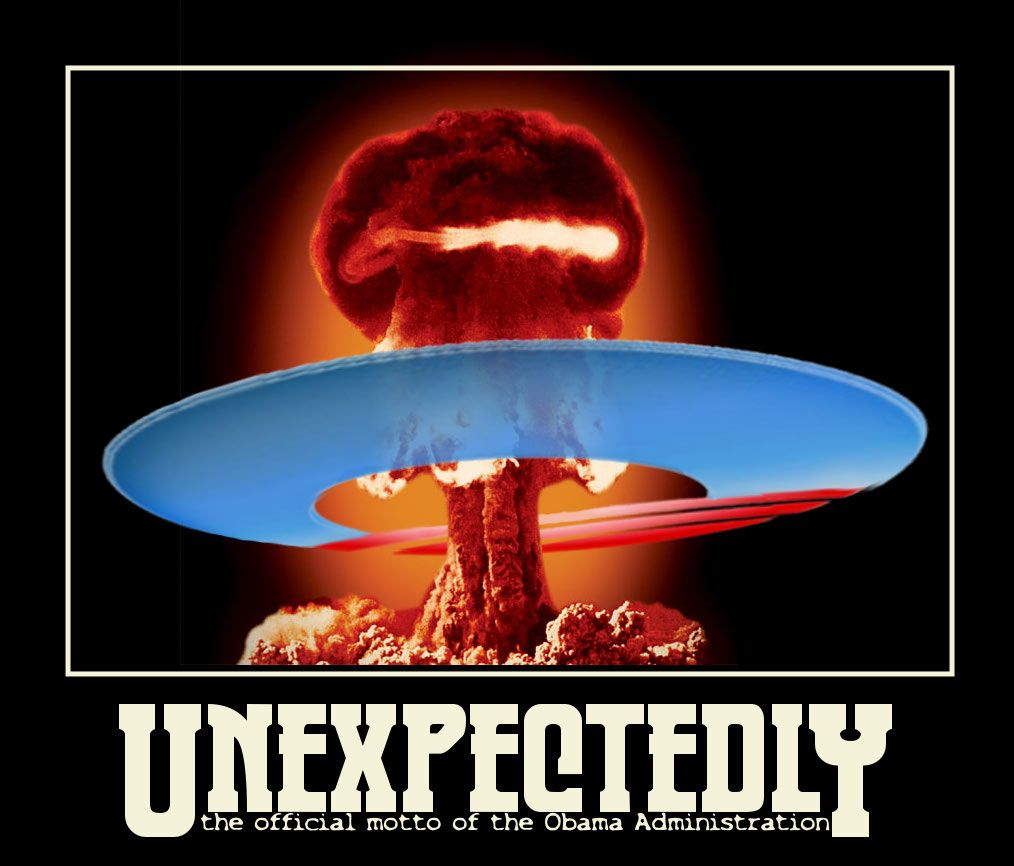
I’ve used that particular adjective before, but it’s appropriate once again for this bit of artistry found at American Digest by way of the blog Serr8d’s Cutting Edge:

We’re all used to hearing that bad economic news is continuously occurring “unexpectedly,” but when an American city sits under a mushroom cloud in the not-too-distant future, we will be undoubtedly told that the weather there turned “unexpectedly warm,” and not to worry.

We’re in the best of hands.

And it was all George Bush’s fault.

Government /= Adulthood

Quite while back I quoted one Jeffery Gardener from an April 27, 2005 Albuquerque Journal column, “Save Us From Us”. In it Gardener said:

During the 1992 presidential debates, there was a moment of absurdity that so defied the laws of absurdity that even today when I recall it, I just shake my head.

It was during the town hall “debate” in Richmond, Va., between the first President Bush and contenders Bill Clinton and Ross Perot.

A grown man – a baby boomer – took the microphone from the moderator, Carol Simpson of ABC News, and said, in a fashion: You’re the president, so you’re like our father, and we’re your children.

See? My head’s shaking already. Where did that come from? Would a grown man have told a president something like that 100 years ago – or 50?

We’ve got our wires crossed, and our ability to accept responsibility for our lives – once so ingrained in our American nature that President Kennedy felt comfortable telling us to “ask not what your country can do for you” – has been short-circuited. We’ve slouched en masse into an almost-childlike outlook: You’re the president, so you’re like our father.

The fact that an adult – on national television, no less – would say this and later be interviewed as though he’d spoken some profound truth struck me then, as now, as more than a little absurd. It was alarming.

It’s still alarming.

In today’s USA Today was a letter from G. Bruce Hedlund of San Andreas, California. Mr. Hedlund said this:

Think of our country as a society made up of children and a government made up of adults. It is up to the adults to weigh all the options and provide services in the best interests of the children.

There is so much wrong with this I don’t even know where to start, but I will say that this attitude is responsible for the US receiving the government we’ve voted for.

On that note, I think I’m going to go get some dinner.

Quote of the Day – de Tocqueville Edition

From the National Review Online column by Mark Krikorian, “A Network of Small Complicated Rules, Minute and Uniform” from October 1:

The federal government bans the incandescent light bulb. It bans street signs that have all capital letters and mandates what font they need to be in. Now, Congress has seen fit to focus its august attention on the volume of TV commercials.

The problem is not that these things create unnecessary costs or destroy jobs, which they do, or that lawmakers have more important things to do, which is also true. Rather, the federal government has no business doing any of these things. Yes, the entitlements trainwreck is a bigger issue, but if we, as a people, continue to shrug at this sort of thing, our unfitness for self-government will become undeniable.

It still amazes me that Tocqueville foresaw this soft despotism so long ago:

It covers the surface of society with a network of small complicated rules, minute and uniform, through which the most original minds and the most energetic characters cannot penetrate, to rise above the crowd. The will of man is not shattered, but softened, bent, and guided; men are seldom forced by it to act, but they are constantly restrained from acting. Such a power does not destroy, but it prevents existence; it does not tyrannize, but it compresses, enervates, extinguishes, and stupefies a people, till each nation is reduced to nothing better than a flock of timid and industrious animals, of which the government is the shepherd.

That’s about 2/3rds of the whole piece, but it’s the QotD.

I’m amazed at the prescience of de Tocqueville, but given the predictability of human nature, maybe I shouldn’t be.