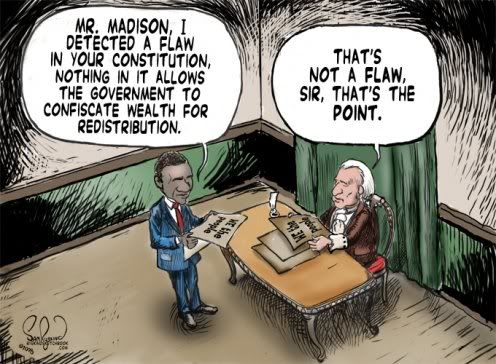
Well, Given His Recently Unearthed Coal Comments . . .
I’d say this cartoon is pretty much spot-on. (h/t Theo Spark)

The Smallest Minority on earth is the individual. Those who deny individual rights cannot claim to be defenders of minorities. – Ayn Rand
Well, Given His Recently Unearthed Coal Comments . . .
I’d say this cartoon is pretty much spot-on. (h/t Theo Spark)
On Professor Brian Anse Patrick’s “Administrative Control Bias” of the media:
This time around I think it’s more than just the usual MSM leftward bias. What the Brits may not have noticed is that the MSM actually has a vested self-interest in Obama winning this thing. After all, it won’t be long before the MSM will join Wall Street and General Motors at the edge of the abyss and in desperate need of a bailout (and in the MSM’s case, coupled with additional protection in the form of Fairness Doctrine v2.0). It’s not hard to see which candidate, should he win on Tuesday, is most likely to go along with this. – “Joshua” in a comment to Presidential Media Bias as Seen from Across the Pond.
Hmm. . . Fits all the available facts.
In relation to yesterday’s post, here’s something in a similar vein from the UK’s Guardian:
Mad about The One
The US media have been captivated by Obama, at the expense of their curiosity and scepticismHarold Evans, Saturday, Nov. 1, 2008
It’s fitting that the cynicism “vote early and vote often” is commonly attributed to Chicago’s Democratic boss, mayor Richard Daley, who famously voted the graveyards in 1960 to help put John Kennedy in the White House. In this 2008 race, it’s the American media that have voted very early and often. They long ago elected the star graduate of Chicago’s Democratic machine, Barack Obama.
I am not talking of editorials in newspapers, though Obama has the preponderance of the endorsements over John McCain. Obama certainly deserves the credit for recruiting impressive advisers and running a more efficient campaign machine than any one in the US’s political history.
What’s troubling to anyone old-fashioned enough to care about standards in journalism is the news coverage in mainstream media. Forget the old notions of objectivity, fairness, thoroughness, and so on. The nastiest rumours on both sides haven’t been published, but the coverage has been slavishly on the side of “the one”.
It has not just been anti-Republican. It goes without saying that after eight years of George Bush’s macho blunders, the disenchantment of even the conservative outlets was bound to show. Researchers at the Project for Excellence in Journalism report that in the six weeks since the Republican convention, McCain, once the darling of the media, got four times as many negative stories as positive ones. Meanwhile, Obama got twice as many positive stories as McCain. The website Politico has also acknowledged that it had loaded the dice against McCain: 100 stories were more favourable to Obama than McCain; 69 were the opposite.
But the press bias towards Obama doesn’t represent a simple revulsion for the Republican party. It was on display in the Democratic primaries with the persecution of Hillary Clinton. Worst of all, in the primaries, the press let the Obama campaign get away with continuous insinuations below the radar that the Clintons were race-baiters. Instead of exposing that absurd defamation for what it was – a nasty smear – the media sedulously propagated it.
Clinton made the historically correct and uncontroversial remark that civil rights legislation came about from a fusion of the dreams of Dr Martin Luther King and the legislative follow-through by President Lyndon Johnson. The New York Times misrepresented that as a disparagement of King, twisting her remarks to imply that “a black man needed the help of a white man to effect change”. This was one of a number of manipulations on race by the Obama campaign, amply documented by the leading Democratic historian, Princeton’s Sean Wilentz. Clinton came close to tears in a coffee shop in Portsmouth, New Hampshire, which many thought helped her to win an upset victory there. MSNBC television gave a platform to the Chicago congressmen, Jesse Jackson Jr, where he questioned her tears and claimed that she’d not shed any tears for the black victims of Katrina, and that she’d pay for that in the South Carolina primary, where 45% of the electorate would be African-Americans.
In fact, MSNBC ran a non-stop campaign for Obama propelled by the misogyny of its anchors, Chris Matthews, Keith Olbermann and David Shuster. Chelsea Clinton joining Clinton’s campaign prompted Shuster to report she was “pimping” for her mother.
Obamania has not been deflated one bit by the non-stop talkers on rightwing radio. They offer vituperation in place of enlightenment; paranoia in place of policies, and as such have little influence with the crucial independents.
On the web, the rightwing Drudge Report highlights anything that favours McCain, the Huffington Post does the same for Obama, and the more independent Slate has said only one of its staff intends to vote for McCain, the other 55 for Obama. Fox News has the vehement Sean Hannity paired with the mildly liberal Alan Colmes, (mildly liberal?) not a fair match, but it has been more willing to investigate than CNN. In the Democratic primaries, there was a pattern on CNN where the short news videos of Clinton rarely let you hear what she was saying, but the short news videos of Obama let his words come through. I mentioned this to a CNN editor who said, “Oh, that’s our young video editors, they just find Obama more exciting.”
The young and affluent liberals have been captivated by Obama’s charisma, the unstated notion that electing a black man will be absolution for the years of discrimination and prejudice, and the expectation that Obama’s undoubted appeal to the outside world will repair America’s image. All understandable, but these emotions have been allowed to swamp the commonplace imperatives of journalism: curiosity and scepticism.
All the mainstream national outlets were extraordinarily slow to check Obama’s background. And until it became inescapable because of a video rant, they wouldn’t investigate the Reverend Jeremiah Wright connection for fear of being accused of racism. They wouldn’t explore Obama’s dealing with the corrupt, now convicted, Chicago businessman Tony Rezko. They haven’t investigated Obama’s pledge to get rid of the secret ballot in trade union affairs. After years of inveighing against “money in politics”, they’ve tolerated his breach of the pledge to restrict himself to public financing as McCain has done (to his cost). Now the LA Times refuses to release a possibly compromising video, which shows Obama praising Palestinian activist Rashid Khalidi at a 2003 banquet, saying its promises to its source prevent it from doing so.
The British press is notorious for political distortions, which more or less balance out. But the American press likes to think of itself as more superior and detached than it actually is. In 2000, the mainstream media did a great deal to elect George Bush by portraying Al Gore as a boastful liar.
Let’s hope the consequences of electing “the one” will be as wondrous as the press has led the voters to believe.
Let’s rather hope that “the one’s” loss will be seen (among other things) as repudiation of the press’s manipulation.
I received the link to this piece from journalism professor Edward Wasserman, with whom I had a short exchange back in 2004, after I sent him an email about the Malone ABC piece. Hopefully in the not-too-distant future, I’ll have a post up concerning a new exchange.
Gun Sales
Tam points to a story on “Gun Sales Thriving in Uncertain Times” in the WaPo with this comment:
Say what you will about Barry…
…but the man’s an even better gun salesman than Hils.
In the last 30 days (actually less) I’ve purchased a T/C Encore frame, ordered an assembled Bushmaster AR-15 lower (less buttstock), and going in the mail today is an order for a custom M14 to Ted Brown.
I’m also buying other stuff – reloading supplies, etc. (I purchased 11 20-round magazines for the M14 already, even though I won’t have the rifle for months.) One thing I’ve noticed when I go into Sportsman’s Warehouse or Murphy’s guns (especially Murphy’s) is that the gun counter is crowded. Murphy’s parking lot just isn’t big enough and hasn’t been for a while. So the WaPo’s observations are accurate even here in flyover country. Perhaps especially here in flyover country.
Van der Leun finds a Good One
By the same artist:

And by all means, do peruse the site. You’ll like this one, for example.
If you’re not too lazy to get off the couch. Bob Parks has found perhaps the definitive example of the stereotypical Obama supporter:
[youtube https://www.youtube.com/watch?v=381gFG4Crr8&color1=0xb1b1b1&color2=0xcfcfcf&hl=en&fs=1&w=425&h=344]
I never thought this day would ever happen. I won’t have to worry ’bout puttin’ gas in my car. I won’t have to worry ’bout payin’ my mortgage.
Yeah, I never thought this day would happen either. Guess I’ll be puttin’ gas in your car and payin’ your mortgage.
Oh, wait . . . I don’t make $250k a year. Or is it $150k. Or $100k.
(Edited to correct transcript error.)
UPDATE: The original JS-Kit/Echo comment thread for this post is available here, thanks to the work of reader John Hardin.
Peggy Noonan has her own web page, unsurprisingly enough, and several days ago I made use of her contact page to ask her a question. It says right on the contact page:
(O)wing to the amount of spam I have received in the past, messages are not forwarded to me until they have been reviewed. That generally results in a delay of a day or two before I see the message.
I imagine she’s received a flood of mail since she endorsed Obama, so I’m not all that surprised that my little missive has apparently not reached her notice.
I didn’t save it, but I remember the gist of it. It was, after all, a variation of the one I sent to Rev. Donald Sensing. In Ms. Noonan’s case, the piece she wrote was Oct. 27th, 2005’s A Separate Peace, which inspired my essay, Tough History Coming. I quoted from her column:
Do people fear the wheels are coming off the trolley? Is this fear widespread? A few weeks ago I was reading Christopher Lawford’s lovely, candid and affectionate remembrance of growing up in a particular time and place with a particular family, the Kennedys, circa roughly 1950-2000. It’s called “Symptoms of Withdrawal.” At the end he quotes his Uncle Teddy. Christopher, Ted Kennedy and a few family members had gathered one night and were having a drink in Mr. Lawford’s mother’s apartment in Manhattan. Teddy was expansive. If he hadn’t gone into politics he would have been an opera singer, he told them, and visited small Italian villages and had pasta every day for lunch. “Singing at la Scala in front of three thousand people throwing flowers at you. Then going out for dinner and having more pasta.” Everyone was laughing. Then, writes Mr. Lawford, Teddy “took a long, slow gulp of his vodka and tonic, thought for a moment, and changed tack. ‘I’m glad I’m not going to be around when you guys are my age.’ I asked him why, and he said, ‘Because when you guys are my age, the whole thing is going to fall apart.’ “
Mr. Lawford continued, “The statement hung there, suspended in the realm of ‘maybe we shouldn’t go there.’ Nobody wanted to touch it. After a few moments of heavy silence, my uncle moved on.”
Lawford thought his uncle might be referring to their family–that it might “fall apart.” But reading, one gets the strong impression Teddy Kennedy was not talking about his family but about . . . the whole ball of wax, the impossible nature of everything, the realities so daunting it seems the very system is off the tracks.
And–forgive me–I thought: If even Teddy knows . . .
I asked her, as I asked Rev. Sensing, if the intervening years had altered her opinion, and if so in what way.
But here’s an equally pertinent excerpt, the concluding paragraphs:
If I am right that trolley thoughts are out there, and even prevalent, how are people dealing with it on a daily basis?
I think those who haven’t noticed we’re living in a troubling time continue to operate each day with classic and constitutional American optimism intact. I think some of those who have a sense we’re in trouble are going through the motions, dealing with their own daily challenges.
And some–well, I will mention and end with America’s elites. Our recent debate about elites has had to do with whether opposition to Harriet Miers is elitist, but I don’t think that’s our elites’ problem.
This is. Our elites, our educated and successful professionals, are the ones who are supposed to dig us out and lead us. I refer specifically to the elites of journalism and politics, the elites of the Hill and at Foggy Bottom and the agencies, the elites of our state capitals, the rich and accomplished and successful of Washington, and elsewhere. I have a nagging sense, and think I have accurately observed, that many of these people have made a separate peace. That they’re living their lives and taking their pleasures and pursuing their agendas; that they’re going forward each day with the knowledge, which they hold more securely and with greater reason than nonelites, that the wheels are off the trolley and the trolley’s off the tracks, and with a conviction, a certainty, that there is nothing they can do about it.
I suspect that history, including great historical novelists of the future, will look back and see that many of our elites simply decided to enjoy their lives while they waited for the next chapter of trouble. And that they consciously, or unconsciously, took grim comfort in this thought: I got mine. Which is what the separate peace comes down to, “I got mine, you get yours.”
You’re a lobbyist or a senator or a cabinet chief, you’re an editor at a paper or a green-room schmoozer, you’re a doctor or lawyer or Indian chief, and you’re making your life a little fortress. That’s what I think a lot of the elites are up to.
Not all of course. There are a lot of people–I know them and so do you–trying to do work that helps, that will turn it around, that can make it better, that can save lives. They’re trying to keep the boat afloat. Or, I should say, get the trolley back on the tracks.
That’s what I think is going on with our elites. There are two groups. One has made a separate peace, and one is trying to keep the boat afloat. I suspect those in the latter group privately, in a place so private they don’t even express it to themselves, wonder if they’ll go down with the ship. Or into bad territory with the trolley.
I believe I have my answer. I think Ms. Noonan’s opinion hasn’t changed. She’s just found a group of elites she fervently hopes might possibly save the ship, put the trolley back on the tracks, ignoring the fact that the elites never do the actual work. It’s always left to Joe Six Pack. (Or Joe the Plumber.)
There’s a scene from Frank Herbert’s classic SF novel, Dune of a dinner party on the desert planet Arrakis where some rather delicate but vicious political maneuvering is going on. During the dinner conversation, Paul Atreides, the young hero of the novel (not at that point, though – that comes later) takes a political jab at one of the dinner guests himself:
“Once, on Caladan, I saw the body of a drowned fisherman recovered. He –“
“Drowned?” It was the stillsuit manufacturer’s daughter.
Paul hesitated, then: “Yes. Immersed in water until dead. Drowned.”
“What an interesting way to die,” she murmered.
Paul’s smile became brittle. He returned his attention to the banker. “The interesting thing about this man was the wounds on his shoulders — made by another fisherman’s claw-boots. The fisherman was one of several in a boat — a craft for traveling on water — that foundered . . . sank beneath the water. Another fisherman helping recover the body said he’d seen marks like this man’s wounds several times. They meant another fisherman tried to stand on this poor fellow’s shoulders in the attempt to reach the surface — to reach air.”
“Why is this interesting?” the banker asked.
“Because of an observation made by my father at the time. He said the drowning man who climbs on your shoulders to save himself is understandable — except when you see it happen in the drawing room.” Paul hesitated just long enough for the banker to see the point coming, then: “And, I should add, except when you see it at the dinner table.”
And, I would add, except when you see it in political punditry.
Quote of the Day – Monster
“You ever heard of Richard Matheson? He wrote some pretty good science fiction back in the day, lots of Twilight Zone Episodes and a whole host of short stories back in the 50’s and 60’s. He’s most remembered for one short story thats been made into a movie about a half a dozen times. It’s called “I AM LEGEND”. Its the story of the last man on earth after a plague wipes out most of the population. What parts of the population the plague doesn’t wipe out, becomes transformed into what can best be described as ‘vampires’. Most people know that narrative of the story, but most every filmed version and most retelling of the story forget is the main point of the story. The point is this; When you live on a planet where humans are normal and vampires are the monsters, thats something we understand. What Matheson’s story forces the reader to come to grips with is the opposite, that when you live on a world where the vampires are the normal, then you, as the last remaining human, have become the monster.
“This is what we conservatives and libertarians have become. With the plague of ‘fairness’ now loose in the ecosystem of public ideas and discourse, we have become the monster. They are working to destroy our nest (the markets) and after that is destroyed, they will come for us.” – Varifrank, Monster.
READ. THE. WHOLE. THING.
I’ve been holding this one for Halloween.
From the same portion of the Uncommon Knowledge interview of Thomas Sowell:
Peter Robinson: Back to Barack Obama. You mentioned the, uh . . . I think you would call it a naive view of world affairs. That he places a great deal of faith in rhetoric, the ability of rhetoric to solve global problems. This reminds you of the 1930’s, it reminds you of Neville Chamberlain. I read you a quotation, the notion of “spreading the wealth around” and again you said that’s perfectly pure Socialist doctrine from the 1930’s. Is it . . . Would you argue that this man is the most leftwing, or the uh, purest embrace of the Unconstrained Vision that we’ve seen in American politics since . . . since when? Since the New Deal?
Thomas Sowell: Since there’s been an American politics.
Robinson: Really?
Sowell: Yes. Yes, I mean, even FDR you know pulled back on some things. But Obama really, he does have the Unconstrained Vision which is really an elitist vision that says “I know what is the best to be done, and I will do it.” When he says “I will change the world” you realize this is a man who’s actually accomplished nothing other than advancing his career through rhetoric. And it reminds me of a sophomore in college, you know, who thinks that he can run the world, because he’s never had to run anything. And you can believe that only until you have personal responsibility for consequences, and that’s when it gives you a little bit of humility.
Robinson: Why don’t the American people see through that? Isn’t that the fundamental bet that the Founders made, that the, that voters would see through, ultimately they’d see through nonsense?
Sowell: Yes, but that was before nonsense became a large part of the curriculum of our educational institutions.
Again, absolutely. Absolutely.
Now, read this.
Too Good a Quote to Leave Until Tomorrow
Aside from the fact that I have a QotD for tomorrow that I’ve been sitting on for a while.
Thomas Sowell from his Uncommon Knowledge interview with Peter Robinson, Part 4 of 5
When people ask me why am I going to vote for McCain rather than Obama it’s because I prefer disaster to catastrophe.
To further quote Mr. Sowell: Oh, absolutely. Absolutely.