Renormalizing the Gun Culture

…or “Scaring the White People”?

I think I first ran across the “Scaring the White People” meme at Say Uncle, and again a bit later. I took up the theme myself.

As I see it, there are essentially three “gun cultures” in this nation: the criminal gun culture, the genteel gun culture, and the gonzo gun culture.

The criminal gun culture is self-explanatory. It exists everywhere, even (perhaps especially) where gun ownership by individuals is heavily restricted or forbidden. The genteel gun culture is the culture of what many of us term the Fudds, the people whose only interest in firearms is for hunting, for example,  or who only shoot sporting clays and see “no reason” for any type of firearm other than what they themselves own.  “Nobody needs” type X gun, as far as they’re concerned.

The gonzo gun culture is the one that encompasses all other forms of shooting and collecting, from those of us who shoot IPSC and USPSA to those who spend literally thousands of dollars annually just feeding their Class III habit. We’re the ones who shoot a lot, and like pretty much anything that goes “bang!”  True, there is some overlap between groups, but we still hear from the genteels from time to time.

Then there’s the two groups who are not gunnies:  the ones who don’t think about them, and the ones who are afraid of them.  And there are a lot more of those than there are of us.

For years the only attention that firearms really got in the media was either crime reports on the news, or the occasional hunting show. Perhaps Wide World of Sports would do a piece on pheasant hunting in Montana, or elk in Wyoming. (Robin Williams did a funny riff about “hunting the monarch butterfly with the .44 Magnum” in one of his routines years ago.)  With the explosion of cable and the need for more content, we got shows like Jim Zumbo Outdoors, but Jim was a member of the genteel gun culture, as evidenced by the Great Zumbo Incident of 2007.

We also got shows like American Shooter with Jim Scoutten, and now his Shooting USA, both arguably a much broader-based view of the shooting sports and recreational shooting in general. Still, Jim isn’t what I’d call an avid supporter of the gonzo gun culture.

Now we have shows like the Outdoor Channel’s Wednesday night lineup of Shooting Gallery (which recently did an entire show on Joe Huffman’s Boomershoot event), Best Defense, the aforementioned Shooting USA, Sighting In, American Guardian, American Rifleman, Impossible Shots, and Cowboys. (Michael Bane is definitely a member of the gonzo gun culture!) Last year brought us History Channel’s Top Shots, about to begin its second season. We’ve actually begun to see some relatively fair treatment in the print media. What there is is overwhelmed by the rest, but still, it’s a sign that the times have been changing.

Well, maybe not the Times.

The renormalization of firearms in American culture is proceeding apace.

Tonight I watched my first episode of the Discovery Channel’s Sons of Guns, another “reality” show, this time about a Class III II SOT (Special Occupational Taxpayer) manufacturer in Louisiana. I haven’t seen that many short-barreled, suppressed, full-auto firearms in my life, and especially not on TV.

It must give Joan Peterson, Paul Helmke, Sarah Brady, Josh Sugarmann et al. nightmares.

And I can’t help but wonder if it “frightens the white people.” The show I saw did indicate, once, that you can’t just walk into a gun shop, buy an NFA restricted weapon and walk out the door with it, but it gave that impression at least one other time. The show I watched involved the assembly of a full-auto Browning M2 “Ma Deuce” machinegun from a parts kit, including the milling of the sideplates to convert the kit from semi- to full-auto.

It never mentioned that only licensed manufacturers can do that legally.  No mention of the 1986 ban was made.  No mention of NFA registration was made.  Just buy a ($6,000) parts kit, and put it together!

It showed the owner’s daughter making sales of multiple quantities of short-barreled suppressed “assault weapons” at “dealer pricing,” without bothering to mention that those sales were going to other licensed dealers. It showed her selling two short-barreled folding-stock suppressed 10/22 rifles, and knocking $500 off the price in exchange for a guided bowfishing trip. No mention of an NFA delay on that one.

This show, I think, could be a treasure-trove of propaganda for The Other Side. After all, remember what the Violence Policy Center wrote in its effort to ban “assault weapons”:

Assault weapons—just like armor-piercing bullets, machine guns, and plastic firearms—are a new topic. The weapons’ menacing looks, coupled with the public’s confusion over fully automatic machine guns versus semi-automatic assault weapons—anything that looks like a machine gun is assumed to be a machine gun—can only increase the chance of public support for restrictions on these weapons. In addition, few people can envision a practical use for these weapons.

(Bold emphasis mine.)  They’ve made it clear that lying to the public in order to frighten them into passing gun bans is perfectly acceptable, and we’ve seen that tactic used more than once.  It’s been a staple of this blog and several others pointing out incidents where it’s done.

My point is, we shouldn’t be helping them.  Personally, I like the show, but I know what’s being left out.  Joe and Jane Average haven’t got a clue.

Discuss.  I’m interested in what you think.

UPDATE:  It’s a topic of discussion at AR15.com.
Match Report – Almost There!

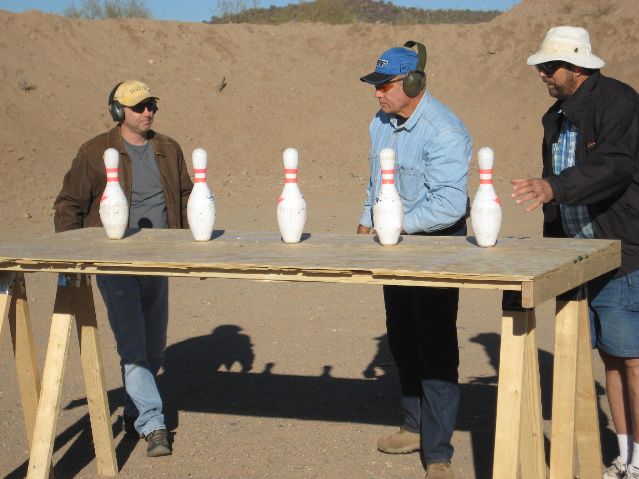
Turnout for this month’s Bowling Pin match was a bit lower – thirteen people in addition to myself, 25 guns.  I brought with me today four tables, but somehow only enough legs for three of them, so we shot (mostly) three-at-a-time.  And you know what?  I may stick to that format.  It worked pretty well!  I also brought an air horn as the match “start” signal.  EVERYBODY can hear it!

We went back to the best two out of three, double-elimination format, eschewing the “timed” runs for handicapping – we just went head-to-head.  I need to work on keeping a little better track of the competition using this format, but I think it’s the way to go, especially if turnout comes back up.

We started shooting at 9AM, and were done by 11:30.  Once again, thanks to everybody who helped reset targets, and especially to those who helped tear down afterwards.

Today’s winner for centerfire was John Higgins, who shot nine matches in four sets with his EAA Witness 9mm, losing only once.  Second place went to Jim Burnett, shooting a Beretta 92, also in 9mm, who gave John his single loss.  I won the .22 class, also shooting against John, who was having a great day.  John had gone undefeated in .22 (he’d already beaten me 2-0 in one match), but I managed to beat him in four straight runs, taking him out in double-elimination.  I love my Ruger MkII!

Larry Boykin won the $25 entry pot drawing.  

Next month’s match is February 13, the day before Valentine’s.  First rounds down range at 9:00AM.  Hope to see you there!

Boomershoot!

I watched the Outdoor Channel’s Shooting Gallery episode last night on Joe Huffman’s Boomershoot.  Except for host Michael Bane using the dreaded word “Tannerite,” the show was excellent.  (No footage of Joe’s daughter Kim, though.)  And we got to see David Whitewolf of Random Nuclear Strikes with his long-range specialty pistols.  I’ve shot some of Dave’s guns, and that inspired me to get The Power Tool™ that I took, along with my Remington 700 5R, to Boomershoot 2009.  I got a Boomer with it, too!  (And scared the hell out of several more.)

Bowling Pin Match, Sunday January 9

Tucson Rifle Club action range. Registration begins at 8:30 AM (we’re starting a little later). Sign in at the range office, but if all you’re going to do is shoot the match, you don’t need to pay the daily use range fee – it’s part of the match entry fee for non-members. $10 for the first gun, $5 each for additional guns. First round downrange (hopefully) by about 9:00.

We’re going to shoot Major (.40 and above), Minor (9mm and below), and .22 rimfire as separate classes, in a double-double-elimination (best two-out-of-three against a competitor, lose against two competitors and you’re done – at least in that division – for the day.)

Smallest centerfire allowed: .38 Special. Hollowpoint and flat-point bullets work better at carrying pins off the tables than round-nose or FMJ bullets do, regardless of caliber.

You’ll be paired off against other shooters in your division for head-to-head competition, again, best 2 out of 3 wins the match. Bring enough ammo! Most tables take way over five shots. Even if you lose the match, you can keep shooting until you’ve cleared your table if you want to. Consider it practice for the next round.

Whoever is left with after elimination will be declared victor of the division. The last match of the day will be a best two-out-of-three competition between the top Major and Minor shooters. Your only prize: the accolades of your peers.

Everyone who hangs around until the end of the shoot will be put in for a drawing. $1 of each entry goes into a pot. A drawing from the names of those present will be taken, and the winner gets the whole pot. Last month it was over $40, so you get your entry fee back, and a little gas money.

See you Sunday, January 9!

Pictures from the Pin Match

Bill and Elaine sent me some of the pictures they took from yesterday’s match. I promised I’d put them up.

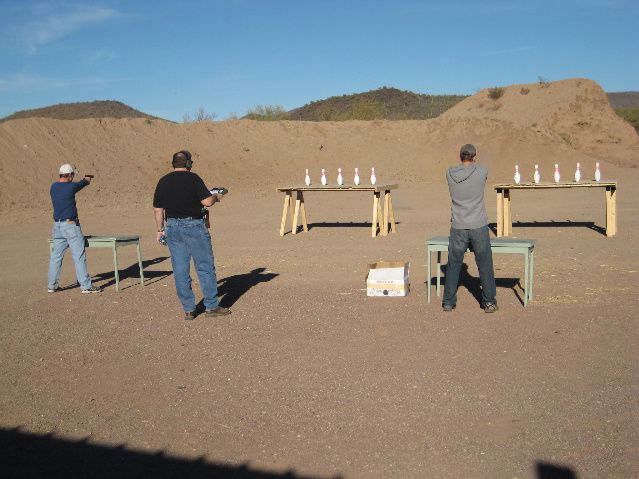
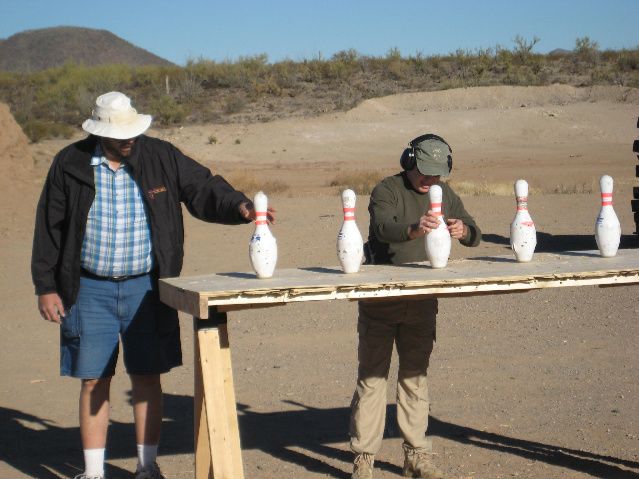
So, what’s a bowling pin match you ask? As CapitalistPig put it, it’s a combination of drag racing, bowling and shooting. Two people line up side-by-side to see who can shoot five bowling pins (or pin tops) off their table fastest. Here’s a table set up for shooting Minor (centerfire smaller than .40 S&W):

The table is eight feet wide, four feet deep, and about 42″ high. The pins are placed 18″ off the back edge of the table, and are spaced 16″ apart. Those people in the back there are my pin setters.

Once the tables are set, the competitors line up, and at the sound of the horn, they’re off!

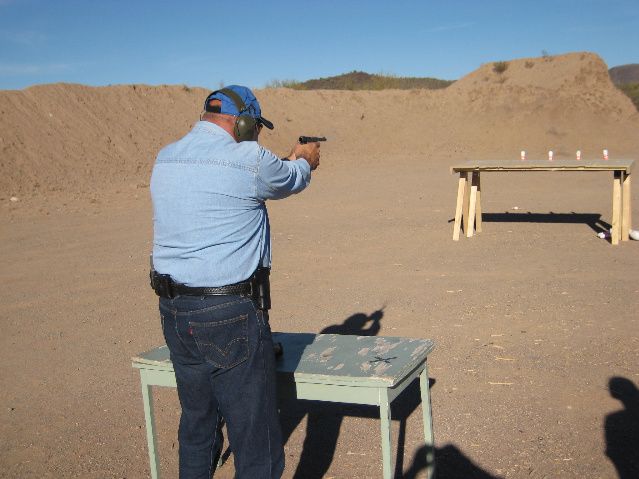
This pair is shooting Major – .40 S&W and larger – with the pins set 12″ off the front edge of the table, making it harder to get them on the ground.

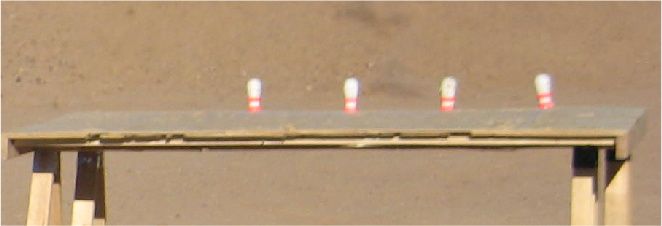
Then there’s the .22 Rimfire class, with five pin tops placed on the back edge of the table:

In all cases, the shooter stands at a table that is 25 feet from the front edge of the bowling pin table.  Those pin tops are pretty small 29′ away.

In all cases the shooters start with their guns in their hands in the “low-ready” position (in this case, muzzle on the surface of the table) and at the sound of the beep, they try to clear their five pins as fast as they can.

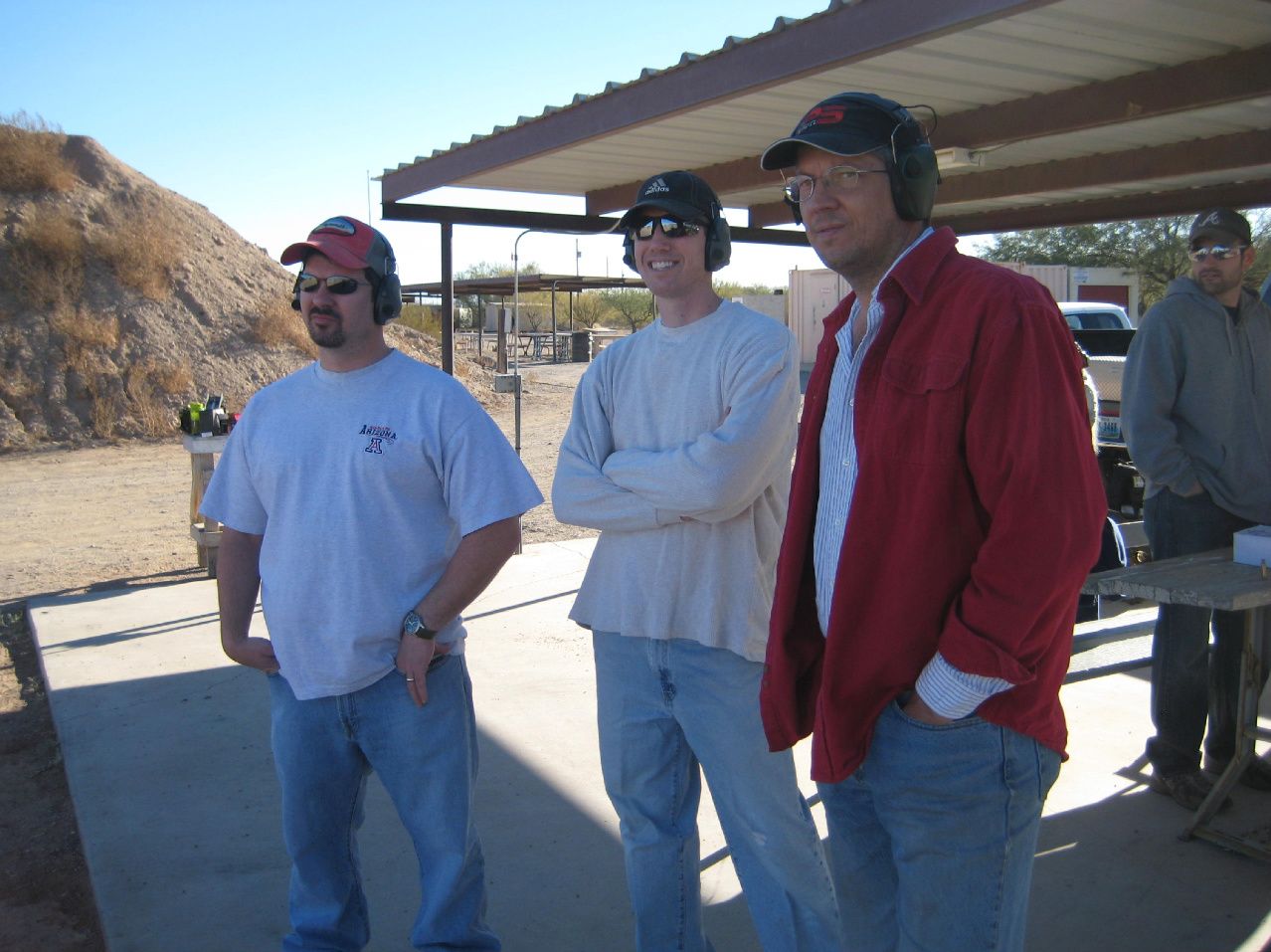
The rest of the competitors watch the matches,

or help reset the pins between matches,

or shoot the breeze.

All in all, it’s a fun way to spend the day! And since pin shooting emphasizes speed, accuracy, and power, it’s good practice, too.

Match Report: Twenty-Two Rabid Beavers

We held the December Bowling Pin match at Tucson Rifle Club today.  Last month, fourteen people showed up, and the round count got a bit out of hand, so I decided to separate the “Major” (.40S&W and up) from the “Minor” (smaller than .40) groups in an effort to cut down the number of matches.

That laughing sound you hear is fate toying with me.

Twenty-two people showed up.  With 37 guns.  Not including me and the two guns I brought.

Twelve people shot Minor.  Thirteen people shot Major.  And fourteen people shot .22 rimfire.

Last month, we shot a total of 133 matches – 105 centerfire and  28 rimfire.  My tables looked a bit chewed-on.  Instead of building new ones, though, I re-skinned them with 1/4″ plywood.  Today’s match went on so long seven or eight people left early.

We shot (even with the DNFs) 156 matches, not including the reshoots on three (3) ties.

The tables didn’t come home with me.  What’s left of them resides in the dumpster at the range, minus what looks like the output of twenty-two rabid beavers remaining on the ground at the action range.  And we picked up the bigger pieces.  In addition, twenty perfectly harmless bowling pins gave their all for our entertainment.  About eight of them will live on as pin tops for the .22 class.

The plan had been to shoot all the minor shooters against each other, and all the major shooters against each other, then the two winners against each other for an overall victor. About 2:30PM, that idea went right out the window.  So here are your winners:

.22 rimfire:  Tie –  Travis Higgins with a Ruger MkIII and me, your humble host with a MkII; nine wins each.  Third place goes to Jim Burnett with a Browning Nomad and eight wins.

Minor:  Tie – Jim Burnett with a Beretta 92 and Larry Boykin with a Rock Island 1911 seven wins each. Third place is also a tie – Jim Walters with a EAA Witness, Ken Cabrera with a Springfield XD, and John Higgins also with a Witness – six wins each. (Sorry about missing your six wins on the first pass, John!)

Major:  Here we have a clear winner – Cliff Reed and his Norinco 1911with ten wins.  Second place  goes to Jim Burnett and his Clark Custom pin gun with six, and third place is a tie between me with my Kimber and Elaine Tab with hers and four wins each.

The lopsided win count is due to the number of shooters who left early. It’s a lot of fun, but next month we’ve GOT to cut down on the number of matches.

Elaine and Bill Tab have promised me pictures, so those will be going up when I receive them.  Thanks to everyone who came, thanks especially to everyone who again helped set up, set pins, and tear down. Oh, and John Higgins won the drawing and the $37 pot.  Again.

Next month there will hopefully be FOUR tables to help speed things along. And an air-horn as a starting signal.  Sunday, January 9. Sign-up at 8:30, first round downrange at 9:00. See you there!

UPDATE: Great Satan has a brief match report and a video clip up!

Bowling Pin Shoot – Tucson, Sunday December 12

(Bumped)

Tucson Rifle Club action range. Registration begins at 8:30 AM (we’re starting a little later). Sign in at the range office, but if all you’re going to do is shoot the match, you don’t need to pay the daily use range fee – it’s part of the match entry fee for non-members. $10 for the first gun, $5 each for additional guns. First round downrange (hopefully) by about 9:00.

After last month’s mega-match, we’re going to shoot Major (.40 and above), Minor (9mm and below), and .22 rimfire as separate classes, but each class will be a free-for-all. Everyone in that class will shoot against everyone else in that class, regardless of pistol type.

Smallest centerfire allowed: .38 Special. Hollowpoint and flat-point bullets work better at carrying pins off the tables than round-nose or FMJ bullets do, regardless of caliber.

If you show up, you’ll be paired off against all other shooters in your class for one (1) man-on-man competition each. Bring enough ammo! We each shot in 14 centerfire matches last month, and most of us took way over five shots per table. This month should be a lower round count than that, but it’s entirely dependent on how many people show up.  And, even if you lose the match, you get to keep shooting until you’ve cleared your table if you want to. Consider it practice for the next round.

Whoever wins the most tables will be declared victor of the class. The last match of the day will be a best two-out-of-three competition between the top Major and Minor shooters. Your only prize: the accolades of your peers.

Everyone who hangs around until the end of the match will be put in for a drawing. $1 of each entry goes into a pot. A drawing from the names of those present will be taken, and the winner gets the whole pot. It’s been running a bit over $20, so you get your entry fee back, and a little gas money.

See you Sunday, December 12!

Range Report: Fiocchi Primer Test

A while back (quite a while back) the folks at LuckyGunner.com asked me if I’d be interested in testing some large rifle primers by Fiocchi. They were willing to send me a sleeve if I would try them out and report on them – good, bad, or indifferent. I said I’d be happy to, but it would be some time before I’d get a chance to actually use them. I told them I would try them out in my Remington 700 5R with my pet load.

Well, that time finally came.

The Fiocchi primers are sold in sleeves of 1,500 rather than the industry standard 1,000.

You get ten packs of 150 rather than 100. The packaging is compact and fairly handy.

At the time of this writing, the Large Rifle primers go for $41/1,500, or 2.73¢ per primer, not including shipping and HazMat fees. By contrast, the CCI BR-2 Benchrest primers I normally use are $50/1000, or 5¢ each not including tax, purchased locally.

To prepare for this test, I decided I wanted everything as identical as possible. I had some Black Hills brass that had originally been the red box (new rather than remanufactured) 168 grain moly-coated match loads. I had reloaded this brass once with 175 grain Sierra Match Kings, so this would be the third time this brass had been loaded. I decapped and trimmed all forty cases to 1.950,” chamfered the inside and outside of the case mouths, and then ran them in my tumbler to make sure they were shiny clean. Afterward, I ran them all through my RCBS small-base X-die to resize them.

These had been fired through the 5R before. I could tell because they all fit into my case gauge already, albeit just a little tightly. After sizing, they fall in and out with ease, and have just a tiny bit of wiggle-room at the case head end. This is what I have to do to get my reloads to feed in my M25 gas gun. In addition to testing the Fiocchi primers, I wanted to see what the small-base sizer does to accuracy in the 5R as opposed to neck-sizing only, which is what I normally do when reloading for my bolt-guns.

After decapping, trimming, chamfering, and resizing the brass, I sat down and hand-primed twenty cases with CCI BR-2’s, and twenty cases with Fiocchi Large Rifle NIK primers using my Lee Auto-Prime. The all seated firmly and consistently, so dimensionally the Fiocchi primers are very uniform. Then, using my modified RCBS ChargeMaster (my technique with that particular device has been thoroughly revised since that post), I threw forty identical 46.4 (± 0.05) grain loads of Alliant Reloder-15 powder (Caution: use load data you find on strange web sites at your own risk!), and seated forty Lapua 155 grain Scenar hollow-point boattail bullets to a cartridge overall length of 2.80″ using my Dillon RL-450 press and an RCBS seating die.

(Note to whom it may concern: The only thing I’ve been given in this entire review is 1,500 Fiocchi primers donated by LuckyGunner.com. Everything else I mention in this post, I bought.)

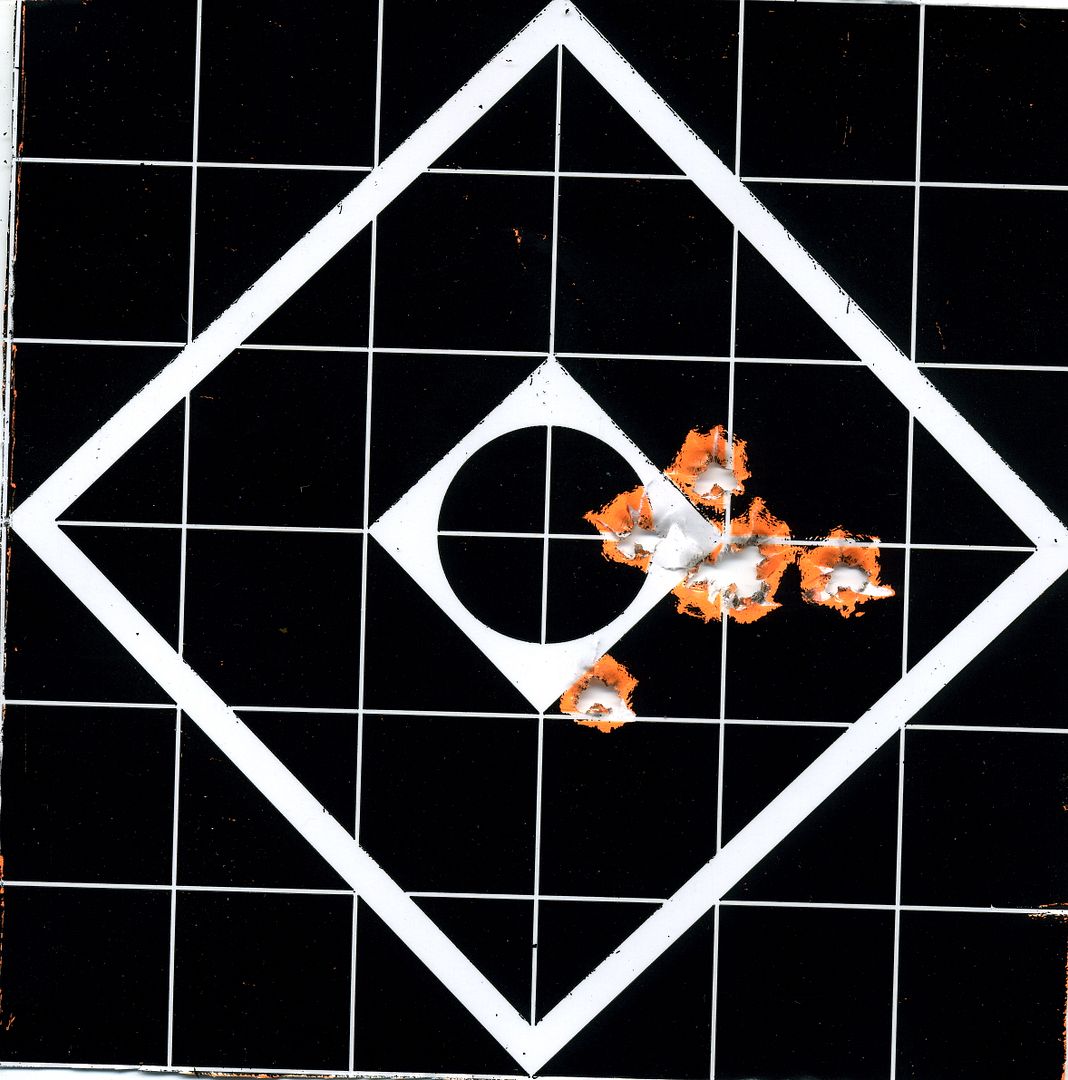
Anyway, now that I had forty rounds of .308 that differ only in the primer used to light them off, it was RANGE TIME! I swapped out the Leupold scope for the Nightforce I bought awhile back, and I’ve had to play with it to get the right eye relief, but I think I’ve got it now. Still, I had to make sure the scope was on target, so I sat down and put my last eight rounds of Black Hills 175 grain through the rifle at 100 yards. Here’s that group:

The low-center hole is the cold-bore shot.  Even including it, that’s a hair over an inch, center-to-center, and about what I’ve come to expect out of that ammo. Next I ran ten rounds of each test load over the chronograph, with a cooling off period between. Here’s the data:

CCI BR-2 Load
Average Velocity: 2876fps
Extreme Spread: 58.40fps
Standard Deviation: 16.52fps

Fiocchi Load
Average Velocity: 2917fps
Extreme Spread: 42.96fps
Standard Deviation: 14.83fps

Now, I’ve gotten this particular load under 10fps Sd using neck-sized Lapua cases, but those are still damned good numbers. Obviously, the Fiocchi is a hair hotter than the BR-2, but it’s every bit, if not more consistent.

How was accuracy, you ask? Here’s the BR-2 load:

If you can’t read it, that’s 0.65MOA at 200 yards for ten shots.

Here’s the Fiocchi:

If you throw out that one far-right shot, the group is easily under 1MOA. Both of these loads ran a bit hotter than I’m used to seeing. Normally that load gives me right at 2800fps, not 2880+, and that seems to be right where the rifle/bullet combination works best. I will blame the difference on the Black Hills cases, sized in the small-base sizer. UPDATE: Nope, I checked my records, and 2880 is normal. Case capacity is probably reduced compared to the Lapua cases. I still think I need to re-run the test with Lapua cases but the purpose of this test has been met: the Fiocchi Large Rifle primer is damned good, and a real value compared to CCI’s Benchrest offering. I’m glad I have a whole lot more of them to experiment with. Thanks to LuckyGunner.com for the chance to try them out!