Molon Labe!.

My wife and I went to see 300 today. It was a pretty good crowd for a Sunday after-matinee show, and we were not disappointed. Good performances, special effects that fed the story and didn’t distract from it, and a good plot. (It’s a well-known historical piece, hard – but not impossible – to screw up.)

I will say one thing further. I found this review (via Rotten Tomatoes) to be amusing. Money quote:

These Spartans are equal parts John Rambo, Conan the Cimmerian, and John McClane. I feel comfortable enough in my (relative lack of) masculinity to say that if I had to stand in the presence of these men for more than ten seconds, I’d spontaneously grow a pair of ovaries.

Let’s just say my wife enjoyed it far more than she’d anticipated.

Light a Seegar, it’s the Best Birthday Present EVER!.

Mrs. Baker’s little boy was born 45 years ago this day, and today the U.S. Court of Appeals for the District of Columbia gave me the best birthday present a gun-nut could ever want: A decision overturning D.C.’s draconian gun-ban on the grounds that the Second Amendment to the Constitution protects an individual right to arms.

If you’ve not been following the case, this has been in the pipeline for a while. The D.C. court was the ideal place to bring up such a suit because the District is not legally a “state.” Its statutes are subject only to federal law. Because of the precedent of U.S. v. Cruikshank the Second Amendment has been excluded from “incorporation” under the 14th Amendment’s “privileges or immunities” and/or “equal protection” clauses. State and local restrictions on the right to arms are legal (thus Chicago and Morton Grove, IL can ban handguns while Kennesaw, GA can mandate firearm ownership). While many courts have thrown out Second Amendment challenges on the “collective rights” arguments, all they’ve needed to do is cite Cruikshank – but Cruikshank, like Dred Scott before it, is a racist decision.

At any rate, Washington, D.C. doesn’t get that protection. It’s under federal law only, and the Second Amendment definitely applies.

Bear with me here. I’ve read enough legal decisions to make my eyes bleed over the last ten or twelve years. As a result, I assume other people have the same knowledge I’ve acquired, or conversely, don’t know a damned thing about what I’m discussing. Either I give too much background information, or not enough. I prefer to err on the side of “too much.”

In 1976 the City of Washington, D.C. passed three ordinances that had the following effects:

1: No new handguns could be added to the existing registry except for handguns belonging to retired police officers – essentially a ban on any new (legally possessed) handguns in the District.

2: No handgun could be carried without a permit – thus preventing even mere possession in ones own home.

3: All firearms – long guns included – had to be kept unloaded and either disassembled or with a trigger or other locking device installed, thus rendering any firearm kept legally from being available for self defense.

(And in the period since, D.C. has often been “murder capital of the U.S.” for cities over 500,000 population – trading off fairly regularly with that other gun-control bastion, Chicago.)

Two very similar cases were brought before the D.C. District Court in 2003. Seegars v. Ashcroft was brought by the NRA on behalf of several plaintiffs arguing that the D.C. ban on registering new handguns was a violation of the Second Amendment. At about the same time the Cato Institute, a libertarian think-tank, filed Parker v D.C. on essentially the same grounds. In both cases all the plaintiffs were asking for was the right to keep a loaded firearm in their own homes. There was much wrangling, and the NRA attempted to get both cases tried simultaneously, but the Cato lawyers fought that battle successfully and kept them separate.

The National Rifle Association drew a lot of flak at the time (even from me) because they argued in front of the court that they were OK with registration. At any rate, Seegars lost in the District court and when it proceeded to the Appeals court that suit was dismissed on a very narrow reading of an earlier case where the panel concluded that the plaintiffs didn’t have standing to sue because they hadn’t actually been arrested and prosecuted for trying to register a firearm! To top it all off, during this period some granstanding Senators tried to render the whole point moot by overturning the D.C. gun ban by act of Congress. That failed too.

So, with Seegars a lost cause, many of us (me among them) figured Parker was headed for the scrap heap as well. The District Court found against Parker and the other plaintiffs because it (like most courts) believed the Second Amendment does not protect an individual right to arms. CATO then appealed to the D.C. Circuit Court of Appeals – and the appeal was granted. It seems one of the Parker plaintiffs actually tried to register a handgun – and was rejected. That was sufficient “damage” in the eyes of the Court. (I’ll be quoting from the decision a lot in a later post.)

Today in a 2-1 decision (District cases are heard by a single judge, Appeals court cases are heard by a three-judge panel) the Appeals court found that the Second Amendment protects an individual right to arms, and that the rights of the plaintiffs had been unconstitutionally violated by the D.C. gun ban.

This was immediately denounced as “judicial activism at its worst” by the Brady Bunch. I’ll have more to say on that topic later, too.

So where do we go from here? Well, most probably the District of Columbia will file for a Stay to prevent the decision from vacating the D.C. gun ban (don’t rush out and buy a handgun yet, you denizens of D.C!) Then it will file an appeal for an en banc rehearing of the case. If granted, all (or at least most) of the judges on the D.C. Circuit will hear the case, and we’ll get to see how many of them are honest and how many (in the words of 9th Circuit judge Alex Kozinski) are willing to constitutionalize their personal preferences, burying language that is incontrovertibly there. Regardless of the outcome of such an appeal, the case will then progress to the Supreme Court.

And there’s the rub.

What happens then?

In 2001 the Fifth Circuit in U.S. v Emerson decided that the Second Amendment did indeed protect an individual right to arms, but that the right was not immune to “limited, narrowly tailored specific exceptions or restrictions for particular cases that are reasonable and not inconsistent with the right of Americans generally to individually keep and bear their private arms as historically understood in this country.” It decided that the defendant’s individual right to arms had not been violated because he had received due process of law “albeit likely minimally so”. In December of 2002 the Ninth Circuit Court of Appeals in Silveira v Lockyer decided that the plaintiffs had no standing to sue because there was no individual right to arms, based on their previous Hickman v Block decision. (Note to the Ninth Circuit: I live in Arizona, one of the states you preside over. And I know what the Second Amendment says, even if you do not.)

So we had two Circuit Courts of Appeals with recent cases having opposite holdings on whether the right to arms was individual or collective.

The Supreme Court passed on both appeals. Dr. Emerson remained in jail, Californians don’t get any new “assault weapons” as defined by whoever is in charge of the California Dept. of Justice this week. And the question of whether or not the Second Amendment protects an individual right remains unanswered by our highest court.

Will they hear it? If they hear it, how will they decide? Will they finally “incorporate” the Second Amendment against infringement by the states?

In other words, will the Supreme Court overturn 72+ years of bad law at one stroke?

Think on that question and see if you can sleep soundly tonight.

I’ll have more to say on today’s decision later. I need to read it again and think a bit.

Voices

Early on in the Zumbo incident, Tam typed these tremendously insightful words:

Ten years ago, had his statement survived the editorial process and made it into print, we would have seen a handful of cherry-picked letters on the “Letters to the Editor” page of Outdoor life, and things would have pretty much proceeded along at status quo ante. Not now. Not today.

Another case in point, a recent (unsigned, natch) op-ed in the Winston-Salem Journal attempting to rally anti-gunrights forces in the wake of the death of an officer by gunshot. I’ll post the op-ed here in its entirety, and restrain myself from fisking it as it so richly deserves, because I have another point to make in this post:

Gun Glut

The Feb. 23 shooting death of Sgt. Howard Plouff of the Winston-Salem Police Department should make two things clear: There are too many handguns in circulation, and these weapons must be more tightly regulated.

We say “should” instead of “will,” because many gun advocates will continue to trot out the same old argument – that handguns aren’t the problem, people are.

That rings especially hollow after a good police officer and family man has just been shot to death.

No doubt, people would keep on killing under tighter handgun regulations, but the number of killings would almost certainly drop.

All indications are that Plouff’s killer used a handgun, just as so many other killers have.

The guns are as readily available as they are easily concealable. The man police charged Tuesday with killing Plouff, Winston-Salem State University student Keith Antoine Carter, got five permits to own a handgun in the last year, and he got four of those permits in a single month, the Journal reported Thursday. Carter is, of course, presumed to be innocent unless proved guilty, but does any one person need that many handguns?

There were way too many handguns in civilian hands when Plouff was shot in the face trying to help control a large and panicked crowd outside the Red Rooster nightclub. He and other officers had responded to the club to help Forsyth County deputies who were working there off-duty.

The people who started fighting in the bar were definitely in the wrong, but the bouncer who fired a shot into the air in an apparent attempt to end the fighting may well have played a major role in aggravating the violence.

After police arrived, more shots were fired from the crowd.

Carter wasn’t charged until a few days after the crime, but shortly after the shooting police seized eight handguns from the area – that’s just the ones they were able to find – and charged three men with carrying a concealed weapon.

Those are misdemeanor charges. They should be felonies.

There should be tighter regulations limiting the number of handguns a person can buy in a single month. And there should be stricter law enforcement of existing regulations, especially to crack down on those ignorant enough to carry handguns into packed bars.

We’re all for the Second Amendment, especially as it pertains to sporting arms, whether for uses such as target practice or hunting.

OK, I can’t resist fisking this, the obligatory “sporting use” bone thrown to the generic gun owner to prove to them that they don’t really intend to confiscate anything.

Go ahead. Pull my other leg.

But that does not mean that there should be no restrictions; most people, for example, have no good reason to own an assault rifle that is designed to kill a number of people quickly.

And this state, and this country, must face the fact that tighter regulations are needed on handguns – for Howard Plouff and all the other victims.

So, we have a cop killed by a guy who owns not one, not two, but at least five handguns that he’s had for up to a year, that (in North Carolina) he’s got to get a permit to purchase. He takes one of these guns someplace they’re not allowed by law, and he shoots a cop. But somehow we’re to believe that more laws would have prevented this heinous crime when the (anonymous) author proclaims that the cause of the problem is “too many handguns in circulation.” Oh, and “assault rifles.”

Where have I heard that before?

But, as Tam pointed out, ten years ago at most we’d have seen a few cherry-picked letters to the editor – in a week or six.

Not anymore! The Winston-Salem Journal has an online feedback function. There are four pages of (apparently unedited) responses. At my count the tally is 28 in support of the right to arms, three (weakly) in support of the editorial or in opposition to one of the other 28 comments. Samples:

It’s truly sad that you are using the death of a valiant officer to advance an anti constitutional stance. If you read the Federalist Papers, you will see the 2nd amendment has nothing to do with hunting or target shooting and everything to do defending liberty from tyranny. If you nibble away the rights of self defense who will guard you rights to print your opinion. – Smith357

Ban this, ban that. Do you know there is almost a total ban on civilian ownership of all guns in the UK? Have you read the latest from them? There is a gun crisis in the UK right now. Seems the criminals don’t pay attention the the laws over there. They keep getting guns. Guess what, if you obey the law, you have no defense against them. If you did defend yourself, even with fists, you can be arrested and prosecuted for assaulting the criminal. That’s what you want here obviously…. – Use your head

I am sick and tired of the news media jumping on every tragedy to try to take away more of the citizens rights. No amount of laws would have saved this fine officer.I knew him personally and at one time I was his supervisor at the PD. I feel you are doing him a disservice by trying to take away one of the the rights that he so proudly upheld in enforcing the constitution of the U.S. Your rights to a free press maybe next if you don’t take care. – sick and tired

I noticed that there is no name associated with this article, so we must assume that this is the official stance of the Journal? As a local deputy, I would like to point out that it is already illegal to carry a firearm into a place that serves alcohol. More gun control laws do nothing but make more people criminals, and by definition, criminals break the law. Sorry, gun control laws do not control guns, they only serve to make more people criminals. – Disappointed Deputy

“We’re all for the Second Amendment, especially as it pertains to sporting arms, whether for uses such as target practice or hunting.” And I’m all for the 1st Ammendment, especially where it pertains to writing about sports and entertainment. Now, writing unapproved articles about politics or editorials, I think there should be some restrictions on what you can say to the masses, or at least some government oversight. – sss

Ahhhh, I feel so much better now. We’re finding our voices, and using them.

I can’t help but wonder what the Journal‘s editorial board is thinking about the feedback policy.

(There’s also a link on the page directly to Technorati so you can see who else is commenting on it. Nobody’s shown at this time, but I wonder if Technorati will pick up this piece?)

You Can Almost Taste His Eager Anticipation

Tim Blair posts today on the topic of “Peak Oil” – a subject near and dear to the heart of at least one of my regular readers. Tim quotes the New York Times (!) pooh-poohing the idea that oil production has peaked or will very soon:

“Within the last decade, technology advances have made it possible to unlock more oil from old fields, and, at the same time, higher oil prices have made it economical for companies to go after reserves that are harder to reach. With plenty of oil still left in familiar locations, forecasts that the world’s reserves are drying out have given way to predictions that more oil can be found than ever before …

“‘It’s the fifth time to my count that we’ve gone through a period when it seemed the end of oil was near and people were talking about the exhaustion of resources,’ said Daniel Yergin, the chairman of Cambridge Energy and author of a Pulitzer Prize-winning history of oil, who cited similar concerns in the 1880s, after both world wars and in the 1970s. ‘Back then we were going to fly off the oil mountain. Instead we had a boom and oil went to $10 instead of $100.'”

But, as Tim notes, “Incredibly, abundance denialists simply won’t accept the oil consensus.”

Like this guy I found in the Tucson Weekly guest editorial slot for last week. You have to read this:

Expect the beginning of the end of Tucson as we know it to arrive next year

By GUY MCPHERSON

For a writer, there are few experiences more thrilling than words that generate action. I was therefore elated when the group Sustainable Tucson grew from my column about the impending Tucson apocalypse (Guest Commentary, April 27, 2006).

Lest you think low gas prices are cause for apathy, I’m calling for more action.

Considerable evidence indicates we passed the world oil peak near the end of 2005. Oil supply follows a bell-shaped curve, so we have been easing down for slightly more than a year.

Now that we’ve burned the inexpensive half of our planetary endowment of oil, we need to prepare ourselves to fall off the oil-supply cliff. This will occur in 2008. The economic, societal and political implications are profound, and discussion of them is curiously lacking from the mainstream media.

I thought these gloom-n-doomers had learned better than to pick dates – especially dates within their forseeable lifetimes – for the sky to come crashing down. After all, Paul Ehrlich predicted in 1968 that by the 70’s or 80’s hundreds of millions of people would inevitably starve to death because we simply wouldn’t be able to grow or distribute enough food to feed them.

Uh, Paul? It’s 2007. No mass famine.

Of course, Mr. McPherson is just a little ahead of the latest curve, since there are a bunch of people running around with their hair on fire, shouting that “we have ten years to save the planet!”

Hey! If McPherson is right, “Peak Oil” will shut down entire economies of every nation around the world! And in 2008!

Whoopee! We’re all saved!

Well, not all of us:

A series of recessions triggered by the high price of gasoline will be followed, within a decade, by a depression that will make the Great Depression seem like the good old days.

We will not recover from this depression before runaway greenhouse effects doom our species to extinction.

Apparently not any of us…

At the very least, we can expect oil prices to exceed $400 per barrel within a decade. At those oil prices, you can kiss goodbye the days of happy motoring, the use of fossil fuels to deliver water and air conditioning to Tucson, and the U.S. dollar.

Mr. McPherson, I’ll make a bet with you. If by 2018 oil is $400 a barrel, I’ll pay you $1,000. But if it’s under $150, you owe me $100,000. Deal?

In light of this knowledge, and the cheerful demeanor with which I pass it along, people often ask my advice as they plan for life without fossil fuels. (All energy sources are derivatives of oil, so expensive oil signals the end of our ability to extract and deliver coal, natural gas and uranium, and seriously impedes our ability to manufacture wind turbines and solar panels.)

“In light of this knowledge – the guy’s Cassandra! But pay attention to the rest of this:

In an attempt to further the much-needed discussion about the looming post-carbon era, I offer the following Tucson-centric perspective.

This country’s ever-expanding economy since World War II, coupled with a profound sense of denial, suggests that relatively few people are prepared for the post-carbon era. As a result, you can expect increasing civil unrest in the decade ahead. The rule of law is likely to give way to anarchy. Local heroes are desperately needed.

Do not expect corporations or elected officials to bail us out. Rather, the collapse of the economy will render them meaningless. The federal government, and then the state government, will join Wal-Mart in simply fading away from your life. We will need plenty of local heroes to step into the breach. If you are honest, compassionate and interested in serving others, this city needs you.

In the very near future, you can expect to see a much smaller population than currently resides in Tucson. If you are committed to remaining in Tucson–and if you don’t own a horse, you won’t have much choice in five years or so–your task is a daunting one. You will have to secure your water supply by harvesting water. You will need enough water to grow your own food, too: $400 oil spells the end of Safeway and Trader Joe’s, and disruptions in the delivery of food, water and electricity to the Old Pueblo will begin next year. Bombing Iran will exacerbate these problems, but I’d rather not think about that.

As an enlightened citizen, you’ll be forced to live in two worlds. You’ll work and play in your “normal” life, saving money for a rainy day and supporting those you love. But in the back of your mind, you’ll know about the new world ahead, and you’ll be planning to be part of a smaller community that lives close to the earth. You’ll be learning how to harvest rainwater, grow your own food and live with far fewer resources.

As you plan for your own personal post-carbon future, please advocate for the city’s nascent efforts in sustainability. Implore city leaders to prepare for the days, less than a decade from now, when we have no fuel for private automobiles, no food-delivery system for the 3,000-mile Caesar salad on which we have come to depend and no water pumped across the desert to feed our insatiable desires.

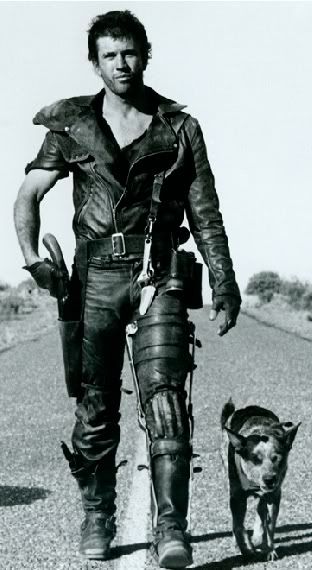
This guy is looking forward to the End Times – something I thought only Fundamentalist Christians got accused of. I think he’s watched the “Mad Max” movies too many times. “Local heroes”? Does he have a leather suit, a knee brace, and a sawed-off in his closet?

I wonder if he’s stockpiled any arms and ammo?

Nah, probably not. He’ll be depending on other people to be the “local heroes.” His kind always do.

Now, the worst part of this whole thing?

Guy McPherson is a professor of natural resources at the University of Arizona and author of many books, including Killing the Natives: Has the American Dream Become a Nightmare? and Letters to a Young Academic.

The only people who can consistently function outside reality are the insane in asylums and tenured professors in theirs. It would be funny if only this guy wasn’t teaching our kids.

How did we grow a generation of people in which such a large percentage hate their own civilization? Can anyone answer that?

Edited to add:

Commenter “M. Smith in Phoenix, AZ” inquired:

Please tell me you saw the OTHER “Guest Commentary” that he wrote in April of last year? If not, scroll to the bottom of the Tucson Weekly page and his other article is the last link. The money paragraphs are 2, 3 and 10.

This guy needs to be dragged out into the desert and left to fend for himself, just to see how in touch he really is with his local eco-system.

I hadn’t, but at his urging I read the piece in question.

My comment in reply:

I see he’s moved up his timetable.

And I notice that he’s still living in Tucson.

I guess tenure is more important to him than surviving “The Greatest Depression.”

Or he really doesn’t believe his own bullshit.

Three guesses as to what my take on that is, and the first two don’t count.
Apology Accepted, Mr. Zumbo

May I call you Jim?

The High Road has a copy of the letter Jim Zumbo sent to Alan Gottlieb of the Citizens Committee for the Right to Keep and Bear Arms. I’m going to reproduce it here (without permission.)

February 28, 2007

Mr. Alan Gottlieb, Chairman
Citizens Committee for the
Right to Keep and Bear Arms
12500 N.E. Tenth Place
Bellevue, WA 98005

Dear Alan:

They say that hindsight is always 20-20. In my case, hindsight has been a hard teacher, like the father teaching the son a lesson about life in the wood shed.

I was wrong when I recently suggested that wildlife agencies should ban semiautomatic firearms I erroneously called “assault rifles” for hunting. I insulted legions of my fellow gun owners in the process by calling them “terrorist rifles.” I can never apologize enough for having worn blinders when I should have been wearing bifocals.

But unlike those who would destroy the Second Amendment right to own a firearm – any firearm – I have learned from my embarrassing mistake. My error should not be used, as it has been in recent days by our common enemies, in an effort to dangerously erode our right to keep and bear arms.

I would hope instead to use this spotlight to address my hunting fraternity, many of whom shared my erroneous position. I am a hunter and like many others I had the wrong picture in mind. I associated these firearms with military action, and saw not hunting as I have known it, not the killing of a varmint, but the elimination of the entire colony. Nothing could be further from the truth, but I know from whence it comes. This ridiculous image, formed in the blink of an eye, exerts an unconscious effect on all decisions that follow. In seeking to protect our hunting rights by guarding how we are seen in the public eye, I lost sight of the larger picture; missed the forest for the trees.

My own lack of experience was no excuse for ignoring the fact that millions of Americans – people who would share a campfire or the shelter of their tent, and who have hurt nobody – own, hunt with and competitively shoot or collect the kinds of firearms I so easily dismissed.

I recently took a “crash course” on these firearms with Ted Nugent, to learn more about them and to educate myself. In the process, I learned about the very real threat that faces all American gun owners.

I’ve studied up on legislation now in Congress that would renew and dangerously expand a ban on many types of firearms. The bill, HR 1022 sponsored by New York Rep. Carolyn McCarthy, is written so broadly that it would outlaw numerous firearms and accessories, including a folding stock for a Ruger rifle. I understand that some of the language could ultimately take away my timeworn and cherished hunting rifles and shotguns as well as those of all American hunters.

The extremist supporters of HR 1022 don’t want to stop criminals. They want to invent new ones out of people like you and me with the simple stroke of a pen. They will do anything they can to make it impossible for more and more American citizens to legally own any firearm.

Realizing that what I wrote catered to this insidious attack on fellow gun owners has, one might say, “awakened a sleeping giant within me, and filled him with a terrible resolve.”

I made a mistake. But those who would use my remarks to further their despicable political agenda have made a bigger one. I hope to become their worst nightmare. I admit I was wrong. They insist they are right.

Enclosed, you will find a check that is intended to be used to fight and defeat HR 1022. I also hope it inspires other gun owners to “do as I do, not as I say.”

I’m putting my money where my mouth should have been, and where my heart and soul have always been. I know the Second Amendment isn’t about hunting and never has been. My blunder was in thinking that by working to protect precious hunting rights I was doing enough. I promise it will never happen again.

I don’t know what lies over the horizon for me. I am not ready for the rocking chair.

I’m going to devote every ounce of my energy to this battle. I will remind my fellow hunters that we are first, gun owners. Whether we like it or not, our former apathy and prejudices may place that which we love, hunting, in jeopardy. I will educate fellow outdoorsmen who mistakenly think like I talked, even if I have to visit every hunting camp and climb into every duck blind and deer stand in this country to get it done. I was wrong, and I’m going to make it right.

Sincerely,
Jim Zumbo

And another post that cinched the deal for me:

I want to confess something.

I’m a gun owner. In fact, I probably own more than most. I pride myself on the quality of my firearms and my skills using them. I spend every weekend, rain or shine, at the range. Defensive pistol, shotgun games, hunting, long range rifle, gun skool…you name it and I do it.

While I’m an NRA member, I don’t do activism. I don’t write letters. I don’t contribute money. I don’t call my congressman…in fact, I don’t even know how all that stuff works.

I just want to be left alone with my hobby. I don’t worry about what bills are proposed. I don’t keep track of what’s going on. Hell, I barely vote.

I don’t tell people what to do and I don’t expect to be told what to do. I just want to shoot.

I’ve been following this Zumbo mess since the beginning. I haven’t commented on it because I felt that everything that needed saying was already said. I also didn’t want to be quick to judge. Initially, I was mad just like everyone else. I’m a fairly forgiving person though, and I thought that if anyone could help him, it would be Ted.

Reading this letter, it’s obvious that Zumbo’s eyes have been opened. I forgive the guy. While what he did was blatantly wrong, I believe he has come around. I would share a campfire with him.

I can also appreciate people that act rather than talk. My donation to CCRKBA has been sent in.

Ed

This guy has over 1,100 posts on THR, but was in no way an activist. Regardless of what the Brady Bunch et al. does with this incident, the net result will be positive for the gun-rights side, I believe.

Darkness: The New Enlightenment.

James Lileks writes another spot-on essay. His Newhouse column for today, Another Empty Symbolic Gesture is eminently quotable, but I’ll give you just a little bit, and a visual aid:

There’s also a curious form of self-loathing involved in the lights-off movement, a revolutionary’s hatred of the old order’s glories. Once the bright lights of a city stood as a sign of civilization, a candle that cast out the night and brought the boon of Prometheus to every humble shack; now darkness is a sign of enlightenment. The sensitive soul who feels the planet’s ceaseless shrieks in all his various chakras is supposed to feel relief when the lights go off, as if darkness is aloe on a burn.

Why, look at those satellite photos of North Korea at night. State control of energy usage, no industry, no cars, no messy pointless “freedom” to hurt our one and only Mother. Seen from above, it’s utterly dark.

They’re years ahead of the rest of us.

Go. Read.

Edited to add:

I can’t explain exactly why, but I was perusing movie critic Roger Ebert’s web page and found his list of “Four Star Movies from 2006”. Among his list? An Inconvenient Truth. Interest piqued, I read the review. The last line is the kicker:

I did a funny thing when I came home after seeing “An Inconvenient Truth.” I went around the house turning off the lights.

I think Billy Beck’s use of the term “Endarkenment” has taken on a whole new and literal meaning.

Dred Scott and Legislating from the Bench.

The Legal Times blog notes that today is the 150th anniversary of the most-highly-reviled Dred Scott decision – the “match that ignited the civil war.” I left a comment there, which I immediately regretted – to wit:

Chief Justice Taney reached a deplorable conclusion, but he did it based on a flawless understanding of the law as it stood, and of the meaning and intent of the Bill of Rights. The Justice wrote that blacks – free or slave – could not be citizens because:

“For if they were so received, and entitled to the privileges and immunities of citizens, it would exempt them from the operation of the special laws and from the police regulations which they considered to be necessary for their own safety. It would give to persons of the negro race, who were recognised as citizens in any one State of the Union, the right to enter every other State whenever they pleased, singly or in companies, without pass or passport, and without obstruction, to sojourn there as long as they pleased, to go where they pleased at every hour of the day or night without molestation, unless they committed some violation of law for which a white man would be punished; and it would give them the full liberty of speech in public and in private upon all subjects upon which its own citizens might speak; to hold public meetings upon political affairs, and to keep and carry arms wherever they went. And all of this would be done in the face of the subject race of the same color, both free and slaves, and inevitably producing discontent and insubordination among them, and endangering the peace and safety of the State.”

He was right – they would. Faced with decades of precedent, regardless of his personal opinion (and that of six other Justices) he didn’t have a lot of choice (though he far overstepped what was legally necessary.)

But upon passage of the 13th and 14th Amendments after a bloody war over just who was and wasn’t a citizen, the Supreme Court saw to it that those privileges and immunities remained restricted from blacks, and later, anyone else the majority felt necessary.

Say what you will about the decision, Chief Justice Taney declined to “legislate from the Bench” in 1857. Chief Justice Waite in 1875 took it upon himself to do that in U.S. v Cruikshank.

(Added emphasis – the LTB doesn’t allow HTML).

That’s what I wrote, but it is not precisely the case. Taney did indeed “legislate from the bench” – just not in a direction modern America would support, nor many of his contemporaries. As I did manage to note, the Chief Justice far overstepped what was legally necessary – or justifiable. And I should have noted that excess more explicitly in my comment. Mea culpa.

Taney was a product of his era, and, I believe it has been well proven, a great supporter of the institution of slavery at least in the latter part of his life. Given this, his decision was not surprising. But the point of my comment wasn’t that Taney went too far – that’s a given – it was that the main portion of the decision, the conclusion that blacks could not be given the “privileges and immunities of citizens,” was pre-ordained by stare decisis. That to find any other way on that point would also have been to “legislate from the bench.”

And here I’d like to argue once again that this is the purpose of having a Supreme Court. As I noted in Game Over, Man. Game Over, our legal system is constrained by the philosophy of stare decisis. As Mike from the now apparently defunct Feces Flinging Monkey put it:

(T)he future of our freedom ultimately rests with the court’s willingness to periodically reexamine the law. Lawmakers, and law enforcers, will always push the limits, and they will always win occasional gains. If the court is unwilling to revisit these issues over time and correct the damage done, then it’s “game over” no matter what we do. This makes it a little easier for me to accept changes in the law where the cost is low and the benefits are significant. If I can’t count on an occasional review, then the game is already lost.

But we hardly ever get that review – “periodic” or otherwise. In my piece But it has to be a heap, now, I quoted Webster’s definition of stare decisis:

(A) doctrine or policy of following rules or principles laid down in previous judicial decisions unless they contravene the ordinary principles of justice

And I quoted extensively from Julian Fisher’s Reason Online essay A Heap of Precedents: Slippery slopes, stare decisis, and popular opinion. Sanchez makes essentially the same argument:

There’s a famous philosophical puzzle, originally attributed to Eubulides of Miletus, known as the sorites paradox or heaps problem. It goes like this: Two or three grains of sand obviously don’t constitute a “heap” of sand. And it seems absurd to suppose that adding a single grain of sand could turn something that wasn’t a heap into a heap. But apply that logic repeatedly as you add one grain after another, and you’re pushed to the equally absurd conclusion that 100,000 grains aren’t a heap either. (Alternatively, you can run the logic in the other direction and prove that three grains of sand are a heap.)

It’s not a terribly deep puzzle, of course: It simply illustrates that some of our everyday concepts, like that of a heap, are vague or fuzzy, not susceptible to such precise definition. Try to define such concepts in too much detail and absurdity results.

The problem is, concepts like “interstate commerce,” “public use,” “unreasonable search,” and “cruel and unusual” are similarly fuzzy. And stare decisis, the principle that cases are to be decided by reference to previous rulings, means that the Court’s interpretation of those rulings looks an awful lot like a process of adding one grain at a time without ever arriving at an unconstitutional heap—an instance of what law professor Eugene Volokh has called an “attitude altering slippery slope.” Jurisprudence is all about distinguishing cases, explaining why some legal principle applies in situation A, but not in apparently similar situation B. But if the grains are fine enough—the differences from case to case sufficiently subtle—plausible distinctions become harder to find.

Sanchez concludes his piece:

Stare decisis is an important guarantor of stability in legal rules: By insisting on like treatment of like cases, it provides people with a more detailed sense of when they’re engaged in constitutionally protected conduct than the stripped-down language of the Constitution alone ever could. But legal rules, to be legitimate, should also reflect a shared public understanding. That’s not to say the polls must vindicate each particular court ruling. But when stability begins to undermine the public’s sense that they understand the most fundamental rules by which they’re governed, it’s a sign that jurists need to be willing to step back and see the heap.

I concluded Game Over, Man thus:

Mike Spenis said “the future of our freedom ultimately rests with the court’s willingness to periodically reexamine the law,” but the evidence is plain that the courts will not do that. They will use obviously flawed precedent so long as it “comports especially well with our notions of good social policy.” And even if it doesn’t, the courts will often bow, as Kozinski does here, to precedent they abhor. We depend upon the honor and intellectual honesty of the judges who make up the Justice system, yet it seems that those who are truly honest and honorable are outnumbered by those who are “willing to bury language that is incontrovertibly there.” The honest and honorable ones abide, under the rule of law, by precedent that is otherwise insupportable. The middling honest ones, the ones Justice Brandeis labled as “men of zeal, well-meaning but without understanding” “build magnificent legal edifices on elliptical constitutional phrases – or even the white spaces between lines of constitutional text.” And those decisions stand, without review, periodic or otherwise, to serve as the next step down the road to Hell.

So “legislating from the bench” has its place, but what is that place?

Sanchez says it’s “when stability begins to undermine the public’s sense that they understand the most fundamental rules by which they’re governed.” Mike says it’s when enough damage has been done by the forces that constantly push the limits of what’s legal. In other words, it’s a judgement call. Like it or not, that power has been placed in the hands of nine un-elected judges.

No one (today) objects to the Supreme Court’s Brown v. Board of Education decision overturning decades of “separate but equal” precedent, but that was clearly “legislating from the bench.” Great howls of outrage and peals of glee resulted from Roe v. Wade, but that too was “legislating from the bench” as defined as violating stare decisis.

So when is “legislating from the bench” valid, and when not?

I would argue that two conditions must be met. First, it can and should only be done by the Supreme Court. To bestow that power on lower courts invites, if not anarchy, then disrespect for law by the citizenry. Second, any decision that violates stare decisis must be done in order to broaden individual rights and freedoms – the “privileges and immunities” of citizens – that have been improperly restricted by decades of grain-upon-grain infringement.

Someone has to have the power to say “That’s a heap,” and knock it down.

In Dred Scott the court was in a position to say that nearly a hundred years of law was wrong, because it denied “the privileges and immunities” of citizens to free blacks, but it did not. Instead the decision (like slavery itself) “contravene(d) the ordinary principles of justice.” Brown v Board of Education restored some of those principles. Roe established a set of rules that I think straddled the dichotomy between the rights of women and the rights of the fetus, but the Doe v Bolton decision – handed down at the same time and almost never mentioned – destroyed those rules, and contravened the principles of justice.

The problem is, this method is messy. Stare decisis is neat and simple. Good decisions do get made, but even good decisions can have bad unintended consequences. It’s a positive feedback loop in which a little garbage in creates ever greater garbage out. There is no established mechanism for “periodically reexamining the law,” and that is a major flaw in the system.

Dred Scott was an understandable decision given the era and the then “shared public understanding” – but the end result was war. Had the Supreme Court of that time been made up of radicals and overturned slavery that decision would have almost definitely also resulted in war. Was there some middle ground that would have satisfied both sides? In my opinion, no. But if you are going to make a decision upon which the rights of citizens depends, I’d prefer it if the Supreme Court of the land decided in favor of expanding those rights, rather than restricting them even further. We depend on those nine un-elected judges to protect our liberty against infringement by ever-encroaching government power.

How do you think they’re doing?

I Finally Got a Safe.

I’ve had a cheap-assed Stack-On gun cabinet for a while, but my collection overflowed its capacity even before my father-in-law sent his guns over here. So, for my birthday (using some of our non-interest-bearing 2006 payroll savings plan) I went out tonight and bought a gun safe. It’s this one, the TG33F model, only I bought it from Sportsman’s Warehouse so it carries a “Yukon Gold” nameplate, and it’s black. I was going to get the smaller version, but my wife said “Get the bigger one. You’ll fill it up eventually.”

I love my wife.

Now I just have to figure out how to get a 675lb. safe from the store to the house, and then into the house.

I’m Sorry the Lesson Cost You So Much, Mr. Zumbo

(Via Uncle)

Jim Zumbo has written an epistle concerning the Second Amendment and his fateful post. I think he really does get it now. As he said,

If I ever, in my wildest dreams, thought the words I had written would bring the validity of the Second Amendment into question, I assure you I never would have touched my fingers to the keypad.

“(G)ame departments should ban them from the praries(sic) and woods”? I believe you, but dude, how tired were you?

I’m glad you understand. Now, would you please take some time and explain it – using small words – to the “many who understood and agreed with (your) original intent”? Because they obviously don’t get it.

If New Jersey can legally proclaim a 17-shot Marlin Model 60 to be an “assault firearm,” a “highly dangerous offensive weapon,” then anything can be – and hunters and benchresters and clay shooters and the rest had better all figure that out.

Sorry, Been Out of Town.

On business. With no internet access. And now I’ve got to catch up around the house, and load some ammo for a range trip in a week or so. Plus I’ve got to catch up on my reading. Did we slavering hoarde of gun-nuts hound another innocent old man out of a job at the behest of the eeeeevil NRA yet? No one sent me any marching orders, and I’m feeling left out.