It’s Not Much, but Nerf™land Pushes Back

A couple of weeks ago I wrote about schools in England that were banning the paper airplane because of fears of student injury, another school that had removed its swingset because it “faced the sun” and they were concerned about kids blinding themselves, and other similar idiocy.

Well, it looks like somebody over there has had enough, and they’re not alone. Wendy McElroy, proprietor of ifeminist.com and a Fox News columnist, has written a piece about a book recently published there:

New Book Revives Lost Notions of Boyhood

The Dangerous Book for Boys by the British brothers Conn and Hal Iggulden is a practical manual that returns boys to the wonder and almost lost world of tree houses and pirate flags. It celebrates the art of teaching an old mutt new tricks and accepts skinned knees as an acceptable risk for running through fields with the same dog yapping along.

As of July 3, The Dangerous Book is the number one seller on Amazon UK and it is holding steady at about 7,000 on Amazon in the U.S., where it was published on June 5. The Australian News reports that the book “has made it to the top five of…Amazon [Australia], after just a week.”

Those results make publishers take notice. But social commentators are also reacting with both applause and condemnation.

Condemnation arises because The Dangerous Book breaks the dominant and politically correct stereotype for children’s books. It presents boys as being deeply different than girls in terms of their interests and pursuits. Although it is highly probable that bookstores will sell the book to girls who then will go on to practice skimming stones, nevertheless the genders are separated within the book’s pages.

Read the whole thing. Wendy isn’t your typical feminist.

An interesting note, Clayton Cramer (not a fan of Amazon.com) reports that Amazon here in the U.S. no longer lists The Dangerous Book for Boys on its website. The excuse is beyond lame.

Other media sources have responded to The Dangerous Book, for example this op-ed from the The Sunday Times, June 17:

Every so often the lofty minarets of publishing find themselves shaken by a seismic crack from down below. The sound — deeply liberating in the age of the pre-digested blockbuster — is that of the book-buying public spontaneously making its presence felt: one of those infrequent but hugely intriguing instances of word-of-mouth buzz picking up on some hitherto under-publicised item and sending it storming up the bestseller list without the people who administer the book trade really noticing.

The latest example of this encouraging trend is a work entitled The Dangerous Book For Boys by the brothers Conn and Hal Iggulden — Conn is a well-known historical novelist — which was overlooked by the literary editors and the three-for-two promotions but is currently number one on the Amazon chart.

Undoubtedly it is being bought not only by boys but by their fathers as a splendidly politically incorrect guide to both boyhood and fatherhood.

Got up in gilt and scarlet covers, stoutly hardbacked and looking for all the world like a juvenile Christmas present from around the time of King Edward VII’s coronation, The Dangerous Book For Boys declares its intent from the opening page.

“In this age of video games and mobile phones there must still be a place for knots, tree houses and stories of incredible courage,” the authors maintain. “Men and boys today are the same as they always were, and interested in the same things . . . We hope in years to come that this will be a book to dig out of the attic and give to a couple of kids staring at a pile of wood and wondering what to do with it.”

I liked this part particularly:

Clearly, over the next few months The Dangerous Book For Boys, however misleading the promise of its title, is set to play a bumper role in Taylor family life.

Behind its success lurk some shrewd cultural deductions that, here in the bright dawn of the technology-driven 21st century, hardly ever occur to people down at the sharp end of the child-rearing process.

The most obvious is the absolute feebleness of what gets taught in schools these days.

Unsurprisingly:

The drawback to the Iggulden project, of course, is that it is completely opposed to practically every development (and developer) currently at work in the British educational process. Not many modern curriculums, after all, feature lists of British kings and queens, troop deployments at Balaclava and the nature of the pluperfect tense.

On the practical side, it goes without saying that the average headmaster would probably have a fit if anyone suggested that his male pupils ought, for the purpose of drawing them closer to their fathers, be taught how to gut a rabbit.

He (or she) would probably be deeply disturbed, too, by the sight of the Oxford historian Niall Ferguson — quoted by the Igguldens — summarising the achievements of the British Empire (downsides are mentioned too) or a list of recommended reading that includes the original James Bond books and the Flashman novels of George MacDonald Fraser.

Even Al-Guardian can’t be too negative about the book:

The book is beautifully accomplished, from its instructions about hunting and cooking a rabbit to its diagrams explaining how to wrap a parcel in brown paper and string. (“Not a very ‘dangerous’ activity, it’s true, but … extremely satisfying.”) But does the chord it has struck also reveal the stubborn prevalence of some rather foolish and deluded fantasy vision of British boyhood? Of a past less noble and less real than it may seem in hindsight, a past which those books and comics that inspired this one would have us believe?

I suppose the answer is mostly yes. I’m old enough to have grown up in a time when the sorts of virtues championed here – wholesome curiosity, diligent teamwork, pluck and decency – still enjoyed some currency, especially in schools and in the cub scouts. However, while boys of my generation enjoyed a freedom to roam and to construct bows and arrows and to play football until dusk, those good-egg moral virtues were often scarce in reality. Boys who were not “hard” or sporty got picked on by boys who were, just as happens now. Bob Cherry, the brave and hearty hero from the Billy Bunter series, was very much a fictional character.

Is this book, then, purely romantic? That’s quite a tricky one to call. I’m wondering why it is called “dangerous”. Does the choice of adjective simply express that hankering after a time when parents were less fearful about their children? Or is it some sort of a comment being made to the effect that it is dangerous these days to insist that boys are totally different creatures from girls? A chapter called The British Empire (1497-1997) repays careful rereading. It’s all battles and rebellions and good intentions that didn’t always work out, but were still good intentions anyway. It is hard to see this as anything other than a conservative reading of the imperial centuries, which makes me inclined to see The Dangerous Book for Boys and its popularity as of a piece with a modern lament about the loss of an old gender order under which a chap knew what a chap was meant to do and the world was a happier place.

I don’t believe it ever was that simple, and pining for it will do none of us much good. Yet there remains much that is admirable here. Some more advice from Sir Frederick Treves: “Don’t swagger. The boy who swaggers – like a man who swaggers – has little else that he can do … It is the empty tin that rattles most. Be honest. Be loyal. Be kind. Remember that the hardest thing to acquire is the faculty of being unselfish. As a quality it is one of the finest attributes of manliness.” Not much to quarrel with there.

The June 13 Telegraph story on the book is equally interesting. Note the opening:

A book of old-fashioned, adventurous pastimes for lads and dads has become a surprise bestseller. Christopher Middleton watched his 11-year-old son transformed into a Middle Earth warrior

It’s amazing that The Dangerous Book For Boys ever got published, really, given the deeply unfashionable connotations surrounding two out of the five words in the title (the ones that aren’t “The”, “Book” and “For”).

The very thought of an educational volume that sets out both to exclude a specific gender and to promote activities with questionable health and safety implications is enough to bring the ultimate condemnation that the world of mealy-mouthdom has to offer – that of being “inappropriate”.

It’s not like Political Correctness is going unnoticed in England, as natural as breathing air. They’re apparently choking on it, too.

Is this a backlash against Political Correctness? Undoubtedly. Does it signal the beginning of a popular movement against it? I doubt, but I can hope. British doctor and writer Theodore Dalrymple, author of several books and numerous essays on the decline of British society, said this in an interview with FrontPage magazine after the publication of his book Our Culture, What’s Left of it: The Mandarins and the Masses:

Political correctness is communist propaganda writ small. In my study of communist societies, I came to the conclusion that the purpose of communist propaganda was not to persuade or convince, nor to inform, but to humiliate; and therefore, the less it corresponded to reality the better. When people are forced to remain silent when they are being told the most obvious lies, or even worse when they are forced to repeat the lies themselves, they lose once and for all their sense of probity. To assent to obvious lies is to co-operate with evil, and in some small way to become evil oneself. One’s standing to resist anything is thus eroded, and even destroyed. A society of emasculated liars is easy to control. I think if you examine political correctness, it has the same effect and is intended to.

And I think he’s absolutely correct.

It’s past time for a backlash against it, both here and most especially in England. The Dangerous Book for Boys isn’t much, but it’s a start, and it’s aimed at exactly the right target.

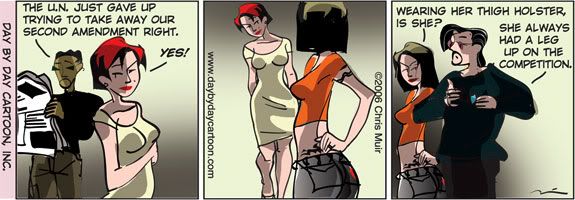
No, It Didn’t.

Today’s Day by Day:

No it didn’t. It just admitted defeat this year.

They’ll be back. They always are.

(And whatever she could hide under that dress must be a popgun!)

She Bush Turned Me Into a Newt!.

The structural scientists at DemocraticUnderground.com have performed an experiment that proves beyond the shadow of a doubt that the World Trade Center towers were brought down by a Bushco Conspiracy™ and not by the raging fires resulting from having fuel-laden 767/737s smash into them.

http://www.democraticunderground.com/discuss/duboard.php?az=show_mesg&forum=125&topic_id=56836&mesg_id=56836

Link left cold on purpose, but by all means, go look. Or, if you don’t want to do that, go look at the AR15.com thread. It reproduces the whole post.

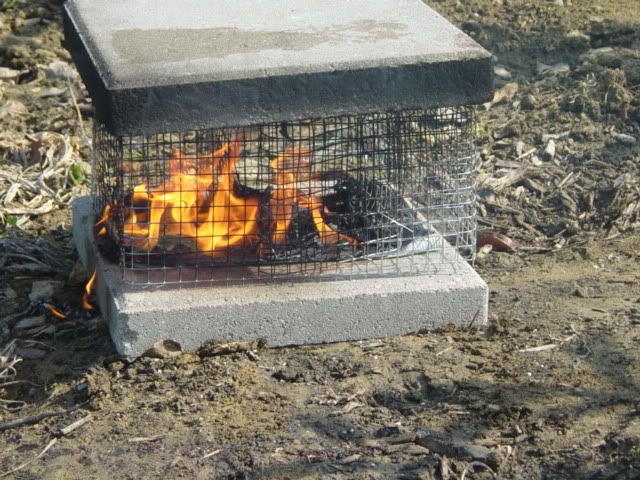
To whet your appetite, here’s the mental midget’s “model” of one of the towers:

From his rigorous, meticulously detailed and calibrated test he determines:

What I conclude is that a fairly flimsy steel structure does not distort and bend and collapse very easily from a simple hydrocarbon fire. And thus, it is not clear why the much stronger steel columns in the WTC towers weakened so much from fires that the towers underwent global collapse.

Being a Python fan, what I was reminded of was this:

FIRST VILLAGER
We have found a witch. May we burn her?

ALL
A Witch! Burn her!

BEDEVERE
How do you know she is a witch?

ALL
She looks like one. Yes, she does.

BEDEVERE
Bring her forward.

They bring her forward – a beautiful YOUNG GIRL (MISS ISLINGTON)
dressed up as a witch.

WITCH
I am not a witch. I am not a witch.

BEDEVERE
But you are dressed as one.

WITCH
They dressed me up like this.

ALL
We didn’t, we didn’t!

WITCH
This is not my nose, It is a false one.

BEDEVERE takes her nose off.

BEDEVERE
Well?

FIRST VILLAGER
… Well, we did do the nose.

BEDEVERE
The nose?

FIRST VILLAGER
And the hat. But she is a witch.

ALL
A witch, a witch, burn her!

BEDEVERE
Did you dress her up like this?

FIRST VILLAGER
… Um … Yes … no … a bit … yes… she has got a wart.

BEDEVERE
Why do you think she is a witch?

SECOND VILLAGER
She turned me into a newt!

BEDEVERE
A newt?

SECOND VILLAGER
(After looking at himself for some time)
I got better.

ALL
Burn her anyway.

BEDEVERE
Quiet! Quiet! There are ways of telling whether she is a witch.

ARTHUR and PATSY ride up at this point and watch what follows with interest

ALL
There are? Tell up. What are they, wise Sir Bedevere?

BEDEVERE
Tell me … what do you do with witches?

ALL
Burn them.

BEDEVERE
And what do you burn, apart from witches?

FOURTH VILLAGER
… Wood?

BEDEVERE
So why do witches burn?

SECOND VILLAGER
(pianissimo)
… Because they’re made of wood…?

BEDEVERE
Good.

PEASANTS stir uneasily then come round to this conclusion.

ALL
I see. Yes, of course.

BEDEVERE
So how can we tell if she is made of wood?

FIRST VILLAGER
Make a bridge out of her.

BEDEVERE
Ah … but can you not also make bridges out of stone?

ALL
Ah. Yes, of course … um … err …

BEDEVERE
Does wood sink in water?

ALL
No, no, It floats. Throw her in the pond Tie weights on her. To the pond.

BEDEVERE
Wait. Wait … tell me, what also floats on water?

ALL
Bread? No, no, no. Apples …. gravy … very small rocks …

ARTHUR
A duck.

They all turn and look at ARTHUR. BEDEVERE looks up very impressed.

BEDEVERE
Exactly. So… logically …

FIRST VILLAGER
(beginning to pick up the thread)
If she … weighs the same as a duck … she’s made of wood.

BEDEVERE
And therefore?

ALL
A witch! … A duck! A duck! Fetch a duck.

FOURTH VILLAGER
Here is a duck, Sir Bedevere.

BEDEVERE
We shall use my largest scales.

He leads them a few yards to a very strange contraption indeed, made
of wood and rope and leather. They put the GIRL in one pan and the
duck in another. Each pan is supported by a wooden stave. BEDEVERE
checks each pan then … ARTHUR looks on with interest.

BEDEVERE
Remove the supports.

Two PEASANTS knock them away with sledge hammers. The GIRL and the
duck swing slightly but balance perfectly.

ALL
A witch! A witch!

WITCH
It’s a fair cop.

All
Burn her! Burn her! Let’s make her into a ladder.

The VILLAGERS drag the girl away, leaving ARTHUR and BEDEVERE
regarding each other admiringly.

And that is precisely the level of “science” involved in that “experiment.”

The forces of publik skooling have won. We’re doomed.

Another Example of Why People Keep Guns for Self-Defense.

Via Uncle, Stalker-0 Armed Husband-1. Excerpt:

On the other hand it gives me tremendous pause to consider just how close I was that night to a decision on whether to shoot or not. Because we didn’t arrest him we don’t know whether he was armed or not, at least the officer didn’t mention frisking him. Given the sequence of events I missed coming upon this freak by perhaps seconds. At night with a flashlight as my guide I would have had to make a decision on whether he was dangerous or not. I am glad it didn’t come to that sort of decision but given my attitude I am confident that I would not have been impetuous.

Pierre has no fear that having a .45 on him will “eat away at (his) sanity as if it were emitting lethal radiation.” Pierre understands the reason for the right to arms, and his responsibilities under it.

Good on ya, mate. I’m glad everything came out well.

“Sumbitch” Revisited

Back in November of 2003 I wrote one of my most popular essays, That Sumbitch Ain’t Been BORN! in response to some questions from a Brazilian commenter. Specifically, he asked what is the idea that all Americans share? My piece was an attempt to answer that question.

Today, Instapundit pointed to an essay that does it far better than I could, Dinesh D’Souza’s What’s So Great About America?. An excerpt (shades of “Sumbitch”):

Everywhere in the world, the rich person lives well. Indeed, a good case can be made that if you are rich, you live better in countries other than America, because you enjoy the pleasures of aristocracy. In India, where I grew up, the wealthy have innumerable servants and toadies groveling before them and attending to their every need.

In the United States, on the other hand, the social ethic is egalitarian, regardless of wealth. For all his riches, Bill Gates could not approach a homeless person and say, “Here’s a $100 bill. I’ll give it to you if you kiss my feet.” Most likely the homeless guy would tell Gates to go to hell. The American view is that the rich guy may have more money, but he isn’t in any fundamental sense better than you are. The American janitor or waiter sees himself as performing a service, but he doesn’t see himself as inferior to those he serves.

Another, more to the point:

In America your destiny is not prescribed; it is constructed. Your life is like a blank sheet of paper and you are the artist. This notion of being the architect of your own destiny is the incredibly powerful idea that is behind the worldwide appeal of America. Young people especially find the prospect of authoring their own lives irresistible. The immigrant discovers that America permits him to break free of the constraints that have held him captive, so that the future becomes a landscape of his own choosing.

If there is a single phrase that captures this, it is “the pursuit of happiness.” As writer V. S. Naipaul notes, “much is contained” in that simple phrase: “the idea of the individual, responsibility, choice, the life of the intellect, the idea of vocation, perfectibility, and achievement. It is an immense human idea. It cannot be reduced to a fixed system. It cannot generate fanaticism. But it is known [around the world] to exist; and because of that, other more rigid systems in the end blow away.”

What is the idea that all Americans share, no matter what their nominal citizenship? No matter where on the planet they live?

We believe in the pursuit of happiness.

Read the whole thing. Twice.

In CONGRESS, July 4, 1776.

The unanimous Declaration of the thirteen united States of America,

When in the Course of human events, it becomes necessary for one people to dissolve the political bands which have connected them with another, and to assume among the powers of the earth, the separate and equal station to which the Laws of Nature and of Nature’s God entitle them, a decent respect to the opinions of mankind requires that they should declare the causes which impel them to the separation.

We hold these truths to be self-evident, that all men are created equal, that they are endowed by their Creator with certain unalienable Rights, that among these are Life, Liberty and the pursuit of Happiness.–That to secure these rights, Governments are instituted among Men, deriving their just powers from the consent of the governed, –That whenever any Form of Government becomes destructive of these ends, it is the Right of the People to alter or to abolish it, and to institute new Government, laying its foundation on such principles and organizing its powers in such form, as to them shall seem most likely to effect their Safety and Happiness. Prudence, indeed, will dictate that Governments long established should not be changed for light and transient causes; and accordingly all experience hath shewn, that mankind are more disposed to suffer, while evils are sufferable, than to right themselves by abolishing the forms to which they are accustomed. But when a long train of abuses and usurpations, pursuing invariably the same Object evinces a design to reduce them under absolute Despotism, it is their right, it is their duty, to throw off such Government, and to provide new Guards for their future security.–Such has been the patient sufferance of these Colonies; and such is now the necessity which constrains them to alter their former Systems of Government. The history of the present King of Great Britain is a history of repeated injuries and usurpations, all having in direct object the establishment of an absolute Tyranny over these States. To prove this, let Facts be submitted to a candid world.

He has refused his Assent to Laws, the most wholesome and necessary for the public good.
He has forbidden his Governors to pass Laws of immediate and pressing importance, unless suspended in their operation till his Assent should be obtained; and when so suspended, he has utterly neglected to attend to them.
He has refused to pass other Laws for the accommodation of large districts of people, unless those people would relinquish the right of Representation in the Legislature, a right inestimable to them and formidable to tyrants only.
He has called together legislative bodies at places unusual, uncomfortable, and distant from the depository of their public Records, for the sole purpose of fatiguing them into compliance with his measures.
He has dissolved Representative Houses repeatedly, for opposing with manly firmness his invasions on the rights of the people.
He has refused for a long time, after such dissolutions, to cause others to be elected; whereby the Legislative powers, incapable of Annihilation, have returned to the People at large for their exercise; the State remaining in the mean time exposed to all the dangers of invasion from without, and convulsions within.
He has endeavoured to prevent the population of these States; for that purpose obstructing the Laws for Naturalization of Foreigners; refusing to pass others to encourage their migrations hither, and raising the conditions of new Appropriations of Lands.
He has obstructed the Administration of Justice, by refusing his Assent to Laws for establishing Judiciary powers.
He has made Judges dependent on his Will alone, for the tenure of their offices, and the amount and payment of their salaries.
He has erected a multitude of New Offices, and sent hither swarms of Officers to harrass our people, and eat out their substance.
He has kept among us, in times of peace, Standing Armies without the Consent of our legislatures.
He has affected to render the Military independent of and superior to the Civil power.
He has combined with others to subject us to a jurisdiction foreign to our constitution, and unacknowledged by our laws; giving his Assent to their Acts of pretended Legislation:
For Quartering large bodies of armed troops among us:
For protecting them, by a mock Trial, from punishment for any Murders which they should commit on the Inhabitants of these States:
For cutting off our Trade with all parts of the world:
For imposing Taxes on us without our Consent:
For depriving us in many cases, of the benefits of Trial by Jury:
For transporting us beyond Seas to be tried for pretended offences
For abolishing the free System of English Laws in a neighbouring Province, establishing therein an Arbitrary government, and enlarging its Boundaries so as to render it at once an example and fit instrument for introducing the same absolute rule into these Colonies:
For taking away our Charters, abolishing our most valuable Laws, and altering fundamentally the Forms of our Governments:
For suspending our own Legislatures, and declaring themselves invested with power to legislate for us in all cases whatsoever.
He has abdicated Government here, by declaring us out of his Protection and waging War against us.
He has plundered our seas, ravaged our Coasts, burnt our towns, and destroyed the lives of our people.
He is at this time transporting large Armies of foreign Mercenaries to compleat the works of death, desolation and tyranny, already begun with circumstances of Cruelty & perfidy scarcely paralleled in the most barbarous ages, and totally unworthy the Head of a civilized nation.
He has constrained our fellow Citizens taken Captive on the high Seas to bear Arms against their Country, to become the executioners of their friends and Brethren, or to fall themselves by their Hands.
He has excited domestic insurrections amongst us, and has endeavoured to bring on the inhabitants of our frontiers, the merciless Indian Savages, whose known rule of warfare, is an undistinguished destruction of all ages, sexes and conditions.

In every stage of these Oppressions We have Petitioned for Redress in the most humble terms: Our repeated Petitions have been answered only by repeated injury. A Prince whose character is thus marked by every act which may define a Tyrant, is unfit to be the ruler of a free people.

Nor have We been wanting in attentions to our Brittish brethren. We have warned them from time to time of attempts by their legislature to extend an unwarrantable jurisdiction over us. We have reminded them of the circumstances of our emigration and settlement here. We have appealed to their native justice and magnanimity, and we have conjured them by the ties of our common kindred to disavow these usurpations, which, would inevitably interrupt our connections and correspondence. They too have been deaf to the voice of justice and of consanguinity. We must, therefore, acquiesce in the necessity, which denounces our Separation, and hold them, as we hold the rest of mankind, Enemies in War, in Peace Friends.

We, therefore, the Representatives of the united States of America, in General Congress, Assembled, appealing to the Supreme Judge of the world for the rectitude of our intentions, do, in the Name, and by Authority of the good People of these Colonies, solemnly publish and declare, That these United Colonies are, and of Right ought to be Free and Independent States; that they are Absolved from all Allegiance to the British Crown, and that all political connection between them and the State of Great Britain, is and ought to be totally dissolved; and that as Free and Independent States, they have full Power to levy War, conclude Peace, contract Alliances, establish Commerce, and to do all other Acts and Things which Independent States may of right do. And for the support of this Declaration, with a firm reliance on the protection of divine Providence, we mutually pledge to each other our Lives, our Fortunes and our sacred Honor.


The 56 signatures on the Declaration appear in the positions indicated:

Column 1
Georgia:
Button Gwinnett
Lyman Hall
George Walton

Column 2
North Carolina:
William Hooper
Joseph Hewes
John Penn
South Carolina:
Edward Rutledge
Thomas Heyward, Jr.
Thomas Lynch, Jr.
Arthur Middleton

Column 3
Massachusetts:
John Hancock
Maryland:
Samuel Chase
William Paca
Thomas Stone
Charles Carroll of Carrollton
Virginia:
George Wythe
Richard Henry Lee
Thomas Jefferson
Benjamin Harrison
Thomas Nelson, Jr.
Francis Lightfoot Lee
Carter Braxton

Column 4
Pennsylvania:
Robert Morris
Benjamin Rush
Benjamin Franklin
John Morton
George Clymer
James Smith
George Taylor
James Wilson
George Ross
Delaware:
Caesar Rodney
George Read
Thomas McKean

Column 5
New York:
William Floyd
Philip Livingston
Francis Lewis
Lewis Morris
New Jersey:
Richard Stockton
John Witherspoon
Francis Hopkinson
John Hart
Abraham Clark

Column 6
New Hampshire:
Josiah Bartlett
William Whipple
Massachusetts:
Samuel Adams
John Adams
Robert Treat Paine
Elbridge Gerry
Rhode Island:
Stephen Hopkins
William Ellery
Connecticut:
Roger Sherman
Samuel Huntington
William Williams
Oliver Wolcott
New Hampshire:
Matthew Thornton

Have a good holiday. Remember what it was about, 230 years ago, and what these men were risking when they put their signatures to that page.

Another Convert

Almost everyone who experiences an epiphany on the gun-rights question, at least in my experience, comes from an opposition to the right to arms to the support of it. Those (very) few who go the other way are (also in my experience) those who discover in themselves a fear of loss of self-control. They believe they personally cannot handle the responsibility of firearm possession and – since they are obviously “normal” – therefore no one else can either (with the curious exception of those members of society who draw a government paycheck.)

One of the best examples I can reference is that of the authors of the gun-control meta-study Under the Gun: Weapons, Crime, and Violence in America. Authored by James D. Wright, a professor of Sociology at Tulane University, Peter H. Rossi, a professor of Sociology at the University of Massachusetts (Amherst), and Kathleen Daly, a Sociology professor at Yale, Under the Gun was an examination of all the gun control studies that had been performed up until 1978. I’ve mentioned it before. The one excerpt from the book that I like best of all is this one:

The progressive’s indictment of American firearms policy is well known and is one that both the senior authors of this study once shared. This indictment includes the following particulars: (1) Guns are involved in an astonishing number of crimes in this country. (2) In other countries with stricter firearms laws and fewer guns in private hands, gun crime is rare. (3) Most of the firearms involved in crime are cheap Saturday Night Specials, for which no legitimate use or need exists. (4) Many families acquire such a gun because they feel the need to protect themselves; eventually they end up shooting one another. (5) If there were fewer guns around, there would obviously be less crime. (6) Most of the public also believes this and has favored stricter gun control laws for as long as anyone has asked the question. (7) Only the gun lobby prevents us from embarking on the road to a safer and more civilized society.

The more deeply we have explored the empirical implications of this indictment, the less plausible it has become.

That’s from the last chapter, Policy Implications, but it is far from the whole chapter. Here’s some more I haven’t quoted before:

American progressivism has always taken a strong and justifiable pride in its cultural pluralism, its belief that minority or “deviant” cultures and values have intrinsic legitimacy and are therefore to be at least tolerated if not nourished, and certainly not be suppressed. Progressives have embraced the legitimacy of many subcultures in the past, including tolerance for a vast heterogeneity of religious beliefs, regional diversities, a belated recognition of the rights of American Indians, and tolerance for immigrant peoples. And more recently, progressives have hastened to affirm the legitimacy of black culture, Hispanic culture, youth culture, homosexuals (and, for that matter, nearly every other subculture that has pressed its claim for recognition.)

A critical issue in modern America is whether the doctrine of cultural pluralism should or should not be extended to cover the members of the gun subculture. Is this cultural pattern akin to the segregationism of the South that was broken up in the interest of the public good? Or, is it more akin to those subcultures that we have recognized as legitimate and benign forms of self-expression?

The authors don’t answer that question, placed as it was in the last paragraph of their 1983 text. The following twenty-three years of the gun control movement, however, has.

This evening I ran across a post at the blog OK So I’m Not Really a Cowboy that brought all of this back up again.

How The Left Made Me A Gun Rights Advocate

People on the left talk a good game. About freedom and empowerment. About prosperity and harmony. Which is all fine and good until you realize that they intend this to happen by instituting government control of all aspects related to the above. But what really gets me about them is that they turn a blind eye to the negative (but all-too-often expected) consequences of their illogical actions. The gun control debate is a perfect illustration of both their disconnect from causality and their inherently statist outlook. Which is–perversely enough–the reason I became a gun owner.

Go read the whole thing.

And for further examples, may I suggest these earlier posts of mine?

How do you Convert a Gun-Phobe? Put One in Her Hands!

Fear, The Philosophy and Politics Thereof

How Do You Get Your Rights Back?

Awakenings IV

Gun-Lust.

You ever come across something that just really grabbed your attention? Something that made you say “I want that”? I feel that way about the Porsche 997 Carrera 4S, for example, notwithstanding that the cost of the car far exceeds what I originally paid for my home.

One gun I’ve wanted for a long time is a nice, custom Browning Hi Power, JM Browning’s last (and some say best) handgun design. I already have a 1911 (yes, I know – “Only one?), but I’d really like to have a Hi Power. Problem is, I have pretty big, fleshy hands, and the Hi Power doesn’t have a beavertail frame. On the 1911, this is a simple fix – get a beavertail grip safety installed. On a Hi Power, this means welding, grinding, polishing, and refinishing. Otherwise I get to be a blood donor somewhere in the middle of the first magazine as the hammer nibbles away at the web of my hand. Even bobbed hammers aren’t much of a help.

I’ve seen a number of nicely done custom Hi Power pistols like the ones by Yost-Bonitz Custom, but like a Porsche, they’re just way too far out there in price for my wallet.

Then I stumbled across this lovely piece currently in stock at California’s famed Bain & Davis gunshop:

It’s advertised on the GunsAmerica website: “This 40 S&W Hi Power has a custom welded beaver tail safety. 3 1/2 lbs trigger job, AO Express sights. Black Moly Coating of all steel parts. and other extras. Well, it has a beavertail, but it’s not a safety. It has an ambidexterous safety, however. That is one workmanlike Hi Power, and it’s not outrageously priced.

But I just put new brakes and four tires on my truck. No can do.

It’s fun to look, though. Maybe next year.

(*sigh*)

Why People Keep Guns for Self-Defense.

Story 1:

Home-invasion spree led to killing

Five robbers who broke into a house and killed a man while his wife and children were home early Monday are believed to have invaded four other South Side residences and attempted to break into another in a spree that began Sunday night, police said.

Three of the five suspects had been arrested by Tuesday morning and Tucson police continued to look for the remaining two men.

The crime spree is said to have began Sunday at 9:15 p.m. in Pima County when several men entered a home in the 10000 block of South Oak Canyon Lane, near South Country Club Road and East Summit Street, while the family was home, said Lt. Michael O’Connor of the Pima County Sheriff’s Department violent-crimes section. The robbers confronted the residents, demanding money, drugs and valuables. When they left, the men stole two vehicles, abandoning one a short time later and fleeing in the other, which is described as a light-colored Lexus.

Nearly five hours later at 2:02 a.m., robbers forced their way into another residence, in the 800 block of West Milton Street, near South 12th Avenue and West Drexel Road, and demanded money, but left the home without taking anything, said Sgt. Decio Hopffer, a Tucson Police Department spokesman.

Around 3:15 a.m., robbers made their way to the 7300 block of South Via Hermosa, near South Cardinal Avenue and West Los Reales Road, where they forced their way into a residence, O’Connor said. They confronted the homeowners, pistol-whipped a man and fired a shot but did not hit anyone. It was unknown what was stolen at that home, but the men fled the scene.

The next home to be hit by the robbers was in the 2600 block of West Vereda Las Muchas, near West Valencia and South Mission roads, around 3:30 a.m., O’Connor said. Several men pounded on the door, trying to force their way in, but when neighbors were awakened and came out to check on the noise, they got into a vehicle and left.

After that unsuccessful attempt, the robbers arrived at a home in the 1800 block of West Arroyo Vista Drive at 3:45 a.m. where they once again forced their way in and demanded money, but did not get any and left the scene, Hopffer said.

Then the group made its way to the home of 35-year-old Martin Guillermo Rodriguez in the 6300 block of South Beardslee Drive, near Valencia and Mission.

They forced their way into the two story home at the end of the cul-de-sac where Rodriguez’s wife, children and relatives were staying, Hopffer said.

They demanded money and gunfire broke out, he said. Rodriguez was hit and the men left in a white sedan.

At 4:44 a.m., Rodriguez’s wife called 911 to report that her husband had been shot, Hopffer said. Police arrived two minutes later, but Rodriguez was pronounced dead in his home shortly thereafter.

The motive remained unknown Tuesday, but police did say that it did not appear to be drug-related.

“These suspects were out there on a crime spree, hitting homes, hitting people,” Hopffer said. “They did not hesitate to use violence and kill a person. The community is safer as a result of having taken these violent individuals off the streets.”

Thomas Michael Hernandez and Adrian Valenzuela, both 19, and 18-year-old Andy Chavarria Gonzales were booked into the Pima County jail on more than a dozen charges each, including first-degree murder, aggravated assault with a deadly weapon, kidnapping, discharging a firearm at a structure, armed robbery and burglary.

Hernandez was arrested early Tuesday while Gonzales and Valenzuela were arrested Monday. They were each being held on $2 million bond.

Hernandez was recently released from prison in March after serving only 10 months of a 2 1/2-year sentence for an aggravated assault charge, according to the Arizona Department of Corrections Web site.

He was to be on supervised release until July 16, the Web site shows.

Gonzales and Valenzuela were indicted by a grand jury on weapons-misconduct charges that stemmed from an incident in April, according to online court records.

Valenzuela has had several other run-ins with the law, including being indicted on a drive-by-shooting charge in an October 2004 incident and a charge of weapons misconduct in November 2005, according to online court records. He is currently facing drug charges as well.

Police are still seeking two men, who are described as being 18 to 20 years old with shaved heads.

Anyone with information is asked to call 911 or 88-CRIME, the anonymous tip line of the Pima County Attorney’s Office.

Story 2, also from here in Tucson:

Homeowner exchanges gunfire with would-be burglars

Imagine waking-up in the middle of the night to the sound of someone trying to break into your home.

A Southwest side homeowner says that happened to him early this morning on South Sparrow Avenue, near West Los Reales Road and Camino de Oeste just east of the Pascua Yaqui Indian Reservation.

“There’s been so many home invasions,” says Alex Morales, “Like what happened down the street. You get scared for your life.”

So, Alex Morales, who lives with his wife, two children, and two grand kids says he didn’t think twice about grabbing his gun when burglary suspects tried to enter his home.

“It’s not that you’re trying to protect what you have; you’re scared for your life, and you’re scared for your family’s life that they might do something to them,” says Morales, who woke up to see a man trying to pry his back door open with a crow bar.

He then grabbed his gun, and rushed over to the door.

“I told him, ‘Either get out of here, or I’m going to blow your head off!’ “

Then Morales said it appeared the intruders tried to run away, so he headed towards the front of the house.

With gun in hand, Morales rushed down this hallway and straight towards the front door.

He went on the door step and then he heard gun shots and says he was forced to exchange fire with the car that was fleeing.

Morales said, “I walked out and they had seen me and they stopped and they shot twice at me, so I got my gun and shot about three or four times at them again.”

Morales doesn’t believe he hit the suspects and, so far, nobody has been arrested.

Whatever the case, Morales says that because he has a family to look out for and protect, if someone tries to rob his house again, “I’m not going to hesitate. If they want to come back, and try to do it again, they are more than welcome. I’ll beef up security and get a few bullets for them. There’s a bullet for everybody that wants to come to my house.”

But Dr. Arthur Kellermann wants you to believe that having a gun in your house for self-protection is more dangerous to you and your family than being disarmed.

If a gun ban was actually passed, who would be disarmed? The home invaders or people like Alex Morales?

Hey! I’m “This Guy”!.

I was on Hugh Hewitt’s radio show late this afternoon, and dropped Hugh an email:

I was one of your last callers on Thursday (6/29). In the beginning of the Mark Steyn interview you said:

“I’ve always thought we were going to win this war, and I’ve always thought we’d summon the political will to do it. But today’s Supreme Court decision, coupled with the House of Representatives’ refusal to name names in their resolution condemning the action of the New York Times, and the similar reasoning coming out of the United States Senate leaves me wondering.”

Then you asked Mark, “What’s it going to take?”

As I said, I’ve been struggling with that question myself. I’ve been a blogger for a little over three years, and while my particular concentration has been on individual rights, I sometimes (often) stray into other areas of politics. Last weekend, as I said, I posted a piece specifically on this question, “A Terrible Resolve.” In short, unless the Jihadis strike a major blow against us, here, in the continental United States, we aren’t going to get serious and we’re going to give up.

As I say in the piece:

“And here we are again. This time we’re engaged in combat with enemies that wear no uniform, that blend with the civilian population, that use that population as a shield as well as a target, and who embrace their own deaths. Our soldiers, once again, are in the unenviable position of having to determine which woman, child, or old man is harmless, friendly, or a killer. Sometimes we make mistakes. And, as before, sometimes they might not be mistakes.

“But still, we’re restrained. No carpet-bombing. No nukes. In fact, we’ve gone so far as to drop precision-guided bombs filled with concrete in order to minimize the risk of killing innocents or destroying important infrastructure. However, we’re willing to unapologetically kill women and children when the target requires it.

“The question is, ‘How much longer will this restraint last?’

“The Wilsonians want us out for diplomatic reasons. The Hamiltonians don’t want to keep paying the financial bill. The Jeffersonians don’t want to keep paying the bill in blood.

“The Jacksonians want us to take the gloves off.”

Please do read the whole thing. It will probably depress you further, but it will remind you that there are a lot of people out here in the shaft of the spear backing up the people on the point.

The “shaft of the spear” bit had to do with the caller right before me, “Major Mike,” who commented that the NYT story and today’s SCOTUS decision were going to send a message to the soldiers on the point of the spear that there was nothing backing them up.

Well, Hugh must’ve read the piece and liked it, because he linked:

Bonus Question: Who’s better read and more trustworthy on basic matters of logic? NYTer Eric Lichtblau, or this guy?