The falcon cannot hear the falconer;
Things fall apart; the centre cannot hold;
Mere anarchy is loosed upon the world,
The blood-dimmed tide is loosed, and everywhere
The ceremony of innocence is drowned;
The best lack all convictions, while the worst
Are full of passionate intensity.
W.B. Yeats, “The Second Coming”
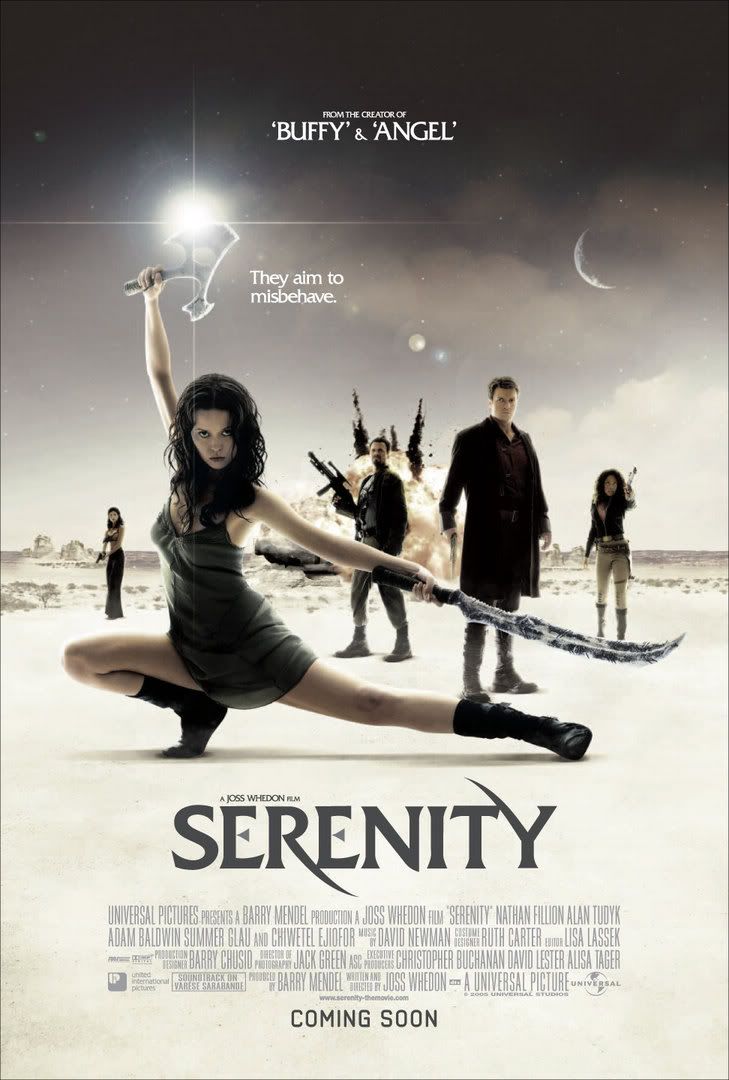
Warning: This piece is going to be long. It is also, in a weird way, a review of Joss Whedon’s Serenity, since that movie finally released the block that’s been keeping me from writing this essay for about a week, though work has conspired to keep me from posting it for the last four days. (Congratulations, Joss. I walked out of the theater Wednesday night with my mind whirring at mach 6, as the gears meshed and the tumblers tumbled and the mechanism, with groaning protest, unlocked. Serenity was excellent mental lubricant.) By now, I hope, most of my readers have already read one or more reviews of the film or have seen it, and have some familiarity with the background of that universe and its characters. Anyway, to proceed:
As I said last weekend, I watched the Jim Carrey movie The Majestic, and it inspired the idea for not one, but two posts. However, I was only able to write the first post. The second stubbornly refused to gel in my mind. I fought with it most of last week, and then Wednesday night I went to the Tucson Serenity sneak preview.
I don’t think I got out of the film what most of the rest of the audience did. Don’t get me wrong, I enjoyed it very much, but the underlying theme of the film spoke to me. We in the audience were not, of course, allowed to record anything, so lines I “quote” will be my best recollection or paraphrasing (and if you’ve not yet seen the film and don’t want to know anything in detail about it, stop reading now.) The theme is “true believers.”
Captain Malcolm Reynolds, the protagonist, was once, but is no longer a True Believer. One of the rebel “Browncoats,” he had his belief beaten out of him at the battle of Serenity Valley. Now he just wants to be as free from the interference of the Alliance government as is humanly possible. He wants to be an individual. He wants his freedom. He is, if you want to draw a contemporary parallel, a practicing anarcho-capitalist living on the fringes of a totalitarian society (with the exception of the fact that he sees no problem with stealing from the Alliance at any opportunity). Although he’d probably have a hard time discussing his personal philosophy in detail, he has his own code that he lives by strictly.
The antagonist in the film, The Operative (since he is given no name), is a True Believer, and it is what he believes that grabbed my attention more than anything else in the film. The Operative believes that the Alliance is “building a better world – better worlds,” and he acts as a mechanism to enable the Alliance to achieve its ends, even though he describes himself as “a monster, who will have no place” in those better worlds. The ends justify his means. “I don’t murder children,” Reynolds husks. “I do,” replies The Operative, with a gentle smile.
Glenn Wishard, in a post at Canis Iratus last year entitled A Thumbnail History of the Twentieth Century wrote:
The rise and fall of the Marxist ideal is rather neatly contained in the Twentieth Century, and comprises its central political phenomenon. Fascism and democratic defeatism are its sun-dogs. The common theme is politics as a theology of salvation, with a heroic transformation of the human condition (nothing less) promised to those who will agitate for it. Political activity becomes the highest human vocation. The various socialisms are only the most prominent manifestation of this delusion, which our future historian calls “politicism”. In all its forms, it defines human beings as exclusively political animals, based on characteristics which are largely or entirely beyond human control: ethnicity, nationality, gender, and social class. It claims universal relevance, and so divides the entire human race into heroes and enemies. To be on the correct side of this equation is considered full moral justification in and of itself, while no courtesy or concession can be afforded to those on the other. Therefore, politicism has no conscience whatsoever, no charity, and no mercy.
(Emphasis in original.) One of the themes that I repeat on this blog is the cockroach resilience of socialism/communism. The line that piqued me from The Majestic was a line that wasn’t even in the original script. Set in 1951 during the McCarthy period, that film’s protagonist has been subpoenaed to appear before the House Un-American Activities Committee. Adele, the love-interest in the film, utters this:
This is a free country, you can be a communist if you want to be a communist!
I think Glenn’s declaration that the 20th Century “neatly contains” the rise and fall of “the Marxist ideal” is a bit premature, but I fully concur with his conclusion that “politicism” has neatly divided societies in the manner described, and now, as Yeats put it in 1921, “The best lack all convictions, while the worst are full of passionate intensity.” (That’s a bit overstated, but we’re talking poetry, not engineering.)
All of human history has encompassed the struggle to “create a better world.” The question, “A better world for whom?” has often been glaringly omitted, but nevertheless, history has shown a continuing progression of improvement for the average individual in freedom, general health, life expectancy, and material wealth. Just ignore those hundreds of millions who have died along the way in misery, squalor, and agony from warfare, disease, starvation, malign neglect and deliberate murder. Don’t you understand? They bore the cost of getting us here, and are bearing the cost of future advancement. As I quoted James Lileks in On Guillotines and Gibbets:
Personally, I’m interested in keeping other people from building Utopia, because the more you believe you can create heaven on earth the more likely you are to set up guillotines in the public square to hasten the process.
Human history is one of constant warfare, and the deadliest warfare hasn’t been over land or over resources, but over ideology. Further, the deadliest warfare has arguably occurred during the last century, and worse, it has been committed by governments not against the military forces of other governments, but against civilians, both foreign and domestic. According to this site run by Rudolph J. Rummel, Professor Emeritus of Political Science at the University of Hawaii:
Nearly 170 million people probably have been murdered by governments in the 20th Century, 1900-1987; over four-times those killed in combat in all international and domestic wars during the same years.
America isn’t left off this list, either.
During our takeover of the Philippines between 1899 and 1902, American soldiers undoubtedly tortured and deliberately murdered several thousand Philippine civilians, and tens of thousands more died of disease and starvation. This war, and our acts during it, was savaged by Mark Twain in his essay “A Defence of General Funston” in 1902. In the collection of Twain’s works On the Damned Human Race, the preface to that essay includes this speech given by Massachusetts Senator George Hoar from 1903:
You, my imperialistic friends, have had your ideals and sentimentalities. One is that the flag shall never be hauled down where it has once floated. Another is that you will not talk or reason with people with arms in their hand. Another is that sovereignty over an unwilling people may be bought with gold. And another is that sovereignty may be got by force of arms….
What has been the practical statesmanship which comes from your ideals and sentimentalities? You have wasted six hundred millions of treasure. You have sacrificed nearly ten thousand American lives, the flower of our youth. You have devastated provinces. You have slain uncounted thousands of people you desire to benefit. You have established reconcentration camps. Your generals are coming home from their harvest, bringing their sheaves with them, in the shape of other thousands of sick and wounded and insane….
The book also quotes Indiana Senator Albert Beveridge:
(God) has marked the American people as His chosen nation to finally lead in the regeneration of the world. This is the divine mission of America… The Philippines are ours forever. We will not repudiate our duty in the archipelago. We will not abandon our opportunity in the Orient. We will not renounce our part in the mission of our race, trustee, under God, of the civilization of the world.
The more things change…
The Philippines only started our 20th Century democidal activities, according to Professor Rummel. The sack of Peking after the Boxer Rebellion, the deliberate bombing of civilian populations during WWII, Korea and Vietnam followed. Rummel concludes:
Putting together all the subtotals in this century the United States probably murdered about 583,000 people, conceivable[sic] even as many as 1,641,000 all told. Virtually all of these were foreigners killed during foreign wars. Domestically, throughout this century the American Federal or state governments were responsible for the murder of about 1 out of every 1,111,000 Americans per year.
And we’re pikers.
According to Rummel:
Communism has been the greatest social engineering experiment we have ever seen. It failed utterly and in doing so it killed over 100,000,000 men, women, and children, not to mention the near 30,000,000 of its subjects that died in its often aggressive wars and the rebellions it provoked. But there is a larger lesson to be learned from this horrendous sacrifice to one ideology. That is that no one can be trusted with power. The more power the center has to impose the beliefs of an ideological or religious elite or impose the whims of a dictator, the more likely human lives are to be sacrificed. This is but one reason, but perhaps the most important one, for fostering liberal democracy.
Or, as he puts it on his main page:
—-Lord Acton
Power kills; absolute power kills absolutely.
—-This Web Site
And ideology kills, but the only thing that can oppose it is another ideology.
BELIEF
At war today are three mutually opposing ideologies. The first striving to “create a better world” is socialism. In its most virulent form, communism, it is responsible for the deaths of over one hundred million people. It has failed everywhere it has been tried; some failures being more spectacular (and bloody) than others. Glenn Wishard believes that “the Marxist ideal” is on its way out with the ending of the 20th century. I’m not so sure. I don’t think that species of cockroach is down for the count, apparently not here in the U.S., and certainly not in Europe. Not by a long shot.
The second ideology is “liberal democracy.” We are, right now, engaged in warfare in the middle East trying to bring sovereignty and liberal democracy to fifty million people by force of arms. So far it has cost us hundreds of billions of dollars, and about two thousand of the flower of our youth with many more wounded, and it shows no sign of ending soon.
The third ideology has been named “Islamism” – the forced spread of Wahabist Islam and the imposition of Sharia law upon the entire world. It is unknown how many that ideology has killed so far, but it’s definitely in the hundreds of thousands at least, millions if you include the internecine warfare between the different islamist sects.
There are, of course, other ideologies extant in the world, but these three are predominant and currently in open warfare, both cold and hot. Many people have commented on the apparent willingness of those of the socialist ideology to act as a fifth column for the Islamists. Why, they wonder, do people who espouse a belief in fairness, equality, justice, religious freedom, and tolerance support an ideology that puts religious leaders above all, that makes women chattel, that makes homosexuality a capital offense, that makes the practice of any religion other than Islam a crime?
Because they BELIEVE – they believe that theirs is the only “true way” to utopia, and that America with its individualism, consumerism, and capitalism is the one true enemy, and the enemy of my enemy is my friend. The Islamists won’t spare them, but they don’t care. Guillotines or car bombs in the public square, either is justifiable if it hastens the process. They have passionate intensity.
Following his own personal code, the character Malcolm Reynolds once again finds something to believe in. At the end of the film he and his entire crew embark on an almost certainly suicidal mission to tell the universe of the horrible secret they have uncovered. “The universe is gonna know the truth,” he says. The Operative asks, “Are you willing to die for that?” He replies, “I am,” and means it. Peter Appleton, Jim Carrey’s character in The Majestic stands before the House Un-American Activites Committee and speaks of his belief in the Constitution and Bill of Rights, fully aware that he could go to jail for contempt of Congress (a valid charge, since he holds the proceedings in contempt.) He believes in something enough to take a risk, for the first time in his life.
We have people in the White House who believe. They believe that we can bring sovereignty to an oppressed people by force of arms. They believe that people – everyday average people, everywhere – want to be free. They believe that liberal democracy is the best form of government for that. They believe in capitalism. They believe in individualism. They believe. The people in our military, in the overwhelming majority, also believe. They are willing to die for it, and have been.
This is America. You can be a communist here if you want to be (but given its track record, I cannot imagine anyone of sound mind actually wanting to be.) We won’t kill or even merely imprison you for your belief – unless you actively work to overthrow the Constitution of the United States, and even then your odds are pretty good. Socialists and their fellow-travellers are disproportionally represented in all levels of public education and the media, and have had literally decades to direct public thought. Yet (by the slimmest of margins) we’ve elected a leadership of True Believers of a different creed. This means that Yeats was wrong – the best do not lack all conviction. However, that doesn’t make us True Believers, either. We are jaded by government. We are often disgusted by the things our government has done in our name, for us and to us and to others. Not enough of us are willing to risk for our convictions. We would rather try to be as free of government interference as possible, because we know that power kills, and absolute power kills absolutely. In the Firefly episode “War Stories,” Shepherd Book speaks a line of great truth:
A government is a body of people, usually notably ungoverned.
But we are at a crossroad of history. Of the three ideologies that are fighting for the future, only one promises at least the possibility of restraint on the power of government. If we don’t support that ideology, one of the others will most certainly be ascendant. People will die. Governments will kill them. The question is, how many, and will they die in vain?
What do you believe?