In a sane nation, “Contempt of Congress” would not be a crime. It would be a Pulitzer Prize category. – Jim @ The Travis McGee Reader
Or a Nobel Prize category….
Just sayin’.
The Smallest Minority on earth is the individual. Those who deny individual rights cannot claim to be defenders of minorities. – Ayn Rand
In a sane nation, “Contempt of Congress” would not be a crime. It would be a Pulitzer Prize category. – Jim @ The Travis McGee Reader
Or a Nobel Prize category….
Just sayin’.
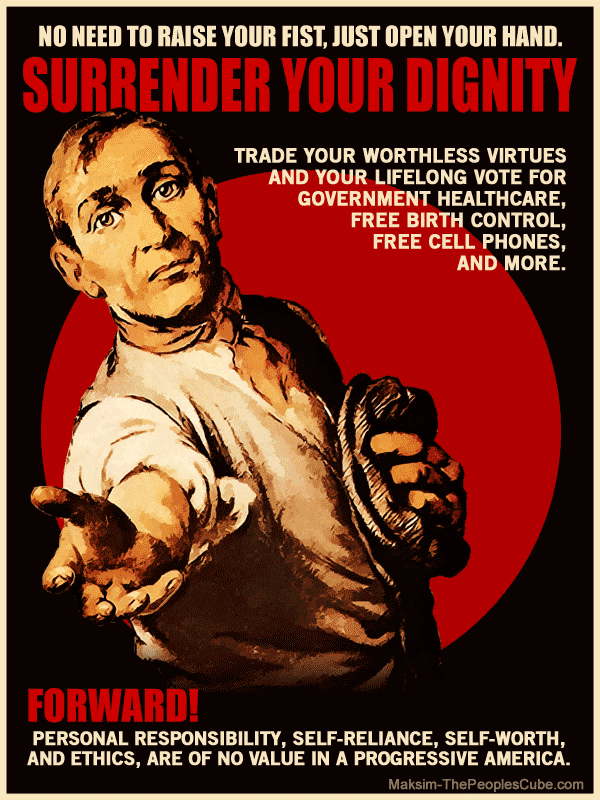
From The People’s Cube:
Rachel starts the year off right with the title to her post, which I made QotD:
Thank God our heroic president spent more than three million dollars of our money to heroically help our heroic Congress heroically do exactly shit-all.
After the title, she really gets going.
Read it all, and all the links. Quoting Rachel again:
When I encounter people in conversation who acknowledge the set of facts about what’s happening in the Western world right now and then say, “Meh, bah, blah blah, there’s nothing I can do about it, I’m just going to enjoy my life,” I literally – I do mean literally – almost burst into tears because it feels so hopeless and frustrating if even the most reasonable of us flat-out do not give a shit. I actually have burst into tears when certain people very close to me have offered those rhetorical shoulder-shrugs.
Sorry to be so pessimistic. Last thing I want is for this blog to become depressing for anyone who likes it. It’s just that I read all that insanity about the fiscal cliff “deal” today, and then a trainload of terrifying anti-2nd Amendment rhetoric by fascists dressed in sheep’s clothing, and then two pieces by the excellent historian and writer Victor Hanson Davis, and I’m ready to offer a cash reward for anyone who can convince me that America as we’ve known it is not irretrievably gone.
I’ve got nothin’ else for you today.
I’ve done this every January 1st since 2007, but I almost skipped it this year. I think burnout is getting to me. But I decided to do it anyway, so here we go.
January brought the single most popular post here ever. My dad sent me the link in an email, and since I put it up on January 11 (according to Google Analytics) it’s drawn 396,497 hits: That’s not Recoil, THIS is RECOIL. And 144 comments without a peep from Markadelphia. Yup, a YouTube video. Somebody ELSE’s YouTube video.
In February another YouTube video post became the #2 all-time traffic draw with 129,711 hits so far and counting: THIS Might Make Me Want to Try Shotgunning. Why do I bother with überposts?
In March, we lost another blogger. Newbius passed away. I know more people online who have died than I know in meatspace, and as I get older that list gets longer. The first death of an online personality that really affected me was when Acidman passed in June of 2006. Rob Smith is, in a way, responsible for the existence of this blog. But it’s still a shock when someone known to you is no longer there. Fair winds to them all.
I had another very popular post – again, someone else’s work – when I posted the story of J. David Phillips and his last-ditch self-defense: The .25ACP and “Stopping Power”
April brought us the conclusion of the GOP primary race, and the Quote of the Year that predicted, somewhat, the outcome in November:
Given how the GOP field has been winnowed, this has really just been a race to determine the form Gozer the Traveler takes.
So this just means the giant Sloar is off the table and means is we’re looking between the moving Torb and the Staypuff Marshmellow man.— Jack
And, of course, the accompanying T-Shirt. Also in April, I drank the Kool-Aid and bought an M&P9.
Speaking of traditions, May 1 is now Victims of Communism Day. I intend to commemorate it every year. I bought a new AR lower. Those are thin on the ground these days. And TSM turned nine years old and drew its 3,000,000th visitor, and that ain’t bad.
Instead of original content (who reads that?) in June I posted a series of Quotes of the Day from educator John Taylor Gatto’s The Underground History of American Education. Twelve of them, in fact.
In July, the Supreme Court ruled on the Constitutionality of Obamacare. A 5-4 decision, written by Chief Justice Roberts, said it was. I took exception.
I was introduced to the concept of “hyperindividualism.” And finally, on the event of Milton Friedman’s 100th birthday, I posted a video of an excellent speech he gave in 1978 at the University of Chicago. I strongly recommend you watch it.
In relation to that video, in early August I posted a Quote of the Day in apposition to one from the video illustrating the ongoing decline Friedman warned about, preceded the previous day by a QotD that illustrates why I think this is happening. Meanwhile in Sarah Brady Paradise, their criminals have apparently started using hand-grenades. I thought that only happened in Mexico. How’s that gun control (on an island no less) working out for them?
September brought the Seventh Annual Gun Blogger Rendezvous, but this year instead of driving, I got to fly up. In a Cessna 310. Still haven’t won a gun there, though. And over in Sarah Brady Paradise, a cop-killer used a hand-grenade in the double-murder of two female Bobbys. And Markadelphia returned to the comment threads. If you see a post with 50+ comments, chances are Markadelphia is in it at least once.
October brought us a preview of coming attractions I thought should be shared, and another from closer to home. I finally concluded that Anthropogenic Global Warming Climate Change is bullshit based on the evidence in hand. And I made my grandson a kick-ass Halloween costume.
November. Ah yes, November. I think the country reached the point of no return in November. Honestly, it happened long before November, but the election ended any speculation on the question. As I said, OUR Austerity Riots are going to be SPECTACULAR!
And finally, December. First post of the month, How We “Lost the Culture War.” Not an überpost, but I’ve kinda lost my enthusiasm for those. There was some good news – Illinois’ ban on concealed carry was found unconstitutional. And we had another mass shooting, this time involving twenty dead first-graders. For the gun-banners, they couldn’t have dreamed of a better pool of blood to dance in. But Newtown, Connecticut is not Dunblane, Scotland. America’s response? There’s not an AR-15 left on a gun store shelf, nor a standard-capacity magazine to fit one. Seven thousand AR-15 rifles sold in Arizona in ten days, according to the Arizona State Rifle & Pistol Association.
SPECTACULAR, I tell you.
2013? Maybe there’s something behind Triskaidekaphobia after all.
Happy New Year, y’all.
I bestow upon you, my readers, my fondest and most fervent wishes that 2013 will not be the whirling vortex of suck and fail I expect it to be. Party hard, be safe, and awake tomorrow with no hangover.
I just received an email from the Arizona State Rifle & Pistol Association (of which I’m a member). To wit:
AR15-101
The safety and information class for all you new AR15 owners….yes all 7,000 of you in Arizona which purchased Americas Most Popular Rifle in the last 10 days!
Join us for this informative and fun seminar this Saturday.So….why would you not attend this fun and informative class?
When: Saturday, January 5th.
Where: Ben Avery Shooting Complex
(I-17 & Carefree Highway)
Phoenix Police Department Rifle Range #1
Time: 9am to 12noon
Cost: *$10 (includes range fees, Safety Device, Study Materials, etc.)Equipment: Your UNLOADED and CASED AR15, 40-50 rounds of ammunition, eye and ear protection, appropriate clothing, water and sunscreen.
* This class is free to ASRPA members.
Seven thousand AR-15s in ten days. In one state. And this doesn’t include the M1As, AK-47s and -74s, Mini-14s, etc. Just ARs.
Yeah. Americans want more gun control. Right.
Exurban Kevin and I have been discussing another Southern/Central AZ blogshoot. As previously, it will be held at the Elsy Pearson Public Shooting Range just off Trekell Road and I-8, just West of I-10 near Casa Grande. We’ve selected Saturday, January 5 as the target date (no pun intended.)
Same as last year, the range opens at 7:00AM. There are no rangemasters. There are no chairs – bring something to sit on. The firing line is covered and there are concrete shooting benches, however.

And the city has porta-potties out there on a permanent basis, so we don’t have to rent our own (but bring your own TP just in case.)
The rules are pretty simple:

No explosives, no .50BMG rifles, clean up after yourself, don’t be a dick.
The rifle range is 300 yards deep with the first berm at 200. The mountains that form the ultimate backstop are another 300 yards out and farther. The ground there is reinforced concrete disguised as sun-baked clay. Forget about any target stand that needs to stick into the ground, it ain’t happenin’. Steel and targets that don’t need taping are best. And the benches are funky-shaped. Regular camping chairs are marginal, stools are better. I bring a folding chair, a target stand made of 2″ PVC pipe, and my steel swingers. I also have some .22 rimfire rated rolling targets made of steel.
I recommend you bring: water or other non-alcoholic beverages (no alcohol on the range), sunscreen, ear and eye protection. Ladies, don’t wear anything low-cut or open-necked. Yes, I’m sure it looks lovely, but you don’t want to catch hot brass down in there. OPTIONAL: Something to shoot with, and something to shoot AT. If you’re a reader or a non-gun blogger interested in coming to a off-the-cuff funshoot, please come on down! I imagine most of us will be bringing multiple firearms and lots of ammo, but if you don’t, well, I’m willing to let people shoot my stuff (with my ammo), and I’m willing to let them shoot at my targets.
We’re planning on trying to have a cookout at the range. Last year’s was meh, but my burgers were pretty good. Hope to see you there! Chime in in the comments if you’re considering coming.
It’s obvious that the way to end school shootings is to forget about the “shootings” part and focus on the first word instead.
We need to abolish schools.
—
Decades hence, our offspring will listen in disbelief when we tell them we used to pay billions of dollars to warehouse children in “gun-free zones” overseen by morons; that 21st-century kids were groomed for 19th-century jobs and came out functionally illiterate but experts nonetheless on the subjects of Kwanzaa, “safe” sex, and something called global warming.
Kathy Shaidle, Ban Schools, not Guns. Taki’s Magazine
RTWT. And the comments.
h/t: Vanderleun
Today’s Quote of the Day from a Forbes piece, Gun Control Tramples On The Certain Virtues Of A Heavily Armed Citizenry.
Excerpt:
Hard cases make bad law, which is why they are reserved for the Constitution, not left to the caprice of legislatures, the sophistry and casuistry of judges or the despotic rule making of the chief executive and his bureaucracy. And make no mistake, guns pose one of the hardest cases a free people confronts in the 21st century, a test of whether that people cherishes liberty above tyranny, values individual sovereignty above dependency on the state, and whether they dare any longer to live free.
RTWT.
I have been working, off and on, on another patented überpost on the latest push for an “assault weapon ban,” but in the interim I went back to the archives and found a piece I wrote in July of 2003, shortly after starting this blog that is still pertinent, though many of the links are now broken. I thought I’d repost it, as I doubt many of you reading today have been with me since 2003 and fewer still have plumbed the depths of the archives or even the “Best of” on the sidebar. So here again is “A Mistake a Free People Get to Make Only Once”:
__________________________________________________________________________________
“May you live in interesting times.”
That fits. A lot happened in the last couple of weeks. Brian Borgelt, the owner of Bull’s Eye Shooter Supply in Tacoma, Washington, the gun shop from which Muhammed and Malvo “acquired” their Bushmaster AR-15, is finally getting his Federal Firearms License pulled for improperly tracking and losing records for over 200 firearms, while the GAO reported that the federal government has lost 824 firearms, some of which were full-auto weapons, and many of which were not properly reported or reported long after the loss. Canada’s gun registration deadline has passed with (a government estimated) 20% of rifles and shotguns remaining unregistered. Another workplace multiple shooting occurred. This time there were five dead and nine wounded at a Lockheed plant in Mississippi (not including the perp.) Three teenagers were arrested before they could carry out what certainly appears to be a premeditated killing spree. A grandmother, mother, and three children – all infants to toddlers – were shot to death in Bakersfield, California. (A quick Google news search on the word “shooting” brings up the normal long list of single-victim stories, as well.) The Supreme Court received the petition for a writ of certiorari in the Silveira v. Lockyer case. And the UN released its Small Arms Survey 2003 that detailed worldwide civilian gun ownership. That report proclaimed that there is a near 1:1 parity of guns and people in the United States.
America, it is often pointed out, has one of the highest firearm-related homicide rates in the world, and easily the most civilian-owned arms. Gun control supporters constantly decry the “number of guns” in America as being the, or at least a cause of our firearm-related mayhem. It is the point of the UN Small Arms Survey: the number of guns in civilian hands worldwide represents a threat to the health and safety of those civilians and their societies, and that governments should work to reduce the number and so reduce the threat.
And here’s a shocker – to some extent I agree with the basic premise that having a lot of guns around, indiscriminately, uncontrolled, does contribute to the volume of injury and death inflicted with firearms. It’s almost – almost – a tautology. Here in America if John Q. Wifebeater didn’t have a .357 revolver laying around, he might not be able to kill the Mrs. (or vice-versa) the next (and last) time they get into a knock-down, dragout fight. It’s possible that a distraught teenager in a moment of bleakness might not kill himself with his father’s shotgun if Daddy just didn’t have one. If no one kept a gun at home, there wouldn’t be twenty or so toddlers killed accidentally with them each year. If guns were less available, it’s possible that more armed robbers would be armed with crowbars and baseball bats rather than 9mm’s, and fewer convenience store clerks and cab drivers would end up shot.
Yes, America has a lot of guns and a lot of death and injury by them. I’ve been asked “How many people have to die before you realize that we need effective gun controls?!?”
And I’ve responded: “How many deaths will it take before you realize that gun control isn’t effective, and stop pushing for new gun control laws?”
Because that’s the question, isn’t it? We all realize that there’s a problem, but we’re divided by the proposed solution to that problem. And we’re really divided on just what that solution entails – because if you believe that “the number of guns” is the problem, then the only answer is to reduce (to some arbitrary “this is enough” level) or eliminate those guns. I’m willing to bet that the arbitrary “this is enough” level is roughly equivalent to zero. In order to eliminate those guns you’ve got two choices: render the Second Amendment meaningless in the minds of the citizens and in the courts of America, or find some way to legally give government the power to do what the Second Amendment prohibits – disarm America.
So far the legal process of making gun ownership by the law-abiding difficult in America has only been successful in a few places: Chicago, New York City, Washington D.C., Maryland, New Jersey, and some others. Generally, buying a gun legally still a fairly easy thing to do nationwide. (You’ll note that it hasn’t affected illegal acquisition in the least.) The second part, rendering the Second Amendment meaningless, has progressed somewhat better. At this time there is no legally recognized individual right to arms in the states of the 9th Circuit Court of Appeals, and to be honest, that right is only recognized – and weakly – in the 5th Circuit. The other circuits are largely mute on the question, but lean towards the 9th Circuit’s opinion. If the Supreme Court grants cert. on Silveira that question might finally get an answer. (And I’m not betting on just what that answer will be, either.)
However, I’ve made a blanket statement: “Gun control isn’t effective.” How can I claim that? Gun control works in other countries, doesn’t it? What about the 1934 National Firearms Act? Hasn’t that been effective? Gun rights proponents proudly proclaim that only one legally registered fully-automatic weapon has been used in a crime – and that by an off-duty police officer. Gun control proponents respond that this means that licensing and registration does work. Well, admittedly the use of NFA weapons is much less than, say, basic handguns, but how do you define “works?” In a discussion I had a while back on another site it was defined to me as “not hindering law abiding citizens from owning guns but making it more difficult for criminals to acquire guns.” My response to that was that the question of “hindering” was one of degree (as in “what, exactly, constitutes ‘infringing’ on a right?”), but that licensing and registration – in some countries – indeed did not significantly hinder the law abiding from owning guns, and that it did, indeed make it “more difficult” for criminals to acquire guns – but it didn’t make it effectively difficult. As an example, the “war on (some) drugs” does not prevent the law abiding from getting needed medications, but it doesn’t effectively prevent criminals from getting illicit drugs, does it? Harder, yes, but I think that scoring a tab of Ecstasy or a baggie of pot is probably only a little more involved than driving down to the neighborhood Walgreen’s if you’re inclined to use that stuff. And if you want to buy a gun while you’re at it, that probably isn’t any harder. You might even get a discount for doing both at once.
What I did note in that discussion, however, is that in many societies that had gun licensing and registration, the registry had been used for gun confiscation, and that I believed that they would be used that way here, as well. Nor am I alone in that belief. Charles T. Morgan, at the time Director of the Washington office of the ACLU said in Senate testimony in 1975 when asked about gun registration:
What the administation’s and Congressman McClory’s bills . . . call for is a whole new set of Federal records. . . .
I have not one doubt, even if I am in agreement with the National Rifle Association, that that kind of a record-keeping procedure is the first step to eventual confiscation under one administration or another.
Only one legally owned NFA firearm has been used in a crime, but it didn’t stop two gunmen from using at least three fully-automatic weapons during the North Hollywood bank robbery. It certainly hasn’t stopped criminals from sawing off shotgun barrels.
But let’s look at the NFA for a second. The primary effect of the 1934 National Firearms Act was the registration of fully-automatic weapons and the strict control of their transfer between law-abiding owners. On top of that, at the time the law was passed a truly draconian “tax” was assessed on each transfer of NFA restricted weapons – $200. In 1934 that was a lot of cash. The effect was to essentially stop the production of many otherwise legal NFA firearms for public consumption such as the Ithaca Auto & Burglar – because the guns themselves didn’t cost $200. Now, of course shotguns like these

are sold for about $400 plus, of course, the $200 transfer tax. Machine guns, on the other hand, have always been pretty pricey with the exception of a few really cheap models like the M3 “grease gun” and the Sterling. But throw $200 on top of the price, and the legal market for them shrinks. With a small legal demand, not too many hit the illicit market either. They weren’t there to steal, and there was a significant obstacle to straw-purchases: owner registration. So, in a sense, the NFA licensing and registration scheme “worked” – it made it harder for criminals to access NFA restricted weapons – but it obviously wasn’t effective at reducing gun crime. Criminals got the weapons they wanted, or just substituted different weapons. If someone really wants a fully-automatic weapon, he can get one – as evidenced by the North Hollywood shootout and other crimes. If someone really wants a short-barrelled shotgun, all it takes is a hacksaw. If someone really wants a suppressor, it just takes a decently equipped shop. Licensing and registration “works” at making it more difficult for criminals to get guns if you can stop or greatly reduce the influx of the weapons you’re trying to restrict. Once they’re in circulation, it’s too late. They don’t get registered, or they get stolen (or reported stolen). In a country with (according to the UN report) 238,000,000 to 276,000,000 guns, registration as a “gun control” measure is a forlorn hope. As a precursor to confiscation, however…
So, reducing the number of guns available to the public could reduce the “heat of the moment” type killings, and the accidental deaths by firearm, but it doesn’t really affect deliberate criminal useage. In fact, as evidenced by England, it might result in an increase in deliberate criminal use. It might prevent, say, the Lockheed slayings, but it won’t have much of a positive effect on the number of convenience stores robbed annually, and might even result in a negative effect when criminals realize they have little to fear from their targets.
The initial argument against semi-automatic “assault weapons” was that these were the “weapons of choice” of criminals, but the fact of the matter is, with well over 2 million (depending on your definition) “assault weapons” in circulation, the most popular firearms in criminals hands remains the handgun – and only the Violence Policy Center is willing to come out in favor of banning those. Now the argument against “assault weapons” is that they’re only good for killing a large number of people indiscriminately (which of course is why police forces across the country are equipping with them. Right?) But using that argument there is now a Federal “ban” on some “assault weapons” and there are some state and local “bans” on them as well. The “bans” just resulted in some redesigns and some workarounds, but the intent was clear – these weapons were no longer to be offered to the general public ostensibly in an effort to keep them out of the hands of people who would misuse them. The same holds true now for .50 BMG caliber rifles – efforts are afoot both locally and nationally to (at a minimum) include these weapons in the NFA restricted list. Demand for both has skyrocketed – if we think the government is going to ban them, we want them.
So, to date the path to civilian (some say “victim”) disarmament has been pursued through the “death-by-a-thousand-cuts” strategy, or, more aptly the “frog in a pot” analogy. This is illustrated well by the “assault weapons ban” that really isn’t. Charles Krauthammer made the true point of the law quite plain in his 1996 Washington Post op-ed “Disarm the Citizenry:”
It might be 50 years before the United States gets to where Britain is today. Passing a law like the assault weapons ban is a symbolic – purely symbolic – move in that direction. Its only real justification is not to reduce crime but to desensitize the public to the regulation of weapons in preparation for their ultimate confiscation.”
The gun control groups term it as the “next step” – as in “Gun DNA is the next step for New York as we continue to develop innovative crime fighting policies.” – so said New York Governor George E. Pataki in 2000. There’s always a “next step” because all the previous steps didn’t work to reduce crime or accidents – but they do work to make it more difficult to legally acquire and keep a firearm.
There is no doubt that there is a movement out there intent on disarming not only Americans, but civilians around the world, because the only “effective” gun control is gun elimination, and the only way to reduce the number of guns in civilian hands is to take them from us, or make us give them up. As with all things political, there is no single reason for this movement. There’s the tinfoil-hat bilderburg/zionist/mason/communist/skull-and-bones conspiracy-of-the-week, there’s the “we know what’s best for you” crowd (which can be rolled into the first group pretty easily), there are the people who have lost loved ones to gun violence, and there are the people who “care” but don’t tend to think much (the “useful idiots.”) And on the face of it, it seems pretty obvious to a lot of people that fewer guns would be a good thing, even to many gun owners. It seems pretty obvious to a lot of people that “assault weapons” have no place in our society. In fact, our gun control laws have, for years, been predicated on a “sporting use” philosophy – and even I will admit that there isn’t a lot of “sporting use” for a gun like an AK-47 or even my Mossberg 590.
This movement, however, has lost traction here in the last few years. More and more states have adopted “shall-issue” concealed-carry laws in the face of vociferous opposition from the gun control crowds. And, most telling, incidents like the Lockheed shooting and Columbine haven’t resulted in the kind of overwhelming outcry for more gun control that incidents like Port Arthur, Dunblane, and Erfurt elicit in other countries. A lot of people ask why that is? What is it about Americans that makes us ignore what is so obvious to others – that guns shouldn’t be in private hands, uncontrolled?
I think I have an answer to that. And to give you an example, I will quote, in its entirety, a letter recently submitted to Kim du Toit (and republished with his permission):
Your offhand comments about keep-and-bear supporters who do not, themselves, keep and bear hit a nerve.
I’ve seen the light, and I’m here to testify.
To those of you who grew up with guns, I expect that what I’m about to say will seem painfully obvious. But I came to class late, and what I learned there is still fresh and vibrant.
I thought, all my life, that I couldn’t own a gun safely, that no one could, really. Guns were dangerous and icky. Even after I realized that the Second Amendment was not quite the shriveled, antiquated appendix I’d been taught, for a couple of years or so I still wobbled around with the training-wheel comfort of believing that while not all gun owners were necessarily gap-toothed red-necked fascist militia whackos, I myself ought not to own firearms. I was too clumsy and careless, and guns were still dangerous and icky.
Just before 9/11 I woke up to how quickly my liberty was eroding, and in a fit of anger and defiance started saving for a handgun while training with rentals. (Thanks to Harry at Texas Shooters Range here in Houston.) When I actually bought one (to the horror and confusion of my friends and family), having it around the house, carrying it in my car, talking about it, showing it off, and of course shooting and maintaining it, taught me what I could not learn from books, magazines, classes, or even Usenet:
It taught me that freedom takes practice.
I thought I’d practiced. I’m as full of opinions as the next guy, and not shy about passing ’em out to anyone who’ll listen. I read banned books and underground comics. I’ve walked the picket lines and hung out with undesirables. A preacher’s kid, I pointedly don’t practice a religion. I’ve done stuff that Wasn’t Allowed.
But when I got a gun, I discovered it had all been safe, padded, wading-pool-with-floaties dabbling. After near on to fifty years, I finally started to grow up. If my Grands are any clue, I’ve still got twenty or thirty years to work on it, and get to be something like mature by the time I go senile.
It’s not just that rights are useless if they are not exercised, not even that rights must be used or be lost. It’s that exercising your rights, constantly, is what instructs you in how to be worthy of them.
Being armed goes far beyond simple self-protection against thugs or even tyrants — it’s an unequivocal and unmatched lesson that you are politically and morally sovereign; that you, and not the state, are responsible for your life and your fate. This absolute personal sovereignty is the founding stone of the Republic. “A well-regulated militia” (where the militia is “the whole people”) isn’t just “necessary to the security of a free state” because it provides a backup to (and defense against) the police and the army. More importantly, keeping and bearing arms trains sovereign citizens in the art of freedom, and accustoms us to our authority and duty.
“To believe one is incompetent to bear arms is, therefore, to live in corroding and almost always needless fear of the self — in fact, to affirm oneself a moral coward. A state further from ‘the dignity of a free man’ would be rather hard to imagine. It is as a way of exorcising this demon, of reclaiming for ourselves the dignity and courage and ethical self-confidence of free (wo)men that the bearing of personal arms, is, ultimately, most important.”
Unless you have some specific impediment (and most impediments can be overcome), arm yourself. Find out who you really are. (Yes, there are many paths to self-knowledge. But this tests something you cannot access any other way. No one path goes everywhere.) You’ll probably discover you’re not all that bad. And if not, well…Think of it as evolution in action.
THAT is what separates us from everybody else: the belief in personal sovereignty, as a citizen of this nation. In fact, there’s a guy out there who has a site dedicated to opposing the very idea of personal sovereignty. (It’s a very good site from an informational standpoint, although I disagree violently with his position.) Why don’t we get rid of our guns? Because we’re not subjects, we’re citizens. The majority of Americans – still, somewhere deep inside, perhaps dimly – understand that we are sovereigns, that we are responsible, not government. Our collapsing schools have not yet broken us of this belief, though I don’t think it exists in many of our children any more. For the majority of us who bother to vote, however, being told that we are not responsible enough, grates. We are not willing to yeild, yet, our right to self defense, and eventually self determination. Somehow, the majority of voters sense a threat to their sovereignty.
I find this encouraging as I watch Europe proceed in its formation of its union. I read as Steven Den Beste points out the disastrous path they are taking, and wonder what’s going to happen there if it all comes crashing down (as I believe it will.) That collapse would have worldwide repercussions. We don’t make a lot of things here any more. There really is a ‘global economy’ all connected together like a vast power grid, just waiting for a circuit failure somewhere to crash the system in whole or in part. And if such a collapse does occur, I believe the results will be very, very bad. I wonder what North Korea is going to do, and when or if China will make a grab for Taiwan. I wonder if Pakistan and India will throw nukes at each other some day. In short, I wonder if the wheels might come off the wagon without much warning, and leave the U.S. and the rest of the world in a really bad position. “Interesting times” indeed.
For all the mayhem guns in civilian hands have caused, guns in the exclusive control of governments have resulted in far more. “Assault weapons” may not have much of a “sporting purpose,” but the Second Amendment isn’t about “sport.” Judge Kozinski in his eloquent dissent to the denial of appeal for an en banc rehearing of Silveira explained it perfectly:
The majority falls prey to the delusion—popular in some circles – that ordinary people are too careless and stupid to own guns, and we would be far better off leaving all weapons in the hands of professionals on the government payroll. But the simple truth – born of experience – is that tyranny thrives best where government need not fear the wrath of an armed people.
—
All too many of the other great tragedies of history – Stalin’s atrocities, the killing fields of Cambodia, the Holocaust, to name but a few – were perpetrated by armed troops against unarmed populations. Many could well have been avoided or mitigated, had the perpetrators known their intended victims were equipped with a rifle and twenty bullets apiece, as the Militia Act required here. If a few hundred Jewish fighters in the Warsaw Ghetto could hold off the Wehrmacht for almost a month with only a handful of weapons, six million Jews armed with rifles could not so easily have been herded into cattle cars.
My excellent colleagues have forgotten these bitter lessons of history. The prospect of tyranny may not grab the headlines the way vivid stories of gun crime routinely do. But few saw the Third Reich coming until it was too late. The Second Amendment is a doomsday provision, one designed for those exceptionally rare circumstances where all other rights have failed – where the government refuses to stand for reelection and silences those who protest; where courts have lost the courage to oppose, or can find no one to enforce their decrees. However improbable these contingencies may seem today, facing them unprepared is a mistake a free people get to make only once.
Somehow, I think that we are almost alone in the world still understanding in our bones that tyranny isn’t something relegated to history, never to raise its ugly head again. And because we understand that, we’re willing to endure our daily mayhem and slaughter. It’s better to live with that, than to make the mistake we only get to make once.