Had to share. (Language warning!)
Category: Uncategorized
And the Mask Drops Further
From my previous post, the New York Times interviews a Leftist who believes we need to eliminate the Electoral College, pack the Supreme Court, and abolish the Senate to “Save Our Democracy!”
The NYT went even further in another op-ed, wistfully decrying the lack of a military coup:
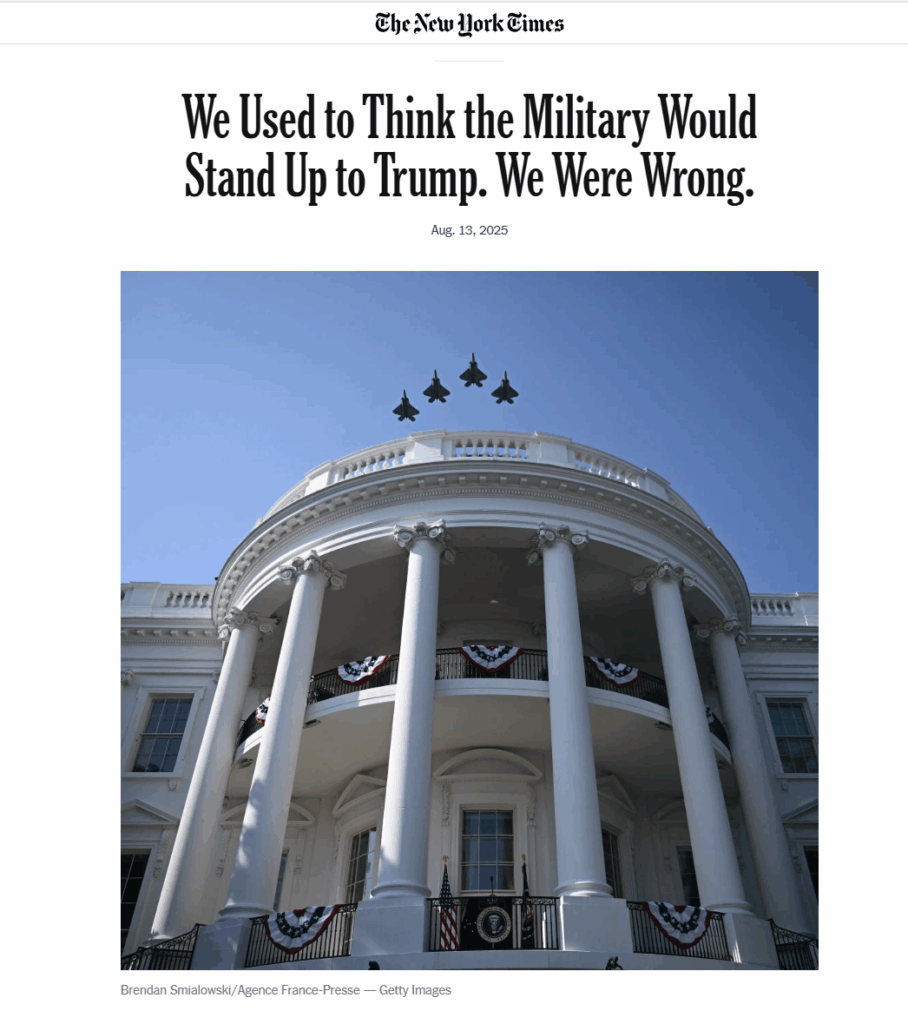
Archived op-ed below the fold again:
Screaming the Quiet Part Out Loud
They have to destroy the Republic to save “Our Democracy” – that is, one-party rule. Theirs.
Mask? What mask?
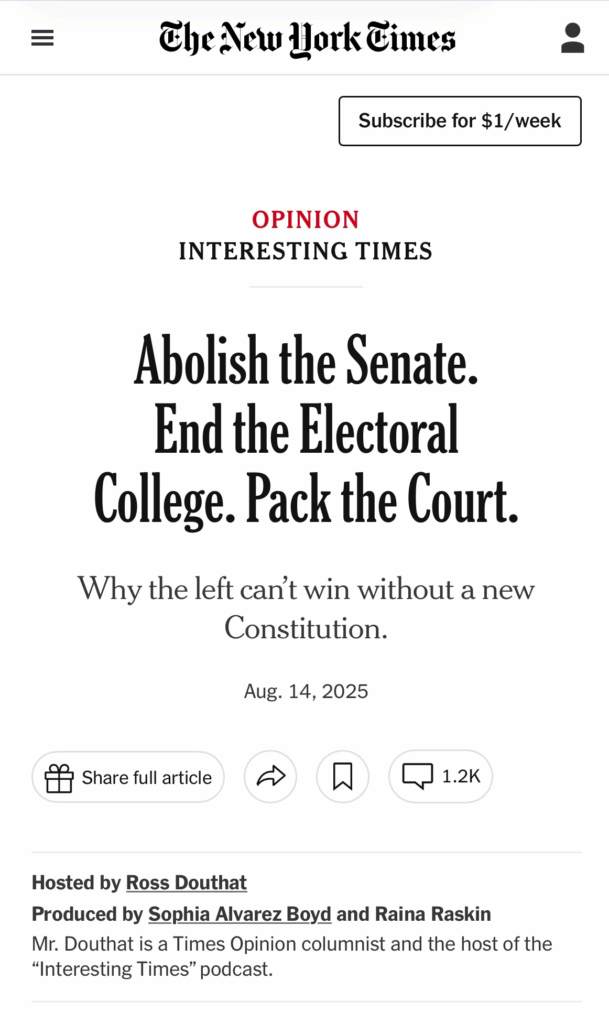
Here’s the transcript, just in case the NYT memory-holes it and the Wayback Machine copies, below the fold:
Will there be a “Revolution” in Britain?
The post below with the British couple stating the reasons they’ll never return to the UK drew an interesting response. On of my readers is a resident of the Commonwealth, having abandoned the UK some time back, and he kindly sat down an wrote an überpost of his own and emailed it to me.
I asked him for permission to post it, and he asked me to remove any reference to his current location from it, but otherwise approved. As I noted, it is a bit long, so it’s below the break.
“The Most American Sh!t I’ve Ever Seen”
It makes me proud to be American.
California
So I just asked Grok to compose a parody version of America’s “Everyone I Meet is From California” (1971) (Video below)
Here’s what it came up with in literally a few seconds:
California Exodus Parody
(To the tune of “Everyone I Meet Is from California” by America)
Lyrics
Well, I said goodbye to the Golden State,
Where the taxes climb and the fires don’t wait.
Streets are lined with tents and broken dreams,
Needles in the gutters, it ain’t what it seems.
Chorus:
Everyone I meet’s from California,
Packing up their bags, they’re headin’ to Nevada.
Red states callin’, they’re leavin’ in a hurry,
‘Cause the Golden Dream’s gone blurry.
Human waste on sidewalks, power’s flickerin’ low,
Brownouts in the summer, nowhere left to go.
Wildfires burn the hills, skies choked with smoke,
Folks are movin’ out, sayin’ this state’s broke.
Chorus:
Everyone I meet’s from California,
Runnin’ to Montana or maybe Arizona.
High costs and chaos, they’re done with the fight,
Headin’ for the Red states’ light.
Used to be the dreamland, surfers and the sun,
Now it’s budget battles, and no one’s havin’ fun.
From Frisco to L.A., the story’s all the same,
Californians leavin’, no one left to blame.
Chorus:
Everyone I meet’s from California,
Crossin’ state lines, sayin’ “See ya, California!”
Homeless camps and taxes, they’re leavin’ it behind,
Searchin’ for a freer state of mind.
Outro:
Oh, California, what happened to your glow?
Your people hit the road, they’re lettin’ you go.
Everyone I meet’s from California,
But they’re buildin’ new lives in Idaho.
The original:
Life in the UK
Shot:
Chaser:
Discuss!
Recommended.
How Half Of America Lost Its F**king Mind
But which half? Discuss.
U.S. v Rock Island Armory
In the coming lawsuit(s) against the NFA registry for suppressors, short-barreled guns and AOWs, I fully expect this rather unknown case to be cited: U.S v Rock Island Armory, (1991) from the Central District of Illinois(!).
From Grok:
The 1991 case United States v. Rock Island Armory, Inc., 773 F. Supp. 117 (C.D. Ill. 1991), centered on a legal challenge involving the National Firearms Act (NFA) and its registration and taxation requirements for machineguns, particularly in light of a 1986 amendment to the Gun Control Act. Below is a detailed background of the case and the ruling:
Background:
National Firearms Act (NFA) of 1934: The NFA, enacted under Congress’s taxing power (Article I, § 8 of the U.S. Constitution), imposed taxes and registration requirements on certain firearms, including machineguns, to regulate their manufacture, possession, and transfer. The constitutionality of the NFA was upheld in Sonzinsky v. United States, 300 U.S. 506 (1937), where the Supreme Court affirmed that the NFA was a valid exercise of Congress’s taxing authority, not a criminal regulation, despite its regulatory effects. The NFA required manufacturers, importers, and dealers to register firearms with the Treasury Department and pay associated taxes.
Firearm Owners’ Protection Act (FOPA) of 1986: On May 19, 1986, Congress passed FOPA, which included 18 U.S.C. § 922(o), commonly known as the Hughes Amendment. This provision prohibited the possession or transfer of machineguns manufactured after May 19, 1986, for private individuals, except for those made for governmental entities. The Bureau of Alcohol, Tobacco, and Firearms (ATF) interpreted § 922(o) as prohibiting the registration of new machineguns for private use and refused to accept tax payments for such firearms. This created a conflict with the NFA’s registration and taxation framework, as the government would not allow compliance with the NFA for post-1986 machineguns.
Case Context:
In United States v. Rock Island Armory, Inc., the defendants, Rock Island Armory, Inc., and David R. Reese, were charged in a superseding indictment with violating provisions of the NFA (26 U.S.C. §§ 5801 et seq.) for acts related to the making and registration of machineguns in 1987 and 1988. Specifically, they were accused of failing to register machineguns and pay the required taxes under the NFA. The defendants moved to dismiss the charges, arguing that the NFA’s registration and taxation requirements were no longer constitutionally valid for post-1986 machineguns due to the enactment of § 922(o).
Key Legal Issue:
The central issue was whether the NFA’s registration and taxation requirements remained constitutionally valid for machineguns manufactured after May 19, 1986, given that § 922(o) prohibited their registration and the government refused to accept tax payments. The defendants argued that since the government no longer allowed registration or tax collection for these firearms, the NFA’s requirements lacked a constitutional basis under Congress’s taxing power, as established in Sonzinsky. They contended that prosecuting them for failing to comply with an impossible requirement (registering post-1986 machineguns) violated fundamental fairness and due process.
From the decision of the District Court:
In sum, since enactment of 18 U.S.C. § 922(o), the Secretary has refused to accept any tax payments to make or transfer a machinegun made after May 19, 1986, to approve any such making or transfer, or to register any such machinegun. As applied to machineguns made and possessed after May 19, 1986, the registration and other requirements of the National Firearms Act, Chapter 53 of the Internal Revenue Code, no longer serve any revenue purpose, and are impliedly repealed or are unconstitutional. Accordingly, Counts 1(a) and (b), 2, and 3 of the superseding indictment are DISMISSED.
With suppressors, SBRs, SBSs, and AOWs reduced to a $0 “tax” that same logic holds – the law no longer serves any revenue purpose.
The BATFE to my knowledge did NOT APPEAL this decision.
Right vs. Left in One Iconic Image