I’ll be honest with you, I’m about burned out. I now fully understand Toren Smith’s reason for pulling the plug on The Safety Valve. It’s fatigue. The idiotarians never give up. Shine the light of fact on them, and they may scurry away like cockroaches, or they might just stand and stare like deer into headlights, but you can’t get through to them. Their vision of utopia precludes any attempt to make them face reality, up to and including a severe beating about the head and shoulders with a ClueBat. It’s exhausting. Especially when they’re paid to be idiotarians, and we in the real world have to earn a living and refute them on our own time.
I’ve been wanting to write an essay on reproductive rates in societies for about a week, inspired by Mark Steyn’s recent piece “It’s the Demographics, Stupid,” but burnout has prevented me from doing so. It’s a hard piece. It needs lots of thought and research, and I just haven’t been up to it. But refuting idiotarian op-eds? That’s pretty much a no-brainer (though time consuming). The problem is, they never stop, and there’s only so much time available. But I found one today courtesy of KeepAndBearArms.com that I couldn’t pass over. From the San Francisco Chronicle (where better?) comes this classic piece of utopian bilge, “And That’s the Trouble: The gun debate, personalized”, by Chronicle writer Kevin Fagin. Let us begin:
My first real memory of a gun is from when I was 8, standing in a Nevada salt flat with my mother leaning over my right shoulder, folding my hand around the oh-so-smooth butt of a .22-caliber revolver. It was the gun she always kept under the car seat.
I squeezed off a shot at a rusty soda can 30 feet away, and the explosion in my ear and puff of sand alongside the can sent a shiver right to my toes.
“You’ll get it, don’t worry. You need to learn how to shoot this,” my mother said, patting my head. “You never know how you might need it someday.”
She was right. I did learn how to shoot, and I did need a gun someday … several somedays. And I came to respect the way a gun could save my life.
So, your mother gave you, at age eight, a useful skill. A skill that you’ve actually used.
I also came to hate guns for the ways they have just as easily, just as coldly, unthinkingly, devastated life around me and come close to ending my own life time and again.
Um, what? Guns have “coldly, unthinkingly, devastated life around” you? Well, guns are cold (unless recently fired) and unthinking, but they are also inanimate objects, not voodoo talismans. In case you hadn’t noticed, someone needs to operate the gun, unless it loads itself, aims itself, and pulls the trigger itself.
First problem, Mr. Fagin: your hatred is (typically) misdirected. Like a lot of people, you blame the tool because it’s easier than trying blaming the person. Blaming the person requires you to accept that people are responsible for their actions – even you, yourself. Personal responsibility is scary, for some.
Let’s continue and see more examples of Mr. Fagin’s denial of this annoying little piece of reality:
And I’ve come to believe guns have no logical, meaningful place in the lives of most ordinary people.
I’ve come to believe differently. What makes your belief more valid than mine? You’re paid to write and I’m an amateur? You’re a journalism school graduate and I only have a Professional Engineer license? How does that work, exactly?
There are plenty of Americans who have had the same relationship with this deadly little dealer of instant death. You could say the same thing about the country as a whole. It’s a dysfunctional relationship, and there’s not even a remotely easy way to fix it.
No, there’s not. Especially if you keep blaming the gun for the problem, and not the shooter. That’s never going to get you anywhere. There’s dysfunction, all right, but it isn’t in the machines, it’s in a tiny percentage of the users. So of course, we should take guns away from all the users, right? No?
I’m not talking here about guns in the context of casual can-plinking, or deer hunting, both of which are plenty of fun (Bambi lovers, chill) and don’t threaten anything if done right. I’m talking about the stuff that makes America the Wild West barbarian outpost which people from other countries shake their heads about. I mean the real gun stuff that happens when you’re staring life in the face, not being chauffeured to Congress past the rabble so you can blather Second Amendment platitudes and cash your NRA lobby checks.
Ah, yes. A literary three-fer. The obligatory “Wild West” reference (See Ravenwood’s Law), a shot (pun intended) at the eeeeevil NRA, plus a genuflection to the “shooting sports” crowd to dissuade them from thinking that their guns might be at risk. Oh no! This, of course, after having stated that “guns have no logical, meaningful place in the lives of most ordinary people.” What, the unspoken message is that “recreational shooters” aren’t “ordinary people”? That they’re somehow a special class? An elite not held to societal norms?
Anybody besides me see the dissimulation here?
Apparently the majority of British recreational shooters never did. Too late now.
Let me elaborate.
Please do. Should be fascinating.
One relative of mine was blown away when he and his brother played stick-em-up in the family barn; they didn’t know the shotgun was loaded.
And whose fault was that? Your mother taught you to shoot a .22 revolver – for defensive purposes, no less – at age eight. Did she teach you the four simple rules of gun safety at the same time?
- All guns are always loaded!
- Never let the muzzle cover anything you are not willing to destroy!
- Keep your finger off the trigger until your sights are on the target!
- Always be sure of your target, and what’s behind it!
Why did no one teach these four simple rules to your relative’s brother? Why did they treat a shotgun as a toy? Why is that relative’s death the fault of the gun and not the fault of the brother, or the adult the gun belonged to? Here’s another case of blaming the object and not the actor.
Another was nearly blasted in half when a robber shot him through his front door.
And the robber (and I assume murderer, since “nearly blasted in half” would suggest a fatal wound) bears no responsibility for loading, aiming, and shooting the gun? It’s the gun’s fault?
A cousin lost use of her arm for years after being shot in the Marin County Courthouse shootout of 1970; the judge’s head was blown off as he sat next to her.
Who loaded, aimed, and pulled the trigger of that gun?
Those were the things I experienced, but didn’t see. Other times guns cut closer.
In college in San Jose, I had to chase off attackers with a Luger 9mm semiautomatic when I lived alongside two warring gangs that promised to rub me out for telling the cops they shot holes in my windows and ripped off my car tires and gas.
So, your mother’s training was useful, no? You had a gun, you defended yourself with that gun, and you didn’t shoot anyone. (“Chase off” implies no one was hit, does it not?) What, your gun was defective? Were you a lousy shot? Or were you a responsible person, properly exercising your rights and responsibilities?
Years later, I had to replace that long-lost Luger with a .25-caliber semiautomatic when I was a young police reporter on a small-town newspaper and got a drug dealer mad at me.
I’d written a story about how this coke pusher kept squirming out of charges because the witnesses against him disappeared with each case. He told me to stop writing about him. When I gave him my Journalism 101 lecture about the First Amendment and wrote again, he stomped into my newspaper office.
“You’re dead, f — ,” he said, jamming his face close to mine. His rapsheet already included a juvenile sentence for murder and two assault convictions with knives and a shotgun. The local police commander shook his head when I asked what he could do to protect me. “Better get a gun, son,” he said.
What?!? The drug dealer had an assault conviction for (mis)using a knife? And another for (mis)using a shotgun? And the police didn’t tell you to “let the professionals handle it – you’re not qualified”? I’m shocked, I tell you! Shocked!
My dad’s .25 was under my pillow the next night, after I’d spent the afternoon blasting at targets. At 2 a.m. someone came slamming on my door, and I sat in the living room with the gun pointed straight ahead, screaming, “‘Bring it on, f — !” at the door. Whoever was outside screamed back, “You’re dead!” I yelled back again; this went on awhile, and then he went away.
Another successful defensive gun use. Again no one was injured. And you used your Second Amendment right to bear arms in defense of yourself and the state to protect your First Amendment right to freedom of speech.
Interesting how that works, isn’t it?
Did either of these defensive gun uses get reported in your newspaper? Just curious.
By the way, good thing the drug dealer didn’t hurl a Molotov cocktail through your living room window, wasn’t it? Once with a knife, once with a shotgun, arson would have made a trifecta. I suppose then you’d have blamed the manufacturer of the bottle, the beverage maker who originally filled it, the gasoline retailer, the refiner, and the textile maker who made the rag used as the wick? The drug dealer would, of course, bear no responsibility for the act itself. That is your thinking, is it not?
No doubt: I would have fired.
Good thing you didn’t. A .25 probably would have just pissed him off. He’d have likely come back with that Molotov.
Just as I might have in other situations over the years when gangsters I was trying to interview stuck pistols in my guts or to my head, or when my wife was robbed at gunpoint in Berkeley.
Berkeley? That bastion of the Liberal Left? It’s inconceivable! You need to deal with a better class of people.
And that’s the trouble.
If none of us had had guns — most particularly, those handy little handguns — all these confrontations would have simply involved yelling, fists or perhaps knives.
Really? Other weapons would be better than guns, like, fr’instance, knives? Well, knives are contact-distance weapons, but I’d rather be able to dissuade someone from out of reach. I’m not particularly fast – bad knee – so running really isn’t an option for me. I’m 43, overweight and out of shape (well, round is a shape), so I’m not going to be faster or stronger than, say, an fit twenty-year old mugger. Or one hyped up on Meth. I probably wouldn’t have an advantage over him in a scuffle, and I certainly wouldn’t if he were armed with the ubiquitous “blunt instrument” like a piece of rebar or a baseball bat and my only weapons were foul language and my fists. And if you think I want to stand and trade knife-strokes with him, you’re out of your freakin’ mind.
Still, I’m a pretty big guy. I have a major advantage over a 5′-nothing 99-lb. woman in the same situation. At least I have a chance to overpower an attacker.
But we’re both in the same boat if there’s more than one attacker. We lose. With a pistol, however, we have at least a chance.
In Great Britain, about 150 people die by handgun every year. In the U.S.? It’s about 29,000. I’ve lived in both places, and let me tell you, your radar for — and encounters with — danger are so drastically reduced across the water that they are nonexistent by comparison.
Really? Is that so? You’ve lived there, so you’re an expert?
First, Great Britain has never had a high homicide rate, even before 1920 when our two nations shared identical gun control laws – that is, none. Their homicide rate has traditionally been about 5% of ours, by all methods, including firearms.
I’m not going to check Mr. Fagin’s assertion that “about 150 people die by handgun every year” in Great Britain, I’m just going to point out to him that all handguns are BANNED in Great Britain, the ban went into effect in 1996, and since the ban was implemented the number of people dying by handgun wound has trended up. According to a 2003 BBC report, the number of crimes committed with handguns there has doubled since the ban.
Boy, that was effective, huh?
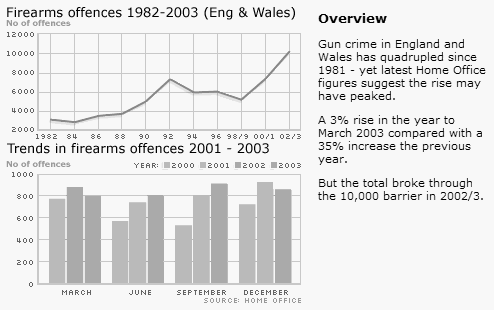
Here’s a handy little graph from the BBC that shows gun crimes in England & Wales since 1982:
“Gun crime” has quadrupled since 1981. Most of it (58%) is committed with handguns. They hope it’s levelling out, but nobody really knows yet.
It’s utopic as hell to say “if none of us had guns,” but that little “150 people die by handguns every year” admission indicates that isn’t going to happen, ever. What Great Britain has done since 1920 in a death-by-a-thousand-cuts strategy, is to disarm its victim pool. It hasn’t done a thing to its criminal pool. That’s gotten larger and more violent.
While violent crime in America has been on a roller coaster, it has for the last eleven years been on a steep decline. This decline has included the crime of homicide. At the same time, the number of guns in circulation, including “those handy little handguns” has been going up here by a few million a year. Moreover, the number of states with “shall issue” concealed-carry laws has reached 35, and two states have no permit requirements for concealed carry at all. In each of these states, allowing responsible people to carry guns for self-defense has not resulted in “blood in the streets” and a revival of the “Wild West.” Violent crime has gone down, in some cases faster than in neighboring states that don’t allow concealed-carry. So much for blaming the guns.
Meanwhile, in Great Britain violent crime has been climbing dramatically since about 1955, while the number of (legally owned) guns has been increasing only slightly, and handguns have been made illegal. Somehow that decline hasn’t affected gun availability to the criminal class. In 2002 the Telegraph reported that gun crime had tripled in already crime-ridden London, and had skyrocketed in other cities as well.
The number of people robbed of personal property at gunpoint rose by 53 per cent in the Metropolitan Police area between April and November last year, compared to the same period in 2000, a rise from 435 victims to 667.
London and other inner city areas, including Birmingham, Manchester and Nottingham, have increasingly suffered from gun crime, mostly perpetrated by young men and fuelled by rows in the lucrative crack-cocaine market.
Police chiefs now fear that a younger generation of street criminals will graduate from stealing mobile phones at knifepoint to using guns to commit street robberies.
The two trends have already overlapped in the Metropolitan area. As well as the increase in gun-point muggings, aggravated burglaries involving guns rose from 101 in April to November 2000 to 153 in the period last year.
Senior officers at Scotland Yard and in a number of inner city forces fear that indiscriminate gun violence will increase as school-age thugs grow up to copy their elders and carry the kind of weapons previously seen in gangland warfare.
Some have suggested that Britain is witnessing the kind of cocaine-fuelled violence which surfaced in America in the 1980s. Cocaine, particularly from the Jamaican connection, now floods into Britain, generating violence and providing a ready source of crack.
Ballistics experts warn that firearms are now cheap and easily available. The discharge of guns in non-gangland crimes, such as muggings, is still relatively rare.
Apparently, Mr. Fagin, you didn’t live in any of those areas.
So, they’ve got a lot of guns, but they’re unlikely to actually pull the trigger. But how many guns do they have? Hard to say, but one estimate is at least three million on the black market. That’s a lot for a country with a population of about 55 million.
There’s that problem again: blame the gun, or blame the criminal? They’ve got the guns, they use the guns in crimes, but they rarely pull the trigger.
So is it the gun, or the gunner?
Absolutely, if you’re a law-abiding citizen and some predator is pointing a barrel at you, you want a barrel of your own to end the argument. But as plain as the blood on the floor every day in America, that’s a perpetual tit-for-tat that will always be awful.
Mr. Fagin, it beats the alternative of being unarmed against predators. You make the mistake of lumping violent but protective in with violent and predatory. You see only violent. You seem to believe that A) disarming us will disarm them, and B) disarming them will make them less dangerous. Your only evidence of this is a comparison to Great Britain, which has never had a high homicide rate, regardless of weapons.
One more time, with feeling: That comparison isn’t valid.
The only way to fix this hideously dysfunctional relationship we in this country have with guns is to treat it like you would any other: End it before you wind up murdered.
Nobody’s saying this will be easy. The important things never are.
So let me get this straight: The law-abiding gun owners should “end our dysfunctional relationship” with guns “before (we) end up murdered.” Right. Disarming ourselves will protect us.
Worked for Great Britain, right? Oh, wait….
Would you have given up that Luger? That .25 Automatic? Would that have made you safer?
What you’re asking is for the responsible people to disarm. Britain’s done that to its population, and it hasn’t made them safer. Clayton Cramer has an excellent piece illustrating the failure of that approach in his essay “The Failure of British Gun Control” (a PDF file, six pages.) Excerpt:
In the period 1981-96, as American crime rates fell, British crime rates rose. Britain now has higher rates of robbery, assault, burglary, and motor vehicle theft than the United States.
–
By 1995, England & Wales had 1.4 times the robbery rate of the U.S.; more than twice the assault rate of the U.S.; and nearly double the U.S. burglary rate.
He’s got all the footnotes and reference. Things there have not improved since 1995. Quite the opposite, in fact.
Mr. Fagin, you might have lived there, but I’m going to assume you lived in the crime equivalent of Fargo, North Dakota. The crime was there, you just weren’t exposed to it. No one bashed you over the head for your cell phone, a relatively common crime in London. No armed gangs invaded your home – a “hot burglary,” a much more common occurence in Great Britain than in the U.S. You were neither victim of or witness to a physical assault by a gang of “hoodies” who would record the “happy slapping” attack on a cell-phone camera for replay on the internet.
Good for you. But don’t tell me how much safer Great Britain is. Your chances of getting shot dead there are much lower. Your chances of being a violent crime victim are much greater.
And don’t make me go into the demographics of murder victims here. I don’t have that kind of time.
But given your personal experience, you want all of us to embrace your utopic vision of a gun-free world and disarm.
Here’s an idea: The criminals and idiots go first. Then we “casual can-plinking, or deer hunting” sport shooters won’t have to, will we?
Your mother apparently had a firm grasp on reality. What the hell happened to you?
(This piece burned 3.5 hours. And could still stand some editing.)