Questions from the Audience?

In a comment to my second “Chocolate Rivers” post, commenter “homeboy” asked a number of good questions. Can’t learn if you don’t ask. However, instead of leaving the questions as an exercise for the student, I figured I’d go ahead and see if I could satisfy him.

1. With improvements in medical technology and access (cell phones), are comparisons with past homicide numbers meaningful?

Well, I guess we’d need to look at homicide rates and try to compare to wounding data. The wounding data is kind of hard to come by. Or, perhaps, homicide to attempted homicide, though that normally doesn’t break out by weapon. First, as far as homicide rates are concerned, there’s this chart for rates from 1900 through 2000:

that shows the rate varying widely. In 1993 the rate was 10.1 per hundred thousand population. In 2000 the rate was 6.1. In 2004 it was 5.5. Prior to 1910? Perhaps the data-gathering wasn’t up to the standards of today?

However, there’s this fascinating graph:
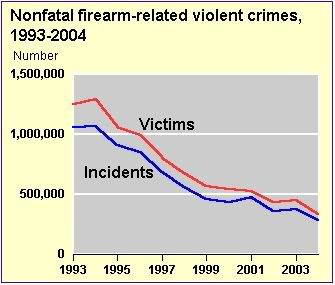
that shows that non-fatal firearm related crime has also been on a steep decline since 1993 – even though, according to that Clinton-era Whitehouse press release, almost two million new handguns enter circulation each year. And remember, a lot of those new guns are what the Violence Policy Center and its ilk term “Pocket Rockets” – more powerful, higher capacity handguns:

Pocket rockets are a prime example of how the firearms industry has exploited increased lethality—greater killing power—over the last several decades to boost sales in its saturated markets.

But note something – the VPC states in that year 2000 report:

The industry has heavily promoted pocket rockets in connection with a wave of new or revised state laws that permit licensed persons to carry concealed firearms.

When did these “new or revised state laws” start? In 1987 with the passage of Florida’s “shall issue” law. In 1990 there were only 15 “shall-issue” states. In 1995 there were 27. In 2000 there were 30. After 1993, what does the homicide rate do? It declines. From 10.0 in 1990, to 8.7 in 1995 to 6.1 in 2000, to 5.5 in 2004, all while literally millions of these guns with supposedly “increased lethality – greater killing power” have entered the market. If the hypothesis is that “improvements in medical technology” are responsible for a decrease in homicide rates – the implication being that more people are getting shot, but surviving the experience – then that theory is shot to hell (pun intended) by this data.

Fewer people are getting shot. Fewer people are getting shot at. And there are more guns in private hands each and every year.

You’ll note that the chart in the VPC report:

ends in 1997. I guess they didn’t want to include data for 1998 and 1999, since it contradicted their premise, and the data since then continues to do so.

2. It seems more honest to compare attempted murder rates since the survival rate is much higher now; is there statistical data available, or can it be estimated?

Well, perhaps the survival rate is “much higher now,” but compared to when? The survival rate in 1950, or the survival rate in 1993? Or is the “increased lethality” of modern guns offsetting the advances in medical technology? I don’t know, but it appears that, at least since the mid-90’s, the actual incidences of gun violence have been declining – even though there are more and more guns in circulation, and – if you want to believe the VPC – those guns have “greater killing power.”

The fact of the matter is, violent crime is down – tremendously. Look at this chart:

From a peak in 1993 of 12.0 aggravated assaults per 100,000 population declined to 4.3 in 2004.

More guns have not meant more violent, more deadly crime. But that doesn’t stop the gun-grabbers from preaching the gospel of “more guns = more gun violence” every chance they get.

3. Is the data available to remove the suicide and domestic violence effects from the statistics used to claim that handguns in a home lead to higher homicide rates, and if so, what is the result?

Not that I’ve seen. Not that the National Academies of Science has seen either, according to their recent report. That data just doesn’t exist. Just for the record, I don’t believe that “handguns in the home” do lead to higher homicide rates.

4. Since we incarcerate at much higher rates than even 20 years ago, what effect is this having on who is committing the bulk of homicides?

Apparently not much. According to this graph:

the decrease in homicide rates has been primarily a decrease in homicide by handgun, and according to this graph,
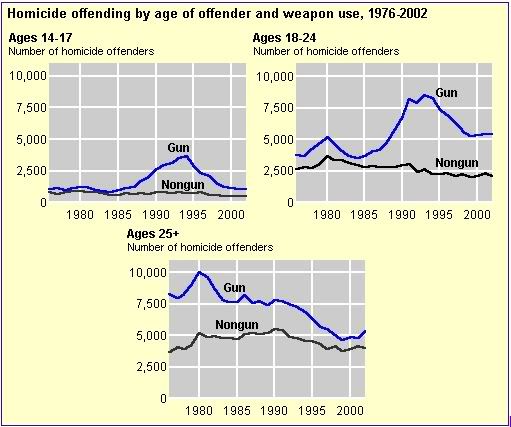
the spike in homicides was primarily committed by young men in the 18-24 age range. And their victims? The same age group:

This suggests to me at least that part of the reason that homicide rates have declined is that the criminally-inclined youth have done a bang-up job (so to speak) of killing themselves off. It’s not a matter of incarcerating them, it’s a matter of burying them.

5. If we’re incarcerating so many people, but we’re still having a problem with homicide, what is it we’re not doing right? Is there a high recindivism rate, or are new criminals arising to fill the some niche, or are we just incarcerating the wrong people?

Well, that’s if you consider a homicide rate of 5.5 per hundred-thousand “a problem.” We’re a violent society. The rate we have now is pretty damned low, historically. It’s down tremendously from a decade ago, but you couldn’t tell that by the rhetoric coming out of the gun-grabber, er, gun-control, um, gun-safety groups today. Certainly everyone would like to see it lower, but at what other cost to society? As you noted, we’ve already got a helluva lot of people in prison.

6. If it’s a high recidivism rate, is it because prison time insufficient deterent, or is the percentage of perpetrators actually punished too low to matter?

Could it be that prison (other than keeping violent criminals separated from the population) doesn’t actually deter? I don’t know.

7. How much of the homicide rate is caused by the “war on drugs” making narco-trafficing so lucrative?

Well, it would appear that the majority of homicides are related to drugs. Look at this graph:

This graph trends up, and mostly for “gang related” – read “inner-city drug wars.”

UPDATE, 1/27: Reader Earl Harding notes in a comment that the graph above is not saying what I’m attributing to it. He’s quite correct. My error. However, a little additional research and I found this:

In an analysis of New York City’s homicides in 1988, Paul Goldstein and his colleagues concluded that 74 percent of drug-related homicides were related to the black market drug trade and not drug use. For instance, the leading crack-related homicide cause was shown to be territorial disputes between rival dealers, and not crack-induced violence or violence (predatory thieving) to obtain money for crack purchases.

Small data point, but I think one that could be easily extrapolated. A Columbia University report stated:

In New York City, drug-related violence contributed to sharp increase in homicides beginning in 1985, peaking at a record rate in 1991. Estimates from police and injury surveillance systems suggest that over half the homicides in these years were drug related, often associated with drug market transactions. These record homicide rates led to intensive street-level law enforcement efforts beginning in 1987, resulting in unprecedented rates of drug arrests and sharp increases in the state prison population.

Still, that’s only New York.

The normally reliable GunCite reports:

  • Indianapolis/Marion County – Homicide review conducted from 1997 thru mid-1998. Victims and suspects were chronic offenders.
    Among homicide suspects:
    • 75% had either an adult or juvenile criminal record.
    • An average of 3.7 adult arrests.
    • Those with a prior record averaged 6 adult arrests and 5.5 juvenile arrests.

    Among homicide victims:

    • 63% had adult or juvenile criminal records.
    • An average of 4.6 adult arrests.
    • Those with a prior record averaged 8 adult arrests and 4.5 juvenile arrests.
    • For the 206 suspects and victims:
      • 1600 total arrests
      • 500 arrests for violent crimes
      • 800 convictions
    • 53% of homicide incidents were drug-related.
  • Minneapolis – Data was analyzed from January 1994 through May 1997. Nearly 45 percent of all homicides appeared to be gang related. More than 40 percent of gang members who were homicide victims or suspects had been on probation and 76.8 percent had arrest histories prior to the homicide incidents, with an average of 9.5 arrests. Suspects and arrestees had 7.4 prior arrests and victims had 7.5 prior arrests.

Draw your own conclusions.

End of Update.

8. What are the demographics of homicide victims and perpetrators; do we have an urban, suburban or rural problem; do we have a poverty problem; or is it a wide spread social problem; or is it predominately racial/predjudical problem; or is it largely caused by the drug war?

And here’s the question the gun-grabber organizations stay as far away from as they can possibly manage: who’s killing, and who’s dying? Look at these graphs, and pay particular attention to the scales:

It’s young, black, urban males. They make up the overwhelming majority of the victims and the perpetrators.

As I detailed in a post from 2003:

I have found the Centers for Disease Control WISQARS Fatal Injury Report tool quite helpful, so I’ll use it again. The latest data is for 2000, so let’s see what it says.

Total homicides: 16,765.
Total population: 275,264,999.
National homicide rate: 6.09/100,000 (Higher than the FBI’s 5.50)
Black homicide victims: 7,867 – Proportion: 46.9%, in agreement with FBI data.
Rate per 100,000: 22.28 – Considerably lower than the FBI says.
Other homicide victims: 8,898 – Proportion: 53.1%
Rate per 100,000: 3.7 – Again, considerably lower than the FBI says, but the ratio of 6:1 does agree with FBI numbers.

Now, if the U.S. had an overall homicide rate of 3.7/100,000 the total number of homicides in 2000 would have been 10,185. The total number of homicides for the black demographic: 1,306. A reduction of 6,561.

Another nice feature of the WISQUARS tool:

Number of firearm related homicides, all ages, all races, both sexes: 10,801
(36% of the total homicides – 5,964 people, were killed without a firearm, for a non-firearm homicide rate of 2.17/100,000.)
Number of black victims of homicide by firearm: 5,699 (53% of all homicide victims by firearm)
Number of black male victims between 15 and 35 years of age: 4,528 (79% of the total black victims of homicide by firearm, 42% of all victims)
Number of all other male victims between 15 and 35 years of age: 3,274 (30% of all homicide victims by firearm)
Number of black male victims between 15 and 35 that died by firearm: 4,343 (84% of the black male victims, 40% of the gunshot homicides.)
Number of all other male victims between 15 and 35 that died by firearm: 2,402 (73% of the white male victims – close enough to parity.)
And note, 62% of all gunshot homicide victims are males between 15 and 35 years of age.

The homicide by firearm rate for males between 15 and 35? Seventeen per hundred-thousand population.

So, does this prove anything? No. But it suggests, and pretty strongly. It suggests that the homicide by firearm problem is concentrated in a small, identifiable group. It suggests that homicide is heavily concentrated in the overall black demographic, and especially in young black men. And it suggests that instead of pursuing wholesale gun control laws that affect everybody, we ought to be pursuing policies that directly address that problem, because “gun control” doesn’t. And it isn’t a case of whites killing blacks, either. The fact is, it’s blacks killing other blacks in disproportionate numbers, and it’s largely restricted to urban (read “gang-related”) violence. See these Bureau of Justice Statistic charts showing the trends in homicide by race of offender and victim. Read this LA Times article to get some kind of feeling for the problem, or this USA Today piece. Money quote, from the second piece:

“Between 1976 and 1999, 94% of black murder victims were killed by other African-Americans. Nearly two-thirds of black homicides were drug related.”

Homicide is an epidemic in the young black male demographic. If it were a communicable disease, we’d be wearing ribbons and spending money on drug research. Instead we’re banning “assault weapons” and trying to pass licensing and registration laws that this very demographic is going to ignore. (See: England, gun bans, “Yardies”, etc.) And the public health organizations and independent groups are trying to treat firearms as if they were the disease vector.

(Hopefully, all those links still work.)

What I’ve never understood is that we know that the majority of homicide is concentrated in a very small, easily identifiable population, why are we trying to attack it by regulating guns? Instead, I’ve come to the conclusion that “gun control” isn’t about reducing crime. It’s about disarming the law-abiding populace.

I hope that helped answer your questions. Now, go and do some research for yourself.

(All graphs with the exception of the VPC one are from the Bureau of Justice Statistics web page.)

UPDATE: This post generated some commentary. A related post, with links, is here: Culture

So NOW Jack Cluth Knows What a Sam Browne Belt Looks Like?

And represents?

Jack Cluth runs the Lefty blog People’s Republic of Seabrook. I first became aware of Jack when, long ago, he commented on the Kalashnikitty t-shirts that an AR15.com member was making, and the “boys” version that I rendered:

I’m no defender of assault weapons, but even I have a sense of humor, and this graphic IS very well done.

—

Hey, it’s only a t-shirt.

I didn’t read all that much of his site, but I thought at the time, “here’s someone with at least a sense of humor.”

The next time I encountered Jack was when he hosted the Carnival of the Vanities #122. My entry that week was the technical opus Why Ballistic Fingerprinting Doesn’t (and Won’t) Work. Jack’s comment:

I’m hardly a gun advocate, but it’s tough to argue with an argument this detailed and well-constructed.

OK, that’s fair, and pretty generous of him.

Now, I’d not paid much attention to Jack since then, but for some reason last December, I clicked on over to his site and read a few posts, and got to one that made my blood boil. Jack and I traded some comments over it. On top of that, Jack posted shortly afterward a “cartoon” of Tom DeLay behind bars with a shirtless prison guard behind him. My comment at the time:

In true compassionate, inclusive, diversity-embracing Leftist style, Jack’s most recent post suggests that he’s in favor of the homosexual rape of prisoners by prison guards. So long as the rape victim is a Republican.

But his side deserves to be in charge.

Jack took exception to that, too.

Jack was so perturbed by my criticism, he named me one of his “Wingnut of the Year” winners.

Rather than attempt to engage in a reasoned, intelligent debate, Baker for some reason seems to think that I actually care what he thinks of me. Better to be thought a troll and a fool than to spread your ignorance and narrow-mindedness all over your weblog and remove all doubt, eh?

We traded comments in that one, too.

Today’s post, however, goes back to that Tom DeLay “cartoon” – the one that Jack insisted I was misreading because I was a “wingnut.”

One of Jack’s defenders wrote:

Kevin, I see a guy in the background. Visored cap, blue jeans, no shirt.

No gun. No badge. No icons of authority. Built like a lot of cons who’ve done some time with more access to the weight room than the law library.

So he’s another guy behind bars with DeLay.

Big fat hairy deal.

My reply:

“No gun. No badge. No icons of authority.”

Check the cap. It’s a military uniform cap, with a badge dead center. And that strap across his chest? That’s part of what’s called a Sam Browne Belt, part of a police or military uniform.

Denial is not a river in Egypt.

Read this post by Jack, put up just yesterday: They’ll be easy to spot…they’ll be the ones wearing the starched brown shirts and the Sam Browne belts. Apparently Jack knows what a Sam Browne belt represents now.

And apparently he doesn’t like being reminded of it. He seems to have removed my comment to that effect at his post.

Instapundit’s Right!.

This quiz does work:

I’m a Porsche 911!

You have a classic style, but you’re up-to-date with the latest technology.
You’re ambitious, competitive, and you love to win. Performance, precision, and
prestige – you’re one of the elite, and you know it.

Take the Which Sports Car Are You? quiz.

I’ve been a major fan of the 911 for a long time, and I seriously lust after the current model.

I just don’t have a spare $90k (or more) for one.

Life is so unfair.

Good Books

Sorry about the lack of posting. I noted a couple of entries ago that I’m a bit burned out. There has been a lot recently to write about, but damned little enthusiasm for actually doing the writing, and since blogging is a hobby and not a paying gig, slacking off only costs me traffic and comments.

Instead, I’ve been reading. (And working. Work has been hectic.)

Now, I’ve noted before that I tend to read a lot, and for the last few months my reading has been largely of the non-fiction persuasion. For example, I recently finished James Webb’s Born Fighting, Theodore Dalrymple’s Life at the Bottom and Our Culture, What’s Left of It, also The True Believer by Eric Hoffer, and Conversations with Eric Sevareid (out of print) for two interviews Sevareid did with Hoffer in the 1960’s. Currently on the headboard I have David McCullough’s 1776 and David Hackett Fischer’s Albion’s Seed. This stuff is interesting, but it’s not exactly entertaining. In fact, sometimes it’s a bit of a slog.

I needed entertaining.

Now, I’m a major fan of The General series by David Drake and S.M. Stirling. I re-read the five-volume series about once a year. I found out that while Drake wrote the outline, Stirling actually wrote the novels. Stirling also wrote another major favorite, the Nantucket alternate-history trilogy; Island in the Sea of Time, Against the Tide of Years and On the Oceans of Eternity. When I found out that he’d penned a companion novel to the series, Dies the Fire, I knew I’d have to read it, though I managed to hold off until it came out in paperback. (The next book in that series, The Protector’s War is now out in hardback. It’ll have to wait.)

Glenn Reynolds has been touting new author John Scalzi’s first book, Old Man’s War pretty heavily, and the critics have been comparing Scalzi to Heinlein – favorably. Since Heinlein is one of my favorite authors, I had to get that, too.

Finally, I’ve heard much, and all of it good, concerning Steven Pressfield’s novel about the battle of Thermopylae, Gates of Fire. This book is on the Marine Corps Commandant’s Reading List for Corporals & Sergeants, and it is also mandatory reading for officers of the Deuce-Four, the 1st Battalion, 24th Infantry of the U.S. Army. According to Michael Yon, Leutenant-Colonel Erik Kurilla, the commanding officer, gives a copy of this book to every officer in the outfit. I cannot imagine a higher recommendation than that.

So week before last I stopped by the local Barnes & Noble, only to discover that they had none of these titles in stock. So I placed an on-line order for them. Two came in on Tuesday, the last on Thursday.

Boy, they were GOOD!

I read Dies the Fire first. If you can get past the premise (I read somewhere that if the author thinks that what he’s writing about might actually happen, it’s Science Fiction, if not, it’s Fantasy) I think most people who read (and like) this blog will enjoy Dies the Fire. It’s a “what if?” novel – what if the laws of physics suddenly changed, and we were thrown back to a Dark Ages level of technology? Not even steam power works any more. No electronics, no internal-combustion engines, no firearms. Good read.

Second, I read Scalzi’s Old Man’s War – described by Cory Doctorow as “It’s Starship Troopers without the lectures.” (I liked the lectures!) “It’s The Forever War with better sex. It’s funny, it’s sad, and it’s true.” And that’s an accurate assessment. Strongly recommended.

Finally, I read Gates of Fire. It arrived Thursday, but I wasn’t able to start on it until after I finished Old Man’s War. That was Saturday night, a couple of hours before I went to bed. I’ll admit I struggled a bit with the Greek names at first, but I got a couple of chapters in before I just couldn’t hold my eyes open any more – and that’s not a commentary on the prose. Sunday I finally made a trip to the range – first time in literally months – and I took the book with me. On the way back I stopped for lunch and started reading where I left off, right about noon. When I got home, I went right back to reading.

I just finished it, minutes before I started writing this post. It’s 440 pages long. I read about a page and a half a minute. You do the math, but I took no more breaks than I could avoid.

If you’ve ever asked yourself, “Why do our soldiers fight?” – READ THIS BOOK.

Oh, and Fûz? I now understand why you named your blog WeckUpToThees!. Good choice.

Gunny Burghardt (and EOD) Gets His Due.

I’ve reported twice before on Marine Gunnery Sgt. Michael Burghardt, first when he became justly famous for his titanium-testicled act of defiance, and then again when he returned to duty after recuperating from his injuries. (The Gunny even commented on the first post!) Now Stars & Stripes has an excellent article profiling Gunnery Sgt. Burghardt, and he deserves it. Excerpt:

Burghardt earned the Bronze Star for disabling 64 roadside bombs and destroying more than 1,500 pieces of ordnance during his second Iraq tour.

But he and his fellow explosive ordnance disposal technicians do not always beat the bomb-makers and planters.

Already, five EOD technicians Burghardt has worked with have been killed, the most recent death occurring three weeks ago when the technician sunk his knife into a dirt berm and activated the pressure switch on a buried bomb.

“Pink mist,” Burghardt said gravely, using the term familiar to Marines to describe the aftermath of a person being blown up.

Where do they find these men?

Apparently Along with the Chocolate Rivers come Rainbow Skies and Gumdrop Smiles, too!

I might as well label this as “Part II” of And There Will Be Chocolate Rivers and Fluffy Bunnies. I should subtitle it But Nobody Wants to Take Your Guns Away! too.

They are getting desperate, aren’t they? In today’s Washington Post comes (anonymously) a near repeat of San Francisco Chronicle writer Kevin Fagin’s recent gun confiscation paean “And That’s the Trouble: The gun debate, personalized,” which I fisked last week. One shot (so to speak) from the left coast, and now one from the right. Today’s bit of utopic mendacity is entitled Killing Made Easy. Let us fisk:

WITH PITIFULLY little notice paid, another rash of year-end homicide statistics points up the madness of this country’s fascination with handguns. The domestic arms race continues full tilt. More kids are taking handguns to school in Maryland and Virginia, according to a report by The Post’s Daniel de Vise, and one big, sorry reason is that more than a few of them are responding to a perceived threat of violence in their midst. Murders by handguns continue to rock Prince George’s County and the District with a vengeance.

Really? Prince George’s County and the District? Where gun control is far more strict than anywhere in neighboring (and much less crime-ridden) Virginia? (Or pretty much anywhere else in the country?) Say it ain’t so!

But this situation is obviously a gun control problem, not a cultural problem, right? It’s so much easier to decide that inanimate objects are the cause than it is to face up to the fact that children feel threatened and that children are willing to commit lethal violence – without guns, too. Nope. Blaming the guns is far easier.

Three Maryland jurisdictions — Baltimore City, Baltimore County and Prince George’s — accounted for more than half of all school weapons incidents (the statistics include knives) in the state.

Ever looked at what it takes to legally buy a gun in Maryland? And keep it? That’s the state where Attorney General J. Joseph Curran, Jr. on October 20, 1999 in a press release “outlined the first step toward making Maryland the first state in the nation to outlaw handgun ownership except in very limited circumstances” with his manifesto, A Farewell to Arms (a 65-page PDF file).

He’s still Attorney General. Apparently the plan isn’t going all that well, at least at disarming the criminally inclined. Color me surprised.

Prince George’s tallied 533 weapon suspensions in 2004-05, up 74 percent from 306 in 1999-2000. But the prevalence of weapons in the schools is only one reflection of the regional scene and that of the nation as a whole. Police in most jurisdictions report that the majority of killings occur after two men argue and one or both pull out guns.

There’s an obvious thread here that members of Congress choose not to see: The all-too-free flow of handguns, a warped way of life that cows presidents and members of Congress who ought to recognize that the availability of handguns is murderous.

There you go: the availability of handguns is “murderous.” You read it in the Washington Post so it must be true, right? The fact that the editorial is unsigned gives it that much more validity! It couldn’t be a “warped way of life” practiced by the victims and assailants, could it?

No, of course not. It’s the guns. It must be the guns!

The problem is that Americans own 65 million handguns and the only effective safety measure would be a ban on these made-for-murder weapons.

(Emphasis mine, of course.) Really? You’re WAY behind, whoever you are. The number was 65 million in 1994. According to the federal Office of Justice Programs 1997 Annual Report:

In 1994, 44 million Americans owned 192 million firearms, 65 million of which were handguns.

The homicide rate in 1994 was 9.6/100,000 population. However, each and every year we add more handguns to the total in private hands. It’s that “availability” problem, you see. According to a White House press release from February 4, 2000:

Handguns Account for Nearly Half of All New Gun Sales – About 2 Million Per Year. Fifty years ago, handguns represented only one out of every 10 new gun sales. Now they account for more than four out of 10.

Being generous and estimating a mere 1.5 million per year, since 1994 we’ve added (carry the one…) over sixteen million new handguns into circulation. Not 65 million, but 81 million handguns or more are currently in circulation. We can trust .gov statistics, right?

The most recent homicide rate information? Still on its decline from the 1993 peak, homicide reached a new low of 5.5/100,000 in 2004 according to the FBI’s Uniform Crime Report.

So, would you please explain how, if “the availability of handguns is murderous,” the addition of at least sixteen million handguns – an increase of about twenty-five percent – resulted in a reduction in homicides nationally – of over 42%?

Unless, of course, your premise is entirely in error.

Nah, couldn’t be. You’re a journalist.

As writer Jenny Price noted in a Dec. 25 op-ed in The Post, only 160 of the 12,000 guns used to kill people every year are employed in legitimate self-defense; guns in the home are used seven times more often for homicide than for self-defense.

If you want to define “self-defense” as strictly “putting the bad guy six feet under.” Most of us in the real world, (that is, not journalism-school graduates) define “self-defense” as “stopping an attack” or “preventing a crime.” The death of the perpetrator is not required. Go peruse Clayton Cramer’s self-defense blog for a long list of successful (and a few not-so-successful) defensive gun uses where, amazingly, nobody died! Or, even better, read the ones where a perpetrator died, but their intended victims survived! Especially the ones where the perpetrator didn’t use a gun, since (also according to the FBI) only about 18% of violent crime involves a firearm.

Unsurprisingly, there are no stories from the Washington Post listed on Clayton’s site at this time. (Or probably ever, for that matter.)

While the actual number of legitimate defensive gun uses is a hotly argued topic, I’d estimate that it’s somewhere around a half-million a year. The lowest estimate anywhere comes from the government (surprise!) In 1994 (before many states enacted “shall-issue” concealed-carry laws) the Bureau of Justice Statistics, in a little-publicized blurb of a report, Guns and Crime: Handgun Victimization, Firearm Self-Defense, and Firearm Theft concluded:

On average in 1987-92 about 83,000 crime victims per year used a firearm to defend themselves or their property.

Personally, I think that number is tremendously low, but still, that’s 227 defensive gun uses a DAY – not exactly the 160 annually that “writer Jenny Price” (and the anonymous author of this op-ed) would like you to walk away believing. And that’s – at a minimum – almost seven times more defensive gun uses than criminal homicides. Interesting numerical coincidence, no?

Still, not inclined to let mere facts get in the way, the piece continues:

Lawmakers know all this and know as well that handguns — however exalted they seem to be in America — should not be in general circulation. Political long shot that it may be, a national ban on the general manufacture, sale and ownership of handguns ought be enacted.

Just like they did in Britain! But, the author admits:

It would not pacify kids or adults with violent tendencies, and it might not curb general criminal activity markedly. But it might well save thousands of lives.

It might? Based on what evidence? The National Academy of Sciences issued a 328-page report in 2004 based on 253 journal articles, 43 government publications, 99 books, a survey of 80 different gun-control laws and some of its own independent study. The report said the panel could find no link between gun control laws and lower rates of crime, firearms violence or even accidents with guns. This duplicates a 324 page study published in 1983 titled Under the Gun: Weapons, Crime and Violence in America. Twenty years more data, and still no evidence that “gun control” has any effect on gun violence. (I reviewed both of these reports back in December, 2004 in Evidence of Absence. Read the last couple of paragraphs of that.)

And Britain serves as a marvelous example of the futility of a handgun ban. Save lives? Can anyone demonstrate that Britain – where all legally owned handguns were registered, so they knew who to take them from – has saved a single life by banning and confiscating all of those legally owned firearms? Hardly, since homicide by handgun has been increasing there since the ban.

In an effort to appease the “sport shooters,” we get this:

Handgun exceptions could be made for federal, state and local law enforcement and military agencies; collectors of antique firearms; federally licensed handgun sporting clubs with certain safety procedures; security guard services; and licensed dealers, importers or manufacturers that are determined to be meeting those needs.

What part of “shall not be infringed” don’t you understand? Don’t you think the burden of proof that such a ban would be effective is on YOU if you want to violate a fundamental enumerated right? How about trying to pass a Constitutional amendment? No, that’s too hard. The populace is obviously stupid, since the NRA can dupe them into opposing gun control, but not stupid enough to be duped into giving up their guns.

Stupid Americans.

Such a bill was proposed more than a decade ago by Sen. John Chafee (R-R.I.), who has since died.

A man who might be surprised to learn that our homicide rate has declined by nearly half in that decade, while the total number of handguns has gone up by over sixteen million, don’t you think?

“I hear people say it’s a radical proposal,” he said then. “Well, I think to have the current situation is radical. No other country has anything like it.”

Britain does. Enacted in 1996. Pretty radical. Didn’t help. So we should repeat their failure here? Expand on that failure?

He described slaughter by handguns as killing in record numbers, threatening education and pushing the high costs of education even higher. So what’s new today?

What’s new? Sixteen million more handguns, 42% less homicide. Chafee introduced his “Public Health and Safety Act of 1993” in September of that year. In 1993 only sixteen states had “shall-issue” concealed carry laws on the books, and only Vermont allowed concealed-carry with no permit. In 2006 there are 35 states that have “shall-issue” concealed carry, and Alaska has adopted “Vermont carry.” That’s new, too.

But with all the evidence against you, you still won’t stop flogging that equine corpse.

Today’s “Honey-do” List:.

1. Pick up a birthday card for my sister.

2. Get a gift for her too.

3. Get a birthday gift for a family friend (we’re having a combo-b’day meal this evening.)

4. Go through all the paperback books and decide what we’re keeping. (We’re paring down due to lack of space. We’re paring down a lot.)

5. And I quote: “Get all the shit out of the kitchen.” (Lots of boxes and assorted crap from the remodel.)

6. Go to the dump. (With all the crap from the kitchen and garage.)

7. Wash clothes. (I think she’s joking here. She hates the way I do laundry.)

8. And I quote: “Clean the back yard before 2008.”

9. Get the Mustang back in the garage. (Note that this comes after “Clean the back yard before 2008.” The Mustang – not in running condition – has been parked in the driveway for the last ten weeks, under a car cover.)

10. Get rid of the trees. (In the back yard. Don’t ask.)

11. Be nice to your wife. (She’s being funny again. I think.)

12. Get all of the gun sh!t out of the garage. (Again, note that this comes after that 2008 deadline. Hmmm…..)

I’m supposed to sign the list.

I’m afraid.

I’m very afraid.

Here’s a Meme for You.

Also recently found at Irons in the Fire was a piece on What got my attention on gun control laws. Firehand says:

(O)ne day Dad and I went to the range. Didn’t get to go often at that time, so it was an occasion. Handguns only that time, Dad’s sidearm and a .22 revolver (side note: I was in my early 30’s before I fired a semi-auto pistol). Great fun was had, and then it hit.

I was lining up a shot when the aforementioned Truth walked up behind me with a 2×4 and swung. There were people out there who would never let us do this again! They’d take the .22, and Dad wouldn’t be able to let me shoot his .357! I’d never be allowed to own a pistol, and if I had kids someday, I wouldn’t be allowed to teach them to shoot them! Hell, if those people had their way, we wouldn’t be allowed to own ANY firearm!!!

It’s kind of hard to overstate how strong a shock this was. I’d known it intellectually, but not in my gut where it counted. I knew it now, and it scared me. And then it made me mad.

Like Firehand, I’d been aware of the war on guns for a while, but hadn’t really paid that much attention. I was still in the mode of “what I know is general knowledge,” and really didn’t understand how bad the propaganda war had gotten. After all, everybody I knew thought about guns pretty much the way I did – they’re tools, and our access to them is guaranteed by the Constitution.

Then I met my wife-to-be. She’s a native Okinawan, brought here when she was nine years old. Her step-father is retired Air Force, and not a shooter (though he owns a couple of guns). All she knew about guns and gun owners she learned from the media.

Hoo boy. Once I understood just how effectively the media was working to demonize guns and gun owners, I got mad.

So, here’s a question for all you gunbloggers out there: What was it that pressed your button?

Paging Mr. Fagin, Mr. Kevin Fagin…

After my fisk of Kevin Fagin’s San Francisco Chronicle op-ed of a couple of days ago, I find a link to a related piece at Pro-Gun Progressive, a site I was previously unaware of, via Firehand of Irons in the Fire (who I really need to read more often.) It’s about comparing the murder rate in the U.S. against other nations. Excerpt:

(I)f you unpack the other half of the anti-gunners’ “America is too violent compared to the rest of the world” argument, you might be surprised to learn that they’re not right there either.

—

Not only is the US ranked behind 23 other countries, there are several EU and CIS nations that have higher murder rates than we do. So much for the idea that violence in the US is somehow a uniquely American pandemic. While I certainly don’t mean to make light of the fact that the US has a violence problem, I do intend to confront head-on the fanciful notion that we’re violent because we have guns and the rest of the world carries on a hunkey-dorey existence thanks to the absence of objects that fire projectiles.

Which is precisely the argument Mr. Fagin was making. It’s a good short piece with good links. Wish I’d seen it a couple of days ago.