True Believers

Turning and turning in the widening gyre
The falcon cannot hear the falconer;
Things fall apart; the centre cannot hold;
Mere anarchy is loosed upon the world,
The blood-dimmed tide is loosed, and everywhere
The ceremony of innocence is drowned;
The best lack all convictions, while the worst
Are full of passionate intensity.

W.B. Yeats, “The Second Coming”

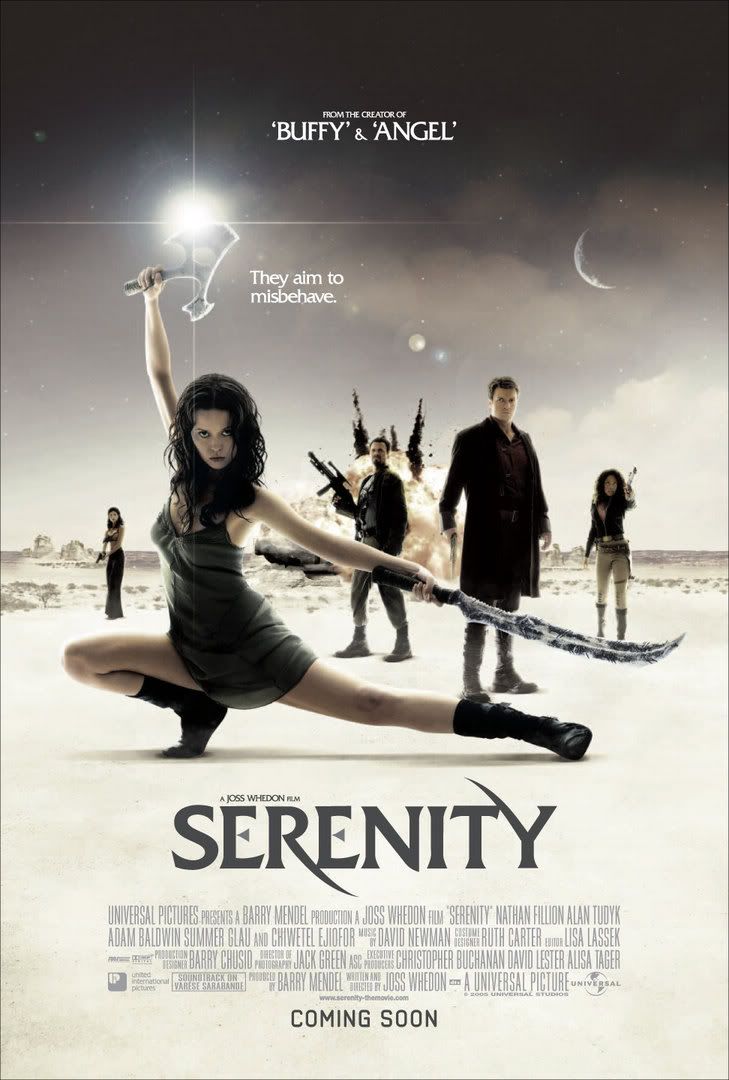
Warning: This piece is going to be long. It is also, in a weird way, a review of Joss Whedon’s Serenity, since that movie finally released the block that’s been keeping me from writing this essay for about a week, though work has conspired to keep me from posting it for the last four days. (Congratulations, Joss. I walked out of the theater Wednesday night with my mind whirring at mach 6, as the gears meshed and the tumblers tumbled and the mechanism, with groaning protest, unlocked. Serenity was excellent mental lubricant.) By now, I hope, most of my readers have already read one or more reviews of the film or have seen it, and have some familiarity with the background of that universe and its characters. Anyway, to proceed:

As I said last weekend, I watched the Jim Carrey movie The Majestic, and it inspired the idea for not one, but two posts. However, I was only able to write the first post. The second stubbornly refused to gel in my mind. I fought with it most of last week, and then Wednesday night I went to the Tucson Serenity sneak preview.

I don’t think I got out of the film what most of the rest of the audience did. Don’t get me wrong, I enjoyed it very much, but the underlying theme of the film spoke to me. We in the audience were not, of course, allowed to record anything, so lines I “quote” will be my best recollection or paraphrasing (and if you’ve not yet seen the film and don’t want to know anything in detail about it, stop reading now.) The theme is “true believers.”

Captain Malcolm Reynolds, the protagonist, was once, but is no longer a True Believer. One of the rebel “Browncoats,” he had his belief beaten out of him at the battle of Serenity Valley. Now he just wants to be as free from the interference of the Alliance government as is humanly possible. He wants to be an individual. He wants his freedom. He is, if you want to draw a contemporary parallel, a practicing anarcho-capitalist living on the fringes of a totalitarian society (with the exception of the fact that he sees no problem with stealing from the Alliance at any opportunity). Although he’d probably have a hard time discussing his personal philosophy in detail, he has his own code that he lives by strictly.

The antagonist in the film, The Operative (since he is given no name), is a True Believer, and it is what he believes that grabbed my attention more than anything else in the film. The Operative believes that the Alliance is “building a better world – better worlds,” and he acts as a mechanism to enable the Alliance to achieve its ends, even though he describes himself as “a monster, who will have no place” in those better worlds. The ends justify his means. “I don’t murder children,” Reynolds husks. “I do,” replies The Operative, with a gentle smile.

Glenn Wishard, in a post at Canis Iratus last year entitled A Thumbnail History of the Twentieth Century wrote:

The rise and fall of the Marxist ideal is rather neatly contained in the Twentieth Century, and comprises its central political phenomenon. Fascism and democratic defeatism are its sun-dogs. The common theme is politics as a theology of salvation, with a heroic transformation of the human condition (nothing less) promised to those who will agitate for it. Political activity becomes the highest human vocation. The various socialisms are only the most prominent manifestation of this delusion, which our future historian calls “politicism”. In all its forms, it defines human beings as exclusively political animals, based on characteristics which are largely or entirely beyond human control: ethnicity, nationality, gender, and social class. It claims universal relevance, and so divides the entire human race into heroes and enemies. To be on the correct side of this equation is considered full moral justification in and of itself, while no courtesy or concession can be afforded to those on the other. Therefore, politicism has no conscience whatsoever, no charity, and no mercy.

(Emphasis in original.) One of the themes that I repeat on this blog is the cockroach resilience of socialism/communism. The line that piqued me from The Majestic was a line that wasn’t even in the original script. Set in 1951 during the McCarthy period, that film’s protagonist has been subpoenaed to appear before the House Un-American Activities Committee. Adele, the love-interest in the film, utters this:

This is a free country, you can be a communist if you want to be a communist!

I think Glenn’s declaration that the 20th Century “neatly contains” the rise and fall of “the Marxist ideal” is a bit premature, but I fully concur with his conclusion that “politicism” has neatly divided societies in the manner described, and now, as Yeats put it in 1921, “The best lack all convictions, while the worst are full of passionate intensity.” (That’s a bit overstated, but we’re talking poetry, not engineering.)

All of human history has encompassed the struggle to “create a better world.” The question, “A better world for whom?” has often been glaringly omitted, but nevertheless, history has shown a continuing progression of improvement for the average individual in freedom, general health, life expectancy, and material wealth. Just ignore those hundreds of millions who have died along the way in misery, squalor, and agony from warfare, disease, starvation, malign neglect and deliberate murder. Don’t you understand? They bore the cost of getting us here, and are bearing the cost of future advancement. As I quoted James Lileks in On Guillotines and Gibbets:

Personally, I’m interested in keeping other people from building Utopia, because the more you believe you can create heaven on earth the more likely you are to set up guillotines in the public square to hasten the process.

Human history is one of constant warfare, and the deadliest warfare hasn’t been over land or over resources, but over ideology. Further, the deadliest warfare has arguably occurred during the last century, and worse, it has been committed by governments not against the military forces of other governments, but against civilians, both foreign and domestic. According to this site run by Rudolph J. Rummel, Professor Emeritus of Political Science at the University of Hawaii:

Nearly 170 million people probably have been murdered by governments in the 20th Century, 1900-1987; over four-times those killed in combat in all international and domestic wars during the same years.

America isn’t left off this list, either.

During our takeover of the Philippines between 1899 and 1902, American soldiers undoubtedly tortured and deliberately murdered several thousand Philippine civilians, and tens of thousands more died of disease and starvation. This war, and our acts during it, was savaged by Mark Twain in his essay “A Defence of General Funston” in 1902. In the collection of Twain’s works On the Damned Human Race, the preface to that essay includes this speech given by Massachusetts Senator George Hoar from 1903:

You, my imperialistic friends, have had your ideals and sentimentalities. One is that the flag shall never be hauled down where it has once floated. Another is that you will not talk or reason with people with arms in their hand. Another is that sovereignty over an unwilling people may be bought with gold. And another is that sovereignty may be got by force of arms….

What has been the practical statesmanship which comes from your ideals and sentimentalities? You have wasted six hundred millions of treasure. You have sacrificed nearly ten thousand American lives, the flower of our youth. You have devastated provinces. You have slain uncounted thousands of people you desire to benefit. You have established reconcentration camps. Your generals are coming home from their harvest, bringing their sheaves with them, in the shape of other thousands of sick and wounded and insane….

The book also quotes Indiana Senator Albert Beveridge:

(God) has marked the American people as His chosen nation to finally lead in the regeneration of the world. This is the divine mission of America… The Philippines are ours forever. We will not repudiate our duty in the archipelago. We will not abandon our opportunity in the Orient. We will not renounce our part in the mission of our race, trustee, under God, of the civilization of the world.

The more things change…

The Philippines only started our 20th Century democidal activities, according to Professor Rummel. The sack of Peking after the Boxer Rebellion, the deliberate bombing of civilian populations during WWII, Korea and Vietnam followed. Rummel concludes:

Putting together all the subtotals in this century the United States probably murdered about 583,000 people, conceivable[sic] even as many as 1,641,000 all told. Virtually all of these were foreigners killed during foreign wars. Domestically, throughout this century the American Federal or state governments were responsible for the murder of about 1 out of every 1,111,000 Americans per year.

And we’re pikers.

According to Rummel:

Communism has been the greatest social engineering experiment we have ever seen. It failed utterly and in doing so it killed over 100,000,000 men, women, and children, not to mention the near 30,000,000 of its subjects that died in its often aggressive wars and the rebellions it provoked. But there is a larger lesson to be learned from this horrendous sacrifice to one ideology. That is that no one can be trusted with power. The more power the center has to impose the beliefs of an ideological or religious elite or impose the whims of a dictator, the more likely human lives are to be sacrificed. This is but one reason, but perhaps the most important one, for fostering liberal democracy.

Or, as he puts it on his main page:

Power tends to corrupt, and absolute power corrupts absolutely.
—-Lord Acton

Power kills; absolute power kills absolutely.
—-This Web Site

And ideology kills, but the only thing that can oppose it is another ideology.

BELIEF

At war today are three mutually opposing ideologies. The first striving to “create a better world” is socialism. In its most virulent form, communism, it is responsible for the deaths of over one hundred million people. It has failed everywhere it has been tried; some failures being more spectacular (and bloody) than others. Glenn Wishard believes that “the Marxist ideal” is on its way out with the ending of the 20th century. I’m not so sure. I don’t think that species of cockroach is down for the count, apparently not here in the U.S., and certainly not in Europe. Not by a long shot.

The second ideology is “liberal democracy.” We are, right now, engaged in warfare in the middle East trying to bring sovereignty and liberal democracy to fifty million people by force of arms. So far it has cost us hundreds of billions of dollars, and about two thousand of the flower of our youth with many more wounded, and it shows no sign of ending soon.

The third ideology has been named “Islamism” – the forced spread of Wahabist Islam and the imposition of Sharia law upon the entire world. It is unknown how many that ideology has killed so far, but it’s definitely in the hundreds of thousands at least, millions if you include the internecine warfare between the different islamist sects.

There are, of course, other ideologies extant in the world, but these three are predominant and currently in open warfare, both cold and hot. Many people have commented on the apparent willingness of those of the socialist ideology to act as a fifth column for the Islamists. Why, they wonder, do people who espouse a belief in fairness, equality, justice, religious freedom, and tolerance support an ideology that puts religious leaders above all, that makes women chattel, that makes homosexuality a capital offense, that makes the practice of any religion other than Islam a crime?

Because they BELIEVE – they believe that theirs is the only “true way” to utopia, and that America with its individualism, consumerism, and capitalism is the one true enemy, and the enemy of my enemy is my friend. The Islamists won’t spare them, but they don’t care. Guillotines or car bombs in the public square, either is justifiable if it hastens the process. They have passionate intensity.

Following his own personal code, the character Malcolm Reynolds once again finds something to believe in. At the end of the film he and his entire crew embark on an almost certainly suicidal mission to tell the universe of the horrible secret they have uncovered. “The universe is gonna know the truth,” he says. The Operative asks, “Are you willing to die for that?” He replies, “I am,” and means it. Peter Appleton, Jim Carrey’s character in The Majestic stands before the House Un-American Activites Committee and speaks of his belief in the Constitution and Bill of Rights, fully aware that he could go to jail for contempt of Congress (a valid charge, since he holds the proceedings in contempt.) He believes in something enough to take a risk, for the first time in his life.

We have people in the White House who believe. They believe that we can bring sovereignty to an oppressed people by force of arms. They believe that people – everyday average people, everywhere – want to be free. They believe that liberal democracy is the best form of government for that. They believe in capitalism. They believe in individualism. They believe. The people in our military, in the overwhelming majority, also believe. They are willing to die for it, and have been.

This is America. You can be a communist here if you want to be (but given its track record, I cannot imagine anyone of sound mind actually wanting to be.) We won’t kill or even merely imprison you for your belief – unless you actively work to overthrow the Constitution of the United States, and even then your odds are pretty good. Socialists and their fellow-travellers are disproportionally represented in all levels of public education and the media, and have had literally decades to direct public thought. Yet (by the slimmest of margins) we’ve elected a leadership of True Believers of a different creed. This means that Yeats was wrong – the best do not lack all conviction. However, that doesn’t make us True Believers, either. We are jaded by government. We are often disgusted by the things our government has done in our name, for us and to us and to others. Not enough of us are willing to risk for our convictions. We would rather try to be as free of government interference as possible, because we know that power kills, and absolute power kills absolutely. In the Firefly episode “War Stories,” Shepherd Book speaks a line of great truth:

A government is a body of people, usually notably ungoverned.

But we are at a crossroad of history. Of the three ideologies that are fighting for the future, only one promises at least the possibility of restraint on the power of government. If we don’t support that ideology, one of the others will most certainly be ascendant. People will die. Governments will kill them. The question is, how many, and will they die in vain?

What do you believe?

Quick Post.

Saw Serenity last night. Full house, 413 seat theater. Quick take: Excellent movie. Much longer post to follow, but I got up at 3:30 this morning, and I walked in the door to my home at 9:45PM this evening. Long day. Another one tomorrow.

Go see Serenity. You won’t be disappointed if you like this blog.

Compass Resigns. Lawsuits to Follow.

Glad to see it. Hope it doesn’t get him off the hook.

Police Superintendent Eddie Compass resigned Tuesday after four turbulent weeks in which the police force was wracked by desertions and disorganization in Hurricane Katrina’s aftermath.

“I served this department for 26 years and have taken it through some of the toughest times of its history. Every man in a leadership position must know when it’s time to hand over the reins,” Compass said at a news conference. “I’ll be going on in another direction that God has for me.”

As the city slipped into anarchy during the first few days after Katrina, the 1,700-member police department itself suffered a crisis. Many officers deserted their posts, and some were accused of joining in the looting that broke out. Two officers Compass described as friends committed suicide.

The story goes on, but no mention of Compass’s announcement that “Everyone will be disarmed. Only police officers will have guns.” Nor was there any mention of the Federal District Court injunction against further confiscations, nor the claim by Nagin and Compass that they did not order any confiscations, and that no confiscations occurred, nor that the plaintiff in the case resulting in the injunction has had the guns that weren’t confiscated from him returned.

Check out SayUncle and work your way backwards. He’s got all the details.

Awwww DAMN.

Fellow blogger Dale of Mostly Cajun reports on the aftermath of Hurricane Rita’s rampage through SW Louisiana as it directly affected him:

I got into my own van and headed to my house. I’d lost shingles and the chimney to my fireplace and the old TV antenna, in addition to some corrugated steel off my workshop. I’d brought a portable generator to power up my freezer and refrigerator so I wouldn’t lose any food. I connected that up and had them both running.

Further exploring the house, I found that I had water dripping inside from the damaged roof, so I spread some pans around to catch the drips and headed to my office to get a wet-vac and a ladder so I could suck up the water and put one of those blue tarps over the damaged roof.

When I got back, smoke was pouring out of my house. I called 9-1-1 to report the fire. After I finished reporting, I ran to the house to see if I could break in windows to let out my cats, but the smoke and the fierce heat coming off the building were so much that I couldn’t get within a few yards.

The local fire department responded very fast, but when they got there, the community water system was dry, killed by Hurrican Rita. They called for assistance from several nearby fire departments who transported water in, but the house was a total loss.

Did you ever think about what you lose? Four loyal pets…irreplaceable. Itty, Splot, Mollie, Callie, my four cats… Mom and Dad’s photo albums… photos of the past 80 years. My library…books I’d acquired over the past twenty-odd years. My gun collection… Personal papers… On and on and on… All gone. Devastation is an over-used word. I use it here…

Damn, Dale. What can I do to help?

Newspeak

I watched a movie this afternoon that I hadn’t seen in a while, The Majestic, starring Jim Carrey. It was set in 1951, during the House Unamerican Activities hearings. It’s a sort of Capra-esque period film, but, given what’s been happening in the news politically recently, it was interesting to watch. It has inspired this post, and hopefully one other if I can eke it out by tomorrow.

The Declaration of Independence? The Constitution? They’re pieces of paper with signatures on them. And you know what a piece of paper with a signature is? A contract. And contracts can be renegotiated at any time. – Author Michael Sloan from the screenplay for The Majestic, spoken by the character Leo Kubelsky, studio lawyer.

—

In his opening statement kicking off “Ghosts of Nominations Past: Setting the Record Straight,” Sen. Schumer declared that Senate Democrats on the committee had been doing their level best to grapple with a breakdown in the process caused by Republicans. The problem, according to Sen. Schumer, went well beyond the stalling resorted to by Republicans when they were last in charge of the Senate Judiciary Committee. The crux of the matter was President Bush’s determination to pack the federal courts with “right-wing ideologues” in the mold of Scalia and Thomas, judges well outside of the mainstream, bent on implementing their extremist political views through conservative judicial activism. What was needed, Sen. Schumer proclaimed, was for the president to nominate moderates — by which he seemed to mean those who would interpret and enforce the law, rather than disregard and willfully rewrite it in order to advance a fierce partisan agenda. – Peter Berkowitz, National Review Online – It’s Unanimous – May 17, 2002

—

(Senator Hillary) Clinton announced Thursday she will oppose Roberts after the Senate Judiciary Committee voted 13-5 to recommend confirmation. The full Senate is expected to vote next week.

She cited “an obligation to my constituents to make sure that I cast my vote for chief justice of the United States for someone I am convinced will be steadfast in protecting fundamental women’s rights, civil rights, privacy rights, and who will respect the appropriate separation of powers among the three branches.”

She added that after Roberts’ testimony before the Senate Judiciary Committee earlier this month, “I believe the record on these matters has been left unclear.”

She said her “desire to maintain the already fragile Supreme Court majority for civil rights, voting rights and women’s rights outweighs the respect I have for Judge Roberts’ intellect, character and legal skills.”

Edward Cox, a Manhattan lawyer and son-in-law of President Richard Nixon who also is seeking the GOP Senate nomination, said Clinton “had a chance to show that she could rise above blind partisanship and not be beholden to left-wing attack groups.”

“The senator unfortunately has again decided to join the likes of Ted Kennedy and the liberal wing of her party in support of judicial activism,” Cox added. – Associated Press story, 9/24/05

—

Ruth Bader Ginsburg told an audience Wednesday that she doesn’t like the idea of being the only female justice on the Supreme Court. But in choosing to fill one of the two open positions on the court, “any woman will not do,” she said.

There are “some women who might be appointed who would not advance human rights or women’s rights,” Ginsburg told those gathered at the New York City Bar Association. – AP Story, 9/21/05

—

If Americans loved judicial activism, liberals wouldn’t be lying about what it is. Judicial activism means making up constitutional rights in order to strike down laws the justices don’t like based on their personal preferences. It’s not judicial activism to strike down laws because they violate the Constitution.

But liberals have recently taken to pretending judicial activism is — as The New York Times has said repeatedly — voting “to invalidate laws passed by Congress.” Invalidating laws has absolutely nothing to do with “judicial activism.” It depends on whether the law is unconstitutional or not. That’s really the key point. – Ann Coulter, Actually, ‘Judicial Activism’ Means E=MC2

—

“When I use a word,” Humpty Dumpty said, in a rather scornful tone, “it means just what I choose it to mean – neither more nor less.”

“The question is,” said Alice, “whether you can make words mean so many different things.”

“The question is,” said Humpty Dumpty, “which is to be master – that’s all.” – Lewis Carrol, Through the Looking Glass

—

“My obligation is to the Constitution. That’s the oath.” – Judge John Roberts, Senate confirmation testimony.

That’s a lot of quotes, but hopefully you got the gist of it. For the Left, “judicial activism” is restraining “progressive” legislation (that just happens to contravene the Constitution). For the Right, “judicial activism” is creating law from the bench, or upholding “progressive” legislation though it violates the Constitution, because it “advances rights,” (as the Left defines “advancing rights.”)

The Senate Democrats proclaim that they want to make sure that Roberts is a “moderate,” or at least not a “judicial activist.” They’ve suddenly fallen in love with the concept of stare decisis. As I noted back in June over the Janice Rogers Brown nomination, at question is what Duke University law professor Erwin Chemerinsky called “shred(ding) the last eighty years of American Constitutional law.” Yet his counterpart, Chapman University law professor John Eastman rebuked him:

What happened seventy or eighty years ago that changed the Constitution? There was not a single amendment at issue in the 1930’s that changed the Constitution. Some radical, federal programs were pushed through. Some radical judges, under pressure, finally signed on them, and the notion that we can’t question that unconstitutional action that occurred in the 1930’s, and somehow that defending that unconstitutionality is adherent to the rule of law, is rather extraordinary. There are scholars on left and right that have understood that what went on in the 1930’s was…had no basis in Constitutional law, or in the letter of the Constitution itself.

But it extends well past the 1930’s, and everyone in the Senate knows it. Chemerinski recently wrote:

Since (Lewis F.) Powell’s resignation, Sandra Day O’Connor has been the fifth vote in such crucial areas as upholding the right to abortion, limiting campaign contributions, protecting the separation of church and state, and permitting universities to engage in affirmative action.

None of this was, in Chemerinski’s eyes, “judicial activism,” and he adds:

Democrats need to oppose any nominee who would bring about significant changes in these areas.

James Madison, writing under the pseudonym Publius, in Federalist #78 defined the intent of the Supreme Court:

By a limited Constitution, I understand one which contains certain specified exceptions to the legislative authority; such, for instance, as that it shall pass no bills of attainder, no ex-post-facto laws, and the like. Limitations of this kind can be preserved in practice no other way than through the medium of courts of justice, whose duty it must be to declare all acts contrary to the manifest tenor of the Constitution void. Without this, all the reservations of particular rights or privileges would amount to nothing.

However, see: Kelo v. New London, Raich v. Gonzales, Wickard v. Filburn, Scott v. Sanford, U.S. v. Cruikshank, …

There is no position which depends on clearer principles, than that every act of a delegated authority, contrary to the tenor of the commission under which it is exercised, is void. No legislative act, therefore, contrary to the Constitution, can be valid. To deny this, would be to affirm, that the deputy is greater than his principal; that the servant is above his master; that the representatives of the people are superior to the people themselves; that men acting by virtue of powers, may do not only what their powers do not authorize, but what they forbid.

If it be said that the legislative body are themselves the constitutional judges of their own powers, and that the construction they put upon them is conclusive upon the other departments, it may be answered, that this cannot be the natural presumption, where it is not to be collected from any particular provisions in the Constitution. It is not otherwise to be supposed, that the Constitution could intend to enable the representatives of the people to substitute their WILL to that of their constituents. It is far more rational to suppose, that the courts were designed to be an intermediate body between the people and the legislature, in order, among other things, to keep the latter within the limits assigned to their authority. The interpretation of the laws is the proper and peculiar province of the courts. A constitution is, in fact, and must be regarded by the judges, as a fundamental law. It therefore belongs to them to ascertain its meaning, as well as the meaning of any particular act proceeding from the legislative body. If there should happen to be an irreconcilable variance between the two, that which has the superior obligation and validity ought, of course, to be preferred; or, in other words, the Constitution ought to be preferred to the statute, the intention of the people to the intention of their agents.

Which is why every elected and appointed Federal official swears an oath, not to the flag, not to the nation, not to the President nor to Congress, but to uphold and defend the Constitution of the United States against all enemies, foreign and domestic.

But of course, if you’re able to redefine the language, “uphold and defend” can mean anything you like. Just like “judicial activism.”

Today’s decision is simply the latest in a string of our cases construing the Public Use Clause to be a virtual nullity, without the slightest nod to its original meaning.

Something has gone seriously awry with this Court’s interpretation of the Constitution. Kelo v. City of New London, Thomas, J. dissenting.

—

The Court must be living in another world. Day by day, case by case, it is busy designing a Constitution for a country I do not recognize. Wabaunsee v. Umbehr, Scalia, J. dissenting.

—

That’s the First Amendment, Mr. Chairman. It’s the backbone of this nation. It’s everything that gives us the potential to be right and good and just — if only we’d live up to that potential. It’s what gives me the right to sit in this chair and say my piece before this committee without fear. It’s the most important part of the contract that every citizen has with this country. And even though this contract… the Constitution and the Bill of Rights — even though they’re just pieces of paper with signatures on them — they’re the only contracts we have that are most definitely not subject to renegotiation. – Author Michael Sloan from the screenplay for The Majestic, spoken by lead character Peter Appleton.

Apparently Mr. Sloan hasn’t been paying attention to the courts.

But he’s bang-on-the-money about that “if only we’d live up to that potential” part.

I Hope Everyone’s All Right.

Mostly Cajun and the Layabout Sailor have both headed for higher ground to get out of Rita’s way, along with tens of thousands of their neighbors. Since Jim lives on his boat, I was heartened to see that Rita bore more Eastward and did not, in fact, slam directly into Galveston harbor. Hopefully the sloop New Dawn will be none the worse for wear when Jim comes home. Dale doesn’t live on his boat, but he was more in the direct path of the storm. Dale, I hope like hell everything is still upright and tight when you get back.

To the rest of you out there that I don’t know, best of luck to you all.

I KNEW This Blogging Thing Would Eventually Pay Off!

Via Instapundit, I’m now going to a Sept. 28 preview of Serenity! All I have to do is write a post reviewing the film afterwards.

I’ve mentioned Serenity here before. Specifically, I got the box-set DVDs of Firefly for Father’s Day last year, this EXCELLENT cartoon from May, and this post from April linking to the first trailer. (Just establishing my bona fides.)

Man, I can’t wait. This looks GOOD, unlike most of the dreck that Hollyweird’s kicked out this year.

Tagline of the year: “I aim to misbehave.”

UPDATE: Per the requirements to get into the advanced screening, the synopsis of the film:

Joss Whedon, the Oscar® – and Emmy – nominated writer/director responsible for the worldwide television phenomena of BUFFY THE VAMPIRE, ANGEL and FIREFLY, now applies his trademark compassion and wit to a small band of galactic outcasts 500 years in the future in his feature film directorial debut, Serenity. The film centers around Captain Malcolm Reynolds, a hardened veteran (on the losing side) of a galactic civil war, who now ekes out a living pulling off small crimes and transport-for-hire aboard his ship, Serenity. He leads a small, eclectic crew who are the closest thing he has left to family –squabbling, insubordinate and undyingly loyal.

IMHO, the ensemble acting is some of the best I’ve seen since M*A*S*H. Maybe better.

And check THIS out:

Validation.

Me, election 2000:

Those of us still capable of intelligent, logical, independent thought have been overwhelmed by the public school system production lines that have been cranking out large quantities of substandard product for the last thirty-five years or so. The majority of three or four generations have managed to make it into the working world with no knowledge of history, no understanding of the Constitution or civics, no awareness of geography, no ability to do even mildly complex mathematics, no comprehension of science, and realistically little to no ability to read with comprehension, or write with clarity. And we seem to have developed attention spans roughly equivalent to that of your average small bird.

After all, about half the public accepted the Democratic premise that we were too stupid to vote correctly because their guy didn’t win by a landslide, didn’t they? And the other half was outraged, not that they made such a ludicrous argument, but that they didn’t want to play fair and by the rules that no one seems to understand or to be able to explain.

The other majority party isn’t blameless in this; they like an ignorant electorate too. It’s easier to lead people who can’t or won’t think for themselves. It took both parties and many years of active bipartisan meddling to make the education system into an international laughingstock.

However, the end result of this downward spiral has been an electorate ignorant in the simple foundations of this country and its government. Most especially the foundation of a rule of law in which EVERYONE is equal under the laws of the land. The Democrats have taken advantage of this general ignorance to its logical extreme. President Clinton, when testifying under oath, debates the meaning of the word “is”, and essentially gets away with it. Vice President Gore, when shown to be in direct violation of campaign finance law states that there was no “controlling legal authority”.

Laws don’t MEAN anything to them. A law is an inconvenient bit of wording that just has to be “interpreted” properly to achieve their ends. When they file suit, they must shop for the proper judge, or they might not be able to get the “spin” they want. Like the Mad Hatter in Alice in Wonderland, words mean just what they want them to mean, no more no less. And that meaning can change at any time.

Paul Mirengoff, Sept. 15, 2005:

And herein lies the problem: to Democrats, respect for the rule of law doesn’t count as a value. To them, the law is simply a pretext for achieving desired results or (if not suited for that work) an obstacle to be circumvented for the same purpose. No wonder John Roberts gives them the willies.

His was more brief, but we just said the same thing.

It’s Been Over a Week, Now.

Since I sent my emails to Sen. Kyle, Sen. McCain, Rep. Kolbe, the White House and the Vice President. All I’ve received in acknowledgement is this:

Subject: FROM THE OFFICE OF CONGRESSMAN JIM KOLBE
From: [email protected]
Date: 9/11/2005 5:24 PM
To:
(My other email address)

Your message has been received.

That’s more than I’ve gotten from anybody else.