Gonzales v Raich Draws its First Gun Law Victim.

If you haven’t, read my earlier piece “Game Over, Man. Game Over.” It gives decent background information on the U.S. v Stewart decision in which the 9th Circuit Court of Appeals upheld the conviction of a man for possessing a firearm after being convicted of a felony, but decided that his possession of a home-made fully-automatic weapon was not per se illegal as it did not affect interstate commerce and therefore was outside the power of the Federal government to regulate.

If you weren’t aware, an individual can build himself a firearm with perfect legality. He just can’t ever sell it. The Stewart decision said that individuals can build themselves fully-automatic weapons, too, even though the 1986 Firearm Owner’s Protection Act carried a rider making it illegal to manufacture any new fully-automatic weapons for the general public. (Police, other government agencies, and properly licensed corporations were excepted from this ban.)

Well, that decision (unsurprisingly) was appealed to the Supreme Court. They granted certiorari on it today, vacating the decision and remanding it to the 9th Circuit. Note the instructions:

The motion of respondent for leave to proceed in forma pauperis is granted. The petition for a writ of certiorari is granted. The judgment is vacated and the case is remanded to the United States Court of Appeals for the Ninth Circuit for further consideration in light of Gonzales v. Raich, 545 U.S.

I wrote a little piece on the Raich decision, and quoted Justice Thomas:

If the Federal Government can regulate growing a half-dozen cannabis plants for personal consumption (not because it is interstate commerce, but because it is inextricably bound up with interstate commerce), then Congress’ Article I powers–as expanded by the Necessary and Proper Clause–have no meaningful limits. Whether Congress aims at the possession of drugs, guns, or any number of other items, it may continue to appropria[te] state police powers under the guise of “regulating commerce.”

—

If Congress can regulate this under the Commerce Clause, then it can regulate virtually anything–and the Federal Government is no longer one of limited and enumerated powers.

It’s pretty obvious that the Supreme Court just told the 9th Circuit, “No homemade machineguns. To hell with limited powers.”

That was quicker than I expected. Good to know where we stand, I suppose.

Of course, David Hardy covers the story earlier and better than I did.

I’m So Ashamed to be American…

Lileks is at his screedy best today, fisking Time’s breathless exposé of “prisoner torture” at Gitmo. It’s a must-read. Excerpt:

And at one point the reader might assume that if something really bad had happened, we might have read about it by now. I know a little bit about modern journalism, and we tend to emphasis the splintery plunger up the butt over the mocking puppet show. In any case, this detail makes you almost want to weep in frustration; domestic politicians are posturing for the camera, huffing about then horrors of Gitmo, insisting that the rest of the world won’t forgive us until we close the joint down and pave it. Over what? A Punch and Judy show? If we gang-mimed the guy and had 17 men in striped shirts with white makeup pantomime falling out of a burning skyscraper, would the critics demand we not only let the guy go but pay him a per diem for his troubles? I’ve read the story twice, and I keep wondering if I missed the part where the suspected 20th hijacker spits teeth into a chamberpot rimming with own bloody urine while massaging the welts the jumper cables left on his groinal division. I mean, I take all that for granted, because our soldiers are all killbot brutes – except for the lower-class ones who got drafted against their will and can only hope Bruce Springsteen sings a monotonal account of their disaffection.

You’ve GOT to read the lyrics! And the rest of the piece, for that matter.

Wahabism delenda est
. And we’re still using kid gloves.

UPDATE: Welcome Salon readers, especially those of you from the left side of the spectrum. I’m honored that The Daou Report saw fit to link to little old me. (Must’ve been the post title.) Take some time, peruse the site. And if you see anything that really irks you, drop me an email. Or leave an anonymous comment like you usually do. Be sure to read my invitation to my readers, though!

Another Best of Me Symphony.

Edition #81 of the Symphony is up at The Owner’s Manual, and yes, I have an entry this week. This week’s guest-host: Pat “Barking-Mad” Buchanan, the Republican Right’s version of Gov. Dean.

Only Pat isn’t running the Republican Party’s fundraising effort.

(Which party is the Stupid Party, and which is the Evil Party again? I’m a little gray on that.)

Myths

I found this quote in a book review, but it resonates:

While our technology influences the means by which we live, it is the myths we believe in that determine how we live.

That is an idea that I understand. Abigale Kohn subtitled her book Shooters, “Myths and Realities of America’s Gun Cultures.” Strewn throughout that book are illuminating paragraphs like this one:

In the 2000 movie The Patriot, South Carolina farmer/landowner Benjamin Martin (played by Mel Gibson) reluctantly rejoins the colonial militia to take on the British during the Revolutionary War. With his wily bravery and unorthodox battle strategies, Martin embodies the ideal citizen soldier, displaying the kind of courage and principle that Aemricans have always imagined marked the early militiamen. The Patriot assures viewers that abstract political principles can have significant personal impact, and that American mythic history, wars and violent conflict forge timeless links between manhood, citizenship, and patriotism. Such mythic (re)tellings continue to resonate with how Americans process their own history, as the success of such movies demonstrate at the box office.

She says that almost like it’s a bad thing.

I’ve had long, involved discussions here at TSM on the subject of what “rights” are, and from my perspective they are our shared myths, and our unique, glorious gift to the world. (Don’t write letters! Oh, hell, go ahead.)

There are three things I’d like you to take time to read. None is short, so make a hole in your schedule for them. The first is Michael Yon’s latest dispatch from Iraq, The Battle for Mosul. The next is not online today, but it will be in a week. However, you should be able to find it pretty easily, since it’s in today’s Parade Sunday insert. The story is entitled Proud to be an American, and it’s about the U.S. Navy’s hospital ship Mercy and its recent tour of the tsunami-smashed Indian Ocean area. The third piece I want you to read is an AP (!) piece, Special-ed kid who won’t quit hits one of life’s great 3-pointers.

Read those three pieces. Reflect on the myths that we as Americans share that lead us to such behavior, both as individuals and as a whole people. And then compare that to the myths that lead people to drive car bombs into crowds of children killing them wholesale, or encourage them to use a child as a decoy, that let them murder foreign journalists and aid workers, that convince them that it is better for young girls to burn to death inside their schoolhouse than to allow them to escape the flames with their heads uncovered.

And tell me then, if you can, why I should concern myself over whether some guards in Guantanamo have shown disrespect for the Koran.

Contrary to popular belief, some cultures are superior to others, regardless of what the American Left espouses.

Honesty is Such a Lonely Word…

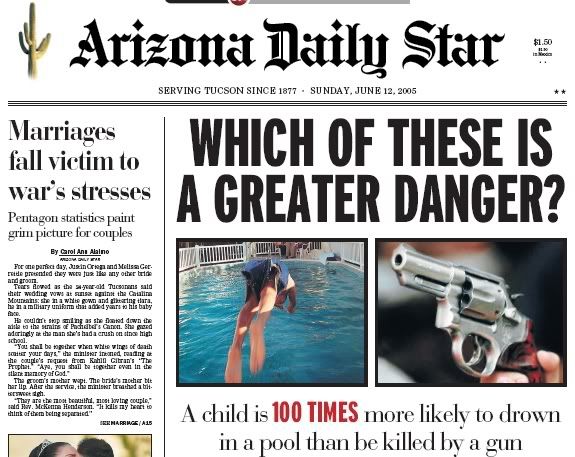
Color me shocked when I saw the cover of today’s Arizona Daily Star:

The story is available online here. Excerpt:

They’re pulled from backyard pools and bathtubs each year, tiny limp bodies, blue and not breathing.

A young life can vanish quickly under water. A survivor can endure a lifetime of disabilities. Either way, families are torn apart by an almost always preventable tragedy.

Standard summer companions in our desert climate, swimming pools can be deadlier for children than guns. A child is 100 times more likely to die in a swimming accident than in gunplay, writes Steven D. Levitt, University of Chicago economics professor and best-selling author.

Levitt analyzed child deaths from residential swimming pools and guns and found one child under 10 drowns annually for every 11,000 pools. By comparison, one child under 10 each year is killed by a gun for every 1 million guns, according to his research, outlined in a new book “Freakonomics: A Rogue Economist Explores the Hidden Side to Everything,” which he co-wrote with journalist Stephen J. Dubner.

Someone should inform Jean Hanff Korelitz. She thinks that “more than 4,000 children…die in gun-related accidents each year”. But let’s check the numbers anyway. According to the CDC, in 2002 there were 676 drowning deaths for children up through 9 years of age. There were 26 accidental firearm deaths. There were 142 firearm deaths of all intents; accident, homicide, and suicide. According to the 2003 UN Small Arms Survey, there are an estimated 238 to 276 million firearms in the U.S. Wouldn’t that mean somewhere between 238 and 275 “children under 10” dying by gunshot, not 142? Professor Levitt really ought to review his numbers more rigorously. It looks like the ratio is more like 175:1.

Shocking, no?

Still, the headline (above the fold!) was quite attention-grabbing.

P.S: My grandchildren are in mortal danger! I own (several) guns, and my wife and I are considering getting a pool!

Welcome, Joe Katzman.

Joe, a Canadian, has embraced the idea of the right to arms as a fundamental human right. Go read his Winds of Change essay on what changed his mind. Here’s the opener:

As many of you know, I’m from Canada. We have a pretty different attitude to guns up here, and I must say that American gun culture has always kind of puzzled me. To me, one no more had a right to a gun than one did to a car.

Well, my mind has changed. Changed to the point where I see gun ownership as being a slightly qualified but universal global human right. A month ago in Yalta, Freedom & The Future, I wrote:

“Frankly, if “stopping… societies from becoming the homicidal hells Mr. Bush described in his Latvia speech” is our goal, I’m becoming more sympathetic to the Right to Bear Arms as a universal human right on par with freedom of speech and religion. U.S. Secretary of State Condi Rice’s personal experience as a child in Birmingham [Alabama] adds an interesting dimension; I hope she talks about this abroad.”

This week, I took the last step. You can thank Robert Mugabe, too, because it was his campaign to starve his political/tribal opponents and Pol-Pot style “ruralization” effort (200,000 left homeless recently in a population of 12.6 million) that finally convinced me. Here’s the crux, the argument before which all other arguments pale into insignificance:

The Right to Bear Arms is the only reliable way to prevent genocide in the modern world.

And Zimbabwe is the poster child for that proposition.

Go read the whole thing.

And this would be a good time to re-read the Dangerous Victims trilogy. Oh, and most especially, Those Without Swords Can Still Die Upon Them.

Commerce Clause Satire.

(Title stolen from The Volokh Conspiracy – thanks to Mike of Feces Flinging Monkey for the email pointer.)

Fafblog! has taken a bit of umbrage at this week’s Raich decision, and has decided to lampoon harpoon the decision with a little satire illustrating the mental gymnastics required to reach that decision. Good read, with graphics and everything, but here’s the bit that got my gungeek attention:

Special Bonus Commerce PARADOX! A cat is in a box. According to quantum mechanics, it is neither bought nor sold. Instead it is a cat commerce waveform sold in all possible states at the same time until it is confiscated and destroyed by the Bureau of Alcohol Tobacco and Cats.

ZING!!!

Couldn’t Happen to Nicer People, or “About Damned Time!”

I’d seen this news elsewhere, but Head of Head’s Bunker has the best bit of news. It seems that the Folsom Gun Club in California has had enough of California’s anti-gun antics and is striking back. They’re officially banning California Department of Justice employees from using their range while acting in any official capacity.

Now that’s good news. The great news? The Brady Bunch has their panties in a twist over it:

GUN ENTHUSIASTS GET UGLY IN CALIFORNIA LEGISLATIVE PUSH, LOCK STATE AGENTS OUT OF TRAINING FACILITY

Sacramento, CA – A shooting range here has announced a ban on use of its shooting facilities by employees of the California Department of Justice because the Department is supporting two bills in the State legislature that the club opposes.

The bills represent groundbreaking new ballistic identification systems which would give police new crime solving tools. Each would set up systems for markings on gun ammunition in California that would help law enforcement investigators track down the perpetrators of shootings that might otherwise remain unsolved. One bill (AB 352) would require handguns to include a device that stamps a specific number on bullets that are fired by that handgun, while the other (SB 357) would require that ammunition manufacturers mark ammunition with a serial number for potential tracking.

The bills have the support of the California DOJ. No California law enforcement organizations oppose the measures. In a letter to California Attorney General Bill Lockyer, Thomas S. Hause, President of the Folsom Shooting Club, which operates the Sacramento Valley Shooting Center outside Sacramento, wrote “The Board of Directors of the Folsom Shooting Club (FSC) has directed me to advise you, in writing, that Department of Justice staff, while acting in their official capacity, are suspended from using the Sacramento Valley Shooting Center (SVSC). The FSC is concerned that your staff will further your efforts regarding AB 352 and SB 357 while using our facility.”

Leaders of the Brady Campaign to Prevent Gun Violence and the Million Mom March are urging the club to drop the policy immediately. “It is offensive that the owners of this shooting range would rather side with criminals than with law enforcement and victims, not to mention that they are discriminating against people simply because they have a different view on legislation,” said Amanda Wilcox, State Council Leader of the Million Mom March. “It is also very troubling when it is law enforcement agents who are using the facility for training purposes.”

“What’s next – should police who support sensible gun laws have their firearms taken away? This is un-American, and these guys ought to have their heads examined,” said Jim Brady, chair of the Brady Campaign.

“This is un-American!” I could make a comment about brain damage, but I won’t.

But that’s not the best part. No, indeed! I loved this:

The state Assembly has passed AB 352, which would give police the ability to match bullet shells at the scene of a crime to the gun that fired the bullet.

Wait! I thought that “ballistic fingerprinting” could do that already!

The two bills being pursued in the California legislature are right up there in terms of reality with repealing the law of gravity, or dictating to the car manufacturers that they WILL build zero-emissions vehicles that people will be willing to drive. And pay for.

But in La-la land they think that passing a law will magically make it so, and to hell with the facts.

It’s about time that they saw some unintended consequences of their own. I applaud the Folsom Gun Club. I wonder if they need a new member?

To Defend Oneself….

Earlier this year I wrote a piece entitled Fear, The Philosophy and Politics Thereof. It was a pretty self-explanatory title, but in short the essay discussed the paranoia and, yes, revulsion that part of the population has against the idea of an armed citizenry. This is a topic I’ve covered before in the “violent-and-predatory” vs. “violent-but-protective” dichotomy illustrated in the Dangerous Victims trilogy.

In all of those pieces I described the problem as I saw it: an irrational fear of armed citizens – but I made no real effort to explain the why of that fear. For the purposes of those essays, illustrating that fear and showing its irrationality was enough.

But long-term it isn‘t enough. That fear is something I’ve been trying to grasp for some time. The first step in trying to bring someone over to your way of thinking is trying to understand their way of thinking. Then you can gently show them the really glaring logical flaws in their worldview and hopefully inspire an epiphany. (Thus one of the earliest posts here at TSM was Is the Government Responsible for Your Protection?) Of course, the further away they are from your position to start with the less likely your success, which is why I continually try to draw self-confessed “moderates” into debate. (Are you reading this, Alex?)

If you’ve been reading this blog long, you know that I recently finished LTC Dave Grossman’s book On Killing: The Psychological Cost of Learning to Kill in War and Society. That book showed me some things that I hadn’t previously considered. For example, in Section II, Chapter 5, The Winds of Hate, Grossman states:

All of us have had to face hostile aggression. On the playground as children, in the impoliteness of strangers, in the malicious gossip and comments of acquaintances, and in the animosity of peers and superiors in the workplace. In all of those instances everyone has known hostily and the stress it can cause. Most avoid confrontations at all costs and to work ourselves up to an aggressive verbal action – let alone a physical confrontation – is extremely difficult.

Simply confronting the boss about a promotion or a raise is one of the most stressful and upsetting things most people can ever bring themselves to do, and many never get that far. Facing down the school bully or confronting a hostile acquaintance is something that most will avoid at all costs.

—

The ultimate fear and horror in most modern lives is to be raped or beaten, to be physically degraded in front of our loved ones, to have our family harmed and the sanctity of our homes invaded by aggressive and hateful intruders. Death and debilitation by disease or accident are statistically far more likely to occur than death and debilitation by malicious action, but the statistics do not calm our basically irrational fears. It is not fear of death and injury from disease or accident but rather acts of personal depredation and domination by our fellow human beings that strike terror and loathing into our hearts.

—

The average citizen resists engaging in aggressive and assertive activities and dreads facing the irrational aggression and hatred of others. The soldier in combat is no different: he resists the powerful obligation and coercion to engage in aggresive and assertive actions on the battlefield, and he dreads facing the irrational aggression and hostility embodied in the enemy

Indeed, history is full of tales of soldiers who have committed suicide or inflicted terrible wounds upon themselves to avoid combat. It isn’t fear of death that motivates these men to kill themselves. Like many of their civilian counterparts who commit suicide, these men would rather die or mutilate themselves than face the aggression and hostility of a very hostile world.

There’s a lot to think about in that excerpt. Yes, physical confrontations are, for the majority, very difficult to “work yourself up to.” Bullies tend to get what they want because most people would rather avoid than confront. Same for robbers. Yes, the greatest fear of most people is the fear of physical depredation, degradation, and domination at the hands of another. Is it “irrational” merely because the likelihood is low? I don’t think so. It just is. How you handle that fear (or not) I think is what defines ones rationality. Killing yourself or self-inflicting grievous wounds is not, I think, a rational response. Neither is ignoring the risk altogether. But weighing the risks, and making a decision based on them is perfectly rational. (See Is the Gov’t Responsible, Pt. II)

Further, because it is difficult to “work yourself up” to being aggressive, bullies and robbers, rapists and murderers are a (thankfully) pretty small portion of the population, thus making “death and debilitation by malicious action” a pretty rare thing. In the case of homicide, for instance, perpetrators usually have a long history of ever-increasing violent behavior before they finally “work themselves up to” murder.

Rare, yes, but not non-existant. Not by a long shot.

The thing that has bothered me the most in my study of history in general and the right to arms in particular is the tendency of societies to disarm themselves. I’ve had a hard time understanding that. As Robert Heinlein put it, “Roman matrons used to say to their sons: ‘Come back with your shield, or on it.’ Later on, this custom declined. So did Rome.”

Want to talk about epiphanies? I had one a couple of days ago. Thanks to American Digest I found this quote by Alexander Solzhenitsyn from a speech he gave at Harvard in 1978:

In a state of psychological weakness, weapons become a burden for the capitulating side. To defend oneself, one must also be ready to die; there is little such readiness in a society raised in the cult of material well-being. Nothing is left, then, but concessions, attempts to gain time and betrayal.

Solzhenitsyn was speaking broadly about governments – Western governments particularly, but that statement I believe is equally applicable within the societies in question. It is true on the macro level because it is true on the micro level. Remember Tytler:

The average age of the world’s greatest civilizations has been 200 years. These nations have progressed through the following sequence

From bondage to spiritual faith

From spiritual faith to great courage

From courage to liberty

From liberty to abundance

From abundance to selfishness

From selfishness to complacency

From complacency to apathy

From apathy to dependency

From dependency back again into bondage

Solzhenitsyn seems to agree with this progression, since “abundance” seems to lead to a “cult of material well-being,” and apathy seems to meet his definition of “psychological weakness.” Or perhaps it’s dependency?

“The ultimate fear and horror” of the individual is “personal depredation and domination by our fellow human beings,” yet the reaction of society is to encourage disarmament?

And they call us irrational?

To the “psychologically weak,” anyone who is armed represents a threat of “personal depredation and domination” unless they believe that the possible predators are constrained by an outside force – in this case, government. That’s why there is an acceptance of state-sanctioned use of violence where there is only rejection of the individual exercise of force. It’s a coping mechanism. Solzhenitsyn is correct: to be willing to defend oneself, one must also be willing to risk ones death or debilitation at the hands of another, and “there is little such readiness in a society raised in the cult of material well-being.” Such readiness is largely dependent on exposure to risk, and the “cult of material well-being” discourages such. Our very prosperity strips us of our willingness, if not our capacity, to resist. “No material thing is worth a human life” is a refrain we hear over and over again. Jeffery Snyder’s A Nation of Cowards hammers on this point.

OUR SOCIETY has reached a pinnacle of self-expression and respect for individuality rare or unmatched in history. Our entire popular culture — from fashion magazines to the cinema — positively screams the matchless worth of the individual, and glories in eccentricity, nonconformity, independent judgment, and self-determination. This enthusiasm is reflected in the prevalent notion that helping someone entails increasing that person’s “self-esteem”; that if a person properly values himself, he will naturally be a happy, productive, and, in some inexplicable fashion, responsible member of society.

And yet, while people are encouraged to revel in their individuality and incalculable self-worth, the media and the law enforcement establishment continually advise us that, when confronted with the threat of lethal violence, we should not resist, but simply give the attacker what he wants. If the crime under consideration is rape, there is some notable waffling on this point, and the discussion quickly moves to how the woman can change her behavior to minimize the risk of rape, and the various ridiculous, non-lethal weapons she may acceptably carry, such as whistles, keys, mace or, that weapon which really sends shivers down a rapist’s spine, the portable cellular phone.

Now how can this be? How can a person who values himself so highly calmly accept the indignity of a criminal assault? How can one who believes that the essence of his dignity lies in his self-determination passively accept the forcible deprivation of that self-determination? How can he, quietly, with great dignity and poise, simply hand over the goods?

The assumption, of course, is that there is no inconsistency. The advice not to resist a criminal assault and simply hand over the goods is founded on the notion that one’s life is of incalculable value, and that no amount of property is worth it. Put aside, for a moment, the outrageousness of the suggestion that a criminal who proffers lethal violence should be treated as if he has instituted a new social contract: “I will not hurt or kill you if you give me what I want.” For years, feminists have labored to educate people that rape is not about sex, but about domination, degradation, and control. Evidently, someone needs to inform the law enforcement establishment and the media that kidnapping, robbery, carjacking, and assault are not about property.

Crime is not only a complete disavowal of the social contract, but also a commandeering of the victim’s person and liberty. If the individual’s dignity lies in the fact that he is a moral agent engaging in actions of his own will, in free exchange with others, then crime always violates the victim’s dignity. It is, in fact, an act of enslavement. Your wallet, your purse, or your car may not be worth your life, but your dignity is; and if it is not worth fighting for, it can hardly be said to exist.

But until I read Solzhenitsyn’s words, it never really clicked for me. I saw it, I accepted the fact of it, but I didn’t really understand it. Denise at The Ten Ring did a two-part post last week on “Types of Anti-Gunnies,” which she broke down into “True Hoplophobes,” “Pacifists,” “Legal-Eagles,” “Victims,” “Opportunists,” “Elitists,” and “Statists.” I think that she’s largely correct in her categorizations (bearing in mind that there might be significant overlap of definition for any particular individual in question), but the characteristic “psychological weakness” described by Solzhenitsyn is primarily manifested in the Hoplophobes, Pacifists, and Victims. These are then used by the Legal-Eagles, Opportunitsts, Elitists and Statists, but each and every one of them to some has either not considered the risks, or rejected those risks not only for themselves, but for everyone else.