Zombies!.

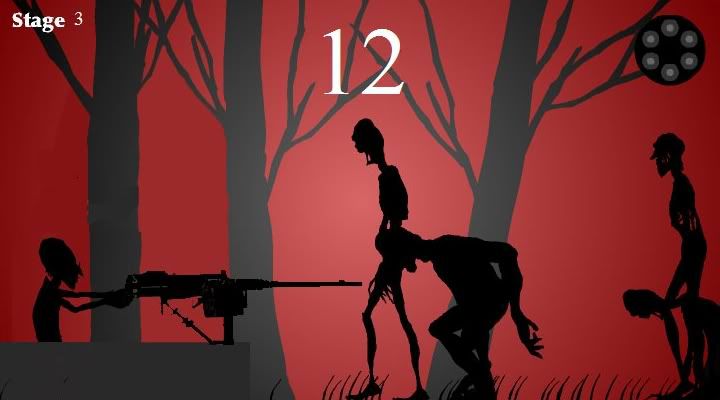
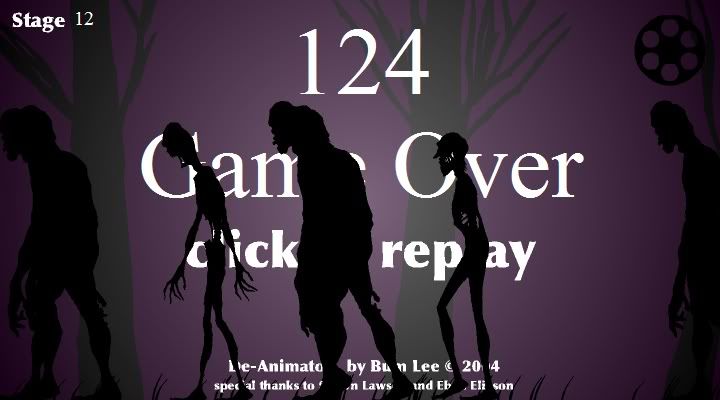
Thanks to Mike at Feces Flinging Monkey, I’ve wasted a lot of time playing De-Animator, a pretty simple, but engrossing Flash game. Through judicious use of the shotgun and inhuman (heh) skill with the Webley revolver, my best score:

One hundred twenty-four zombies before they pulled my arm off and beat me to death with it. Think you can do better?

UPDATE: Best yet (for me.) UPDATED AGAIN!

One MORE Update: Mike from Feces Flinging Monkey sent me his suggestion for higher scores of de-animated zombies; happiness is a warm belt-fed!

I just haven’t figured out how to move to the foxhole with the pintle-mount in it.

More Moronics from Nerf™land – I Mean England.
(Or: “At What Price, Safety?”)

Have you seen the latest? Two Three Four readers emailed me, and one commenter posted on this story:

Doctors seek kitchen knife ban

EDWARD BLACK

Key points
• Doctors claim long kitchen knives serve no purpose except as weapons
• 55 out of 108 homicide victims in Scotland were stabbed last year
• Police superintendents say a ban would be difficult to enforce

Key quote
“Many assaults are impulsive, often triggered by alcohol or misuse of other drugs, and the long pointed kitchen knife is an easily available, potentially lethal weapon, particularly in the domestic setting” – Dr Emma Hern, writing in British Medical Journal

LONG, pointed kitchen knives should be banned as part of a concerted effort to reduce the terrible injuries and deaths caused by stabbing attacks, doctors warned today.

Accident and emergency medics claim the knives serve no useful purpose in the kitchen but are proving deadly on the streets of Britain, with the doctors claiming the knives are used in as many as half of all stabbings.

Wait a minute. “(P)roving deadly on the streets of Britain”?? It’s already illegal to carry almost any kind of knife “on the streets” of Britain unless you can prove “need” of it. (No presumption of innocence there.) Just ask Charlie Booker, arrested and sentenced for carrying a butter knife in public. Last I checked, a butter knife wasn’t pointy or sharp.

Moreover, they’re setting up metal detectors in public places, and searching anyone who tries to avoid them. It’s “for the children,” you know. If it saves just one life!

But now they need to ban kitchen knives?

The doctors claimed they had consulted leading chefs who said the knives were not needed for cooking – a claim disputed by chefs contacted by The Scotsman.

Latest figures from the Scottish Executive show that in 2003, 55 of 108 homicide victims were stabbed by a sharp instrument – often a kitchen knife.

Fifty-five homicides justifies banning kitchen knives. Jeebus. And of those 55 the weapon was often, not always a kitchen knife. Anyone see a realty disconnect here?

Writing in the British Medical Journal, specialist registrar Dr Emma Hern and emergency medicine consultant Dr Mike Beckett said a short pointed knife may cause a substantial superficial wound if used in an assault, but is unlikely to penetrate to inner organs. However, a pointed long blade pierces the body like “cutting into a ripe melon”.

Define “short.” One inch? Two? I’ve got this Ka-bar meat cleaver that I could really go medieval on your ass with. I don’t think it qualifies as “pointy.”

Internal organs can be heavily damaged, causing serious injury or death. The doctors said long knives with blunt ends – such as bread knives – would do far less damage.

Unless they’re used to slash one’s throat. Or femoral artery. Don’t underestimate the lethality of a serrated bread knife!

Dr Hern said: “Many assaults are impulsive, often triggered by alcohol or misuse of other drugs, and the long pointed kitchen knife is an easily available, potentially lethal weapon, particularly in the domestic setting. Government action to ban the sale of such knives would drastically reduce their availability over the course of a few years.”

Wait, wait. I thought the problem with these knives is that they’re “on the street”. Doesn’t that suggest some premeditation? I mean, after all, you’ve got to be willing to break the law in the first place to simply carry such a knife out of your home, right? So if you’re willing to do that, why wouldn’t you be willing to substitute some other weapon? And banning the sale would “drastically reduce their availability over the course of a few years“??? IT’S A PIECE OF STEEL, YOU MORON!! THEY TAKE DECADES TO WEAR OUT! That Ka-bar meat cleaver I mentioned? WWII-era, if not older. I’ve got a couple of Old Hickory carbon-steel knives about the same age. And I don’t think my 10” bladed, razor-sharp, needle-pointed Henckels chef’s knife will be retiring any time soon, either.

Scotland’s most respected pathologist, Professor Anthony Busuttil, said: “All the statistics show that for the last 15 years, victims of stabbings, whether fatal or seriously injured, are caused by kitchen knives such as steak knives rather than knives bought specially for the purpose.”

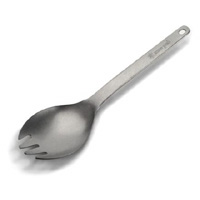
Which, of course, could change overnight if such knives were all banned and confiscated, right? There’ll be a big amnesty for people to turn in all their sharp, pointy knives and be reimbursed by the government who will issue them sporks in return? And then house-to-house searches and imprisonment for those who fail to comply?

Restaurateurs and chefs reacted angrily to suggestions of banning kitchen knives. Malcolm Duck, chairman of the Edinburgh Restaurateurs Association, said: “Kitchen knives are designed for a purpose. It would be like asking a surgeon to perform an operation with a bread knife instead of a scalpel. Anything in the house like a cricket bat could be used as weapon in the hands of an idiot.”

Chief Superintendent Tom Buchan, president of the Association of Scottish Police Superintendents, said although a ban on sharp, pointed kitchen knives would be welcome, it could be difficult to enforce.

Gee, ya THINK?? You’ve got to have licensing and registration FIRST! Didn’t you learn anything from the handgun ban?

Oh, right. Of course you didn’t. Silly me.

The BBC has a story on this too. More of the same, except for this quote:

The use of knives is particularly worrying amongst adolescents, say the researchers, reporting that 24% of 16-year-olds have been shown to carry weapons, primarily knives.

The study found links between easy access to domestic knives and violent assault are long established.

French laws in the 17th century decreed that the tips of table and street knives be ground smooth.

A century later, forks and blunt-ended table knives were introduced in the UK in an effort to reduce injuries during arguments in public eating houses.

Ten minutes on a grinder: sharp pointy knife again. Or, of course, everyone could just switch to chisels.

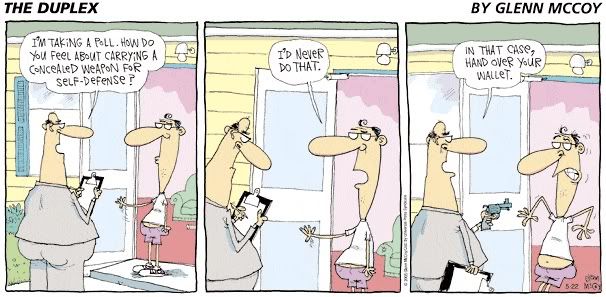
Now, lest you think this is merely an aberration (even after the banning of full-auto weapons, semi-auto rifles, all handguns, pepper & other defensive sprays, tasers, pretty much anything suitable for self-defense, et cetera,) let me remind you that in 2003 they were discussing forcing pubs to use plastic glasses and plastic beer bottles to, what? REDUCE VIOLENCE, of course, because Pub fights cost £4m a year and bottles and drinking glasses were used to inflict 15,000 injuries a year! I don’t know what the outcome of that effort was. If anyone does, please let me know.

But I’ll tell you what: Let’s just raze the British Isles, tote off all of the wood and brick and glass and metal and rebuild with terrycloth, foam rubber, Saran-wrap and soft plastics and then you’ll all be safe! Right?

As soon as everyone is in a straightjacket, that is. You seem to need the spinal support.

Quote of the Week.

By now I’m sure that most of you have read Keith Thompsons’s San Francisco Chronicle piece, Leaving the Left. If you haven’t, you need to. Too much crunchy goodness to excerpt even a teaser. But that’s not where the Quote of the Week comes from this time. Mr. Thompson has his own web site, and on that site is another of his essays, Busting the Moral Equivalence Racket. In it he quotes author Sam Harris from his book The End of Faith:

(S)o many Muslims are eager to turn themselves into bombs these days because the Koran makes this activity seem like a career opportunity

But we’re not in a religious war, you understand. Words like “Crusade” must not be uttered.

Mr. Thompson has a blog, too: Sane Nation. I think I’m going to have to spend some time there. He says things like this:

Spot quiz. Who made the following statement:

“The free use of private property is just as important as … speech, the press, or the free exercise of religion.”

A. James Madison
B. Thomas Jefferson
C. Adam Smith
D. Bobcat Goldwaithe

Answer: none of the above. Janice Rogers Brown made that statement. But it sounds a lot like Madison or Jefferson. So what is it that has “progressive” opponents of Brown’s nomination to the D.C. Court of Appeals screaming like Bobcat?

Here’s what: Brown had the audacity to declare that courts have the responsibility not run roughshod over groups that are unpopular or lack political power.

Yup. I definitely need to read more of what this ex-Leftist has to say.

The Pendulum is Still Swinging, Apparently.

A Google News search for the term “assault weapon” today brings up a plethora of news stories on the Illinois House rejecting the current attempt to ban them. Whatever they are. It was a close one, however, failing by a single vote.

But the thing that grabbed my attention was the number of op-eds and letters-to-the-editor that were pro-gun. Like this one from Maine’s Morning Sentinel:

I am tired of gun-control laws, their supporters and their tired lies. The assault-weapons ban is dead. You cannot breathe new life into it with the same lies and emotional diatribe that gave it life initially. My opinion is unchanged by the most recent reiteration.

So-called assault weapons do not function differently from any other semi-automatic firearm. They shoot one bullet with each squeeze of the trigger, like a revolver. They shoot bullets that are either the same as, or less powerful than, common hunting calibers. They do not “spray” bullets, because they are not machine guns. They look like machine guns. They have bayonet lugs, pistol grips, flash suppressors and detachable magazines, and they’re usually black.

They’re scary looking, but they won’t kill anything any deader than any other firearm. Anyone with any familiarity knows this. If you have done your research, you know it. I can only assume your supporting this misguided effort means you will someday support banning all semi-automatic firearms. That failing, eventually, you will support banning all firearms.

The NRA, gun makers, dealers and sportsmen’s groups don’t vote; gun owners vote. We always have, and always will. We buy newspapers, too. Lawmakers would do well to not ignore those who elect them, and those who make their livelihoods selling newspapers should pay heed as well. Deal in truth and facts. You’ll be respected and prosper.

Leon A. Richard

That was published as an op-ed.

Or this one from the St. Paul MN Pioneer Press:

The Minnesota Personal Protection Act has been in the news recently for two very important reasons — the “carry law” will become law and a permit holder has been charged with murder. It seems reasonable to try to determine if this is the exception, or the rule, in other states that have had much more than two years of experience and many more permit holders than the 25,000 in Minnesota.

By law, Texas is required to gather statistics on the arrests and convictions of permit holders. These statistics show that 3,370 permit holders have been arrested in the nine years since Texas enacted its carry law. That may sound frightening unless you know that there are 350,000 permit holders in Texas, and that only 24 percent of those arrests resulted in a conviction.

The resulting conviction rate makes permit holders almost eight times less likely to be convicted of any crime compared with nonpermit holders. The events in Minneapolis were an exception, not the rule. This is a good law that deserved to be resurrected.

MICHAEL MARTIN

Which rebutted this one that appeared two letters above it:

I found it interesting that your brief mention of the shooting death of Billy Walsh, a doorman at Nye’s Polonaise Room in Minneapolis, never mentioned that the shooter was a permit holder, issued a permit under the 2003 conceal and carry law. Given that the day after the shooting the Senate passed a bill to re-enact the 2003 law, wasn’t the fact that the shooter was a permit holder worthy of reporting? No wonder there isn’t more outrage about having so many loaded handguns in public — if the media doesn’t include such details, how are we to know?

SHARON ALLEN

Can you say “balance”?? Color me shocked.

Now, how about this piece in the North Greenville College newspaper, The Skyliner?

Library staff retires overused words

During several lunchtime discussions in the fall of 2003, the faculty of Hester Memorial Library began to comment to each other about the tendency of pop culture to overuse various words and phrases.

From these discussions, came a list of words which the group felt should be retired, or at least given a rest. The following spring, the group honed this list down to the top five words for that year.

In the spring of this year, the group gathered to compile a second list of overused words.

Certain words that are abused or overused by media, news casters, and television culture as a whole will be put on a list to be banned from the English language. This list is composed by Jonathan Bradsher, Director of the Library here at NGC for five years and NGC librarian of six years Carla McMahan.

The idea behind this list was to critique the usage of the English language in popular culture and to note its overuse, or misuse, of words and phrases. Because television tends to be such an influence in American culture, this critique is focused on the medium of television.

The top five words to the retired for 2005 are as follows:

1. Literally- A word that means “free from exaggeration or embellishment.” It has been a favorite of news programs and especially the local ones. It is unfortunate that many of these users do not seem to understand its meaning. A recent newscaster reporting on a flood stated that “the water is just a few feet away… literally.” One’s first thought after such a statement is, what about the water that’s “figuratively” just a few feet away?

2. Assault Weapon (and/or High powered Assault Weapon)- a phase that is loaded with politics and factual ambiguity. The reason that this word is on the list is because there is no one definition for this phrase and yet it is so widely used. What is an assault weapon? Whatever the speaker wants it to be. Since there is no definition, this phrase does not have to be qualified. Therefore, one could state that a slingshot was an assault weapon and a slingshot with an extra strong rubber band was a high powered assault weapon.

The remaining three worst words and phrases were “Ripped from the headlines!”, “To the next level”, and “Weapons of Mass Destruction.” (To that I’d like to add “going forward” or “moving forward.” “Conceptualize” is pretty bad, too, but not used as widely.) But still, the wording of the “assault weapon” paragraph makes me smile.

And finally, there’s this op-ed from Florida’s Tallahassee Democrat:

Florida isn’t about to become Deadwood East

By Bill Cotterell
CAPITAL CURMUDGEON

Shortly after Gov. Bob Martinez signed the 1987 concealed-weapons bill, I was seated next to a Sports Illustrated reporter at a Miami-FSU game. Before kickoff, he was prattling on and on about this wacky new Florida law.

Of course, he hadn’t read it. He’d only heard about it from late-night comedians and national news accounts.

The magazine writer had already chosen his headline – “Shootout in the Gunshine State” – so it’s fortunate that the football game turned out to be one of the best ever. Shaking his head, he told me he was going to write in SI how one of the first folks he’d met upon landing in Miami was a filling station attendant with a gun on his hip.

Perhaps feeling obliged to defend my home state, I pointed out that (a) a holstered pistol is not a concealed weapon, (b) although the law had been signed, the state was not yet issuing “conceal to carry” permits and (c) there were probably guns under the counters of some gas stations and convenience stores he had stopped at on his way up here. But southerners can’t talk guns to New Yorkers because they’ve made their city so safe.

An odd thing is, Georgia had permitted concealed weapons a few years earlier and nobody noticed. Maybe it was the popularity of TV shows like “Miami Vice” or movies like “Scarface” back then, but Florida still has a reputation for weird things that only happen here.

Remember all those wild gun battles on Monroe Street since 1987? Remember how the concealed weapon law created an O.K. Corral in every crossroads of Florida? Me neither.

Actually, nothing much changed.

Law-abiding gun owners continued to abide by the law and criminals kept on being criminals. And people who don’t want anything to do with guns weren’t required to run out and get one.

Then there was the assault-weapon ban a few years later. Congress adopted a federal ban on certain types of rifles amid much discussion of folding stocks, banana-shaped clips and whether there could be handles on top of the thing.

I don’t know much about guns, but, when I got out of the Marine Corps 40 years ago, the guidebook said a projectile leaves the muzzle at 2,500 feet per second. It doesn’t matter whether a weapon is shaped like a pistol, a rifle or a piano. As long as it fires one shot per trigger-squeeze, an ounce of lead at that speed will do the same damage.

The Bush administration let the assault weapons ban expire last year. Have you seen a lot of people running around with AK-47s and Uzis? Me neither.

Actually, nothing much changed.

Now we’re hearing the same indulgent chuckles from more enlightened quarters because the Legislature approved the “castle doctrine.” The law Gov. Jeb Bush signed last week says you don’t have to retreat if someone tries to invade your home or car, or assaults you on the street.

The law says you can meet force with force but it doesn’t say you should. A sensible person (and our laws do presume that you’re sensible) will still try to avoid a deadly confrontation.

There’s a certain macho appeal to the law, but any sheriff or police officer would probably tell you that if you can get your family to safety and call 911 from next door, that’s still the best thing to do.

It’s doubtful many of the critics have read the bill. In fairness, neither have most of its supporters, but this time, the hooting and finger-pointing can be hazardous. A lot of the dire warnings about this new law may leave the impression that you can shoot the Avon lady.

There still must be a reasonable belief that you, or people near you, are in imminent danger. Police and prosecutors aren’t stupid. Maybe some guy who shoots his wife will try to get off by saying he thought she was a burglar, but that could happen under the previous law – and juries can still see through alibis under the new one.

As with the conceal-to-carry law and the lifting of the assault-weapons ban, we’re told that Florida will become Deadwood East. We hear how street-corner confrontations that used to end in shouted threats or maybe a bloody nose will now wind up with a chalk outline on the sidewalk.

When I worked in Atlanta, the little town of Kennesaw got into Johnny Carson’s monologue with an ordinance that said every “head of household” – in Georgia at the time, this meant “husband” – had to own a gun. (In a bit of sublime satire, the elders of Ely, Minn., mandated that every home had to have a fishing pole, on the theory that feeding your family is as important as defending it.)

Sent to Kennesaw to write a story, I asked a merchant to give me the big picture.

“Well,” he said, pausing, “I guess I’m gonna sell a gun – if there’s anybody around here that don’t already have one.”

Actually, nothing much changed.

And maybe, if people will quit saying you can shoot first with impunity, nothing much will change with Florida’s new castle doctrine.

Yes, I know they’re all insignificant next to the New York Times, but taken together, they indicate to me that the pendulum is still swinging our way.

I May Have Hooked a Live One!.

I’ve been commenting over at Banana Oil! on Ian’s post A Challenge, sparring with another commenter, Alex. If you’re interested in the exchange, it starts here. Well, Alex has taken up the gauntlet, and I’ve invited him to post here at TSM. We’ll see.

I love doing this.

I’m weird, aren’t I?

I Imagine This Post May Be Unpopular.

I just took the time to read the Bach v. Pataki decision. (A day late and a dollar short.) Several bloggers have commented on it. Yosemite Sam of The Ten Ring wrote:

Now via Alphecca we have a decision from the 2nd U.S. Circuit Court of Appeals that pretty much takes a crap on the Bill of Rights. The case is Bach vs. Pataki in which a Virginia man argued that his Virginia carry license should be valid in New York State, just like a driver’s or marriage license.

But this “Court” decided that New York has a compelling reason to crap on the Constitution and said that the state’s restriction of permits to New York residents was valid. They justify their decision using the totally bogus 2nd Amendment collective rights argument that even Lawrence Tribe says is utter bullshit.

The referenced piece by Jeff contains:

Once again we see judges who should be figuratively tarred-and-feathered for their astounding lack of knowledge concerning current thinking on constitutional law. Even such liberals as Lawrence Tribe have come around to believe that the Second Amendment refers to a personal right, just as all the other amendments do. Here we have (in my opinion) incompetent judges attempting to twist the original meaning of the Bill of Rights to suit their activist positions.

Most bloggers, though, were more circumspect. David Hardy wrote:

In the 1980s, the 2d Circuit easily waved the Second Amendment away. For example, in U.S. v Toner, 728 F.2d 115 (2nd Cir. 1984), an equal protection question was raised with regard to the Gun Control Act’s ban on possession by illegal aliens, and the Circuit disposed of the “fundamental right” criterion (if a fundamental right is involved, a court must use a higher level of scrutiny in determining whether equal protection has been violated) with a sentence: “….the right to possess a gun is clearly not a fundamental right, cf. United States v. Miller, 307 U.S. 174, 59 S.Ct. 816, 83 L.Ed. 1206 (1939) (in the absence of evidence showing that firearm has “Some reasonable relationship to the preservation or efficiency of a well regulated militia,” Second Amendment does not guarantee right to keep and bear such a weapon)…”

Today, the Circuit has to spend a lot of time hedging, and it declines the obvious opportunity simply to adopt the district court ruling. This suggests it sees the Second Amendment question as up in the air rather than settled.

Countertop Chronicles is pessimistically enthusiastic:

Boy, I’d love to see the Supreme Court knock this one out of the park. Unfortunatly, its probably a very good delaying tactic on part of the GFW’s on the 2nd, because if the Supreme’s were to take the issue up, they likely would limit their review to the error of relying upon Presser. Once reversed, they would simply send it back down to the Second Circuit and avoid any discussing of the underlying Second Amendment concerns that are really at issue.

And, finally, Crime & Federalism was more encouraged:

This is almost a model test case on the incorporation question. Some have speculated that the reason four Justices haven’t voted to grant cert. in other Second Amendment cases resulted from the lack of a good “test plaintiff.” Well, Bach is the perfect plaintiff.

You know what a decade of reading legal decisions has done to me? It’s made me appreciate it when judges actually follow the law. A while back I wrote “Game Over, Man, Game Over” when I was disillusioned at 9th Circuit Judge Alex Kozinski bowing to the precedent of that circuit’s Hickman v. Block when it so obviously went against what he believes. I said then:

Mike Spenis said “the future of our freedom ultimately rests with the court’s willingness to periodically reexamine the law,” but the evidence is plain that the courts will not do that. They will use obviously flawed precedent so long as it “comports especially well with our notions of good social policy.” And even if it doesn’t, the courts will often bow, as Kozinski does here, to precedent they abhor. We depend upon the honor and intellectual honesty of the judges who make up the Justice system, yet it seems that those who are truly honest and honorable are outnumbered by those who are “willing to bury language that is incontrovertibly there.” The honest and honorable ones abide, under the rule of law, by precedent that is otherwise insupportable. The middling honest ones, the ones Justice Brandeis labled as “men of zeal, well-meaning but without understanding” “build magnificent legal edifices on elliptical constitutional phrases – or even the white spaces between lines of constitutional text.” And those decisions stand, without review, periodic or otherwise, to serve as the next step down the road to Hell.

I stand by those words still, but I do so because if the honest and honorable judges did not abide by precedent, we would not have even the semblance of rule of law.

This is what caught my attention in the Bach ruling:

Although the sweep of the Second Amendment has become the focus of a national legal dialogue, we see no need to enter into that debate. Instead, we hold that the Second Amendment’s “right to keep and bear arms” imposes a limitation on only federal, not state, legislative efforts. We thus join five of our sister circuits.

Our holding is compelled by the Supreme Court’s opinion in Presser v. Illinois, 116 U.S. 252 (1886). In 1879, Herman Presser led four hundred armed members of a society called the Lehr und Wehr Verein through the streets of Chicago. Illinois’s Military Code required that any “parade with arms” be licensed by the Governor. Presser lacked a license, and was charged and convicted under the Code. Presser argued to the Supreme Court that Illinois had exercised a power “forbidden to the States by the Constitution of the United States.” He relied on both the Second and Fourteenth Amendments.

The Supreme Court rejected Presser’s argument. Justice Woods explained, “[A] conclusive answer to the contention that [the Second Amendment] prohibits the legislation in question lies in the fact that the amendment is a limitation only upon the power of Congress and the National government, and not upon that of the States.” The Court quoted Chief Justice Waite’s opinion in United States v. Cruikshank, 92 U.S. 542 (1875). “[T]he right of the people to keep and bear arms ‘is not a right granted by the Constitution. Neither is it in any manner dependent upon that instrument for its existence. The Second Amendment declares that is shall not be infringed, but this, as has been seen, means no more than that it shall not be infringed by Congress.’” Presser, 116 U.S. at 265 (quoting Cruikshank, 92 U.S. at 553). The Court affirmed Presser’s conviction.

Presser stands for the proposition that the right of the people to keep and bear arms, whatever else its nature, is a right only against the federal government, not against the States. The courts are uniform in this interpretation. Just as Presser had no federal constitutional right “to keep and bear arms” with which to challenge Illinois’s license requirement, Bach has none to assert against New York’s regulatory scheme. Under Presser, the right to keep and bear arms is not a limitation on the power of States.

Like it or not, that’s sound legal reasoning, and here’s why:

We must follow Presser. Where, as here, a Supreme Court precedent “has direct application in a case, yet appears to rest on reasons rejected in some other line of decisions, the Court of Appeals should follow the case which directly controls, leaving to th[e Supreme] Court the prerogative of overruling its own decisions.” Rodriquez de Quijas v. Shearson/Am. Express Inc., 490 U.S. 477, 484 (1989); see also id. at 486 (Stevens, J., dissenting). The Court has cautioned, in the context of constitutional interpretation, that “courts should [not] conclude [that] more recent [Supreme Court] cases have, by implication, overruled an earlier precedent.” Agostini v. Felton, 521 U.S. 203, 207 (1997); see also id. at 258 (Ginsburg, J., dissenting). Even if a Supreme Court precedent was “‘unsound when decided’” and even if it over time becomes so “‘inconsistent with later decisions’” as to stand upon “‘increasingly wobbly, moth-eaten foundations,’” it remains the Supreme Court’s “prerogative alone to overrule one of its precedents.” State Oil Co. v. Khan, 522 U.S. 3, 9, 20 (1997) (quoting Khan v. State Oil Co., 93 F.3d 1358, 1363 (7th Cir. 1996) (Posner, J.)). Thus, “regardless of whether appellant[] agree[s] with the Presser analysis, it is the law of the land and we are bound by it. The[] assertion that Presser is illogical is a policy matter for the Supreme Court to address.” We cannot overrule the Supreme Court.

Quite right. To do otherwise means that the system of rule of law falls apart. Both Cruikshank and Presser, while bad decisions, are clear on what they meant – and they stated in no uncertain terms that the Second Amendment didn’t protect against STATE infringements on the right to arms. Inferior courts do not have the legal power to overturn those decisions. Individual Appeals Court judges do not have the power to overturn en banc Circuit decisions, either.

The metaphorical crap was taken on the Bill of Rights by the justices in the Cruikshank and Presser courts. The judges sitting on the 2nd Circuit bench are not the clean-up crew, nor should their decision be grounds for tarring and feathering. They’re doing their job, as far as I can see. It’s up to the Supreme Court to fix this one, and while I hope they’ll do the right thing, or at least what Countertop thinks likely, I would not be surprised if they deny cert. on this case as they did on both Emerson and Silveira. It is, after all, easier to dodge uncomfortably bad decisions than correct them.

They’ve been doing that since 1939.

Range Report!!.

Cowboy Blob has the pictures and details. The malfunctions I was experiencing with my Kimber were new to me. I just added Cylinder & Slide’s Safety Fast System. Among other things, it came with a new slide release. Well, it seems to work too good, locking the slide back when it shouldn’t be. I was shooting Federal 230gr hardball, and several times the slide would lock back, and I’d look to see the cartridge about 1/4 of the way forward. Drop the slide release and everything was copacetic. Very odd. But the SFS works great! Might have to go back to the original slide release, though.

The 25-round Butler-Creek 10/22 mag seems to have surrendered, but the factory 10-rounders still work perfectly.

Both the Garand and the AR-15 were flawless.

But by 10:30 it was already too damned hot, so we packed it in. Good day, though.