Democrats and Dictators

Perusing Free Market Fairy Tales this evening, I came upon this snippet from Mr. Free Market:

In the European countries where the ratification process has been put to a popular vote, the electorate have said resoundingly ‘No’. In the countries where ratification has been via a Parliamentary vote, they have said ‘Yes’. Worrying to think how out of step the political class is with the common man in whatever country.

Dutch blogger Arjan Dasselaar made the same connection (h/t Daniel Drezner):

If 85 percent of Parliament wants to support a constitution that 63 percent of the constituency rejects, it seems obvious that our representatives in the Second Chamber (our Lower House/House of Representatives) no longer represent us.

I have a fairly good memory, so this immediately reminded me of a Steven Den Beste piece, Antipopulism from January of last year, which is so short I will quote it in whole:

In her new book, Danish Liberal EU spokesperson Charlotte Antonsen questions the use of referenda as a useful way to build up European democracy.

The book – “Towards the European Constitution” warns that the EU could fall apart if the Danish practise of consulting the people in referenda over important EU treaties is copied by other member states.

“Referenda have a very conservative effect on development. If the other countries copy us, the EU will fall apart”, she writes.

Mrs Antonsen, a member of the Danish Parliament for the ruling Liberal party, argues that representative democracy is just as democratic as referenda.

“Referenda are in fact pure gambling. There is no guarantee of a positive outcome, unfortunately”.

Think about what she’s saying here. These questions are far too important to trust to the voters to decide. We cannot do what we need if we consult them in order to find out what they really want.

“There’s no guarantee of a positive outcome.” You should never hold a referendum unless you can be sure ahead of time that it will result in approval.

You should not consult the people and actually let them decide because they might choose the wrong answer. The purpose of elections is to permit the people to rubber-stamp what their rulers have already decided, thus making the people feel as if they participated in the decision – even though they didn’t really.

Ms. Antonsen is referred to as a “Liberal”, but her opinion sharply diverges from what has traditionally been known as “liberal democracy”. It is yet another demonstration of the way that modern “Liberals” are deeply illiberal.

Prophetic, wasn’t she? Truer words….

Steven expanded on the theme in a comment at Daily Pundit last Sunday.

See, because Blair was utterly stupid and decided to let the people of the UK make the decision about the future of their nation, that forced the French and the Dutch to do the same, and now look where that’s gotten us? Haven’t you learned that you should never consult the voters when you face major decisions, Blair, you stupid crypto-Tory?

What I like is the way the pro-EU advocates are starting to show their true anti-democratic colors during this process. It’s making blatantly obvious what I concluded long ago: the constitution of the EU is intended to set up a benevolent dictatorship by the progressive (read “socialist”) elite of Europe.

The title of this post comes from James Hudnall’s Hud’s Blog-O-Rama from September of 2003. Discussing in that case the difference between the Democrats and Republicans, Hudnall stated:

If there’s any universal truth these days it’s only Democrats and Dictators are afraid of elections.

Again, truer words….

Samizdatist Perry de Havilland wrote sometime yesterday Shine the spotlight, name the names in which he advocates:

This time we need to not just point out why these people are wrong, we need to grind their faces in their own words for all to see. It is imperative to show that there is often more than just mere ignorance or naivety at work when people choose to take an ‘even handed approach’ between Al Qaeda, the Taliban or the Ba’athists on one hand and the USA and UK on the other.

This is good advice, but I’m not really sure how useful. I’m not sure there are enough of us to get the message out (though I’d like to think so) because there seems to be a powerful human longing for that which cannot be, to the point that humanity seems willing to self-immolate rather than face uncomfortable facts. And there are always those who will exploit that willingness so as to grasp the reins of power, such as Ms. Antonsen, and M. Chirac.

For our own good, you understand!

Many people have pointed out that the French, in rejecting the EU Constitution, did the right thing for the wrong reason; that they rejected the idea of working longer, retiring later, and losing social welfare benefits if they actually had to compete in a common European market. The Dutch? According to Mr. Dresner’s references, the result was due to “Dutch anger with the political elite since the 2002 murder of anti-immigration populist Pim Fortuyn.” The Dutch rebelled against being “pushed around by the big countries” and “the union’s heavy bureaucracy (and lack of) transparency and democracy,” which, to my mind are laudable reasons.

But the fact remains that the “heavy bureaucracy” and “political elite” aren’t giving up. And I wonder how many more countries are going to allow the question to go up for popular vote?

(Heavy use of Instapundit links were made for the preparation of this post.)
Rob Smith Defends the Saturday Night Special.

Yes he does!

Now, riddle me this— if you live in a bad neighborhood, you DON’T intend to go off to the range and fire a couple of hundred rounds a week, and all you want is a pistol to run off some crack-addled thug who may try to break into your house at 2:30 in the morning, are you going to buy a $1,300 Smith & Wesson, or would you prefer a $25 .38 pistol that’s good enough to fire six shots ONCE in your life?

Good question.

Dept. of Our Collapsing Schools

Division of “AAAAAAAGGGGH!! AAAAAAAAGGGH!”

English doctors want to ban sharp, pointy kitchen knives. Legislators there want to replace the glass in beer bottles and bar glasses with plastic. Silly? Of course. Concepts like this make me shake my head vigorously to make sure I didn’t miss anything in the translation. It’s difficult to believe people can be that naïve.

But the Brits are hardly alone. The Nerfland Coalition™ isn’t restricted to that side of the pond.

Via El Capitan’s Baboon Pirates blog I found this USA Today op-ed on our “softer, gentler” advocates in the national education intelligentsia. The key quotation:

It seems that many adults today regard the children in their care as fragile hothouse flowers who require protection from even the remote possibility of frustration, disappointment or failure. The new solicitude goes far beyond blacklisting red pens. Many schools now discourage or prohibit competitive games such as tag or dodge ball. The rationale: too many hurt feelings. In May 2002, for example, the principal of Franklin Elementary School in Santa Monica, Calif., sent a newsletter to parents informing them that children could no longer play tag during the lunch recess. As she explained, “In this game, there is a ‘victim’ or ‘It,’ which creates a self-esteem issue.”

Is anything OK?

Which games are deemed safe and self-affirming? The National PTA recommends a cooperative alternative to the fiercely competitive “tug of war” called “tug of peace.” Some professionals in physical education advocate activities in which children compete only with themselves, such as juggling, unicycling, pogo sticking, and even “learning to … manipulate wheelchairs with ease.”

But juggling, too, poses risks.

A former member of The President’s Council on Physical Fitness and Sports suggests using silken scarves rather than, say, uncooperative tennis balls that lead to frustration and anxiety. “Scarves,” he points out, “are soft, non-threatening, and float down slowly.”

I would have more to say, but El Capitan points out that Red at Sheila Variations does it just fine.

In the mean time, I need to find a nice hard surface to bang my head against.

UPDATE, 6/3: Toren points to an associated piece at Silent Running with this excerpt:

Trying to raise children with the erroneous belief that there are no winners or losers, and that nothing bad will ever be allowed to happen to them will only result in an unworkable society full of litigious, therapy-obsessed malignant narcissists with a widly inflated sense of self-importance, a belief that nothing is ever their fault and an inability to recognise evil, let alone actually do anything about it.

Oh.

Never mind.

And one commenter, Lucyna, left this there:

There is a reason why this is being done – it’s called “dumbing down”. Cocooning creates adults that need to be looked after – that way they are far more manageable and less likely to be troublesome. This process is well under way and has been in progress for over a century now.

Oh and pc is the palatable explanation – not the actual reason.

Which once again reminds me of Connie du Toit’s explanation for the destruction of our public schools:

The other day our Carpenter’s helper heard me say something along the lines of, “it is difficult to conclude that incompetence is the reason why our public schools have deteriorated. There comes a point where you have to suspect sabotage, or a conspiracy.”

He asked me if I really meant that. I gave him the five minute explanation of John Dewey’s known affiliation with communists, his frequent essays and articles about the wonders of the Soviet education system, and his quote, “You can’t make Socialists out of individualists. Children who know how to think for themselves spoil the harmony of the collective society which is coming where everyone is interdependent.”

I then went on to tell him about how public schools changed at the turn of the last century. That there were others involved in turning Americans from free-thinking individualists to factory drones. I also added that many people probably went along with it because it seemed like a good idea, but there were certainly enough people behind the scenes, who knew that the goal posts had been moved. THAT is a conspiracy.

Yes. There does come that time when you are forced to don the tinfoil hat.

The incompetence excuse only works once. Incompetence this great is impossible to attribute to accident.

This isn’t naïveté. This isn’t incompetence. Lucyna is correct. This is deliberate sabotage.

Just an Update.

Sorry I haven’t been posting much lately. I’ve been busy, and just not all that inspired to write at the moment.

I am, however, waiting for Alex to join TSM and begin our debate. I emailed him the day before yesterday and received an affirmative reply:

I am trying to get one more project out the door.

I will post something as soon as I can.

So expect to see something on that subject soon.

I’m planning on writing a couple more pieces on LTC Dave Grossman’s book, On Killing, as well; one on that 2% of the population that can apparently kill without much in the way of remorse, and another on whether or not we’ve been inadvertently conditioning our kids to be killers. Neither of those pieces has jelled, yet, and I don’t want to force them.

I’ve also been spending my online time reading a lot of the milblogs. If you haven’t, I recommend it. You’re not going to hear about any of what these guys have to say in the regular media.

Anyway, I haven’t dropped off the face of the Earth, and thank you to all the regular readers who check in each day and keep my hit counter rolling over.

And remember, I also do requests, though it might take me some time.

Keep checking in.

Remember to Honor the Others

I mentioned below that I had just finished reading Lt. Col. Dave Grossman’s On Killing: The Psychological Cost of Learning to Kill in War and Society. This is a pretty sobering look at the actualities of lethal force, and I wanted to wait until Memorial Day for this post because Col. Grossman makes a point that I think the majority of our society doesn’t grasp. Doesn’t want to grasp, in fact. But I’ll get to that in a moment.

I was first introduced to the concepts explored by Col. Grossman in his book in an essay by Eric S. Raymond of Armed and Dangerous, The Myth of Man the Killer. Eric’s piece was about the reluctance of people to kill or even inflict injury until forced to by extraordinary circumstances, but also about the perpetuation of a belief in the “myth of man the killer” and what that belief has done to our society. If you haven’t read it, I strongly recommend you do.

But Col. Grossman, who has a bachelor’s degree in history, and a graduate degree in psychology, examines the aftermath of both inflicting and experiencing the exercise of lethal force – through the spectrum of the impersonal (bombing, shelling) to the up-close-and-personal of close-quarters combat.

While this book will be fodder for several future posts, this is the topic I want to explore on this Memorial Day.

Col. Grossman notes that during WWII studies have shown that only 15-20% of combat troops – the ones on the line facing the enemy with weapons in hand – “would take any part with their weapons” – that is, actually fire at the enemy. He notes, however, that the studies found

Those who would not fire did not run or hide (in many cases they were willing to risk great danger to rescue comrades, get ammunition, or run messages), but they simply would not fire their weapons at the enemy, even when faced with repeated waves of banzai charges.

I won’t get into the “why” of this in this essay, but accept it as fact, and understand that the military saw this as a major problem to be solved – not the “why,” but the “how to increase firing rates” question.

And they did. According to Grossman, changes in training regimens increased the firing rate during the Korean conflict to 55%. During the Vietnam war the firing rate was 95%. That number probably reflects conditions today in Afghanistan and Iraq. That rate explains why, after a 24-hour firefight in Mogadishu, Somalia without armor, without much air support, and without artillery support, US forces only 450 strong came out of that hostile city with only 18 dead, and 73 wounded. And inflicted around 1,000 Somali casualties. We have built an army of ferocious fighters, as Lt. Gen. William S. Wallace stated:

“The thing I remember most about the entire operation was the extraordinary endurance and bravery, heroism and sacrifice of the young Americans who were under my command.

“They were absolutely ferocious fighters when they needed to be,” Wallace recalled, “and in a moment they could turn into the most compassionate people you could ever imagine.”

That’s something we need to remember.

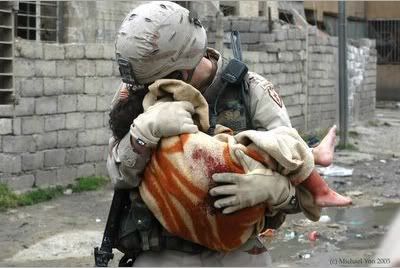
According to Col. Grossman, regardless of all the classic war movies you’ve seen, only about 2% of the people on the sharp end are capable of killing without suffering some psychological effect. The rest, even the ones who haven’t fired a shot in anger, are affected by the violence they’re exposed to. I, for example, cannot imagine the effect of being a direct witness to this:

or this on a daily basis:

An American soldier told me today that he has been telling kids to stay away from his unit so they won’t be killed. This is harder, on all parties, than it might seem to anyone who hasn’t seen first hand how much the kids here love the soldiers. The sound of heavily armored trucks rumbling through the streets has the same effect these kids as the tinkling bells of the “ice cream man” back home. Imagine having to tell kids to run the other way when they hear the icecream truck on a summer afternoon.

Recently, an insurgent hid behind a child in order to attack Americans. The tactic came as no surprise to the soldiers here. Terrorists routinely play wounded or feign their surrender in order to get close enough to launch an attack on Coalition or Iraqi Forces. In January I wrote about one bomber who grabbed the hand of a small child while she was playing on a sidewalk. Smiling, he walked with the child in hand, approaching some Iraqi police and exploded. Americans standing close by were unharmed.

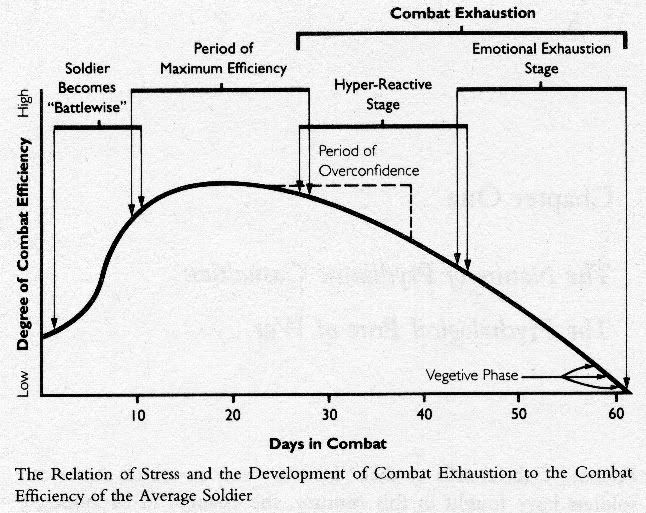
The ability to switch from ferocious fighter to compassionate person is an extremely admirable trait of our modern military, but one that would strain the emotional capacity of any human being to or even past the breaking point. There’s an interesting chart in Col. Grossman’s book, of what combat did to soldiers in WWII:

The effects of this are lessened, Col. Grossman notes, if the soldiers can be pulled “off the line” and given rest and recreation, but that wasn’t really possible during the Vietnam war, because there was no “line,” and VC activity could occur anywhere, any time. I’m not one to draw parallels between that war and this one, but in this one case the similarities are striking.

And in the Vietnam war, the psychological casualties were enormous.

Col. Grossman notes, however, that recovery from such psychological trauma is dependent on a number of factors. Grossman notes:

Something unique seems to have occurred in the rationalization process available to the Vietnam veteran. Compared with earlier American wars the Vietnam conflict appears to have reversed most of the processes traditionally used to facilitate the rationalization and acceptance of killing experiences. These traditional processes involve:

* Constant praise and assurance to the soldier from peers and superiors that he “did the right thing” (One of the most important physical manifestations of this affirmation is the awarding of medals and decorations.)
* The constant presence of mature, older comrades (that is, in their late twenties and thirties) who serve as role models and stabilizing personality factors in the combat environment
* A careful adherence to such codes and conventions of warfare by both sides (such as the Geneva conventions, first established in 1864), thereby limiting civilian casualties and atrocities
* Rear lines or clearly defined safe areas where the soldier can go to relax and depressurize during a combat tour
* The presence of close, trusted friends and confidants who have been present during training and are present throughout the combat experience
* A cooldown period as the soldier and his comrades sail or march back from the wars
* Knowledge of the ultimate victory of their side and of the gain and accomplishments made possible by their sacrifices
* Parades and monuments
* Reunions and contiued communication (via visits, mail, and so on) with the individuals whom the soldier bonded with in combat
* An unconditionally warm and admiring welcome by friends, family, communities, and society, constantly reassuring the soldier that the war and his personal acts were for a necessary, just, and righteous cause
* The proud display of medals.

We, the general public, can’t do much about the majority of these processes. We cannot make “safe zones” in Baghdad, we are not in control of troop rotation, we don’t award medals, but we are the ones in charge of that “unconditionally warm and admiring welcome.” It’s up to us to reassure the returning soldiers that we’re proud of them and what they’ve done.

What they’re witnessing and what they have to do as soldiers is destructive to the psyche of any human being. They are all in a crucible, under stresses most of us cannot imagine. So, by all means, respect the dead for their sacrifice this Memorial Day. But remember too the others who come back, both the wounded and the whole, who have answered our Nation’s call and put themselves on the sharp end. Honor them whenever you see them, and let them know that their sacrifices are appreciated. We’re doing a pretty good job, but not, I think, as a conscious process.

And we need to be.

Enjoy your Memorial Day. And thank a vet.

UPDATE: Just to give you a feel, read this post by Red2Alpha at This is Your War. A taste:

I pulled the trigger and a glittering brass cartridge spun out of the chamber and away. Half a heart beat later the shot roared back at me from the buildings lining Market St, coming back to me in waves as the detonation echoed up and down the street, off the flat surface of windows and walls, cars and people. It sounded deeper than a 5.56mm on a range, yet softer. My ears didn’t pop and ring.
The truck jerked slightly and lurched to a halt. I saw the figures in it start. The white paint on the plastic bumper was flaking off like a scab, revealing the yellow primer under neath. Dead bugs spattering the bumper with their black bodies. I smelled cordite.

Since the IED things have been different for my team. We are more aggressive, quicker to anger. I’m angry all the time now. Everything and everyone is a threat to me. I’d much rather lash out with violence and rage than anything else.

Remember the role of the civilian at home. We do have one.

Book Meme.

David Codrea of the blog War on Guns just tagged me for another blogmeme, this one on books. Who am I to refuse?

Total number of books I’ve owned: No way to tell. At least a few thousand. My current collection, mostly paperbacks, mostly science fiction, runs about 1,000. I try not to sell or give away anything I like, but it’s difficult to provide enough room for them all.

Last book I bought: R is for Ricochet by Sue Grafton. Not her best work.

Last book I read: On Killing: The Psychological Cost of Learning to Kill in War and Society, by Lt. Col. Dave Grossman, about which I hope to have a post up later today. Lots of food for thought.

Five books that mean a lot to me: I can’t pick five specific books, but I think I can pick four specific authors, and one book.

Robert A. Heinlein (everything he wrote)

John D. MacDonald (his Travis McGee novels)

Robert B. Parker (his Spenser novels – even the poor ones)

– These three men molded my personal philosophy

Issac Asimov

– Asimov is in large part responsible for my fascination with science and technology. I still have his three-volume work on elementary physics, and his Biographical Encyclopedia of Science and Technology, among many others. I liked his work in SF, but it was his non-fiction writing that I found most interesting.

And the book; The Science Fiction Hall of Fame, Vol. I.

This is a collection of short stories from the “golden age” of SF that I stumbled across in a school library at about age 13. It contains such classics as “The Cold Equations,” “Flowers for Algernon,” “First Contact,” “Microcosmic God,” “The Weapon Shop,” “Arena,” and many, many others. This is stuff to make you think. Very subversive! Highly recommended.

Now I’m supposed to tag five others to do this. Don’t feel obligated, but I am curious:

Kim du Toit

Connie du Toit (she now, occasionally, blogs on Kim’s site, so she still counts!)

Bill Whittle (right, like he’ll actually read this)

Rob Smith

Keith Thompson

Remember “Police Aware”?

That post from earlier last Saturday? It was an editorial on the inefficacy of Britain’s police. Well, thanks to Cryptic Subterranian, I’ve found another sterling example:

TRADER’S TORMENT

A SHOPKEEPER has been given a DNA kit by police – so he can take samples every time his teenage tormentors spit in his face.

The man likened the girls to Vicky Pollard, of TV’s Little Britain.

Six months of harassment began after he refused to sell the girls cigarettes or give them cigarette papers.

He was beaten by a man linked to the group and his cheekbone and jaw were broken.

The 53-year-old, of Crouch End, North London, said: “We do not feel safe. The guy who hit me in the face has since threatened me.

“You hear about Vicky Pollard, but these girls are worse.”

A police spokesman said: “This behaviour will not be tolerated.”

“This behavior will not be tolerated.”

By whom? “Police Aware” – it’s been taken care of!

How do you hand a man a DNA sample kit and explain to him, “The next time they spit in your face, old chap, just carefully collect some of the spittle into this sample bottle and ring us up! We’ll be by in a week or two to collect the evidence! In the mean time, do try to avoid getting your neck broken or your throat slashed when they come back.”

I. Am. DUMBFOUNDED. And I thought the proposed knife ban took the cake. And if you think this is a hoax, the barely more reliable Guardian corroborates, but here’s a slightly more detailed version from a local online source. A quote from the victim:

“We are hanging on for the time being. Our customers have been very supportive.

“I know other shops in Crouch End are suffering because of these people.

“I’ve been to the police station a number of times to find out what’s happening, but all I’m told is investigations are on-going.”

What will be the outcome of the “on-going investigation?

If enough evidence is gathered against the group, police and Haringey Council could work together to bring an Anti-Social Behaviour Order into effect which could ban the yobs from the area altogether.

“Police Aware!” And ah, yes, the dreaded ASBO!

And if they disobey the ASBO? I’m sure a strongly worded warning will follow!

Bear in mind, too, that it isn’t only the proles being treated this way. These same kits are being given to London’s “traffic control officers” (meter maids). According to This is London, however,

Three (parking attendants) are assaulted in the capital each day, some being attacked with baseball bats and knives.

so they’ll have to be very careful to make sure they don’t get any of their own blood in the samples. It would be awkward if they got ASBO’d for assaulting themselves. But there’s more justification for that knife ban! I suppose a Louisville Slugger ban will follow posthaste.

What the HELL happened to the Brits?

Presser v. Cockrum

Reader Robert Lewis, commenting on I Imagine This Post Might Be an Unpopular One, below, takes exception to my citation of the 1886 Supreme Court Presser v. Illinois decision:

“Under Presser, the right to keep and bear arms is not a limitation on the power of States.”

Hah …the supreme court of Texas claims otherwise …

“The right of a citizen to bear arms, in lawful defense of himself or the State, is absolute. He does not derive it from the State government. It is one of the ‘High Powers’ delegated directly to the citizen by the United States Constitution, Amendment II, and “is excepted out of the general powers of government”. A law cannot be passed to infringe upon it or impair it, because it is above the law, and independent of the law-making power.”
-Supreme Court of Texas, Cockrum v. State of Texas (1859).

Delving into my library, I pulled my copy of Clayton Cramer‘s For Defense of Themselves and the State: The Origins and Judicial Interpretation of the Right to Keep and Bear Arms. Here’s what Clayton has to say about it over pages 90-92:

Article 610 of the penal code specified that manslaughter committed with a Bowie knife or dagger would be considered to be murder, and punishable accordingly. The defendant, John Cockrum, was indicted in 1857 for murdering William N. Self, of Freestone County. In 1858, Cockrum was convicted of murder, apparently based on article 610, and sentenced to life in prison in solitary confinement.

Cockrum appealed. The relevant part of his argument, as presented by his lawyer:

It is contended, that Article 610 of the Penal Code, is in violation of both of the State and Federal Constitution, which contain substantially the same provision, securing the citizen from any infringement on the right to keep and bear arms. 1st. it is asserted, that any law prohibiting a citizen from keeping or bearing any knife, which is intended to be worn upon the person, which is capable of inflicting death, and not commonly known as a pocket-knife, would be unconstitutional. To prohibit absolutely the keeping and having of an ordinary weapon, is certainly to infringe on the right of keeping and bearing arms. A bowie-knife, or dagger, as defined in the Code, is an ordinary weapon, one of the cheapest character, accessible even to the poorest citizen. A common butcher-knife, which costs not more than half a dollar, comes within the description given of a bowie-knife or dagger, being very frequently worn on the person. To prohibit such a weapon, is substantially to take away the right of bearing arms, from him who has not money enough to buy a gun or pistol.

Here Cockrum’s attorney, Robert S. Gould, crisply articulated the position that would be taken a century later, in opposition to laws banning so-called “Saturday Night Specials” – that such laws work principally to disarm the poor.

And I cannot help but point out the extreme divergence between this argument and the argument being put forth today in England seeking justification to ban all long, sharp kitchen knives.

Clayton continues:

But what is the relevance of a law enhancing the penalty for manslaughter, to the right to carry a “bowie-knife or dagger”?

Gould pointed to the court decisions on the right to keep and bear arms, in particular. Nunn v. State (1846), since it had overturned a law banning small pistols. He then argued that if it was unconstitutional to ban the carrying of an arm for a lawful purpose, such as self-defense; and discriminating against a particular arm by enhancing the penalty for criminal use would be an attempt to discourage law-abiding people from carrying such arms, for fear that a manslaughter might thus be punished as severely as murder.

From what I’ve seen, England has been treating arms violations more severely than some murders. Anyway, continuing:

Most of the Texas Supreme Court decision, written by Justice Roberts, addressed the issues of how the varying punishments available for a murder conviction could be determined by the jury, and are of no relevance to our interests. Of relevance to the Second Amendment and Texas’ similar constitutional provision, especially in light of the post-war decisions by the Texas Court: “it is contended, that this article of the Code, is in violation of the Constitution of the United States, and of this State.” After citing the Second Amendment and the 13th section of the Texas Bill of Rights: “Every citizen shall have the right to keep and bear arms, in the lawful defense of himself or the State,” the Court explicated the purposes of the state and Federal Constitutional protections, with no apparent disagreement that both applied to a state law:

The object of the first clause cited, has reference to the perpetuation of free government, and is based on the idea, that the people cannot be effectually oppressed and enslaved, who are not first disarmed. The clause cited in our Bill of Rights, has the same broad objec in relation to the government, and in addition thereto, secures a personal right to the citizen. The right of a citizen to bear arms, in the lawful defence of himself or the State, is absolute. He does not derive it from the State government, but directly from the soveriegn convention of the people that framed the State government. it is one of hte “high powers” delegated directly to the citizen, and “is excepted out of the general powers of government.” A law cannot be passed to infringe upon or impact it, because it is above the law, and independent of the law-making power.

The Court then held that discrimination in sentencing based on the probable lethality of a weapon was legally justified, but:

The right to carry a bowie-knife for lawful defence is secured, and must be admitted. It is an exceedingly destructive weapon. It is difficult to defend against it, by any degree of bravery, or any amount of skill. The gun or pistol may miss its aim, and when discharged, its dangerous character is lost, or diminished at least. The sword may be parried. With these weapons men fight for the sake of the combat, to satisfy the laws of honor, not necessarily with the intention to kill, or with a certainty of killing, when the intention exists. The bowie-knife differs from these in its device and design; it is the instrument of almost certain death. He who carries such a weapon, for lawful defence, as he may, makes himself more dangerous to the rights of others, considering the frailties of human nature, than if he carried a less dangerous weapon.

Today’s controversy over semiautomatic military style rifles (so-called “assault weapons”) has strong parallels to the concern expressed here about the Bowie. In both cases, the weapon was perceived as an “instrument of almost certain death,” and a a weapon against which there was no defense. Also like today’s controversy, the distinction between a Bowie knife and a butcher knife is partly in the perception of the purposes of the weapon, not their actual capabilities.

Interesting parallels to today, aren’t they? The more things change….

The critical thing about this, though is that the Cockrum decision came in 1859. The U.S. v. Cruikshank decision came in 1875, followed by Presser v. Illinois in 1886. Cockrum should still be precedent for Texas STATE law, given the wording of 13th Section of the Texas Bill of Rights, but it does not apply to the FEDERAL government, because inferior courts cannot tell the Federal Supreme Court that it’s out to lunch, even when it is. And laws have been passed to infringe on or impair the right to keep and bear arms, but not too damned many in Texas.

You’ll notice that the Texas legislature didn’t stand up to the 1994 Assault Weapons Ban as being violative of the right to keep and bear arms, nor did it protest the 1934 National Firearms Act, nor any part of the 1968 GCA.

Nice try, Robert, but no kewpie doll for you! 😉

Oh Sh#^!! I’m a “Free Liberal!”.

At least I fit this definition:

A Free Liberal is a person who values individual freedom, is alive to the dangers inherent in all forms of power and authority, and believes in the possibility of the rule of law, equal justice, fundamental rights, and a free and prosperous society.

This reminds me a lot of Steven Den Beste’s piece, Liberal Conservatism. A lot.