Sweet Bleeding Jeebus!
Found on AR15.com tonight, I had to share this little GIF:

Is that accurate, or what?
The Smallest Minority on earth is the individual. Those who deny individual rights cannot claim to be defenders of minorities. – Ayn Rand
Sweet Bleeding Jeebus!
Found on AR15.com tonight, I had to share this little GIF:
Is that accurate, or what?
Stealing Shamelessly…
Perusing Serenity’s Journal tonight I found a poem she’d been sent, and as that poem reflects a recurring theme in this blog – the difference between violent and predatory vs. violent but protective – I’m going to steal it and reproduce it here.
(BTW, I’ve met the young lady and had an interesting person-to-person conversation with her at the du Toit’s 9/11 get together. Very enjoyable encounter!)
Thanks, Serenity!
The Sheepdogs
Most humans truly are like sheep
Wanting nothing more than peace to keep
To graze, grow fat and raise their young,
Sweet taste of clover on the tongue.
Their lives serene upon Life’s farm,
They sense no threat nor fear no harm.
On verdant meadows, they forage free
With naught to fear, with naught to flee.
They pay their sheepdogs little heed
For there is no threat; there is no need.
To the flock, sheepdog’s are mysteries,
Roaming watchful round the peripheries.
These fang-toothed creatures bark, they roar
With the fetid reek of the carnivore,
Too like the wolf of legends told,
To be amongst our docile fold.
Who needs sheepdogs? What good are they?
They have no use, not in this day.
Lock them away, out of our sight
We have no need of their fierce might.
But sudden in their midst a beast
Has come to kill, has come to feast
The wolves attack; they give no warning
Upon that calm September morning
They slash and kill with frenzied glee
Their passive helpless enemy
Who had no clue the wolves were there
Far roaming from their Eastern lair.
Then from the carnage, from the rout,
Comes the cry, “Turn the sheepdogs out!”
Thus is our nature but too our plight
To keep our dogs on leashes tight
And live a life of illusive bliss
Hearing not the beast, his growl, his hiss.
Until he has us by the throat,
We pay no heed; we take no note.
Not until he strikes us at our core
Will we unleash the Dogs of War
Only having felt the wolf pack’s wrath
Do we loose the sheepdogs on its path.
And the wolves will learn what we’ve shown before;
We love our sheep, we Dogs of War.
Russ Vaughn
2d Bn, 327th Parachute Infantry Regiment
101st Airborne Division
Vietnam 65-66
It’s All Over but the Lawsuits
I voted today. Arizona has early voting through Friday, 10/29. There’s a real chance that I might be sent out of town on election day on a service call, and I missed the deadline for an absentee ballot (I was out of town, on a service call, when that deadline expired). However, I found out about the early voting option, and there’s a polling place just a stone’s throw (err… bad metaphor) from where I live. So, bright and early this morning (an hour after I’m normally in my office) I lined up in front of the polling place, and at 8:05AM I presented my voter registration card, got my ballot, and voted.
Now on Tuesday I don’t have to stand in line with a bunch of Kerry supporters.
Whoopee. Can’t wait for Wednesday.
“You can never do only one thing”
Francis Porretto has written another of his excellent essays, this time illustrating the (small “L”) libertarian position on the War on (some) Drugs™. Entitled Consensus And Constitutional Order, Part Six: Look To Your Margins! it’s worth your time. And while you’re at it, read my own take on the topic, It is Not the Business of Government from almost precisely a year ago.
Pardon the light blogging, but like I said earlier, I’ve been busy. And besides, I’m trying to catch up on my reading.
Hat tip to Michelle for the link, since I stopped reading PC Magazine a long time ago.
Apparently PC Magazine contributor and opinion columnist John C. Dvorak has an ongoing problem with blogs and bloggers. As they say, those who forget history are destined to be run over by it.
Let us fisk:
By John C. Dvorak
After witnessing the latest Presidential election process, it’s apparent to me that the Internet is turning into a bad dream. Nobody wants to admit it, but the Web’s natural ability to remove normal interpersonal structures that prevent society from falling into chaos is not a benefit to anyone. Information revolution notwithstanding, the Internet will prove to be the undoing of society and civilization as we know it. It may not happen today, but it will happen sooner than we think.
I believe similar pronouncements were made after the invention of the printing press, the radio, and the television. Each has undoubtedly caused massive change, but hardly resulted in “falling into chaos,” John.
It is the change I think you fear, because the voices of the hoi polloi now have a place to be heard, and the Anointed, such as yourself, can be called to task without filtration through the editoral process. Our “letters to the editor” no longer have to pass your scrutiny.
Just look at politics. Thanks to the Net and the so-called New Media, the entire political scene has become one massive virtual Hyde Park corner filled with kvetching, squabbling bores.
Newsflash: We’ve been there long before there was any electronic media. Blogs haven’t changed that, just made it a bit louder.
In the process, the dichotomous nature of binary communication has imposed itself on the public, forming two collectives with opposing and very rigid viewpoints. Call them the Ones and the Zeros: the conservatives and the liberals. Because of the Internet, these two crowds—or mobs—are each growing in size and becoming increasingly intolerant of the other. Since none of the purely liberal or conservative political parties are taken seriously in the U.S., these mobs have latched on to the major parties and hijacked them.
Right. We’ve never been this divided, this polarized before.
Remember the Civil War?
The best example of this is the recent sniping over the fabled George Bush memos in which he was told to take a military physical in 1972. It seemed as if the letter could not have been written on a 1972 typewriter but was some sort of hoax. The two political beehives swarmed over this, making all sorts of accusations against anyone who even suggested that their side might be wrong. The untenable Democratic position (which was the weaker) managed to save face by accusing Karl Rove of setting them up. As I was reading all this, I thought to myself, “So he was asked to take a physical. Who cares?” There were other documents, of course, but it was an eye roller to everyone except the Zeros and Ones, whose ranks continue to grow.
But you weren’t thinking “A major news outlet was willing to use obvious forgeries in an attempt to influence the election?” We certainly were. You weren’t the least bit affected by the fact that CBS was shameless enough to defend those forgeries as “fake but accurate”?
Methinks you (deliberately) missed the crucial issue. And the power of the blogs to illuminate it and bring it to a much, much wider audience. No, you’re carping because Memogate illustrated, with great fireworks, that the “journalists” are no longer the gatekeepers of information.
Rather than benefit from intelligent debate, the public is subjected to a lot of bickering fanned by the Internet. I used to think that everyone was entitled to his opinion, but no longer.
And you, of course, are one of the Annointed who has the inherent power to decide who is and who is not entitled to have, much less express an opinion, right? That’s implicit in that statement, John. You see it as your job to give an opinion to those not so entitled. Those YOU select as being unworthy.
Most opinions are worthless. As a culture, we are trained never to believe or say that opinions are worthless. For some reason, opinions are supposed to be revered because, uh, well, it’s free speech! (No letters, please.)
Too late. I’m blogging my response.
Go ahead and hate me. I don’t give a damn about your worthless opinion.
I’m not suggesting that because most opinions stink they should be censored in order for us all to think a certain way.
No? Sure sounds that way.
Rather, thanks to the Internet, we are confronted with too many opinions from too many people—a large number of whom are seriously disturbed or feebleminded. Before the Internet, these opinions would have been handed out in leaflet form to just a few people unlucky enough to bump into their purveyors. But now they’re on the Net, accompanied by miles of commentary written by people who are frustrated pamphleteers themselves.
So, you’re saying that the internet forces people to be exposed to stinky opinions? What, you don’t have a “Back” button on your browser? Some mechanism binds you immobile to your chair and forces your eyelids open, “A Clockwork Orange” style, so that you cannot look away?
You could throw the leaflets away, John. You can click on through those sites that express stinky opinions with even greater ease.
So some bloggers are “frustrated paphleteers,” so what? If they write well and cogently, they draw an audience. If they don’t, they won’t. It’s called the free market of ideas.
And you object to it because everybody has access to it now, not just the Elite Journalists.
Don’t like it that some of us amateurs do for fun what you do for a living, and often do it better? Don’t like it that we now know that what you do for a living doesn’t require anything more than a knowledge of the subject and an ability to write? Don’t like it that we can fact-check and criticize and be heard?
That’s sour grapes, John. You’re just another member of the Holy Church of Journalism objecting to the peasants getting their hands on Bibles printed in the vernacular. Your power is diminishing due to the Information Revolution. We’ve been there and done that in history before. It’s just your turn now.
Almost everyone on the Net is anonymous.
Oh horseshit. Anonymity is damned near impossible. Because of the Information Revolution, anonymity is one of the hardest things to maintain, and if you’re an influential blogger, it’s almost assured you’ll be exposed. A LOT of bloggers use our own names, and give out more personal information that YOU do, John. (If that’s your real name.)
When you see someone on the street handing out a flyer, it is usually not hard to determine whether he or she is a lunatic. Not so with the haughty blogger who, by hiding behind a good online template, is actually taken seriously. A blogger who stays hidden long enough may even become famous. I know, not every blogger is a whack job—but that’s the point. How can you tell?
You read their words. You read their links. You read other people’s responses and comments. And you make up your own mind.
Rather than, say, reading the New York Times and accepting every word as gospel because, well, it’s “the paper of record.” Or watching 60 Minutes II and believing the memo “evidence” must be real, because Dan Rather said so!.
Hard to tell just who’s a lunatic these days? On the contrary. It’s easier and easier every day, because of the Information Revolution. Wake up and smell the coffee, John.
Saying from behind a false identity what one otherwise wouldn’t dare say is a practice that began long ago, and blogging has just made it worse. I first noticed it with alter egos cropping up in e-mail, newsgroups, and especially online chat rooms, where true dweebs are suddenly transformed into Don Juans. The persona thing sometimes goes into new dimensions as boys are turned into men, men pretend to be women, and women turn into sex fiends. Just keep the lights turned off.
You’re talking about email, newsgroups and chat rooms now, John. I thought this column was about BLOGS. Blogs can be journalism. Email, newsgroups and chatrooms are not, or are at least far more difficult to use as sources. Blogs provide for review, fact-checking, and comment. With email, newsgroups and chatrooms it is far more difficult. Apples and oranges.
Blogs are now the easiest way to remake oneself, as the tools for their creation are fantastic and easy to use. They have emboldened a lot of otherwise shy people. This is the New Media at work, creating false personas that are pumped up by other phonies. Under the right circumstances, virtual lynch mobs emerge like swarms of locusts—individual bugs may be easy to squish, but a swarm is dangerous. I think these online mobs, where one or two troublemakers rile up the frustrated, are just as dangerous.
This, I admit, is a possibility. It’s one of those unexpected consequences of any new technology. I don’t think anybody considered the ramifications of publishing the Bible in lay language, either. But the question here is “do you or don’t you trust the people.” I do. You apparently don’t. After all, the majority of their opinions stink, in your opinion.
It is good to know where you stand.
If it were up to me, I’d shut down the Net tomorrow and make people get out of the house and mingle.
Like I said, good to know where you stand. I’m glad you’re not running for Emperor. We might have to form a virtual lynch mob.
By the time the liberal and conservative extremes, incensed by blog-driven blather, leave the house, it will be as two swarms of locusts hell-bent on revolution—or on battling each other: The Zeros versus the Ones.
Actually, we’ve already discussed the probablility of that happening here on the blogs.
Our opinion is: It won’t happen. Some rioting, some domestic terrorism, that’s all. The extremes just aren’t that numerous.
You overestimate the power of the blogs, and underestimate the intelligence of their audience.
But then, that’s why you’re one of the Anointed, and believe you know what’s best for us peons. And I, for one, am glad your influence is waning.
This is What Propaganda Is
The New York Times, by “reporting” the “disappearance” of 380 tons of high-explosives from Qa Qaa has thrown up a new “talking point.” Never mind that there were already over 600,000 tons of munitions scattered in ammo dumps throughout the country. Never mind that the IEDs used by the insurgents terrorists are mostly made from artillery shells and land mines. No, this story is about one thing and one thing only: unseating George W. Bush. And the lackeys in the editorial cartoon department hop unthinkingly on the bandwagon, as usual:
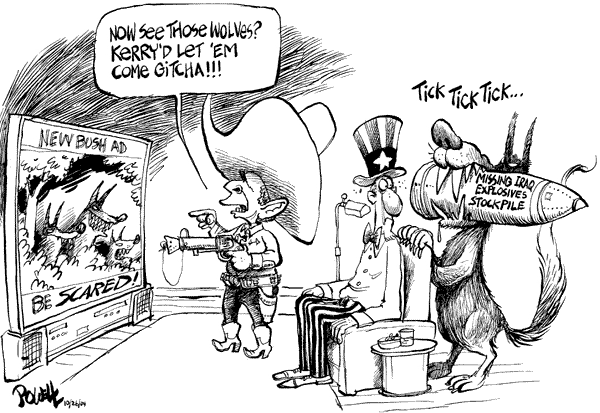
Duane Powell, Raleigh’s News & Observer
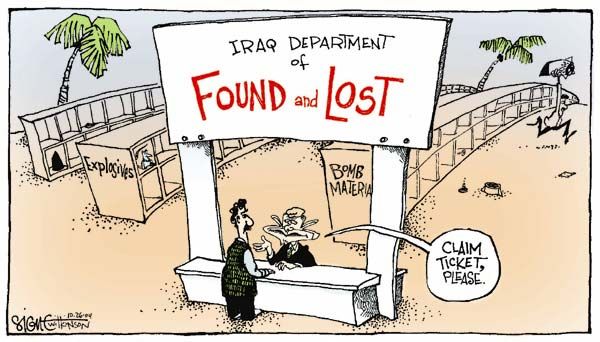
Signe Wilkinson, Philadelphia Daily News
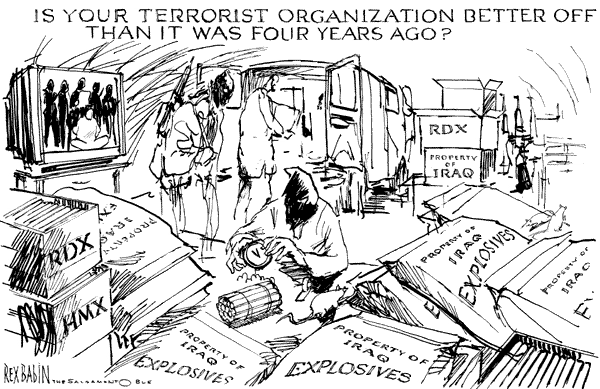
Rex Babin, The Sacramento Bee
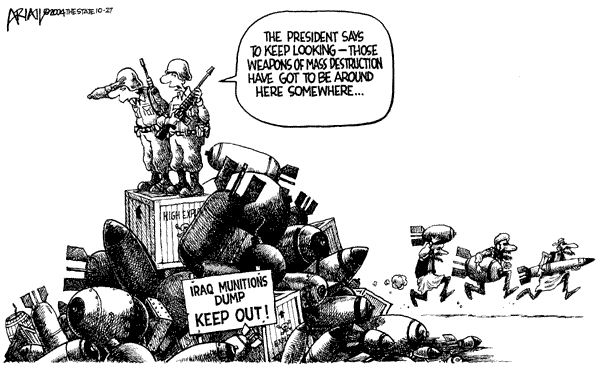
The normally thoughtful Robert Arial, of South Carolina’s The State
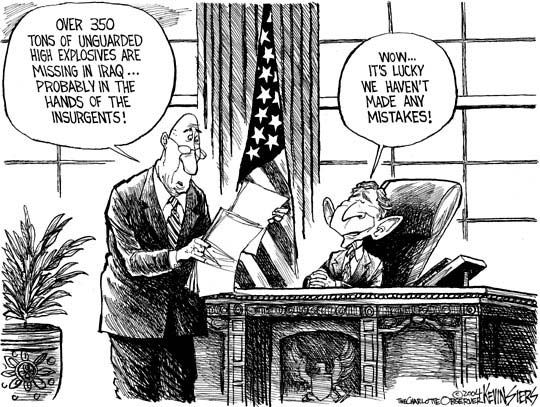
Kevin Siers of the Charlotte Observer
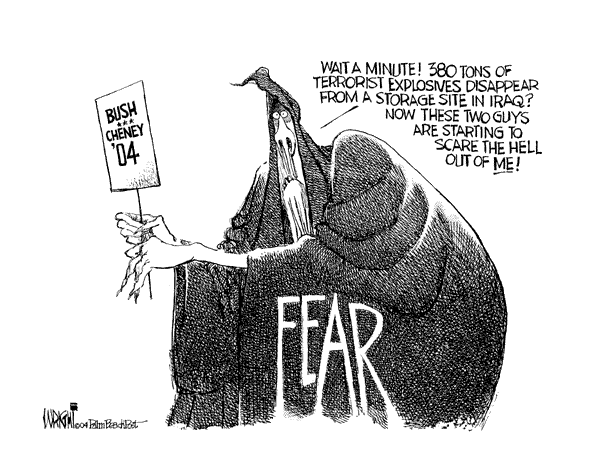
Don Wright of the Palm Beach (FL) Post
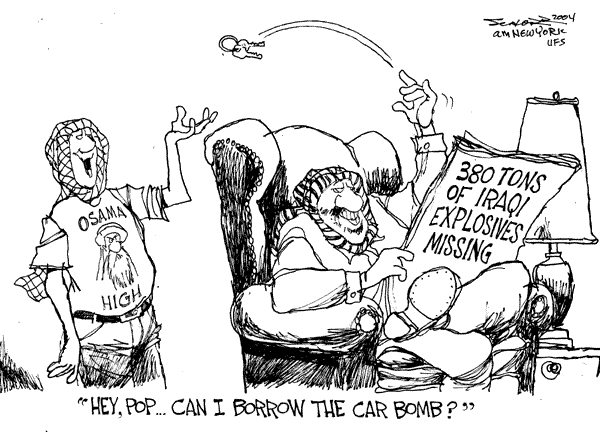
Bill Schorr, of United Media
And, finally
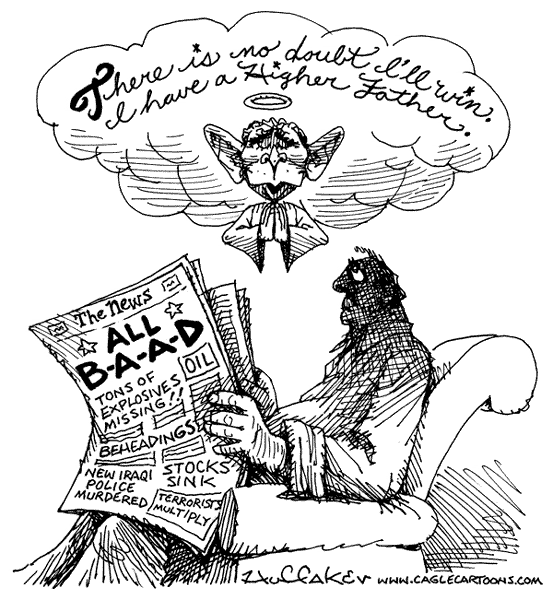
Sandy Huffaker, currently freelance.
Sandy obviously doesn’t read anything other than the mainstream media, or he’d know that “ALL BAD!” is an outright lie. He obviously doesn’t know anyone with family stationed in Iraq, o he’d know “ALL BAD!” is an outright lie.
But that’s what propaganda is.
And this is why it works.
And this is why the internet and the blogosphere is so crucial. Something, finally, must counterbalance the media’s ability to spin, twist, fold, distort, mutilate and spindle the news.
Light Blogging Alert
Just a warning. I won’t be posting much for a bit. Probably not until after the election. I’m swamped at work and too tired to crank out those 2,500 word fisks, much less spend the face-time necessary to look up idiocy to whup up on.
However, on Sunday I found a series of articles in the Albany Times-Union on gun control in New York (by the ironically named journalist Jordan Carleo-Evangelist) that I thought y’all might find interesting. I had planned on commenting extensively on these pieces, but I think I’ll just let them be. Read ’em and discuss amongst yourselves:
Guns and crime: the great debate
Excerpt:
For decades, some states have tried to fight gun violence by a variety of laws restricting gun buying and ownership. Yet homicides involving firearms remain the nation’s second leading cause of violent death, trailing only suicides involving guns.
That experience has led to a growing body of research that suggests the relationship between gun-control laws and gun crime is at best unclear. The most promising solutions to gun violence, say some researchers, may have little to do with passing new gun laws.
Cop’s slaying spotlights challenges of gun control
Excerpt:
The handgun used to fatally wound Albany Police Lt. John Finn last December presents a lesson in the complexity — and perhaps the futility — of New York’s gun control laws.
Keshon Everett, who has since pleaded guilty to murder, was on federal probation for a felony drug conviction when he shot Finn three times on Dec. 23. He used a gun purchased in Ohio more than a decade ago.
Gun permit rules open to interpretation
Excerpt:
The U.S. Air Force trained Maj. Dave Panzera how to fire machine guns, and has certified him to carry a gun at work since 1985. Oklahoma, Florida and Arkansas all let him carry a pistol anywhere he went, issuing a concealed weapon permit in no time at all.
But New York was different. Despite his military service and training, the 38-year-old father of five had to prove to this state that he’s an upstanding citizen before he could have a gun.
Programs, activism target gun crimes
Excerpt:
“The Weed and Seed model has not failed,” insisted Richard Ortiz, the Buffalo Police Department’s chief for administration. “We have to be creative because we can no longer do things on overtime.”
One lesson learned from the program, Mestre said, is that gun violence can be reduced without passing new gun laws.
“The folks who have these guns are not paying attention to any laws. What they’re paying attention to is enforcement — whether they’re being prosecuted,” he said.
Politics, paranoia fuel war of words over guns
Excerpt:
School shootings are rare. Disarming drug dealers would save more lives than banning certain types of guns or making it harder for otherwise law-abiding people to own one, they said.
The panel identified promising strategies to reduce gun violence that appeared to be working in Buffalo, New York City and other places. The programs encourage citizens to get involved in community improvement while police step up efforts to seize illegal weapons from known criminals.
Following that strategy, Lizotte said, New York City cut homicides from 2,245 in 1990 to 598 in 2003.
“No new laws were passed,” he said. “New York is the shining example that something can happen while enforcing existing laws.”
Sonofabitch!
Via fellow Tucson blogger Cowboy Blob comes this first-hand story of combat medicine in Iraq. READ IT.
Excerpt:
We get to the dust-off point. We get him out of the vehicle, I and a staff sergeant from CA sit with him, and I am assessing him in my head, trying to figure out what is wrong with him. He can’t lay down because too much blood is going down his throat. Probably too much blood getting into his airways, keep him upright. Urgent Surgical, Lacerations to the face, possible loss of eyesight, lacerations left and right shoulder, shrapnel entrance wounds, scrape left leg. I am cutting away his uniform with a knife he gave me. Exposing his wounds, seeing how bad it might be. Other than on his face, none are terribly serious. His face scares the shit out of me. Out of my mouth are constant comfort and jokes and bullshit and anything I can think of. I am even telling him not to worry and telling him what I see. He is drowning I am describing the water.
Helluva piece.
While the Mercury Appears to be Falling, a Snowball Still Won’t Survive Hell
But perhaps, just perhaps, the Brits are beginning to grasp what their laws have brought them to. Via Keepandbeararms.com I found this London Sunday Telegraph op-ed advocating “the law to be changed to give householders the right to use whatever force is necessary against intruders.”
Here’s the piece:
‘People must be given the right to defend themselves in their own homes’
(Filed: 24/10/2004)The Sunday Telegraph today launches a campaign for the law to be changed to give householders the right to use whatever force is necessary against intruders.
Our initiative follows last week’s fatal stabbing of Robert Symons, a schoolteacher, who disturbed a burglar at his family home in Chiswick, west London.
It is backed by Mr Symons’ mother, Amyra, who said yesterday: “I agree with your campaign totally. The law must be changed.” Victims of crime, MPs and victims’ charities are also supporting the campaign.
The law permits the use of “reasonable force” as a method of self-defence against intruders. What “reasonable force” constitutes, however, is difficult to define, leaving vulnerable people unsure of what force they can use to protect themselves and their homes. The Home Office, admitted to this newspaper last week: “There is no definition of what is ‘reasonable force’.”
This produces that “chilling effect” that Tim Lambert finally grudgingly admitted to after months of back-and-forth discussions over the legal risks of self-defense in England. If you don’t know what the definition of “reasonable force” is, but you know that if you use any significant force, you’re going to court to prove it was “reasonable” – to a group that gets to use perfect hindsight in reviewing your actions and that can decide your fate based on that vague law. In fact, according to one English barrister I quoted previously:
“The law,” explains Harry Potter, the barrister who, with Charles Bott, would defend Osborn, “does not require the intention to kill for a prosecution for murder to succeed. All that is required is an intention to cause serious bodily harm. That intention can be fleeting and momentary. But if it is there in any form at all for just a second – that is, if the blow you struck was deliberate rather than accidental – you can be guilty of murder and spend the rest of your life in prison.”Moreover,” Mr Potter continues, “while self-defence is a complete defence to a charge of murder, the Court of Appeal has ruled that if the force you use is not judged to have been reasonable – if a jury, that is, decides it was disproportionate – then you are guilty of murder. A conviction for murder automatically triggers the mandatory life sentence. There are no exceptions.”
Now, if an intruder is in my home, I would intend to use a level of violence necessary to render him no longer a threat. I would do so deliberately – and by Mr. Potter’s definition, that would mean that I would attempt murder, and would therefore face the wrath of the State for doing so.
Yet Tim insists that “self defence is legal.”
I guess it depends on the whim of the Crown and the depths of your pockets.
Continuing:
The Sunday Telegraph believes that the law must be changed so that once intruders enter someone’s home with the intent of stealing, or raping or assaulting them, they lose their rights to protection from the law.
Here are some of the harrowing stories of people attacked and robbed in their homes, and who support the move to change the law.
Sam and Eleanor Orr, of County Antrim
Mr and Mrs Orr were at home in November 2003, with Eleanor’s 86-year-old mother Elizabeth at their farm in Co Antrim when three masked men burst into their house. The men pistol-whipped Sam and pushed Eleanor and her mother to the floor.
The thugs were particularly rough with Elizabeth as they tried violently to wrestle the gold rings from her arthritic and swollen fingers. She has since died.
Sam, 60, recalled last week: “They stood over us and kept hitting me on the head, there was blood washing down my face so I couldn’t see out of one eye.
“It feels like there is no law at all to protect us. If the boys were caught, which they weren’t, they would have been given a few months and then been let back out again. You should be able to shoot them if they come into your home.
“Eleanor’s mother never recovered from the stress of the attack and we are convinced that is what killed her.
“The law just isn’t strong enough. The robbers aren’t frightened of the law, they act as if they can do whatever they want to do. You should not be prosecuted for injuring an intruder.”
Actually, the problem is that the law is too strong – it prevents people from defending themselves, protecting the thugs in the process. They act as if they can do whatever they want to do because they can, by and large, and they know you will be prosecuted if you defend yourself.
John Bolt OBE, a retired Royal Marine, of Northumberland
Mr Bolt, 81, who served in the Second World War, was stabbed twice by an intruder at his Northumberland home in February 2001. Mr Bolt was upstairs with his wife when they heard a noise.
He went to investigate and was confronted by a burglar armed with a knife. The two struggled and the thief stabbed Mr Bolt twice before fleeing through a window.
“The chap had a knife and so I was entitled to have a go at him. I think, in law, if he’s got a knife, I think I’m entitled to kill him, but I don’t know what the law is in detail.
Because no one does. It apparently varies by jurisdiction and judge.
“It is a funny thing to try and manage with the law because your reaction in those situations is immediate – you don’t stop and think: ‘Gosh, what does it say in the book about this?’
Yet, as the law is written, you aren’t supposed to have to. What you believe at that moment – right or wrong – is supposed to be the deciding factor. But it’s not. Instead, others deciding with calm reflection, months after the incident and with all the pertinent facts at hand are supposed to decide if what you did was “reasonable.”
When, at the time, you aren’t able to reason much, just act. Or not.
“I’m an ex-Royal Marine so my reaction was quite active and wholly motivated by self preservation. I would certainly have tried to finish him off if I had something in my hand at the time, but that is a reaction, an instinct. Whether it is legal or not I don’t know.”
Quite probably not, but again it seems to vary by jurisdiction and judge.
Comforting, no?
Major Roderick Petley and his wife Victoria, 62, of East Sussex
The Petleys, who live near Heathfield, East Sussex, were woken by burglars who broke into their home in the middle of the night earlier this year.
Major Petley, 71, an officer in the Rifle Brigade (now the Royal Green Jackets) from 1952 to 1964, said: “When we were burgled, I went downstairs with a loaded rifle, but they had fled.
“What happened to us has toughened me up a bit. What happened to that man in Chiswick is absolutely awful.”
The burglars smashed a plate glass window with a battering ram, smashing coffee cups and saucers worth £1,000. They escaped with Major Petley’s £3,500 bracket clock in the back of their van.
The Petleys have been forced to spend more than £32,000 on home security improvements, while their annual home insurance premium has risen to £8,000.
Mrs Petley, 62, said: “It’s a nightmare. The police know who did it, but can’t catch them.
“No longer is an Englishman’s home his castle. We are denied the right to defend ourselves and our family, and the law must be changed.”
I wish you luck, but I doubt seriously that you’ll live to see it.
Anonymous couple, of East Sussex
The elderly couple, who live near Heathfield have been burgled twice this year, in June and August. They are now trying to sell their house and move to a “more secure” area.
The man, an 83-year-old former insurance broker, and his wife, 69, were in their house during both burglaries, although they escaped harm by staying in their bedroom. They used to enjoy having their 10 grandchildren to stay, but are now too frightened to have them there.
“The present law stands justice on its head,” the man said. “If you can’t defend your home, what can you do? Both times I have woken and heard burglars in the house, I have felt angry and afraid but have had to leave them to it.
And why? Because he believes (and with reason) that defending his property would land him in jail.
There’s that “chilling effect” again.
“One does worry about what one would do if they came into the bedroom. I don’t know what I could do. I wouldn’t have much hope.
And why? Because this couple is disarmed, while the burglars aren’t. An elderly couple isn’t much of a match for young men, much less young men carrying, say, a crowbar or a knife. This is the condition in which a firearm and only a firearm will make the victim at least equal to the assailant(s).
But you just can’t convince some people of that.
“I would like burglars to expect the worst. It would make a difference. Something to drop on his head or give him a electric shock should be sufficient. These aren’t things you can do, as the law is now.
And this is the mental attitude that will prevent, I think, the Brits from ever retaking their right to self defense. “The worst” isn’t a knock on the head or an electric shock. It’s a sucking chest wound or worse.
“The definition of ‘reasonable force’ should be broader. The burglar should expect anything. A change in the law would, undoubtedly, have an effect on our decision to go or stay.”
Then I suggest you start packing.
Crispin Reed, a website developer, of East London
Mr Reed, 27, was confronted by two burglars at his warehouse flat in Hackney in February last year.
A kitchen knife was held to his throat and his stomach was slashed before the intruders fled with a bicycle, mobile telephone and camera equipment.
Note that all the anti-weapon laws on the books in England didn’t prevent Mr. Reed from being knifed in his own home. They didn’t disarm his attackers. They disarmed the victim.
And that’s all they ever do.
“There was a knocking early one morning. I was half-asleep and I thought it was the postman. When I opened it, two men in their early twenties were standing there. They mumbled something about wanting to buy crack and barged in.
“There were four of us in the flat and I shouted for everyone to get up – I thought that together we could fight them off. But the man holding the knife to my throat told me to be quiet or he would cut me.
“The other one swiped his knife against my stomach. Fortunately I had moved back and the cut wasn’t deep, but it was a 5in long cut and it bled a lot.
“At the time this happened my sister Hanna was staying with me and she was terrified – she hasn’t been back here to stay since.
“What made me really angry was that one of them said, in a mocking voice, ‘You are allowed to defend yourself, you know’. But I was panicked and confused.
The thugs obviously know the law… to the letter. And they like it just the way it is.
“I didn’t know what to do or what I should do. To be honest, I’m still not sure where the law stands. Now I keep a rounders bat and a crowbar by the front door. If something like this happens again I will use them, regardless of the consequences. Because of this, I support your campaign.”
Once more, no one knows where the law stands. Including the State. And they like it the way it is. It’s unfortunate that people have to learn who’s responsible for their protection the hard way, and then have to make the decision to damn the consequence of doing what is right rather than what’s legal.
William Rutter, a council worker from Newcastle upon Tyne
On Christmas Day in 2002, Mr Rutter, 54, was subjected to a horrific attack in his home.
He was watching television when masked burglars broke in. They pinned him against a wall, punched him repeatedly, slashed at his chest and hands with Stanley knives and said that if he did not hand over his life savings, they would kill him.
More evidence of how effective those anti-knife laws are. But hey, since their victims aren’t going to have a firearm to defend themselves with, a knife is more than enough weapon, isn’t it?
Mr Rutter was stabbed in the heart and left for dead while the men rifled through his wallet, which contained £40, before heading upstairs to search through his possessions.
Luckily for Mr Rutter the intruders were disturbed by policemen, who had heard sounds coming from the house from their unmarked patrol car. The men were caught as they tried to escape over Mr Rutter’s garden fence.
When Mr Rutter was discharged from hospital, with a foot-long scar on his back and a smaller scar on his chest, it was months before he felt able to return to his home.
Yesterday, he greeted the news of the campaign enthusiastically. “This is good,” he said. “What goes on now is a disgrace.
“My brother and sister and my friends all look out for me. I have a panic button, too.
“Nobody is going to do to me what those people did, ever again.”
Best of luck to you, Mr. Rutter. Sincerely. You probably used most of yours in that first incident, since the cops were on the scene in time to intervene. Next time press the panic button and order a pizza and see who gets there first.
Don’t get me wrong, I am heartened that some of the Brits are starting to understand. Given the level of violent and property crimes there, I’m actually surprised that more of them aren’t pissed off enough to back this, but it does appear that decades of indoctrination has removed that “aggressive edge” from the overwhelming majority of the population, leaving it only in the criminal class.
Remember the distinction: Violent and predatory vs. violent but protective. Britain forgot it. We can’t afford to.
(All emphasis in article is mine.)
My One Entry for Today
And it’s a link to something someone else wrote.
I’ve spent some time today catching up on stuff – oil change for my truck, trip to the bookstore, getting reacquainted with my wife, 😉 – and doing some reading. I mostly write about stuff I read online, and I’ve found something that will result in another long post, but for right now, if you haven’t read it, Michael J. Totten has a piece up from last week that I just stumbled across about what a real totalitarian state is like, and why the Leftist poseurs here are talking out of their asses when they accuse the current administration of totalitarianism and fascism.
Go read Overheard at the Coffee Shop, if you haven’t already.
Note: totalitarianism isn’t impossible here. The mechanisms are always right there just waiting to be assembled and put to use, but we’re a long way from that point. At the moment. Personally, I think civilian disarmament is a prerequisite for totalitarianism here, but I could be wrong about that. It’s possible that the majority of residents here might reach the point where they’d accept the chains of totalitarianism if they were convinced it would bring them safety.
I hope not, but the holy church of statism has been preaching here for decades. It’s hard to tell just how effective it’s been.