Sorry ‘Bout the Light Posting

Life interferes. I’ve been working a lot, today was my IHMSA match day, birthday party for my niece, and my belated Father’s Day gift came in – the entire 14 episode DVD collection of the Fox Sci-Fi series Firefly.

Damn, this show is GOOD! I hadn’t heard about it before it had already been cancelled, but apparently the DVD’s have been selling well enough by word of mouth to inspire Fox to make a 2-hour movie. Maybe they’ll bring it back. Great Western Space Opera. Good writing, good acting, good special effects, neat guns. What more could you want?

Anyway, I’ll try to post something pithy tomorrow. Maybe Part III in the Brady CCW FAQ fisking.

I Also Do Requests, Part II

More fisking of the Brady Center “CCW FAQ” page, per reader Sarah’s request.

Next up:

Q: What are the state laws that allow people to carry guns?
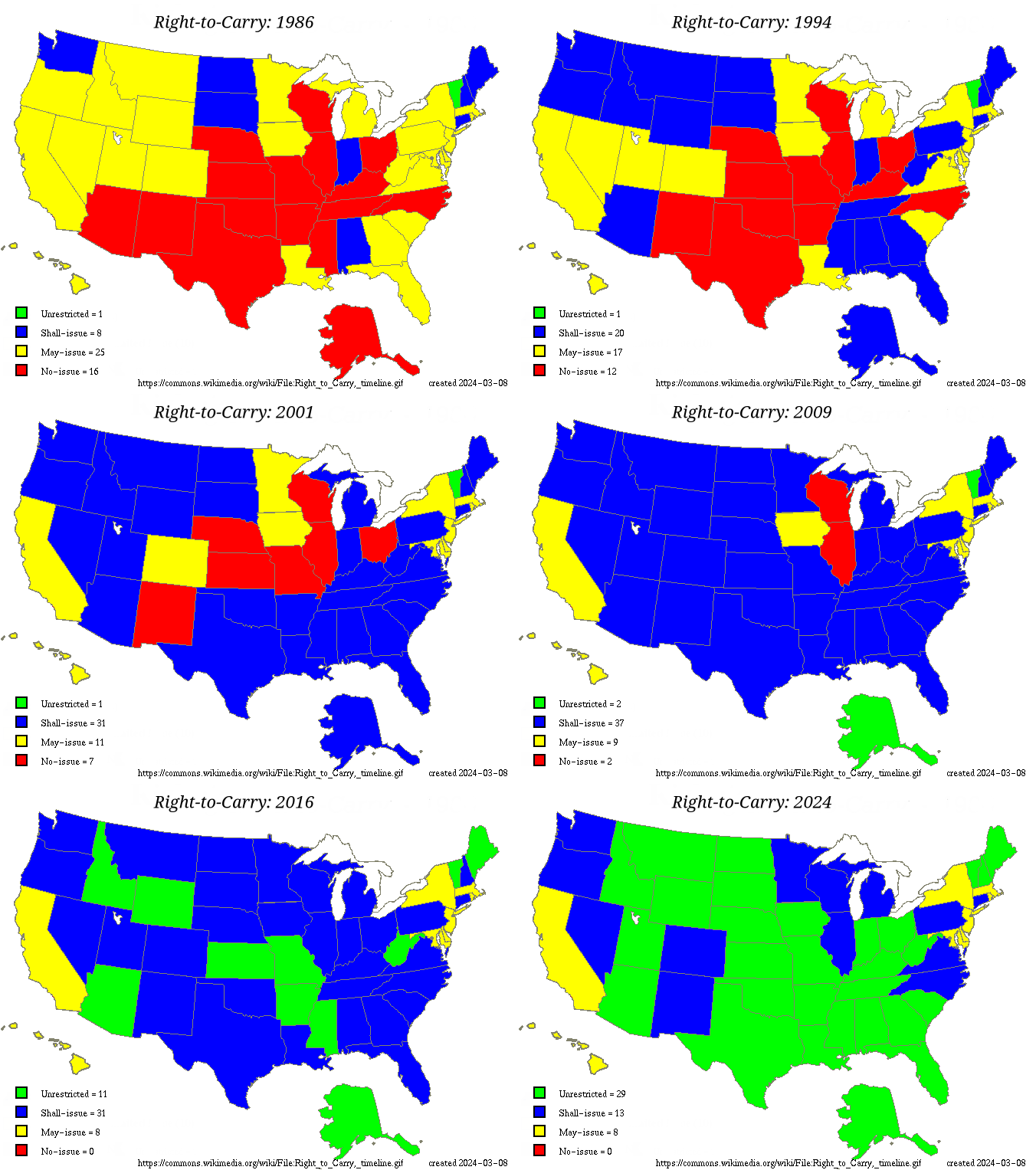
A: The carrying of concealed weapons is prohibited in the following 7 4 states:

Illinois, Kansas, Missouri, Nebraska, New Mexico, Ohio, Wisconsin

The carrying of concealed weapons is permitted in the following 14 9 states, but only with a CCW license issued by police. These states allow local law enforcement authorities to approve or deny an application for a CCW license based on an applicant’s full record. Called “may-issue” licensing, an applicant must demonstrate a specific need (e.g. a security guard or merchant who transports money to a bank) AND these licenses are generally restricted to certain times and places. Because of the stringent “need” requirement, few CCW licenses are issued in most of these states:

Alabama, California, Delaware, Georgia, Hawaii, Iowa, Maryland, Massachusetts, Michigan, Minnesota, New Jersey, New York, Rhode Island, South Carolina

In the following 29 36 states, practically all non-felons can obtain a CCW license and carry a concealed weapon. These states require law enforcement officials to issue a CCW license to an individual unless s/he is in a prohibited category (generally, a convicted felon). Called “shall-issue” licensing, applicants are not required to demonstrate “need” to be granted a license, and in most of these states, applicants can obtain a license by only claiming a lawful purpose such as basic “self-defense”:

Alaska*, Arizona, Arkansas, Colorado*, Connecticut, Florida, Idaho, Indiana, Kentucky, Louisiana, Maine, Mississippi, Montana, Nevada, New Hampshire, North Carolina, North Dakota, Oklahoma, Oregon, Pennsylvania, South Carolina, South Dakota, Tennessee, Texas, Utah, Virginia, Washington, West Virginia, Wyoming, New Mexico, Alabama, Georgia, Michigan, Minnesota, Missouri, Ohio

*Note: Although Colorado does not require a showing of “need”, law enforcement officials have considerable discretion in granting CCW permits. In practice, it is extremely difficult to obtain a CCW license in Colorado.

Then Colorado isn’t really a “shall-issue” state, is it? I’m actually uncertain as to the status of Colorado’s CCW laws. Perhaps someone out there can clear up the confusion.

In one state, Vermont, no license is required to carry a concealed weapon.

*Not quite. Alaska became, as of 2004, the SECOND state with “Vermont Carry” though for reasons of reciprocity with other states you can jump through the hoops and get an Alaska CCW. Overall, I don’t have a problem with this as it is factual, though badly out of date, and lacks the visual impact of the animated graphic from the previous post.
Next up, the meat of the issue:

Q: What happened in Florida after they weakened their CCW law?
A:
Florida was the first state to pass a CCW law. Weakening CCW laws has not made Florida a safer place; in fact, the opposite is true. Florida’s CCW law became effective on October 1, 1987. Between 1987 and 1992, the violent crime rate in that state increased 17.8%. In every year since 1987, Florida has had the highest rate of violent crime in the nation according to the FBI’s Uniform Crime Report. The violent crime rate is composed of four offenses: murder and non-negligent manslaughter, forcible rape, robbery, and aggravated assault; all of which involve force or threat of force according to the FBI.

Florida’s handgun homicide rate has decreased somewhat in the past few years – part of this may well have been a result of the strong gun laws enacted during that time. As the following chart indicates, the handgun homicide rate in Florida increased considerably after passage of the CCW law in 1987. Decreases in handgun homicide occurred only after tough new gun laws were passed:

Year Number of Murders Legislative Action
1987 569 CCW becomes effective October 1, 1987.
1988 N/A No data available.
1989 700 After a rash of unintentional deaths of children by firearms, the Florida legislature passes the first Child Access Prevention Law (CAP) in the nation.
1990 588 A background check on handgun purchasers passes in the Florida Legislature, effective October 1, 1990. A state-wide election on a Constituional Amendment (Article 1, Section 8) for a three-day waiting period on handgun purchasers passes by a margin of 85% to 15% effective November 6, 1990.
1991 565 In accordance with the Constitutional Amendment, the Florida Legislature makes it a felony to violate the three-day waiting period.
1992 554
1993 525*

The bottom line is that Florida, now the most violent state in the nation, has not seen the results promised by their CCW law. There has been an increase in violent crime with no corresponding increase in personal security.

These trends continue in Florida. According to 1994 FBI Uniform Crime Report data, Florida cities still rank high in terms of violent crime. In 1994, Tampa and Miami were the 4th and 5th most violent cities in America. Fort Lauderdale, Tampa and Miami ranked 1, 2 and 3 respectively in the category of highest rates of property crime (which includes burglary, larceny-theft and motor vehicle theft).

Let’s look at ALL homicides, not just HANDGUN homicides, shall we? (All data from the CDC WISQARS tool)

Year Number of Homicides Florida Homicide rate National Homicide Rate
1987 1,480 12.34 8.59
1988 1,709 13.89 8.91
1989 1,593 12.61 9.15
1990 1,583 12.16 9.87
1991 1,460 10.92 10.38
1992 1,369 10.03 9.80
1993 1,374 9.87 9.87
1994 1,308 9.19 9.33
1995 1,230 8.46 8.47
1996 1,176 7.92 7.66
1997 1,115 7.34 7.15
1998 1,061 6.85 6.49
1999 964 6.12 6.05
2000 937 5.86 5.96
2001 969 5.92 7.12

Now, starting in 1989 the total number of homicides did nothing but trend DOWN, did it not? And meanwhile, what was the rest of the nation doing? National homicide rates continued to trend up for two more years. The Brady Center called Florida the “most violent state in the nation” but in 1993 Florida’s homicide rates matched the national average, down from 43% higher than the national average just five years before. And Florida’s homicide rate – continuously trending downward – hovered in close proximity to the national average from that point forward.

Yet weren’t the gun control groups calling Florida the “Gunshine State” and “Dodge City East” when the bill was being considered in the legislature? The Brady Center has to cherry-pick homicides committed with handguns to obscure the fact that initially, homicide trends in Florida were better than the national average, and later were at least equal to the national average. And the only thing that changed in 1989 was a “Child Access Prevention Law” that made it a misdemeanor to leave a gun where a child could access it. Yet we’re supposed to accept that THAT law was the “tough” one that caused the decrease in homicide rates after 1989?

If you believe that, I’ve got the title to this bridge in Brooklyn…

And what of that “most violent state” business? Well, check this page out for National rates of various types of (recorded) crime from the FBI’s Uniform Crime Reports, and this page for Florida’s rates. Here’s a graph of Florida’s violent crime rates since 1994:

Photobucket pooped!

And one showing the percentage change from year to year:

Photobucket pooped!

I thought “liberalized concealed carry” was supposed to make violent crime go UP? Isn’t that what the gun control groups told anybody who’d listen? Isn’t that still what you see in the op-eds when another state looks at joining the 36 other states that have it? Florida’s ALWAYS been at the top for violent crime! Why do you think the people finally went for a “shall-issue” concealed carry law? They were tired of the high violent crime rates. They may still be #1, but the actual rate is far, far lower today than it was in 1987.

The gun control groups tell us that “liberalized concealed carry” legislation will result in “more guns on the street” and that more guns on the street will lead to “Dodge City” shootouts and higher crime. But it never happens. Gun rights proponents tell us that “shall issue” concealed carry laws will make the community safer. That hasn’t been (in my opinion) statistically proven, but the assertions of the gun control groups have been proven wrong over and over and over again. The worst thing they can honestly say is that liberalized concealed carry might not reduce violent crime.

I can live with that.

One more thing: It would be a relatively simple matter for the Brady Center to update this “FAQ” page. The data is out there. But it apparently suits their purposes better to use older data, since the later data doesn’t make their position look as good, does it?

(More to come…)

More Excellent News from the Youth Front

A week ago I got an email from a young reader. Here’s what he sent me:

Dear Sir,

I’m in 8th grade and visit your blog almost every day. I enjoy shooting my uncle’s handgun (a Smith and Wesson .44 special). I also like politics and am interested in what you have to say about current events. You’re definitely one of my favorite bloggers. (Sucking up never hurts.)

My 7th period Civics teacher assigned our class a writing assignment yesterday and, because I respect your opinion, I was hoping you could reply briefly.

She passed out columinst Ted Ralls article about Ronald Reagans death to the class yesterday and assigned us a 2 page paper that addresses a list of issues that the column mentions. She listed 10 questions but we only have to answer 3. These are the 3 that I decided to answer:

1. “According to the author, the Reagan administration slashed AIDS research budgets in order to fund tax cuts for the upper 2% of American taxpayers. As a result, AIDS research was set-back at least 8 years, resulting in the deaths of millions of innocent people and costing billions of dollars in health care costs. Knowing what we know today, what would you have said to Ronald Reagan about AIDS the day he was elected President?”

2. “The author notes that the Reagan administration illegally authorized the sale of 107 tons (!) of anti-aircraft missles to the nation of Iran in order to support an extremist right-wing insurgency in Nicaragua. Iran was – and remains – a staunch enemy of the United States. The author argues that because Mr. Reagan violated an act of Congress and provided material support to the enemy he should have been tried for treason and faced the death penalty. Do you agree that people – even presidents – who sell weapons to enemies of the United States should be prosecuted?”

3. “After retreating from Lebanon (a country in the Middle East) in 1983, Mr. Reagan ordered the invasion of Grenada, a tiny island in the Caribbean. The author says that this was a way for him to “look tough” by bullying a country that couldn’t fight back. Do you agree with Reagan’s decision to invade a peaceful country most Americans had never heard of in order to “look tough?” Reference George Bush’s similar efforts to “look tough” after the tragic events of 9/11.”

I wasn’t born when Reagan was president, so I’m not very familiar with the background behind the questions. Ms. Hawthorne told me she supports gun rights, she is definitely a very smart teacher, and I respect her opinion. However I think the assigment is biased by the tone of the questions.

This is due Friday and I’m trying to find articles that argue with Mr. Ralls conclusions. I’ve googled “Reagan + AIDS”, “Reagan + Iran” and “Reagan + Grenada” among many others. Alot of what I found agrees with the author, more or less. If you have time before Friday, do you know of a link that deals with one or more of these topics and offers a counter-argument? I know you’re busy, so PLEASE don’t take any time to help unless you know of a link immediately. It’s not a big deal, I’ll definitely get the paper done regardless. Thanks in advance for any help.

Well, after sucking up, and then invoking the RCOB™ by mentioning that subhuman pustule Ted Rall, of course I had to help out. So I gave him a pointer to a site showing government spending on AIDS from 1981 through 1999, and a PBS (!) site for an overview of the invasion of Grenada. On question #2 I was not as sanguine. I told Mr. Pomeroy:

In regards to question #2, Ronald Reagan was, in my humble opinion, in the wrong.

Strategically I understand what he was doing, but he was doing it outside the law. The weapons were sent to Iran to be used in the then-raging Iran-Iraq war, not “to free hostages in Lebanon” – or at least not ONLY for that reason. Better, I assume, that they fight each other than sit and plot against us. Plus, the money from those sales went to fund support for the anti-communist Contras in Nicaragua – people who were none too savory themselves. Had this gotten out, the scandal probably would have resulted in impeachment. As much as I hate to say it, he should have been prosecuted for it. As one of my favorite people to quote – Justice Louis Brandeis – said:

“Decency, security and liberty alike demand that government officials shall be subject to the rules of conduct that are commands to the citizen. In a government of laws, existence of government will be imperiled if it fails to observe the law scrupulously. Our government is the potent, omnipresent teacher. For good or ill, it teaches the whole people by example. Crime is contagious. If the government becomes a law-breaker, it breeds contempt for the law. It invites every man to become a law unto himself. It invites anarchy.”

However, Reagan was successful in his effort to defeat communism both in South America and in the Soviet Union. To me, that mitigates the crime. But it does not negate it. If we allow leaders to violate the law, it does damage to the entire system. What good is it to defeat an external enemy if the system we are striving to save collapses from internal rot?

Well, he did more research and wrote his paper, which I will reproduce here in its entirety:

Analysis of “Reagan’s Shameful Legacy” by Ted Rall

1. “According to the author, the Reagan administration slashed AIDS research budgets in order to fund tax cuts for the upper 2% of American taxpayers. As a result, AIDS research was set-back at least 8 years, resulting in the deaths of millions of innocent people and costing billions of dollars in health care costs. Knowing what we know today, what would you have said to Ronald Reagan about AIDS the day he was elected President?”

The author writes that the Reagan administration “refused to do anything about the AIDS epidemic, all so they could fund extravagant tax cuts for a tiny sliver of the ultra rich.” However, he does not use any evidence to support his claim.

According to the “CRS Report for Congress, AIDS Funding for Federal Programs 1981-1999”, funding for AIDS increased every year Reagan was President. When he took office in 1981, funding for AIDS was only $200,000. When he left office in 1988, annual funding for AIDS was over 1.3 billion dollars. According to my calculations, that is approximately a 4000% increase in spending. In contrast, during Clinton’s presidency, there was only about a 100% increase in AIDS spending.

Although the author does not mention the “deaths of millions of innocent people”, the question does so I will address that. While some people definitely caught AIDS from blood banks, I would assume (though I don’t have any sources to back this up) that most caught it from unprotected sex and sharing needles. When you knowingly engage in high risk behavior, this does not make you “innocent”. They did not deserve to die but, if they had practiced some basic personal responsibility they probably would be alive today.

I would have told Reagan in 1981, based on what I know today, that he probably did everything he could by funding research. The only thing he should have done differently in my opinion, is also fund needle-sharing programs and condom programs which would have cut down on health care costs since less people would have caught AIDS.


2. “The author notes that the Reagan administration illegally authorized the sale of 107 tons (!) of anti-aircraft missles to the nation of Iran in order to support an extremist right-wing insurgency in Nicaragua. Iran was – and remains – a staunch enemy of the United States. The author argues that because Mr. Reagan violated an act of Congress and provided material support to the enemy he should have been tried for treason and faced the death penalty. Do you agree that people – even presidents – who sell weapons to enemies of the United States should be prosecuted?”

Based on my research, this is a complicated issue that the author simplifies in order to make a point. There were strategic and political goals besides supporting the Contras in Nicaragua that led to sale of weapons to Iran. At the time, Iran and Iraq were at war and supporting that conflict (rather than have them scheme to harm the United States) may have been in the best interest of the U.S. Reagan also compared the Contras to the Founding Fathers during the Revolutionary War. This may have been an exaggeration or even completely incorrect but, it seems obvious that Reagan thought he was doing the right thing and decided to make painful compromises to achieve his goal. I also think it was a different time too. When Reagan was President, Communism was the biggest threat, like terrorism is today.

However, it is clear he did break the law by going around Congress and doing something he said he wouldn’t do (sell weapons to terrorists). He probably should have been prosecuted. However I think the death penalty is extreme in this case. If Reagan was just trying to put money in his bank account or sold weapons to be used against the United States, then maybe. But the evidence points to the fact that although his methods were wrong, his intention was good. In court, this probably would have been a “mitigating factor” that resulted in a much lighter sentence.


3. “After retreating from Lebanon (a country in the Middle East) in 1983, Mr. Reagan ordered the invasion of Grenada, a tiny island in the Caribbean. The author says that this was a way for him to “look tough” by bullying a country that couldn’t fight back. Do you agree with Reagan’s decision to invade a peaceful country most Americans had never heard of in order to “look tough?” Reference George Bush’s similar efforts to “look tough” after the tragic events of 9/11.”

I do not agree that Reagan, or any other leader, should invade a peaceful country in order to “look tough”. Putting people’s lives at risk just to “look tough” is immoral and should be illegal. However, again the facts do not back up the authors claim. There were many other factors involved.

According to an article on the PBS website, the Grenada invasion had been planned long before the terrorist attack in Lebanon. The reasons included Cuban soldiers stationed in Grenada, a Communist coup, martial law on the island, and the construction of an airstrip that could have been used as a “Communist beachhead”. There were also the 800 medical students whose lives may or may not have been in danger. After the fact, some said they were in danger, others said they were not. After the invasion, U.S. soldiers found enough arms for 10,000 men. Although there is not anything necessarily wrong with being armed, it sounds like they were doing more on the island than just being peaceful.

In my opinion, the author is showing bias by only telling part of the story. If the reader did not research the facts, it would be easy to believe what he says. But once you do the research, there is a lot more to it. It makes me think that Mr. Rall is not informed or he is trying to deceive. In my opinion, neither option speaks well for him.

Comparing Grenada to Iraq and Afghanistan after the 9/11 attacks on the World Trade Center and Pentagon is difficult to do because, there doesn’t seem to be much connection. Although I have mixed feelings about the Iraq war, I fully support the war in Afghanistan. Also, we were attacked and I think we need to fight back out of necessity. There are also many strategic and political factors that influenced the decision including strict Wahabist Islam, countries in the region like Syria and Iran which support terrorism, and the flaunting of U.N. resolutions by Iraq for 12 years. There is a big difference between “looking tough” and “being tough” when it is necessary. For the most part, I think Bush is trying to do what is necessary.

Chris also sent me the other seven questions he had to select from:

According to the article, at the end of the 1980’s America was “buried in the depths of a recession and a trillion bucks in debt. It took us over a decade to dig out.” It wasn’t until the less-rightist Clinton administration took office that the economy began to improve. What does this tell you about Reagan’s theory of “supply-side economics”?

The author states that the Reagan administration “turned welfare recipients into homeless people” through welfare reform initiatives. Which do you think is more harmful to society as a whole: higher taxes that help provide necessities for the poor or lower taxes and millions of homeless families with nowhere to go? Would it affect your decision to know that a few welfare recipients took advantage of the welfare system?

The author reminisces about his time in college, when Reagan slashed education budgets, forcing universities to strip their best and brightest students of their scholarships. As a result, many had to take low-wage jobs and have never reached their full potential as members of society. Were tax cuts for the rich worth denying those students a future? Was it just those students who suffered or have we all lost something?

Twenty years ago, many people believed that war with Russia (then the USSR) was a real possibility. The author argues that the Cold War isn’t over. He asks “In which direction do you think those old ICBM’s (nuclear missiles) point today?” Did Reagan give us real safety from a nuclear war or just an illusion? Based on our reading, do you think the USSR was even a real threat to the United States, or was it “manufactured”?

The federal tax code was designed to redistribute income from the most wealthy to the least fortunate. Reagan took steps to dismantle this century-old social contract and now Bush is continuing his legacy. As a result, a tiny sliver of the population now controls 80+ percent of all the wealth in our country. Discuss how this affects our prospect for democracy. What can be done?

The author notes that Reagan, like Bush, “relied on Christianist depictions of foes as “evil” and America. as “good”.” Based on the passage we discussed from “A People’s History of the United States”, do our foes have any legitimate reasons to hate and fear us (excluding the fact that they’re all just “evil”)?

The author draws parallels between Reagan and Bush, including the fact that “both appointed former generals as secretaries of state and enemies of the environment to head the Department of the Interior.” Based on what we’ve learned, what do you think the most likely motive is behind appointments like these?

Chris and I discussed, as you might imagine, the teacher’s apparent leftist bent, despite her stated support for gun rights.

Well, now that you’ve read all that, I thought you’d like to know the last and most important part:

Just thought I’d let you know I got an A minus. She wrote that it was well thought out even though she wrote almost as much as I did arguing with me! Thanks again for your help. I’m very happy with my grade and the paper.

Sincerely,
Chris

Congratulations, Chris. Glad I could help. And keep thinking for yourself. Perhaps you ought to correspond with Bryan Henderson for some ideas.

I haven’t felt this good in a long time!

Let’s Pick on the Amish

Just kidding. I came across an interesting thread in the rec.guns newsgroup on the Amish and firearms. It seems that the Amish, while pacifists, do use modern firearms for hunting. Learn something new every day. So, of course the jokesters came out to play. Here are some highly offensive jokes at the expense of another culture:

(Armed Amish homeowner confronting a burglar)
“I am Amish, and I cannot harm thee.

“But thou standest where I am about to shoot.”

—

What goes clippity-clop, clippity-clop, bang, clippity-clop, clippity-clop?
.
.
.
.
.
.
.
.
.
.
.
.
.
.
.
.
An Amish drive-by.

—

What do you call a man with his arm up a horses ass?

An Amish mechanic!

—

And then there was the Amish man who took his young son into the big city so he could see first-hand the temptations of Mammon.

They walked into a large modern building and watched as a shriveled, decrepit old lady hobbled into a small room in the lobby. The shiny metal doors slid closed and an illuminated number above them counted up to ten and then returned back to one. The shiny metal doors slid open again and a stunningly beautiful woman stepped out of the small room.

The Amish man thought about this phenomenon for a few seconds and turned to his boy. “Son, go fetch your ma.”

I’m gonna smoke a turd in hell for this, aren’t I?

There is Still Hope

As you know, I’ve blogrolled ProtestWarrior.com near the top, as this group takes the fight directly to the Left. No passive response here, they get right in their faces and force them to confront into congnitive dissonance by making them face their hypocrisy.

Well, there are still some young people able to think for themselves. I’ll have another example up later, but this one makes me want to stand up and cheer.

Go read Operation Tiger Claw. It’s worth every second of your time.

Not as Smooth as it Looked

NewScientist.com has an interesting story up on the SpaceShipOne flight of yesterday.

‘Anomalies’ in first private spaceflight revealed

12:27 22 June 04

NewScientist.com news service

The flight of the first private astronaut was not as perfect as it first appeared – a number of glitches occurred during the flight, some potentially catastrophic.

The revelations were made by Burt Rutan, designer of SpaceShipOne, which on Monday became the world’s first privately funded craft to enter space. Until the team fully understands exactly what went wrong during the flight, he said, they will not go ahead with the pair of flights needed to claim the $10 million Ansari X-Prize.

Luckily, the glitches did not prevent a successful flight. But pilot Mike Melvill said that a partial failure of the system controlling the spacecraft’s orientation could have been disastrous if it had occurred just slightly earlier in the flight,.

The problem struck at the end of the rocket engine’s firing time of about 70 seconds, just as Melvill reached space. “As I came out of the atmosphere I no longer had any attitude control,” Melvill told New Scientist and other reporters. “If that had happened earlier, I would never have made it and you all would be looking sad right now.”

Read the whole thing.

See why I recommended that you re-read Bill Whittle’s essay Courage?

Pass the Word

John Moore, author of Useful Fools is a fellow Arizonan and a Vietnam vet.

And John is not happy with the Democrat frontrunner for President.

No, I’d say John is pretty damned irate at the white-washing Kerry is receiving in the press when it comes to his “heroic war record” and his service in Vietnam. So John would like some help from the blogosphere in spreading the truth, rather than the elaborately stage-managed propaganda that we’ve been seeing.

Please read his link-filled post “Kerry Smeared His Country and The Press is Hiding It“, and send a link to it to all your friends.

Hell, maybe even Prof. Reynolds will pick up on it.

I Also Do Requests

Reader Sarah forwarded a link to me and asked that I fisk it. It’s to the Brady Campaign’s “CCW FAQ” page. I’m very much pressed for time at the moment, so I’m going to have to do this in pieces, but I promised her I’d do it, and it is fiskworthy, as you’d expect. Let’s get right to it, shall we?

Q: What is a “carrying concealed weapons” license?
A:
A “carrying concealed weapons” (CCW) license allows an individual to carry a loaded, concealed gun.

CCW laws have nothing to do with private firearms ownership in the home. They relate solely to allowing individuals to carry their concealed guns almost anywhere in the community.

Except places where the government prohibits, like courtrooms and schools and restaurants that serve alcohol, and places that have signs prohibiting concealed carry on the premises. Pretty much anywhere the Brady Bunch et al. can get the business owner to object.

Q: The gun lobby, headed by the National Rifle Association, has been engaged in a major campaign in all 50 states to pass the weakest CCW laws. What is their rationale for making it easier for just about anyone to carry a concealed, loaded weapon?
A:
It is extremely important to understand the NRA’s motivation for advocating these laws – the NRA is a special interest group whose primary goal is to increase gun ownership in America.

Right-o! The idea behind the NRA is to have a nation of marksmen – people who possess weapons and are trained in their proper use. I’m all for that.

The NRA no longer disguises the fact that they are an advocacy group for the gun industry. In response to questions about the new, more deadly ultracompact guns that have appeared on the market, Tanya Metaksa, chief lobbyist for the NRA, crowed that: “The gun industry should send me a basket of fruit – our efforts have created a new market.”

“More deadly”? More deadly that what? The high-capacity pistols that they made ultra-expensive by stopping the manufacture of magazines of greater than 10 rounds capacity? How is an “ultracompact” 9mm handgun that holds ten rounds “more deadly” than a regular sized one that carries fifteen? Sophistry.

This is evidence that “the NRA is an advocacy group for the gun industry”? The NRA must have a gun industry to accomplish its ends – defined above as “increasing gun ownership in America.” Allowing the gun controllers to wipe out the source lets them end-run the Second Amendment without bothering to overthrow it. Damned straight the NRA supports the gun manufacturers. The gun banners change the rules, and then bitch when the market responds to the rule changes. You don’t get it both ways.

Or perhaps, if you’re the Brady Bunch, you do.

Laws that make it easier to carry concealed weapons are legislative sales tools for the gun industry and their loudest cheerleader, the NRA. In fact, gun sellers view these laws as excellent marketing tools. According to the Vice President of Marketing for Interarms, the effort to weaken CCW laws is the “most important star on the horizon.”

They sure are. And they’re also a great way for people to take responsibility for their own safety. It’s a win-win situation for people who want to be citizens and not wards of the State.

Former National Rifle Association President Tom Washington was often quoted as saying: “an armed society is a polite society.”

If he was, he was quoting author Robert Anson Heinlein from one of his science fiction novels.

If this were the case, the United States would be the most polite society on earth. Already there are over 222 million privately-owned firearms in the country, and we are by no means the safest nation on earth.

And we are not and armed nation. We’re a nation with a lot of guns, certainly, but we’re not “armed” in the sense that Heinlein meant it. Here’s the entire quotation:

“An armed society is a polite society. Manners are good when one may have to back up his acts with his life.”

(Emphasis mine.) In Heinlein’s meaning, “armed” means “bearing weapons.” Yes, perhaps as in carrying concealed. Yet in the states that have “shall issue” CCW only about 2% of the eligible population actually acquire a permit, and it’s probable that only about half of those actually carry at any time. This is hardly an “armed society.”

We’ve got lots of guns in cabinets, safes, and closets, but very damned few in hand or on hips. Perhaps if there were more of the violent but protective out there bearing arms, our society would be more polite.

In 1994, 38,505 Americans were killed by firearms – in homicides, suicides and accidents. Between 1987 and 1994, the rate for non-handgun murders declined by 11%, while the rate of handgun homicides increased by 52%. 1.1 million violent crimes were committed with handguns in 1993. Recently, the extraordinary benefits of reasonable gun control laws like the Brady Law, the Federal ban on assault weapons, and certain state laws have started to emerge. Crime with guns is just now falling faster than the overall crime rate. It is vital that we continue to move forward in our fight against gun violence in America.

Spin, spin, spin. It’s all they can do. They know that all the gun laws they’ve tried have not affected violent crime in the least, but they’ve got to make it look good. How about some reality? Here’s the long-term homicide trend in the U.S., 1950 through 2000:

Click on the graph for the data set by year. Note that there were peaks in 1972, 1980, and 1991. By 1994 and the passage of the Assault Weapon Ban, the homicide rate was declining. Bear in mind that each and every year about two million new long guns and one million new handguns enter the civilian market. Including lots of those “assault weapons” that the Brady’s and others protest “skirt the ban.”

The Brady’s want to take credit for that decline by citing “the Brady Law, the Federal ban on assault weapons (that isn’t a ban), and certain state laws.” Let me present another graphic for you to look at of “certain state laws,” and please note the dates:

Is CCW in any way responsible for the precipitous decade of decline in homicide rates? I don’t know, but my assertion is every bit as possible as theirs. Throwing in the other statistics about violent crime and handguns? Just more cherry picking to obscure the fact that gun control laws haven’t had any noticeable effect on crime rates. Here’s another long-term trend, this time of gun crime:

Again, click on the graph for the source data. Notice that the Brady center picked 1993 – the WORST year for gun crime in the last 30 for their piece. But the Brady law was passed in 1994 and was reviewed in 2000 by the (not gun friendly) Journal of the American Medical Association by (not gun friendly) Jens Ludwig and Philip Cook of Georgetown University in their paper “Homicide and Suicide Rates Associated with Implementation of the Brady Handgun Violence Prevention Act.” Let me quote from the paper for you:

Our analyses provide no evidence that implementation of the Brady Act was associated with a reduction in homicide rates. In particular, we find no differences in homicide or firearm homicide rates to adult victims in the 32 treatment states directly subject to the Brady Act provisions compared with the remaining control states.

—

Although our study detected no reduction in homicide rates in treatment states compared with control states, we found that suicide rates for persons aged 55 years or older were reduced in the treatment states. The estimated association between the Brady Act treatment and gun suicide rates among persons aged 55 years and older is equal to ?0.92 per 100000 (95% CI, ?1.43 to ?0.42), or about 6% of the gun suicide rate among this age group in the control states after the Brady Act had become law.

However, we did not detect an association of the Brady Act with overall suicide rates.Wefind some signs of an offsetting increase in nongun suicides to those aged 55 years or older, which makes the reduction in the total suicide rate smaller than the reduction in gun suicides. Neither the increase in nongun suicides nor the decrease in suicides from all causes are statistically significant at the conventional 95% level, though the overall pattern of findings is consistent with theories of “weapon substitution.”

Let me translate: The Brady law did not affect homicide. It resulted in some elderly men choosing a different method of committing suicide. That’s it. And that result was reported by two champions of the gun control movement.

As I keep saying, the gun control philosophy cannot be wrong! So “Do it some more, only HARDER!“ is ever the cry.

More to come…

WTF?

Kim, oh, Kim. And to think, I once respected your opinion.

Kim du Toit put up his flameworthy list of 25 People, Places Or Things That Are Popular, For No Apparent Reason

Here they are, with my comments:

1. Light beer

I don’t drink, so I’ll give this one a pass.

2. Chev Camaro

Chevy. It’s CHEVY. And I’m a FORD GUY, but I’d still like to have a 1970 SS396.

3. Apocalypse Now

Another pass. What the hell was that about?

4. Tofu

I’m not into it, but my wife, who is Japanese, loves the stuff. Hell, I love grits.

5. Bob Dylan

Here we are in complete agreement, though I do like Lay Lady Lay.

6. DisneyWorld

I grew up in Florida, and went to Disney World the year they opened, and several times after. I went there on my honeymoon. Try being a KID, Kim. It helps.

But I would like to machinegun It’s a Small World. And napalm the ruins.

7. Piercing of the private parts

I’m in full agreement on this one. Semi-precious boogers (nose piercings) are bad enough.

8. Candy with coconut in it

Mounds Bars RULE!.

9. Olive Garden restaurants

Salad and breadsticks. They need no other justification.

And have no other justification.

10. the NBA

Male ballet. We agree again.

11. Les Miz (the musical)

Haven’t seen it, don’t plan to.

12. California

An absolutely beautiful state. Too bad it’s occupied by Californians. As someone once said, in the middle of the night the country tilted, and everything loose rolled into California.

13. Unintended Consequences, by John Ross

It’s worth the read just for the history lesson in how civil liberties slip away while no one notices.

14. Windows operating systems

I’ve been using Windows since it came out. Beats Linux for the average user. And commercial software makers write A LOT of stuff for it, which is more than you can say about Apple.

15. the Rolling Stones

They’re still going to be on stage when they’re using walkers. They were once very good. Now they’re just good, but I give ’em points for longevity.

16. Any novel by John Grisham

I’ve liked almost all of them. What, you were expecting Tolstoy?

17. Margarine

Two words: “Soft Spread.”

18. Hawaii

Another beautiful place full of people disconnected from reality.

19. Lettuce

Iceberg. See “Olive Garden” above.

20. Sex In The City

Kim Cattral.

21. Buffalo wings

We’re in full agreement here.

22. New Orleans

Never been there, but any place where women flash their breasteses for some cheap-ass plastic beads is OK in my book.

23. Suntanning

I burn like Joan of Arc, so I understand his aversion, but toasty brown is much more appealing than pasty-white.

24. the “music” of AC/DC

Hell’s Bells. Back in Black. Highway to Hell. ‘Nuff said.

25. Tattoos

Unless you’re a sailor, I agree.

And Now For Something Completely Different

The Bestofme Symphony™©® resides here this week, at The Smallest Minority. It’s a bit of a change of pace for me, but as I’ve contributed to it several times, it seemed only fair to host it once. The Bestofme Symphony is made up of posts at least two months old that the authors were particularly pleased with, or some reader was and recommends that we all take a look at. In internet time that makes these posts antiques, but collectables.

Our first entry in this week’s iteration is My Invasi…Err…Trip to Canada by The Lefty Destroyer from March 14. Described as “Aboot Invading Canadia, eh?” our fearless author reports on the land that is like America, only unarmed and with socialized medicine.

I think he’s angling for Frank J.’s job, myself.

Entry #2 comes from The Smarter Cop, vintage March 29 (apparently a rare vintage). Entitled 20 MORE Questions I’d Like To Ask John F*** Kerry, Pietro gives the Presidential hopeful the other barrel from his 20 gauge. I’d like the answer to some of those, myself.

Our third entry comes from Mr. Cruse of The Owner’s Manual. A brief piece from last April, Land of La Mancha? shows us a proposed $12 billion superscraper for the Moscow skyline, and draws a parallel of interest for the reader. Actually, it looks kinda cool, but I think that until we get a handle on those wacky muslims willing to fly airliners into tall structures, the insurance bill might be a bit high.

Fourth up, Andrew Ian Dodge of Dodgeblogium decries the sad editorial state of the once-righty UK newspaper The Spectator in another April entry, The Speccie in decline. Give it a read, eh wot?

Number five this week, one more April entry, comes from Practical Penumbra, with the tremendously enjoyable Pythonesque title Oh, Denis, there’s some lovely filth down here! While this entry has nothing to do with Monty Python in actuality, it is set in a movie theater, and it does sound as though someone could use the Holy Hand Grenade of Antioch. On the customers.

Entry six comes to us from The Cycling Dude, who, unsurprisingly sends us an entry on (wait for it…) Cycling! But in this case political cycling! He gives us his April 5 entry, Congressional Bicycle Caucus: An Introduction. As he says, “How many ordinary bicyclists are even aware that there is such a thing as the Congressional Bicycle Caucus among the members of the United States House of Representatives?” (Damned special interest groups. They’re in the pocket of the bicycle manufacturers, you know. Only interested in selling more bicycles. They just want to see more kids killed and injured in bicycle accidents… Ok, I’ll stop now.)

Our seventh entry comes from link whore Symphony Founder Jim Peacock of Snooze Button Dreams. His January 13 post I Can Read Your Mind is one of those “How the Hell Does THAT Work?” mindbender things. Try it out.

Entry #8 comes to us again from April. The Watcher of Weasles gives us A Recipe for Disaster. Yes, hindsight is 20/20, but sometimes that light at the end of the tunnel is the oncoming train, too.

Our ninth entry comes to us from Interested Participant from (guess when?) April. Apparently Acidman read this one and it inspired his last trip. It seems that Key West has been taking suggestions from San Francisco on how to attract vagrants, er, bums, um… the employment-challenged. *Ahem* The Homeless. In Key West – A New Image he explains how in a matter of weeks after implementing new plans to “help” the unfortunate, they got themselves a LOT of unfortunates. Who’dathunkit? Give it a read and see, once again, how the concept of “cause and effect” seems to escape people who win public office. Sounds like a dream vacation to me. (The beach bum part, not the public official part.)

I have no personal entry in this week’s Symphony. I do, however, have a fairly long list on the left column of my blog of posts I think were good or important that you can peruse. I will ask you to read something, though. In honor of today’s (June 21) attempt by the team at Scaled Composites to meet the challenge of the X-Prize in their scheduled launch of Space Ship One to 100km altitude, please read (or if you already have, re-read) Bill Whittle’s essay Courage. It takes courage to do this stuff, and America is the land built on courage and the willingness to face risks in order to win in the end. We may stumble, and we may fall, but we always get back up. Nobody does it better. We will carry on the dream. We ARE carrying on the dream.

Upcoming sites for The Bestofme Symphony:

Jun 28 – Xset
July 05 – Wetwired
July 12 – The Owner’s Manual
July 19 – Sneakeasy’s Joint
July 26 – Various Orthodoxies
Aug 02 – (Your blog here) Go ahead. Volunteer. I did. NOW Jim’s bribing people to host. Me, I did it for free. (grumblegrumblegripebitchmoan…)