…between 1967 and 1974, teacher training in the United States was covertly revamped through coordinated efforts of a small number of private foundations, select universities, global corporations, think tanks, and government agencies, all coordinated through the U.S. Office of Education and through key state education departments like those in California, Texas, Michigan, Pennsylvania, and New York.
Important milestones of the transformation were: 1) an extensive government exercise in futurology called Designing Education for the Future, 2) the Behavioral Science Teacher Education Project, and 3) Benjamin Bloom’s multivolume Taxonomy of Educational Objectives, an enormous manual of over a thousand pages which, in time, impacted every school in America. While other documents exist, these three are appropriate touchstones of the whole, serving to make clear the nature of the project underway.
Take them one by one and savor each. Designing Education, produced by the Education Department, redefined the term “education” after the Prussian fashion as “a means to achieve important economic and social goals of a national character.” State education agencies would henceforth act as on-site federal enforcers, ensuring the compliance of local schools with central directives. Each state education department was assigned the task of becoming “an agent of change” and advised to “lose its independent identity as well as its authority,” in order to “form a partnership with the federal government.”
The second document, the gigantic Behavioral Science Teacher Education Project, outlined teaching reforms to be forced on the country after 1967. If you ever want to hunt this thing down, it bears the U.S. Office of Education Contract Number OEC-0-9-320424-4042 (B10). The document sets out clearly the intentions of its creators — nothing less than “impersonal manipulation” through schooling of a future America in which “few will be able to maintain control over their opinions,” an America in which “each individual receives at birth a multi-purpose identification number” which enables employers and other controllers to keep track of underlings and to expose them to direct or subliminal influence when necessary. Readers learned that “chemical experimentation” on minors would be normal procedure in this post-1967 world, a pointed foreshadowing of the massive Ritalin interventions which now accompany the practice of forced schooling.
The Behavioral Science Teacher Education Project identified the future as one “in which a small elite” will control all important matters, one where participatory democracy will largely disappear. Children are made to see, through school experiences, that their classmates are so cruel and irresponsible, so inadequate to the task of self-discipline, and so ignorant they need to be controlled and regulated for society’s good. Under such a logical regime, school terror can only be regarded as good advertising. It is sobering to think of mass schooling as a vast demonstration project of human inadequacy, but that is at least one of its functions.
Why We’re Winning
I may have another mom hooked on the idea of shooting. After getting the hang of the pellet rifle, she pointed at my pistol and asked if she could shoot that as well. I explained that there wasn’t a safe place in my little yard to do so, but that there was talk of getting a “Mom Shoot” together for beginners and she should really come to that. I kept a calm and neutral tone, but inwardly I was jumping up and down clapping my hands yelling “WE’VE GOT ANOTHER ONE!!!” — Nancy R. at Excels at Nothing
As Robb Allen says, what have the anti-gunners got? Anti-gun ranges?
Automotive Whimsy
I saw a couple of things in the last few days that caused me to whip out my cell phone and snap some shots. This first one made me laugh:

The second one made me do a double-take:

Don’t see it? (Always wanted to use this, since I first saw it used at Rachel Lucas‘ place):

Yes, those are eyelashes – not paint, fake eyelashes. Ooookay.
Here We Go Again
Well, Mitt Romney (actually the RNC) sent me another begging letter – a two pager, telling me about Mitt’s stellar “conservative business principles” and “fiscal discipline.” I guess they didn’t get the message last time.
So I wrote a bit longer letter in reply:
Dear Mitt (or other RNC politbot – not that I have any illusions that someone will actually read this missive):I received your letter recounting your record as governor of Massachusetts and asking for my monetary support of the RNC. I noted, after studying the letter thoroughly, that while you spoke highly of your “conservative business principles” and “fiscal discipline,” you made absolutely no mention of “Romneycare” and what it has done to your state’s economy.
I find I am reminded by the current race for President of the 2003 recall election of California governor Gray Davis, wherein several candidates vied for the captaincy of the Titanic and then the titular Republican victor proceeded to rearrange the deck chairs – for two terms. This is that election, I think, writ an order of magnitude or two larger.
President Obama, ex-Speaker Pelosi and Senate Majority Leader Reid have been boring holes in the bilges of the Ship of State. I have no illusions that you as President can plug them. So no, Mr. Romney, I won’t be sending you or the RNC any money this year, or in 2014. At best, I will vote “Republican” because it will slow the rate at which this nation sinks, but at this point I don’t think there’s much chance of saving the old girl. We’re past that, I think. As someone recently said, when your last Republican opposition dropped out,
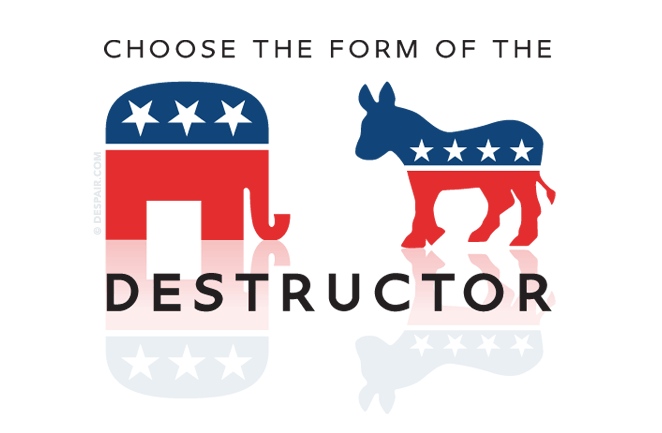
“Given how the GOP field has been winnowed, this has really just been a race to determine the form Gozer the Traveler takes.
“So this just means the giant Slor is off the table and we’re choosing between the moving Torb and the Staypuft Marshmallow man.” (Ghostbusters reference, look it up.)
That’s a T-shirt design now, if you weren’t aware. They sell it at Despair.com. I bought one.
Sincerely,
Kevin Baker
It goes out in tomorrow’s mail in the RNC’s postage-paid envelope. Useless, but it makes me feel better.
Is the Fat Lady Clearing Her Throat?

Stocks accelerated their selloff in the final minutes of trading to close down more than 1 percent across the board Monday, as initial euphoria over Spain’s bank bailout fizzled and amid ongoing fears over a global economic slowdown.
The S&P 500 fell 16.73 points, or 1.26 percent, to end at 1,308.93. The Nasdaq dropped 48.69 points, or 1.70 percent, to close at 2,809.73.
The CBOE Volatility Index, widely considered the best gauge of fear in the market, jumped above 23.
The pin’s not pulled out quite yet, but…
UPDATE: Here’s some more:
The only problem with the deathbed conversions of the sort that Ken Livingston is metaphorically experiencing is that it often happens at the stage when a crisis is cascading. It happens too late. The damage is widening exponentially. There won’t be years or months left to change course. What Spain illustrates is the compression of time within a crisis. Things are not only happening, they are happening faster than anyone believed was possible.
Quote of the Day – Belmont Club Edition
A short break from excerpts of John Taylor Gatto’s The Underground History of American Education, today’s QotD comes from Wretchard, and this weekend’s Who Will Bell the Cat?
Let’s spell out it again for emphasis. “The Obama administration can’t do a damn thing.” So too bad about the Syrian people. Too bad about the real and dire consequences of Syria falling apart, watching its WMDs (are you sure? Where did they come from?) fall into the wrong hands, become a locus for regional instability. Too bad about everything. Because “the Obama administration can’t do a damn thing.”And that’s all she wrote.
All these years the Euroleft has wanted to see a chastened America. One incapable of acting. An America that was just another country; a hamstrung giant. Well they have it now. So they must like it. Someone once said, be careful what you wish for, because you might get it.
Match Report – Bowling Pins, 6/10/12
Well, I’ve heard the expression “Won the whole shootin’ match,” but I’ve never actually done it.
Until today.
Seven other shooters showed up for the June Bowling Pin match. Two brought Major guns, four brought Minor guns, six brought revolvers, and six brought .22’s. There were too few of us to break out Major vs. Minor, so we shot centerfire pistol as one class. There were a lot of malfs. Still, I managed to win all three divisions. (No malfs on my part, except for the loose nut behind the trigger.)
Note: Eight shots in the revolver class really helps. I only managed to clear a table in six shots or less twice. The rest of the time it took seven, and once it took all eight.
The next match is July 8. Hope to see you there.
I Can’t Figure Out if Ted Rall…
…has given up on Obama, or is covering for him:
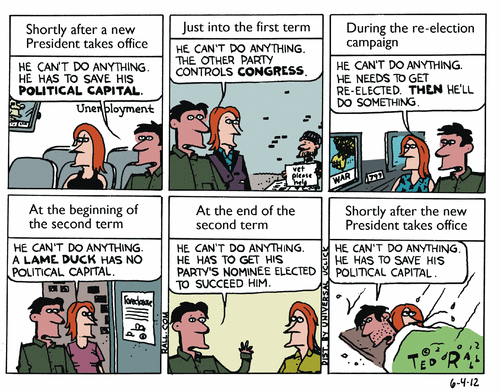
I just know he’d NEVER say the same thing about Bushitler.
Of course, it could be BOTH.
Quote of the Day – John Taylor Gatto (Pt. 5)
From the beginning, there was purpose behind forced schooling, purpose which had nothing to do with what parents, kids, or communities wanted. Instead, this grand purpose was forged out of what a highly centralized corporate economy and system of finance bent on internationalizing itself was thought to need; that, and what a strong, centralized political state needed, too. School was looked upon from the first decade of the twentieth century as a branch of industry and a tool of governance. For a considerable time, probably provoked by a climate of official anger and contempt directed against immigrants in the greatest displacement of people in history, social managers of schooling were remarkably candid about what they were doing. In a speech he gave before businessmen prior to the First World War, Woodrow Wilson made this unabashed disclosure:We want one class to have a liberal education. We want another class, a very much larger class of necessity, to forgo the privilege of a liberal education and fit themselves to perform specific difficult manual tasks.
—
I know how difficult it is for most of us who mow our lawns and walk our dogs to comprehend that long-range social engineering even exists, let alone that it began to dominate compulsion schooling nearly a century ago. Yet the 1934 edition of Ellwood P. Cubberley’s Public Education in the United States is explicit about what happened and why. As Cubberley puts it:
It has come to be desirable that children should not engage in productive labor. On the contrary, all recent thinking…[is] opposed to their doing so. Both the interests of organized labor and the interests of the nation have set against child labor.
The statement occurs in a section of Public Education called “A New Lengthening of the Period of Dependence,” in which Cubberley explains that “the coming of the factory system” has made extended childhood necessary by depriving children of the training and education that farm and village life once gave. With the breakdown of home and village industries, the passing of chores, and the extinction of the apprenticeship system by large-scale production with its extreme division of labor (and the “all conquering march of machinery”), an army of workers has arisen, said Cubberley, who know nothing.
Furthermore, modern industry needs such workers. Sentimentality could not be allowed to stand in the way of progress. According to Cubberley, with “much ridicule from the public press” the old book-subject curriculum was set aside, replaced by a change in purpose and “a new psychology of instruction which came to us from abroad.” That last mysterious reference to a new psychology is to practices of dumbed-down schooling common to England, Germany, and France, the three major world coal-powers (other than the United States), each of which had already converted its common population into an industrial proletariat.
Arthur Calhoun’s 1919 Social History of the Family notified the nation’s academics what was happening. Calhoun declared that the fondest wish of utopian writers was coming true, the child was passing from its family “into the custody of community experts.” He offered a significant forecast, that in time we could expect to see public education “designed to check the mating of the unfit.” Three years later, Mayor John F. Hylan of New York said in a public speech that the schools had been seized as an octopus would seize prey, by “an invisible government.” He was referring specifically to certain actions of the Rockefeller Foundation and other corporate interests in New York City which preceded the school riots of 1917.
The 1920s were a boom period for forced schooling as well as for the stock market. In 1928, a well-regarded volume called A Sociological Philosophy of Education claimed, “It is the business of teachers to run not merely schools but the world.”
Quote of the Day – John Taylor Gatto (Pt. 4)
Sometimes the best hiding place is right in the open. It took seven years of reading and reflection for me to finally figure out that mass schooling of the young by force was a creation of the four great coal powers of the nineteenth century. It was under my nose, of course, but for years I avoided seeing what was there because no one else seemed to notice. Forced schooling arose from the new logic of the Industrial Age—the logic imposed on flesh and blood by fossil fuel and high-speed machinery.This simple reality is hidden from view by early philosophical and theological anticipations of mass schooling in various writings about social order and human nature. But you shouldn’t be fooled any more than Charles Francis Adams was fooled when he observed in 1880 that what was being cooked up for kids unlucky enough to be snared by the newly proposed institutional school net combined characteristics of the cotton mill and the railroad with those of a state prison.
After the Civil War, utopian speculative analysis regarding isolation of children in custodial compounds where they could be subjected to deliberate molding routines, began to be discussed seriously by the Northeastern policy elites of business, government, and university life. These discussions were inspired by a growing realization that the productive potential of machinery driven by coal was limitless. Railroad development made possible by coal and startling new inventions like the telegraph, seemed suddenly to make village life and local dreams irrelevant. A new governing mind was emerging in harmony with the new reality.
The principal motivation for this revolution in family and community life might seem to be greed, but this surface appearance conceals philosophical visions approaching religious exaltation in intensity—that effective early indoctrination of all children would lead to an orderly scientific society, one controlled by the best people, now freed from the obsolete straitjacket of democratic traditions and historic American libertarian attitudes.
Forced schooling was the medicine to bring the whole continental population into conformity with these plans so that it might be regarded as a “human resource” and managed as a “workforce.” No more Ben Franklins or Tom Edisons could be allowed; they set a bad example. One way to manage this was to see to it that individuals were prevented from taking up their working lives until an advanced age when the ardor of youth and its insufferable self-confidence had cooled.