OK, Who’s Telling the Truth Here?

Regarding Expelled: No Intelligence Allowed, the Ben Stein documentary that I referred to below, we have two conflicting stories. One, as apparently told by the documentary, is that Richard Sternberg, a staff scientist at the National Institutes of Health and (former) editor of Proceedings of the Biological Society of Washington was responsible for the publishing of a “a pro-intelligent design article” by one Stephen C. Meyer. Meyer is referred to as “a proponent of intelligent design” by NPR, but as “director and Senior Fellow of the Center for Science and Culture at the Discovery Institute” by the Institute itself.

It appears that the film, according to this site “claims that Sternberg was ‘terrorized’ and that ‘his life was nearly ruined’….” Further: “The paper ignited a firestorm of controversy merely because it suggested intelligent design might be able to explain how life began.”

NPR reports:

Sternberg says his colleagues and supervisors at the Smithsonian were furious. He says — and an independent report backs him up — that colleagues accused him of fraud, saying they did not believe the Meyer article was really peer reviewed. It was.

Eventually, Sternberg filed a complaint with the U.S. Office of Special Counsel, which protects federal employees from reprisals. The office launched an investigation. Ultimately, it could not take action, because Sternberg is not an employee of the Smithsonian.

But Sternberg says before closing the case, the special counsel, James McVay, called him with an update. “As he related to me, ‘the Smithsonian Institution’s reaction to your publishing the Meyer article was far worse than you imagined,'” Sternberg says.

McVay declined an interview. But in a letter to Sternberg, he wrote that officials at the Smithsonian worked with the National Center for Science Education — a group that opposes intelligent design — and outlined “a strategy to have you investigated and discredited.” Retaliation came in many forms, the letter said. They took away his master key and access to research materials. They spread rumors that Sternberg was not really a scientist. He has two Ph.D.’s in biology — from Binghamton University and Florida International University. In short, McVay found a hostile work environment based on religious and political discrimination.

After repeated calls and e-mails to the Smithsonian, a spokesman told NPR, “We have no public comment, and we won’t have one in the future.”

The anti-Expelled site has a different take:

Expelled doesn’t even get the paper’s subject right. The paper was not about how life began; it was about the Cambrian Explosion, which occurred about three billion years later. The greater error is claiming that the discussion of ID generated the controversy. There was an understandable outcry from members of the Biological Society of Washington over the embarrassing publication of what they recognized as poorly-written, inaccurate science in their journal. The argument presented in the Meyer paper had previously been reviewed and rejected by scientists. Seeing this shoddy science in their journal indeed “ignited a firestorm”, but not for the reasons given in Expelled. For more on why the paper was bad science, see the review published on the Panda’s Thumb blog and the review in the Palaeontological Society Newsletter.

The first question asked by BSW members was “how did this paper ever get published?” According to the Council of the Biological Society of Washington, Sternberg failed to follow proper procedure in publishing the paper: “Contrary to typical editorial practices, the paper was published without review by any associate editor; Sternberg handled the entire review process. The Council, which includes officers, elected councilors, and past presidents, and the associate editors would have deemed the paper inappropriate for the pages of the Proceedings because the subject matter represents such a significant departure from the nearly purely systematic content for which this journal has been known throughout its 122-year history.” The BSW withdrew the paper in embarrassment, emphasizing that the paper was substandard science. It commented that the society endorsed “a resolution on ID published by the American Association for the Advancement of Science (http://www.aaas.org/news/releases/2002/1106id2.shtml), which observes that there is no credible scientific evidence supporting ID as a testable hypothesis to explain the origin of organic diversity. Accordingly, the Meyer paper does not meet the scientific standards of the Proceedings.”

Though Sternberg claimed that he was the best qualified to handle the review process, science blogger Ed Brayton notes that this is not the case: (Quote omitted)

The fact that Sternberg published the Meyer paper in his second-to-last scheduled issue as editor, and that he didn’t follow normal procedure, suggests that he knew that his actions and the paper would be seen as objectionable by his fellow scientists.

It continues:

The Claim: “In October, as the OSC complaint recounts, [Sternberg’s supervisor] Mr. Coddington told Mr. Sternberg to give up his office and turn in his keys to the departmental floor, thus denying him access to the specimen collections he needs.” (Wall Street Journal editorial, linked from Expelled website)

That is correct per the WSJ piece.

But it’s apparently not true:

The Facts

According to Coddington in a January 2005 communication, “Well prior to the publication of the Meyer article and my awareness of it, I asked him and another Research Associate to move as part of a larger and unavoidable reorganization of space involving 17 people and 20 offices. He agreed. I offered both individuals new, identical, standard Research Associate work spaces. The other accepted, but Dr. von Sternberg declined and instead requested space in an entirely different part of the Museum, which I provided, and which he currently occupies.”

The Smithsonian wrote a letter to the Wall Street Journal, observing, “Dr. Sternberg’s characterization of his work conditions and treatment at the Smithsonian is incorrect. He was never denied office space, keys or access to the collections.”

In a January 30, 2006, letter responding to Sternberg’s concerns, Smithsonian Deputy Secretary & Chief Operating Officer Sheila Burke explained:

“As you know, as part of an effort to enhance security at the Museum, all researchers were asked to return their keys in 2004, and were issued coded identification badges to provide access to non-public areas. The badge you were issued, which provides general access to doors and elevators, is still operative. If you have any problems gaining access to conduct your research, however please contact the Security office at NMNH. In accordance with NMNH policy, please return your old keys as soon as possible to your sponsor, Dr. Vari.”

In short, Sternberg has turned two bits of bureaucratic minutiae affecting an entire division of the museum – a switch from keys to ID badges and a routine shuffling of office space – into a conspiracy to undermine him personally.

There’s more, and I suggest you follow the leads, but the way it appears to me is that Richard Sternberg pulled a fast one – for whatever reason – and it resulted in a firestorm of criticism that he has since blown out of proportion – with the willing assistance of the Discovery Institute.

And this isn’t one-sided, either. Watch this YouTube video of what happens when you oppose support of Intelligent Design:

[youtube https://www.youtube.com/watch?v=sQacQy1KJ9M&hl=en&w=425&h=355]

You can bet that didn’t turn up in Expelled.

Discriminating

Remember when that word meant “discerning,” or “judicious?” Whereas now it means “bigoted” or “prejudiced.”

Well, I’m guilty of prejudice.

There are two documentary films out, or coming out, that I find interesting for different reasons. One I want to see. I’ve prejudged it, and judiciously discerned that it’s worth some of my time. The other, I don’t. I’ve prejudged it, and judiciously discerned that it’s not worth my time or my dime.

The one I want to see, and am willing to spend some of my hard-earned money on, is Indoctrinate-U by Evan Coyne Maloney. Regular readers of TSM will understand why.

The one I’m going to skip is Expelled: No Intelligence Allowed by and with Ben Stein. You know, I like Ben Stein, but I think as he gets older he’s getting further and further “out there.” This movie pretty much settles it for me – I can’t take him seriously any longer.

UPDATE, 4/20: WRT Expelled, quoth Professor Reynolds,

I hate writing about this stuff because — pardon me while I speak plainly — the people on both sides of this issue are assholes. I mean, even by the low standards of Internet discussion. I’m getting email calling me a “theocon shill” for mentioning Stein, and email telling me I’ll burn in hell for calling Intelligent Design “pernicious twaddle.” Frankly, the rabid atheists and the rabid creationists seem an awful lot alike, and no proper hell could be truly hellish without the both of them yammering away at each other. Feh.

Er, “amen”? I mean, I’m not getting the “fanmail” he is, but I certainly understand his position.

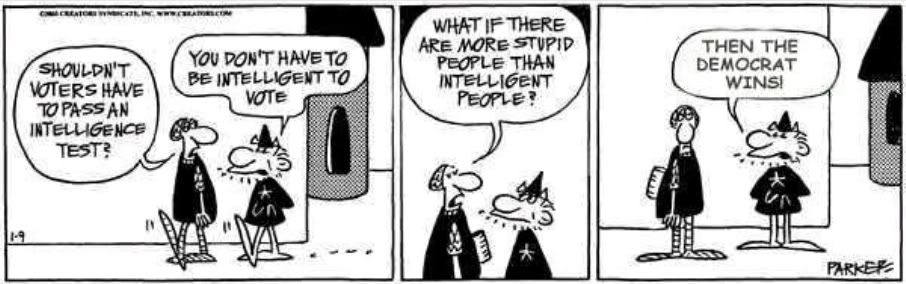
Really,.It’s Worse Than That


(Click for full size)

Really, it’s worse than that.

The stupid people vote in the primaries first.

Both side’s primaries.

And, obviously, they outnumber the intelligent people now and have for a while. I blame the public education system, and have for a long while.

It’s easier to lead stupid people around than intelligent, informed ones. Here’s that Connie du Toit quote again:

The other day our Carpenter’s helper heard me say something along the lines of, “it is difficult to conclude that incompetence is the reason why our public schools have deteriorated. There comes a point where you have to suspect sabotage, or a conspiracy.”

He asked me if I really meant that. I gave him the five minute explanation of John Dewey’s known affiliation with communists, his frequent essays and articles about the wonders of the Soviet education system, and his quote, “You can’t make Socialists out of individualists. Children who know how to think for themselves spoil the harmony of the collective society which is coming where everyone is interdependent.”

I then went on to tell him about how public schools changed at the turn of the last century. That there were others involved in turning Americans from free-thinking individualists to factory drones. I also added that many people probably went along with it because it seemed like a good idea, but there were certainly enough people behind the scenes, who knew that the goal posts had been moved. THAT is a conspiracy.

Yes. There does come that time when you are forced to don the tinfoil hat.

The incompetence excuse only works once. Incompetence this great is impossible to attribute to accident.

Amen.

And you may want to give a listen to some sound clips from a recent speech by Michele Obama. I’m fairly certain I don’t want my government trying to fix my soul so that the Great Collective functions as she seems to believe it ought to.

A Surprising Member of Academe

In yesterday’s post, More Misinformed Ignorance and Hyperbole, the Observer op-ed I excerpted had a quote from University of Toledo Professor Brian Anse Patrick which was part of my excerpt. Professor Patrick left a comment to that post, and a valid email address, so I sent him a reply email and did a little research on him.

He’s a good guy.

Check out this web page about his honors seminar on American Gun Policy. It’s not what you’d expect from today’s university campuses.

He sent me a reply to my initial email, and I have responded further. He’s given permission to post our exchanges, so here they are to date, beginning with his initial comment:

I’m quoted, more or less accurately but in no sensible context, in the Observer article by Paul Harris. He and I talked on the phone for 30 minutes or so, and as is usual with elite media reporters, he did not let the facts get in the way of his story.

Professor Brian Anse Patrick
Department of Communication
University of Toledo

ps –and I am only a “liberal critic” in the 18th Century sense of that phrase.

Professor Patrick:

Thank you for commenting at my blog, The Smallest Minority. You wrote “…as is usual with elite media reporters, he did not let the facts get in the way of the story.” Would you care to elaborate on this? Also on your postscript, “I am only a ‘liberal critic’ in the 18th Century sense of the phrase”?

Hi Kevin:

You are welcome!

Re “he did not let the facts get in the way of the story.” Journalists like to represent themselves as “objective,” as unbiased lenses for examining reality, and some of the old time journalists approached this ideal fairly well, but modern journalists tend to be market driven story tellers. They tell the easiest, most dramatic story that caters to the debased tastes of a mass audience with an average attention spans measured in seconds, probably not minutes, and certainly never hours. When journalist say they are “working on a story” they really are, quite literally. Usually, as you know, they call the story theme “the angle” and of course angles are selected to cater to the cartoon-like tastes and crude emotions of the mass market. Walter Lippmann called these crude stock characters and ideas “stereotypes.” Actually explaining American gun culture, the success of the concealed carry movement, and the complicated sociology of guns and gun violence in America would overtax both reporter and audience. So the story must prevail. And of course in this article it was, more or less, “look at those crazy gun-wielding Americans.” Anything the reporter could collect was weighed on this scale and fit into the story accordingly, all else ignored. This is the nice thing about ‘angles, from a reportorial pint of view, they help quickly sort through mounds of problematic information a produce a coherent. albeit idiotically simplified “story.”

I talked with the reporter for maybe 30 minutes by telephone, he was in New York at the time, and I explained a number of facts, trends historical patterns, and effects re guns and concealed carry in America. These included things like the success of the CCW movement and modern American gun culture–e.g.., reduced crime, no crime from CCW holders, and the amazing mobilization of gun culture since the about 1970 or so as a broad-based social movement that has not only resisted top down elite-administrative power, but successfully spread its own message. I explained how widespread legal concealed carry by trained responsible citizens was unthinkable 20 years ago, but how the idea diffused and caught on–because of its success–and how a successful social movement made ideas that were unthinkable 20 years ago, thinkable today, e.g., the civil right movement. Similarly new American gun culture has expanded personal freedom. He of course translates this, via his angle, into how unthinkable it is for a teacher to carry a gun. He ignored the legally armed, trained responsible adult portions of my comments; and also my comments about how the CCW movement shows that the mere fact of gun carrying by this woman is not going to disrupt the orderly course of her life–or any other good person’s life: she is a valuable and useful person and will likely remain so. Armed criminals are a different order of creatures, impulsive, violent and dangerous with or without guns.

He also ignored comments I made about The American Gun Policy honors class I taught last semester, how my students had no problem with the idea of fellow students who were legally licensed and trained carrying concealed in class. Nor that I personally did not care to carry a gun while professoring, unless circumstances changed much for the worse in this country, but that I had no objection to any professor with a carry license doing so. I also gave him so estimates on the size of American gun culture much higher than the ones he used.

The reporter preferred his crazy Americans angle, and so probably does his audience–because any other angle might disturb their torpor. There is more, but you get the idea.

Re “classic liberal.” I am very tolerant in the John Locke sense. Formally I am a pluralist and a pragmatist, thus I believe well intended and informed people can be trusted with power, they are capable of rational thought –even if the habit seems to be dying out in our media, educational, and mass media systems. I think people must form their own interpretative communities and alternative media –like this blog–to make sense of the world and to organize and “in-form” themselves meaningfully to create, modify and socially construct a world in such a way that pleases their virtuous dispositions. This means no mass society run top-down by elites who claim to speak the truth on behalf of bovine masses, or a group of consumers rather than citizens, but rather a society of vigorous, active publics and interest groups pursuing their own ends and in-forming themselves e.g., like the Concealed Carry Movement as it has diffused from state to state.

Incidentally, I have a book on NRA and the Media: how NRA benefits by negative media coverage, gaining more members with more bad coverage. I will also be done soon writing a new book on the concealed carry movement.

A last comment re the article. One can no more expect a British journalist who writes for a mass audience to write a thoughtful and sensible article on American Gun Culture than one could expect gourmet food from the golden arches–it would just confuse their respective markets; who would consume it? Real informational substance is found in other places, such as blogs and alternative media. I could add a corollary to “known thyself” –it is “inform thyself” especially if you wish to pursue excellence.

Professor Patrick:

What a refreshing (nay, stunning) response from a member of academe! I know people like you are out there, but I suspect the camouflage is carefully worn to inhibit a “hostile work environment” in the majority of cases. May I assume you are grudgingly tolerated by most of the other tenured staff on your campus?

I am in complete agreement with you on the topic of professional journalism. One of my favorite anecdotes – you may have heard it – comes from Diane Sawyer:

“You know, I wanted to sit on a jury once and I was taken off the jury. And the judge said to me, ‘Can, you know, can you tell the truth and be fair?’ And I said, ‘That’s what journalists do.’ And everybody in the courtroom laughed. It was the most hurtful moment I think I’ve ever had.” – Diane Sawyer, Good Morning America, 7/12/07

The public at large is obviously aware, as well. Journalists, not so much.

One point in your reply struck a special chord with me. You wrote:

“He ignored the legally armed, trained responsible adult portions of my comments; and also my comments about how the CCW movement shows that the mere fact of gun carrying by this woman is not going to disrupt the orderly course of her life–or any other good person’s life: she is a valuable and useful person and will likely remain so. Armed criminals are a different order of creatures, impulsive, violent and dangerous with or without guns.”

I refer to this as an inability to differentiate between the two “gun cultures” – the “violent and predatory” and the “violent, but protective.” His type (exemplified by the British press, and it would seem, the majority of the British populace) sees only violent, and all violence is, by their definition, bad – unless that violence is carried out by an authorized member of the government, where it is instead referred to as force. And there is still some ambivalence even about those acts. I’m heartened to see what appears to be a growing public support for what they term “have-a-go heroes” – those who fight back against attackers – but they’ve got a long way to go after almost ninety years of a disarmament culture.

I did a little research on you and found this page concerning you and your American Gun Policy seminar. Needless to say, it was not what I was expecting. I’ve been studying the topic since about 1995 on my own, and I honestly believe if there was a PhD program available, I could fairly easily earn one. You state on that page, “Some of the research is very, very good; some of it is laughably bad.” I completely agree. I’m curious, however, on whether we agree on just which research is which. I pretty much discount anything coming from John Lott. He, like Michael Bellisiles, has proven himself untrustworthy, and I don’t have the time (or frankly, the statistician’s background) to check him. I am also leery of data coming from Gary Kleck. His data may be valid, but it doesn’t pass my smell test – and again, I’m not a statistician. Anything funded by the Joyce Foundation is, as far as I’m concerned, highly suspect. Garen Wintemute’s work may be quite good, but I cannot help but believe that it is distorted by his obvious bias. Anything that comes from Arthur Kellermann I treat like it came from John Lott.

I am particularly enamored of one particular work, Under the Gun: Weapons, Crime, and Violence in America by Wright, Rossi and Daly, a meta-study of all gun control research available at the time, commissioned by the Carter administration. It seemed to be very, very good work. And I was honestly surprised by the recent National Academies of Science meta-study report commissioned by the Clinton administration. I was expecting a hatchet-job, and instead they delivered pretty much the same report Wright, Rossi and Daly provided twenty years earlier.

Can you recommend or refer me to other “very, very good” sources?

Thank you for your time. As you can see, the topic is my particular hobby horse, and it is not every day that I run into someone who has, at least partially, made an academic career out of it. We’ll be here all night. I have to earn my living as an engineer, and do this in my off-time.

I would like your permission to post this, and any future exchanges we may have at my blog. And once again, thank you for commenting there.

Sincerely, a fellow Lockean

Please do post it.

I like John Lott’s stuff, ambitious, but his inferences often outrun the strength of his research designs. I like your Diane Sawyer anecdote, too. I agree re Wright and Rossi. Kleck is a very typical sociologist and speaks that language. His analysis of public opinion data on guns is pretty good, though, but I also wonder.

I just reviewed , and beat up, a gun book by Kristen Goss–see the new Journal of Popular Culture (Vol 40, no 5. ) –the October issue. I will follow up with a longer email with some opinions, comments re the literature.

BAP

PS tenure is a wondrous thing, got it back in May, and my colleagues are just beginning to realize, I think.

Regarding tenure, I’ll bet. This could get very interesting. A distinct divergence from my exchanges with Saul Cornell.

Like Water Off a Duck’s Back

Say Uncle pointed to a Chicago Sun-Times op-ed yesterday by columnist and journalism professor Laura Washington. I won’t reproduce the whole piece, but here’s a taste:

Gun lovers disarm control advocates

August 27, 2007
LAURA WASHINGTON Sun-Times columnist

It looks like the petulant, gun-toting NRA stalwarts have won the first round.

Last time, I used this space to ask where you stand on the issue of gun control. A torrent of e-mails later, it’s clear: Gun-control advocates were outgunned, four to one.

The gun lovers were legion, robust and vitriolic. Many of you told me to go places where the sun doesn’t shine and the temperature is way too hot. Yet, if you believe public opinion polls, that reaction is an anomaly. For instance, last April, ABC News polled adults nationwide, and asked: “Do you favor or oppose stricter gun control laws in this country?” Sixty-one percent favored them, 36 percent were opposed, and 3 percent were “unsure.”

CBS News asked, “In general, do you feel the laws covering the sale of handguns should be made more strict, less strict, or kept as they are now?” Two-thirds of respondents nationwide opted for “more strict.”

What is the problem with the advocates of gun control? Why are their voices not being heard? They are consistently cowed and overmatched. Gun violence is out of control, yet the gun lovers are ascendant.

You think we’ve got problems now? Just listen to Mike Huckabee, the former Arkansas governor and Republican presidential aspirant. At a recent Conservative Political Action Conference, he bragged, “I’m not a newcomer to the NRA,” the New York Times reported on its political blog. “I was the first governor to have a conceal-carry permit, so don’t mess with me.”

Huckabee, mind you, recently made a flashy second-place showing in the Iowa presidential straw poll.

Do you want to be standing in line for gas, popcorn or a gallon of milk and find yourself next to someone who’s packing heat? If he takes the White House, we can all go shopping for embossed leather holsters and pearl-handled pistols. I’ll be looking to accessorize that with rhinestone-studded boots.

You know, the usual Reasoned Discourse™ we’ve come to expect from our opposition. Please, RTWT. (And yes, I do know about the Zogby poll.)

Instead of fisking her piece, I thought I’d drop her a nice email (and copy the paper’s letters-to-the-editor while I was at it. What the hell, worth a shot.) Here’s what I sent:

Ms. Washington:

I read with interest your op-ed in the online edition of the Sun-Times, and I had some comments to make. I hope that you will see this epistle in the volume of email I am sure has been forthcoming since your little jeremiad was published. Provoking an outpour of response was, I am sure, one of your intentions. Let me apologize in advance (though it is not really my place) for those who will shower you with invective and vitriol. We on the side of the right to arms have been fighting against a decades-long slow-motion hate crime,1 and it tends to wear on our patience. I understand such responses, but I cannot countenance them.

I am eternally fascinated by people who see themselves as “gun control advocates.” I find them fascinating because they epitomize to me the phrase “cognitive dissonance.” The fact that you write from Chicago, one of the epicenters of “common-sense gun control” only adds to my fascination.

Cognitive dissonance has been defined thus:

“When someone tries to use a strategy which is dictated by their ideology, and that strategy doesn’t seem to work, then they are caught in something of a cognitive bind. If they acknowledge the failure of the strategy, then they would be forced to question their ideology. If questioning the ideology is unthinkable, then the only possible conclusion is that the strategy failed because it wasn’t executed sufficiently well. They respond by turning up the power, rather than by considering alternatives. (This is sometimes referred to as ‘escalation of failure’.)”2

Or, as I phrase it, “The philosophy cannot be wrong! Do it again, only harder!” We see this behavior in gun control advocates all the time. There’s always a “loophole” to blame. Always a “next step.” But “gun control” never improves crime rates, never reduces homicide rates. Never. Gun control advocates always – without exception – predict “blood in the streets” and “wild West shootouts” when “shall issue” concealed-carry legislation makes progress in state legislatures, but this never happens. Never. Somehow this data fails to make a dent in the “gun control” mindset. The strategy constantly fails, but the ideology cannot be questioned. Do it again, only harder!

Ms. Washington, you note in your piece: “(I)t seems the gun control advocates have been outmatched. Abigail Spangler acknowledges as much. Spangler is the founder of ProtestEasyGuns.com, a Virginia-based group that has been spearheading a slew of anti-gun protests around the nation.

“Gun control activists, she wrote me, ‘are TRYING HARD but they are seriously affected in state after state by lack of funding and contributions.” She recently met, she says, with the leader of Virginia’s only gun control group. “He says they may not even be able to afford any lobbyist at all soon in Virginia!'”

Ms. Washington, the citizenry will offer an opinion to anyone. Opinions are free. But activism costs money – and the anti-gun side has shown that the hearts and wallets of the general public are not really into it. Ask any hundred random people on the street if they favor stricter gun laws and most likely the majority will say “yes.” Ask them what the current gun laws are, and they won’t be able to tell you. Gun rights activists can. The gun control side of the argument has been supported for decades with money from foundations, perhaps the largest contributor being the Joyce Foundation. Look them up. Those of us who believe in the right to arms are the true grass-rooters, and there are far more of us than the mere four million that the NRA claims as members. As someone once put it so pithily: “Poor Lefties; they’ve been playing on astroturf so long that they don’t know grassroots even when fed a mouthful of divot.” 3

Ms. Washington, our side is winning because we can see reality. We are not blinded to a flawed ideology. The ideology you operate under is expressed best as “Guns are baaad, mmmmkay?” This ideology springs from an inability or unwillingness to see a difference between “violent and predatory” and “violent but protective.” You see only “violence” and violence offends you. From this inability you mistake the tools of violence to be the cause of violence, and from that error comes the desire to eradicate the tools. But this does not address the actual cause. In other words, “Gun control is what you do instead of something.”4

When disaster strikes and civil society breaks down, when the government proves unmistakably that it cannot protect everyone, everywhere, all the time, then some people have an awakening – and they go to a gun store or a Wal-Mart and try to buy a gun.

And that’s when they discover just what the gun laws really are.

And many become gun-rights activists because, as one woman put it when she found out she had to wait a week for a gun while being stalked by an ex-boyfriend, “I’ve been against guns and violence my whole life.”5 She and those like her were responsible for that interminable week wait. She finally understood the difference between “violent and predatory” and “violent but protective,” and wanted protection – which the law denied her for a full week.

Some of us are “gun lovers,” Ms. Washington. I am, unashamedly. But many, many more simply want to be able to choose how to defend ourselves. That is a choice you wish to deny us out of a belief in a flawed ideology that you cannot bring yourselves to recognize.

I’d love to discuss this topic with you further, but I seriously doubt you’ve bothered to read this far.

Thank you for your attention, however much of it I was able to garner.

(Footnotes not in original).

Somewhat to my surprise, she replied:

Dear Mr. Baker,

Thanks for your comments on the gun control column. I appreciate you taking the time to share your thoughts.

Be consoled that you are winning the battle. And yes, I did read your entire letter.

Best, Laura

=================================================================
Laura S. Washington
Ida B. Wells-Barnett University Professor
DePaul University
Contributing Columnist, Chicago Sun-Times
Senior Editor, In These Times

The fact that she responded was surprising. The content was not.

I sent her a short reply:

Dear Laura:

Thank you for your gracious reply, and for taking the time our of your obviously busy schedule to read my missive.

Water off a duck’s back, eh?

My sincere condolences,

Kevin

But wait! There’s more! Phelps had a beautiful response of his own that I hope he sent to her. I urge you not to miss it.

Footnotes:

1Dr. Michael S. Brown
2Steven Den Beste
3Tamara K
4Say Uncle
5Seraphic Secret

Credit where credit is due.

UPDATE: Commenter Kevin P. notes that he maintains (an EXCELLENT) Wikipedia page on the Joyce Foundation and their funding efforts. Way to go, Kevin!

Wait a Minute…

…you mean it’s not the fault of “too many guns”? Another op-ed from the Sunday Times over where Great Britain used to be:

Gangs, alas, are offering what boys need

Harriet Sergeant

What are the reasons behind the spate of murders by feral gangs of youths? And can we as a society do anything about it?

For my report on the care system, I spent last year interviewing young men who, as Norman Brennan, director of the Victims of Crime Trust, said, “put a knife in their pockets as routinely as they pull on their trainers in the morning”. Drugs and alcohol (and weapons – Ed.) are merely the symptoms of a deeper problem. Too many young men suffer from an absence of authority at home, in school and on the street. We have created a moral vacuum around our young people. We should not be surprised at how they fill it.

Young boys join gangs, they told me, because they are afraid. There is nobody else to protect them, certainly no responsible adult. “You don’t start off as a killer,” said a 19-year-old gang leader, “but you get bullied on the street. So you go to the gym and you end up a fighter, a violent person. All you want is for them to leave you alone but they push you and push you.” Another boy aged 13 explained that in his area boys “would do anything” to join a gang. If they join a gang with “a big name” people will “look at them differently, be scared of them”.

This echoes Grim’s observation that I quoted in It’s most important that all potential victims be as dangerous as they can:

Very nearly all the violence that plagues, rather than protects, society is the work of young males between the ages of fourteen and thirty. A substantial amount of the violence that protects rather than plagues society is performed by other members of the same group. The reasons for this predisposition are generally rooted in biology, which is to say that they are not going anywhere, in spite of the current fashion that suggests doping half the young with Ritalin.

The question is how to move these young men from the first group (violent and predatory) into the second (violent, but protective). This is to ask: what is the difference between a street gang and the Marine Corps, or a thug and a policeman? In every case, we see that the good youths are guided and disciplined by old men.

The author of this piece seems to grasp this, dimly.

The police and the Home Office have not taken crimes against young people seriously because they do not know they are happening.

Oh bullshit. They know, but recording those crimes would make the already horrible numbers from Britain even worse.

The British Crime Survey, described by the Home Office on its website as “the most reliable measure of crime” does not include crimes against anyone under 16.

The Home Office admits that young men aged 16-24 are most at risk of being a victim of violent crime. But only at the beginning of this year did a Freedom of Information request to each of the 43 police forces reveal that four out of 10 muggings are committed by children under 16 — and that is only the ones reported.

How can protecting young people on the streets take priority when the Home Office does not acknowledge the number of crimes against them? It is no wonder one young gang member said, “There’s no one to look after me but me.” He is quite right.

Note here, however, that Ms. Sergeant has completely omitted any reference to family – for her, if the State isn’t there to protect you, then you are, by definition, all alone. Where is this kid’s father? Where are the older men who used to guide boys away from the “violent and predatory” culture to the “violent but protective” one? They don’t exist. And the government won’t lead him there either. The society, seeing only “violence,” wants him to at least act as though he’s on Ritalin.

It is the same story in the majority of inner-city schools. As a mother of a 14-year-old boy and a 17-year-old girl I know that young men are a different species to the rest of us. In times of war we value their aggression, their sense of immortality, their loyalty to one another. But in peacetime they are at best a nuisance, at worst a threat.

See? For her, the “violent but protective” behavior of soldiers at war is indistinguishable from the “violent and predatory” behavior of youth gangs. She literally cannot see a difference. Violence is violence to Ms. Sergeant, and all violence is bad – unless it’s carried out by sanctioned members of the State.

Teenage boys need different treatment to girls to become responsible members of society. They need a role model.

As said Grim, above.

When my son was about nine he became resentful of his young female teachers. He had no respect for them. He then moved to his middle school where most of his teachers were male. The change was dramatic. Suddenly it was all, “Sir says this and sir says that.” In state primary schools 80% of teachers are female.

I am lucky. I can afford to send my son to a private school. The discipline, pastoral care and academic rigour do a good job at counterbalancing parental failings. Compare his experience with that of boys in the inner cities.

Those with a chaotic family life need school to be a refuge and a contrast. Even more than middle-class boys with a stable background, they need school to provide authority, moral leadership and an outlet for their aggression. It should be giving boys what they need to thrive: discipline, sport and a group with which to identify. Instead what do they get?

My son does one to two hours of sport a day with a match on Saturday. He is so exhausted by the evening he can barely pick up a knife to eat, let alone stab anyone.

State schools, by contrast, offer only one hour of sport a week. Then teachers wonder why adolescent boys play up and have difficulty concentrating on lessons. When boys look around for a group to join, too often it is not a school sports team but the local gang.

I think what she’s advocating here is pretty much the same idea as “midnight basketball.” The results of which would be just as predictable.

With their hierarchy and strict discipline, street gangs are nothing more than a distorted mirror image of the house system common in private schools where loyalty and team effort are all important. As one young gang leader chillingly told me, “You have to know the people, you have to trust the people, because you do everything together. When you stab, you stab together.”

Then instead of authority and leadership, boys in state schools too often find themselves taught by teachers ashamed of their values. One young man teaching in a school in a deprived area in the northeast said his “main focus” was not to offend his pupils. “I don’t want to push my middle-class values on them,” he explained earnestly. When a pupil described his hopes for the future, stacking shelves in the local supermarket, “I pointed out the many positive aspects of the job — meeting people and so forth.” There was little attempt by the school, he admitted, to provide pastoral care or raise pupils’ expectations. He saw no link between this and his No 1 problem — pupil apathy.

Now here she’s on to something. This is a classic example of what “liberal” education has done to the education system itself – it’s produced teachers who hate the society that produced them, because that’s what they’ve been taught their whole lives. Western Civilization – “middle-class values” – are responsible for all the evils in the world: slavery, Colonialism, war, pollution, and now, Global Warming. I’m sure I missed a few items on that list. How can you respect a teacher who cannot respect his own society, and thus himself?

It is not surprising that teenage boys are, as a recent report from the Bow Group think tank points out, “the main cause of the discipline crisis in our schools”. A “cotton-wool culture” and lack of competitive sport means one in five aged 13 or 14 were suspended from school last year. They are four times more likely than girls to be expelled from school and 2 times more likely to be suspended.

Here’s a hint: Boys have always been the primary discipline problem in schools. It’s that biology thing that Grim pointed out. The difference now is that there’s no discipline at home and no discipline at school – one result of that “cotton-wool culture” thing that views corporal punishment as child abuse, that tries to stivle the natural behavior of boys instead of direct it, and tries to make girls – “a different species” – out of them. It’s the rebellion against that “cotton-wool culture” that has made The Dangerous Book for Boys an international best-seller. A book, I imagine, that would make Ms. Sergeant shudder.

The result is catastrophic for them and for society. At 14, one in five boys has a reading ability of a pupil half his age and at 16, a quarter of boys — almost 90,000 — do not gain a single GCSE at grade C or above. For members of the general public such as Garry Newlove the implications are more serious. Three out of 10 murders are done with a sharp instrument. The most likely person to be equipped with a knife is a boy aged 14-19. And the most likely of all is an excluded school boy.

We have failed to provide a safe, disciplined and principled environment in which young people can relax, find themselves and channel their best efforts. Instead we have relegated many of them to a ghetto of violence and despair. The results stare us in the face.

Well, she sees at least half of the problem. At least she didn’t blame either knives or guns. But like most people mired in a socialist or socialist-lite society, she looks to government for the solution – the very same government that produced the problem in the first place.

The society needs to change, that’s for sure, but it won’t be through passage of new legislation. And it won’t happen any time soon. It’s difficult to imagine how the former Great Britain could pull back from the mess they’ve created for themselves now.

Now THIS is Freaking Fascinating.

(Copied verbatim from here, from a WSJ subscriber-only piece. Her copy-fu seems weak, so sorry for the missing bit of text.)

Propaganda Redux

By ION MIHAI PACEPA
August 7, 2007; Page A11

During last week’s two-day summit, British Prime Minister Gordon Brown thanked President Bush for leading the global war on terror. Mr. Brown acknowledged “the debt the world owes to the U.S. for its leadership in this fight against international terrorism” and vowed to follow Winston Churchill’s lead and make Britain’s ties with America even stronger.

Mr. Brown’s statements elicited anger from many of Mr. Bush’s domestic detractors, who claim the president concocted the war on terror for personal gain. But as someone who escaped from communist Romania — with two death sentences on his head — in order to become a citizen of this great country, I have a hard time understanding why some of our top political leaders can dare in a time of war to call our commander in chief a “liar,” a “deceiver” and a “fraud.”

I spent decades scrutinizing the U.S. from Europe, and I learned that international respect for America is directly proportional to America’s own respect for its president.

My father spent most of his life working for General Motors in Romania and had a picture of President Truman in our house in Bucharest. While “America” was a vague place somewhere thousands of miles away, he was her tangible symbol. For us, it was he who had helped save civilization from the Nazi barbarians, and it was he who helped restore our freedom after the war — if only for a brief while. We learned that America loved Truman, and we loved America. It was as simple as that.

Later, when I headed Romania’s intelligence station in West Germany, everyone there admired America too. People would often tell me that the “Amis” meant the difference between night and day in their lives. By “night” they meant East Germany, where their former compatriots were scraping along under economic privation and Stasi brutality. That was then.

But in September 2002, a German cabinet minister, Herta Dauebler-Gmelin, had the nerve to compare Mr. Bush to Hitler. In one post-Iraq-war poll 40% of Canada’s teenagers called the U.S. “evil,” and even before the fall of Saddam 57% of Greeks answered “neither” when asked which country was more democratic, the U.S. or Iraq.

Sowing the seeds of anti-Americanism by discrediting the American president was one of the main tasks of the Soviet-bloc intelligence community during the years I worked at its top levels. This same strategy is at work today, but it is regarded as bad manners to point out the Soviet parallels. For communists, only the leader counted, no matter the country, friend or foe. At home, they deified their own ruler — as to a certain extent still holds true in Russia. Abroad, they asserted that a fish starts smelling from the head, and they did everything in their power to make the head of the Free World stink.

The communist effort to generate hatred for the American president began soon after President Truman set up NATO and propelled the three Western occupation forces to unite their zones to form a new West German nation. We were tasked to take advantage of the reawakened patriotic feelings stirring in the European countries that had been subjugated by the Nazis, in order to shift their hatred for Hitler over into hatred for Truman — the leader of the new “occupation power.” Western Europe was still grateful to the U.S. for having restored its freedom, but it had strong leftist movements that we secretly financed. They were like putty in our hands.

The European leftists, like any totalitarians, needed a tangible enemy, and we gave them one. In no time they began beating their drums decrying President Truman as the “butcher of Hiroshima.” We went on to spend many years and many billions of dollars disparaging subsequent presidents: Eisenhower as a war-mongering “shark” run by the military-industrial complex, Johnson as a mafia boss who had bumped off his predecessor, Nixon as a petty tyrant, Ford as a dimwitted football player and Jimmy Carter as a bumbling peanut farmer. In 1978, when I left Romania for good, the bloc intelligence community had already collected 700 million signatures on a “Yankees-Go-Home” petition, at the same time launching the slogan “Europe for the Europeans.”

During the Vietnam War we spread vitriolic stories around the world, pretending that America’s presidents sent Genghis Khan-style barbarian soldiers to Vietnam who raped at random, taped electrical wires to human genitals, cut off limbs, blew up bodies and razed entire villages. Those weren’t facts. They were our tales, but some seven million Americans ended up being convinced their own president, not communism, was the enemy. As Yuri Andropov, who conceived this dezinformatsiya war against the U.S., used to tell me, people are more willing to believe smut than holiness.

The final goal of our anti-American offensive was to discourage the U.S. from protecting the world against communist terrorism and expansion. Sadly, we succeeded. After U.S. forces precipitously pulled out of Vietnam, the victorious communists massacred some two million people in Vietnam, Laos and Cambodia. Another million tried to escape, but many died in the attempt. This tragedy also created a credibility gap between America and the rest of the world, damaged the cohesion of American foreign policy, and poisoned domestic debate in the U.S.

Unfortunately, partisans today have taken a page from the old Soviet playbook. At the 2004 Democratic National Convention, for example, Bush critics continued our mud-slinging at America’s commander in chief. One speaker, Martin O’Malley, now governor of Maryland, had earlier in the summer stated he was more worried about the actions of the Bush administration than about al Qaeda. On another occasion, retired four-star general Wesley Clark gave Michael Moore a platform to denounce the American commander in chief as a “deserter.” And visitors to the national chairman of the Democratic Party had to step across a doormat depicting the American president surrounded by the words, “Give Bush the Boot.”

Competition is indeed the engine that has driven the American dream forward, but unity in time of war has made America the leader of the world. During World War II, 405,399 Americans died to defeat Nazism, but their country of immigrants remained sturdily united. The U.S. held national elections during the war, but those running for office entertained no thought of damaging America’s international prestige in their quest for personal victory. Republican challenger Thomas Dewey declined to criticize President Roosevelt’s war policy. At the end of that war, a united America rebuilt its vanquished enemies. It took seven years to turn Nazi Germany and imperial Japan into democracies, but that effort generated an unprecedented technological explosion and 50 years of unmatched prosperity for us all.

Now we are again at war. It is not the president’s war. It is America’s war, authorized by 296 House members and 76 senators. I do not intend to join the armchair experts on the Iraq war. I do not know how we should handle this war, and they don’t know either. But I do know that if America’s political leaders, Democrat and Republican, join together as they did during World War II, America will win. Otherwise, terrorism will win. Abu Musab al-Zarqawi predicted just before being killed: “We fight today in Iraq, tomorrow in the land of the Holy Places, and after there in the West.”

On July 28, I celebrated 29 years since President Carter signed off on my request for political asylum, and I am still tremendously proud that the leader of the Free World granted me my freedom. During these years I have lived here under five presidents — some better than others — but I have always felt that I was living in paradise. My American citizenship has given me a feeling of pride, hope and security that is surpassed only by the joy of simply being alive. There are millions of other immigrants who are equally proud that they restarted their lives from scratch in order to be in this magnanimous country. I appeal to them to help keep our beloved America united and honorable. We may not be able to change the habits of our current political representatives, but we may be able to introduce healthy new blood into the U.S. Congress.

For once, the communists got it right. It is America’s leader that counts. Let’s return to the traditions of presidents who accepted nothing short of unconditional surrender from our deadly enemies. Let’s vote next year for people who believe in America’s future, not for the ones who live in the Cold War past.

Lt. Gen. Pacepa is the highest-ranking intelligence official ever to have defected from the Soviet bloc. His new book, Programmed to Kill: Lee Harvey Oswald, the Soviet KGB, and the Kennedy Assassination (Ivan R. Dee) will be published in November.

If anybody’s a subscriber and can fill in the blanks, it would be much appreciated. One thing I’m continually struck by: Immigrants to this nation who were “Americans born in other countries” seem to have a firmer grip on what it is to be American than many of our native-born fellow citizens. I’m firmly convinced that this is the result of about 100 years of public school indoctrination by a system that was deliberately infiltrated by communist and socialist “true believers” like John Dewey and his acolytes, and who have turned out generations of “useful idiots.”

In answer to your question, Mark, yes, there was only one person pulling a trigger. Was there an organization behind them? Yes, no, and maybe. What those organizations may have been? I think you and I would disagree on that.

UPDATE: A reader who shall remain nameless unless I’m told otherwise has provided the missing text.

Dept. of Our Collapsing Schools, Higher Education Div.

(via Instapundit)

Author and City Journal contributing editor John Leo riffs on writing and higher education in On Good Writing, a speech he gave in 2006. Excerpts:

George Orwell, at the beginning of his essay, “Politics and the English Language,” made clear that he thought the language had become disheveled and decadent. That was in 1946. Intending shock, Orwell offered five examples of sub-literate prose by known writers. But these examples don’t look as ghastly to us as they did to Orwell, because language is so much worse today.

Several kinds of writing heresies are thriving in the universities. One is that the ability to write is so unimportant that it should be expected only in the humanities department, maybe just in English courses. Another is the romantic notion that rules, coherence, grammar and punctuation are unimportant. What counts is the gushing of the writing self. One adherent of this school of thought told me that we should no longer talk about misspellings, but personal spellings. The self decides what is right and wrong. Writing in the Public Interest magazine, Heather Mac Donald reported that “students who have been told in their writing class to let their deepest selves loose on the page and not worry about syntax, logic, or form have trouble adjusting to their other classes—the ones in which evidence and analysis are more important than personal revelation or feelings.”

Grammar and clear expression are under another kind of attack as well. Rules, good writing, and simple coherence are sometimes depicted as habits of the powerful and privileged. James Sledd, professor emeritus of English at the University of Texas, writes in the textbook College English that standard English is “essentially an instrument of domination.” If proper English is oppressive, what could be more logical that setting out to undermine it? English Leadership Quarterly ran an article urging teachers to encourage intentional writing errors as “the only way to end its oppression of linguistic minorities and learning writers.” The pro-error article, written by two professors at Indiana University of Pennsylvania, actually won an award from the quarterly, a publication of the National Council of Teachers of English. So you can now win awards for telling the young to write badly. (YU CAN NOW WIN A WARD IF YU CAN TELL YOUNG TO BADLY WRITE.)

When George Orwell wrote 1984 the “Big Brother” government controlled the language with specific intent. The control of language was termed “Newspeak,” and the purpose behind Newspeak, as Orwell explained in an appendix, was:

…not only to provide a medium of expression for the world-view and mental habits proper to the devotees of Ingsoc (English Socialism), but to make all other modes of thought impossible. It was intended that when Newspeak had been adopted once and for all and Oldspeak forgotten, a heretical thought – that is, a thought diverging from the principles of Ingsoc – should be literally unthinkable, at least so far as thought is dependent on words. Its vocabulary was so constructed as to give exact and often very subtle expression to every meaning that a Party member could properly wish to express, while excluding all other meanings and also the possibility of arriving at them by indirect methods. This was done partly by the invention of new words, but chiefly by eliminating undesirable words and by stripping such words as remained of unorthodox meanings, and so far as possible of all secondary meanings whatever. To give a single example. The word free still existed in Newspeak, but it could only be used in such statements as ‘This dog is free from lice’ or ‘This field is free from weeds’. It could not be used in its old sense of ‘’politically free’ or ‘intellectually free’ since political and intellectual freedom no longer existed even as concepts, and were therefore of necessity nameless. Quite apart from the suppression of definitely heretical words, reduction of vocabulary was regarded as an end in itself, and no word that could be dispensed with was allowed to survive. Newspeak was designed not to extend but to diminish the range of thought, and this purpose was indirectly assisted by cutting the choice of words down to a minimum.

Newspeak was founded on the English language as we now know it, though many Newspeak sentences, even when not containing newly-created words, would be barely intelligible to an English-speaker of our own day.

The man was truly prophetic. Later in that appendix:

When Oldspeak had been once and for all superseded, the last link with the past would have been severed. History had already been rewritten, but fragments of the literature of the past survived here and there, imperfectly censored, and so long as one retained one’s knowledge of Oldspeak it was possible to read them. In the future such fragments, even if they chanced to survive, would be unintelligible and untranslatable. It was impossible to translate any passage of Oldspeak into Newspeak unless it either referred to some technical process or some very simple everyday action, or was already orthodox (goodthinkful would be the Newspeak expression) in tendency. In practice this meant that no book written before approximately 1960 could be translated as a whole. Pre-revolutionary literature could only be subjected to ideological translation—that is, alteration in sense as well as language. Take for example the well-known passage from the Declaration of Independence:

We hold these truths to be self-evident, that all men are created equal, that they are endowed by their creator with certain inalienable rights, that among these are life, liberty, and the pursuit of happiness. That to secure these rights, Governments are instituted among men, deriving their powers from the consent of the governed. That whenever any form of Government becomes destructive of those ends, it is the right of the People to alter or abolish it, and to institute new Government. . .

It would have been quite impossible to render this into Newspeak while keeping to the sense of the original. The nearest one could come to doing so would be to swallow the whole passage up in the single word crimethink. A full translation could only be an ideological translation, whereby Jefferson’s words would be changed into a panegyric on absolute government.

I quoted Thomas Sowell a couple of posts ago:

A recently reprinted memoir by Frederick Douglass (1818-1895) has footnotes explaining what words like ‘arraigned,’ ‘curried’ and ‘exculpate’ meant, and explaining who Job was. In other words, this man who was born a slave and never went to school educated himself to the point where his words now have to be explained to today’s expensively under-educated generation.

There is really nothing very mysterious about why our public schools are failures. When you select the poorest quality college students to be public school teachers, give them iron-clad tenure, a captive audience, and pay them according to seniority rather than performance, why should the results be surprising?

Ours may become the first civilization destroyed, not by the power of our enemies, but by the ignorance of our teachers and the dangerous nonsense they are teaching our children. In an age of artificial intelligence, they are creating artificial stupidity.

In a democracy, we have always had to worry about the ignorance of the uneducated. Today we have to worry about the ignorance of people with college degrees.

For those of us with a modern public-school education and a college degree, a “panegyric” is defined as “a lofty oration or writing in praise of a person or thing”. Orwell published 1984 in 1949. It is fascinating that he put the target date for the end of “Oldspeak” and the complete adoption of Newspeak to be about 2050.

We seem to be right on schedule.

Al Gore’s Internet

Al Gore has another book coming out. This one’s not about how the world is going to be destroyed by Global Climate Change if we don’t immediately cut back to a subsistence agriculture society. No, this one is about how stupid we Americans are. It’s entitled The Assault on Reason. Time magazine has a short excerpt from the book, and you know what? I actually agree with some of what Al has to say – just not necessarily for the same reasons. Let us fisk:

Not long before our nation launched the invasion of Iraq, our longest-serving Senator, Robert Byrd of West Virginia, stood on the Senate floor and said: “This chamber is, for the most part, silent — ominously, dreadfully silent. There is no debate, no discussion, no attempt to lay out for the nation the pros and cons of this particular war. There is nothing. We stand passively mute in the United States Senate.”

Why was the Senate silent?

In describing the empty chamber the way he did, Byrd invited a specific version of the same general question millions of us have been asking: “Why do reason, logic and truth seem to play a sharply diminished role in the way America now makes important decisions?” The persistent and sustained reliance on falsehoods as the basis of policy, even in the face of massive and well-understood evidence to the contrary, seems to many Americans to have reached levels that were previously unimaginable.

And he writes this with (one assumes) a straight face!

A large and growing number of Americans are asking out loud: “What has happened to our country?” People are trying to figure out what has gone wrong in our democracy, and how we can fix it.

A somewhat smaller, but hopefully growing number of people are asking “What has gone wrong with our REPUBLIC?

To take another example, for the first time in American history, the Executive Branch of our government has not only condoned but actively promoted the treatment of captives in wartime that clearly involves torture, thus overturning a prohibition established by General George Washington during the Revolutionary War.

Not to put too fine a point on it, but during the Revolutionary War our opponents wore uniforms and fought in accordance with the rules of honor. If you want a more apt comparison, you need to go back and look at what our government did against the American Indian population before, during and after the Revolutionary War.

How quickly we forget, when it’s convenient.

It is too easy — and too partisan — to simply place the blame on the policies of President George W. Bush. We are all responsible for the decisions our country makes. We have a Congress. We have an independent judiciary. We have checks and balances. We are a nation of laws. We have free speech. We have a free press. Have they all failed us?

It sure looks that way.

Why has America’s public discourse become less focused and clear, less reasoned? Faith in the power of reason — the belief that free citizens can govern themselves wisely and fairly by resorting to logical debate on the basis of the best evidence available, instead of raw power — remains the central premise of American democracy. This premise is now under assault.

American democracy is now in danger — not from any one set of ideas, but from unprecedented changes in the environment within which ideas either live and spread, or wither and die. I do not mean the physical environment; I mean what is called the public sphere, or the marketplace of ideas.

It is simply no longer possible to ignore the strangeness of our public discourse. I know I am not alone in feeling that something has gone fundamentally wrong. In 2001, I had hoped it was an aberration when polls showed that three-quarters of Americans believed that Saddam Hussein was responsible for attacking us on Sept. 11. More than five years later, however, nearly half of the American public still believes Saddam was connected to the attack.

What, no mention of the percentage of people who think that the U.S. Government was complicit? Or directly involved?

At first I thought the exhaustive, nonstop coverage of the O.J. Simpson trial was just an unfortunate excess — an unwelcome departure from the normal good sense and judgment of our television news media. Now we know that it was merely an early example of a new pattern of serial obsessions that periodically take over the airwaves for weeks at a time: the Michael Jackson trial and the Robert Blake trial, the Laci Peterson tragedy and the Chandra Levy tragedy, Britney and KFed, Lindsay and Paris and Nicole.

While American television watchers were collectively devoting 100 million hours of their lives each week to these and other similar stories, our nation was in the process of more quietly making what future historians will certainly describe as a series of catastrophically mistaken decisions on issues of war and peace, the global climate and human survival, freedom and barbarity, justice and fairness. For example, hardly anyone now disagrees that the choice to invade Iraq was a grievous mistake.

Nice to know I sit in the ranks of “hardly anyone.” I guess I get to pick a comfy chair, and there’s lots of elbow room.

Yet, incredibly, all of the evidence and arguments necessary to have made the right decision were available at the time and in hindsight are glaringly obvious.

That is, if your definition of “right” is “leaving Saddam & Sons in power in Iraq after dropping the sanctions against him.” Which explains why the majority of Congress voted for the war before they voted against it.

Those of us who have served in the U.S. Senate and watched it change over time could volunteer a response to Senator Byrd’s incisive description of the Senate prior to the invasion: The chamber was empty because the Senators were somewhere else. Many of them were at fund-raising events they now feel compelled to attend almost constantly in order to collect money—much of it from special interests—to buy 30-second TV commercials for their next re-election campaign.

What?!?! McCain-Feingold didn’t work?!?

I’m shocked.

The Senate was silent because Senators don’t feel that what they say on the floor of the Senate really matters that much anymore — not to the other Senators, who are almost never present when their colleagues speak, and certainly not to the voters, because the news media seldom report on Senate speeches anymore.

In no small part because of the speeches of Senators like Robert Byrd.

Our Founders’ faith in the viability of representative democracy rested on their trust in the wisdom of a well-informed citizenry, their ingenious design for checks and balances, and their belief that the rule of reason is the natural sovereign of a free people. The Founders took great care to protect the openness of the marketplace of ideas so that knowledge could flow freely. Thus they not only protected freedom of assembly, they made a special point — in the First Amendment — of protecting the freedom of the printing press. And yet today, almost 45 years have passed since the majority of Americans received their news and information from the printed word. Newspapers are hemorrhaging readers. Reading itself is in decline. The Republic of Letters has been invaded and occupied by the empire of television.

Which doesn’t cover Senate speeches. And your point is?

Radio, the Internet, movies, cell phones, iPods, computers, instant messaging, video games and personal digital assistants all now vie for our attention — but it is television that still dominates the flow of information. According to an authoritative global study, Americans now watch television an average of 4 hours and 35 minutes every day — 90 minutes more than the world average. When you assume eight hours of work a day, six to eight hours of sleep and a couple of hours to bathe, dress, eat and commute, that is almost three-quarters of all the discretionary time the average American has.

In the world of television, the massive flows of information are largely in only one direction, which makes it virtually impossible for individuals to take part in what passes for a national conversation.

And this was different when newspapers ruled… how, exactly? Because they’d publish your (heavily edited) letter to the editor, maybe, a few weeks after it was no longer timely?

Individuals receive, but they cannot send. They hear, but they do not speak. The “well-informed citizenry” is in danger of becoming the “well-amused audience.” Moreover, the high capital investment required for the ownership and operation of a television station and the centralized nature of broadcast, cable and satellite networks have led to the increasing concentration of ownership by an ever smaller number of larger corporations that now effectively control the majority of television programming in America.

“In danger,” hell. We’re already there. And a “smaller number of larger corporations?” Same for newspapers. And, if you’ll notice, television news is hemorrhaging viewership too.

In practice, what television’s dominance has come to mean is that the inherent value of political propositions put forward by candidates is now largely irrelevant compared with the image-based ad campaigns they use to shape the perceptions of voters. The high cost of these commercials has radically increased the role of money in politics — and the influence of those who contribute it. That is why campaign finance reform, however well drafted, often misses the main point: so long as the dominant means of engaging in political dialogue is through purchasing expensive television advertising, money will continue in one way or another to dominate American politics. And as a result, ideas will continue to play a diminished role. That is also why the House and Senate campaign committees in both parties now search for candidates who are multimillionaires and can buy the ads with their own personal resources.

Oh, please. The #1 job of the elected official is to keep getting re-elected – either to the same seat, or one higher up the totem pole. Money has always ruled. It just costs more to be a player today. So? Back when Pulitzer was manipulating the electorate, Paddy the Milkman couldn’t affect the political system either.

When I first ran for Congress in 1976, I never took a poll during the entire campaign. Eight years later, however, when I ran statewide for the U.S. Senate, I did take polls and like most statewide candidates relied more heavily on electronic advertising to deliver my message. I vividly remember a turning point in that Senate campaign when my opponent, a fine public servant named Victor Ashe who has since become a close friend, was narrowing the lead I had in the polls. After a detailed review of all the polling information and careful testing of potential TV commercials, the anticipated response from my opponent’s campaign and the planned response to the response, my advisers made a recommendation and prediction that surprised me with its specificity: “If you run this ad at this many ‘points’ [a measure of the size of the advertising buy], and if Ashe responds as we anticipate, and then we purchase this many points to air our response to his response, the net result after three weeks will be an increase of 8.5% in your lead in the polls.”

I authorized the plan and was astonished when three weeks later my lead had increased by exactly 8.5%. Though pleased, of course, for my own campaign, I had a sense of foreboding for what this revealed about our democracy. Clearly, at least to some degree, the “consent of the governed” was becoming a commodity to be purchased by the highest bidder. To the extent that money and the clever use of electronic mass media could be used to manipulate the outcome of elections, the role of reason began to diminish.

As a college student, I wrote my senior thesis on the impact of television on the balance of power among the three branches of government. In the study, I pointed out the growing importance of visual rhetoric and body language over logic and reason. There are countless examples of this, but perhaps understandably, the first one that comes to mind is from the 2000 campaign, long before the Supreme Court decision and the hanging chads, when the controversy over my sighs in the first debate with George W. Bush created an impression on television that for many viewers outweighed whatever positive benefits I might have otherwise gained in the verbal combat of ideas and substance. A lot of good that senior thesis did me.

While I’m not surprised at Al’s self-centered example, the one almost everyone else thinks of first is the televised debate between Richard Nixon and John F. Kennedy. The people who heard it on the radio thought Nixon won. The people who saw it on TV thought Kennedy did.

“Never let them see you sweat,” I believe is the expression.

The potential for manipulating mass opinions and feelings initially discovered by commercial advertisers is now being even more aggressively exploited by a new generation of media Machiavellis. The combination of ever more sophisticated public opinion sampling techniques and the increasing use of powerful computers to parse and subdivide the American people according to “psychographic” categories that identify their susceptibility to individually tailored appeals has further magnified the power of propagandistic electronic messaging that has created a harsh new reality for the functioning of our democracy.

As a result, our democracy is in danger of being hollowed out. In order to reclaim our birthright, we Americans must resolve to repair the systemic decay of the public forum. We must create new ways to engage in a genuine and not manipulative conversation about our future. We must stop tolerating the rejection and distortion of science.

AGAIN with a straight face!

We must insist on an end to the cynical use of pseudo-studies known to be false for the purpose of intentionally clouding the public’s ability to discern the truth. Americans in both parties should insist on the re-establishment of respect for the rule of reason.

And here I’m going to interrupt Mr. Gore’s interesting rant for a bit longer interjection. Gore is blaming the media for taking advantage of the public’s gullibility.

He never once questions why the electorate is so gullible. Here’s a clue: As Bill Bennett wrote some time back, a hundred years ago our high schools taught Latin and Greek. They taught rhetoric and logic. They taught world geography, and ancient and modern history.

Now our public universities teach remedial English and basic arithmetic to incoming freshmen.

Others have commented on the quality of many of the letters written by Civil War soldiers on both sides of that war – their literary, historical, and biblical allusions, their excellent grammar and punctuation. Have you perused LiveJournal recently? Or randomly sampled some of the personal blogs on Blogger? What language is that?

Thomas Sowell recently wrote:

A recently reprinted memoir by Frederick Douglass (1818-1895) has footnotes explaining what words like ‘arraigned,’ ‘curried’ and ‘exculpate’ meant, and explaining who Job was. In other words, this man who was born a slave and never went to school educated himself to the point where his words now have to be explained to today’s expensively under-educated generation.

There is really nothing very mysterious about why our public schools are failures. When you select the poorest quality college students to be public school teachers, give them iron-clad tenure, a captive audience, and pay them according to seniority rather than performance, why should the results be surprising?

Ours may become the first civilization destroyed, not by the power of our enemies, but by the ignorance of our teachers and the dangerous nonsense they are teaching our children. In an age of artificial intelligence, they are creating artificial stupidity.

In a democracy, we have always had to worry about the ignorance of the uneducated. Today we have to worry about the ignorance of people with college degrees.

You want to know the main reason for the ills you’re protesting against, Al? Our government has destroyed the public education system. It’s done it slowly, methodically, systematically and deliberately. And why?

TO PRODUCE A POPULACE THAT CAN BE EASILY LED AROUND BY ITS POLITICAL MASTERS.

What you’re protesting here isn’t that the American public is too easily manipulated, you’re upset because they apparently can’t yet be manipulated into doing what YOU want. As you say, it’s too easy – and too partisan – to simply blame George Bush, or even just the Republicans. No, it took both parties, a hundred years, and hundreds of billions of dollars to get to where we are today. It started with John Dewey at about the turn of the 20th Century, and it’s gone downhill from there. Formation of the federal Department of Education in 1980 seems only to have accelerated the problem. (There’s a surprise.)

You don’t want to “create new ways to engage in a genuine and not manipulative conversation about our future.” Politicians aren’t interested in no longer “tolerating the rejection and distortion of science.” They’re out to shut up the opposition by labeling them as ignorant drooling boobs who must be led by the hand by our political masters. I said as much in a piece I wrote during that 2000 election debacle, An Uncomfortable Conclusion:

With the continuing legal maneuvers in the Florida election debacle, I have been forced to a conclusion that I may have been unconsciously fending off. The Democratic party thinks we’re stupid. Not “amiable uncle Joe” stupid, but DANGEROUSLY stupid.

Lead-by-the-hand-no-sharp-objects-don’t-put-that-in-your-mouth stupid.

And they don’t think that just Republicans and independents are stupid, no no! They think ANYBODY not in the Democratic power elite is, by definition, a drooling idiot. A muttering moron. Pinheads barely capable of dressing ourselves.

Take, for example, the position under which the Gore election machine petitioned for a recount – that only supporters of the Democratic candidate for President lacked the skills necessary to vote properly, and that through a manual recount those erroneously marked ballots could be “properly” counted in Mr. Gore’s favor. They did this in open court and on national television, and with a straight face.

So, it is with some regret that I can no longer hold that uncomfortable conclusion at bay:

They’re right. We are.

Not all of us, of course, but enough. Those of us still capable of intelligent, logical, independent thought have been overwhelmed by the public school system production lines that have been cranking out large quantities of substandard product for the last thirty-five years or so. The majority of three or four generations have managed to make it into the working world with no knowledge of history, no understanding of the Constitution or civics, no awareness of geography, no ability to do even mildly complex mathematics, no comprehension of science, and realistically little to no ability to read with comprehension, or write with clarity. And we seem to have developed attention spans roughly equivalent to that of your average small bird.

After all, about half the public accepted the Democratic premise that we were too stupid to vote correctly because their guy didn’t win by a landslide, didn’t they? And the other half was outraged, not that they made such a ludicrous argument, but that they didn’t want to play fair and by the rules that no one seems to understand or to be able to explain.

The other majority party isn’t blameless in this; they like an ignorant electorate too. It’s easier to lead people who can’t or won’t think for themselves. It took both parties and many years of active bipartisan meddling to make the education system into an international laughingstock.

As you can see, I’ve held this opinion for some time now.

Would you like some example of what I’m talking about here? I have just the thing, thanks to Dr. Sanity. Here are some quotes by psychologists – certainly the recipients of some of the highest levels of education – specifically on what they believe the function of public education ought to be, via PsychQuotes.com:

“Every child in America entering school at the age of five is insane because he comes to school with certain allegiances to our founding fathers, toward our elected officials, toward his parents, toward a belief in a supernatural being, and toward the sovereignty of this nation as a separate entity. It’s up to you as teachers to make all these sick children well – by creating the international child of the future”
Dr. Chester M. Pierce, Psychiatrist, address to the Childhood International Education Seminar, 1973

“We have swallowed all manner of poisonous certainties fed us by our parents, our Sunday and day school teachers, our politicians, our priests, our newspapers, and others with a vested interest in controlling us. ‘Thou shalt become as gods, knowing good and evil,’ good and evil with which to keep children under control, with which to impose local and familial and national loyalties and with which to blind children to their glorious intellectual heritage… The results, the inevitable results, are frustration, inferiority, neurosis and inability to enjoy living, to reason clearly or to make a world fit to live in.”
Dr. G. Brock Chisholm, President, World Federation of Mental Health

Teaching school children to read was a “perversion” and high literacy rate bred “the sustaining force behind individualism.”
John Dewey, Educational Psychologist

He says that like individualism is a bad thing.

The school curriculum should “…be designed to bend the student to the realities of society, especially by way of vocational education… the curriculum should be designed to promote mental health as an instrument for social progress and a means of altering culture…”
Report: Action for Mental Health, 1961

“Education should aim at destroying free will so that after pupils are thus schooled they will be incapable throughout the rest of their lives of thinking or acting otherwise than as their school masters would have wished … The social psychologist of the future will have a number of classes of school children on whom they will try different methods of producing an unshakable conviction that snow is black. Various results will soon be arrived at: first, that influences of the home are ‘obstructive’ and verses set to music and repeatedly intoned are very effective … It is for the future scientist to make these maxims precise and discover exactly how much it costs per head to make children believe that snow is black. When the technique has been perfected, every government that has been in charge of education for more than one generation will be able to control its subjects securely without the need of armies or policemen.”
Bertrand Russell quoting (one assumes approvingly – ed.) Johann Gottlieb Fichte, the head of philosophy & psychology who influenced Hegel and others – Prussian University in Berlin, 1810

“…through schools of the world we shall disseminate a new conception of government – one that will embrace all of the collective activities of men; one that will postulate the need for scientific control and operation of economic activities in the interests of all people.”
Harold Rugg, student of psychology and a disciple of John Dewey

Dewey raises his ugly head again.

“Education does not mean teaching people to know what they do not know – it means teaching them to behave as they do not behave.”
National Institute of Mental Health (NIMH) sponsored report: The Role of Schools in Mental Health

“This is the idea where we drop subject matter and we drop Carnegie Unites (grading from A-F) and we just let students find their way, keeping them in school until they manifest the politically correct attitudes. You see, one of the effects of self-esteem (Values Clarification) programs is that you are no longer obliged to tell the truth if you don’t feel like it. You don’t have to tell the truth because if the truth you have to tell is about your own failure then your self-esteem will go down and that is unthinkable.”
Dr. William Coulson, explaining Outcome Based Education

These are the kind of people who have been influencing public education for the last century.

And you wonder why so few Americans have critical thinking skills anymore? Let’s not blame television. The populace had to be prepped first.

Continuing with Gore’s piece:

And what if an individual citizen or group of citizens wants to enter the public debate by expressing their views on television? Since they cannot simply join the conversation, some of them have resorted to raising money in order to buy 30 seconds in which to express their opinion. But too often they are not allowed to do even that. MoveOn.org tried to buy an ad for the 2004 Super Bowl broadcast to express opposition to Bush’s economic policy, which was then being debated by Congress. CBS told MoveOn that “issue advocacy” was not permissible. Then, CBS, having refused the MoveOn ad, began running advertisements by the White House in favor of the president’s controversial proposal. So MoveOn complained, and the White House ad was temporarily removed. By temporarily, I mean it was removed until the White House complained, and CBS immediately put the ad back on, yet still refused to present the MoveOn ad.

Was the .gov piece run as a “public service” spot? Did CBS run any other paid “advocacy” commercials? I mean besides for excessive beer drinking? Did CBS deny MoveOn commercial time on any evening sitcoms or during its Evening News broadcast?

Sorry, but I’m just not getting all that worked up here. I understand that the SwiftBoat Veterans for Truth had some trouble getting their ads placed on national television as well.

To understand the final reason why the news marketplace of ideas dominated by television is so different from the one that emerged in the world dominated by the printing press, it is important to distinguish the quality of vividness experienced by television viewers from the “vividness” experienced by readers. Marshall McLuhan’s description of television as a “cool” medium—as opposed to the “hot” medium of print—was hard for me to understand when I read it 40 years ago, because the source of “heat” in his metaphor is the mental work required in the alchemy of reading. But McLuhan was almost alone in recognizing that the passivity associated with watching television is at the expense of activity in parts of the brain associated with abstract thought, logic, and the reasoning process. Any new dominant communications medium leads to a new information ecology in society that inevitably changes the way ideas, feelings, wealth, power and influence are distributed and the way collective decisions are made.

As a young lawyer giving his first significant public speech at the age of 28, Abraham Lincoln warned that a persistent period of dysfunction and unresponsiveness by government could alienate the American people and that “the strongest bulwark of any government, and particularly of those constituted like ours, may effectively be broken down and destroyed — I mean the attachment of the people.”

Thomas Jefferson beat him to it:

The people cannot be all, & always, well informed. The part which is wrong will be discontented in proportion to the importance of the facts they misconceive; if they remain quiet under such misconceptions it is a lethargy, the forerunner of death to the public liberty.

Lethargy we’ve got, in abundance.

Many Americans now feel that our government is unresponsive and that no one in power listens to or cares what they think.

Case in point: today’s “compromise” immigration legislation.

They feel disconnected from democracy. They feel that one vote makes no difference, and that they, as individuals, have no practical means of participating in America’s self-government. Unfortunately, they are not entirely wrong. Voters are often viewed mainly as targets for easy manipulation by those seeking their “consent” to exercise power. By using focus groups and elaborate polling techniques, those who design these messages are able to derive the only information they’re interested in receiving from citizens — feedback useful in fine-tuning their efforts at manipulation. Over time, the lack of authenticity becomes obvious and takes its toll in the form of cynicism and alienation. And the more Americans disconnect from the democratic process, the less legitimate it becomes.

“Lack of authenticity” from a guy who did a creditable imitation of a cardboard cutout and had to pay Naomi Wolf for advice on how to act like an “alpha male.”

Gore should do standup.

Many young Americans now seem to feel that the jury is out on whether American democracy actually works or not. We have created a wealthy society with tens of millions of talented, resourceful individuals who play virtually no role whatsoever as citizens. Bringing these people in — with their networks of influence, their knowledge, and their resources — is the key to creating the capacity for shared intelligence that we need to solve our problems.

Translated: “We need their money.”

Unfortunately, the legacy of the 20th century’s ideologically driven bloodbaths has included a new cynicism about reason itself — because reason was so easily used by propagandists to disguise their impulse to power by cloaking it in clever and seductive intellectual formulations.

Wait…

The 20th century’s ideologically driven bloodbaths? I thought television was at fault for all of this. We didn’t get TV until the latter half of the 20th century. Prior to that it was newspapers and radio.

Let’s put the blame for the 20th century’s ideological bloodbaths where it belongs: on the shoulders of failed philosophies that were emotionally appealing, but logically insupportable – communism and fascism. And the majority of the victims of the 20th century’s bloodbaths were victims of their own governments – not victims of war between opposing powers. Further, television wasn’t all that widespread in those countries. That required the benefits of capitalism.

When people don’t have an opportunity to interact on equal terms and test the validity of what they’re being “taught” in the light of their own experience and robust, shared dialogue, they naturally begin to resist the assumption that the experts know best.

Err… what? When people DO have the opportunity to interact and test the validity of what they’re being taught is when they resist the assumption that the “experts” know best. It’s when they’re denied the ability that “groupthink” arises. Why do you think there’s a press on to reinstitute the “fairness doctrine?” To stifle voices one side doesn’t want you to hear – the side questioning the “experts.”

So the remedy for what ails our democracy is not simply better education (as important as that is) or civic education (as important as that can be), but the re-establishment of a genuine democratic discourse in which individuals can participate in a meaningful way — a conversation of democracy in which meritorious ideas and opinions from individuals do, in fact, evoke a meaningful response.

Here’s where I finally start to agree with Gore.

Fortunately, the Internet has the potential to revitalize the role played by the people in our constitutional framework. It has extremely low entry barriers for individuals. It is the most interactive medium in history and the one with the greatest potential for connecting individuals to one another and to a universe of knowledge. It’s a platform for pursuing the truth, and the decentralized creation and distribution of ideas, in the same way that markets are a decentralized mechanism for the creation and distribution of goods and services. It’s a platform, in other words, for reason.

But the Internet must be developed and protected, in the same way we develop and protect markets — through the establishment of fair rules of engagement and the exercise of the rule of law.

The same ferocity that our Founders devoted to protect the freedom and independence of the press is now appropriate for our defense of the freedom of the Internet. The stakes are the same: the survival of our Republic. We must ensure that the Internet remains open and accessible to all citizens without any limitation on the ability of individuals to choose the content they wish regardless of the Internet service provider they use to connect to the Web. We cannot take this future for granted. We must be prepared to fight for it, because of the threat of corporate consolidation and control over the Internet marketplace of ideas.

The danger arises because there is, in most markets, a very small number of broadband network operators. These operators have the structural capacity to determine the way in which information is transmitted over the Internet and the speed with which it is delivered. And the present Internet network operators—principally large telephone and cable companies — have an economic incentive to extend their control over the physical infrastructure of the network to leverage control of Internet content. If they went about it in the wrong way, these companies could institute changes that have the effect of limiting the free flow of information over the Internet in a number of troubling ways.

The democratization of knowledge by the print medium brought the Enlightenment. Now, broadband interconnection is supporting decentralized processes that reinvigorate democracy. We can see it happening before our eyes: As a society, we are getting smarter. Networked democracy is taking hold. You can feel it. We the people — as Lincoln put it, “even we here” — are collectively still the key to the survival of America’s democracy.

While I agree with what he says here, I cannot help but believe that what he actually intends would have a result counterproductive to his (stated) ends. Or am I exhibiting critical thinking skills here and questioning the expert?

Fool me once, shame on you…