Quote of the Day.
If this feels slow, just remember that it has taken 31 years to get to this point.
More like seventy-eight years, but other than that, right on the money.
From Heller Timeline at Gun Law News.
The Smallest Minority on earth is the individual. Those who deny individual rights cannot claim to be defenders of minorities. – Ayn Rand
Quote of the Day.
If this feels slow, just remember that it has taken 31 years to get to this point.
More like seventy-eight years, but other than that, right on the money.
From Heller Timeline at Gun Law News.
The Smallest Minority was born of a debate between me and a gentleman living in London. Since that time I’ve had several discussions with other bloggers, a guest poster, and by email with a correspondent more than once.
But just recently I have had two debates just not happen. The first was Robyn Ringler, a gun control activist blogging at a newspaper site. Robyn had an open comments policy. Then she didn’t. Then she stopped blogging in September. I never got a response on my invitation. Not even a “go to hell.”
Later in September Say Uncle found an anti-gun piece and linked to it. I, of course, left a comment or two, and those comments drew a response from another reader. That reader is (or was) also a blogger, and we agreed (or so I thought) to have a debate. His next post, however, was apparently his last. I’m afraid that he was possibly arrested by the TSA and received rendition to a redacted country for interrogation! I can’t come up with another reasonable explanation for his disappearance. Surely I did not frighten him away!
Tonight I have made another invitation to discuss the topic of gun control with a lawyer-type blogger in Philadelphia. I won’t go further at this time, as I don’t want to inundate her with gun-rights traffic, but I’m hopeful that this one will take the bait agree to discuss the topic. If she is a lawyer, it should be a most illuminating discussion.
Hope springs eternal…
Quote of the Day.
From time to time I hear people who think that the EU will eventually lead to more liberal gun laws here in the UK. They reason that because many of our neighbours have less strict gun control that EU law will eventually standardise to the French or German model. They are of course quite wrong. The EU is not in the business of providing freedom, it is in the business of control. – Lurch at Gun Culture
(RTWT) Thus it is with all governments, which is why government is best kept small and watched closely.
But starry-eyed idealists always seem to believe that human nature is not what it is, thus Supreme Court Justice Louis Bradeis’s warning:
Experience should teach us to be most on our guard to protect liberty when the Government’s purposes are beneficent. Men born to freedom are naturally alert to repel invasion of their liberty by evil-minded rulers. The greatest dangers to liberty lurk in insidious encroachment by men of zeal, well meaning but without understanding.
Or as P.J. O’Rourke put it:
Neither conservatives nor humorists believe man is good. But left-wingers do.
Couldn’t Happen to a More Deserving Guy.
Ex-Sheriff Ken Jenne of Broward County Florida has been sentenced to a year and a day in prison:
Fla. Sheriff Gets Prison for Corruption
By CURT ANDERSON
FORT LAUDERDALE, Fla. (AP) — The former head of the largest sheriff’s office in Florida was sentenced to a year and a day in prison Friday after pleading guilty to federal corruption charges.
Ex-Broward County Sheriff Ken Jenne, 60, had pleaded guilty in September to tax evasion and mail fraud conspiracy charges involving a series of questionable transactions, including getting money and favors from Broward Sheriff’s Office vendors and payments made on his behalf for a Mercedes-Benz convertible.
Jenne was taken into custody immediately and will likely serve his term at a minimum-security prison camp, possibly in the Miami area, said his attorney, David Bogenschutz.
With good behavior, Jenne could be eligible for release in as little as nine months, his attorney said.
Federal prosecutors had asked U.S. District Judge William Dimitrouleas to impose a two-year sentence, the maximum possible under sentencing guidelines, saying Jenne had done immense damage to the office.
Two years? Is this all they could stick him with? From everything I’ve read Jenne was the most blatantly corrupt political hack since Torricelli.
“The people of Broward County shouldn’t have to choose between leaders who are effective and those who are law-abiding. They are entitled to both,” Assistant U.S. Attorney Matthew Axelrod said.
But Jenne, a former state senator and long one of Broward County’s leading Democratic politicians, sought a lenient sentence involving no prison time. He has already agreed to pay the IRS about $46,000 in back taxes, interest and penalties and has spent most of his life doing good works for Broward County, Bogenschutz said.
At least we don’t have to play “What political party does this criminal belong to?” Though they did wait until the sixth paragraph.
“Like no other public official in this county’s history, Ken Jenne has left an imprint that will be felt and enjoyed by generations to come,” Bogenschutz said in court papers.
Jenne was praised during Friday’s hearing by a who’s who of public figures, including former state Attorney General Bob Butterworth, former Senate president Jim Scott and many others who asked for leniency.
Every damned one of them should be investigated, too.
In arguing for no prison term, Jenne said he didn’t take taxpayer money, just got help from friends and associates. He noted that pleading guilty had already severely damaged his reputation and career.
I hope it’s ruined you.
But Dimitrouleas said Jenne’s crimes, committed by the county’s chief law enforcement officer, deserve at least some prison time.
SOME?!? They ought to throw his ass UNDER the jail.
“It’s a sad day for Broward County,” Dimitrouleas said. “It doesn’t promote respect for the law if the public views someone as getting a slap on the wrist.”
Although Dimitrouleas insisted on jail time, he also gave Jenne a break because inmates must serve every day of a one-year prison term. By making it a year and a day, the judge made Jenne eligible for release in as little as nine months for good behavior, Bogenschutz said.
“Judge Dimitrouleas did a very kind thing,” Bogenschutz said.
Dammit, they ought to make him serve it ALL.
My first introduction to Ken Jenne came in 2003 when he either duped CNN or they collaborated in making several pieces about the “Assault Weapons Ban.” In my opinion, CNN was a willing player. Since they I’ve payed attention to what was going on in his department.
About damned time.
“The Government Must Have a Monopoly on Force”.
A few days ago AlanDP made a slideshow everyone needs to watch, and posted it at Blogonomicon. My apologies for being so late in linking it.
Ladd Everitt? You can kiss my gun-owning ass. Apparently you never read the Declaration of Independence.
Alan? Outstanding job.
At least it is here in the U.S.
Expanding on Clayton Cramer’s seminal paper The Racist Roots of Gun Control, Michael Menkus of GeorgiaCarry.org has authored a paper on the state of Georgia’s gun control history, entitled DISARM THE NEGROES: The Racist Roots of Gun Control (a PDF file.) Illustrated with images of period newspapers, deeply researched and footnoted, it’s worth your time.
Some time back I was trading comments with a European on someone else’s site. He was aghast at the “lax laws” here, and protested that “guns are extremely dangerous!” or words to that effect. I believe my response was “Yes they are. That’s why we shouldn’t entrust them only to criminals and governments. But I repeat myself.”
In Europe gun control developed out of a fear of anarchists and communists, and it didn’t begin until about the turn of the 20th Century. Here, however, gun control grew out of a fear of the people our nation oppressed – people who quite often outnumbered their oppressors, and the legacy of that oppression has twisted and distorted our legal system for over 140 years.
The Supreme Court now has an opportunity to untwist a bit of that. I hope they take it.
But I don’t think they will.
…where the formerly Great Britain used to be.
After the school shooting in Finland, the BBC came out with a multi-part piece on guns, gun violence, and gun control in England and Europe. Interestingly enough, they started with a timeline of British gun control laws that began with this rather startling admission:
The contrast between UK legislation on gun ownership – among the strictest in the world, and that in the United States – among the most relaxed, might appear stark.
But in fact both countries’ firearms laws can be traced back to the same source.
The right to bear arms was guaranteed in the 1689 Bill of Rights, in which the new King William of Orange enshrined a series of rights for his subjects – Catholics were famously excluded.
This was enshrined in common law during the early years of the US, and later informed the second amendment of the US constitution, which explains why the right to bear arms remains so strong a factor in America.
Why didn’t it remain strong in the UK?
Meanwhile back in Britain – where hostile natives and rogue bears – were less of an issue, few people took up the right to carry arms.
If you don’t exercise a right, it atrophies.
Compare the BBC’s timeline with one I did in 2001 that got picked up by Enter Stage Right, entitled A Sterling Example. Mine, I think, gives the reader a bit more perspective.
The BBC series continues with an exploration of Who supplies the guns on our streets? In this piece the writer utters that-which-shall-not-be-admitted-aloud:
Britain has some of the toughest gun laws in the world, and has done a great deal to choke off the supply – but as long as there is a demand for guns there will always be someone willing to find a way to provide them, at a price.
Economics 101 from Father Guido Sarducci’s Five-Minute University: “Supply and-a Demand – that’s it!”
But hope springs eternal!
MEPs are currently discussing amendments to a European directive which police hope could make a big difference in the fight against gun crime.
The new, updated rules, which replies Directive 477 will introduce a number of extra controls on the sale of guns.
Gisela Kallenbach, the German Green MEP responsible for pushing through the directive, said: “You can never 100% stop people illegally obtaining guns no matter what legislation you have, but with the legislation you can at least make it as difficult as possible.”
But it won’t make it effectively difficult. All you can do is affect the price.
The directive will mean individuals wanting to buy blank-firing and imitation guns will have to prove their identity to the retailer or manufacturer, who will be under a duty to register that sale in the same way as the sale of a new or used car.
Buyers would have to provide a passport or identification card.
“If you can manage it with cars then why not with guns?” said Ms Kallenbach.
Because guns are small, easily concealable, easily stolen, increasingly valuable the harder you squeeze the market, and the distribution channels are already established?
Later in the piece:
Revenue & Customs are at the forefront of efforts to stop guns getting into the country.
A spokesman said there was no doubt guns were smuggled in on ferries, but they had achieved several notable intelligence-led successes.
In July two men were jailed for a total of 24 years for trying to smuggle in two Czech assault rifles, which had been broken down into components.
The guns, along with 460 rounds of ammunition, were found during the search of a car at Dover docks.
The Customs spokesman said: “We can’t stop every single passenger and we work on where the risks are. The figures suggest the number of guns being smuggled is at a fairly low level compared with drugs.”
But drugs are consumables. Guns are durable goods. And you know you can’t stop drugs from coming in.
A third piece discusses How guns get into the hands of crooks. Another rather startling admission is printed therein:
In the spring of 2005 Manchester gangster Desmond “Dessy” Noonan was interviewed for a television documentary and bragged about having “more guns than the police”.
A few days later he was shot dead on a street in south Manchester.
Noonan’s brother Dominic was arrested in May of that year in possession of a blank-firing gun that had been imported from Germany and then converted into a deadly weapon. He was later jailed.
But the gun was one of a batch of hundreds imported from Germany by a gang who had employed an engineer to convert them.
The sales manager at Cuno Melcher’s factory near Cologne still sounds mystified by the logic of the gang who tricked her into selling them hundreds of guns, which they would later convert into lethal weapons.
“It would have been easier to buy real weapons, from Eastern Europe, which you can get for 50 euros. Why did they buy gas weapons and convert them?” asked Julia Nicolai.
(My emphasis.)
Supply and-a Demand.
I read the rest of the piece. Personally, I think they’re vastly overestimating the value of those converted guns. Why do I say that? Well in the piece entitled Who carries guns and why? the BBC reports:
In the 1980s and 1990s the number of armed robberies fell away as more and more criminals moved into the drugs trade.
Despite the 1997 ban on handguns – introduced after the Dunblane massacre – the crooks increasingly favoured pistols and revolvers, which were easier to hide and more “fashionable”.
And:
What does seem to have changed in the past decade is the average age of both offenders and victims, which has come down considerably.
The average age of the victims in those 10 murders in the spring of 1997 was 29 and the youngest was aged 19.
Ten years on, if you look at the gun deaths that took place in June and July 2007 the average age of the five victims had fallen to 25 and that falls to 20 if 47-year-old boxer James Oyebola is excluded.
Detective Chief Superintendent Helen Ball, who heads up Operation Trident, recently told BBC Radio Five Live: “We have noticed for a couple of years now that the ages of people involved in gun crime is reducing and it’s something that we have been deeply concerned about and until we are able to tackle that trend I am not sure that we will be able to be confident in solving this problem.”
She said the proportion of victims who were teenagers had risen from 19% to 31% in the last four years.
So some very young offenders are scraping up that kind of cash for guns? Possible, but I think the reality is that guns are in actuality much cheaper than the BBC is reporting – which goes right back to Supply and-a Demand. The better the supply, the lower the price. As recently as August The Telegraph was reporting that handguns were going for as little as £50. Who’s right? Which hypothesis more closely matches the evidence?
Another fascinating tidbit. At the bottom of that piece was this bit of rather old but interesting data:
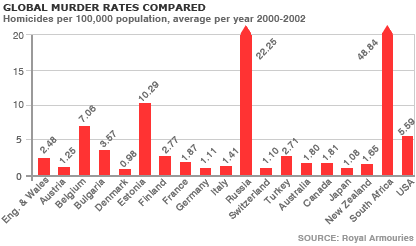
Note the date – 2000-2002. That makes the ratio between the UK and the US right at 2.25 to one. A far cry from where it was in the 1950’s, no?
By most rational measures, the UK doesn’t really have much of a firearm problem. They do, however, have a violent crime problem. And they have a firearm paranoia problem, as evidenced by this story illustrating the inability to differentiate between “violent and predatory” and “violent but protective”:
March without your guns, says mayor
A MAYOR sparked a row by asking soldiers to lay down their guns before marching in this Sunday’s Remembrance Day parade.
Chepstow town councillor Hilary Beach says the 1 Rifles Army regiment, based at nearby Beachley Barracks, should not carry their weapons during the ceremony because of the rising tide of gun crime across the country.
Veterans’ groups criticised her comments as “ridiculous”.
As well they should. But she’s the Mayor, and thought it was a good idea.
And here’s the inevitable result of that mindset when carried into the halls of power:
Jail term cut for ‘feral’ killers
Two Cheshire teenagers who terrorised a vulnerable man before beating him to death and throwing his body in a river, have had their life sentences cut.
Craig Dodd, aged 17, will now serve a minimum of three-and-a-half years in prison and Ryan Palin, 15, three years.
The pair were dubbed as “feral” when they were jailed for life for the manslaughter of Raymond Atherton, 40, in Warrington.
They beat and urinated on Mr Atherton before dumping him in the River Mersey.
Despite the severity of their crime, Lord Justice Rix overturned the life terms and replaced them with sentences of detention for public protection, giving each a minimum tariff to serve before parole can be considered.
Lord Justice Rix decided the sentencing judge at Warrington Crown Court had not been right to impose life sentences for the killing.
He said: “We think it was an error of principle to say that a discretionary sentence of detention for life should be imposed.”
But here’s the kicker:
The court heard Palin, of Grasmere Avenue, Orford, and Dodd, of Lisguard Close, Runcorn spent months systematically abusing the victim, who had severe learning difficulties, in a process they nicknamed ‘terroring’.
They regularly broke into his council flat on St Katherine’s Way, Howley, where they wrote graffiti on the walls, burnt his hair and daubed his face with paint.
On the night of his death in May 2006, the boys were seen by neighbours beating him with planks of wood until he bled.
(My emphasis.) I guess his neighbors should have honked their horns and jumped up and down.
This is what disarmament has done to the formerly Great Britain. This is the result of a society unable to differentiate between “violent and predatory” and “violent but protective.” This is what happens when the State denies its citizens the right to defend themselves, and abrogates its duty to protect them. This is what happens when a society journeys down the path of compelled helplessness.
And what was the mantra of the (not nearly a) Million Mom March?
England can do it. Australia can do it. So Can WE!
Not on my watch. Not ever.
An interesting piece at CO-ED Magazine, by that same title. Excerpts:
I could have cared less about firing a gun.
Growing up, even on the mean streets of New Jersey, I had never even seen a gun, fire arm, pistol, or whatever you want to call it except for television and movies. It wasn’t that my family was against weapons or the right to bare(sic) arms, we just didn’t bare arms. So when it came time to act interested, I had to do just that: ACT.
But being familiar with fire arms and pistols is something that is very important and every woman should know. Not only can it be thrilling to fire a gun but it is also very empowering.
(Emphasis mine.)
Together, we’ve gone to the range often. To find a range near you look here. Honestly, it surprises me to say, but I am even considering buying a gun myself. To see the laws in your state look here. In some states it takes a long time to buy a gun, which can be good or bad.
Something probably needs to change since there are so many nut cases carrying guns on college campuses these days. Still, as much as the government wants us to feel safe, I think I would definitely feel safer if I had a gun like Dirty Harry. I sit in my classes, and in the back of my mind, I think of how I am going to get out of the room if I hear shots from the hallway.
I’ve actually contemplated taking classes only on the first floor so I have a quick getaway. I’m not saying that I would want to carry a gun with me to class but at least if the campus security carried something other then a flashlight and a cup of coffee, I might feel safer. I don’t think I’m alone or crazy in my thoughts, but even if I am so what, I don’t think it is too much to have an expectation of making it safely through my classes each day.
RTWT.
Education. Isn’t it wonderful?
“Be consoled that you are winning the battle.” – Pt. II
That’s a quote from journalist Laura Washington in an email to me concerning the current status of the gun control battle.
Bear with me here, it’s a pertinent quote.
Back in December of 2005 while listening to NPR one Saturday afternoon, I heard a plea from the editors of Weekend America, which I wrote about that very day. At their website, WeekendAmerica.publicradio.org, they had posted this:
Early next year, we’ll take on the hot-button topic of guns and gun control. No doubt, you probably have a few questions of your own. We’d like to hear from you.
I invited my readers to respond. I certainly did. Ever since I’ve been getting weekly emails from them, telling me what will be on the upcoming show.
As far as I know, they never did run that piece on the topic of gun control.
But they’ve got an interesting one coming up this weekend! Get this:
Buy a Gun. Find Peace.
The first firearm Eric bought was a Ruger MK II pistol. It changed his life. According to Eric, owning the gun has made him think long and hard about the responsibility. And believe it or not, owning a firearm has brought calm to his life. Shooting at the range helps him take a step back from his hectic life and breathe deeply — it’s almost zen.
That sounds remarkably like the comparison Emily Yoffe made in another NPR piece between shooting and yoga.
We are winning the battle. This does not mean, however, that we can pack up and go home now. It ain’t over. It’s never going to be over. The price of liberty is eternal vigilance.
I think I’ll try to listen to the show this weekend. If I miss it, I’m sure that segment will be available as a podcast.
In yesterday’s post, More Misinformed Ignorance and Hyperbole, the Observer op-ed I excerpted had a quote from University of Toledo Professor Brian Anse Patrick which was part of my excerpt. Professor Patrick left a comment to that post, and a valid email address, so I sent him a reply email and did a little research on him.
He’s a good guy.
Check out this web page about his honors seminar on American Gun Policy. It’s not what you’d expect from today’s university campuses.
He sent me a reply to my initial email, and I have responded further. He’s given permission to post our exchanges, so here they are to date, beginning with his initial comment:
I’m quoted, more or less accurately but in no sensible context, in the Observer article by Paul Harris. He and I talked on the phone for 30 minutes or so, and as is usual with elite media reporters, he did not let the facts get in the way of his story.
Professor Brian Anse Patrick
Department of Communication
University of Toledops –and I am only a “liberal critic” in the 18th Century sense of that phrase.
—
Professor Patrick:
Thank you for commenting at my blog, The Smallest Minority. You wrote “…as is usual with elite media reporters, he did not let the facts get in the way of the story.” Would you care to elaborate on this? Also on your postscript, “I am only a ‘liberal critic’ in the 18th Century sense of the phrase”?
—
Hi Kevin:
You are welcome!
Re “he did not let the facts get in the way of the story.” Journalists like to represent themselves as “objective,” as unbiased lenses for examining reality, and some of the old time journalists approached this ideal fairly well, but modern journalists tend to be market driven story tellers. They tell the easiest, most dramatic story that caters to the debased tastes of a mass audience with an average attention spans measured in seconds, probably not minutes, and certainly never hours. When journalist say they are “working on a story” they really are, quite literally. Usually, as you know, they call the story theme “the angle” and of course angles are selected to cater to the cartoon-like tastes and crude emotions of the mass market. Walter Lippmann called these crude stock characters and ideas “stereotypes.” Actually explaining American gun culture, the success of the concealed carry movement, and the complicated sociology of guns and gun violence in America would overtax both reporter and audience. So the story must prevail. And of course in this article it was, more or less, “look at those crazy gun-wielding Americans.” Anything the reporter could collect was weighed on this scale and fit into the story accordingly, all else ignored. This is the nice thing about ‘angles, from a reportorial pint of view, they help quickly sort through mounds of problematic information a produce a coherent. albeit idiotically simplified “story.”
I talked with the reporter for maybe 30 minutes by telephone, he was in New York at the time, and I explained a number of facts, trends historical patterns, and effects re guns and concealed carry in America. These included things like the success of the CCW movement and modern American gun culture–e.g.., reduced crime, no crime from CCW holders, and the amazing mobilization of gun culture since the about 1970 or so as a broad-based social movement that has not only resisted top down elite-administrative power, but successfully spread its own message. I explained how widespread legal concealed carry by trained responsible citizens was unthinkable 20 years ago, but how the idea diffused and caught on–because of its success–and how a successful social movement made ideas that were unthinkable 20 years ago, thinkable today, e.g., the civil right movement. Similarly new American gun culture has expanded personal freedom. He of course translates this, via his angle, into how unthinkable it is for a teacher to carry a gun. He ignored the legally armed, trained responsible adult portions of my comments; and also my comments about how the CCW movement shows that the mere fact of gun carrying by this woman is not going to disrupt the orderly course of her life–or any other good person’s life: she is a valuable and useful person and will likely remain so. Armed criminals are a different order of creatures, impulsive, violent and dangerous with or without guns.
He also ignored comments I made about The American Gun Policy honors class I taught last semester, how my students had no problem with the idea of fellow students who were legally licensed and trained carrying concealed in class. Nor that I personally did not care to carry a gun while professoring, unless circumstances changed much for the worse in this country, but that I had no objection to any professor with a carry license doing so. I also gave him so estimates on the size of American gun culture much higher than the ones he used.
The reporter preferred his crazy Americans angle, and so probably does his audience–because any other angle might disturb their torpor. There is more, but you get the idea.
Re “classic liberal.” I am very tolerant in the John Locke sense. Formally I am a pluralist and a pragmatist, thus I believe well intended and informed people can be trusted with power, they are capable of rational thought –even if the habit seems to be dying out in our media, educational, and mass media systems. I think people must form their own interpretative communities and alternative media –like this blog–to make sense of the world and to organize and “in-form” themselves meaningfully to create, modify and socially construct a world in such a way that pleases their virtuous dispositions. This means no mass society run top-down by elites who claim to speak the truth on behalf of bovine masses, or a group of consumers rather than citizens, but rather a society of vigorous, active publics and interest groups pursuing their own ends and in-forming themselves e.g., like the Concealed Carry Movement as it has diffused from state to state.
Incidentally, I have a book on NRA and the Media: how NRA benefits by negative media coverage, gaining more members with more bad coverage. I will also be done soon writing a new book on the concealed carry movement.
A last comment re the article. One can no more expect a British journalist who writes for a mass audience to write a thoughtful and sensible article on American Gun Culture than one could expect gourmet food from the golden arches–it would just confuse their respective markets; who would consume it? Real informational substance is found in other places, such as blogs and alternative media. I could add a corollary to “known thyself” –it is “inform thyself” especially if you wish to pursue excellence.
—
Professor Patrick:
What a refreshing (nay, stunning) response from a member of academe! I know people like you are out there, but I suspect the camouflage is carefully worn to inhibit a “hostile work environment” in the majority of cases. May I assume you are grudgingly tolerated by most of the other tenured staff on your campus?
I am in complete agreement with you on the topic of professional journalism. One of my favorite anecdotes – you may have heard it – comes from Diane Sawyer:
“You know, I wanted to sit on a jury once and I was taken off the jury. And the judge said to me, ‘Can, you know, can you tell the truth and be fair?’ And I said, ‘That’s what journalists do.’ And everybody in the courtroom laughed. It was the most hurtful moment I think I’ve ever had.” – Diane Sawyer, Good Morning America, 7/12/07
The public at large is obviously aware, as well. Journalists, not so much.
One point in your reply struck a special chord with me. You wrote:
“He ignored the legally armed, trained responsible adult portions of my comments; and also my comments about how the CCW movement shows that the mere fact of gun carrying by this woman is not going to disrupt the orderly course of her life–or any other good person’s life: she is a valuable and useful person and will likely remain so. Armed criminals are a different order of creatures, impulsive, violent and dangerous with or without guns.”
I refer to this as an inability to differentiate between the two “gun cultures” – the “violent and predatory” and the “violent, but protective.” His type (exemplified by the British press, and it would seem, the majority of the British populace) sees only violent, and all violence is, by their definition, bad – unless that violence is carried out by an authorized member of the government, where it is instead referred to as force. And there is still some ambivalence even about those acts. I’m heartened to see what appears to be a growing public support for what they term “have-a-go heroes” – those who fight back against attackers – but they’ve got a long way to go after almost ninety years of a disarmament culture.
I did a little research on you and found this page concerning you and your American Gun Policy seminar. Needless to say, it was not what I was expecting. I’ve been studying the topic since about 1995 on my own, and I honestly believe if there was a PhD program available, I could fairly easily earn one. You state on that page, “Some of the research is very, very good; some of it is laughably bad.” I completely agree. I’m curious, however, on whether we agree on just which research is which. I pretty much discount anything coming from John Lott. He, like Michael Bellisiles, has proven himself untrustworthy, and I don’t have the time (or frankly, the statistician’s background) to check him. I am also leery of data coming from Gary Kleck. His data may be valid, but it doesn’t pass my smell test – and again, I’m not a statistician. Anything funded by the Joyce Foundation is, as far as I’m concerned, highly suspect. Garen Wintemute’s work may be quite good, but I cannot help but believe that it is distorted by his obvious bias. Anything that comes from Arthur Kellermann I treat like it came from John Lott.
I am particularly enamored of one particular work, Under the Gun: Weapons, Crime, and Violence in America by Wright, Rossi and Daly, a meta-study of all gun control research available at the time, commissioned by the Carter administration. It seemed to be very, very good work. And I was honestly surprised by the recent National Academies of Science meta-study report commissioned by the Clinton administration. I was expecting a hatchet-job, and instead they delivered pretty much the same report Wright, Rossi and Daly provided twenty years earlier.
Can you recommend or refer me to other “very, very good” sources?
Thank you for your time. As you can see, the topic is my particular hobby horse, and it is not every day that I run into someone who has, at least partially, made an academic career out of it. We’ll be here all night. I have to earn my living as an engineer, and do this in my off-time.
I would like your permission to post this, and any future exchanges we may have at my blog. And once again, thank you for commenting there.
Sincerely, a fellow Lockean
—
Please do post it.
I like John Lott’s stuff, ambitious, but his inferences often outrun the strength of his research designs. I like your Diane Sawyer anecdote, too. I agree re Wright and Rossi. Kleck is a very typical sociologist and speaks that language. His analysis of public opinion data on guns is pretty good, though, but I also wonder.
I just reviewed , and beat up, a gun book by Kristen Goss–see the new Journal of Popular Culture (Vol 40, no 5. ) –the October issue. I will follow up with a longer email with some opinions, comments re the literature.
BAP
PS tenure is a wondrous thing, got it back in May, and my colleagues are just beginning to realize, I think.
Regarding tenure, I’ll bet. This could get very interesting. A distinct divergence from my exchanges with Saul Cornell.