I Think They Blinked…

Here’s a news release from the Second Amendment Foundation, which is currently engaged in a lawsuit against the City of New Orleans for the illegal gun confiscations that occurred in the aftermath of Hurricane Katrina:

New Orleans Admits to SAF Attorneys They Have Seized Guns

BELLEVUE, Wash., March 15 /U.S. Newswire/ —

In a stunning reversal, the City of New Orleans revealed today to attorneys representing the Second Amendment Foundation and National Rifle Association that they do have a stockpile of firearms seized from private citizens in the wake of Hurricane Katrina.

The disclosure came as attorneys for both sides were preparing for a hearing in federal court on a motion filed earlier by SAF and NRA to hold the city in contempt. Plaintiffs’ attorneys traveled to a location within the New Orleans city limits where they viewed more than 1,000 firearms that were being stored.

“This is a very significant event,” said attorney Dan Holliday, who represents NRA and SAF in an on-going lawsuit seeking to enjoin the city from seizing privately-owned firearms.

“We’re almost in disbelief,” admitted SAF Founder Alan Gottlieb. “For months, the city has maintained it did not have any guns in its possession that had been taken from people following the hurricane. Now our attorneys have seen the proof that New Orleans was less than honest with the court.”

Under an agreement with the court, the hearing on the contempt motion has been continued for two weeks, the attorneys said. During that time, according to Holliday and fellow attorney Stephen Halbrook, the city will establish a process by which the lawful owners of those firearms can recover their guns.

“While we are stunned at this complete reversal on the city’s part,” Gottlieb said, “the important immediate issue is making sure gun owners get their property back. We’re glad that the city is going to move swiftly to make that possible, and naturally we will do whatever is necessary to make this happen.

“What happened in New Orleans after Hurricane Katrina was an outrage,” Gottlieb observed. “Equally disturbing is the fact that it apparently took a motion for contempt to force the city to admit what it had been denying for the past five months.

I wonder if they’ve got Patricia Konie’s .38? Anybody got an update on her lawsuit? Nothing on Google news.

Boy, It’s a Good Thing England Banned Handguns!.

Bank of England: Armed Gang Makes Haul

LONDON – A gang of armed robbers tied up 15 employees at a southern England security company and stole the equivalent of $43.5 million, the Bank of England said Wednesday.

The money, about 25 million pounds in bank notes, was stolen overnight from a cash center at Tonbridge in Kent county, a bank spokesman said. No one was injured in the robbery.

At least six men participated in the robbery, Kent police said, and 15 staff members on duty at the security company were tied up during the heist. The thieves, who wore balaclavas and carried handguns, were in the security company building for more than an hour, police said.

Detective Superintendent Paul Gladstone said the robbery was clearly planned in detail over time.

Perhaps next England should ban balaclavas. Or maybe thieves.

“Clearly planned in detail over time.” Good to know that their sharpest detective is all over this one.

(Hat tip to reader Lee P. for the link.)

Questions from the Audience?

In a comment to my second “Chocolate Rivers” post, commenter “homeboy” asked a number of good questions. Can’t learn if you don’t ask. However, instead of leaving the questions as an exercise for the student, I figured I’d go ahead and see if I could satisfy him.

1. With improvements in medical technology and access (cell phones), are comparisons with past homicide numbers meaningful?

Well, I guess we’d need to look at homicide rates and try to compare to wounding data. The wounding data is kind of hard to come by. Or, perhaps, homicide to attempted homicide, though that normally doesn’t break out by weapon. First, as far as homicide rates are concerned, there’s this chart for rates from 1900 through 2000:

that shows the rate varying widely. In 1993 the rate was 10.1 per hundred thousand population. In 2000 the rate was 6.1. In 2004 it was 5.5. Prior to 1910? Perhaps the data-gathering wasn’t up to the standards of today?

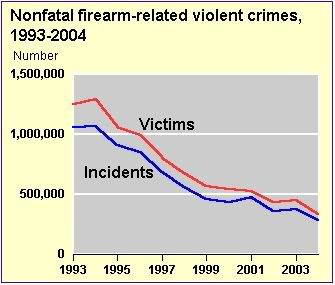
However, there’s this fascinating graph:

that shows that non-fatal firearm related crime has also been on a steep decline since 1993 – even though, according to that Clinton-era Whitehouse press release, almost two million new handguns enter circulation each year. And remember, a lot of those new guns are what the Violence Policy Center and its ilk term “Pocket Rockets”more powerful, higher capacity handguns:

Pocket rockets are a prime example of how the firearms industry has exploited increased lethality—greater killing power—over the last several decades to boost sales in its saturated markets.

But note something – the VPC states in that year 2000 report:

The industry has heavily promoted pocket rockets in connection with a wave of new or revised state laws that permit licensed persons to carry concealed firearms.

When did these “new or revised state laws” start? In 1987 with the passage of Florida’s “shall issue” law. In 1990 there were only 15 “shall-issue” states. In 1995 there were 27. In 2000 there were 30. After 1993, what does the homicide rate do? It declines. From 10.0 in 1990, to 8.7 in 1995 to 6.1 in 2000, to 5.5 in 2004, all while literally millions of these guns with supposedly “increased lethality – greater killing power” have entered the market. If the hypothesis is that “improvements in medical technology” are responsible for a decrease in homicide rates – the implication being that more people are getting shot, but surviving the experience – then that theory is shot to hell (pun intended) by this data.

Fewer people are getting shot. Fewer people are getting shot at. And there are more guns in private hands each and every year.

You’ll note that the chart in the VPC report:

ends in 1997. I guess they didn’t want to include data for 1998 and 1999, since it contradicted their premise, and the data since then continues to do so.

2. It seems more honest to compare attempted murder rates since the survival rate is much higher now; is there statistical data available, or can it be estimated?

Well, perhaps the survival rate is “much higher now,” but compared to when? The survival rate in 1950, or the survival rate in 1993? Or is the “increased lethality” of modern guns offsetting the advances in medical technology? I don’t know, but it appears that, at least since the mid-90’s, the actual incidences of gun violence have been declining – even though there are more and more guns in circulation, and – if you want to believe the VPC – those guns have “greater killing power.”

The fact of the matter is, violent crime is down – tremendously. Look at this chart:

From a peak in 1993 of 12.0 aggravated assaults per 100,000 population declined to 4.3 in 2004.

More guns have not meant more violent, more deadly crime. But that doesn’t stop the gun-grabbers from preaching the gospel of “more guns = more gun violence” every chance they get.

3. Is the data available to remove the suicide and domestic violence effects from the statistics used to claim that handguns in a home lead to higher homicide rates, and if so, what is the result?

Not that I’ve seen. Not that the National Academies of Science has seen either, according to their recent report. That data just doesn’t exist. Just for the record, I don’t believe that “handguns in the home” do lead to higher homicide rates.

4. Since we incarcerate at much higher rates than even 20 years ago, what effect is this having on who is committing the bulk of homicides?

Apparently not much. According to this graph:

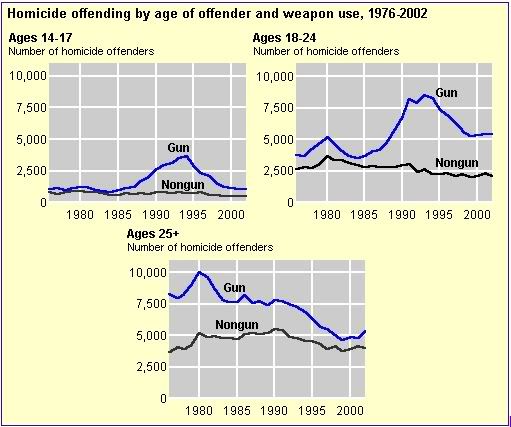
the decrease in homicide rates has been primarily a decrease in homicide by handgun, and according to this graph,

the spike in homicides was primarily committed by young men in the 18-24 age range. And their victims? The same age group:

This suggests to me at least that part of the reason that homicide rates have declined is that the criminally-inclined youth have done a bang-up job (so to speak) of killing themselves off. It’s not a matter of incarcerating them, it’s a matter of burying them.

5. If we’re incarcerating so many people, but we’re still having a problem with homicide, what is it we’re not doing right? Is there a high recindivism rate, or are new criminals arising to fill the some niche, or are we just incarcerating the wrong people?

Well, that’s if you consider a homicide rate of 5.5 per hundred-thousand “a problem.” We’re a violent society. The rate we have now is pretty damned low, historically. It’s down tremendously from a decade ago, but you couldn’t tell that by the rhetoric coming out of the gun-grabber, er, gun-control, um, gun-safety groups today. Certainly everyone would like to see it lower, but at what other cost to society? As you noted, we’ve already got a helluva lot of people in prison.

6. If it’s a high recidivism rate, is it because prison time insufficient deterent, or is the percentage of perpetrators actually punished too low to matter?

Could it be that prison (other than keeping violent criminals separated from the population) doesn’t actually deter? I don’t know.

7. How much of the homicide rate is caused by the “war on drugs” making narco-trafficing so lucrative?

Well, it would appear that the majority of homicides are related to drugs. Look at this graph:

This graph trends up, and mostly for “gang related” – read “inner-city drug wars.”

UPDATE, 1/27: Reader Earl Harding notes in a comment that the graph above is not saying what I’m attributing to it. He’s quite correct. My error. However, a little additional research and I found this:

In an analysis of New York City’s homicides in 1988, Paul Goldstein and his colleagues concluded that 74 percent of drug-related homicides were related to the black market drug trade and not drug use. For instance, the leading crack-related homicide cause was shown to be territorial disputes between rival dealers, and not crack-induced violence or violence (predatory thieving) to obtain money for crack purchases.

Small data point, but I think one that could be easily extrapolated. A Columbia University report stated:

In New York City, drug-related violence contributed to sharp increase in homicides beginning in 1985, peaking at a record rate in 1991. Estimates from police and injury surveillance systems suggest that over half the homicides in these years were drug related, often associated with drug market transactions. These record homicide rates led to intensive street-level law enforcement efforts beginning in 1987, resulting in unprecedented rates of drug arrests and sharp increases in the state prison population.

Still, that’s only New York.

The normally reliable GunCite reports:

  • Indianapolis/Marion County – Homicide review conducted from 1997 thru mid-1998. Victims and suspects were chronic offenders.
    Among homicide suspects:
    • 75% had either an adult or juvenile criminal record.
    • An average of 3.7 adult arrests.
    • Those with a prior record averaged 6 adult arrests and 5.5 juvenile arrests.

    Among homicide victims:

    • 63% had adult or juvenile criminal records.
    • An average of 4.6 adult arrests.
    • Those with a prior record averaged 8 adult arrests and 4.5 juvenile arrests.
    • For the 206 suspects and victims:
      • 1600 total arrests
      • 500 arrests for violent crimes
      • 800 convictions
    • 53% of homicide incidents were drug-related.
  • Minneapolis – Data was analyzed from January 1994 through May 1997. Nearly 45 percent of all homicides appeared to be gang related. More than 40 percent of gang members who were homicide victims or suspects had been on probation and 76.8 percent had arrest histories prior to the homicide incidents, with an average of 9.5 arrests. Suspects and arrestees had 7.4 prior arrests and victims had 7.5 prior arrests.

Draw your own conclusions.

End of Update.

8. What are the demographics of homicide victims and perpetrators; do we have an urban, suburban or rural problem; do we have a poverty problem; or is it a wide spread social problem; or is it predominately racial/predjudical problem; or is it largely caused by the drug war?

And here’s the question the gun-grabber organizations stay as far away from as they can possibly manage: who’s killing, and who’s dying? Look at these graphs, and pay particular attention to the scales:

It’s young, black, urban males. They make up the overwhelming majority of the victims and the perpetrators.

As I detailed in a post from 2003:

I have found the Centers for Disease Control WISQARS Fatal Injury Report tool quite helpful, so I’ll use it again. The latest data is for 2000, so let’s see what it says.

Total homicides: 16,765.
Total population: 275,264,999.
National homicide rate: 6.09/100,000 (Higher than the FBI’s 5.50)
Black homicide victims: 7,867 – Proportion: 46.9%, in agreement with FBI data.
Rate per 100,000: 22.28 – Considerably lower than the FBI says.
Other homicide victims: 8,898 – Proportion: 53.1%
Rate per 100,000: 3.7 – Again, considerably lower than the FBI says, but the ratio of 6:1 does agree with FBI numbers.

Now, if the U.S. had an overall homicide rate of 3.7/100,000 the total number of homicides in 2000 would have been 10,185. The total number of homicides for the black demographic: 1,306. A reduction of 6,561.

Another nice feature of the WISQUARS tool:

Number of firearm related homicides, all ages, all races, both sexes: 10,801
(36% of the total homicides – 5,964 people, were killed without a firearm, for a non-firearm homicide rate of 2.17/100,000.)
Number of black victims of homicide by firearm: 5,699 (53% of all homicide victims by firearm)
Number of black male victims between 15 and 35 years of age: 4,528 (79% of the total black victims of homicide by firearm, 42% of all victims)
Number of all other male victims between 15 and 35 years of age: 3,274 (30% of all homicide victims by firearm)
Number of black male victims between 15 and 35 that died by firearm: 4,343 (84% of the black male victims, 40% of the gunshot homicides.)
Number of all other male victims between 15 and 35 that died by firearm: 2,402 (73% of the white male victims – close enough to parity.)
And note, 62% of all gunshot homicide victims are males between 15 and 35 years of age.

The homicide by firearm rate for males between 15 and 35? Seventeen per hundred-thousand population.

So, does this prove anything? No. But it suggests, and pretty strongly. It suggests that the homicide by firearm problem is concentrated in a small, identifiable group. It suggests that homicide is heavily concentrated in the overall black demographic, and especially in young black men. And it suggests that instead of pursuing wholesale gun control laws that affect everybody, we ought to be pursuing policies that directly address that problem, because “gun control” doesn’t. And it isn’t a case of whites killing blacks, either. The fact is, it’s blacks killing other blacks in disproportionate numbers, and it’s largely restricted to urban (read “gang-related”) violence. See these Bureau of Justice Statistic charts showing the trends in homicide by race of offender and victim. Read this LA Times article to get some kind of feeling for the problem, or this USA Today piece. Money quote, from the second piece:

“Between 1976 and 1999, 94% of black murder victims were killed by other African-Americans. Nearly two-thirds of black homicides were drug related.”

Homicide is an epidemic in the young black male demographic. If it were a communicable disease, we’d be wearing ribbons and spending money on drug research. Instead we’re banning “assault weapons” and trying to pass licensing and registration laws that this very demographic is going to ignore. (See: England, gun bans, “Yardies”, etc.) And the public health organizations and independent groups are trying to treat firearms as if they were the disease vector.

(Hopefully, all those links still work.)

What I’ve never understood is that we know that the majority of homicide is concentrated in a very small, easily identifiable population, why are we trying to attack it by regulating guns? Instead, I’ve come to the conclusion that “gun control” isn’t about reducing crime. It’s about disarming the law-abiding populace.

I hope that helped answer your questions. Now, go and do some research for yourself.

(All graphs with the exception of the VPC one are from the Bureau of Justice Statistics web page.)

UPDATE: This post generated some commentary. A related post, with links, is here: Culture

Apparently Along with the Chocolate Rivers come Rainbow Skies and Gumdrop Smiles, too!

I might as well label this as “Part II” of And There Will Be Chocolate Rivers and Fluffy Bunnies. I should subtitle it But Nobody Wants to Take Your Guns Away! too.

They are getting desperate, aren’t they? In today’s Washington Post comes (anonymously) a near repeat of San Francisco Chronicle writer Kevin Fagin’s recent gun confiscation paean “And That’s the Trouble: The gun debate, personalized,” which I fisked last week. One shot (so to speak) from the left coast, and now one from the right. Today’s bit of utopic mendacity is entitled Killing Made Easy. Let us fisk:

WITH PITIFULLY little notice paid, another rash of year-end homicide statistics points up the madness of this country’s fascination with handguns. The domestic arms race continues full tilt. More kids are taking handguns to school in Maryland and Virginia, according to a report by The Post’s Daniel de Vise, and one big, sorry reason is that more than a few of them are responding to a perceived threat of violence in their midst. Murders by handguns continue to rock Prince George’s County and the District with a vengeance.

Really? Prince George’s County and the District? Where gun control is far more strict than anywhere in neighboring (and much less crime-ridden) Virginia? (Or pretty much anywhere else in the country?) Say it ain’t so!

But this situation is obviously a gun control problem, not a cultural problem, right? It’s so much easier to decide that inanimate objects are the cause than it is to face up to the fact that children feel threatened and that children are willing to commit lethal violence – without guns, too. Nope. Blaming the guns is far easier.

Three Maryland jurisdictions — Baltimore City, Baltimore County and Prince George’s — accounted for more than half of all school weapons incidents (the statistics include knives) in the state.

Ever looked at what it takes to legally buy a gun in Maryland? And keep it? That’s the state where Attorney General J. Joseph Curran, Jr. on October 20, 1999 in a press release “outlined the first step toward making Maryland the first state in the nation to outlaw handgun ownership except in very limited circumstances” with his manifesto, A Farewell to Arms (a 65-page PDF file).

He’s still Attorney General. Apparently the plan isn’t going all that well, at least at disarming the criminally inclined. Color me surprised.

Prince George’s tallied 533 weapon suspensions in 2004-05, up 74 percent from 306 in 1999-2000. But the prevalence of weapons in the schools is only one reflection of the regional scene and that of the nation as a whole. Police in most jurisdictions report that the majority of killings occur after two men argue and one or both pull out guns.

There’s an obvious thread here that members of Congress choose not to see: The all-too-free flow of handguns, a warped way of life that cows presidents and members of Congress who ought to recognize that the availability of handguns is murderous.

There you go: the availability of handguns is “murderous.” You read it in the Washington Post so it must be true, right? The fact that the editorial is unsigned gives it that much more validity! It couldn’t be a “warped way of life” practiced by the victims and assailants, could it?

No, of course not. It’s the guns. It must be the guns!

The problem is that Americans own 65 million handguns and the only effective safety measure would be a ban on these made-for-murder weapons.

(Emphasis mine, of course.) Really? You’re WAY behind, whoever you are. The number was 65 million in 1994. According to the federal Office of Justice Programs 1997 Annual Report:

In 1994, 44 million Americans owned 192 million firearms, 65 million of which were handguns.

The homicide rate in 1994 was 9.6/100,000 population. However, each and every year we add more handguns to the total in private hands. It’s that “availability” problem, you see. According to a White House press release from February 4, 2000:

Handguns Account for Nearly Half of All New Gun Sales – About 2 Million Per Year. Fifty years ago, handguns represented only one out of every 10 new gun sales. Now they account for more than four out of 10.

Being generous and estimating a mere 1.5 million per year, since 1994 we’ve added (carry the one…) over sixteen million new handguns into circulation. Not 65 million, but 81 million handguns or more are currently in circulation. We can trust .gov statistics, right?

The most recent homicide rate information? Still on its decline from the 1993 peak, homicide reached a new low of 5.5/100,000 in 2004 according to the FBI’s Uniform Crime Report.

So, would you please explain how, if “the availability of handguns is murderous,” the addition of at least sixteen million handguns – an increase of about twenty-five percent – resulted in a reduction in homicides nationally – of over 42%?

Unless, of course, your premise is entirely in error.

Nah, couldn’t be. You’re a journalist.

As writer Jenny Price noted in a Dec. 25 op-ed in The Post, only 160 of the 12,000 guns used to kill people every year are employed in legitimate self-defense; guns in the home are used seven times more often for homicide than for self-defense.

If you want to define “self-defense” as strictly “putting the bad guy six feet under.” Most of us in the real world, (that is, not journalism-school graduates) define “self-defense” as “stopping an attack” or “preventing a crime.” The death of the perpetrator is not required. Go peruse Clayton Cramer’s self-defense blog for a long list of successful (and a few not-so-successful) defensive gun uses where, amazingly, nobody died! Or, even better, read the ones where a perpetrator died, but their intended victims survived! Especially the ones where the perpetrator didn’t use a gun, since (also according to the FBI) only about 18% of violent crime involves a firearm.

Unsurprisingly, there are no stories from the Washington Post listed on Clayton’s site at this time. (Or probably ever, for that matter.)

While the actual number of legitimate defensive gun uses is a hotly argued topic, I’d estimate that it’s somewhere around a half-million a year. The lowest estimate anywhere comes from the government (surprise!) In 1994 (before many states enacted “shall-issue” concealed-carry laws) the Bureau of Justice Statistics, in a little-publicized blurb of a report, Guns and Crime: Handgun Victimization, Firearm Self-Defense, and Firearm Theft concluded:

On average in 1987-92 about 83,000 crime victims per year used a firearm to defend themselves or their property.

Personally, I think that number is tremendously low, but still, that’s 227 defensive gun uses a DAY – not exactly the 160 annually that “writer Jenny Price” (and the anonymous author of this op-ed) would like you to walk away believing. And that’s – at a minimum – almost seven times more defensive gun uses than criminal homicides. Interesting numerical coincidence, no?

Still, not inclined to let mere facts get in the way, the piece continues:

Lawmakers know all this and know as well that handguns — however exalted they seem to be in America — should not be in general circulation. Political long shot that it may be, a national ban on the general manufacture, sale and ownership of handguns ought be enacted.

Just like they did in Britain! But, the author admits:

It would not pacify kids or adults with violent tendencies, and it might not curb general criminal activity markedly. But it might well save thousands of lives.

It might? Based on what evidence? The National Academy of Sciences issued a 328-page report in 2004 based on 253 journal articles, 43 government publications, 99 books, a survey of 80 different gun-control laws and some of its own independent study. The report said the panel could find no link between gun control laws and lower rates of crime, firearms violence or even accidents with guns. This duplicates a 324 page study published in 1983 titled Under the Gun: Weapons, Crime and Violence in America. Twenty years more data, and still no evidence that “gun control” has any effect on gun violence. (I reviewed both of these reports back in December, 2004 in Evidence of Absence. Read the last couple of paragraphs of that.)

And Britain serves as a marvelous example of the futility of a handgun ban. Save lives? Can anyone demonstrate that Britain – where all legally owned handguns were registered, so they knew who to take them from – has saved a single life by banning and confiscating all of those legally owned firearms? Hardly, since homicide by handgun has been increasing there since the ban.

In an effort to appease the “sport shooters,” we get this:

Handgun exceptions could be made for federal, state and local law enforcement and military agencies; collectors of antique firearms; federally licensed handgun sporting clubs with certain safety procedures; security guard services; and licensed dealers, importers or manufacturers that are determined to be meeting those needs.

What part of “shall not be infringed” don’t you understand? Don’t you think the burden of proof that such a ban would be effective is on YOU if you want to violate a fundamental enumerated right? How about trying to pass a Constitutional amendment? No, that’s too hard. The populace is obviously stupid, since the NRA can dupe them into opposing gun control, but not stupid enough to be duped into giving up their guns.

Stupid Americans.

Such a bill was proposed more than a decade ago by Sen. John Chafee (R-R.I.), who has since died.

A man who might be surprised to learn that our homicide rate has declined by nearly half in that decade, while the total number of handguns has gone up by over sixteen million, don’t you think?

“I hear people say it’s a radical proposal,” he said then. “Well, I think to have the current situation is radical. No other country has anything like it.”

Britain does. Enacted in 1996. Pretty radical. Didn’t help. So we should repeat their failure here? Expand on that failure?

He described slaughter by handguns as killing in record numbers, threatening education and pushing the high costs of education even higher. So what’s new today?

What’s new? Sixteen million more handguns, 42% less homicide. Chafee introduced his “Public Health and Safety Act of 1993” in September of that year. In 1993 only sixteen states had “shall-issue” concealed carry laws on the books, and only Vermont allowed concealed-carry with no permit. In 2006 there are 35 states that have “shall-issue” concealed carry, and Alaska has adopted “Vermont carry.” That’s new, too.

But with all the evidence against you, you still won’t stop flogging that equine corpse.

And There Will Be Chocolate Rivers, and Fluffy Bunnies…

I’ll be honest with you, I’m about burned out. I now fully understand Toren Smith’s reason for pulling the plug on The Safety Valve. It’s fatigue. The idiotarians never give up. Shine the light of fact on them, and they may scurry away like cockroaches, or they might just stand and stare like deer into headlights, but you can’t get through to them. Their vision of utopia precludes any attempt to make them face reality, up to and including a severe beating about the head and shoulders with a ClueBat. It’s exhausting. Especially when they’re paid to be idiotarians, and we in the real world have to earn a living and refute them on our own time.

I’ve been wanting to write an essay on reproductive rates in societies for about a week, inspired by Mark Steyn’s recent piece “It’s the Demographics, Stupid,” but burnout has prevented me from doing so. It’s a hard piece. It needs lots of thought and research, and I just haven’t been up to it. But refuting idiotarian op-eds? That’s pretty much a no-brainer (though time consuming). The problem is, they never stop, and there’s only so much time available. But I found one today courtesy of KeepAndBearArms.com that I couldn’t pass over. From the San Francisco Chronicle (where better?) comes this classic piece of utopian bilge, “And That’s the Trouble: The gun debate, personalized”, by Chronicle writer Kevin Fagin. Let us begin:

My first real memory of a gun is from when I was 8, standing in a Nevada salt flat with my mother leaning over my right shoulder, folding my hand around the oh-so-smooth butt of a .22-caliber revolver. It was the gun she always kept under the car seat.

I squeezed off a shot at a rusty soda can 30 feet away, and the explosion in my ear and puff of sand alongside the can sent a shiver right to my toes.

“You’ll get it, don’t worry. You need to learn how to shoot this,” my mother said, patting my head. “You never know how you might need it someday.”

She was right. I did learn how to shoot, and I did need a gun someday … several somedays. And I came to respect the way a gun could save my life.

So, your mother gave you, at age eight, a useful skill. A skill that you’ve actually used.

I also came to hate guns for the ways they have just as easily, just as coldly, unthinkingly, devastated life around me and come close to ending my own life time and again.

Um, what? Guns have “coldly, unthinkingly, devastated life around” you? Well, guns are cold (unless recently fired) and unthinking, but they are also inanimate objects, not voodoo talismans. In case you hadn’t noticed, someone needs to operate the gun, unless it loads itself, aims itself, and pulls the trigger itself.

First problem, Mr. Fagin: your hatred is (typically) misdirected. Like a lot of people, you blame the tool because it’s easier than trying blaming the person. Blaming the person requires you to accept that people are responsible for their actions – even you, yourself. Personal responsibility is scary, for some.

Let’s continue and see more examples of Mr. Fagin’s denial of this annoying little piece of reality:

And I’ve come to believe guns have no logical, meaningful place in the lives of most ordinary people.

I’ve come to believe differently. What makes your belief more valid than mine? You’re paid to write and I’m an amateur? You’re a journalism school graduate and I only have a Professional Engineer license? How does that work, exactly?

There are plenty of Americans who have had the same relationship with this deadly little dealer of instant death. You could say the same thing about the country as a whole. It’s a dysfunctional relationship, and there’s not even a remotely easy way to fix it.

No, there’s not. Especially if you keep blaming the gun for the problem, and not the shooter. That’s never going to get you anywhere. There’s dysfunction, all right, but it isn’t in the machines, it’s in a tiny percentage of the users. So of course, we should take guns away from all the users, right? No?

I’m not talking here about guns in the context of casual can-plinking, or deer hunting, both of which are plenty of fun (Bambi lovers, chill) and don’t threaten anything if done right. I’m talking about the stuff that makes America the Wild West barbarian outpost which people from other countries shake their heads about. I mean the real gun stuff that happens when you’re staring life in the face, not being chauffeured to Congress past the rabble so you can blather Second Amendment platitudes and cash your NRA lobby checks.

Ah, yes. A literary three-fer. The obligatory “Wild West” reference (See Ravenwood’s Law), a shot (pun intended) at the eeeeevil NRA, plus a genuflection to the “shooting sports” crowd to dissuade them from thinking that their guns might be at risk. Oh no! This, of course, after having stated that “guns have no logical, meaningful place in the lives of most ordinary people.” What, the unspoken message is that “recreational shooters” aren’t “ordinary people”? That they’re somehow a special class? An elite not held to societal norms?

Anybody besides me see the dissimulation here?

Apparently the majority of British recreational shooters never did. Too late now.

Let me elaborate.

Please do. Should be fascinating.

One relative of mine was blown away when he and his brother played stick-em-up in the family barn; they didn’t know the shotgun was loaded.

And whose fault was that? Your mother taught you to shoot a .22 revolver – for defensive purposes, no less – at age eight. Did she teach you the four simple rules of gun safety at the same time?

  1. All guns are always loaded!
  2. Never let the muzzle cover anything you are not willing to destroy!
  3. Keep your finger off the trigger until your sights are on the target!
  4. Always be sure of your target, and what’s behind it!

Why did no one teach these four simple rules to your relative’s brother? Why did they treat a shotgun as a toy? Why is that relative’s death the fault of the gun and not the fault of the brother, or the adult the gun belonged to? Here’s another case of blaming the object and not the actor.

Another was nearly blasted in half when a robber shot him through his front door.

And the robber (and I assume murderer, since “nearly blasted in half” would suggest a fatal wound) bears no responsibility for loading, aiming, and shooting the gun? It’s the gun’s fault?

A cousin lost use of her arm for years after being shot in the Marin County Courthouse shootout of 1970; the judge’s head was blown off as he sat next to her.

Who loaded, aimed, and pulled the trigger of that gun?

Those were the things I experienced, but didn’t see. Other times guns cut closer.

In college in San Jose, I had to chase off attackers with a Luger 9mm semiautomatic when I lived alongside two warring gangs that promised to rub me out for telling the cops they shot holes in my windows and ripped off my car tires and gas.

So, your mother’s training was useful, no? You had a gun, you defended yourself with that gun, and you didn’t shoot anyone. (“Chase off” implies no one was hit, does it not?) What, your gun was defective? Were you a lousy shot? Or were you a responsible person, properly exercising your rights and responsibilities?

Years later, I had to replace that long-lost Luger with a .25-caliber semiautomatic when I was a young police reporter on a small-town newspaper and got a drug dealer mad at me.

I’d written a story about how this coke pusher kept squirming out of charges because the witnesses against him disappeared with each case. He told me to stop writing about him. When I gave him my Journalism 101 lecture about the First Amendment and wrote again, he stomped into my newspaper office.

“You’re dead, f — ,” he said, jamming his face close to mine. His rapsheet already included a juvenile sentence for murder and two assault convictions with knives and a shotgun. The local police commander shook his head when I asked what he could do to protect me. “Better get a gun, son,” he said.

What?!? The drug dealer had an assault conviction for (mis)using a knife? And another for (mis)using a shotgun? And the police didn’t tell you to “let the professionals handle it – you’re not qualified”? I’m shocked, I tell you! Shocked!

My dad’s .25 was under my pillow the next night, after I’d spent the afternoon blasting at targets. At 2 a.m. someone came slamming on my door, and I sat in the living room with the gun pointed straight ahead, screaming, “‘Bring it on, f — !” at the door. Whoever was outside screamed back, “You’re dead!” I yelled back again; this went on awhile, and then he went away.

Another successful defensive gun use. Again no one was injured. And you used your Second Amendment right to bear arms in defense of yourself and the state to protect your First Amendment right to freedom of speech.

Interesting how that works, isn’t it?

Did either of these defensive gun uses get reported in your newspaper? Just curious.

By the way, good thing the drug dealer didn’t hurl a Molotov cocktail through your living room window, wasn’t it? Once with a knife, once with a shotgun, arson would have made a trifecta. I suppose then you’d have blamed the manufacturer of the bottle, the beverage maker who originally filled it, the gasoline retailer, the refiner, and the textile maker who made the rag used as the wick? The drug dealer would, of course, bear no responsibility for the act itself. That is your thinking, is it not?

No doubt: I would have fired.

Good thing you didn’t. A .25 probably would have just pissed him off. He’d have likely come back with that Molotov.

Just as I might have in other situations over the years when gangsters I was trying to interview stuck pistols in my guts or to my head, or when my wife was robbed at gunpoint in Berkeley.

Berkeley? That bastion of the Liberal Left? It’s inconceivable! You need to deal with a better class of people.

And that’s the trouble.

If none of us had had guns — most particularly, those handy little handguns — all these confrontations would have simply involved yelling, fists or perhaps knives.

Really? Other weapons would be better than guns, like, fr’instance, knives? Well, knives are contact-distance weapons, but I’d rather be able to dissuade someone from out of reach. I’m not particularly fast – bad knee – so running really isn’t an option for me. I’m 43, overweight and out of shape (well, round is a shape), so I’m not going to be faster or stronger than, say, an fit twenty-year old mugger. Or one hyped up on Meth. I probably wouldn’t have an advantage over him in a scuffle, and I certainly wouldn’t if he were armed with the ubiquitous “blunt instrument” like a piece of rebar or a baseball bat and my only weapons were foul language and my fists. And if you think I want to stand and trade knife-strokes with him, you’re out of your freakin’ mind.

Still, I’m a pretty big guy. I have a major advantage over a 5′-nothing 99-lb. woman in the same situation. At least I have a chance to overpower an attacker.

But we’re both in the same boat if there’s more than one attacker. We lose. With a pistol, however, we have at least a chance.

In Great Britain, about 150 people die by handgun every year. In the U.S.? It’s about 29,000. I’ve lived in both places, and let me tell you, your radar for — and encounters with — danger are so drastically reduced across the water that they are nonexistent by comparison.

Really? Is that so? You’ve lived there, so you’re an expert?

First, Great Britain has never had a high homicide rate, even before 1920 when our two nations shared identical gun control laws – that is, none. Their homicide rate has traditionally been about 5% of ours, by all methods, including firearms.

I’m not going to check Mr. Fagin’s assertion that “about 150 people die by handgun every year” in Great Britain, I’m just going to point out to him that all handguns are BANNED in Great Britain, the ban went into effect in 1996, and since the ban was implemented the number of people dying by handgun wound has trended up. According to a 2003 BBC report, the number of crimes committed with handguns there has doubled since the ban.

Boy, that was effective, huh?

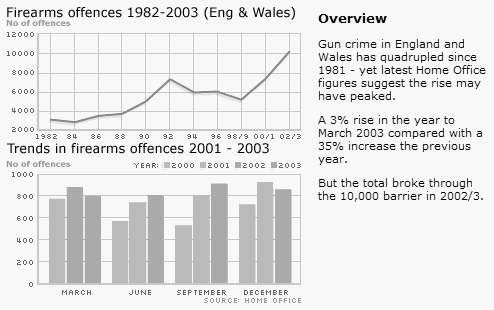
Here’s a handy little graph from the BBC that shows gun crimes in England & Wales since 1982:

“Gun crime” has quadrupled since 1981. Most of it (58%) is committed with handguns. They hope it’s levelling out, but nobody really knows yet.

It’s utopic as hell to say “if none of us had guns,” but that little “150 people die by handguns every year” admission indicates that isn’t going to happen, ever. What Great Britain has done since 1920 in a death-by-a-thousand-cuts strategy, is to disarm its victim pool. It hasn’t done a thing to its criminal pool. That’s gotten larger and more violent.

While violent crime in America has been on a roller coaster, it has for the last eleven years been on a steep decline. This decline has included the crime of homicide. At the same time, the number of guns in circulation, including “those handy little handguns” has been going up here by a few million a year. Moreover, the number of states with “shall issue” concealed-carry laws has reached 35, and two states have no permit requirements for concealed carry at all. In each of these states, allowing responsible people to carry guns for self-defense has not resulted in “blood in the streets” and a revival of the “Wild West.” Violent crime has gone down, in some cases faster than in neighboring states that don’t allow concealed-carry. So much for blaming the guns.

Meanwhile, in Great Britain violent crime has been climbing dramatically since about 1955, while the number of (legally owned) guns has been increasing only slightly, and handguns have been made illegal. Somehow that decline hasn’t affected gun availability to the criminal class. In 2002 the Telegraph reported that gun crime had tripled in already crime-ridden London, and had skyrocketed in other cities as well.

The number of people robbed of personal property at gunpoint rose by 53 per cent in the Metropolitan Police area between April and November last year, compared to the same period in 2000, a rise from 435 victims to 667.

London and other inner city areas, including Birmingham, Manchester and Nottingham, have increasingly suffered from gun crime, mostly perpetrated by young men and fuelled by rows in the lucrative crack-cocaine market.

Police chiefs now fear that a younger generation of street criminals will graduate from stealing mobile phones at knifepoint to using guns to commit street robberies.

The two trends have already overlapped in the Metropolitan area. As well as the increase in gun-point muggings, aggravated burglaries involving guns rose from 101 in April to November 2000 to 153 in the period last year.

Senior officers at Scotland Yard and in a number of inner city forces fear that indiscriminate gun violence will increase as school-age thugs grow up to copy their elders and carry the kind of weapons previously seen in gangland warfare.

Some have suggested that Britain is witnessing the kind of cocaine-fuelled violence which surfaced in America in the 1980s. Cocaine, particularly from the Jamaican connection, now floods into Britain, generating violence and providing a ready source of crack.

Ballistics experts warn that firearms are now cheap and easily available. The discharge of guns in non-gangland crimes, such as muggings, is still relatively rare.

Apparently, Mr. Fagin, you didn’t live in any of those areas.

So, they’ve got a lot of guns, but they’re unlikely to actually pull the trigger. But how many guns do they have? Hard to say, but one estimate is at least three million on the black market. That’s a lot for a country with a population of about 55 million.

There’s that problem again: blame the gun, or blame the criminal? They’ve got the guns, they use the guns in crimes, but they rarely pull the trigger.

So is it the gun, or the gunner?

Absolutely, if you’re a law-abiding citizen and some predator is pointing a barrel at you, you want a barrel of your own to end the argument. But as plain as the blood on the floor every day in America, that’s a perpetual tit-for-tat that will always be awful.

Mr. Fagin, it beats the alternative of being unarmed against predators. You make the mistake of lumping violent but protective in with violent and predatory. You see only violent. You seem to believe that A) disarming us will disarm them, and B) disarming them will make them less dangerous. Your only evidence of this is a comparison to Great Britain, which has never had a high homicide rate, regardless of weapons.

One more time, with feeling: That comparison isn’t valid.

The only way to fix this hideously dysfunctional relationship we in this country have with guns is to treat it like you would any other: End it before you wind up murdered.

Nobody’s saying this will be easy. The important things never are.

So let me get this straight: The law-abiding gun owners should “end our dysfunctional relationship” with guns “before (we) end up murdered.” Right. Disarming ourselves will protect us.

Worked for Great Britain, right? Oh, wait….

Would you have given up that Luger? That .25 Automatic? Would that have made you safer?

What you’re asking is for the responsible people to disarm. Britain’s done that to its population, and it hasn’t made them safer. Clayton Cramer has an excellent piece illustrating the failure of that approach in his essay “The Failure of British Gun Control” (a PDF file, six pages.) Excerpt:

In the period 1981-96, as American crime rates fell, British crime rates rose. Britain now has higher rates of robbery, assault, burglary, and motor vehicle theft than the United States.

By 1995, England & Wales had 1.4 times the robbery rate of the U.S.; more than twice the assault rate of the U.S.; and nearly double the U.S. burglary rate.

He’s got all the footnotes and reference. Things there have not improved since 1995. Quite the opposite, in fact.

Mr. Fagin, you might have lived there, but I’m going to assume you lived in the crime equivalent of Fargo, North Dakota. The crime was there, you just weren’t exposed to it. No one bashed you over the head for your cell phone, a relatively common crime in London. No armed gangs invaded your home – a “hot burglary,” a much more common occurence in Great Britain than in the U.S. You were neither victim of or witness to a physical assault by a gang of “hoodies” who would record the “happy slapping” attack on a cell-phone camera for replay on the internet.

Good for you. But don’t tell me how much safer Great Britain is. Your chances of getting shot dead there are much lower. Your chances of being a violent crime victim are much greater.

And don’t make me go into the demographics of murder victims here. I don’t have that kind of time.

But given your personal experience, you want all of us to embrace your utopic vision of a gun-free world and disarm.

Here’s an idea: The criminals and idiots go first. Then we “casual can-plinking, or deer hunting” sport shooters won’t have to, will we?

Your mother apparently had a firm grasp on reality. What the hell happened to you?

(This piece burned 3.5 hours. And could still stand some editing.)

South Park Pundit Hits a Bullseye…

…with his most recent post, Freaks and Geeks, on the topic of how to not put off new shooters. And Josh is right on target. Money quote (from my perspective):

The conclusion that I came to is that image matters to the liberals and gun grabbers. It isn’t the content – it’s the image. Hence the AWB “Scary Looking Weapons Ban” that sunset last year. Hence the .50 ban in CA. Hence half of the “feel good” legislation these idiots keep trying to shove down our necks. And they do it because they’re scared of that which they don’t know and that which they see as the norm.

From an earlier piece of mine, Fear, The Philosophy and Politics Thereof I quoted cultural anthropologist Abigale Kohn, author of the book Shooters: Myths and Realities of America’s Gun Cultures.

Our initial attempt to meet local militia members took us to a shooting range in the Bay Area, where we assumed local militia meetings would be held. We went on a Tuesday night, fully expecting the range to be seething with radical political activity. Why else would people congregate at a shooting range, if not to meet other like-minded, potentially dangerous right-wing gun nuts?

That’s what they expect. And I said in that piece:

It’s important to understand this: We call ourselves “gun nuts” – embracing the label thrust upon us by the ignorant, anti-gun bigots – but many of them really believe it. We’re “potentially dangerous” because we like guns.

I think that’s something most gun owners don’t really grasp. I know it initially took me a while to get my mind around the idea.

Josh also said in his piece:

I guess what I’m asking is for everyone to be the buffer for new shooters. Introduce them to the world the right way and don’t let the “crazy” be their first influence. Don’t let some of the kooks get to them first.

Exactly right.

I noted, a few posts down, that even the DemocraticUnderground.com now has a forum for gun-related posts, and apparently a small but growing contingent of gun owners. A few posts later, in one relating a surprisingly pro-gun New York Times piece, I commented that this combination made me “wonder if there’s not some subtle, conscious or subconscious effort ongoing to ensure that the Left arms up in time for the coming conflict.” Commenter TomWright, however, was more sanguine:

Kevin, I have no problem with the DU or anyone else arming up. It forces personal responsibility on those that do, which may move them the tiniest bit away from the left, educates them on firearms, and can only help RKBA.

And he’s right – because ignorance promotes fear. Exposure, as Abigale Kohn, Slate columnist and NPR contributor Emily Yoffe, and even more recently blogger Redmemory1 have discovered, destroys that fear.

On top of that, owning a firearm tends to make already responsible citizens remarkably aware of a whole new world of responsibilities. I’ve quoted this letter before, but here’s a perfect place to put it again. It’s a piece written to Kim du Toit’s old site (link’s broken), but I have it archived. Written by “Refugee,” it goes like this:

I’ve seen the light, and I’m here to testify.

To those of you who grew up with guns, I expect that what I’m about to say will seem painfully obvious. But I came to class late, and what I learned there is still fresh and vibrant.

I thought, all my life, that I couldn’t own a gun safely, that no one could, really. Guns were dangerous and icky. Even after I realized that the Second Amendment was not quite the shriveled, antiquated appendix I’d been taught, for a couple of years or so I still wobbled around with the training-wheel comfort of believing that while not all gun owners were necessarily gap-toothed red-necked fascist militia whackos, I myself ought not to own firearms. I was too clumsy and careless, and guns were still dangerous and icky.

Just before 9/11 I woke up to how quickly my liberty was eroding, and in a fit of anger and defiance started saving for a handgun while training with rentals. (Thanks to Harry at Texas Shooters Range here in Houston.) When I actually bought one (to the horror and confusion of my friends and family), having it around the house, carrying it in my car, talking about it, showing it off, and of course shooting and maintaining it, taught me what I could not learn from books, magazines, classes, or even Usenet:

It taught me that freedom takes practice.

I thought I’d practiced. I’m as full of opinions as the next guy, and not shy about passing ’em out to anyone who’ll listen. I read banned books and underground comics. I’ve walked the picket lines and hung out with undesirables. A preacher’s kid, I pointedly don’t practice a religion. I’ve done stuff that Wasn’t Allowed.

But when I got a gun, I discovered it had all been safe, padded, wading-pool-with-floaties dabbling. After near on to fifty years, I finally started to grow up. If my Grands are any clue, I’ve still got twenty or thirty years to work on it, and get to be something like mature by the time I go senile.

It’s not just that rights are useless if they are not exercised, not even that rights must be used or be lost. It’s that exercising your rights, constantly, is what instructs you in how to be worthy of them.

Being armed goes far beyond simple self-protection against thugs or even tyrants — it’s an unequivocal and unmatched lesson that you are politically and morally sovereign; that you, and not the state, are responsible for your life and your fate. This absolute personal sovereignty is the founding stone of the Republic. “A well-regulated militia” (where the militia is “the whole people”) isn’t just “necessary to the security of a free state” because it provides a backup to (and defense against) the police and the army. More importantly, keeping and bearing arms trains sovereign citizens in the art of freedom, and accustoms us to our authority and duty.

As Eric S. Raymond wrote:

“To believe one is incompetent to bear arms is, therefore, to live in corroding and almost always needless fear of the self — in fact, to affirm oneself a moral coward. A state further from ‘the dignity of a free man’ would be rather hard to imagine. It is as a way of exorcising this demon, of reclaiming for ourselves the dignity and courage and ethical self-confidence of free (wo)men that the bearing of personal arms, is, ultimately, most important.”

It isn’t true for all gun owners, but the fact remains that taking responsibility for your own protection tends to make one understand the limits of the State, and the duties of the citizen. And, as TomWright said, new shooters – no matter their political leanings – can only help.

There are the Freaks out there who are off-putting. One of the reasons I don’t enjoy shooting in the desert is the yahoos that are often shooting nearby, but they are the minority in the ranks of gun owners. Many of us are willing to introduce newbies to shooting. Publicola maintains a list of volunteer instructors, and I’m on it. I have an invitation posted at the top of the left column of this blog:

If you have never shot a firearm, regardless of your position on the right to arms, and if you live near or visit the Tucson, AZ metropolitan area, I invite you to go shooting for a day. I will provide the arms, ammunition, targets, safety equipment, range fees and instruction.

All you have to do is show up.

I’ve not been as successful at attracting interested shooters as I’d like, but at least I’m trying. The residents of the UK have, for all intents and purposes, lost their right to arms because there were not enough among them familiar with firearms to counter public opinion. While the number of guns in circulation here continues to increase, the number of gun owners has been in decline for a long time. If we do not want to follow the British lead, then we need more people who are familiar with and not afraid of guns and gun owners. That means we need more shooters.

So let’s take Josh’s advice.

Edited to add: Stickwick Stapers has a new post up which is remarkably coincidental. Excerpt:

I like to tell Canadians that I am surrounded by armed and dangerous people in Texas — my neighbors — and that’s a good thing. But Canadians just don’t get it. They inevitably associate guns with bad guys, and I kind of understand, because, unless they’ve grown up in the far north or Alberta, none of them has grown up in anything resembling a self-reliant culture. I’d always been a 2A supporter when I lived in Canada, but the reality of the gun-culture was a little scary when I first moved to the States. My first couple of times to the range, I wasn’t 100% sure that the guy next to me wasn’t some kind of maniac. It was weird trusting a complete stranger with the power of life and death over me — and that’s the root of Canada’s problem with guns.

Not just Canada’s. RTWT.

Edited again to add this piece over at Boots & Sabers from yesterday. Excerpt:

It was disconcerting to know that wherever we went in Texas, any one there could be carrying a gun—the bank, the hospital, the mall, our church, virtually everywhere we went except for bars and the movie theater could be full of gun-toting nutjobs.

Then during a trip back home, I had an epiphany. Any one or more of the people at Fox River Mall in Appleton, Wisconsin, could be a gun-toting nutjob, too, and if one of those nutjobs went off, we were all sitting ducks. It took having the right to protect myself to miss it when it was gone. It is that moment that changed the way I felt about concealed carry. It’s that day that I realized that even though I may choose not to carry a weapon, someone else who is trained, licensed, and ready may be able to protect me from a gun-toting nutjob who might break the law and shoot or threaten to shoot an innocent person.

That is when I stopped rolling my eyes when Owen put his handgun on his belt. That is when I asked him to take me out and teach me to shoot a handgun. That is when my view of Texas changed. The people with CCLs aren’t the gun-toting nutjobs, it’s the criminals without CCLs who are the trigger-happy loonies.

Again, RTWT. It’s a meme!

And Owen? Link to your wife’s blog in the piece, would you?

Updated AGAIN, 12/1, 9:25PM: South Park Pundit has a new post up by the new gun owner in question, Examining “Gun Nuts”. More of the same meme, but recommended reading. Excerpt:

So after dealing with these notions half a dozen people had, what can I conclude? One, people are stupid when it comes to guns and gun owners, and that just compounds the fear they have. I mean – I own something capable of killing another person. My car. Golf clubs. Bat. Frying pan, maybe. But everyone owns those things and sees them everyday. They aren’t exposed to guns all the time, so they fear them, and because they fear, they hate.

Ayup. And the only thing that can overcome that fear is familiarity.

So take a newbie shooting this weekend.

Reprinted with Permission of the Author

Dr. Peter Friedman is a professor of mechanical engineering at UMass Dartmouth who lives in South Dartmouth. He wrote an op-ed that was published online at the SouthCoastToday.com web site and on Page A16 of The Standard-Times on November 17, 2005. I wrote and asked him for his permission to reprint the piece in its entirety, and got his approval. (Hat tip, Jeff at Alphecca)

Gun control is not the answer to crime

The headline on his Web site reads, “Kennedy urges House to not weaken D.C. gun safety law.”

In the statement that follows, Sen. Edward M. Kennedy asserts, “The House amendment would repeal the D.C. government’s long-standing ban on firearms and would be a disastrous blow to gun safety in the district. For almost three decades, D.C.’s ban on handguns and assault weapons has helped reduce the risk of deadly handgun violence.”

Could Sen. Kennedy actually believe that Washington’s ban on firearms has been effective? Perhaps he could prove his sincerity by giving his bodyguards and servants the night off and taking a stroll alone around a few of Washington’s low-income neighborhoods one night.

Sen. Kennedy’s headline avoids the real purpose of the current law. It is not “gun safety”; it is to completely disarm the public. In fact, the D.C. law makes it almost impossible for anyone to legally obtain a firearm, and makes it illegal to use a gun for self-defense by mandating that all guns be kept in inoperable condition.

The result of the D.C. gun ban is a different reality than Sen. Kennedy’s world. According to FBI crime statistics, before the ban in 1976, Washington’s murder rate was declining. In the 15 years that followed the ban, Washington’s murder rate climbed 200 percent, while the national rate climbed only 12 percent.

Washington, D.C., is now consistently one of the most dangerous cities in the country. In 2002, it overtook Detroit and claimed the title as the murder capital of the United States. During that year, it defied national trends of decreasing murder rates to post a 13 percent increase.
What Sen. Kennedy either fails to understand or intentionally ignores is that criminals will not stop carrying guns just because it is illegal. What the gun ban would do is make the law- abiding easy targets by preventing them from having the means to defend themselves.

For most gun owners, possessing a gun is like owning an insurance policy. You hope that you never need it, but if you do, it is a nice thing to have.

But gun ownership has another and more important impact: Statistical studies have shown that increasing citizens’ rights to use firearms for self-defense reduces crime because criminals fear armed victims.

Because criminals do not know who is armed, non-gun owners also benefit. It is precisely for this reason that home invasions are rare in the United States; on the other hand, they have become common in Great Britain since that country passed its near-total gun ban.
In Washington, D.C., because residents are denied their right to self-defense, the criminals know that they have the streets to themselves.

If you are in favor of the D.C. gun ban, perhaps it is because you believe that the citizens can rely on their overworked Police Department to protect them. A series of court rulings, however, held that the police have no obligation to provide protection. In Warren v. District of Columbia, three women who were held captive for 14 hours and repeatedly beaten, raped and sodomized, sued the city after it failed to respond to their emergency calls.

D.C. Superior Court ruled, “A government and its agents are under no general duty to provide public services, such as police protection, to any particular individual citizen.”
The net result is that the law-abiding residents of Washington are not allowed to defend themselves, and cannot rely on the police to protect, defend or rescue them, either. They are left at the mercy of Washington’s rampant criminal element. Instead of being a national showplace, Washington is a national disgrace!

The total gun ban that remains in D.C. also is in stark contrast to the right to carry laws that have swept across the nation. While gun control advocates predicted that increasing the self-defense rights of gun owners would turn the United States into the OK Corral, the opposite is true.

Solid and comprehensive statistical evidence from examination of crime trends in every county in the country has proven that states that have liberalized the right to self-defense have had a reduction in crime when compared to states that have not.

Because an entourage of bodyguards and police constantly surrounds him, Sen. Kennedy might not care that ordinary citizens of Washington would like to be safe in their homes.

I disagree with the senator, and feel that everybody — not just the rich and powerful –has the right to protection from crime. It is time to restore the right to self-defense to the oppressed people of Washington, D.C. Perhaps then they will see their worst-in-the-nation murder rate turn around.

EXCELLENT piece, Dr. Friedman.

One More Example of the Futility of Prohibition

I have posted previously on the illicit gun manufacturing industry in Pakistan. (Check out some of their work. It’s exquisite.) Dave Kopel, in a February 6, 2002 NRO piece reported that residents of the island of Bouganville, blockaded by Australia in their fight against mining interests and the governments of both Papua New Guinea and Australia, had begun making functional copies of the fairly sophisticated M-16 automatic rifle. They’d started out with crude single-shot weapons, but had learned, rapidly.

So I’m not at all surprised to find out via David Hardy that there are gunmakers in the Phillipines manufacturing handguns and submachine guns at remarkably reasonable prices. Here are the key parts of the Taipei Times piece:

Ronberto Garcia picks up a freshly-made, well-oiled automatic sub-machine gun from a formica table under a huge gazebo and screws on a long silencer.

“We sell these guns to anyone, provided they have money,” Garcia says, proudly showing the weapon to a group gathered in his heavily secured concrete home.

“We are just plain businessmen who sell something people want,” the portly 53-year-old Garcia said in his home….

Guns made in Danao have become so famous that Japanese Yakuzas were known in the past to fly to the central Philippines to collect them, townsfolk say. Military officials as well as local politicians also buy them for their own purposes.

“Everyone buys from us. The military officials, some foreigners too, and civilians for their protection,” Garcia says, but stops short when asked if he has ever sold firearms to communist guerrillas who proliferate in the countryside.

Danao guns are bought on a cash basis, and deals are done without any papers changing hands. Word of honor is important between buyer and seller and anyone seeking to buy is screened thoroughly.

There are no actual figures as to how many guns are produced in Danao at any given time, but Garcia estimates up to 500 units of various gun models are smuggled out of the area every month.

Father Guido Sarducci’s Five-Minute University, Economics: “Supply and-a Demand. That’s it.”

When guns are severely legally restricted, a black market will spring up. A lucrative black market. And the people the legal restrictions were enacted to disarm will still be armed. But the law-abiding won’t be. There’s that cliché again: “When guns are outlawed, only outlaws will have guns.” And these manufacturers don’t report to the government. They sell to anyone with the necessary cash.

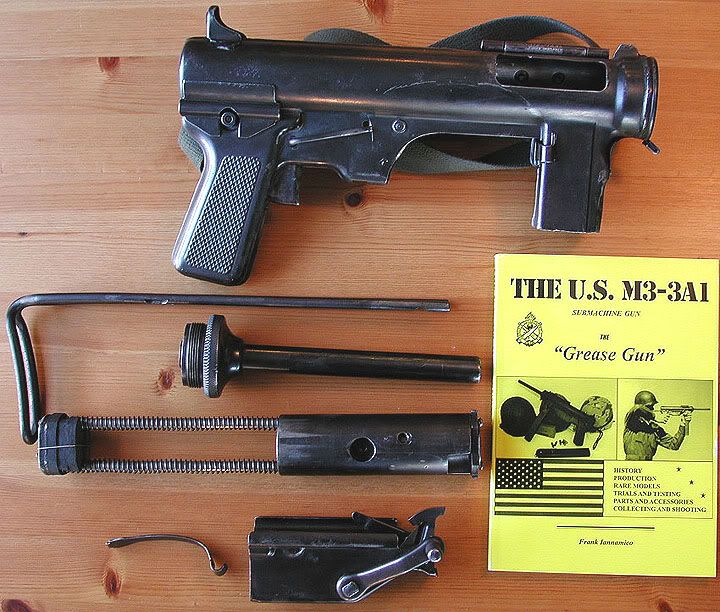
Gun manufacturing isn’t rocket science. Pakistanis with hand tools and bench vises can build perfectly functional automatic weapons. Take a look at an M3 “Grease Gun” some time. Here’s one disassembled so you can see just how simple it is.

Grease Gun

Stamped out in the thousands by GM’s Guide Lamp division for WWII, it is simplicity itself. Each unit cost the U.S. government $20.94 in 1942, according to a recent issue of American Rifleman magazine. That’s the equivalent today of $262.75, for a highly reliable, .45 caliber, fully-automatic weapon, at a profit. And I could build one in my garage today.

“Reducing gun availability” in an effort to “make us safer” is a pipe-dream, and always has been.

Just Like Communism, Gun Control Only Works if EVERYBODY Does It?

Mr. Free Market emailed me this one, and it bears a striking resemblance to the argument Canada is making about the U.S.

Chunnel security shambles

A SUN undercover reporter smuggled a pistol into Britain using the Channel Tunnel — just like Harvey Nichols killer Michael Pech.

Our man bought a Walther P-38 gun at a Czech market, then drove to Calais and on to the Chunnel’s shuttle train without being searched or quizzed.

Evil Pech, 30, used the same route to smuggle in a gun and murder shop girl Clare Bernal before killing himself.

GUN crime is soaring in Britain — with an armed offence committed EVERY HOUR.

The number of firearms incidents has doubled in England and Wales since 1997.

Cases of attempted murder with firearms have also doubled to over 1,200 annually — more than three every day.

In the year up to June, 11,160 gun crimes were recorded, up five per cent on 2004.

A study has revealed that one in ten teenage schoolboys in London had carried a real handgun, replica, or ballbearing gun in the last year. The list of victims falling prey to firearms is also growing.

They include schoolgirl Danielle Beccan, 14, who was murdered in a drive-by shooting as she returned from Goose Fair in Nottingham in October 2004. Two men were jailed this month.

And in another crime which shocked the nation, Toni-Ann Byfield, seven, was shot alongside her drug-dealer father Bertram Byfield, 41, at a flat in North West London two years ago.

An associated story:

Gun scandal

THE SUN today reveals the scandal of how simple it is for smugglers to bring deadly handguns into Britain.

At the weekend two of our journalists bought a deadly Walther pistol in a Czech market.

Then it was next stop London, with no checks made as they journeyed across Europe and through the Channel Tunnel.

It is believed thousands of firearms enter the country this way — fuelling the terrifying rise in gun crime on our streets.

Eastern Europe is awash with guns. They pour in from the former Soviet states and the Middle East.

Six weeks ago the Chunnel route was used by Slovakian Michael Pech before he shot ex-girlfriend Clare Bernal in a London store.

Shockingly, NOTHING has been done since then to tighten controls.

The possession of handguns was banned in Britain in 1997 following the Dunblane massacre.

Yet illegal ownership is believed to be higher than it has ever been, and the yearly toll of deaths and injuries from guns has DOUBLED.

If no effort is made to stop firearms at our borders that figure will continue to rise … and shame us.

And all of this, after the government banned all modern handguns, and 57,000 people turned in their 162,000 legally owned, legally registered firearms.

“No effort” is being made? I find that highly doubtful. I mean, after all, I reported on the fully-automatic Uzi submachineguns being smuggled into England that were detected by customs officials. Thirty Uzis, twenty-nine silencers and 475 rounds of ammo. And a lot of frozen pizza.

It does make me wonder how many they’ve missed, though. And whether you can order a large pepperoni with a suppressed Uzi on the side.

Supply and demand. The first law of economics cannot be eliminated. And, although England is an island, they still cannot keep guns out. Yet Canada thinks the U.S. can stop the flow of firearms across that pourous border? We can’t stop the flood of drugs and illegal aliens across the (much shorter) Southern border.

“Homicide rates tend to be related to firearm ownership levels. Everything else being equal, a reduction in the percentage of households owning firearms should occasion a drop in the homicide rate”.

Evidence to the Cullen Inquiry 1996: Thomas Gabor, Professor of Criminology – University of Ottawa

According to this Home Office report the homicide rate for England & Wales over the last two decades is as follows:

1984 – 10.8/million population
1985 – 10.7
1986 – 11.2
1987 – 11.9
1988 – 10.9
1989 – 10.3
1990 – 10.9
1991 – 12.3
1992 – 11.4
1993 – 11.1
1994 – 12.4
1995 – 13.0
1996 – 11.4
1997 – 11.9 (all handguns banned)
1997/98 – 11.8 (They changed reporting methods here – wonder why?)
1998/99 – 12.6
1999/2000 – 13.1
2000/01 – 14.9
2001/02 – 15.5
2002/03 – 18.4
2003/04 – 15.8

Yes, the gun confiscation was tremendously successful, wasn’t it?

Words Mean Things…

You want to know one reason Chicago keeps trading places with Washington D.C. for “murder capital of the U.S.”? Reader Fabio from England emailed me this link to the City of Chicago’s Gun Safety/Violence Reduction page, and here is what it says:

The principal cause of violent crime in the City of Chicago is the use of firearms by criminal street gangs. Although Chicago has among the toughest gun control laws in the country, street gangs have been able to arm themselves with increasingly deadly firearms with little apparent problem. Although Congress and the Administration appear unwilling to make further gun safety legislation a high priority, the City urges increased attention to these issues in Washington.

The City remains deeply concerned about a last minute provision enacted as part of the FY03 Omnibus Appropriations bill that derailed the City’s Supreme Court argument regarding the Bureau of Alcohol, Tobacco and Firearms (BATF) restricting the availability of public information for litigation purposes. Furthermore, Congress has included other last minute provisions in the FY04 Omnibus Appropriations bill that put in place additional limitations on BATF’s accountability for, and ability to collect and distribute, what should otherwise be public information on firearms purchases. In addition, Congress is considering legislation to provide unprecedented limits on liability focused solely on the firearms industry. These enormously misguided efforts are a direct threat to general public safety and will greatly undermine the efforts of state and local governments to combat illegal firearms trafficking.

Let’s parse this, shall we?

The principal cause of violent crime in the City of Chicago is the use of firearms by criminal street gangs.

Bang! (No pun intended.) Right out of the gate we have an outright falsehood. The principal cause of violent crime is the use of firearms. Um, what?

No, the principal crime IS the improper, illegal use of firearms. (Since the City of Chicago prohibits the use of firearms for legitimate self-defense, that’s about the only kind of firearm use you’re going to see there.) The CAUSE of this is something else entirely. But I have absolutely no doubt that the powers-that-be see the situation precisely as that first sentence is written. The cause to them is the “use of firearms.” That makes the solution simple, no?

Eliminate the firearms and the “cause” is eliminated.

And here we have a textbook example of my favorite gun-control meme, “cognitive dissonance” – described most eloquently by Steven Den Beste:

When someone tries to use a strategy which is dictated by their ideology, and that strategy doesn’t seem to work, then they are caught in something of a cognitive bind. If they acknowledge the failure of the strategy, then they would be forced to question their ideology. If questioning the ideology is unthinkable, then the only possible conclusion is that the strategy failed because it wasn’t executed sufficiently well. They respond by turning up the power, rather than by considering alternatives. (This is sometimes referred to as “escalation of failure”.)

Or as I put it, “Do it again, only harder! To wit:

Although Chicago has among the toughest gun control laws in the country, street gangs have been able to arm themselves with increasingly deadly firearms with little apparent problem.

In other words, “Our efforts to control the cause of violent crime, have failed. But the ideology cannot be wrong! The only possible conclusion is that the strategy failed because it wasn’t executed sufficiently well, so…”

Although Congress and the Administration appear unwilling to make further gun safety legislation a high priority, the City urges increased attention to these issues in Washington.

“We must try again only harder!” (And note the use of the phrase “gun safety” and not “gun control” – though we are told endlessly that “gun safety” isn’t “gun control.”) And since they cannot acheive the ends their philosophy dictates through legislation, they must then pursue it through the courts:

The City remains deeply concerned about a last minute provision enacted as part of the FY03 Omnibus Appropriations bill that derailed the City’s Supreme Court argument regarding the Bureau of Alcohol, Tobacco and Firearms (BATF) restricting the availability of public information for litigation purposes.

I’ll bet the City of Chicago will be joining the Brady Center in its legal challenge to the recently passed Protection of Lawful Commerce in Arms Act, since it shuts down the nuisance lawsuits Chicago and other cities have been pursuing. They say as much in the last two sentences:

In addition, Congress is considering legislation to provide unprecedented limits on liability focused solely on the firearms industry. These enormously misguided efforts are a direct threat to general public safety and will greatly undermine the efforts of state and local governments to combat illegal firearms trafficking.

Efforts pursued thorough tort law, not legislation. But on top of that, read this again:

Furthermore, Congress has included other last minute provisions in the FY04 Omnibus Appropriations bill that put in place additional limitations on BATF’s accountability for, and ability to collect and distribute, what should otherwise be public information on firearms purchases.

No, I don’t think so. While the BATF has been moved from the Treasury Department to the Department of Justice, the BATF is still a tax collection agency. The information the BATF gathers isn’t “public information,” it’s protected tax information, as the state of California recently learned to its displeasure when charges against licensed FFL dealer Andy Sun were thrown out when the judge determined the search warrant was obtained based on “protected information” obtained from the BATF:

(Judge Frank P.) Briseno ruled that the search warrant was based on mandatory information Sun was required to submit to the Bureau of Alcohol, Tobacco, Firearms and Explosives during an administrative inspection.

Not public information – protected information.

So it appears that the City of Chicago is quite willing to break Federal law to achieve its ends. My only question is this: Why doesn’t Chicago look around the rest of the country and figure out why its violent crime rate is so much higher than other cities of similar size that don’t have “the toughest gun control laws in the country”?

Oh, right. Because the philosophy cannot be wrong!

Fabio concluded in his email to me, “They don’t get it and never will.” Sadly, I’m pretty sure he’s right.