The Other Side

Whenever I write an essay or argue a point about “gun control,” I always consider what the other side believes. While I’ve always had an individual-rights understanding of the topic, it took me the better part of a decade to construct what I believe is the logically defensible ideology to support that position. I have tried to repeat those logical points, sometimes ad nauseam, in order to reach a broad audience. After three and a half years that audience has about reached its maximum here, I think, but I’m not quite done yet. The other side certainly isn’t.

A long time ago I came across an anonymous quote:

Simply put, gun control cannot survive without an accompanying sea of disinformation.

This fact is one of the major reasons I started this blog. I’ve found through my studies that this is a truism that most people simply don’t recognize. I feel a need to counter that disinformation. I found another quote, courtesy of Triggerfinger that is almost a truism:

The difference between gun control activists and gun rights activists is simple: gun rights advocates know what they are talking about, because they have depth of knowledge and expertise about firearms and pay attention to the issue. Gun control advocates, for the most part, don’t know anything about guns, aren’t interested in guns, and only pay attention to gun issues when the latest blood-dancing press release arrives. There’s no sustainability.

All but the last sentence is correct. There may not be individual sustainability, but the bad ideas, the erroneous memes, live on.

Today’s example: an op-ed in the Philadelphia Inquirer. Let us fisk:

Too many weapons

Control guns to stop the tide of death.

John D. Kelly IV is an associate professor and vice chair of orthopedic surgery at Temple University School of Medicine

Weeks ago, I witnessed – again – a young man’s needless departure from this life. Another victim of the senseless gunshot violence that has besieged our city.

Note: Not “senseless violence,” but “senseless gunshot violence,” as though it is not the violent who are at fault, but the guns. Not the person behind the trigger. Not the person who acquired the gun, loaded the gun, aimed the gun, and pulled the trigger – but the gun itself.

As an on-call surgeon, I ambled into the emergency room before I left for home that evening to be sure that no orthopedic care would be needed for the “trauma category one” I heard announced throughout the hospital.

When I entered the trauma bay of our emergency department, I was mesmerized by the surgeons who were trying heroically, albeit unsuccessfully, to revive the young man who had been shot in the chest, presumably at close range. In the cacophony of the life-and-death rescue attempt, I couldn’t help overhearing a nurse exclaim, “There is another gunshot wound to the abdomen on the way.”

The poor lifeless body I beheld was essentially dead on arrival. I was overwhelmed by the childlike countenance of this poor victim, who was reportedly 21 years old, but appeared still an adolescent.

A 21 year-old who the Bradys will count as a “child” in their statistics, but by any measure ought to be an adult. And why isn’t he an adult? Is that the fault of guns in society? Or is there a deeper problem that guns are a symptom, but not a cause of? Dr. Kelly doesn’t, and won’t, consider that question. He has bought the “guns-as-disease-vector” meme.

I remember my 21st year with the fondest of memories – family, friends, romance, sports, college, and the prospects of going to medical school. I grieve this young man’s truncated existence – the loss of yet another precious life, a life that will never experience the full joys of early manhood, of vocational calling, of marriage and parenthood – all the things I revere about my blessed life.

I can infer from this that Dr. Kelly, the fourth, was not raised in the “inner city.” That he was not part of the tiny identifiable population (young urban black males) who make up the largest portion of homicide victims in this country, at a ratio of 6:1 over any other group. That he was raised in a whole family, and was not exposed to drugs and violence and poverty and neglect from childhood.

But it’s guns that are the problem.

With every gunshot-related death I read about or discover on TV, there always seems to be a continual lament: This violence and senseless killing must stop. With the recent death of Philadelphia Police Officer Gary Skerski, the commemoration of the 25th anniversary of the slaying of Officer Daniel Faulkner, and the recent Springfield High School tragedy, the public outcry against gun violence seems to have reached its zenith.

For this month. But as I’ve pointed out, Birchwood, Wisconson is not Hungerford, England, and Philadelphia is not Dunblane.

Alas, nothing has changed. Yet one blatant truth remains: There are too many guns.

And this, ladies and gentlemen, is what every single one of us who believes in the right to arms must never forget:

The Other Side BELIEVES THIS. Absolutely. Without question.

It is their single article of faith.

And it is why we cannot trust them when they assure us that they “don’t want to take our guns away,” because if the “one blatant truth” is that there are “too many guns,” then the only answer is to reduce the number of guns.

This is simple logic.

If the single tenet of the gun control faith is that there are too many guns, the end purpose of “gun control” must be to eliminate them, or – at a minimum – reduce the number to some arbitrary “this is OK” level which I suspect must be significantly close to “nobody but the police and the military can have them” as to be indistinguishable from zero.

Yet we’ve seen what that’s done for England. A complete ban on full-auto weapons? Gun crime increased. And full-auto weapons are still used in crimes, such as the January, 2003 shooting of two young women at a party in London, or a young man at a carnival in August of 2004, or the group, including a 14 year-old girl, arrested in October for supplying guns to criminals – including a sub-machine gun. What do they all have in common?

Youth gangs and drugs. Poverty and crime. Failed government policies based on “blatant truths.”

Oh, and full-auto, completely banned firearms on an island.

What about their ban on semi-auto and pump-action rifles? Gun crime went up. The ban on handguns? Well, according to the BBC, “there were 4,903 firearms incidents recorded in 1997 when Labour first took power” and banned handguns. In the 2004/2005 reporting period there were 10,979 recorded firearms crimes according to the Home Office. Fifty-eight percent of them involved handguns.

The handgun ban removed over 160,000 – legally owned – handguns from the UK with the insistence that the “number of guns” was the problem, and the promise that banning them would make the public safer.

Go ahead. Pull my other leg.

The British government estimated in 2000 that some three million firearms were held illegally there. Boy, those bans really worked well, didn’t they?

A wounded culture simply does not need more weapons to settle its conflicts. Until this truth is embraced and conquered, the carnage will continue.

Par for the course, once you’ve erroneously identified the problem, the platitudes commence. There’s a “wounded culture,” all right, but “more weapons” isn’t the cause of it, nor will removing those weapons cure that culture even if it was possible. England is the petri-dish that proves this. Until that truth is embraced, the real problems will never be addressed – because it’s far easier to point to an inanimate object than it is to overcome cognitive dissonance and accept the facts of human nature and failed social policies.

The state legislature’s failure last month to pass a paltry “one-gun-a-month” limit speaks volumes about Pennsylvania’s resistance to change. Who on God’s earth needs more than one gun a month?

Ah, yes. The “need” argument. Who needs “X.” Fast cars? Trans-fats? Cigarettes? Why not ban it? If you can limit purchases to one a month, why not one a year? One a decade? If someone is already a gun owner, how does limiting them to one a month stop them from committing a gun crime with one they already own? Or how does preventing a purchase from a dealer prevent a purchase on the street? Criminals won’t pay attention to “one gun a month” laws. They don’t pay attention to “murder is illegal” laws. This is another example of “feel good” legislation that acts as “the next step.”

The next step to what? To not taking our guns away, of course!

Because the “blatant truth” is the number of guns is the problem!

Oh. Wait…

Pennsylvania eased restrictions on gun permits in 1985. Since then, the number of citizens authorized to carry a handgun has risen from 700 to 32,000.

Wait for it…

Guns are simply too accessible and too often used to settle disagreements.

By CCW permit holders?

Our beloved city saw 380 homicides in 2005, the most since 1997. Of those, 208 deaths were over “disputes.” Drug-related killings accounted for only 13 percent. This year, we are on track to surpass the total.

Again, BY CCW HOLDERS?

That’s certainly the implication he’s blatantly making. Oh, and according to the Pennsylvania State Police, there are currenly not 32,000 carry licenses on issue in Pennsylvania, but 101,643. This report does not mention how many of those permits have been revoked, so I must assume that (as it is in other states) the number is insignificantly small, but these are the people Dr. Kelly thinks should be disarmed.

Because we know they have guns. They’ve got a license to carry.

And what were those “disputes” about? Could it be “disrespect?”

I have had the profound privilege of caring for injured members of our beloved police force for the last 17 years. These men and women risk their lives every day for our society. Yet they continue to be outgunned by their foes. Even an Uzi submachine gun, classified as a handgun, is not difficult for a criminal to procure.

It’s not too hard in England, either, and sub-machine guns have been banned there since 1935. Also, Uzi submachine guns are classified by the Bureau of Alcohol, Tobacco, Firearms and Explosives as fully-automatic weapons, not handguns, unless you’re talking about the semi-auto version called the mini-uzi. The full-sized semi-auto Uzi is considered to be a rifle. The submachine gun version is heavily restricted, and it is difficult for a law-abiding citizen to procure. But remember this Violence Policy Center advice from 1988:

Although handguns claim more than 20,000 lives a year, the issue of handgun restriction consistently remains a non-issue with the vast majority of legislators, the press, and public. The reasons for this vary: the power of the gun lobby; the tendency of both sides of the issue to resort to sloganeering and pre-packaged arguments when discussing the issue; the fact that until an individual is affected by handgun violence he or she is unlikely to work for handgun restrictions; the view that handgun violence is an “unsolvable” problem; the inability of the handgun restriction movement to organize itself into an effective electoral threat; and the fact that until someone famous is shot, or something truly horrible happens, handgun restriction is simply not viewed as a priority. Assault weapons—just like armor-piercing bullets, machine guns, and plastic firearms—are a new topic. The weapons’ menacing looks, coupled with the public’s confusion over fully automatic machine guns versus semi-automatic assault weapons – anything that looks like a machine gun is assumed to be a machine gun – can only increase the chance of public support for restrictions on these weapons.

Dr. Kelly provides another example of that “sea of disinformation” and his willingness to prey on the public’s ignorance.

Our country experiences 30,000 firearm-related deaths each year. The estimated cost to society – including loss of productivity, pain and suffering, and reduced quality of life – has been estimated at $63.4 billion per year.

According to the Centers for Disease Control, in 2004 the total was 29,569. Of those, 16,750 – 56.6% – were suicides. Yet America ranks relatively low for suicide internationally. Japan, with almost no privately owned firearms has a far higher suicide rate. France, higher still.

But guns are at fault for all of this?

There were 5,733 non-gun homicides and 15,689 non-gun suicides in 2004. What inanimate object is at fault for those? And why are we only concerned with gun violence? (And why don’t they call it the “Gun-Violence Policy Center”?)

Contrast these figures to countries with strict handgun prohibitions, where the number of gunshot-related deaths is but a handful.

Like England? Where the number of gunshot-related deaths has always been “a handful?” But has done nothing but increase since they addressed the “one blatant truth” that there were “too many guns?” Or how about Switzerland, where every eligible male of military age possesses a military (read: “full-auto”) firearm and ammunition for it, and handgun regulation is minimal?

Care to run that one past me again?

It is time we embrace the obvious. Unless we make it more difficult (if not impossible) to carry a concealable firearm, the loss of precious life will inexorably continue.

Yes, let’s “embrace the obvious.” How do you plan to accomplish this? Force everyone to walk around naked, or dressed in Saran-Wrap sarongs? How do you propose to make the some 65 million (in reality, probably far more) handguns already in private hands unconcealable?

I’m waiting for suggestions. You know, that don’t include “Mr. and Mrs. America, turn them all in.”

Let’s get back to the fundamentals: Life is more important than outdated “Second Amendment rights” or special-interest groups.

At least Dr. Kelly recognizes that the Second Amendment stands in the way of his vision of utopia. Unlike most, while he considers it a withered appendage, it’s not yet powerless to him. Life is more important than a lot of things. That’s one reason so many people have gotten concealed-carry permits, 101,000 in Pennsylvania alone. My “special interest group” supports the Constitution of the United States and all of the Bill of Rights. My “special interest group” recognizes that even über-liberal Alan Dershowitz understands the problem illustrated here:

Foolish liberals who are trying to read the Second Amendment out of the Constitution by claiming it’s not an individual right or that it’s too much of a public safety hazard, don’t see the danger in the big picture. They’re courting disaster by encouraging others to use the same means to eliminate portions of the Constitution they don’t like.

And so does Ninth Circuit Judge Andrew Kleinfeld:

About twenty percent of the American population, those who live in the Ninth Circuit, have lost one of the ten amendments in the Bill of Rights. And, the methodology used to take away the right threatens the rest of the Constitution. The most extraordinary step taken by the panel opinion is to read the frequently used Constitutional phrase, “the people,” as conferring rights only upon collectives, not individuals. There is no logical boundary to this misreading, so it threatens all the rights the Constitution guarantees to “the people,” including those having nothing to do with guns. I cannot imagine the judges on the panel similarly repealing the Fourth Amendment’s protection of the right of “the people” to be secure against unreasonable searches and seizures, or the right of “the people” to freedom of assembly, but times and personnel change, so that this right and all the other rights of “the people” are jeopardized by planting this weed in our Constitutional garden.

The populations of the states in the 9th Circuit could, if they wished, do as Washington DC has done and ban the possession of handguns, for all the good it has done DC. That Court has said that the Second Amendment does not protect against this. But Judge Kleinfeld understands the danger, and he is not alone. Dr. Kelly apparently rejects or has never considered the argument.

Society’s cultural ills, including the dissolution of family, departure from God, and the degradation of mores, will not be cured overnight. In the meantime, guns remain the default option for conflict resolution, and more guns lead to more killings. One more senseless killing is one too many.

Excuse me for now. I must rest and prepare for the next call. I pray my spirit can withstand what befalls my eyes in my next sojourn to the ER.

And here I will ask Dr. Kelly Joe Huffman’s “Just One Question”:

Can you demonstrate just one time, one place, throughout all of human history, where restricting the access of handheld weapons to the average person made them safer?

Because that’s what Dr. Kelly is advocating.

The only people he and those like him can disarm are the law abiding, as England has discovered. All they can accomplish is to build a population of disarmed victims for what we know is a small but willing pool of violent criminals who will never be prevented from getting all the weapons they want or need. England and Wales may not have the murder rates that the U.S. does (and never has), but their rates of many other violent crimes – muggings, home invasion, assault – outstrip ours now.

As I illustrated in Questions from the Audience?, the United States just went through a decade of significantly declining violent crime – including homicide – while “the number of guns” here increased each and every year. During the same period, the UK experienced significantly increased violent crime, even though they banned handguns. How does Dr. Kelly reconcile this fact with his belief that “too many guns” are the cause of violent crime? I submit that he cannot.

His position is, as it is for all who support “gun control” as a solution to violent crime, based on an erroneous ideology. His solution is, as Mencken (or someone) put it, “simple, neat, and wrong,” but it’s the one “solution” that all fervent gun-control supporters believe. “If we could only get rid of the guns…” But we can’t. They’re not going to go away.

And that is why we must reach those fence-sitters out there and educate them. The best way I can think of is to make them shooters too. As Teresa Neilson Hayden put it:

Basically, I figure guns are like gays: They seem a lot more sinister and threatening until you get to know a few; and once you have one in the house, you can get downright defensive about them.

I think Mike S. Adams might be on to something. Interesting idea, anyway.

UPDATE, 1/1/06: Dr. Kelly responds:

Kevin, thanks for writing. I am all for individual rights but life is sacred. Too many guns end up in the wrong hands. Whatever reason, the youth of North Philly too easily obtain firearms which are designed to seriously wound. Furthermore, the folks who wrote the constitution also owned slaves. Times do change and we have not demonstrated that the masses, unlike you, can responsibly control firearms. Peace, JK

My reply to the good Doctor:

Dr. Kelly:

You didn’t read the piece, did you?

Read your email to me carefully. What you’re saying here is that “the masses” – your words – are “the wrong hands.” Apparently I’m OK, though.

Sorry, Doc. “The wrong hands” belong to about 1% of the total population – i.e.: by definition, not “the masses.” But your “solution” is to disarm them, with the erroneous belief that doing so will disarm “the wrong hands.” We have evidence that this doesn’t work. That the fundamental idea behind it all – that there are “too many guns” – is in error.

Are you familiar with the term “cognitive dissonance”?

Oh, and as to “the Founders owned slaves” – yes, they did. And seventy years after the ratification of the Constitution and the Bill of Rights we went to war over that. Following the war, we amended the Constitution. Read the Fourteenth Amendment, ratified in 1868, the one that contains this clause:

No state shall make or enforce any law which shall abridge the privileges or immunities of citizens of the United States; nor shall any state deprive any person of life, liberty, or property, without due process of law; nor deny to any person within its jurisdiction the equal protection of the laws.

Are you familiar with the Dred Scott decision? The 1856 Supreme Court case that declared that blacks, free or slave, could not be citizens because:

For if they were so received, and entitled to the privileges and immunities of citizens, it would exempt them from the operation of the special laws and from the police regulations which they considered to be necessary for their own safety. It would give to persons of the negro race, who were recognised as citizens in any one State of the Union, the right to enter every other State whenever they pleased, singly or in companies, without pass or passport, and without obstruction, to sojourn there as long as they pleased, to go where they pleased at every hour of the day or night without molestation, unless they committed some violation of law for which a white man would be punished; and it would give them the full liberty of speech in public and in private upon all subjects upon which its own citizens might speak; to hold public meetings upon political affairs, and to keep and carry arms wherever they went.

I don’t think the “privileges or immunities” language in the Fourteenth Amendment was an accident. I think Chief Justice Taney quite well understood what the Founders intended with the Bill of Rights, and he and six others on the Supreme Court denied fundamental human rights to blacks because they were “the wrong hands” in their eyes.

So you’re in good company. You’ve just broadened the bigotry.

UPDATE: The good doctor sent another reply. So did I.

Quick! Somebody Tell the 9th Circuit!

(And the New Jersey Superior Court)

Eugene Volokh reports that the Washington Supreme Court has declared in State v. Williams:

In the present case, we are similarly concerned that possessing a firearm can be innocent conduct. Citizens have a constitutional right to bear arms under both the federal and state constitutions. U.S. Const. amend. II; Wash. Const. art. I, § 24. A person may lawfully own a shotgun so long as the barrel length is more than 18 inches in length and has an overall length of less than 26 inches.

This is an error. The overall length must be greater than 26 inches, not less. The decision gets this right in at least two other places.

See RCW 9.41.010(6). RCW 9.41.190 precludes possession of a short-barreled shotgun. Moreover, the statute also criminalizes possession of a short-barreled rifle and a machine gun. The factor concerned with innocent conduct is particularly important in the case of a machine gun, which can be altered in ways not easily observable.3 If strict liability is imposed, a person could innocently come into the possession of a shotgun, rifle, or weapon meeting the definition of a machine gun but then be subject to imprisonment, despite ignorance of the gun’s characteristics, if the barrel turns out to be shorter than allowed by law or the weapon has been altered, making it a machine gun. The legislature likely did not intend to imprison persons for such seemingly innocent conduct.

This decision did uphold Mr. Williams’ conviction for possession of a short-barreled shotgun, but contrast this wording to, for example, New Jersey’s Superior Court in State v. Pelleteri. Here are the facts of that case:

On May 30, 1990, our Legislature proscribed the “knowing” possession of “assault firearms.” N.J.S.A. 2C:39-5f. Persons legally in possession of such firearms prior to the effective date of the statute could retain these weapons by obtaining the appropriate registration. N.J.S.A. 2C:58-12. Included in the definition of “assault firearm” is “[a] semi-automatic rifle with a fixed magazine capacity exceeding [fifteen] rounds.” N.J.S.R 2C:39-1w(4). Defendant was convicted of “knowingly” having in his possession an assault firearm, a semi-automatic rifle with a magazine capacity of seventeen cartridges.

Defendant, an expert marksman who at one point was employed as a firearms instructor, won a Marlin semi-automatic rifle in the late 1980’s by placing first in a police combat match. An avid gun collector, defendant placed the weapon in his safe. Defendant claimed that he neither inspected nor used the firearm. When the police recovered the gun from defendant’s residence in December 1993, it still had the manufacturer’s tags and the owner’s manual attached to the trigger guard. The owner’s manual indicated that the rifle could hold at least seventeen cartridges. Defendant claimed that he never read the manual. While conceding that he knew the rifle was a semi-automatic weapon, defendant contended that he was unaware that the firearm had a magazine capacity exceeding fifteen rounds.

And here’s the court’s decision:

We are concerned here with a statute dealing with gun control. “New Jersey has carefully constructed a ‘grid’ of regulations” on the subject. In re Two Seized Firearms, 127 N.J. 84, 88, 602 A.2d 728, cert. denied sub nom Sholtis v. New Jersey, 506 U.S. 823, 113 S.Ct. 75, 121 L.Ed.2d 40 (1992). This is an area in which “regulations abound and inquiries are likely,” and where the overarching purpose is to insure the public safety and protect against acts and threats of violence. State v. Hatch, 64 N.J. 179, 184, 313 A.2d 797 (1973); see also Burton v. Sills, 53 N.J. 86, 248 A.2d 521 (1968). “[T]he dangers are so high and the regulations so prevalent that, on balance, the legislative branch may as a matter of sound public policy and without impairing any constitutional guarantees, declare the act itself unlawful without any further requirement of mens rea or its equivalent.” State v. Hatch, 64 N.J. at 184-85, 313 A.2d 797. When dealing with guns, the citizen acts at his peril. In short, we view the statute as a regulatory measure in the interests of the public safety, premised on the thesis that one would hardly be surprised to learn that possession of such a highly dangerous offensive weapon is proscribed absent the requisite license.

Here’s that “highly dangerous offensive weapon” that the State of New Jersey declared an “assault firearm.”:

Actually, that’s not true. The picture here is of the current Marlin Model 60 .22 rimfire semi-automatic tube-magazine rifle. The new one has been redesigned so that it can only hold fourteen of the horrificly deadly .22 rimfire rounds, thus rendering it not an “assault weapon” in the eyes of the State of New Jersey.

Then, of course, there’s the Ninth Circus, who, in Hickman v. Block declared:

The Second Amendment to the United States Constitution states: “A well regulated Militia, being necessary to the security of a free State, the right of the people to keep and bear Arms, shall not be infringed.” U.S. Const. amend. II. Hickman argues that the Second Amendment requires the states to regulate gun ownership and use in a “reasonable” manner. The question presented at the threshold of Hickman’s appeal is whether the Second Amendment confers upon individual citizens standing to enforce the right to keep and bear arms. We follow our sister circuits in holding that the Second Amendment is a right held by the states, and does not protect the possession of a weapon by a private citizen. We conclude that Hickman can show no legal injury, and therefore lacks standing to bring this action.

In the later Silveira v. Lockyer case, Judge Kleinfeld wrote this in his dissent to the decision to refuse to hear the case en banc:

The panel opinion holds that the Second Amendment “imposes no limitation on California’s [or any other state’s] ability to enact legislation regulating or prohibiting the possession or use of firearms” and “does not confer an individual right to own or possess arms.” The panel opinion erases the Second Amendment from our Constitution as effectively as it can, by holding that no individual even has standing to challenge any law restricting firearm possession or use. This means that an individual cannot even get a case into court to raise the question. The panel’s theory is that “the Second Amendment affords only a collective right,” an odd deviation from the individualist philosophy of our Founders. The panel strikes a novel blow in favor of states’ rights, opining that “the amendment was not adopted to afford rights to individuals with respect to private gun ownership or possession,” but was instead “adopted to ensure that effective state militias would be maintained, thus preserving the people’s right to bear arms.” It is not clear from the opinion whom the states would sue or what such a suit would claim were they to try to enforce this right. The panel’s protection of what it calls the “people’s right to bear arms” protects that “right” in the same fictional sense as the “people’s” rights are protected in a “people’s democratic republic.”

About twenty percent of the American population, those who live in the Ninth Circuit, have lost one of the ten amendments in the Bill of Rights. And, the methodology used to take away the right threatens the rest of the Constitution. The most extraordinary step taken by the panel opinion is to read the frequently used Constitutional phrase, “the people,” as conferring rights only upon collectives, not individuals. There is no logical boundary to this misreading, so it threatens all the rights the Constitution guarantees to “the people,” including those having nothing to do with guns. I cannot imagine the judges on the panel similarly repealing the Fourth Amendment’s protection of the right of “the people” to be secure against unreasonable searches and seizures, or the right of “the people” to freedom of assembly, but times and personnel change, so that this right and all the other rights of “the people” are jeopardized by planting this weed in our Constitutional garden.

Washington’s Supreme Court has stated that the Second Amendment and Washington’s Constitution both protect an individual right to arms, but Washington is one of the states in the 9th Circuit. If someone attempts to appeal in FEDERAL court on the grounds that they have such a right, said claim will be rejected. Hickman v. Block settled it.

UPDATE: Ben at Carnaby Fudge has an excellent take on the search that resulted in Mr. Williams’ arrest for possession of the sawed-off. But in my case I think I’m just going to stick with telling the officer, “No, you can’t come in without a warrant.”

And I want one of these for Christmas.

Saul Cornell Receives a Professional Whuppin’

(h/t: Geek with a .45 who emailed me the link!)

Professor of Law Stephen Halbrook has apparently had his fill of Associate Professor of History Saul Cornell and his attempt to rewrite history in the effort to convince people that the Second Amendment wasn’t written to protect an individual right to arms.

For those unfamiliar, Associate Professor Cornell is the director of the “Second Amendment Research Center” at Ohio State University – a “research center” established with funds from the rabidly anti-gun Joyce Foundation. Yet Associate Professor Cornell presents himself as an unbiased academic, merely out to explain to we poor, unwashed, ignorant savages what the Second Amendment to the Constitution really means. He writes op-eds that end up in newspapers all over the country, and he has recently published a book has received glowing reviews from gun-grabbers. I’ve written several pieces here on Associate Professor Cornell, including a rebuttal to an email he sent me in response to my first piece. See:

Dept. of They Never Ever Stop

Professor Saul Cornell Responds, and So Do I

Saul Cornell, Unbiased Researcher

and, most recently, The Jabberwocky World of Saul Cornell.

While I’m merely an amateur, Stephen Halbrook is a professional. His curriculum vitae:

Attorney at Law, Fairfax, Va.; Ph.D. Florida State University, J.D. Georgetown University; former philosophy professor, Tuskegee University, Howard University, George Mason University. Books include The Founders’ Second Amendment (forthcoming); That Every Man Be Armed: The Evolution of a Constitutional Right (1984, 2000); A Right to Bear Arms: State & Federal Bills of Rights & Constitutional Guarantees (1989); Freedmen, the Fourteenth Amendment, & the Right to Bear Arms (1998); Firearms Law Deskbook (2006). Argued Printz v. United States, 521 U.S. 898 (1997), and other Supreme Court cases.

So when Professor Halbrook talks about law, especially firearms law, one ought to listen. Professor Halbrook has written a 25-page rebuttal (a PDF file, about half of it footnotes) to Cornell’s recent presentation of “St. George Tucker and the Second Amendment: Original Understandings and Modern Misunderstandings” at a symposium at the William and Mary College of Law. Once again, Professor Cornell has twisted history to meet his agenda. Like others of his ilk, he selectively quotes, baldly misstates, and deliberately omits material that conclusively disproves the ideas he attempts to foist off on his unsuspecting, credulous victims readers.

I’m not going to quote too extensively from Professor Halbrook’s truly devastating rebuttal but let me give you a little of the flavor of it:

While humble people generally think that they are among “the people,” a segment of the not-so-humble appear to disagree when it comes to the right of “the people” to keep and bear arms.

Debunking the individual-rights “hijackers” of the Second Amendment, Professor Cornell refers to “the often-quoted passage describing it [the Second Amendment] as the ‘palladium of liberty’” at least five times, but strangely fails to provide the actual quotation or to acknowledge its contents. It would be worthwhile to do so at the outset in order to determine the extent of the constitutional hijacking by scholars who read the Second Amendment as protecting individual rights.

As with Tucker, Cornell studiously avoids mention of the content of Story’s analysis of the Second Amendment, much less does he quote any of Story’s “palladium of liberty” statement.

Having left the reader in the dark about what Tucker and Story actually said on “the palladium of liberty,” Cornell asserts that for both: “Protection of states’ rights, not individual rights, was the issue that had prompted the inclusion of the Second Amendment.”

Cornell refers to this statement of Tucker, but fails to quote it, and asserts that it does “not address the question of individual self defense.”

Tucker made further references to infringement of the individual right to bear arms which Cornell fails to mention.

As usual, Cornell avoids the embarrassing quotations.

Cornell’s rendition of Tucker is long on Cornell’s characterizations and citations to recent law review articles supporting the “collective rights” view of the Second Amendment, but woefully short on Tucker’s actual words. This pattern also arises regarding Tucker’s views on judicial review.

Cornell refers to the page number, but neither quotes the passage nor summarizes its content.

Halbrook corrects Cornell’s omissions, and proves conclusively that what Cornell is selling is unadulterated bullshit.

When I wrote Why Ballistic Fingerprinting Doesn’t (and Won’t) Work, I noted

What they say (and this is overwhelmingly true for these groups) is only partly (in this case, minimally) true. There’s a whole lot of information they neglect, gloss over, bury, and avoid.

Associate Professor Cornell is another example of this sad fact. Professor Halbrook hammers that point home until Cornell’s reputation ought to be nothing but a thin, putrid smear. However, as is common for the type, I’m sure Associate Professor Cornell will continue with cockroach resilience, writing more op-eds and more books filled with omissions, distortions, and outright lies.

And we, amateurs and professionals alike, will keep exposing him.

The Jabberwocky World of Saul Cornell.

Here he is again! Associate professor of History Saul Cornell of Ohio State University and its “Second Amendment Research Center at the John Glenn Institute” has published a new tome on the topic of just what the Second Amendment doesn’t protect. Unsurprisingly, it’s getting rave reviews (I seem to remember that Michael Bellisile’s Arming America got glowing reviews, too….) Entitled A Well Regulated Militia: The Founding Fathers and the Origins of Gun Control in America (working title, Armed in the Holy Cause of Liberty: Guns and the American Constitution – but I guess that one was a little too… provocative?) Associate professor Cornell attempts to shed just a little unbiased light on the subject.

Or, at least, that’s what he wants you to believe.

Clayton Cramer does his typical masterful job of dissecting the Minneapolis Star-Tribune’s laudatory op-ed/book review with, you know, facts and citations that indicate just how far off in never-never-land Associate professor Cornell really is.

Clayton opens:

Saul Cornell Is Suddenly No Longer a Partisan on Gun Control

At least, that’s what this editorial from the Minneapolis-St. Paul Star-Tribune claims…

Any of you who are familiar with Professor Cornell’s work can start the insane giggling right now–yeah, he’s not really on one side or the other, nor is he trying to disarm the masses.

Numerous other bloggers have noted that the “Second Amendment Research Center at the John Glenn Institute” is largely funded by the extremely anti-gun Joyce Foundation (see this post, and this post, and this one.)

But Associate professor Cornell? “He’s neither antigun nor progun. He really isn’t a gun guy at all. His thing is history.”

Right. Cue hysterical laughter.

But as I said in my first response to the good Associate professor,

He doesn’t have to be right, he just has to be convincing. The ill-informed who read this piece think “Hey, he’s an authority, he must be right.” That’s why his side has to keep repeating the big lies.

Clayton notes the same thing I did:

It just gets more and more “alternate universe” the deeper I read

As I said in my reply to Associate professor Cornell’s email:

You, an historian, have taken it upon yourself to distort history – something that you yourself claim is unacceptable. You claim that the Justice department’s recognition of the “standard model” of the Second Amendment is somehow “well beyond” a “living document” re-interpretation. I’m sorry, Professor, but if you actually believe that you’re delusional, and if you know better you’re a bald-faced liar. I honestly cannot tell which.

I think I have a better handle on that question now.

I think we all do, at least those of us who are paying attention.

But what about the general readership of the Strib?

THAT is the fight we have to fight each and every day.

I Don’t Mind if YOU Don’t Feel Responsible Enough…

…I just mind if you decide that I must be just like YOU.

Longtime reader Ryan Gill (aka “Montieth”) emailed me yesterday for a link to an older post, and today I noticed a visitor in Sitemeter from a location I didn’t recognize. Turns out it was a Livejournal post. I visited the site, and found a post that I think is very interesting, coming as it does, from “the other side” as it were. Titled Why I Do Not Own A Gun, let me excerpt a bit from the piece, and follow up with some of my favorites from the comments to it:

A lot of my friends have the gun terror – they’ve never fired a weapon, and guns terrify them. They not only refuse to have one in the house, but they don’t want to see anyone holding a gun. I get the impression that to them, guns are kind of like landmines – even if you’re just holding one by the barrel, it could go off and kill everyone in the room at any time. And for them, the idea that someone would keep a miniature Death Star in the house is evidence of purest insanity.

But me? I think guns are simply a tool that can be used for good or evil. I think that having a gun in the house is a choice that people should be allowed to make – it’s not always a wise choice, but like smoking and drinking and drugs, as long as there are laws to force people to do it responsibly, I have no issues with it.

I’m just smart enough to know myself. If I bought a gun, I’d buy a damned fine weapon, and it wouldn’t just sit in the closet in a safety case; I’d have to take it out and look at it a lot, and I’d dress up in my Matrix trenchcoat and pose with it, and I’d probably be dumb enough to go out in the backyard and see what the hell it did when I shot a tree. Give me long enough, and I’d accidentally shoot someone while experimenting to see what the gun could do, maybe with a bad richocet, and then look phenomenally stupid when the cops showed up.

I am not responsible enough to own a gun. And that is why I do not have one.

The comment fury may now commence.

And it did, to the tune of over 400 comments. I can’t read them all tonight, but I read quite a few. Here are some gems, and (of course) my comments:

Seems fair and sensible to me – but then I live on the other side of the pond.

Thanks for staying there!

I’m glad I live in a country where private guns are illegal, because I don’t trust myself with a gun. (I worry I’d end up taking pot shots at the local kiddie gangs out of my window when they kept me awake AGAIN.) And if I don’t trust myself, I damn well don’t trust anyone else.

But you trust your government with guns? Again, thanks for staying wherever it is you are.

Actually I’m right there with you on this. I started a sword collection a few years back (amazingly it’s more than just *gasp* katanas!) and toyed with the idea of starting a gun collection as well. I knew though that I probably wouldn’t have the responsibility and intelligence it takes to safely own them.

What else don’t you have the “responsibility and intelligence” to “safely” own? Can we trust you with those swords? Kitchen knives? Play-doh?

I have a full-fledged case of Northeast gun terror and am proud of it. Then again as I get older I become more pacifistic. I get queasy at the concept of killing imaginary NPCs in role-playing games. I just don’t like pain and suffering for anyone. Period.

But if you hear someone breaking into your home, will you call the police – who will come with guns to investigate the incident and mark your chalk outline because the person who assaulted you didn’t have a pacifistic streak? Do you trust those men and women with guns simply because they draw a government paycheck?

Personal repsonsibilty is why my boyfiend doesn’t own anything that could be used as a weapon… between his eliteism and his temper it would be too dangerous– I dont want him in prision beceause he snapped due to the cashiers incompetance for example. (But YOU LIVE WITH HIM???)

However, although I think that tighter laws in America should be the next step, getting rid of guns altogether I feel should be the last. You can regulate all you like, but you never know who will commit a crime, only who has. And as long as you can’t stop people from having guns because they’re irresponsible (not everybody has the same sense as you to leave well alone) or stupid- they’ve a huge risk waiting to happen. (But we’re not supposed to believe that each successive “next step” is leading to that last one – “getting rid of guns altogether.” We’re told that it’s paranoid to believe that.)

Thats my view from blighty.

But of course! You’re from the land where they’ve neutered 90%+ of the nation and made the populace totally dependent on the government for everything. Take the guns away from everyone! Disarm the victim class!

Hrm, I don’t know. Outlawing guns seems to have worked pretty well for the UK, and this is coming from someone who was born in the South to a family of card-carrying NRA members. It’s amazing how few people feel the need to own guns when they can’t buy them when they buy their groceries.

Here’s the obviously ignorant speaking from his lack of information. Uh, they banned handguns in the UK and firearm crime went up. A LOT. “Outlawing guns” didn’t “work pretty well.”

But most people don’t realize this. The problem is, most of us who support the right to arms don’t understand that the majority of the population lacks basic data like this. That population believes what the media tells them. They have no interest in looking for themselves. Ignorance rules.

There’s a deep, rich vein to mine in that one post and comment thread, but let me finish with this true gem:

I shot a gun once. I didn’t like it. They’re not for me. I’m not sure if I could ever be comfortable with one in my home.

That said, one of my good friends is a hunting/survival kinda dude. Lives on lots of wild open land, hunts deer and pretty much anything else he can, grows his own veggies and owns *many* guns. I spend the night at his house a couple times a month when he throws a party. He is *very* responsible with his guns and never once have I felt uncomfortable being around him or the guns. (Excepting perhaps when I actually *shot* it that one time.)

Truth be known, should civilization start falling apart, I’d probably high-tail it out to his place asap as the safest place I could go. So, you know, even if I *personally* am uncomfortable around them, buddy you better believe I’m happy that other people aren’t like me.

My question: What makes you think he’ll let you stay?

Honestly, if someone believes, for whatever reason, that he or she should not own a gun I think they really ought not own a gun. This is America. Freedom means the ability to choose “no,” too. But I think Eric S. Raymond was on to something when he wrote in Ethics from the Barrel of a Gun:

(T)he bearing of arms functions not merely as an assertion of power but as a fierce and redemptive discipline. When sudden death hangs inches from your right hand, you become much more careful, more mindful, and much more peaceful in your heart — because you know that if you are thoughtless or sloppy in your actions or succumb to bad temper, people will die.
Too many of us have come to believe ourselves incapable of this discipline. We fall prey to the sick belief that we are all psychopaths or incompetents under the skin. We have been taught to imagine ourselves armed only as villains, doomed to succumb to our own worst nature and kill a loved one in a moment of carelessness or rage. Or to end our days holed up in a mall listening to police bullhorns as some SWAT sniper draws a bead…
But it’s not so. To believe this is to ignore the actual statistics and generative patterns of weapons crimes. Virtually never, writes criminologist Don B. Kates, are murderers the ordinary, law-abiding people against whom gun bans are aimed. Almost without exception, murderers are extreme aberrants with lifelong histories of crime, substance abuse, psychopathology, mental retardation and/or irrational violence against those around them, as well as other hazardous behavior, e.g., automobile and gun accidents.
To believe one is incompetent to bear arms is, therefore, to live in corroding and almost always needless fear of the self — in fact, to affirm oneself a moral coward. A state further from the dignity of a free man would be rather hard to imagine. It is as a way of exorcising this demon, of reclaiming for ourselves the dignity and courage and ethical self-confidence of free (wo)men that the bearing of personal arms, is, ultimately, most important.
This is the final ethical lesson of bearing arms: that right choices are possible, and the ordinary judgement of ordinary (wo)men is sufficient to make them.
We can, truly, embrace our power and our responsibility to make life-or-death decisions, rather than fearing both. We can accept our ultimate responsibility for our own actions. We can know (not just intellectually, but in the sinew of experience) that we are fit to choose.
And not only can we — we must. The Founding Fathers of the United States understood why. If we fail this test, we fail not only in private virtue but consequently in our capacity to make public choices. Rudderless, lacking an earned and grounded faith in ourselves, we can only drift — increasingly helpless to summon even the will to resist predators and tyrants (let alone the capability to do so).

I think Eric is absolutely correct.

As the subquote at the top of this blog says, “I don’t just want gun rights… I want individual liberty, a culture of self-reliance….I want the whole bloody thing.”

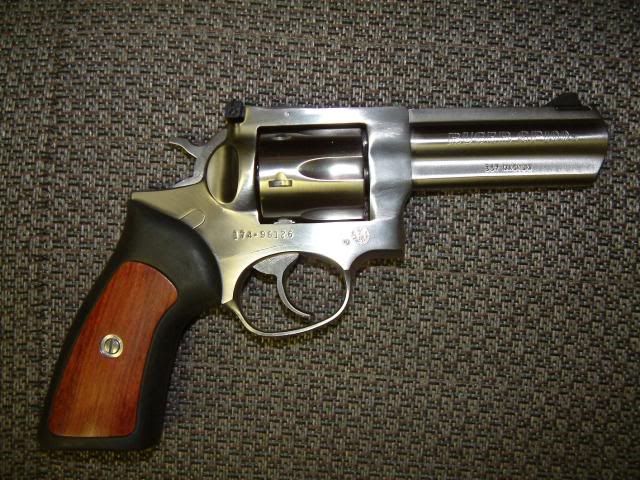
Oh, and I bought myself another gun today. A nice used Ruger GP100, 4″ with the “Target Grey” finish. I’m taking another new shooter to the range this weekend, and wanted something suitable for him to try. At least, that was the excuse I used to convince myself to whip out the plastic this afternoon.

UPDATE: Upon request, here’s the best image I’ve found of a GP100 in the “Target Grey” finish, and a regular stainless one to compare it to:

Shill

In his email to me, Professor Saul Cornell asked,

I wonder how you feel about Nelson Lund’s NRA chair at GMU law school. Would you say he is shilling for NRA?

To which I answered: “Yes.”

Dictionary.com defines “shill”:

(noun.)

One who poses as a satisfied customer or an enthusiastic gambler to dupe bystanders into participating in a swindle.

(verb)

1. To act as a shill for (a deceitful enterprise).

2. To lure (a person) into a swindle.

I must apologize to Mr. Lund.

I truly think that both Mr. Lund and Professor Cornell believe that which they profess. They are not attempting deceit as they see it. Each is professing honestly held beliefs. (At least, I hope so.)

The difference, however, is in how closely those beliefs relate to reality, and how much each person is willing to ignore or even manipulate fact in order to promote their own particular world-view.

It was this willingness to avoid or manipulate that prompted Sanford Levinson to write The Embarrassing Second Amendment. He wanted to put a spotlight on the fact that the meaning of the Second Amendment was avoided in modern law simply because it made so many people uncomfortable. He wrote:

I cannot help but suspect that the best explanation for the absence of the Second Amendment from the legal consciousness of the elite bar, including that component found in the legal academy, is derived from a mixture of sheer opposition to the idea of private ownership of guns and the perhaps subconscious fear that altogether plausible, perhaps even “winning,” interpretations of the Second Amendment would present real hurdles to those of us supporting prohibitory regulation.

Note that he included himself in that group supporting “prohibitory regulation.”

I’ve said before that I really started studying the topic of the right to arms – and, by extension, the Constitution and the Bill of Rights – starting about 1995. I have stated that I had a certain understanding of that right, and in fact all of the rights protected by that document before I began that study. To some extent, my education has lead me to some conclusions I don’t particularly care for. For instance, I think state-permitted concealed-carry is historically justifiable (but prohibition of unlicensed open carry is not.) The one thing I have noted, however, is that when people actually take the time to study the topic, the conversion of opinion goes only one way: If they believe the right to arms is an individual one, their opinion is not changed. If they believe there is no individual right to arms, either they are converted to the opposite belief, however grudgingly, or their personal prejudices prevent them from doing so. But no one is converted from believing that the Second Amendment protects an individual right to an opposite conclusion. The evidence is too overwhelming.

The best example of this I know of is Professor Laurence Tribe. Professor Tribe is a professor of Law at Harvard, and is author of the textbook American Constitutional Law, which is used in (I believe) the majority of ConLaw classes in the U.S. Professor Tribe is a self-described member of the Left, and was a member of Al Gore’s legal team during the 2000 election debacle. I have absolutely no doubt about Professor Tribe’s position concerning gun control – he’s in favor of it. In the first two editions of his textbook, printed in 1978 and 1988 respectively, he relegated discussion of the Second Amendment to footnotes. But in his third edition, published in 2000, he dedicated nine pages to the topic, concluding:

Perhaps the most accurate conclusion one can reach with any confidence is that the core meaning of the Second Amendment is a populist / republican / federalism one: Its central object is to arm ‘We the People’ so that ordinary citizens can participate in the collective defense of their community and their state. But it does so not through directly protecting a right on the part of states or other collectivities, assertable by them against the federal government, to arm the populace as they see fit. Rather the amendment achieves its central purpose by assuring that the federal government may not disarm individual citizens without some unusually strong justification consistent with the authority of the states to organize their own militias. That assurance in turn is provided through recognizing a right (admittedly of uncertain scope) on the part of individuals to possess and use firearms in the defense of themselves and their homes — not a right to hunt for game, quite clearly, and certainly not a right to employ firearms to commit aggressive acts against other persons — a right that directly limits action by Congress or by the Executive Branch and may well, in addition, be among the privileges or immunities of United States citizens protected by §1 of the Fourteenth Amendment against state or local government action.

A November 1999 Wall Street Journal piece, Liberals Have Second Thoughts On the Second Amendment discusses the topic as well. (The galley prints of Prof. Tribe’s book were out by then – and were already stirring controversy.)

Mr. Tribe believes the right to bear arms is limited, subject to “reasonable regulation in the interest of public safety,” as he and Yale Law Professor Akhil Reed Amar wrote in the New York Times last month. But Mr. Tribe has written that people on both sides of the policy divide face an “inescapable tension. . . between the reading of the Second Amendment that would advance the policies they favor and the reading of the Second Amendment to which intellectual honesty, and their own theories of Constitutional interpretation, would drive them.”

Journalist Daniel Lazare, a liberal gun-control advocate, acknowledges the tension, writing in Harper’s: “The truth about the Second Amendment is something that liberals cannot bear to admit: The right wing is right.” Mr. Lazare argues for amending the Constitution to repeal the Second Amendment.

And there is the point I want to make with this piece. Daniel Lazare wrote to the WSJ in response to the piece:

Ms. Levey is right that I agree with constitutional scholars like Sanford Levinson and Laurence Tribe that the Second Amendment guarantees an individual right to keep and bear arms. But she is wrong elsewhere.

First of all, she describes me as a liberal. In fact, I’m a socialist.
Second, she calls me a “gun-control advocate.” In fact, nowhere in my Harper’s article, “Your Constitution is Killing You,” did I specifically argue in favor of gun control; all I said, rather, is that if that is what the democratic majority wants, that is what the democratic majority should get, Second Amendment or no Second Amendment.
Third, she says that I argue in favor of “amending the Constitution to repeal the Second Amendment.” Not so: I devoted much of it to pointing out that the amending process is quite useless in this instance. Under the terms set forth in Article V, as few as 13 states representing less than 5% of the population can block any change desired by the emaining 95%. Given that no one would have any trouble drawing up a list of 13 rural states in the South or West, states for whom repealing the Second Amendment would be akin to repealing the four Gospels, the amendment is, under anything like present conditions, invulnerable. Even though polls indicate that a majority of Americans do not want an individual right to bear arms, a Constitution made in the name of the people says that is what the people must have whether they like it or not.
This is anything but democratic. Rather than amending the Constitution, my position is that we should toss this antiquated document and create a new plan of government from scratch, this time one based on strict majority rule.

Daniel Lazare
New York

There is an honest man. A fucking socialist, but an honest man.

Which, in my humble opinion, Professor Saul Cornell is not. (Honest, not socialist – though he might be that as well.) He is at best a self-deluded man. He twists logic, consciously or unconsciously, to justify a position that cannot be reasonably held by someone willing to look reality squarely in the face. As I said to him previously:

You, an historian, have taken it upon yourself to distort history – something that you yourself claim is unacceptable. You claim that the Justice department’s recognition of the “standard model” of the Second Amendment is somehow “well beyond” a “living document” re-interpretation. I’m sorry, Professor, but if you actually believe that you’re delusional, and if you know better you’re a bald-faced liar. I honestly cannot tell which.

And I can’t.

But it doesn’t really matter. He’s working willingly for the Joyce Foundation – a group dedicated to, among other things, disarming Americans. David Hardy has an interesting post from April of last year concerning the Professor, his association with the Joyce Foundation, and a symposium put on by Fordham University. Hardy notes:

You must, of course, apply to Joyce for a grant. And its standards make it clear that the project — or in this case law review — is expected to advance the enactment of gun legislation (buzzword = “policy”).

The Gun Violence Program supports efforts to bring the firearms industry under comprehensive consumer product health and safety oversight as the most promising long-term strategy for reducing deaths and injuries from handguns and other firearms.
Program priorities are:
• Supporting state-based policy initiatives in Illinois and Wisconsin that can achieve meaningful reforms and provide a model for gun policy nationwide ….
• Supporting focused research to inform state policy efforts.

From its grant FAQ,

Do you fund educational programs in violence prevention? We generally do not fund such programs.
….
Do you fund research? We fund research that is likely to have a strong impact on public policy.
…..
Please tell me more about your focus on public policy. We focus our grantmaking on initiatives that promise to have an influence on public policies. That includes advancing the public debate about important policy issues, most notably the need for federal consumer product health and safety standards for the firearm industry. We believe such policy initiatives can lead to broad, systemic changes that affect the most people over the long run.

In other words: don’t come to us with a law review that will explore the Second Amendment. Come to us with an idea for one that will help enact gun laws. That is what we fund.

Now, I’m sure the professor would point out that Nelson Lund is under similar restrictions regarding NRA funding – they don’t support anti-gun research, either.

But the NRA isn’t trying to swindle Americans out of their Constitutionally guaranteed rights.

And that IS a difference.

UPDATE, 5/15: I sent an email to Prof. Lund with a link to this piece. He responds:

Mr. Baker–

Thanks for your message and consideration. I took a quick look at the web page to which you provided a link, and feel that I should point out that it is incorrect to say that “Nelson Lund is under similar restrictions regarding NRA funding – they don’t support anti-gun research, either.” My academic work is under no such restrictions. The dean of my law school has designated me the Patrick Henry Professor of Constitutional Law and the Second Amendment. I do not answer to the donor, any more than hundreds or thousands of other holders of named professorships in this country answer to those who donated funds to establish the chairs. Nor has my dean ever so much as suggested that I am under any obligation to conform my views or the results of my research to the preferences, presumed or expressed, of the donor that provided funds for the professorship to which I was named. In short, I am perfectly free to publish “anti-gun research” if that is where the search for truth leads me, and I do not believe I would suffer any financial penalty of any sort if I did so.

If you could find a way to alert your readers to these facts, I would be grateful.

Nelson Lund

Consider it done.

Prof. Cornell Responds!

I’ll give him credit for that, anyway. Here is his email in its entirety:

Kevin,

Thanks for the e-mail. I wonder how you feel about Nelson Lund’s NRA chair at GMU law school. Would you say he is shilling for NRA? Any way, I am in the midst of grading essays so I can’t respond to all of the errors in your blog. I think you confuse laws aimed at preventing slave revolts and the infamous Black Codes enacted after the Civil War, with earlier laws aimed at reducing gun violence. I agree with you that Tucker is quite important, but I fear you have taken his writings out of context. Tucker’s primary concern is with the danger posed by disarmament of the militias during the Alien and Sedition Crisis, not an individual right of self defense. The latter right was well established under common law and Federalists showed no interest in enacting laws that might impact this right. What Tucker wished to guard was the right of citizens to keep and bear arms in state controlled militias. In this sense, this aspect of Tucker’s thought does not fit either of the modern theories of the Second Amendment. I suggest you read my forthcoming book on the subject. You will find quite a few surprises in it.

In regard to Mr. Lund, the answer is “yes.” Like yourself, Professor, I’m certain Mr. Lund believes what he says, but I also believe he wouldn’t be sitting in an NRA-endowed chair if he wasn’t aligned with the NRA’s agenda.

I’ve taken Tucker out of context? I quoted, so far as I know, the entire passage concerning Tucker’s understanding of the Second Amendment. I find it difficult to believe I have misinterpreted Tucker when he says The right of self defence is the first law of nature: in most governments it has been the study of rulers to confine this right within the narrowest limits possible,” and “Wherever standing armies are kept up, and the right of the people to keep and bear arms is, under any colour or pretext whatsoever, prohibited, liberty, if not already annihilated, is on the brink of destruction. In England, the people have been disarmed, generally, under the specious pretext of preserving the game: a never failing lure to bring over the landed aristocracy to support any measure, under that mask, though calculated for very different purposes. True it is, their bill of rights seems at first view to counteract this policy: but the right of bearing arms is confined to protestants, and the words suitable to their condition and degree, have been interpreted to authorise the prohibition of keeping a gun or other engine for the destruction of game, to any farmer, or inferior tradesman, or other person not qualified to kill game. So that not one man in five hundred can keep a gun in his house without being subject to a penalty.”

He’s talking about the individual rights of possession and self-defense, and organized defense against tyrannical government. What part did I get wrong? And are you not championing “robust regulation” – by government – up to and including “broad-scale prohibition?” The very thing Tucker decried? Sorry Professor, but that’s more pretzel-logic.

After your book comes out, I’ll see if I can pick one up on the used market. I’m sure it will be as fascinating and fact-filled as Michael Bellesiles’ Arming America.

Saul Cornell, Unbiased Researcher

Professor Saul Cornell of Ohio State University and I have had our differences before. Back in February of last year Prof. Cornell (then associate professor) published an op-ed in a number of papers that lit my fuse, so I fisked it, and sent him a link to the post. To my surprise, he responded. I was surprised that he responded. I was not surprised by the response. In March I received a nice email from a student at OSU who had penned a story for the school’s alternate student paper, The Sentinel, entitled Something’s Fishy at the John Glenn Institute, noting that the “Second Amendment Research Center” at the John Glenn Institute was established with a $400,000 grant from The Joyce Foundation. It’s a good piece.

The Geek with a .45 has done a lot of research on the Joyce Foundation and who and what it supports. That’s worth a read, too.

Anyway, it looks like the good Professor is still earning his grant money, as Rob Smith has discovered yet another op-ed by that unbiased historian, entitled Reconstructing the Second Amendment. Let us fisk:

Reconstructing the Second Amendment

By Saul Cornell
History News Service

Few issues in America are more controversial than guns. Yet even among hot button topics in American public life there is something perverse about the dynamics of the debate over guns.

Only since we’ve figured out that your side intends to disarm us, the law-abiding. Controversial, yes, but I don’t consider it “perverse.” Interesting choice of word though, don’t you think?

Polling data for decades have shown that most Americans favor stronger gun laws. Indeed, surveys demonstrate that such policies are even supported by most gun owners. Yet pundits and political soothsayers have written off this issue because it is perceived to be a loser at the polls.

That’s because the issue IS a loser at the polls. Yes, when interviewed with generic questions most people say they want “more effective gun laws,” (who wouldn’t?) but almost every time your side proposes a specific “next step” the response at the ballot box is “Not THAT!!

Gun rights and gun control have long histories. Although both sides in the great American gun debate have claimed to have history on their side, each has presented a version of the past that is highly selective.

True, to some extent.

One of the many embarrassing truths about the debate over the right to bear arms that neither side wishes to admit is that gun rights ideology is the illegitimate and spurned child of gun control.

Au contraire, mon ami. One of the most embarrassing truths about the debate over the right to bear arms is that gun control is the illegitimate and spurned child of racist laws designed to disarm blacks after the Civil War. Want to discuss that topic? I believe I mentioned that in the initial rebuttal to a Saul Cornell op-ed.

Efforts at gun control, particularly policies aimed at broad-scale prohibitions of firearms, have generally led to an intensification of gun rights rhetoric and activism.

You don’t say. I can’t imagine why “broad-scale prohibition” would raise our ire. Is that the “perverse” reaction the professor was alluding to?

Understanding the history of this tangled relationship, one of American history’s more bizarre examples of ideological co-dependency, may provide some insights into how we might move this debate forward and break this cycle.

Hmm… perversion and co-dependency. Interesting how the professor – of history – is couching his argument in terms of abnormal psychology, isn’t it? Do you think he’s implying anything?

New York Mayor Michael Bloomberg’s recent summit on gun violence reminds us that this is not the first time in American history that gun violence and gun control have been on the minds of New Yorkers. DeWitt Clinton, mayor from 1803 to 1815, bemoaned the problem posed by handguns almost 200 years ago.

Yes, I believe DeWitt Clinton fought a duel in 1802, shooting his challenger, John Swartwout, once in the thigh and once in the ankle. (They exchanged five shots during the duel.) I imagine he had some interesting things to say about gun violence and gun control. Too bad Prof. (of history) Cornell didn’t bother to tell us any of them. As to New York and gun control, the thing that comes immediately to my mind is New York’s 1911 Sullivan Law that made it mandatory to get a permit from the police to possess a handgun in the city. You have to wonder just who it was they were trying to disarm, don’t you? And were they successful?

Well, if Mayor Bloomberg has found it necessary to hold a “gun summit,” 95 years after the passage of that law, it would appear not. So that “next step” would seem to be San Francisco’s “broad-scale prohibition,” wouldn’t it? It’s worked so well in Washington D.C.

As long as there have been guns in America there have been regulations governing their use and storage.

Really? Use, yes, but storage?

Without government direction there would have been no body of Minutemen to muster on the town greens at Lexington and Concord.

Minutemen who brought their own guns from their own homes where how they were stored was no business of the government? What was that argument again?

If the Founders had imbibed the strong gun rights ideology that drives today’s gun debate we would all be drinking tea and singing, “God save our gracious Queen.”

This is the thing about Prof. Cornell that just floors me. He attempts to invert reality in his op-eds, counting that his position as an “authority” will convince the ignorant. In the first piece I fisked the good Professor insisted that it was “activist judges” who were responsible for “striking down existing gun laws,” and that returning to the original understanding of the Second Amendment in his words, “goes well beyond the idea of interpreting the Constitution as a living document that must respond to changing times.” Now, according to the esteemed Professor, if the Founders had really believed that citizens should have the right to keep and bear arms, we’d have lost the Revolutionary war!

I have to wonder what color the sky is in Professor Cornell’s world. Green, probably. That Joyce Foundation money must be really impressive. (Actually, I think the Professor really thinks like this regardless of where his grant money comes from, but I’m sure he’s more than happy to have it.)

Ironically, the Second Amendment does not prohibit robust gun regulation, it compels it.

Let’s see what the Second Amendment really says:

A well regulated militia, being necessary to the security of a free state, the right of the people to keep and bear arms, shall not be infringed.

So, if we change the language to say “A well-read populace, being necessary to the security of a free state, the right of the people to keep and carry books, shall not be infringed,” it compels “robust regulation” of the possession (and storage) of books?

I don’t see it. But then, I don’t live in Prof. Cornell’s topsy-turvey world, either. Ironic, isn’t it?

Today’s gun rights ideology is antithetical to the original understanding of the Second Amendment and only emerged in the 19th century when individual states began passing the first gun control laws to deal with the new problems posed by hand guns.

No, today’s gun rights ideology is antithetical to the gun control laws first passed in the 19th century that were written to deal with the new problems of armed free black citizens. Let me quote Chief Justice Taney from his late 18th century decision in Dred Scott v. Sanford again:

(Citizenship) “would give to persons of the negro race, who were recognized as citizens in any one State of the Union, the right to enter every other State whenever they pleased, singly or in companies, without pass or passport, and without obstruction, to sojourn there as long as they pleased, to go where they pleased at every hour of the day or night without molestation, unless they committed some violation of law for which a white man would be punished; and it would give them the full liberty of speech in public and in private upon all subjects upon which its own citizens might speak; to hold public meetings upon political affairs, and to keep and carry arms wherever they went. And all of this would be done in the face of the subject race of the same color, both free and slaves, and inevitably producing discontent and insubordination among them, and endangering the peace and safety of the State.” (My emphasis)

Let’s see, the Chief Justice gave a pretty good list of the rights of citizens in the United States that were protected by the Constitution, didn’t he? But Prof. Cornell wants you to believe that the laws passed that were intended to disarm blacks were actually in response to the introduction of handguns. (Even though handguns had been around since long before the 18th century.) Just like he wants you to believe that if the Founders had really believed in a right to arms, we’d have lost the Revolutionary War.

I’m not buying, Professor.

There is much to be learned from America’s first gun violence crisis and the first gun-control movement.

I’ll say. And it’s not the bilge you’re selling.

It is not surprising that during that struggle gun rights supporters tried to lay claim to the Second Amendment by reinterpreting it as an individual right of self-defense.

Um, sorry. Professor, you’re supposedly an historian. Haven’t you heard of St. George Tucker and American Blackstone, his 1803 (that’s 19th century ante-bellum) legal text? A text that came out during the same period in which DeWitt Clinton lived and fought his pistol duel? Quoting Tucker on the Second Amendment:

This may be considered as the true palladium of liberty. . . . The right of self defence is the first law of nature: in most governments it has been the study of rulers to confine this right within the narrowest limits possible. Wherever standing armies are kept up, and the right of the people to keep and bear arms is, under any colour or pretext whatsoever, prohibited, liberty, if not already annihilated, is on the brink of destruction. In England, the people have been disarmed, generally, under the specious pretext of preserving the game: a never failing lure to bring over the landed aristocracy to support any measure, under that mask, though calculated for very different purposes. True it is, their bill of rights seems at first view to counteract this policy: but the right of bearing arms is confined to protestants, and the words suitable to their condition and degree, have been interpreted to authorise the prohibition of keeping a gun or other engine for the destruction of game, to any farmer, or inferior tradesman, or other person not qualified to kill game. So that not one man in five hundred can keep a gun in his house without being subject to a penalty.

St. George Tucker, arguably one of the greatest authorities on American law during the period immediately after Ratification understood the Second Amendment as a protection of the individual right of self-defense, and the individual right of the possession of arms.

Yet the good Professor of HISTORY insists that no, no! That’s a modern reinterpretation of the Second Amendment! A reinterpretation that “goes well beyond the idea of interpreting the Constitution as a living document that must respond to changing times.”

Again, I’m not buying. I’m experiencing deja moo – I’ve heard this bullshit before.

This argument continues to be effectively employed by opponents of gun regulation.

Perhaps because it’s true?

Modern gun-control proponents have generally been embarrassed by the Second Amendment, viewing it as an anachronism.

As beautifully described by a real student of history, Law Professor Sanford Levinson in his 1989 Yale Law Journal paper The Embarrassing Second Amendment where he wrote:

I cannot help but suspect that the best explanation for the absence of the Second Amendment from the legal consciousness of the elite bar, including that component found in the legal academy, is derived from a mixture of sheer opposition to the idea of private ownership of guns and the perhaps subconscious fear that altogether plausible, perhaps even “winning,” interpretations of the Second Amendment would present real hurdles to those of us supporting prohibitory regulation. Thus the title of this essay–The Embarrassing Second Amendment–for I want to suggest that the Amendment may be profoundly embarrassing to many who both support such regulation and view themselves as committed to zealous adherence to the Bill of Rights….

Such people as Professor Saul Cornell, who must twist himself into a logical pretzel to make the arguments he keeps making – and getting published across the country on the basis that he’s a professor of history, and must therefore be an unbiased and informed voice only interested in educating the hoi polloi.

Early proponents of gun regulation did not make the same mistake. Rather than dismiss the Second Amendment as a remnant of America ‘s revolutionary past, they venerated it, reminding their opponents that the Second Amendment was about an obligation citizens owed to their government and communities to contribute to public defense.

No, they couched their arguments in terms of “public safety” while nudging and winking at each other because their intent was merely to disarm blacks and other minorities – in direct violation of the Second and Fourteenth Amendments.

They also staked out another right that has not been much talked about recently in this debate: a right to be free from the fear of gun violence.

Yes, this is a new topic – the “right” to be free – not of “gun violence,” but the fear of it.

A right to be free of fear. Who thought that one up?

What does all of this mean for the contemporary gun debate? Proponents of gun control must not demonize gun owners, particularly given the fact that most gun owners support reasonable gun regulation. Any solution to America’s gun problem must have the support of gun owners.

Read: “We must confuse and trick them into giving up what they will not otherwise yield willingly.”

Rather than abandon the Second Amendment and dismiss it as a relic of another era, supporters of gun regulation need to reclaim this part of our constitutional heritage.

“Just so long as, you know, we don’t acknowledge that it actually protects anything.”

Supporters of regulation need to point out that liberty without regulation is impossible. The right to be free from the threat of gun violence deserves as much respect as the right to bear arms.

Tell me, Professor, do I have a “right” to be free of the fear of, say, cancer? The “right” to be free of the fear of man-made pollutants? The “right” to be free of the fear of car accidents? The “right” to be free of the fear of being the victim of a violent crime committed with a weapon other than a firearm? The “right” to be free of the fear of a planet-killing asteroid? Global warming? Alien abduction?

Rob Smith has it absolutely right:

I have just one question: Why is it that the more imaginary “rights” people invent, the less personal freedom I have?

And why didn’t the Salt Lake Tribune note that Prof. Cornell was also Director of the Second Amendment Research Center at the John Glenn Institute at Ohio State University?

Escalation of Failure

When someone tries to use a strategy which is dictated by their ideology, and that strategy doesn’t seem to work, then they are caught in something of a cognitive bind. If they acknowledge the failure of the strategy, then they would be forced to question their ideology. If questioning the ideology is unthinkable, then the only possible conclusion is that the strategy failed because it wasn’t executed sufficiently well. They respond by turning up the power, rather than by considering alternatives. (This is sometimes referred to as “escalation of failure”.) – Steven Den Beste

Today’s example comes from the City of Boston, as reported in today’s Boston Glob, er Globe. To wit:

City plans a retooled buyback of guns

Exchange may offer gift cards instead of cash

The City of Boston and community groups plan to launch a gun buyback program as early as next month that may offer gift cards instead of cash to people who turn in weapons, community leaders and a police spokeswoman said yesterday.

The buyback program, the first such effort in a decade, is being designed to avoid some of the problems a similar program faced in the mid-1990s.

From 1993 through 1996, the city collected 2,800 guns by offering $50 for each weapon. While there was some evidence that the program took some of the targeted weapons off the street, criminologists who studied the program found that many of the guns were older and not the guns typically used in crimes. The program was abandoned as violent crime fell and as police and critics raised questions about its effectiveness.

Note that, as I’ve mentioned before, violent crime fell everywhere. Gun “buybacks” had nothing to do with the decline.

This time, said community leaders involved in the planning, they will try to recruit more grass-roots groups that work with young people involved in crime. Police want the new campaign to use gift cards instead of cash; criminologists found that some people used the buyback money to buy newer guns.

You. Don’t. Say.

Imagine that! (And note that it says “newer” not “new.”)

Pending final approval from Mayor Thomas M. Menino, the city has made a preliminary pledge of about $25,000 for this year’s campaign, said community leaders who have been planning the effort with City Hall. They hope the final amount will grow with private pledges from businesses, neighborhood groups, and others.

In addition, city officials plan to try to leverage the initial $25,000 by getting businesses to give significant discounts on gift cards to stores such as Target and Best Buy. Community leaders said the buyback program probably will offer gift cards of around $100 for each working gun.

I wonder if the drug/gun dealer on the corner will take the gift cards in exchange for his products? I mean, $100 is $100, right?

Aren’t Lorcins going for about $65 these days? They “work.” Kinda.

The program is proposed as City Hall seeks answers to an alarming surge in firearm violence, in which 99 people were shot in Boston this year by April 6. The number of shootings has risen over last year, when there were the most shootings since 1995.

At the same time, police believe there are more guns on the street than in at least six years. Last year, police seized 797 guns, a 35 percent increase over 2004, and the number of seizures through the middle of March was up over last year.

I don’t know about Boston, but I’ve driven Tucson’s streets for years, and I have yet to find a gun laying on any of them.

And that pisses me off, because Diane Feinstein promised there would be AK-47s and Uzis on the streets after the Assault Weapon Ban (that wasn’t) expired. I want an H&K MP5, but I’ll settle for an Uzi.

Menino’s office declined to comment yesterday, but Police Department spokeswoman Elaine Driscoll confirmed that officials have been meeting with community leaders to plan for a probable buyback debut next month.

“It’s still in its conceptual phase,” Driscoll said yesterday. “Although we are well aware of the historical perspective of this program, both in favor and opposed, we know it is our responsibility to explore every possible avenue in our efforts to decrease violent crime.”

With the glaring exception of allowing the law-abiding to carry a firearm for self-defense. “Every possible avenue” but that one. More “guns on the street,” you understand.

Driscoll said that officials are trying to design a buyback program that weds the best aspects of the effort of the mid-1990s with fixes to the worst. She said officials still believe that offering amnesty to people turning in illegal guns is a good idea, while offering cash incentives for turning in guns is a bad idea.

Yup. Let them turn in guns used in crimes for destruction and give ’em $100 that they can use to get a newer “hot” gun. It doesn’t matter if it’s cash or a gift card. It all trades the same on the street.

“Cash awards were inappropriate,” Driscoll said. She said officials are focusing on gift cards for guns as a “way to ensure that incentives are being used for proper reasons.”

And how, exactly are you going to do that?

Anyone?

Anyone?

Bueller?

Driscoll declined to discuss the $25,000 figure, saying, “We are still actively exploring potential funding options, as well as soliciting corporate donations.”

The effectiveness of gun buyback programs, which became popular across the country during the 1990s, has been questioned by criminologists who have concluded that few guns used in crime are turned in.

You know, the English have found that to be the case too. (But at least the Brits got a rocket launcher!)

But cognitive dissonance prevents anyone from actually learning from experience. So, $50 didn’t work? Let’s try it again only harder! Certainly $100 will bring in those evil crime guns!

Richard Rosenfeld, a criminologist at the University of Missouri at St. Louis, found that a buyback program there had little impact on violent crime. In addition, many people used the cash rewards for new guns and others turned in guns they no longer used while holding onto other, more favored firearms, he said.

Like I said, if I could get a $100 gift card for a $65 Lorcin or Raven, I’d be down at the local gun shop like a shot (pun intended.)

But instead, what they get is stuff out of people’s closets and from under their beds. Sometimes historic weapons like the Japanese Arisaka pressure-test rifle World War II Navy veteran Bruno Filippelli turned in for a $75 Target gift-card in 2005, or the 18th century Brown Bess musket turned in during an amnesty (no compensation) in Stoney Creek, Ontario, Canada. Yeah. Real useful.

But what are they good at? Getting attention. Drawing press. It’s the appearance of “doing something” – and, since the job of politicians is to keep getting reelected

“Gun buybacks don’t have much of an impact on crime, because they tend not to attract guns from the segment of the population most likely to use them in crime,” Rosenfeld said. “City officials know they are popular, they attract attention, and they can attract attention to the overall crime problem.”

John Rosenthal, a close ally of the Boston police on efforts to fight violence and cofounder of the nonprofit Stop Handgun Violence, said he does not support buybacks because they don’t work.

“I applaud the mayor’s office and City Hall for trying to do anything and everything, (with the one, noted, exception) but the sad reality is Boston Police, among the best law enforcement agencies in the country . . . are never going to stop the flow of crime guns into Boston or any other city across the country until there are uniform federal laws that restrict gun access to criminals,” Rosenthal said.

Read that: “Uniform federal laws that restrict gun access to everybody BUT criminals.” No matter what, the criminals will get all the guns they want. Notice how Rosenthal’s comment echos that of Britain’s shadow home affairs minister James Paice from that BBC link: “Nearly all gun crime involves illegally-held handguns, not legally-owned shotguns or rifles. The real problem is that illegal firearms are flooding into Britain because the government cannot secure our borders.”

Rosenthal thinks that uniform federal laws will help keep guns from “flowing into” his city. England has uniform laws. It’s a freaking island. They’ve got a handgun BAN. And with all of those preconditions they can’t keep guns out of the hands of the people willing to use them in crime.

Once again, everyone’s concentrating on the wrong problem. But guns are the easy target. Everyone knows that it’s the number of guns that’s the cause of all this crime. Right?

However, Rosenthal said he is pleased that the city will not be giving out cash. “In the past, kids would bring in cheap guns and would go out and buy a better gun,” he said.

I LOVE the fact that they keep repeating this. And where do kids buy guns? Not at the local federally licensed dealer!

And this time will be different… why?

But community leaders helping to organize the buyback and make it an annual event said that they believe it can make a difference and that taking even a few guns off the street is worth it.

“Even if we take off five, 10 guns that stopped a shooting that could be potentially fatal, I think that we’ve succeeded,” said Jesús Gerena, director of community development and organizing for the Hyde Square Task Force, a nonprofit that works on youth development in Jamaica Plain and Roxbury.

Yes, if it saves just one life! Except they’ve proved pretty conclusively that “buy-backs” don’t.

But to those suffering from cognitive dissonance, this matters not! The philosophy cannot be wrong!

Jorge Martinez — director of Project RIGHT, a Roxbury community organization, said the buyback program will include public service announcements. He said the program aims to persuade friends and relatives of criminals to turn in guns, as well as residents who know or discover so-called community guns: shared weapons that are used for crimes and then returned to a hiding place.

“We’re not talking about the high-tech guns that criminals are going to be using,” Martinez said. “We know we won’t get those folks to turn in their guns. That would be foolish. We’re talking about mothers who find guns, youths who know where guns are.”

Kathie Mainzer, a Jamaica Plain restaurant owner who helped launch the first gun buyback program more than a decade ago after a shooting on the playground of her daughter’s school, said that many guns that appeared to be active were turned in the last time.

Michael Patrick MacDonald, who answered the hot line for that campaign and whose well-known book “All Souls” chronicles life in South Boston, said he received calls asking where to turn in guns from street workers helping teenagers leave gangs and from former girlfriends of men in jail.

“It’s really important to get the guns out of circulation, and it should be done every year,” said Mainzer, who is helping city officials plan the new buyback. “We want people to have an opportunity to safely get rid of a gun without turning it over to another 15-year-old or selling it, which happens.”

Excuse me, but I thought there was a program already in place for that. It’s called a police department?

As far as doing this every year, won’t the Violence Policy Center issue a press release accusing the gun manufacturers of using buy-backs to create demand for new guns?

Oh, I see. It’s useless, and it’s a media circus opportunity. A “Win-Win” scenario!

(h/t to Dodd, who I sincerely hope is writing somewhere under a pseudonym.)

Well, Since the Crackdown on GUNS Has Failed…

…it seems only logical, I suppose. Mr. Free Market emailed me a link to the BBC:

Call for crackdown on gun crime

A campaign is being launched aimed at reducing gun crime in Wales.

The number of firearm offences in north Wales was almost six times higher in 2004-2005 than the previous year, according to Home Office figures.

How high was it in 1996, right before the “ban?”

In south Wales, gun offences have more than doubled. There were smaller rises in Gwent and Dyfed-Powys force areas.

Crimestoppers Wales is asking anyone with information on people who own guns or imitation guns being used in crime, to let them know anonymously.

Yes, you too can be an agent of Big Brother, spy and narc on your neighbors. The ones who are otherwise good guys will get arrested and go to jail. The really bad actors will find out who turned them in and torch their houses, or throw hand-grenades through their windows.

The total number of firearm offences in Wales – excluding those involving air weapons – rose from 169 in 2003-2004 to 288 in 2004-2005, according to the Home Office.

Neale Evans, chairman of the independent charity Crimestoppers Wales, said: “We are focusing on people who are on the fringes of gun crime – relatives, friends of people who are being pressurised to get involved in crime and use a gun, or an imitation gun.”

As part of the anti-gun campaign, the charity will be distributing posters and leaflets across Wales.

Note, they haven’t learned yet. “Anti-gun campaign,” not “anti-criminal campaign.” As long as they keep focusing on the wrong target, things will continue to get worse. So, in short, the title to the piece is wrong – it’s not a crackdown on gun crime, it’s another crackdown on guns, which means they haven’t learned a damned thing in the last ten years.

Mr Evans said anyone who may have information about people who may have guns that are being used in criminal activity should call Crimestoppers anonymously on 0800 555 111. The information will then be passed on to the police.

‘Innocent bystanders’

He added: “By doing this your anonymity will be preserved and you will be playing your part in protecting the community in which you live.

“Crimestoppers does not trace or record any information about any caller and you will not have to give evidence in court.”

The charity said it was not just the criminals who were affected, but “innocent bystanders who can be caught up in this ruthless violence perpetuated by criminals who do not care who gets in the way”.

Criminals, for the most part, that the police are already aware of and are unable to get the Crown Prosecution Service to lock up. Go read The Policeman’s Blog for an hour or two.

It said the growth of imitation firearms over “real firearms” is no less worrying, as criminals use them as blunt instruments or to intimidate and threaten people.

However, the publicity Crimestoppers has generated about imitation firearms has not found favour with everyone.

Tim Wyborn, spokesman for a pressure group linked to a simulation game called Airsoft which uses imitation guns, said the publicity presented replica firearms in a poor light.

Welcome. You’re the next victim of firearm phobia, of a culture that does not recognize the difference between “violent and predatory,” and “violent but protective.” It sees only “violent,” and violence is bad.

But he stressed their games players were against any sort of gun crime.

“Owning an imitation firearm is perfectly legal and there are many legitimate uses of imitation firearms in the UK,” he said.

It’s legal now, until the Nanny-state concludes that letting adults play with toy guns is psychologically harmful and it takes those away, too.

The games players fear they will be adversely affected by impending legislation to ban the sale of replica guns.

And you are right to fear that.

“As the bulk of crime with replicas is by 13 year old children with cheap replica BB guns, a better way of tackling the problem (of those crimes) would be education,” Mr Wyborn added.

Now, I’ve got a question: Is that true? That the bulk of crime with replicas is by children with BB guns? Is the majority of those 288 firearms crimes recorded in Wales kids shooting out windows with BB guns, or is it kids mugging people with BB guns? I’d really like to know. But either way, it’s obvious that “gun control” has been a dismal failure.

So of course the reaction is to “turn up the power” and escalate the failure. After all, the philosophy cannot be wrong!