Spin, Spin, Spin

A couple of posts down is the story of Caroyln Lisle who shot an intruder in her Rancho Cordova home. Quoted in the story is one William Vizzard, described as “chair of the criminal justice department at California State University, Sacramento.” One commenter called him “a gun control flunky” and suggested Googling to prove it. So I did.

I found this interesting transcript from PBS’s Newshour from October 18, 2002 where Mr. Vizzard, described as an ex-employee of the BATF was one of the panel. The discussion was about “ballistic fingerprinting,” and was inspired by the fact that the DC snipers were active at that time.

This will be kinda long, but I’m going to fisk it.

RAY SUAREZ: The recent sniper attacks in the Washington, DC, area have revived a debate over a technology that helps authorities trace ammunition found at crime scenes. The technology is called ballistic fingerprinting, and it’s based on the idea that every gun leaves unique markings on its bullet casings.

Um, not quite so unique. Modern manufacturing methods and tooling mean that guns coming sequentially off a production line are very likely to have very similar tooling marks.

Gun makers would be required to register those fingerprints so a national database could be compiled. Until recently, crime labs relied solely on the human eye and a microscope to look at evidence from bullets, but now bullets, bullet fragments and shell casings are scanned into a computer and compared against thousands of other bullets or casings.

SPOKESMAN: When a barrel is produced or a firearm itself is produced, it’s made by other tools. The metal is formed and moved around, scraped away, and those imperfections of each of those tools in the manufacturing process have accidental characteristics it imparts on the gun. It’s still a needle in a haystack, but now we can get through the haystack faster. These comparisons from bullet to bullet are into tenths of seconds.

This assumes that there’s enough left of the bullet to allow identification. On top of that, the bullets being compared must also be of similar composition. For example, a .45 caliber 230 grain full metal jacket bullet made by Speer will have much different markings than a 185 grain hollowpoint bullet manufactured by Federal when fired from the same gun. Especially if the first was fired into a water barrel and the second recovered from a corpse after impacting a major bone. A computer probably wouldn’t be able to get a match. A human eyeball Mark I might. But the human eyeball takes a lot longer than tenths of a second.

RAY SUAREZ: Law enforcement officials back the idea of ballistic fingerprinting and so does the federal Bureau of Alcohol, tobacco and Firearms. Several lawmakers have called for legislation requiring gun makers to record the ballistic markings. The National Rifle Association and other gun rights advocates oppose legislation, saying the fingerprinting is an unproven science.

The Bush administration was also skeptical, saying earlier this week the technology might not be reliable and could infringe on privacy. But on Wednesday, Spokesman Ari Fleischer said the President does want to look into creating a national registry.

ARI FLEISCHER: The president wants this issue explored. And to that end, the Bureau of Alcohol, Tobacco and Firearms has been meeting, and met yesterday afternoon with White House staff to start to discuss the various issues: The technical issues, there are feasibility issues, the pros and cons about how this could possibly… may be effective, whether it could work or whether it would not be able to work.

Gee, thanks Mr. President.

RAY SUAREZ: While the national debate continues, two states, New York and Maryland, have already enacted laws requiring a ballistic fingerprinting for handguns.

Neither of which has yet to have a match that didn’t identify a crime gun already in their possession, contemporary with the crimes, and firing ammunition that matched that found at the crime scene.

We pick up the debate with Joe Vince, the former chief of the crime guns analysis branch of the Bureau of Alcohol, Tobacco and Firearms. He now has a consulting company in the Washington area. And William Vizzard, a former ATF agent, now chair of the division of criminal justice at California State University at Sacramento.

Well, since the speculation, Joe Vince began with the Washington area sniper, let’s take a look at how ballistic fingerprinting may have been useful in a case like this, in investigating a case like this?

JOE VINCE: In a case like this, Ray, this right now, the ballistic evidence is your best evidence. It’s almost your only evidence. So it provides a lead for law enforcement. And any time you’re working an investigation, law enforcement officials are looking for leads that take them to the next step.

You build your case incrementally. And for this, knowing that it was a .223 what type of firearm it could come from, is very useful.

RAY SUAREZ: But would you, if you had this database, have been able necessarily to narrow down what firearm?

Note, now, how Mr. Vince artfully dodges answering the question:

JOE VINCE: With a database like this, the possibilities multiply. And we have to remember that law enforcement today needs to rely on 21st century technology. In 1890, if you wanted to get in law enforcement, you received a badge, a gun and a club, and said go out there, enforce the law.

Well, that was towns of hundreds. Now we have metropolitan areas of millions. Law enforcement has to leverage technology in order to help them solve crimes — as the gentleman said on your earlier piece, to take the haystack and eliminate as much hay as you can to find the needle.

Simple question, wasn’t it? Would the technology help narrow down what firearm? Answer? Evasion, obfuscation, and haystacks. Is he called on this? Don’t be silly.

RAY SUAREZ: William Vizzard, would this have been a useful tool in this investigation?

WILLIAM VIZZARD: Well, it conceivably could be although — given the circumstances — an individual who apparently has planned these shootings in advance, it’s most likely not in the sense that we have about 200 to 250 million guns in circulation in the United States today.

And it’s possible for an individual simply to acquire one of those and use it, knowing that it’s not in the database. I mean, if we were to begin a database, for instance, today, or at whatever point Congress would cease debating it, presumably, it would start recording bullets and cartridge cases from that day forward.

Now one could of course try to collect the 250 million existing samples out there. But I don’t hear anybody really advocating that because the mechanics of simply trying to track down those guns and get some sort of record on them is extremely difficult. So Joe is certainly right about the technology; it’s extremely useful technology.

It’s proven very useful in a number of crimes involving suspect firearms and bullets or cartridge cases recovered from crime scenes. And had we been doing this from the 1930’s on, and of course in those days we didn’t have in way of cataloging it, we might have some utility at this point.

Hey! An actual answer! No wonder he’s no longer in the ATF.

RAY SUAREZ: But given the plans that are under consideration now this gun would have had to have been either used in a crime before or purchased and profiled at the time of purchase in order to get a hit in a database, is that right?

WILLIAM VIZZARD: It would have to be placed in the data base through scanning in either at time of manufacture or when it was picked up by the police.

Of course unlike fingerprints when you fingerprint an individual and they’re subsequently released and you have their fingerprints, in the case of guns, normally when police get their hands on a gun, they don’t release it and so it’s usually useful only for checking against previous crimes as opposed to building a database for future crimes.

This, too is factually accurate. So far I’m impressed.

RAY SUAREZ: I’m sorry, Joe Vince, go ahead.

JOE VINCE: Well, a good comparison is over 100 years ago when we started fingerprinting. We had no database and we were doing everything in a card file. However, we said this is a good tool to use and it has been extremely useful. Now we have a computerized AFA system; that’s a national system that has fingerprints computerized.

And we don’t only put bad people into that system of fingerprinting. Every man and woman who enters our armed services is fingerprinted. Schoolteachers are fingerprinted.

My wife is a schoolteacher; she’s in there. The reason for that in the military is to obviously check their background, check the teacher’s background but also, God forbid, if they were injured or killed in the line of duty, we could identify them.

This is the same thing we have to do. We have to take incremental steps now and build our database up so we have the same capability that we have with fingerprints.

Yet no one suggests that we fingerprint and DNA scan every single individual so we can pick criminals out of the population from crime scene evidence.

RAY SUAREZ: William Vizzard notes that there are some 250 million guns already out there. How long would it take until you had a database that was actually useful, a body of profiles that was large enough to be useful compared to the number that’s already out there?

And, once again, Mr. Vince dodges the very simple question: “How long?”

JOE VINCE: Well, I agree with Bill, there are a lot of firearms out there. But we have to take the next step. (And there is ALWAYS a “next step.”) I was in Palm Beach, Florida, last week and I talked to the sheriff’s office there. Six months ago they received the IBIS equipment and that has already linked seven or eight different homicides and shootings together that they did not know it was related.

So you can see, in a short period of time you can have some success. We have to start somewhere. Congress wisely already allocated the money. We’ve put the equipment everywhere in the United States. Now we have to effectively use it as a law enforcement tool.

Uh, Mr. Vince, you matched crime scene evidence. You did not identify the firearm or its possessor. And YOU DIDN’T ANSWER THE QUESTION.

RAY SUAREZ: Mr. Vizzard, you’ve used the fingerprints analogy. To carry it one step further, it’s pretty hard to change your fingerprints. Is it hard to change the so-called fingerprint that a firearm puts on a shell casing?

WILLIAM VIZZARD: It’s difficult. It’s more difficult than the opponents have characterized. Firearms are made of extremely hard steel and it takes a long time to wear them enough to significantly alter them. But they are capable of being altered, unlike fingerprints and DNA.

Not exactly true, Mr. Vizzard. For example, take two identical Glock model 17 handguns manufactured three years apart, both of which had been ballistically fingerprinted at manufacture. Run 10,000 rounds through gun #1. Then replace the barrel with a new one you can buy – without a background check, via mailorder. You won’t get a ballistic match on the bullet any more. You might be able to get a shell casing match, but after 10,000 rounds I’d imagine the breechface, the extractor, and the firing pin would be quite worn and the last two items might have been replaced. Add to that the fact that the hardness of the brass and the primer cup has a significant effect on the markings put on the case and you just decreased the possibility even more. Finally, swap the slides and barrels between gun #1 and gun #2. It’s the frame of the pistol that’s considered the “gun.” But it’s the slide and barrel that leave the ballistic markings. Your trail just went cold.

WILLIAM VIZZARD: I think the real issue probably here is that the devil is in the details. It’s a question of cost/benefit analysis, not a question of whether it would be desirable to have this data. I think it would be. I’m not an apologist for the NRA. I’m not morally opposed to the idea.

I simply think that if you consider the cost and the benefits, for instance, we aren’t currently, I believe, scanning into AFIS, any of the prints– any of the non-criminal prints that Joe mentioned, either at the state or the federal level. Some local agencies do.

We are taking DNA only on a very small number of samples from serious offenders. It varies from state to state, depending on what the state law is. We would probably solve far more crimes collecting DNA from everybody in the United States than we would from collecting ballistics from every gun manufactured, so I think you just have to weigh what’s the cost going to be, how is it going to work. (I stand corrected. Someone has suggested it.)

Is there going to be a chain of custody issue, which I haven’t heard anybody discuss; you can get a lead without a chain of custody issue, but if you want to actually make the comparison and you don’t recover the firearm, that’s going to be a problem.

So I don’t think it’s a case of it being a bad program in the sense that it’s evil. I think it’s just simply a very difficult program. And before you rush into it, you sit down and you figure the cost and you figure the benefits. And you say what would we do with the money if we didn’t spend it on this. That’s my only point.

And a good one it is.

RAY SUAREZ: Well, Joe Vince, how would it work? A lot of the firearms sold in the United States are made overseas. There are domestic makers and sellers as well. At what point in the life cycle of a gun would we check the markings that it puts in the firearm?

JOE VINCE: It would have to be when the firearm sold. Right now in Maryland and New York, they’re doing it with new handguns. And it really is not keeping a database of names. It refers back to a serial number of a gun and then back to the records of that dealer.

So the government really doesn’t have the information. But we do it in a way that’s very similar to the tracing of firearms that we do now for crime guns, which has also been very useful. But again I really think we have to look at integrating this, too with the various information systems we have in law enforcement.

Like, say a gun registration database? That would be the logical “next step” would it not?

JOE VINCE: The idea is that law enforcement collects enormous amounts of information. This is just one piece and DNA is another. But it’s getting knowledge from all that information. That’s what we have to look at. So it is integrating this so we can get those leads consistently and so that crimes like the sniper in Maryland can be swiftly apprehended.

RAY SUAREZ: How about that, Mr. Vizzard, the idea not being that it would provide absolute information, but when cross referenced, when overlaid with a lot of the other sources that police use, it might be useful?

WILLIAM VIZZARD: It would clearly be useful in some cases. My guess is that for sometime what you would get are rather poorly planned crimes, particularly among younger offenders who tend to acquire new guns more readily than older offenders.

I suspect– I really would question Joe’s characterization of collecting at the time of sale. Frankly collecting at the time of import or manufacture would make more sense. We’re talking about a lot of guns here and I envision ATF being back where they were when they used to put personnel at the distilleries — simply putting somebody at the factory and scanning the data in there, but without a national gun registration and licensing system, you’ve got real limits on the value. (Thank you for making my point, Mr. Vizzard.)

And of course that’s why the NRA gets so exercised by it. I’m as not offended by a licensing and registration system as they are. But without that information, private sales very often result in guns just simply being swallowed up and disappearing.

And we do oftentimes trace guns to individuals. We oftentimes lose the track, also. So I think you just have to again analyze the worth of the system as it relates to the specific kind of information you’re looking for. Nobody, I think at this point, can estimate the cost.

Every computer system ever built has turned out to be different than people expected and I realize we’re running the system on a small scale today. But if we start running on a much larger scale, we’ll probably gain some economy of scale and probably also run into problems we didn’t know we would have. All of those things have to be addressed.

Thus endeth the transcript.

All in all, I thought Mr. Vizzard was quite fair, and Mr. Vince was the typical official-line-spewing, job-justifying government flunky.

For further reading on the efficacy of a ballistic fingerprinting database for identifying firearms in the general population, I strongly recommend the initial ballistic fingerprinting study report to the California legislature, Feasibility of a California Ballistics Identification System , the follow-on AB1717 report – Technical Evaluation: Feasibility of a Ballistics Imaging Database for All New Handgun Sales, and the Maryland State Police Forensics Division IBIS report (a 2.5Mb scanned document in PDF format. Maryland never officially released this report as far as I can tell.)

When Vizzard said “Nobody, I think at this point, can estimate the cost” he wasn’t kidding. What he didn’t say was nobody can estimate the effectiveness, either. Without those two crucial bits of information, it’s damned hard to do a cost/benefit analysis, isn’t it?

UPDATE, 2/12: Reader Kevin P., who was the commenter that characterized William Vizzard as a “gun control flunky” has withdrawn that comment, and instead states: “I withdraw that term unreservedly and apologize to Mr. Vizzard should he ever read this.

“However, I will stand by the assertion that he is a gun control advocate. He is a rarity, an informed and knowledgeable gun control advocate, probably because of his career in the ATF. His performance in the PBS ballistic fingerprinting debate was fair and accurate – but it is something that should be expected and demanded of everyone.”

Yes, it should. Kevin P. also links to this quite interesting review of Mr. Vizzard’s book Shots in the Dark: The Policy, Politics, and Symbolism of Gun Control by Dave Kopel. Give it a read.

Thank you, Kevin. Stuff like this makes my day.
They Keep Missing the POINT

The Baltimore Sun reports that Maryland’s Senate Judicial Proceedings Committee heard testimony yesterday on a proposed state “assault weapon” ban.

Leading the BAN ‘EM ALL! charge was testimony that “One in five law enforcement officers killed in the line of duty is killed with an assault weapon.” The piece reports:

There’s just one problem with the ratio, according to gun rights advocates: It isn’t true.

Dozens of them testified before the Senate Judicial Proceedings Committee yesterday, and a hundred more crammed an antechamber while committee members considered a bill that would give Maryland one of the nation’s strictest bans on semiautomatic firearms by banning 45 named weapons and any subsequent copycats. Though 70 state senators and delegates back the bill, gun shop owners, hunting groups, and assorted police organizations rejected the ban and the statistic.

Lt. Col. Steven. T. Moyer of the Maryland State Police — which opposes prohibiting the sale, transfer and ownership of semi-automatic weapons — told committee members that of the 50 rifle-related deaths in the state over the past decade, none of them were officers.

“The statistics are not here and [don’t] support this legislation,” he said.

That’s a surprising thing to hear from a high official of any law-enforcement department. Usually these people are politically savvy and anti-gun. In Maryland it’s especially refreshing. However:

Roots of the 20-percent figure lie in the Washington-based Violence Policy Center, a nonprofit group that works to curtail gun violence through research, advocacy, education and litigation. The group analyzed unpublished FBI data on fatal police shootings from Jan. 1, 1998, through Dec. 31, 2001. During the period, 211 officers nationwide were killed in the line of duty, 41 of them with weapons the group determined to be assault weapons, such as M1 Carbines, AK-47s, Tec 9s and AR-15s.

“They classified all rifles as assault weapons,” Republican state Sen. Nancy Jacobs, wearing a button with the words “MARYLAND GUNOWNERS VOTE,” complained during the marathon hearing.

Not so, said Kristen Rand, the Violence Policy Center’s legislative director, in a telephone interview.

“All we did was we called the FBI, we asked them if we could get a list of guns used to kill police officers,” Rand said. “We took those instances where we knew for sure that it was an assault weapon and put them together. I think the confusion comes in that this data is not routinely released.”

The data, summarized in the organization’s “Officer Down” report, includes the model number and bullet caliber used in police shootings from Alaska to New York. Among the fatalities is the Oct. 20, 2000, death of Baltimore County Police Officer John Stem, the last Maryland officer to die of wounds inflicted by an assault weapon. Stem suffered the wounds during a barricade shooting in 1977 that left him paralyzed and killed a fellow officer.

One quibble – “research, advocacy, education and litigation”? The VPC is unabashedly in favor of banning handguns. If they can get “assault weapons” banned first, they’re all for it. Here’s where I get to insert my favorite VPC quote:

Although handguns claim more than 20,000 lives a year, the issue of handgun restriction consistently remains a non-issue with the vast majority of legislators, the press, and public. The reasons for this vary: the power of the gun lobby; the tendency of both sides of the issue to resort to sloganeering and pre-packaged arguments when discussing the issue; the fact that until an individual is affected by handgun violence he or she is unlikely to work for handgun restrictions; the view that handgun violence is an “unsolvable” problem; the inability of the handgun restriction movement to organize itself into an effective electoral threat; and the fact that until someone famous is shot, or something truly horrible happens, handgun restriction is simply not viewed as a priority. Assault weapons – just like armor-piercing bullets, machine guns, and plastic firearms – are a new topic. The weapons’ menacing looks, coupled with the public’s confusion over fully automatic machine guns versus semi-automatic assault weapons – anything that looks like a machine gun is assumed to be a machine gun – can only increase the chance of public support for restrictions on these weapons.

Yeah, they’re really dedicated to honesty and full disclosure. People are confused about the difference between semi-autos and machine guns? Great! Works for us! Plastic firearms? Don’t exist, but boy, what a fear-inspiring soundbite! Armor piercing ammo? Who cares if any rifle round will penetrate a police vest, we can use that to slip in a backdoor ban! Spin, twist, mislead, obfuscate, exaggerate, lie! It’s for a righteous cause!

Ok, what we’ve got here is both sides offering “sloganeering and pre-packaged arguments” for the purpose of influencing lawmakers. (Big surprise.)

I covered the VPC’s report back in May when the Atlanta Urinal Constipation Journal Constitution ran a story on it. What I found was that the report said that of the 211 officers killed with firearms, 41 were killed with “assault weapons.” The accuracy of this statement depends on the definition of “is” how you define “assault weapon.” Unsurprisingly, the VPC defines it as broadly as possible. Of the 41 deaths, four (4) were with M1 Carbines, eight (8) with SKS rifles, two (2) with Mini-14’s, three (3) M-11’s, and two (2) TEC-9’s. Problem is, the M1 Carbine, the SKS and the Mini-14 don’t qualify under the current Federal ban as “assault weapons,” and neither the M-11 nor the TEC-9 is a rifle. The table indicates that in 2000 a Maryland officer was killed with an M1 Carbine, so somebody is obviously in error.

But the point everybody misses is the one I made in that May piece: The underlying implication is that the “assault weapon ban” would result in officer’s lives saved, but the statistics show that’s a conclusion you can’t draw. According to this table provided by the National Law Enforcement Officers Memorial Fund, there is no evidence that the proliferation of “assault weapons” has caused any increase in officer deaths. In other words, you cannot honestly conclude that banning these guns would save anybody. If someone’s willing to shoot a cop, they’re willing to shoot a cop. Choice of weapon is apparently immaterial. And an “assault weapon ban” is a useless exercise, as Lt. Col. Moyer correctly stated.

John Stossel, Iconoclast

John Stossel, ABC News’s token libertarian/conservative, will be on 20/20 tonight talking about the Ten Biggest Lies, Myths, and Outright Stupidities that Americans believe.

On the ABC website, Stossel says that Myth #3 is Guns are Bad

America is notorious for its culture of gun violence. Guns sometimes do cause terrible harm, and many kids are killed every year in gun accidents. But public service announcements and news stories make it seem as if the accidents kill thousands of kids every year.

According to the Centers for Disease Control and Prevention, however, fewer than 100 kids 15 and under are killed in gun accidents every year. Of course that’s horrible, and I understand why demonstrators say we need more gun control.

But guess what? The Centers for Disease Control recently completed a review of studies of various types of gun control: background checks, waiting periods, bans on certain guns and ammunition. It could not document that these rules have reduced violent crime.

The government wants to say things like the Brady Gun Control Law are making a difference, but they aren’t. Some maximum security felons I spoke to in New Jersey scoffed at measures like the Brady law. They said they’ll have no trouble getting guns if they want them.

A Justice Department study confirmed what the prisoners said. But get this: the felons say that the thing they fear the most is not the police, not time in prison, but, you, another American who might be armed.

It’s a reason many states are passing gun un-control. They’re allowing citizens to carry guns with them; it’s called concealed carry or right to carry. Some women say they’re comforted by these laws.

Many people are horrified at the idea of concealed carry laws, and predict mayhem if all states adopt these laws.

But surprise, 36 states already have concealed carry laws, and not one reported an upsurge in gun crime.

Stossel has a new book out, Give Me a Break, from which ABC’s web site has an excerpt from the opening chapter. But here’s the money quote:

In retrospect, I see that it probably helped me that I had taken no journalism courses.

I’ll say.

I Suppose it’s the Gun’s Fault

Another hunting “accident” claims the life of a 14 year-old boy. Daddy shot him, thinking he was a hog.

Teen Accidentally Killed By Father While Hunting

A 14-year-old boy Jacksonville boy was shot and killed by his father Saturday morning in what the Baker County sheriff called a tragic hunting accident.

Dennis Plucknett was on a weekend trip in a hunting camp near the Georgia state line with his two sons, 14-year-old Alex and 17-year-old Jonathan.

Investigators said that about 9:30 a.m., Plucknett asked his older son to see if he could see an animal moving in the woods. He couldn’t, so he handed the .308 rifle to his dad. Thinking it was a hog, Plucknet fired one shot, hitting his younger son in the back of the head.

One more time, the ten simple rules of handling a gun:

1. ALWAYS CHECK THE GUN to see if it is loaded. Even if you just saw someone else check the gun, even if you know it is unloaded, ALWAYS visually inspect the gun before handling it further. This means opening it up to check any places where a live round might be hiding. Do this WHENEVER you acquire the gun–someone reaches under the counter in a gun store to show you a weapon–check it. You hand someone an unloaded gun to hold while you shift some ammo cases. When they hand it back–check it. It should be a routine matter of habit, anytime you pick up a gun or someone hands you one.

COROLLARY: Never accept into your possession a gun that you do not know how to check! Ask someone to show you how to check the gun first.

2. ALWAYS treat the gun as if it were loaded anyway. The following rules thus apply to any gun, loaded or not.

3. ALWAYS keep the gun pointed in a safe direction. If you are at a range, keep it pointed downrange. When reloading, be aware of where the weapon is pointing. It should be pointing at the target, or into the ground. If your weapon is holstered, your holster should direct the muzzle downward at a relatively acute angle, not poking out from under your arm to endanger everyone standing behind you. If you are hunting, keep your rifles pointing skyward if slung, or into the ground if carried, not aimed at your friend-in-front-of-you’s butt. Don’t lean on a rifle. Don’t cowboy-twirl your single-action revolvers. Don’t be a moron.

When cleaning or repairing a gun this might not be possible–it’s difficult, for instance, to keep the gun safely pointed while looking down the barrel. When you clean, either the action of the gun is open, or the gun is disassembled. Be cautious, and use common sense.

4. Unless your gun is ON THE TARGET, keep your FINGER OFF THE TRIGGER. Simple: on target equals on trigger, off target equals off trigger. Easy to say, but the trigger is a natural place to rest a finger when holding a gun. Don’t do it! Keep your trigger finger straight, resting against the side of the trigger guard. The only time the finger comes to the trigger is when the gun has been brought to bear on the target you intend to shoot.

Once you know this rule, you can watch nearly any gun-handling TV show or movie to see how commonly it is violated. If you are a TV cop approaching a possibly lethal situation, your gun should be at ready, pointed in a safe direction, finger OFF the trigger. Carrying the gun, examining the gun, drawing the gun from a holster–whatever. Finger off the trigger until the gun is on the target.

5. The oft-repeated, NEVER point your gun at anything you are not prepared to shoot. This doesn’t mean that if you have pointed a gun at something that you are obliged to pull the trigger. It DOES mean that anything you point your gun at could possibly take a bullet, whether you intend it to or not. It also means you NEVER brandish your gun or threaten anyone with it unless you are in an immediate life or death situation and you are prepared to use it. It means that it doesn’t matter if the gun is loaded or not–handle it as if it were.

This rule, again, is ridiculously ignored in movies. People are always gesturing to each other with their guns. Watch the arc that the muzzle covers when they do this. People who cross your body while waving their guns around are not your friends.

6. Be sure of your target and what is beyond it. This means NEVER point or fire at anything that (1) you cannot clearly and unambiguously identify as a target, and (2) that would pose a danger to anyone were your bullet to stray, richochet, or overpenetrate. It means always knowing where your bullet has the potential to go. Be sure of your target.

7. Store and transport your guns safely. There is no strong concensus as to what constitutes safe storage and transportation, so it’s up to your discretion. Some people keep all their guns in a fireproof basement gun vault with their ammunition stored separately, other people keep their handgun loaded and on their person at all times. Investigate the options, and exercise your common sense. You should know that if a child ever acquires a firearm due to your negligence, you could be federally liable. Be aware that your vehicle typically stands a much greater chance of being burglarized than your home. Factory ammunition doesn’t constitute a fire hazard, but be careful where you store it. Investigate the options, make a formal determination about how your weapons will be safely stored and transported, and then stick to it.

A couple common rules of thumb are: never be separated from a loaded weapon–if the gun is away from your person, in your car, at home alone, etc, it should be unloaded. And never depend on hiding a weapon to keep it from a child.

8. Shoot with eye and ear protection. Simple, eh? Obviously in some cases (self-defense, hunting) you may not be able to, but you’ll be better off when you do.

9. The common-sense rule of threat avoidance: never do anything when you are armed that you wouldn’t do if you weren’t–i.e. intervening in a robbery, going outside your house to investigate noises, going to tell your drunken neighbor to shut up, etc. Think about leaving the gun behind. If you wouldn’t do it without a gun–DON’T DO IT. Call the police, swallow your pride, take the loss–whatever. Don’t carry a gun into a potential conflict where you feel you might need it. Avoid the situation. Simple advice, but sometimes difficult to follow. Don’t be macho, be smart. Editorial addendum: I don’t quite hold with this rule. If you believe it’s your duty as a citizen to, for example, intervene in a robbery, then having a gun would be advantageous. But that’s a choice you should make for yourself. If I hear a suspicious noise, then not taking a gun with me when investigating seems counterproductive if I think my home may be being burglarized. Sometimes threat avoidance is wrong, and it isn’t “being macho” to say that.

10. The tenth and final rule–never hand a gun to anyone that doesn’t understand and abide by these rules. Once they are holding the gun, it is their, not your, responsibility to handle it safely, but you have your conscience to live with.

(These rules stolen unashamedly from here.)

Ten simple rules, but some assholes never get it, and because of that, somebody dies.

(Edited to add: My apologies. This story was sent to me by reader Tricia. Thank you Tricia.)

SWEET FREAKIN’ JEEBUS!

Via Keepandbeararms.com comes this LA Times op-ed in approval of guns! (Registration required, use Newslinks for both user and password. And captialize the “N”.) But I’m going to quote it and comment throughout:

Skeptic Gives Guns a Shot

The firearms issue looks a little different from behind the trigger.

Yes, it does. And author Diane Wagman illustrates this beautifully. Continuing:

Guns are bad. All my life, it’s been that simple. At my son’s preschool, if a child pointed a banana and said “bang,” he was admonished to “use the banana in a happier way.” As far as I was concerned, the 2nd Amendment gave us the right to protect ourselves against invading armies, not the right to buy a gun and keep it under our beds.

So what would make someone like me change my mind? I met this gun enthusiast. As research for my new novel, I asked him many questions, all the while voicing my disgust. My character might use a gun, but I never would. “Come to the range,” the gun guy said. “I’ll teach you to shoot.”

I expected a dungeon full of men missing teeth and wearing T-shirts decorated with Confederate flags. Instead, I found a sunny, wood-paneled lobby and guys who looked like lawyers on their lunch break.

Point 1: She bought the knuckle-dragging, single-digit IQ’d racist white male stereotype the anti-gun forces have been selling for decades, hook, line and sinker.

The man behind the counter was as pleasant as a grandfather from Central Casting. “What would it take for me to buy a gun?” I asked him. He explained the California laws, some of the most stringent in the country. I would have to wait 10 days ? the “cooling off” period. There would be federal and local background checks. I’d have to take a safety class. I’d have to buy a childproof lock. I couldn’t purchase an assault weapon. I couldn’t buy more than one handgun per month. Of course, he said, if I didn’t want to wait, I could drive 10 minutes and buy an Uzi illegally out of someone’s car.

Thank you, thank you, thank you sir. And thank you, Ms. Wagman, for repeating it.

When my guide arrived, he gave me a choice of handguns. I went with the .357 magnum – I recognized the name – and a traditional target with a red bull’s-eye. I couldn’t imagine shooting at one shaped like a man.

First lesson, respect your firearm. I got a little talk about how powerful it was. I learned how to hold it. To load it. And finally to fire it. It was terrifying. The gun was so heavy, I couldn’t keep it steady. It took both index fingers to pull the trigger, and then there was a flash of flame, a loud crack, a substantial kick. It was much harder than it looked in the movies.

Point 2: The only experience most people – especially most anti-gun people – have with firearms is in the popular media. And they are horribly, horribly misinformed because that source never gets it right.

I occasionally hit the target, but I also managed to obliterate the metal hanger that held it.

I have to admit: I loved it. I had a fantastic time. The power of that gun for me, a 5-foot, 3-inch woman, was immediately, shockingly seductive. The thrill when I hit the bull’s-eye (once) was as great as making a perfect tennis shot. I felt like I was playing a careful game of darts in a small, alcohol-free bar.

Point 3: Shooting is fun, and anti-gun people always find this amazing. Or fear it as a corrupting influence on “right-thinking” people.

Later, I was surprised to discover that some of my closest friends owned guns. People I never would have suspected confessed that their guns made them feel protected.

Point 4: Many, many people own guns. Far more than anti-gunners want to admit to themselves. After all, if the UN estimate is correct, there’s almost a 1:1 parity of firearms to population in this country, and that doesn’t mean 10% of the population owns ten guns each. (The pikers.)

Still, most of my friends thought handguns should be outlawed, completely, in every circumstance.

Point 5: Yet we’re told constantly by the organized anti-gun forces that they’re not interested in banning guns, only in regulating them. They’re only interested in gun safety. And they can’t imagine why we’re so paranoid as to think that the ultimate motive is the disarmament of the American public, “completely, in every circumstance.” We have to be brainwashed by the extremist NRA.

I no longer was so sure. I did some research – there are countless testimonials about guns saving someone’s life. I looked into shooting as a sport. I spoke to a woman who had found a wounded deer and shot it, ending its agony. I changed my mind: Guns aren’t bad.

Point 6: If you actually look at the facts with a fair, open mind, this is the conclusion any reasonable person will come to. And I applaud Ms. Wagman for making the effort.

Which leaves gun violence. At least in California, we don’t need more laws – we just need to enforce the ones we have. What else?

Here Ms. Wagman and I disagree – I don’t think California needs most of the laws it already has, but she’s new at this, so I’ll give her the benefit of the doubt.

The answer has to be education: teaching people to deal with anger, to solve problems, offering them brighter futures, but also Gun 101. Maybe if teenagers were given computer-generated pictures of their own bodies, post-gunshot wounds, it would help them understand the enormity of firing a weapon. Maybe if everyone spent an afternoon at the shooting range, forced to follow the rules, they would respect the power of a gun.

Point 7: Except that the anti-gun forces have done everything they can to ensure that the only exposure most kids from the cradle have to firearms is through the media that never gets it right. (See the preschool banana incident above) Or unsupervised; in criminal activity or in “playing” with the guns that she didn’t know that people like her friends owned. Yet these very same organizations are flying behind a banner of “gun safety.” The media teaches that either you’re shot dead, or “it’s only a (painless) flesh wound.” They’re taught that guns have incredible, attractive, nearly magical powers – and that they’re so evil they should never be touched. But they’re never taught the reality. After all, if they’re exposed to the truth they might become knuckle-dragging, single-digit IQ’d racists. You know: gun-nuts.

The anti-gun forces aren’t interested in “safety with guns” but “safety from guns.”

Now she sees, even if dimly, that down this path lies disaster.

I confess, I don’t know exactly how to solve the problem, but at least now I know I don’t know. Firing guns as a sport is great fun. Having a gun because it makes you feel safer seems understandable. Changing the way people behave? If you thought gun control was a distant dream – it could take centuries.

That’s the first step – admitting ignorance. Changing the way people behave? It only took us a few decades to get to where we are now, but…

Meanwhile, my 15-year-old has asked me to take him shooting. And I’ve agreed.

Ms. Wagman’s behavior has already changed, and for the better.

One at a time…

And a reminder: Don’t forget my invitation over there on the left side of the page.

Bullet Hoses, Eh?

According to the Violence Policy Center:

All assault weapons—military and civilian alike—incorporate specific features that were designed to provide a specific military combat function. That military function is laying down a high volume of fire over a wide killing zone, also known as “hosing down” an area. Civilian assault weapons keep the specific design features that make this deadly spray-firing easy. These features also distinguish assault weapons from traditional sporting firearms.

“Spray-firing” from the hip, a widely recognized technique for the use of assault weapons in certain combat situations, has no place in civil society.

Civilian assault weapons keep the specific functional design features that make this deadly spray-firing easy.

The most significant assault weapon functional design features are: (1) ability to accept a high-capacity ammunition magazine, (2) a rear pistol or thumb-hole grip, and, (3) a forward grip or barrel shroud. Taken together, these are the design features that make possible the deadly and indiscriminate “spray-firing” for which assault weapons are designed.

Got that?

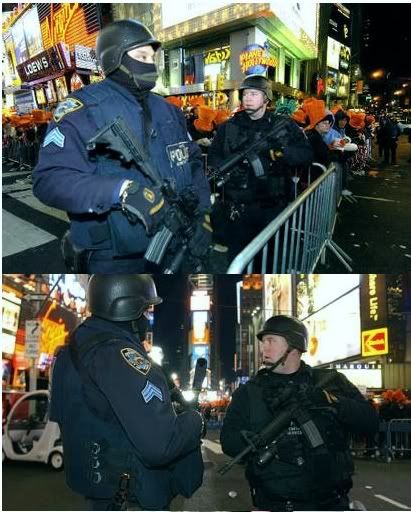
So, why are all these law enforcement officers carrying these deadly “bullet hoses” around public places on New Year’s eve? So they can “spray fire” the crowds? (Note that many also have the evil baby-killing LE Only collapsable stocks and bayonet lugs. – Do they issue police bayonets these days?)


Didn’t think so.

The Hoplophobic Mindset

Via Say Uncle comes the link to fellow blogger Michael Williams’ disgusted response to being denied a CCW permit by his betters in California.

While I’m not surprised by the denial, I was a bit shocked to see the comment by Barry, another blogger who runs The Inn of the Last Home from Tennessee. It is the quintessential gun-phobe:

I just…I just blink my eyes in amazement everytime this crops up – actually watching people feel the need to carry a concealed weapon in public…

If I were to take a live, armed weapon and carry it on my person, in public, it would eat away at my sanity just as if it were emitting lethal radiation. To know that I carried an instrument of sure and certain death on my person, available and ready to be pulled out and used at a moment’s notice to possibly kill…a child. A homeless person. An innocent.

Obviously that is not your intent. You want to protect yourself – maybe that is how you feel in California. But being brought up in Eastern Tennessee I’ve never once felt the need to protect myself from imminent bodily harm in public. And if I were aware of a location that might be unduly hazardous – a dark alley, a badly lighted parking area – I would avoid it. I’ve never been mugged, nor can I readily pull up a name of any person I’ve ever met that’s been mugged or even bodily threatened in my whole life.

What scares me most is the arbitrary nature of self-defense. What line must be crossed to signal to you that there is imminent danger or threat? Is it a criminal pulling a gun on you? In which case, unless you’re a gunslinger, you’re not going to outdraw him. Is it someone pulling a knife? Threatening words? Bad language or rude gestures? Where is that one point where you decide, “Yes, my life or the life of my loved ones is in danger and I must now take it upon myself to take the life of another person.” What if the guy is reaching into his jacket, and you are sure, absolutely certain that it is a weapon. You pull your gun and shoot–and see he’s reaching for his wallet. Or worse, you miss and hit a child running in the street. Where is that line?

The radiation would rot my brain and I would never be able to live with myself.

Maybe it’s different in California. Maybe it’s different in Tennessee. Maybe I don’t love my family enough…maybe I love them too much. But I know myself, and know that if I surrendered to the paranoia – and I mean that in the most basic sense – there would be no turning back.

I’ll stay in the light, thanks.

Note the change: “If I were to take a live, armed weapon and carry it on my person, in public, it would eat away at my sanity just as if it were emitting lethal radiation.” Followed below by: “The radiation would rot my brain….”

That is fear of an inanimate object. He actually believes that the presence of a firearm will warp his sanity.

Barry, I applaud your decision to remain unarmed. I hope, however, that you will get some psychiatric or psychological treatment for your crippling fear of your own lack of control.

And I sincerely hope that neither you nor anyone you know becomes the victim of a violent crime.

But please, don’t project your mental disturbance on others.

UPDATE:  The original JSKit/Echo comment thread is available here, thanks to reader John Hardin.

England Slides Further Toward Bondage

Remember the Tytler quote?

A democracy cannot exist as a permanent form of government. It can only exist until the voters discover that they can vote themselves money from the public treasure. From that moment on the majority always votes for the candidates promising the most money from the public treasury, with the result that a democracy always collapses over loose fiscal policy followed by a dictatorship.

The average age of the world’s great civilizations has been two hundred years. These nations have progressed through the following sequence: from bondage to spiritual faith, from spiritual faith to great courage, from courage to liberty, from liberty to abundance, from abundance to selfishness, from selfishness to complacency from complacency to apathy, from apathy to dependency, from dependency back to bondage.

Well, it looks like they’ve taken another step along the path.

Britain OKs Jeopardy Law Reform

The British Parliament on Thursday approved legislation to overturn “double jeopardy” protection for offenses such as murder, rape and armed robbery.

The centuries-old legal rule prevents suspects from being tried twice for a crime, and it is enshrined in the legal codes of many of Britain’s former colonies, including the United States.

Under the Criminal Justice Bill, introduced by Prime Minister Tony Blair’s government last year, a person acquitted of certain serious offenses, including rape and murder, would face a second trial if compelling new details, such as DNA evidence, come to light.

The legislation, hailed by the government as the biggest reform of Britain’s criminal justice system in a generation, now needs only royal assent, which is virtually automatic, before it becomes law.

And why are they doing this? Because England has the highest rate of violent crime in the Western world. Because you are far more likely to be a victim of crime in England than anywhere else in Europe. And why is that? Because Britain’s liberal courts don’t see the judicial system as a tool for punishing criminals, but treating them. Because the police are overwhelmed and the citizenry is powerless. Because nobody wants to be a witness. It’s so bad that the police are not reporting crime in an effort to make things look better than they are. Video surveillance cameras, in an eerie 1984 parallel, are going up all over England – to make the subjects safer, you see. Now they’re trying to introduce a national ID card. Individual privacy is becoming a thing of the past – if you’re a law-abiding subject.

Here’s the image of England today:

Make the People powerless. Make them dependent. Pass more and more and more laws, each stripping the law abiding of more of their rights, all in the name of “public safety.” Allow government to acquire more and more power – also in the name of “public safety” – all the while not providing public safety. As Mencken put it:

All government, of course, is against liberty.

and

The whole aim of practical politics is to keep the populace alarmed (and hence clamorous to be led to safety) by menacing it with an endless series of hobgoblins, all of them imaginary.

Except in this case, the hobgoblins aren’t imaginary, which I think makes it worse.

In my humble opinion, this dates back (at least) to the end of World War I. In 1900 the government of England still trusted the people to be their own guardians. Prime Minister Robert Gascoyne-Cecil, the Marquess of Salisbury, said in 1900 that he would “laud the day when there is a rifle in every cottage in England.” But in 1903 England passed its first gun control law. A minor one, simply requiring an easily acquired permit to purchase a handgun, and restricting the age of purchasers, but it was the first toe over the slippery slope. In 1919, in fear of anarchists and communists, England passed its first sweeping gun law – as a crime control measure – even though crime involving firearms was rare as hen’s teeth. You could only have a handgun or a rifle if you showed “good reason” to have one. (Sound familiar?) So much for “a rifle in every cottage” being a laudable goal. The descent had begun in earnest.

In 1936 short-barreled shotguns and fully-automatic weapons were outlawed – not regulated as they are here, outlawed. The reasoning? Civilians had no “legitimate reason” for owning them. Another slide down the slope. The reasoning had changed from the government needing to show reason for the restrictions to the people needing to show reason to exercise the right, to government telling them that there was no acceptable reason.

The English Bill of Rights stated “That the subjects which are protestants, may have arms for their defence suitable to their conditions, and as allowed by law.” Sir William Blackstone, commenting on this in his Commentaries on the Laws of England said:

“THE fifth and last auxiliary right of the subject, that I shall at present mention, is that of having arms for their defence, suitable to their condition and degree, and such as are allowed by law. Which is also declared by the same statute 1 W. & M. ft. 2. c. 2. and is indeed a public allowance, under due restrictions, of the natural right of resistance and self-preservation, when the sanctions of society and laws are found insufficient to restrain the violence of oppression.”

Whatever happened to the “natural right of resistance and self-preservation”? Have not the “sanctions of society and laws” been proven “insufficient to restrain the violence of oppression”? And I’m just talking about the criminals, not the government.

In 1936 the British added a “safe storage” requirement for all handguns and rifles. (Sound familiar?)

As a result of the 1920 restrictions, not only didn’t England have “a rifle in every cottage,” they didn’t have many rifles period. In 1940 England was in danger of being invaded and begged America to send it rifles with which to defend its shores. And we, American private citizens, sent them. Rifles, shotguns, and pistols.

But at the end of the war the English didn’t get to keep them, and we didn’t get them back.

In 1946 self-defense was no longer a “good reason” to have a firearm. The slope got steeper.

In 1953, carrying a weapon for self-defense was made illegal. Any kind of weapon.

In 1967 the law was amended to require a license to own a shotgun, and jury trials no longer required a unanimous decision.

In 1982 reloaders and blackpowder enthusiasts were made subject to police inspection without a warrant to ensure “safe storage” of the reloading materials. In other words, agents of the government, without a warrant, could come into ones home at any time, without warning.

In 1988 all semi-auto and pump-action rifles were banned. By this time there weren’t many rifle owners anyway, but that didn’t matter. The personal property of law-abiding subjects was, once again, made illegal. And they were all registered – that is, the ones belonging to the law-abiding.

In 1996 all handguns were banned. And they were all registered… Well, you get the point.

Also in 1996, carrying any kind of knife was made illegal – unless you could prove you had a good reason for having it. The presumption of innocence was gone.

Defending yourself in England has become progressively more and more risky, as you stand a very good chance of being prosecuted for use of excessive force. You cannot carry a weapon when out in public, and you cannot use a firearm in self-defense in your home. The law has made crime safe for the criminals. It’s no wonder that crime in Britain has been on the climb since the 1950’s.

Am I suggesting that this has been some nefarious plan all along to strip the British of their rights and bind them into slavery? No I am not. I’m suggesting that this is a cycle of human behavior – long recognized – that we should be paying attention to and trying to break. We know what government does: it acquires power at the expense of the governed, for good reason or bad. And it does it slowly, almost imperceptibly, because we never believe that each “next step” is leading where we’ve been told it always leads. “Not this time,” we think. “We know better.”

Yeah?

Ask the English.

How long before we follow them?

But, But, Ballistic Fingerprinting Saves Lives!

Also via Keepandbeararms.com,

State police speak against expanding gun database

Ballistics system has flaws, crime lab director says

No, really?

After finding substantial problems with the state’s ballistic fingerprinting database, Maryland State Police have recommended that it not be expanded.

A 40-page report by the director of the agency’s crime lab concludes, among other things, that the ballistic samples on file are often not from the type of guns used by criminals, and that the state system is not linked to the national database.

To date, the database — which has cost $2.1 million over the past three years — has generated four matches, and in each case, police already had the gun they were trying to trace, according to the report.

Among the problems identified in the report: Some casings submitted by manufacturer Glock have not been reliable; the casings submitted by gun manufacturers are not usually from the type of guns linked to crime scenes; and the state’s database cannot be linked with the national database.

“Not reliable” how, exactly?

Yet Johns Hopkins thinks ballistic fingerprinting is the best thing since sliced bread.

In direct opposition to the findings of a California Dept. of Justice study that predicted precisely what the Maryland report confirms:

The RBID “beta” sites in New York and Maryland currently contain only handgun information. In 2002, there were approximately 12,400 handguns sold in Maryland that were subject to the ballistics imaging requirements. New York ballistically imaged 20,973 handguns in 2002. To date, New York and Maryland have made no matches, or “hits,” with these programs.

Attachment A of this report states:

Automated computer matching systems do not provide conclusive results. Rather, a list of potential candidates are presented that must be manually reviewed. When applying this technology to the concept of mass sampling of manufactured firearms, a huge inventory of potential candidates will be generated for manual review. This study indicates that this number of candidate cases will be so large as to be impractical and will likely create complications so great that they cannot be effectively addressed.

There are several issues associated with an automated imaging concept that have to be considered. These relate to issues that impact the efficacy of the use of ballistics imaging when applied to large numbers of commercially produced firearms. These are:

1. Current imaging systems require trained personnel, ideally a firearms examiner, for entry, searching and verification. The use of technicians typically results in higher numbers of false positives that need to be microscopically compared.

2. Current systems may not be as efficient for rimfire firearms and are limited to auto loading weapons. Proposed systems will not practically accommodate revolvers, rim fires, certain shotguns and rifles. A large proportion of firearms sold in CA may never make entry into the system.

3. It is unknown at this time whether or not the algorithm can successfully ID a cartridge case fired after typical break-in and wear have occurred back to the #1 casing fired at the time of manufacture. Performance Test #7 (See page 8-11) showed that even in a limited database, the ranking of subsequently fired casings could drop enough to fall from a candidate list for consideration. Typically quoted existing research/papers regarding persistence of fired marks on fired cartridge cases were written based on manual comparison by qualified firearms examiners, not automated correlation techniques.

4. All potential “hits” selected for further inspection by computer correlation must be confirmed by “hands on” microscopic examination by a qualified firearms examiner.

5. Firearms that generate markings on cartridge casings can change with use and can also be readily altered by the user. They are not permanently defined identifiers like fingerprints or DNA. Hence, images captured when the firearm is produced may not have a fixed relationship to fired cartridge casings subsequently recovered.

6. Cartridge casings from different manufacturers of ammunition may be marked differently by a single firearm such that they may not correlate favorably.

7. As progressively larger numbers of similarly produced firearms are entered into the database, images with similar signatures should be expected that would make it more difficult to find a link. Therefore, this increase in database size does not necessarily translate to more hits.

8. Fired cartridge casings are much easier to enter, correlate, and review than fired bullets.

9. Not all firearms generate markings on cartridge casings that can be identified back to the firearm.If you’re interested, read the whole report and all the appendices.

So, Maryland has spent $2,100,000 on their automated system, and it’s identified four (4) cases – for guns they already had on hand. It hasn’t identified a single firearm they didn’t have to immediately compare to.

Wow. That’s effective use of taxpayer money, isn’t it?

How many police officer salaries does that represent?

Oh well, I guess they can confiscate some more boats and cash and property to cover the costs.

I HATE Registration

And I HATE government confiscation of property.

See this story about a man who just received a Presidential pardon. You can bet your ass he didn’t get his boat or his rifle back.

Dentist Convicted Of Transporting Automatic Weapon

A man who pleaded guilty to transporting an automatic weapon in 1987 was pardoned by President George W. Bush, the Justice Department announced Thursday.

Fort Lauderdale dentist Bruce Louis Bartos, 60, said he pleaded guilty to the charge of transporting an automatic weapon on his 45-foot fishing boat because he had two children in college, had just lost his wife to cancer and did not want to go to trial.

And lose everything he had, and probably go to jail. That’s the big stick the government hangs over the heads of nominally law-abiding citizens who just didn’t know the law or failed to cross some “t” or dot some “i”. Ayn Rand got it dead to rights:

There’s no way to rule innocent men. The only power any government has is the power to crack down on criminals. Well, when there aren’t enough criminals, one “makes” them. One declares so many things to be a crime that it becomes impossible for men to live without breaking laws. Who wants a nation of law-abiding citizens? What’s there in that for anyone? But just pass the kind of laws that can neither be observed nor enforced nor objectively interpreted — and you create a nation of law-breakers — and then you cash in on the guilt.

Bartos said he was unaware at the time that his AR-15 – the civilian version of the M-16 military assault rifle – was illegal without a permit. He used the rifle, along with a handgun and other weapons, for protection from drug dealers and pirates when boating between South Florida and the Bahamas, he said.

“CIVILIAN VERSION” That means SEMI-AUTOMATIC. It’s a big distinction. Just ask the Violence Policy Center.

Now I cannot imagine a more appropriate firearm for defense against piracy – and piracy does occur in those waters. All he had it for was self-defense, but like Mr. Campbell in the post below, he’s the one victimized by the government. Read on.

Bartos agreed to plead guilty and forfeit his boat in return for two years’ probation.

What did the government need with his boat? We’re talking about a paperwork omission. Do they take your house if you fail to register your car?

I’d say the government “cashed in” on Mr. Bartos’s “guilt.” I wonder if a government employee now owns a 45′ fishing boat he got at a really good price.

“I pleaded guilty and lost my boat over a stupid $200 or $300 dollar gun,” he said. “And for $200 I could have had a permit.”

THEY STOLE HIS BOAT OVER A $200 TAX. And that, my friends, is what registration is good for – aside from confiscation of guns, which I’m sure they also did. I doubt he got to keep any of his guns.

Bartos later began to challenge his conviction by filing clemency requests and having character references sent to the Department of Justice on his behalf. He hired a Washington lawyer, and hoped to be among those pardoned before President Bill Clinton left office.

Sorry Mr. Bartos, but you weren’t a big Clinton campaign contributor (or big enough criminal) were you?

When he found out about the pardon Wednesday he became “breathless, speechless.”

I’m a little surprised myself. I expect the Deep Space Nine to make hay over Bush pardoning an “assault weapon smuggler” or some such quite soon.

“Someone in the Justice Department read my file and basically felt that I had really received a raw deal, and that it should never have been handled this way,” Bartos said.

Even though only close friends and advocates knew about his conviction, the pardon came as a great relief.

“It gives me the ability to hold my head up high, like I’m a full fledged citizen of this country,” he said.

You just got reamed by the government of this country, and they had the courtesy to kiss you afterward. That is all.

A U.S. Attorney’s Office spokesman in Miami did not have any comment on the pardon.

No, I bet they didn’t.

Does this restore all his rights? Was it a felony conviction? Could it have resulted in a sentence of more than one year (or was there a sentencing guidline at all?)

Did the pardon come with the keys to his boat?

Enquiring minds want to know.

UPDATE: According to this story:

Bartos said his boat was stopped and searched when he returned from a family trip to Bimini in 1986. On board he had an AR-15, the civilian version of the M-16 military assault rifle, which Bartos said he carried for protection.

The gun was tested at the FBI lab and deemed to be automatic, which is illegal.

Illegal without the $200 “tax”. I should have recognized that just by the reference to the $200 requirement. (Then again, his assertion that it was a $200-300 rifle is in error. Even in 1986 a full-auto AR-15 would have been worth over a thousand dollars. A semi-auto version would be worth more than $500.) I assume that Mr. Bartos’s AR-15 had M-16 parts installed in it, which is a no-no. But I stand by my objection: Taking someone’s hundred-thousand dollar boat over a $200 tax omission is excessive punishment.