A Non-Binding Surrender.

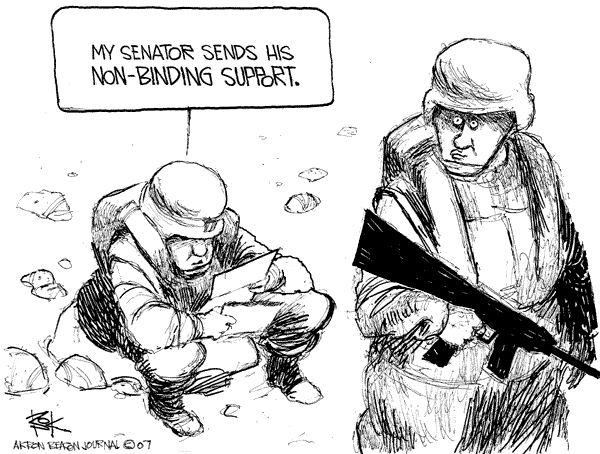
I don’t have too many words to say about this, other than I see it as just another nail in the coffin of Western Civ. While researching for the post below, I came across two Chip Bok cartoons that said it as well as anyone could:

The Senate gets its chance tomorrow.

And I’m reminded once again of an Alexander Solzhenitzyn quote:

In a state of psychological weakness, weapons become a burden for the capitulating side. To defend oneself, one must also be ready to die; there is little such readiness in a society raised in the cult of material well-being. Nothing is left, then, but concessions, attempts to gain time and betrayal.

(*sigh*)

I’m going to bed.

Indoctrination

A couple of posts below I linked to An Infuriating Man, an essay by Leo Rosten about economist Milton Friedman. In the post between this one and that one, I mentioned that I fairly recently read the book Conversations with Eric Sevareid: Interviews with Notable Americans. It so happens that Leo Rosten was one of Mr. Sevareid’s guests, and that transcript was one in the book. Taped on August 24, 1975, Sevareid introduces Rosten:

“Wisdom,” according to Leo Rosten, “is only the capacity to confront intolerable ideas, with composure. Most men debase the pursuit of happiness by transforming it into a foolish pursuit of fun. But where was it promised that the purpose of life is to be happy? To me, the most important thing in life is to matter, to count, to stand for something. In short, to have it make some difference that you lived at all.”

Leo Rosten has taught at Yale, Stanford, Columbia and the University of California. In addition to all else, he’s an astute economist trained at the University of Chicago and the London School of Economics. He belongs to an interesting intellectual mutation. He was a New Deal liberal in Franklin Roosevelt’s day; today he’s a neo-conservative. From old liberal to new conservative is paradoxically a function of aging and changing society. Neo-conservatives don’t believe that education or government can determine the total picture of American society.

This is the earliest reference I have seen of the term “neo-conservative.” I was a little surprised that it dates back to at least 1975.

The interview begins:

Rosten: We didn’t assume thirty years ago that the schools could solve all our problems. We never assumed that politics could solve them. In fact, this country was based on the commanding idea that the politicians should do and what the government should do is make it possible for people to pursue happiness. Now the disenchanted say, “Make me happy!” Schools can’t make anyone happy.

Sevareid: What happened? Some of the Supreme Court decisions, some of the rules from the Department of Health, Education, and Welfare, from the federal government, are going to instruct every high school in every local community what boys and girls can do, what sports they can play at together, and what can or can’t be done in the locker room. (Title IX passed in 1972.) This would have made Alexander Hamilton and Ben Franklin turn in their graves. Why shouldn’t local communities have something to say about how children are educated?

Rosten: I think the tide has to turn. The story of the growth of federal power is one of the most lamentable in American history. I think historians of the future will mark 1932 as one of the black years of American history – not that Roosevelt was a bad President, not that he didn’t do extraordinary things. His greatest talent was that of a politician. He cemented a society that was falling to pieces in very ugly ways. But what he did was start the pattern by which instead of fixing your community’s bridge you wrote to your Congressman and asked him to get Congress to appropriate $28,000 for your bridge – a pattern by which everything is taken care of by federal money. What’s wrong with this is that it prevents the most powerful engine mankind has ever known, the free market, from working.

I think we are now beginning to learn that it is foolish to assume that people in Washington know better how to run Alameda County that the men who are farming in Alameda County.

I don’t think the lesson stuck.

Rosten on the press:

Sevareid: A long time ago, during the 1930’s, you wrote the first real sociological study of the Washington press corps. A lot has changed since then. It’s now a vast herd of people. The tone has changed. The press has itself become a great controversial issue. What’s the big difference now?

Rosten: The decline of newspapers, the decline of local papers, the pabulumized news leads me to read weekly journals more than ever because they at least put things into perspective. The kind of person who now goes into journalism may also be different.

Now even the weeklies are pabulum, and the dailies are dying from decreasing readership.

Sevareid: The Watergate adventures have something to do with it. Press people have been lured and forced out of their normal roles to a degree. They’ve become actors in the play themselves. They’re writing about each other. There also is a new level of howling monkeys at news conferences. They’ve given the press a pretty bad image with lots of people. Some reporters seem to think they’re prosecuting attorneys at every encounter with officials. They don’t understand that civility is not the enemy of freedom; it’s an ally.

Rosten: I have the feeling that the editorial pages of this country, with the exception of the Wall Street Journal, are repeating the cliches of the 1940’s and 1950’s. “If a government program fails it’s because not enough money was put into it. Let’s put more money into it!” And more and more money is poured down the rat hole.

Or, as Steven Den Beste put it, cognitive dissonance leading to “escalation of failure.”

And, finally, Leo Rosten on education:

Sevareid: Leo, you’ve written about everything, thought about everything, studied everything. You’re a great generalist, which is not much in fashion any more. What’s happened to the knowledge industry? Sociologists, economists, psychologists, psychiatrists, seem rather bankrupt. Have we overburdened the human mind with too many facts? Vocabulary seems to have outrun knowledge, which has outrun wisdom. Where do we turn?

Rosten: We’ve always gone on the assumption (a good one) that education will liberate the human mind or the human spirit. There’s a second assumption that’s forgotten. Some people are meant to be educated and to learn and to enjoy the uses of the mind. Some people are meant to paint. Some people are meant to draw castles in the sand and make them into sculpture. Some people love to prune trees and gardens. What we have done is assume that everyone can potentially become an intellectual. We’ve confused learning with schooling.

It’s absolutely absurd that in this country today there should be seven million youngsters going to college. There are not seven million people who want to read Plato or Aristotle or Montesquieu. And there’s no reason why they should. We have failed to see that there aren’t enough jobs for those who learn esoteric things. For a while there was a big fling on learning Swahili in New York. Lots of kids were studying it because it was part of the Black movement, the idea of Black identity, Black liberation. It so happens that Swahili was the language of the Arab slave traders. In any event, what good does it do to know Swahili? I don’t mean “good” simply in terms of economics. What sort of good does it do?

When you’re young, when your mind and spirit are like a sponge, there is no better time to learn certain things and there is no worse time to learn certain things. I would abolish the study of some courses except for students aged thirty and above.

I was lucky as a child of the depression. I couldn’t get a job for three years. I was lonely and miserable. At the end of those three years, because I was desperate, I went back to school. I was older than my classmates, I had learned something. I had learned how hard it is to walk all day long, trying to earn a dollar. I had learned how important it is to save, to appraise people, to figure out if this or that guy can be trusted or not trusted. This is what life and the world are about.

We’re practically using the colleges as a dump into which to put youngsters we do not know what to do with. There are today 45 million people between the age of roughly 7 and 24. Their parents don’t know what to do with them. They want them to go to college and they often think that they’re being trained for jobs. But they’re not getting training for useful employment.

Someone has said that education is what remains after everything you’ve learned is forgotten. The purpose of educating young people is not only to illuminate their spirit and enrich their memory bank but to teach them the pleasures of thinking and reading. How do you use the mind? As a teacher, I always was astonished by the number of people in the classroom who wanted to learn as against those who just wanted to pass. I took pride in my ability to communicate. Generally “communicate” meant one thing. Now the young think “communicate” means “Agree with me!”

The more things change, the more they stay the same.

But here’s the kicker:

Rosten: The student rebellions of the 1960’s exposed the fact that our entire educational system has forgotten the most important thing it can do prior to college: indoctrinate. I believe in the indoctrination of moral values. There’s a lot to be said for being good and kind and decent. You owe a duty to those who have taken care of you. You owe a duty to whatever it is that God or fate gave you – to use your brain or your heart. It’s senseless to whine, to blame society for every grievance, or to assume that the presence of a hammer means you have to go out to smash things.

The young want everything. They think they can get everything swiftly and painlessly. They are far too confident. They don’t know what their problems are, not really. They talk too much. They demand too much. Their ideas have not been tempered by the hard facts of reality. They’re idealists, but they don’t sense that it’s the easiest thing in the world to be an idealist. It doesn’t take any brains. This was said by Aristotle 2300 years ago. Mencken once said that an idealist is someone who, upon observing that a rose smells better than a cabbage, assumes that it will also make better soup.

To some extent, Rosten sounds like all elders complaining about youths:

Our youth now love luxury. They have bad manners, contempt for authority; they show disrespect for their elders, and love chatter in places of exercise. They no longer rise when elders enter the room. they contradict their parents, chatter before company, gobble up their food and tyrannize their teachers. – Socrates

I am ambivalent on the topic of “indoctrination.” My problem is with what that indoctrination entails. Rosten objects to the failure of the educational system to indoctrinate moral values. I’d say it still does. It just doesn’t indoctrinate goodness, kindness, and decency anymore. It indoctrinates “multicuturalism,” “tolerance,” “sensitivity,” “fairness,” “socialism,” and “self-esteem.” It fails to instruct in history, civics, ethics, mathematics, English, or for that matter, job skills. The education system receives “young skulls full of mush” and processes them right on through, sending them into the world with what Ayn Rand described as “a junk heap of unwarranted conclusions, false generalizations, undefined contradictions, undigested slogans, unidentified wishes, doubts and fears.”

The reasons for this are myriad. Diane Ravitch puts part of the blame (convincingly) on the textbook companies who are loath to put anything in a text that someone, anyone, might find offensive. I put a large part of the blame on the influx of socialist True Believers into the ranks of educators since the time of John Dewey. As far as public schools are concerned, we’ve abandoned the idea that education can liberate the human mind or human spirit. Schools are now warehouses, run by administrators terrified of lawsuits and too many teachers who are literally tyrannized by their charges and their parents. Indoctrination still goes on, though. Read this lovely little op-ed by Mark Bradley, a history teacher from Sacramento. I bet his classes are popular!

It would seem that if you want some good indoctrination, your only choices are homeschooling or private – often ecumenical – schools.

Indoctrination of children is not necessarily a bad thing, but somewhere along the line we stopped paying attention to what was and what wasn’t getting poured into their heads, and it started long before 1975.

Philosophy

All who have meditated on the art of governing mankind have been convinced that the fate of empires depends on the education of youth. – Aristotle

I’ve been writing here for right at three and a half years. If the post counter is to be believed (blogspot being what it is), this is the 2281st post here. Prior to TSM I spent six months and a bit over 1800 posts at DemocraticUnderground.com in the “Gun Dungeon” irritating the Progressive faithful. (Most honest expression of the faith ever posted there: “There is no room in the progressive agenda for gun rights.”) Before that I spent a few months in the mosh-pit of talk.politics.guns and at the late, lamented Themestream.com. I have been a member of AR15.com since February of 2001. I have posted about 8,500 times there, and am still active.

In the last, oh, three years or so, on top of the fiction I prefer, I have read the following books (not a complete list, and certainly not in order):

Albion’s Seed: Four British Folkways in America, by David Hackett Fischer

Guns, Germs & Steel by Jared Diamond

Restoring the Lost Constitution: The Presumption of Liberty by Randy Barnett

Shooters: Myths and Realities of America’s Gun Cultures by Abigale Kohn

Born Fighting: How the Scots-Irish Shaped America by James Webb

Revolutionary Characters: What Made the Founders Different by Gordon S. Wood

1776 by David McCullough

On Killing: The Psychological Cost of Learning to Kill in War and Society by LTC Dave Grossman

Ripples of Battle: How Wars of the past Still Determine how We Fight, how We Live, and how We Think by Victor Davis Hanson

Life at the Bottom: The Worldview That Makes the Underclass and Our Culture, What’s Left of It: The Mandarins and the Masses, both by Theodore Dalrymple

For the Defense of Themselves and the State: Legal Case Studies of the 2nd Amendment to the U. S. Constitution by Clayton Cramer (Contact Clayton directly. I’m sure he’d be happy to sell you an autographed edition.)

Bias: A CBS Insider Exposes How the Media Distort the News by Bernard Goldberg

Philosophy: Who Needs It and Atlas Shrugged by Ayn Rand

Armed: New Perspectives on Gun Control by Gary Kleck and Don Kates

Whose Right to Bear Arms Did the Second Amendment Protect? edited by Saul Cornell

True Believer: Thoughts on the Nature of Mass Movements by Eric Hoffer

and, by association,

Conversations with Eric Sevareid by Eric Sevareid, which has two interviews with Hoffer

Men in Black: How the Supreme Court is Destroying America by Mark Levin

The Vision of the Anointed: Self-Congratulation as a Basis for Social Policy by Thomas Sowell

Honor: A History by James Bowman

And, of course,

Silent America: Essays from a Democracy at War by Bill Whittle

This is in addition to all the blogs, court decisions, op-eds, news pieces, and other internet reading I’ve done. Next on deck are Milton Friedman’s Free to Choose and Capitalism and Freedom, and F.A. Hayek’s The Road to Serfdom. (Be still, my beating heart.)

I’m 44 years old. I think I’ve finally developed a firm grasp on just how much I don’t know. I believe I’ve developed a firm grasp on what little I do know. I’m reminded of that quote from The Purple Avenger‘s blog:

“I now understand”, he said, “why engineers and their like are so hard to examine, whether on the stand or in a deposition. When they say a thing is possible, they KNOW it is possible, and when they say a thing is not possible, they KNOW it is not. Most people don’t understand know in that way; what they know is what we can persuade them to believe. You engineers live in the same world as the rest of us, but you understand that world in a way we never will.”

I’m interested in what works. In the course of writing this blog, I’ve had numerous discussions, both in posts and in comments, with others interested in the same things I am from similar and from widely divergent perspectives. In my six-part discussion with Dr. Danny Cline, he stated:

I do indeed believe that man has innate moral knowledge (I wouldn’t say an instinct, but that’s a pretty minor problem). I should say rather that I believe that I have innate moral knowledge.

In a comment to Freedom’s Just Another Word for Nothin’ Left to Lose, Billy Beck said:

At the root, I don’t understand how and why individuals don’t “lead” themselves.

But he had already answered his own question:

(Y)ou people are talking about blowing the place up, whether you know it or not. That’s the only way it can go, as things are now, because there is no philosophy at the bottom of what you’re talking about.

No philosophy.

Damned straight.

In Philosophy, Who Needs It, Rand said:

As a human being, you have no choice about the fact that you need a philosophy. Your only choice is whether you define your philosophy by a conscious, rational, disciplined process of thought and scrupulously logical deliberation — or let your subconscious accumulate a junk heap of unwarranted conclusions, false generalizations, undefined contradictions, undigested slogans, unidentified wishes, doubts and fears….

Dr. Cline may have an “innate moral knowledge,” I won’t gainsay him on that, but my observation of objective reality leads me to believe that he is by far the exception rather than the rule. The overwhelming majorty of people “accumulate a junk heap of unwarranted conclusions, false generalizations, undefined contradictions, undigested slogans, unidentifed wishes, doubts and fears” and are therefore incapable of leading themselves anywhere. Aristotle was absolutely right: the fate of empires depends on the education of youth.

And we’re failing in that – horribly. The entirety of Western Civilization is, apparently. If this was a WordPress blog, I’d have a category titled “Dept. of Our Collapsing Schools” filled with story after story of how parents, lawsuits, and socialist influences not limited only to political correctness and teachers unions have caused our education system to largely give up on the duty of education, and instead become twelve years of daycare. We’ve produced generation after generation of people with no coherent philosophy. At least, no single philosophy, or one that stands up to scrutiny.

For example, many localities passed minimum-wage increase initiatives with the last election. Speaker-elect Pelosi promises to address this apparently crucial issue in the first 100 hours of the new Congress. Why? Because a lot of Americans are convinced that the minimum wage is too low. Dale of Mostly Cajun isn’t. Neither is Tam from View from the Porch. They’re in good company. As Leo Rosten channeled recently deceased economist Milton Friedman on the topic:

“The public,” sighed Fenwick, “is not well-informed about economics, and will pay for its innocence. Increased minimum wages lead to increased costs, which lead to higher…. Then many honest, low-wage earners in the South (where the cost of living is lower; which is one reason wages there stay lower) will become disemployed. And many more of the young and no-skilled, in Harlem no less than Dixie, will remain more hopelessly unemployed than they already are.” Fenwick regarded Rupert Shmidlapp innocently. “Tell me, honestly: Would you rather work for $1.25 an hour or be unemployed at $1.40?”

While Shmidlapp was wrestling with many unkind thoughts, Fenwick gave his guileless smile: “I am strongly in favor of wages rising — which is entirely different from raising wages. Let wages go up as far as they can and deserve to, for the right reasons, which means in response to demand and supply and freedom to choose… Take domestic servants, Mr. Shmidlapp. Why maids, cooks, cleaning women, laundresses have enjoyed a fantastic increase in their earnings. And notice, please, that domestic servants are not organized; they don’t have a union, or a congressional lobby. Or take bank clerks…”

In Arizona, voters decided to ban smoking in public places but also decided to raise taxes on cigarettes to fund a child health-care program. What will they do with the fallout from dwindling tax revenues? (Oh. Silly me!) I’m sure there are other similar examples from all over the country.

For far too many people, what they know is what they can be persuaded to believe, and they can be persuaded to believe two or more mutually exclusive things simultaneously with apparently little effort. Without putting my tinfoil hat on too tight, I’m convinced that the primary reason our education system, and that of the majority if not entirety of Western civilization has collapsed is that ignorant people are easily persuaded, and politicians like it that way. So do trial lawyers. A populace with a conscious, rational, disciplined philosophy cannot be easily lead around by the nose. Such a philosophy must be avoided in a democratic society if power is to be acquired and accumulated.

To have a populace with such a philosophy, it is crucial to start with the education of youth. Some of us have been lucky in our education. I owe my basic beliefs to the quite good education I received as a child growing up on America’s “Space Coast” during the Cold War and our race to the Moon. The rest of it has been a desire to educate myself that comes from I don’t know where. I know I’m relatively rare; I’ve seen who we keep getting for elected officials and the programs they keep foisting on us to keep getting elected. We don’t “lead ourselves” because most of us aren’t willing to lose what we have in order to become tomorrow’s forgotten martyrs. We know that there are not enough of us to affect radical change – and radical change seems to be the only answer. “Blowing the place up” worked once. I hold little hope that it will again, because the general populace does not share a common philosophy in any way, shape, or form. I’m afraid Henry George was right:

A corrupt democratic government must finally corrupt the people, and when a people become corrupt there is no resurrection. The life is gone, only the carcass remains; and it is left for the plowshares of fate to bury it out of sight.

And I’m afraid that Osama Bin Laden and his ilk through their madrassas schools have inculcated a shared philosophy that will allow them to build a new empire on the buried carcass of the West.

Aristotle never said empires had to be benevolent.

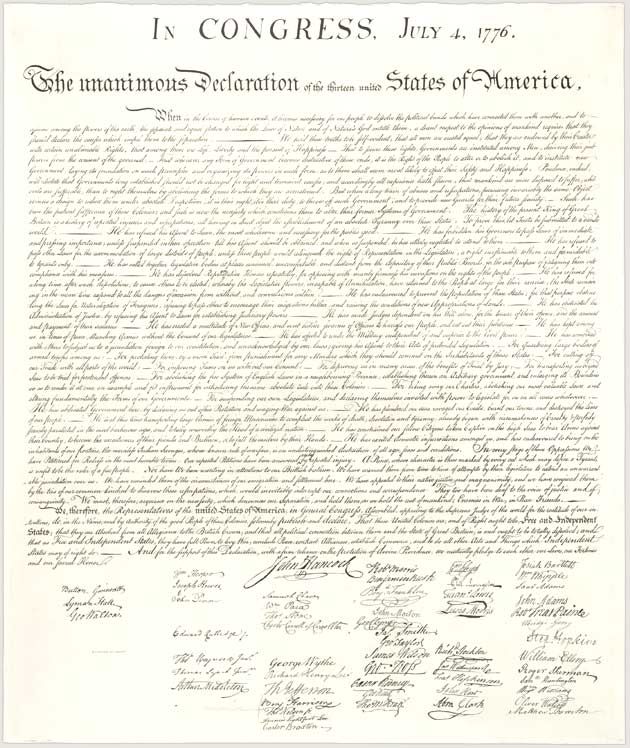
In CONGRESS, July 4, 1776.

The unanimous Declaration of the thirteen united States of America,

When in the Course of human events, it becomes necessary for one people to dissolve the political bands which have connected them with another, and to assume among the powers of the earth, the separate and equal station to which the Laws of Nature and of Nature’s God entitle them, a decent respect to the opinions of mankind requires that they should declare the causes which impel them to the separation.

We hold these truths to be self-evident, that all men are created equal, that they are endowed by their Creator with certain unalienable Rights, that among these are Life, Liberty and the pursuit of Happiness.–That to secure these rights, Governments are instituted among Men, deriving their just powers from the consent of the governed, –That whenever any Form of Government becomes destructive of these ends, it is the Right of the People to alter or to abolish it, and to institute new Government, laying its foundation on such principles and organizing its powers in such form, as to them shall seem most likely to effect their Safety and Happiness. Prudence, indeed, will dictate that Governments long established should not be changed for light and transient causes; and accordingly all experience hath shewn, that mankind are more disposed to suffer, while evils are sufferable, than to right themselves by abolishing the forms to which they are accustomed. But when a long train of abuses and usurpations, pursuing invariably the same Object evinces a design to reduce them under absolute Despotism, it is their right, it is their duty, to throw off such Government, and to provide new Guards for their future security.–Such has been the patient sufferance of these Colonies; and such is now the necessity which constrains them to alter their former Systems of Government. The history of the present King of Great Britain is a history of repeated injuries and usurpations, all having in direct object the establishment of an absolute Tyranny over these States. To prove this, let Facts be submitted to a candid world.

He has refused his Assent to Laws, the most wholesome and necessary for the public good.
He has forbidden his Governors to pass Laws of immediate and pressing importance, unless suspended in their operation till his Assent should be obtained; and when so suspended, he has utterly neglected to attend to them.
He has refused to pass other Laws for the accommodation of large districts of people, unless those people would relinquish the right of Representation in the Legislature, a right inestimable to them and formidable to tyrants only.
He has called together legislative bodies at places unusual, uncomfortable, and distant from the depository of their public Records, for the sole purpose of fatiguing them into compliance with his measures.
He has dissolved Representative Houses repeatedly, for opposing with manly firmness his invasions on the rights of the people.
He has refused for a long time, after such dissolutions, to cause others to be elected; whereby the Legislative powers, incapable of Annihilation, have returned to the People at large for their exercise; the State remaining in the mean time exposed to all the dangers of invasion from without, and convulsions within.
He has endeavoured to prevent the population of these States; for that purpose obstructing the Laws for Naturalization of Foreigners; refusing to pass others to encourage their migrations hither, and raising the conditions of new Appropriations of Lands.
He has obstructed the Administration of Justice, by refusing his Assent to Laws for establishing Judiciary powers.
He has made Judges dependent on his Will alone, for the tenure of their offices, and the amount and payment of their salaries.
He has erected a multitude of New Offices, and sent hither swarms of Officers to harrass our people, and eat out their substance.
He has kept among us, in times of peace, Standing Armies without the Consent of our legislatures.
He has affected to render the Military independent of and superior to the Civil power.
He has combined with others to subject us to a jurisdiction foreign to our constitution, and unacknowledged by our laws; giving his Assent to their Acts of pretended Legislation:
For Quartering large bodies of armed troops among us:
For protecting them, by a mock Trial, from punishment for any Murders which they should commit on the Inhabitants of these States:
For cutting off our Trade with all parts of the world:
For imposing Taxes on us without our Consent:
For depriving us in many cases, of the benefits of Trial by Jury:
For transporting us beyond Seas to be tried for pretended offences
For abolishing the free System of English Laws in a neighbouring Province, establishing therein an Arbitrary government, and enlarging its Boundaries so as to render it at once an example and fit instrument for introducing the same absolute rule into these Colonies:
For taking away our Charters, abolishing our most valuable Laws, and altering fundamentally the Forms of our Governments:
For suspending our own Legislatures, and declaring themselves invested with power to legislate for us in all cases whatsoever.
He has abdicated Government here, by declaring us out of his Protection and waging War against us.
He has plundered our seas, ravaged our Coasts, burnt our towns, and destroyed the lives of our people.
He is at this time transporting large Armies of foreign Mercenaries to compleat the works of death, desolation and tyranny, already begun with circumstances of Cruelty & perfidy scarcely paralleled in the most barbarous ages, and totally unworthy the Head of a civilized nation.
He has constrained our fellow Citizens taken Captive on the high Seas to bear Arms against their Country, to become the executioners of their friends and Brethren, or to fall themselves by their Hands.
He has excited domestic insurrections amongst us, and has endeavoured to bring on the inhabitants of our frontiers, the merciless Indian Savages, whose known rule of warfare, is an undistinguished destruction of all ages, sexes and conditions.

In every stage of these Oppressions We have Petitioned for Redress in the most humble terms: Our repeated Petitions have been answered only by repeated injury. A Prince whose character is thus marked by every act which may define a Tyrant, is unfit to be the ruler of a free people.

Nor have We been wanting in attentions to our Brittish brethren. We have warned them from time to time of attempts by their legislature to extend an unwarrantable jurisdiction over us. We have reminded them of the circumstances of our emigration and settlement here. We have appealed to their native justice and magnanimity, and we have conjured them by the ties of our common kindred to disavow these usurpations, which, would inevitably interrupt our connections and correspondence. They too have been deaf to the voice of justice and of consanguinity. We must, therefore, acquiesce in the necessity, which denounces our Separation, and hold them, as we hold the rest of mankind, Enemies in War, in Peace Friends.

We, therefore, the Representatives of the united States of America, in General Congress, Assembled, appealing to the Supreme Judge of the world for the rectitude of our intentions, do, in the Name, and by Authority of the good People of these Colonies, solemnly publish and declare, That these United Colonies are, and of Right ought to be Free and Independent States; that they are Absolved from all Allegiance to the British Crown, and that all political connection between them and the State of Great Britain, is and ought to be totally dissolved; and that as Free and Independent States, they have full Power to levy War, conclude Peace, contract Alliances, establish Commerce, and to do all other Acts and Things which Independent States may of right do. And for the support of this Declaration, with a firm reliance on the protection of divine Providence, we mutually pledge to each other our Lives, our Fortunes and our sacred Honor.


The 56 signatures on the Declaration appear in the positions indicated:

Column 1
Georgia:
Button Gwinnett
Lyman Hall
George Walton

Column 2
North Carolina:
William Hooper
Joseph Hewes
John Penn
South Carolina:
Edward Rutledge
Thomas Heyward, Jr.
Thomas Lynch, Jr.
Arthur Middleton

Column 3
Massachusetts:
John Hancock
Maryland:
Samuel Chase
William Paca
Thomas Stone
Charles Carroll of Carrollton
Virginia:
George Wythe
Richard Henry Lee
Thomas Jefferson
Benjamin Harrison
Thomas Nelson, Jr.
Francis Lightfoot Lee
Carter Braxton

Column 4
Pennsylvania:
Robert Morris
Benjamin Rush
Benjamin Franklin
John Morton
George Clymer
James Smith
George Taylor
James Wilson
George Ross
Delaware:
Caesar Rodney
George Read
Thomas McKean

Column 5
New York:
William Floyd
Philip Livingston
Francis Lewis
Lewis Morris
New Jersey:
Richard Stockton
John Witherspoon
Francis Hopkinson
John Hart
Abraham Clark

Column 6
New Hampshire:
Josiah Bartlett
William Whipple
Massachusetts:
Samuel Adams
John Adams
Robert Treat Paine
Elbridge Gerry
Rhode Island:
Stephen Hopkins
William Ellery
Connecticut:
Roger Sherman
Samuel Huntington
William Williams
Oliver Wolcott
New Hampshire:
Matthew Thornton

Have a good holiday. Remember what it was about, 230 years ago, and what these men were risking when they put their signatures to that page.

A Terrible Resolve

A brief (and incomplete) overview of America’s involvement in WWIV (WWIII was the Cold War. We won that one, too.)

Nov. 4, 1979: The U.S. embassy in Tehran is taken over by Iranian “students.” The hostage situation goes on for 444 days.

April 18, 1983: A suicide truck bomb destroys the U.S. Embassy in Lebanon, killing 17 Americans and 46 others.

Oct. 23, 1983: A suicide truck bomb destroys the Marine barracks in Beirut, killing 241. A few minutes later, another explodes near the French barracks in West Beirut, killing 58 French paratroops.

Dec. 12, 1983: Multiple suicide vehicle-born bombs target multiple locations in Kuwait City, Kuwait, including the U.S. Embassy. Five die.

Sept. 20, 1984: Beruit again. A truck bomb is detonated outside the U.S. embassy annex. The death toll is 24.

Dec. 3, 1984: Beirut one more time. A Kuwait Airways flight is hijacked to Pakistan. Two Americans working for USAID are killed.

June 14, 1985: A TWA flight en route from Athens to Rome is hijacked. Navy Seabee diver Robert Dean Stethem was extensively tortured and then shot to death.

April 5, 1986: A Berlin disco popular with off-duty American service members was bombed by Libyan-backed terrorists. One Turkish woman died, about 200 people were wounded.

Dec. 21, 1988: Islamist terrorists with Libyan backing put a bomb on board a Pan Am flight. It detonated over Lockerbie, Scotland, killing 259 on board, and 11 on the ground.

Aug. 2, 1990: Iraq invades Kuwait. January 17, 1991 the Coalition air campaign against Iraq begins. The ground campaign commenced on Feb. 24, and was over in 100 hours. U.S. losses are reported 147 combat and 325 non-combat deaths, the non-combat deaths mostly traffic and aircraft accidents. Iraqi military casualties are estimated at 20-22,000 dead.

Feb. 26, 1993: The first attempt to bring down the World Trade Center towers with a truck bomb, killing 6 and injuring over 1,000.

Oct. 3 & 4, 1993: Task Force Ranger attempts to capture Somali warlord Mohammed Farrah Aidid and get caught up in a running firefight that lasts two days. One hundred and sixty U.S. combatants are involved in the initial assault. A joint task force enters the city on the following day to rescue the trapped members of the assault force. The U.S. forces suffer 18 dead, 73 wounded. Somali losses are estimated at as much as 1,500 dead, 4,000 wounded.

June 25, 1996: A massive truck bomb explodes outside the Khobar Tower apartments in Dhahran, Saudi Arabia where U.S. military personnel are billeted. Nineteen service members die, hundreds are wounded. Osama Bin Laden is suspected as one of the planners of this attack.

Aug. 7, 1998: Simultaneous truck-bombings at the U.S. embassies in Nairobi, Kenya, and Dar es Salaam, Tanzania kill 224 and injure about 4,500.

Oct. 12, 2000: A suicide boat-bomb explodes next to the U.S.S. Cole in port in Aden, Yemen, killing 17 sailors and heavily damaging the ship.

Sept. 11, 2001: Everybody knows about that.

Oct. 7, 2001: Air strikes against Afghanistan begin. Small Special Forces groups are already on the ground in Northern Afghanistan. By Dec. 6 the Taliban was no longer in control of any major area. As of June 22, 2006 there have been 306 American fatalities and 84 other Coalition dead in Operation Enduring Freedom. About 775 American service members have been wounded. I can’t find reliable stats on Taliban casualties. They’re in the thousands.

March 20, 2003: The U.S. begins its assault on Iraq. So far, 2500 or so American service members are dead, tens of thousands of Iraqi and foreign jihadists.

What’s stands out in this?

That we didn’t get serious until a lot of American civilians got killed, and got killed here on our own soil. We seem to expect that our service members and government employees face violent death on a regular basis, but not our civilians. We seem to accept that being in a foreign land is risky, but we’re supposed to be safe here. Nick Berg was kidnapped in Iraq and beheaded. We were outraged, but restrained. Four Blackwater contractors were murdered and mutilated – again, we were outraged, but restrained. Just this week two soldiers were kidnapped, tortured, murdered, and mutilated, and still we are restrained.

Restrained? Hell, the Senate is discussing surrender.

But restrained or not, when our military kicks ass it does it far out of proportion to its size.

A while back I found a tremendously thought-provoking essay, The Jacksonian Tradition by Walter Russell Mead, which discusses the primary philosophies extant in the American polity; Jacksonian, Jeffersonian, Hamiltonian and Wilsonian – named, of course for their respective politicians. The Wilsonians are described by Mead as crusading moralist transcendentalists, Hamiltonians as commercial realists, Jeffersonians as supple but principled pacifists. Jacksonians, however, are described as follows:

Suspicious of untrammeled federal power (Waco), skeptical about the prospects for domestic and foreign do-gooding (welfare at home, foreign aid abroad), opposed to federal taxes but obstinately fond of federal programs seen as primarily helping the middle class (Social Security and Medicare, mortgage interest subsidies), Jacksonians constitute a large political interest.

In some ways Jacksonians resemble the Jeffersonians, with whom their political fortunes were linked for so many decades. Like Jeffersonians, Jacksonians are profoundly suspicious of elites. They generally prefer a loose federal structure with as much power as possible retained by states and local governments. But the differences between the two movements run very deep — so deep that during the Cold War they were on dead opposite sides of most important foreign policy questions. To use the language of the Vietnam era, a time when Jeffersonians and Jacksonians were fighting in the streets over foreign policy, the former were the most dovish current in mainstream political thought during the Cold War, while the latter were the most consistently hawkish.

One way to grasp the difference between the two schools is to see that both Jeffersonians and Jacksonians are civil libertarians, passionately attached to the Constitution and especially to the Bill of Rights, and deeply concerned to preserve the liberties of ordinary Americans. But while the Jeffersonians are most profoundly devoted to the First Amendment, protecting the freedom of speech and prohibiting a federal establishment of religion, Jacksonians see the Second Amendment, the right to bear arms, as the citadel of liberty. Jeffersonians join the American Civil Liberties Union; Jacksonians join the National Rifle Association. In so doing, both are convinced that they are standing at the barricades of freedom.

I’ve recently read James Webb’s Born Fighting: How the Scots-Irish Shaped America, and I’m nearly finished reading David Hackett Fischer’s Albion’s Seed: Four British Folkways in America, which does a deft job of detailing the cultures that spawned these four very different men and their philosophies. I’m also reading Victor Davis Hanson’s Ripples of Battle: How Wars of the past Still Determine how We Fight, how We Live, and how We Think (I tend to read more than one book at a time, especially when I’m reading non-fiction.)

One interesting common thread throughout all four of these works is America’s military, and its unique combination of lethality and compassion, of general decency in action, but ruthlessness when unrestrained. The first chapter in Ripples of Battle is concerned with the battle for Okinawa in WWII. Hanson points out the absolutely horrendous casualties suffered by both sides, and the military tactics employed to produce them, such as Japan’s massive kamikaze attacks and the U.S. tactic of firing flamethrowers into enemy-occupied caves before sealing them up with satchel charges.

…American ground and naval forces suffered 12,520 killed and another 33,631 wounded or missing in the three months between the invasion on April 1 and the official end of the Okinawan campaign on July 2.

The defenders… suffered far worse — at least 110,000 killed or nearly ten soldiers lost for every American slain, at a sickening clip of fifty men dead every hour of the battle, nearly one per minute, nonstop for three months on end. Perhaps 100,000 civilians may have been killed — how many of them were active combatants is not known. Nor do we have any accurate idea of the number of wounded and missing Okinawans; some estimates put the number of soldiers and civilians who were sealed in caves at over 20,000. Fewer than 7,500 Japanese soldiers were taken prisoner. All in all, nearly a quarter of a million people were killed or wounded in the fighting on Okinawa…

Mead notes in the opening of his essay:

In the last five months of World War II, American bombing raids claimed the lives of more than 900,000 Japanese civilians — not counting the casualties from the atomic strikes against Hiroshima and Nagasaki. This is more than twice the total number of combat deaths that the United States has suffered in all its foreign wars combined.

On one night, that of March 9-10, 1945, 234 Superfortresses dropped 1,167 tons of incendiary bombs over downtown Tokyo; 83,793 Japanese bodies were found in the charred remains–a number greater than the 80,942 combat fatalities that the United States sustained in the Korean and Vietnam Wars combined.

Both James Webb and David Hackett Fischer note that America’s military muscle is made up mostly of the descendants of Scots-Irish immigrants – a people with a long history of military service and martial pride, and no politician better exemplifies the Scots-Irish temperament better than Andrew Jackson. Mead explains:

Many students of American foreign policy, both here and abroad, dismiss Jacksonians as ignorant isolationists and vulgar patriots, but, again, the reality is more complex, and their approach to the world and to war is more closely grounded in classical realism than many recognize. Jacksonians do not believe that the United States must have an unambiguously moral reason for fighting. In fact, they tend to separate the issues of morality and war more clearly than many members of the foreign policy establishment.

The Gulf War was a popular war in Jacksonian circles because the defense of the nation’s oil supply struck a chord with Jacksonian opinion. That opinion — which has not forgotten the oil shortages and price hikes of the 1970s — clearly considers stability of the oil supply a vital national interest and is prepared to fight to defend it. The atrocity propaganda about alleged Iraqi barbarisms in Kuwait did not inspire Jacksonians to war, and neither did legalistic arguments about U.S. obligations under the UN Charter to defend a member state from aggression. Those are useful arguments to screw Wilsonian courage to the sticking place, but they mean little for Jacksonians. Had there been no UN Charter and had Kuwait been even more corrupt and repressive that it is, Jacksonian opinion would still have supported the Gulf War. It would have supported a full-scale war with Iran over the 1980 hostage crisis, and it will take an equally hawkish stance toward any future threat to perceived U.S. interests in the Persian Gulf region.

In the absence of a clearly defined threat to the national interest, Jacksonian opinion is much less aggressive. It has not, for example, been enthusiastic about the U.S. intervention in the case of Bosnia. There the evidence of unspeakable atrocities was much greater than in Kuwait, and the legal case for intervention was as strong. Yet Jacksonian opinion saw no threat to the interests, as it understood them, of the United States, and Wilsonians were the only segment of the population that was actively eager for war.

In World War I it took the Zimmermann Telegram and the repeated sinking of American ships to convince Jacksonian opinion that war was necessary. In World War II, neither the Rape of Nanking nor the atrocities of Nazi rule in Europe drew the United States into the war. The attack on Pearl Harbor did.

To engage Jacksonians in support of the Cold War it was necessary to convince them that Moscow was engaged in a far-reaching and systematic campaign for world domination, and that this campaign would succeed unless the United States engaged in a long-term defensive effort with the help of allies around the world. That involved a certain overstatement of both Soviet intentions and capabilities, but that is beside the present point. Once Jacksonian opinion was convinced that the Soviet threat was real and that the Cold War was necessary, it stayed convinced. Populist American opinion accepted the burdens it imposed and worried only that the government would fail to prosecute the Cold War with the necessary vigor. No one should mistake the importance of this strong and constant support. Despite the frequent complaints by commentators and policymakers that the American people are “isolationist” and “uninterested in foreign affairs”, they have made and will make enormous financial and personal sacrifices if convinced that these are in the nation’s vital interests.

This mass popular patriotism, and the martial spirit behind it, gives the United States immense advantages in international affairs. After two world wars, no European nation has shown the same willingness to pay the price in blood and treasure for a global presence. Most of the “developed” nations find it difficult to maintain large, high-quality fighting forces. Not all of the martial patriotism in the United States comes out of the world of Jacksonian populism, but without that tradition, the United States would be hard pressed to maintain the kind of international military presence it now has.

It is the Jacksonians who fight our wars, and the Jacksonians who are willing to pay for them, and – to date – it has been the Jacksonians who make up a majority of the public, or at least the part that votes.

But there is one other important component of the Jacksonian philosophy. Mead again:

Jacksonian America has clear ideas about how wars should be fought, how enemies should be treated, and what should happen when the wars are over. It recognizes two kinds of enemies and two kinds of fighting: honorable enemies fight a clean fight and are entitled to be opposed in the same way; dishonorable enemies fight dirty wars and in that case all rules are off.

An honorable enemy is one who declares war before beginning combat; fights according to recognized rules of war, honoring such traditions as the flag of truce; treats civilians in occupied territory with due consideration; and — a crucial point– refrains from the mistreatment of prisoners of war. Those who surrender should be treated with generosity. Adversaries who honor the code will benefit from its protections, while those who want a dirty fight will get one.

Although American Indians often won respect for their extraordinary personal courage, Jacksonian opinion generally considered Indians to be dishonorable opponents. American-Indian warrior codes (also honor based) permitted surprise attacks on civilians and the torture of prisoners of war. This was all part of a complex system of limited warfare among the tribal nations, but Jacksonian frontier dwellers were not students of multicultural diversity. In their view, Indian war tactics were the sign of a dishonorable, unscrupulous and cowardly form of war. Anger at such tactics led Jacksonians to abandon the restraints imposed by their own war codes, and the ugly skirmishes along the frontier spiraled into a series of genocidal conflicts in which each side felt the other was violating every standard of humane conduct.

The Japanese, another people with a highly developed war code based on personal honor, had the misfortune to create the same kind of impression on American Jacksonians. The sneak attack on Pearl Harbor, the gross mistreatment of American POWs (the Bataan Death March), and Japanese fighting tactics all served to enrage American Jacksonians and led them to see the Pacific enemy as ruthless, dishonorable and inhuman. All contributed to the vitriolic intensity of combat in the Pacific theater. By the summer of 1945, American popular opinion was fully prepared to countenance invasion of the Japanese home islands, even if they were defended with the tenacity (and indifference to civilian lives) that marked the fighting on Okinawa.

Given this background, the Americans who decided to use the atomic bomb may have been correct that the use of the weapon saved lives, and not only of American soldiers. In any case, Jacksonians had no compunction about using the bomb. General Curtis LeMay (subsequently the 1968 running mate of Jacksonian populist third-party candidate George Wallace) succinctly summed up this attitude toward fighting a dishonorable opponent: “I’ll tell you what war is about”, said Lemay in an interview, “You’ve got to kill people, and when you’ve killed enough they stop fighting.”

Hanson makes a similar point:

The American military and public also came away from Okinawa with a number of perceptions about land warfare in Asia, some of them accurate, some racist, a few entirely erroneous — but all fundamental in forming the American way of war in Korea and Vietnam in the next thirty years. After the startling array of suicides on Okinawa, Americans were convinced that Asians in general did not value life — theirs or anyone else’s — in the same manner as Westerners, and when faced with overwhelming military power and sure defeat would nevertheless continue to fight hard in their efforts to kill Americans. Because territory was not really as important on Okinawa as body counts — the fight would end not with the capture per se of strategic ground but rather only with the complete annihilation of the enemy who was trapped on the island — Americans developed a particular mentality that would come to haunt them in both the Korean peninsula and Southeast Asia.

Because Okinawa was the major engagement in the Pacific where civilians sometimes fought on the side of the enemy, Americans experienced the dilemma of determining which woman, child, or old man was harmless, friendly, or a killer. And because Okinawa was out of view, little reported on, and fought against a supposedly repugnant and fascist enemy, Americans left the island with the assurance that when stranded in such a hell, they should blast indiscriminantly any civilian in their proximity on suspicion of aiding the enemy — also with disastrous consequences to come in the suddenly televised fighting of the 1960s and 1970s when victory hinged not on enemy body counts alone, but also in winning the hearts and minds of supposedly noncombatant civilian populations in an arena broadcast live around the world. Japanese veterans of the rape of Nanking might murder thousands of Okinawan civilians — 40,000 adult males alone were shanghaied into the imperial army. But in such a messy battle, jaded American GIs — as purportedly more liberal Westerners — who either mistakenly or by intent shot a few hundred would incur far greater moral condemnation both at home and far abroad.

And here we are again. This time we’re engaged in combat with enemies that wear no uniform, that blend with the civilian population, that use that population as a shield as well as a target, and who embrace their own deaths. Our soldiers, once again, are in the unenviable position of having to determine which woman, child, or old man is harmless, friendly, or a killer. Sometimes we make mistakes. And, as before, sometimes they might not be mistakes.

But still, we’re restrained. No carpet-bombing. No nukes. In fact, we’ve gone so far as to drop precision-guided bombs filled with concrete in order to minimize the risk of killing innocents or destroying important infrastructure. However, we’re willing to unapologetically kill women and children when the target requires it.

The question is, “How much longer will this restraint last?”

The Wilsonians want us out for diplomatic reasons. The Hamiltonians don’t want to keep paying the financial bill. The Jeffersonians don’t want to keep paying the bill in blood.

The Jacksonians want us to take the gloves off.

I noted a while back that Eric S. Raymond made this comment:

One of the reasons I support the present war is that killing 50K of the jihadis now may keep them from mounting the city-killing attack that will really enrage the U.S.. Because if that happens, millions on millions of Arabs will die and my country will be transformed by its rage into something I won’t like.

In that same comment, he also said:

These are not civilized people…. They’re barbarians — howling fanatics with a world view so close to psychopathology that I still find it difficult to comprehend even after having studied Islamic history for 31 years. Sheikh Yousef Al-Qaradhawi, OBL’s mentor, once wrote of infidels: “There can no dialogue with them, save by the sword and the rifle.” Mainstream Salafists and Wahhabis and Deobandis really believe this! It’s not just posturing.

Being “reasonable” with barbarians like these doesn’t work; you have to make them fear you, and if you can’t make them fear enough you have to kill them as you would put down a rabid animal. I wish it wasn’t that way, but it is.

Sounds remarkably close to Hanson’s “Americans were convinced that Asians in general did not value life — theirs or anyone else’s — in the same manner as Westerners, and when faced with overwhelming military power and sure defeat would nevertheless continue to fight hard in their efforts to kill Americans”, doesn’t it? Just yesterday Ace at Ace of Spades HQ posted this:

If the majority of Muslims do in fact believe that an apocalyptic conflict with the west is inevitable, then 1, it is indeed inevitable, and 2, let the apocalypse begin.

If genocide is unavoidable, I choose genocide against my enemies rather than myself.

There will be one more massive outrage from the Religion of Peace, and then things are going to go rather badly for them.

Okay, let me not be so coy and cute. I am just about ready to give my blessing to a genocidal nuclear strike on the majority of the Muslim world, and I suspect many of my countrymen are similarly itchy-fingered.

One more. One more fucking mass-murder. Go for it, boys. Give us the excuse. Some of us suspect it’s inevitable and the only way to finally get it through your primative heads that we will no longer put up with being murdered by savage animals, but we need the moral pretext. We need the hot anger of fresh provocation.

So do it. If you are incapable of sharing the earth peacefully, then we will have to absent you from it. And when the nuclear fire rains down on you, you can cry out to your God and ask him “What have we possibly done to deserve this?”

In 50 years Americans will look back in horror at what we’ve done, just as they did 50 years after Hiroshima; but then, we’ll have peace for 50 years. I’ll exchange some guilt for safety.

Ace is obviously Jacksonian in philosophical outlook – and he’s quite right, many of his countrymen are similarly itchy-fingered. Francis Porretto offers a slightly less dark analysis:

Another strike with a hijacked aircraft would be terrible, but it would be a scale of destruction with which we’re already tragically familiar. It would probably precipitate a new expedition by our conventional military forces. But a terrorist act involving a biological agent, poison gas, or a nuclear weapon would reap many more lives, perhaps in the hundreds of thousands. It would evoke demands that the Islamic world be punished with supreme brutality — demands that could not be denied.

Americans aren’t enthusiasts for the shedding of innocent blood, and either of the above scenarios would guarantee the destruction of an unthinkable number of lives, among which some innocents would surely be numbered. Yet one or the other would be unavoidable should Islamic lunatics perpetrate an atrocity with WMD. Were Washington to balk at such a response, the American people would scrape Washington hollow — and we wouldn’t wait for the next election to do it.

No, indeed. And the Jeffersonians and Hamiltonians will join us. The Wilsonians never do.

All it will take is a little bit more convincing. September 11, 2001 was enough to get the Jacksonians on board to fight the war against our attackers – correctly identified as Islamic extremists, not just Al-Qaeda, and not just Osama Bin Laden. It was, to us, another Pearl Harbor. As usual, the Jacksonians are worried only that the government is failing to prosecute the war with the necessary vigor.

As Admiral Yamamoto is credited to have said after the Japanese naval air strikes on Pearl Harbor, “I fear all we have done is to awaken a sleeping giant and fill him with a terrible resolve.” Okinawa, if nothing else, fulfilled that fear. If the Islamists manage to pull off a truly major strike involving thousands or even tens of thousands of American civilian casualties, the world will once again see what we moral, liberal, civilized Americans are willing to do when the gloves finally come off.

The difference between us and them is, once we’re finished we’ll pick up the pieces and wearily go home to our lives again, because we’re really not interested in running the world. As Eric Raymond so eloquently stated in American Empire Redux:

I was traveling in Europe a few years back, and some Euroleftie began blathering in my presence about America’s desire to rule the world. “Nonsense,” I told him. “You’ve misunderstood the American character. We’re instinctive isolationists at bottom. We don’t want to rule the world — we want to be able to ignore it.”

That, too, is a Jacksonian characteristic.

A Modest Proposal

From President Bush’s (Illegal) Immigration Address:

Since I became President, we’ve increased funding for border security by 66 percent….

Tonight I’m calling on Congress to provide funding for dramatic improvements in manpower and technology at the border.

So we’ll increase federal funding for state and local authorities assisting the Border Patrol on targeted enforcement missions.

And I will ask Congress for additional funding and legal authority, so we can end “catch and release” at the southern border once and for all.

Why don’t we just pay the Mexicans on a monthly basis to go home and stay there, and cut out the middle-men?

It would slow the expansion of (already horribly bloated, ineffective) government. It would avoid the need to implement the President’s “national ID card” – which would at first be for immigrant workers, but would shortly be made mandatory for everyone. It would be cheaper in the long run. (Look at what the illegals are willing to work for, vs. bureaucrat salaries and benefits.)

And unlike the President’s recommendations, it might actually work.

And it’s welfare. The Left would have to vote in favor!

Game, Set, Match!

(I mean, hell, we’re going to dump a mountain of cash on the problem it the hopes of burying it anyway. Now that an issue has been recognized by the .gov, that is the pavlovian Congressional response.)

Artistic, Superior Idiots

I did a run through the Cagle Cartoon page for today’s pieces. I see that the overwhelming majority of political cartoonists are still of the socialist/leftist mold. Let’s review a few, shall we?

Let’s start with the Left’s favorite refrain when it comes to Iraq, “QUAGMIRE!!”

M.E. Cohen, a freelancer, sees Iraq as a failure. Nope, no hope there at all.

He’s not alone.

Mike Lane of the Baltimore Sun does it more graphically. What says “QUAGMIRE!” better than quicksand in a swamp?

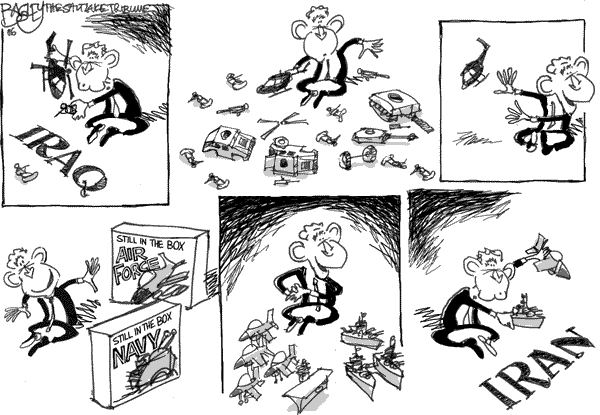
Pat Bagley of the Salt Lake Tribune thinks G.W. Bush is just a child playing with his toys:

Yes, Iraq was no threat, and apparently Iran isn’t one either!

Vince O’Farrel, an Australian, uses an interesting image in his piece:

Apparently the modern domino theory just isn’t working, according to Vince. Libya and Lebanon notwithstanding. Perhaps we should just fly airliners into those dominos? That’d bring ’em down.

Jerry Holbert thinks part of the failure is that Iraqis just aren’t capable of freedom:

Enough of that. Let’s see what our social superiors are saying about the illegal immigration kerfuffle.

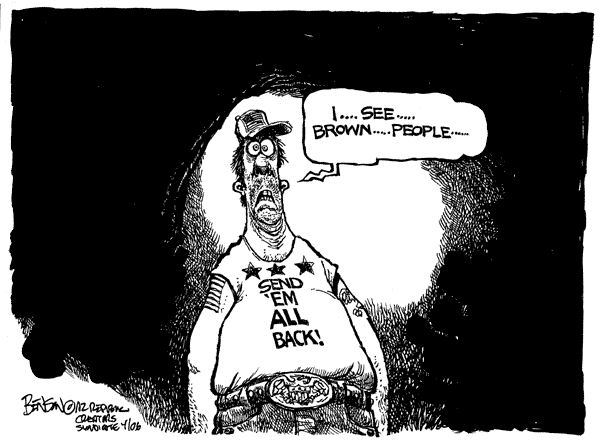
United Media’s Steve Benson says the problem is Americans are ignorant racist rednecks:

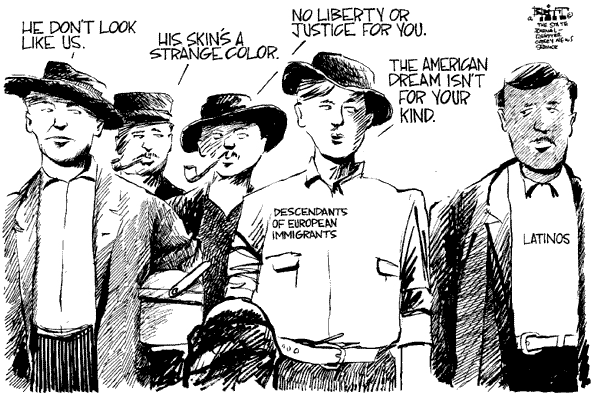
Chris Britt of the Springfield, IL State Journal-Register apparently agrees:

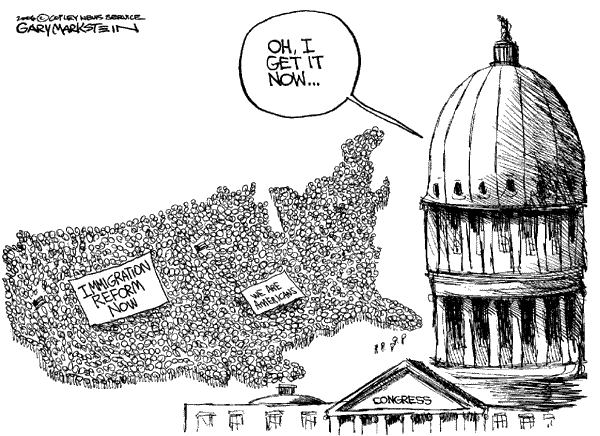
Gary Markstein of Copley News Service thinks that all of the illegal immigrants in the country are just undocumented Americans:

However, at least Randy Bish of the Pittsburg Tribune-Review has a little different take:

And finally, Simanca Osmani, a Brazilian cartoonist, draws a parallel between the Berlin Wall, put up by the Communists to keep their people IN, the Israeli wall in Palestine, put up to keep suicide bombers OUT, and the proposed U.S. border fence:

Let’s see if I can explain the differences and the similarities. If Mexico put up a fence to keep its oppressed people in, and set up minefields, machine-gun nests and attack dog patrols with orders to shoot on sight anyone trying to escape – that would be a valid comparison. With Israel, the parallel is a little closer. We’d really like to prevent an Islamofascist with a backpack full of biowarfare materials or poisons from coming across our border and killing a few hundred or few thousand people.

I wonder if Osmani is aware that Guatemala built a fence across its border with Mexico? I guess Guatemalans are afraid of “brown people” too?

Nobody seems to get that WE’RE IN A WAR FOR CIVILIZATION. Which is why I posted the link to the two pieces on that topic last night. I swear, I see some of this stuff and I get that RCOB moment that makes me want to take a ClueBat™ to these purblind idiots.

They’re not all bad, but that’s about all I can stomach for one day.

Let Me Repeat Myself…

(…on a different topic.)

Remember this post?

It’s the only power Congress really has. They’re not going to give it up, short of being at gunpoint.

Instapundit links to an Opinion Journal piece on the Republican’s failure to live up to their purported principles. Excerpts:

If Republicans lose control of Congress in November, they might want to look back at last Thursday as the day it was lost. That’s when the big spenders among House Republicans blew up a deal between the leadership and rank-in-file to impose some modest spending discipline.

Unlike the collapse of the immigration bill, this fiasco can’t be blamed on Senate Democrats. This one is all about Republicans and their refusal to give up their power to spend money at will and pass out “earmarks” like a bartender offering drinks on the house.

Jeff Flake of Arizona wanted each spending “earmark” to be identified along with the Member who requested it, so perhaps lawmakers might be shamed into using tax dollars more responsibly. He assumed, wrongly as it turned out, that a legislative body that has allowed these pork projects to quadruple in the past five years is still capable of being embarrassed.

I repeat myself: No reform unless it’s at the Point. Of. A. Gun.

Which means, no reform.

Ah, politics. And it’s been this way literally for decades. Just ask Henry Louis Mencken or Will Rogers.

The more you read and observe about this Politics thing, you got to admit that each party is worse than the other. The one that’s out always looks the best. – Will Rogers

This country has come to feel the same when Congress is in session as when the baby gets hold of a hammer. – Will Rogers

The government consists of a gang of men exactly like you and me. They have, taking one with another, no special talent for the business of government; they have only a talent for getting and holding office. Their principal device to that end is to search out groups who pant and pine for something they can’t get and to promise to give it to them. Nine times out of ten that promise is worth nothing. The tenth time is made good by looting A to satisfy B. In other words, government is a broker in pillage, and every election is sort of an advance auction sale of stolen goods. – H.L. Mencken

It is the invariable habit of bureaucracies, at all times and everywhere, to assume…that every citizen is a criminal. Their one apparent purpose, pursued with a relentless and furious diligence, is to convert the assumption into a fact. They hunt endlessly for proofs, and, when proofs are lacking, for mere suspicions. The moment they become aware of a definite citizen, John Doe, seeking what is his right under the law, they begin searching feverishly for an excuse for withholding it from him. – H.L. Mencken

And, finally:

The ideal Government of all reflective men, from Aristotle onward, is one which lets the individual alone—one which barely escapes being no government at all. This ideal, I believe, will be realized in the world twenty or thirty centuries after I have passed from these scenes and taken up my public duties in Hell. – H.L. Mencken

I’m afraid his timeline might have been a little optimistic.

Reasonable People

Reasonable people adapt themselves to the world. Unreasonable people attempt to adapt the world to themselves. All progress, therefore, depends on unreasonable people. – George Bernard Shaw

There’s some truth to that, but it is not a truism. Einstein was perhaps the most reasonable person on the planet, and he changed the universe – or at least our perception of it. Stalin was one of the most unreasonable people in the world, and while he attempted to “adapt the world to himself,” what resulted certainly wasn’t “progress” in any sense of the term – even the Marxist one. Especially the Marxist one.

Reasonable People Can Differ? Not with me they can’t.

That’s the title of a December, 2000 Slate piece by Michael Kinsley about the 2000 election debacle. It is, perhaps, the first publicly exhibited symptom of Bush Derangement Syndrome. Charles Krauthammer’s 2003 Townhall piece describes “BDS” as a psychological condition. (As an aside, I find much of what Mr. Krauthammer writes to be pretty astute, but – as reasonable people – we differ on the subject of gun control.) Since that time, amateur and professional pshrinks alike have expounded on “BDS” with increasingly outré examples to illustrate.

Dr. Patricia Santy, author of the blog Dr. Sanity writes on the topic, for instance:

The psychology of some of the Bush Haters is pretty cut and dried. They hate Bush because he stands between them and the implementation of their collectivist “utopian” vision. I have no time to waste on them, except to note that their intentions are deliberately and decidedly malevolent toward this country. They want it to fail at anything and everything it does and they openly cheer for the barbarians at the gate.

They are indistinguishable from the barbarians we are actively fighting, with the only difference being that they have different ideas about which group of thugs will be in charge of the “utopia”. They prefer themselves–a more secularly-oriented set of thugs–to rule.

And this is undoubtedly accurate – for some. But she continues:

But what about the average person on the street who has, or has come to have a visceral hatred of President Bush? Perhaps they simply didn’t vote for him in 2000, believing the media propaganda or caricature of his intellect and capabilities; or perhaps they simply didn’t like him because he was from the opposition party, or a Texan. or any other number of normal reasons.

It seems to me that the Democrats and the Left have used their continuous propaganda well, but there is a also a strong personal psychological factor involved in being able to convince normally sane people that the source of all evil in the world is George W. Bush.

And that, dear readers, is the subject of this essay.

As I’ve mentioned previously, I’m reading Eric Hoffer’s 1951 treatise, The True Believer: Thoughts on the Nature of Mass Movements. I hadn’t heard of it prior to my writing an essay on just that topic, True Believers, where a commenter pointed it out to me. (In fact, I’d never even heard of Eric Hoffer, but he’s a thoroughly fascinating man. If you’re unfamiliar with him, I advise you to peruse The Eric Hoffer Resource page.) Hoffer was a renaissance philosopher – he was self-educated, lived simply, worked at manual labor jobs, read, thought, and wrote. And he saw things very clearly.

The True Believer, being written in the immediate post-WWII years, was primarily about the mass movements of Italian and German Fascism and the rise of Communism, but Hoffer did not limit his observations. He reflected on mass movements throughout history, including the Zionist movement in pre-revolutionary Russia, the French Revolution, the Protestant Reformation, and others. He makes a point, in fact, that,

When people are ripe for a mass movement, they are usually ripe for any effective movement, and not solely for one with any particular doctrine or program.

Which explains in a sentence the current enthusiastic crossover between the eco-movement, the gay-rights movement, the anti-war movement, the socialist movement, et al. But what is it that makes people “ripe for a mass movement”? That’s the primary topic of the book, and something I’ve been struggling with for quite a while, because I see a major conflict coming and I don’t know that my side can mobilize to face it, much less succeed. In October of 2003, just a few months after starting this blog, I wrote Not with a Bang, but a Whimper?, that began:

Everybody bitches about how bad things are, politically. (Well, everybody but Bill Whittle.) And the bitching is pretty much evenly divided on both the left and the right. But I’ve noticed something I find disturbing. It appears to me that the Right is resigning. Giving up. Leaving the field.

And I gave a couple of examples from the blogosphere. This was one of my earlier posts on the cockroach resilience of the Left. I’ve since written several posts on what I see as a coming conflict, though I’ve been (until now) unable to determine what the two sides will be. In fact, at one point I convinced myself that there wouldn’t be a second Civil War because, as I put it then:

The divide now is philosophical, too, but not as easily demarcated. It isn’t slavery vs. abolition, it’s “Left” vs. “Right.” It’s Libertarian vs. Conservative. Green vs. Democrat. Socialists vs. Capitalists. Anarchists vs. Government. Christians vs. Humanists. Jihadists vs. Infidels. Atheists vs. Christianity. Gun-grabbers vs. Gun-nuts. The perpetually disinterested vs. everyone else.

Grab any six random people off the street – chances are they’ll have strongly held (and largely unsupported) opinions on a variety of topics, and those opinions will stray all over the philosophical boundaries of the merely Left and Right. It’s not a binary division, it’s an n-dimensional space of varying density.

I’ve also recently begun reading David Hackett Fischer’s Albion’s Seed: Four British Folkways in America, and this piece from the introduction struck me:

We Americans are a bundle of paradoxes. We are mixed in our origins, and yet we are one people. Nearly all of us support our Republican system, but we argue passionately (sometimes violently) among ourselves about its meaning. Most of us subscribe to what Gunnar Myrdal called the American Creed, but that idea is a paradox in political theory. As Myrdal observed in 1942, America is “conservative in fundamental principles . . . but the principles conserved are liberal, and some, indeed, are radical.”

We live in an open society which is organized on the principle of voluntary action, but the determinants of that system are exceptionally constraining. Our society is dynamic, changing profoundly in every period of American history; but it is also remarkably stable.

Well, it has been remarkably stable, excepting that first Civil War, but I no longer believe that “nearly all of us support our Republican system,” and I believe the percentage is falling. Please note that Albion’s Seed was published in 1989. Much has changed since then.

Another psychology blogger, Robert Godwin, posted this at One Cosmos:

At this point in time, I am more inclined to think of leftism as an intellectual pathology rather than a psychological one (although there is clearly considerable overlap). What I mean is that it is impossible to maintain a priori that a conservative person is healthier or more emotionally mature than a liberal. There are plenty of liberals who believe crazy things but are wonderful people, and plenty of conservatives who have the right ideas but are rotten people. However, this may be begging the question, for it is still puzzling why people hold beliefs that are demonstrably untrue or at the very least unwise.

One of the problems is with our elites. We are wrong to think that the difficulty lies in the uneducated and unsophisticated masses–as if inadequate education, in and of itself, is the problem. As a matter of fact, no one is more prone to illusions than the intellectual. It has been said that philosophy is simply personal error on a grandiose scale. Complicating matters is the fact that intellectuals are hardly immune to a deep emotional investment in their ideas, no less than the religious individual. The word “belief” is etymologically linked to the word “beloved,” and it is easy to see how certain ideas, no matter how dysfunctional–for example, some of the undeniably appealing ideas underpinning contemporary liberalism–are beloved by those who believe them. Thus, many liberal ideas are believed not because they are true, but because they are beautiful. Then, the intellectual simply marshals their intelligence in service of legitimizing the beliefs that they already hold. It has long been understood by psychoanalysts that for most people, reason is the slave of the passions.

(F)or the person who is not under the hypnotic psycho-spiritual spell of contemporary liberalism, it is strikingly devoid of actual religious wisdom or real ideas. As such, it is driven by vague, spiritually infused ideals and feelings, such as “sticking up for the little guy,” or “war is not the answer.” On the other hand, conservatism is not so much based on ideas, but on simply observing what works, and then generalizing from there. It is actually refreshingly free of dogma, and full of dynamic tension. For example, at the heart of conservatism is an ongoing, unresolvable dialectic between freedom and virtue. In other words, there is a bedrock belief in the idea that free markets are the best way to allocate scarce resources and to create wealth and prosperity for all, but a frank acknowledgment that, without a virtuous populace, the system may produce a self-centered, materialistic citizenry living in a sort of degenerate, “pitiable comfort.” Thus, there is an ongoing, unresolvable tension between the libertarian and traditional wings of the movement.

There is no such dynamic tension in liberalism. Rather, it is a top-down dogma that is not dictated by what works, but by how liberals would like reality to be. This is why liberalism must be enforced with the mechanism of political correctness, in order to preempt or punish those who deviate from liberal dogma, and see what they are not supposed to see.

In another post, he stated:

People typically think that the right represents the party of sanctimonious and judgmental morality, but this is hardly the case. In fact, this is an exact reversal of the situation. Morality in and of itself is neither moral nor immoral. Sometimes–perhaps more often than not–a moral system can actually be a source of great evil. One of the things that sets human beings apart from animals is that we cannot avoid making moral distinctions. There seems to be a built in need to distinguish between right and wrong. This impulse is just as strong and ubiquitous as the sex drive, and, just like the sex drive, can become distorted and perverted. With the left, we are generally not dealing with immoral people, but with quite serious moral perversion. And I say this in all seriousness and with all due respect.

For example, yesterday on LGF, Charles linked to a photo gallery of the anti-death penalty demonstrators outside San Quentin Prison Monday night. Here are examples of some of the signs that were carried by protesters: “Tookie Has Done More For Kids Than Arnold.” “Arnold is a Nazi. Terminate Him Now.” “America is Still Murdering Blacks. Slavery: 1492-Present.” “Tookie = Greater Integrity. Worth 100 Times as Much to Our World as All of the Neocons, Hypochristians & Fascist Pigs of Profit.”

So clearly, there is an extraordinary amount of moral passion behind these sentiments. And yet, it is an insane and deranged moral passion. The philosopher Michael Polanyi pointed out that what distinguishes leftism in all its forms is the dangerous combination of a ruthless contempt for traditional moral values with an unbounded moral passion for utopian perfection. The first step in this process is a complete skepticism that rejects traditional ideals of moral authority and transcendent moral obligation–a complete materialistic skepticism combined with a boundless, utopian moral fervor to transform mankind.

“A boundless, utopian moral fervor to transform mankind.” The kind of ideal that attracts and inspires the True Believer. For a moment, let’s discuss who these people are. Hoffer writes:

The superior individual, whether in politics, literature, science, commerce, or industry, plays a large role in shaping a nation, but so do individuals at the other extreme — the failures, misfits, outcasts, criminals, and all those who have lost their footing, or never had one, in the ranks of respectable humanity. The game of history is usually played by the best and worst over the heads of the majority in the middle.

The reason that the inferior elements of a nation can exert a marked influence on its course is that they are wholly without reverence toward the present. They see their lives and the present as spoiled beyond remedy and they are ready to waste and wreck both: hence their recklessness and their will to chaos and anarchy. They also crave to dissolve their spoiled, meaningless selves in some soul-stirring spectacular communal undertaking — hence their proclivity for united action. Thus they are among the early recruits of revolutions, mass migrations, and of religious, racial and chauvinist movements, and they imprint their mark upon these upheavals and movements which shape a nation’s character and history.

The discarded and rejected are often the raw materials of a nation’s future. The stone the builders reject becomes the cornerstone of a new world. A nation without dregs and malcontents is orderly, decent, peaceful and pleasant, but perhaps without the seeds of things to come. It was not the irony of history that the undesired in the countries of Europe should have crossed an ocean to build a new world on this continent. Only they could do it.

Or, as George Bernard Shaw put it, “Unreasonable people attempt to adapt the world to themselves.” As a bit of further evidence of how “the inferior elements of a nation can exert a marked influence on its course,” let me reiterate on the concept of cultural “trickle up,” and how the extremes in society “play the game of history” over the heads of the middle. Theodore Dalrymple has spent most of his life working among the “other extreme” of British culture while living among the elite. His book Life at the Bottom: The Worldview that Makes the Underclass is specifically on this topic. James Lileks wrote perhaps the most accurate and succinct review of the book:

“Life at the Bottom,” an account of the British underclass by Theodore Dalrymple. “Bracing” does not describe it, anymore than “Brisk” describes the sensation of a bucket of lemon juice poured on a sucking chest wound. The book concerns the ideas that animate, if you can use that word, the sullen masses of the impotent and indifferent, where they come from (two guesses) and how uncouthness becomes chic, and trickles up.

Examples range from multiple out-of-wedlock births by different (absent) fathers, to ubiquitous tattooing and piercings, all encouraged as “authentic behaviors” by the liberal intelligentsia, who are just as wholly without reverence towards the present.

Hoffer writes:

A rising mass movement attracts and holds a following not by its doctrine and promises, but by the refuge it offers from the anxieties, barrenness and meaninglessness of an individual existence. It cures the poignantly frustrated not by conferring on them an absolute truth or by remedying the difficulties and abuses which made their lives miserable, but by freeing them from their ineffectual selves — and it does this by enfolding and absorbing them into a closely knit and exultant corporate whole.

It is obvious, therefore, that, in order to succeed, a mass movement must develop at the earliest moment a compact corporate organization and a capacity to absorb and integrate all comers. It is futile to judge the viability of a new movement by the truth of its doctrine and the feasibility of its promises. What has to be judged is its corporate organization for quick and total absorption of the frustrated. Where new creeds vie with each other for the allegiance of the populace, the one which comes with the most perfected collective framework wins.

The milieu most favorable for the rise and propagation of mass movements is one in which a once compact corporate structure is, for one reason or another, in a state of disintegration.

The general rule seems to be that as one pattern of corporate cohesion weakens, conditions become ripe for the rise of a mass movement and the eventual establishment of a new and more vigorous form of compact unity.

Another and final illustration of the thesis that effective collective bodies are immune to the appeal of mass movements, but that a crumbling collective pattern is the most favorable milieu for their rise is found in the relation between the collective body we know as an army and mass movements. There is hardly an instance of an intact army giving rise to a religious, revolutionary or nationalist movement. On the other hand, a disintegrating army — whether by the orderly process of demoblilization or by desertion due to demoralization — is fertile ground for a proselytizing movement. The man just out of the army is an ideal potential convert, and we find him among the early adherents of all contemporary mass movements. He feels alone and lost in the free-for-all of civilian life. The responsibilities and uncertanties of an autonomous existence weigh and prey upon him. He longs for certitude, camaraderie, freedom from individual responsibility, and a vision of something altogether different from the competitive free society around him — and he finds all of this in the brotherhood and the revivalist atmosphere of a rising movement.

And, most interestingly, Hoffer discusses the love-hate relationship rising mass movements have with the military:

It is well at this point, before leaving the subject of self-sacrifice, to have a look at the similarities and differences between mass movements and armies.

The similarities are many: both mass movements and armies are collective bodies; both strip the individual of his separateness and distinctness; both demand self-sacrifice, unquestioning obedience and singlehearted allegiance; both make extensive use of make-belief to promote daring and united action; and both can serve as a refuge for the frustrated who cannot endure an automomous existence. A military body like the Foreign Legion attracts many of the types who usually rush to join a new movement. It is also true that the recruiting officer, the Communist agitator and the missionary often fish simultaneously in the cesspools of skid row.

But the differences are fundamental: an army does not come to fulfill a need for a new way of life; it is not a road to salvation. It can be used as a stick in the hand of a coercer to impose a new way of life and force it down unwilling throats. But the army is mainly an instrument devised for the preservation or expansion of an established order — old or new. It is a temporary instrument that can be assembled and taken apart at will. The mass movement, on the other hand, seems an instrument of eternity, and those who join it do so for life. The ex-soldier is a veteran, even a hero; the ex-true believer is a renegade. The army is an instrument for bolstering, protecting and expanding the present. The mass movement comes to destroy the present. Its preoccupation is with the future, and it derives its vigor and drive from this preoccupation.

Being an instrument of the present, an army deals mainly with the possible. Its leaders do not rely on miracles. Even when animated by fervent faith, they are open to compromise. They reckon with the possibility of defeat and know how to surrender. On the other hand, the leader of a mass movement has an overwhelming contempt for the present — for all its stubborn facts and perplexities, even those of geography and the weather. He relies on miracles. His hatred of the present (his nihilism) comes to the fore when the situation becomes desperate. He destroys his country and his people rather than surrender.

Thus the psychological projection of the Left impugning its opponents as “drinking the Kool-Aid” of the Right – invoking the image of Jim Jones.

The spirit of self-sacrifice within an army is fostered by devotion to duty, make-believe, esprit de corps, drill, faith in a leader, sportsmanship, the spirit of adventure and the desire for glory. These factors, unlike those employed by a mass movement, do not spring from a deprecation of the present and a revulsion of an unwanted self. They can unfold therefore in a sober atmosphere.

See the recent Wall Street Journal piece by ex-journalist and new Marine 2nd Lieutenant Matt Pottinger for an example of devotion to duty unfolding in a sober atmosphere. Just an aside, the modern military no longer “fishes in the cesspool of skid row” for recruits – which is one reason the Left is having a harder and harder time finding examples like Jimmy Massey and Pablo Paredes to promote their cause. The rising mass-movement sees in the military a vast repository of raw recruit material – that has been co-opted by the hated enemy. The soldiers, the “cannon fodder,” are merely confused! The officers are the true enemy – thus the exhortations to the soldiers to “frag” their officers and join the mass movement.

What we have in America today is the result of about a hundred years of Leftist influence in American culture, best exhibited by the rise of “Transnational Progressivism” (read the whole thing) – an ideology that essentially places the blame for all iniquity around the world at the feet of a single enemy, the United States; and one group in the United States, heterosexual conservative white males. That’s rather narrow. For some it’s just “white people.” For others it’s anyone who is “conservative.” (Especially if they, themselves, are white males.) For groups outside the U.S., (and some inside it) it’s more broadly “Americans.” However defined, this group is symbolized in effigy at the present time by one individual – George W. Bush. But that won’t last forever.

Remember Hoffer’s words: “It is futile to judge the viability of a new movement by the truth of its doctrine and the feasibility of its promises. What has to be judged is its corporate organization for quick and total absorption of the frustrated.” It doesn’t matter if the idea is illogical, ridiculous, or outright insane. It matters if you can mobilize the disaffected to the cause.

What we are seeing today is the coalescing of a new mass movement. There are many disaffected out there who are members of various fringe groups and organizations – the ones Dr. Santy defines as those who “hate Bush because he stands between them and the implementation of their collectivist “utopian” vision.” But the efforts of the Leftist intelligentsia and the “underclass” have splintered our culture. We are no longer “one people.” We are no longer one culture made up of many smaller, meshing cultures. We are “Red America” and “Blue America.” There is sand in the gears, and corporate cohesion is being lost. As a result there is a slowly rising tide of the disaffected, frightened of the future and looking for someone to blame and someone to promise them utopia.

Hoffer again:

Hatred is the most accessible and comprehensive of all unifying agents. It pulls and whirls the individual away from his own self, makes him oblivious of his weal and future, frees him of jealosies and self-seeking. He becomes an anonymous particle quivering with a craving to fuse and coalesce with his like into one flaming mass. (Heinrich) Heine suggests that what Christian love cannot do is effected by a common hatred.

Mass movements can rise and spread without belief in a God, but never without belief in a devil. Usually the strength of a mass movement is proportionate to the vividness and tangibility of its devil. When Hitler was asked whether he thought the Jew must be destroyed, he answered: “No…. We should have then to invent him. It is essential to have a tangible enemy, not merely an abstract one.” F.A. Voigt tells of a Japanese mission that arrived in Berlin in 1932 to study the National Socialist movement. Voigt asked a member of the mission what he thought of the movement. He replied: “It is magnificent. I wish we could have something like it in Japan, only we can’t, because we haven’t got any Jews.”

Meet the new Jews, and George W. Bush as Satan incarnate.

As an example, let me quote Forrest Church from his Sept. 2002 New Republic essay, “The American Creed”:

In many quarters of the world today America is resented–even hated–for its perceived embrace of godless and value-free materialism and the felt imposition of this moral “decadence” on world society. The first American armed conflict of the twenty-first century is being cast by its aggressor in religious terms as a jihad against the infidel, with America blasphemed as “the great Satan.” Osama bin Laden proclaimed that those who attacked the World Trade Center and the Pentagon were martyrs, servants of Allah dying for a holy cause–a view not restricted to terrorists alone. America is caricatured in much of the Muslim world as a godless society wedded to materialism and wanton in the exercise of its power around the globe.

On the other hand, inside the U.S. it isn’t “godless and value-free materialism” that is hated, it is the concept of a rising theocracy and value-free materialism (at least they’re consistent on one point.) Read Jane Smiley’s most recent Huffington Post piece where George W. is at once responsible for every evil out there. And she’s serious. Or just read Robert Godwin’s dissection of it, if you can’t stomach it unfiltered.

As of yet this mass movement is also splintered, but as Hoffer noted, when people are ripe for a mass movement, any mass movement will do. And the mass movement that is best equipped to absorb them, wins them.

I noted recently that I received a solicitation from “Rev. Billy Bob Gisher” to exchange links to his website Less People, Less Idiots. In an interesting coincidence I came across a comment by Eric S. Raymond at his blog Armed and Dangerous today concerning the kidnapping of four members of a group called Christian Peacemaker Teams in Iraq who are now threatened with beheading by the very people they went there to “protect.”

I like it when villains or dangerous idiots are killed by their own folly. That seems just to me. More importantly, it’s how other people learn not to be that way. It’s evolution in action; it improves the meme pool, or the gene pool, or both.

This is actually one of my gut reasons for favoring drug legalization, though I’d never thought it through quite so far before. I don’t think we have enough selective pressures against idiocy any more; I’d like idiots to have more chances to kill themselves, ideally before they get old enough to vote or reproduce. Not because I relish their deaths, but because I want to live in a future with fewer idiots in it.

By the way, I’m using “idiot” in its original sense here. To the ancient Greeks, an “idiot” was a person too closed in on himself to be a net plus to his neighbors and his society. Distinctions between mental impairments, communicative defects like deaf-muteness, or insanity were not clear and not considered important; the important question was whether the ‘idiotes’ (private person) was capable of discharging the responsibilities of a citizen in the agora.)

Somehow I don’t think that Eric’s position is the same as “Rev. Gisher” on the topic. Read the comment thread. Very interesting.

The Rev. Gisher is on a quest, to wit, from the link entitled “Do you want to see changes for the better?”:

Do you believe that lobbyists, who write most of the bills that are passed to become our laws, control the American government? Do you believe that it does not matter which party is in office, that other than small shifts in agendas, both sides of the aisle have to cater to the people that fund their reelections? Do you really believe it was absolutely necessary that we sent our young men to Iraq to die? Do you believe that questioning what our government does is not unpatriotic? Do you believe that in less than a hundred years, humans will be in serious trouble, because of the effects of overpopulation, and toxic chemical concentrations, as well as possible wars that break out from a desperate grab for diminished resources? Do you believe that the trouble may be brought upon us faster, because of possible major shifts in climate? Do you believe that the “Crossfire” mentality of arguing a point to death, rather than working towards common ground might be great entertainment, but is putting nails in humanity’s coffin? Do you care about what kind of world we are leaving our children and our grandchildren? Do you want to see changes; do you want things to improve?

So what can you do to try and turn all of this around? How do you perform this trick without bringing more violence and death to mankind, through yet another armed revolution?

You have something in your possession that you are looking at right this moment that is called a computer. The device sitting right in front of you allows you to reach out and contact anyone in the world who has access to a computer, and the Internet.

You can help humans to move away from the paralysis caused by, greed, apathy, and polarization that infects our current system of government. You can do this by reaching out to someone who has just a slightly different view of the world from your own, and finding areas that you can agree upon. If the other party reaches out to someone else who differs slightly from them, and this process of reaching out continues, eventually it is possible for everyone that has access to a computer to be linked into a system where everyone is attempting to find common ground and moving forward to try and resolve some of our problems.

I won’t reproduce the whole post, please read it yourself. What the Rev. is trying to do is reach out to the “reasonable people,” to form a network of those who do not necessarily agree on everything, but who are willing to A) agree on some things, and B) agree to at least discuss their differences on other topics. I’ve got, for example, a problem with some of the items on his laundry-list of grievances, and I’m not sure that he’s one of those David Hackett Fischer refers to as being supportive of our Republican system.

It’s a noble idea, though. It’s an idea made practical by the revolution that is the internet – communication so cheap that all it costs you is your time. (I’ve been working on this essay for the last four hours, and I haven’t edited it yet. And yes, I edit. Voltaire once wrote “I’m writing you a long letter because I don’t have time to write a short one.” Hoffer once wrote “There is not an idea that cannot be expressed in 200 words or less.” With that thought, he established the “Eric Hoffer-Lili Fabilli Essay Award” at the University of California, Berkeley, for the best essay on a topic in 500 words or less. I’d never win it.) At any rate, if the idea appeals to you, go to this link and read more.

I’m not convinced that the Rev’s idea will work. The mass movement is growing, and it’s not made up of “reasonable people.” Perhaps his idea would serve to keep “reasonable people” from becoming disaffected fodder for the mass movement, perhaps not. Perhaps not enough. In another idea, Kim and Connie du Toit are trying to establish a Nation of Volunteers organization, which is much the same idea, but narrower, with a bit more activism involved. And money.

Again, Kim and Connie are trying to reach out to “reasonable people” – mostly conservatives. I applaud the concept – and again wonder how much success it might have in the face of a growing mass movement.

I said at the opening of this piece that I was unable to determine what the two sides will be in the coming conflict. It will be the “True Believers” of the new mass movement against the “reasonable people.” And it won’t be pretty. Stopping a mass movement can be done – bloodily – by an army. Or from within, by washtubs filled with poisoned Kool-Aid after a Congressional investigation. Hoffer writes:

The problem of stopping a mass movement is often a matter of substituting one movement for another. A social revolution can be stopped by promoting a religious or nationalist movement. Thus in countries where Catholicism has recaptured its mass movement spirit, it counteracts the spread of communism.

The example he was probably thinking of there was post WWII Greece.

In the comments to that piece at Armed and Dangerous, Eric Raymond says:

One of the reasons I support the present war is that killing 50K of the jihadis now may keep them from mounting the city-killing attack that will really enrage the U.S. Because if that happens, millions on millions of Arabs will die and my country will be transformed by its rage into something I won’t like.

That is an example of how one mass movement can be stopped. As Hoffer says:

This method of stopping one movement by substituting another for it is not always without danger, and it does not come cheap.

No indeed.

But there is a mass movement gathering, and it must be stopped. And reasonable people may not be enough to do it.