Quote of the Day – Accurate Diagnosis Division

Reader Phil B. emails a link to another outstanding piece:  Untouchable, from the blog The View from Cullingworth.  Read the whole post, but here’s a taste that qualifies for QotD:

Unlike Oborne – and unlike the left – I reject the idea of man’s perfectibility. Or indeed that we are in need of a “moral reformation” – it is an economic and political reformation we require, a change to the order of things. It is not moral decadence that links the powerful to the rioter but a belief that they are untouchable, that the normal rules of society do not apply.

Quote of the Day – Endgame Edition

This column is so right that it’s very difficult to pull just one piece out of it for a quote of the day, but Janet Daley’s UK Telegraph op-ed If we are to survive the looming catastrophe, we need to face the truth is today’s must-read:

We have arrived at the endgame of what was an untenable doctrine: to pay for the kind of entitlements that populations have been led to expect by their politicians, the wealth-creating sector has to be taxed to a degree that makes it almost impossible for it to create the wealth that is needed to pay for the entitlements that populations have been led to expect, etc, etc.

The only way that state benefit programmes could be extended in the ways that are forecast for Europe’s ageing population would be by government seizing all the levers of the economy and producing as much (externally) worthless currency as was needed – in the manner of the old Soviet Union.

That is the problem. So profound is its challenge to the received wisdom of postwar Western democratic life that it is unutterable in the EU circles in which the crucial decisions are being made – or rather, not being made.

The solution that is being offered to the political side of the dilemma is benign oligarchy.

Yes, that’s what’s being offered, but it’s not what will be delivered.

Read the whole piece.  Twice.  At the time of this writing there are nearly 800 comments.  One of them was this:

…this article is the most important one I have ever read in the mainstream media.

I concur.

This Sounds Familiar

From that WSJ page mentioned in the previous post:

The “two different worldviews” that divide Washington, explains Eric Cantor, are too far apart for anything more than an armistice.

That sounds remarkably like Anarchangel’s quote from a while back:

There can be no useful debate between two people with different first principles, except on those principles themselves.

I quoted that in What We Got Here . . . is Failure to Communicate.  Also Thomas Sowell, from an Uncommon Knowledge interview:

Peter Robinson: If you had a sentence or two to say to the Cabinet assembled around President Obama, and this cabinet holds glittering degrees from one impressive institution after another, if you could beseech them to conduct themselves in one particular way between now and the time they leave office, what would you say?


Thomas Sowell: Actually, I would say only one word: Goodbye. Because I know there’s no point talking to them.

Sounds like Eric Cantor finally figured it out.

You’ve Gotta Have Standards!

So our public education system has resulted in a population in which 1 in 7 adults are functionally illiterate, and “only 12 percent of high-school seniors, who are getting ready to vote for the first time, have a proficient knowledge of history.”

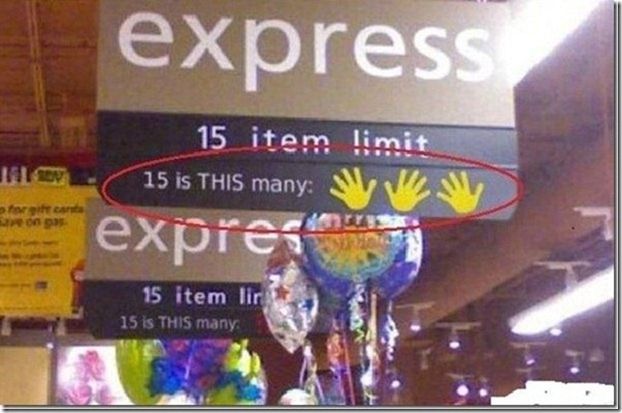
What about math? I think this picture says the proverbial 1,000 words:

Well, it’s good to know in these dark days of mass ignorance that our institutions of higher learning have their standards! Or, at least are considering having standards.

The local junior college, Pima Community College has a standard: students must be at least sixteen years old. But now they’re considering imposing some new ones:

The question boils down to how smart you should have to be to attend Pima Community College.

Currently there is no requirement. You only need to be age 16.

But Pima’s governing board is considering changing that to require new students to have a high school diploma or GED. Students also would have to pass a reading, writing and math assessment test with the skills of a sixth or seventh grader.

Pima Chancellor Roy Flores says, “We need to find different pathways for those students that are testing in at second, third, fourth and fifth grade levels.”

Sweet. Bleeding. Jeebus.  No, it’s not a question of how smart you are, it’s a question of how educated you are. Ignorance is correctable, but as comedian Ron White has said, “You can’t fix stupid. There’s not a pill you can take; there’s not a class you can go to. Stupid is forever.”

Bear in mind, this is a college. Yes, you can go learn to weld at PCC (and if you don’t test out at above sixth grade, be prepared to suffer a lot of burns for the rest of your life), but you can also go get a 2-year associate’s degree. When I moved to Arizona I went to PCC for the first two years and got caught up on my freshman and sophomore courses before transferring to the University of Arizona (at in-state tuition rates, which I couldn’t get at the U of A until I’d lived here a year.)

Read the last line in the above excerpt again: “We need to find different pathways for those students that are testing in at second, third, fourth and fifth grade levels.” These are, at minimum, sixteen year-olds. The vast majority of them are over 18.

And as Say Uncle put it this morning, “their vote counts just as much as yours.”

You want to know how we ended up with the government we have? This is how. In 1983 the report A Nation at Risk on the state of public education in America pulled no punches when it stated:

If an unfriendly foreign power had attempted to impose on America the mediocre educational performance that exists today, we might well have viewed it as an act of war.  As it stands, we have allowed this to happen to ourselves.

Our government-provided schools have produced generation upon generation of government-approved product. It’s a positive-feedback loop, and it has achieved full screeching saturation.

Tar, Feathers, Rail – Some Assembly Absolutely Justified

So a recent Rasmussen poll reports that 46% of “likely U.S. voters” believe that “most members of Congress” are corrupt.  That’s up 7% from June, by the way.

And I thought that only 1 in 7 adults was functionally illiterate.

Well, it would seem that their belief is well founded (quelle surprise). Watch the video:

[youtube https://www.youtube.com/watch?v=G96TY5JsV-s?rel=0]

I’d like to see the data. And the list of names.

THIS!

From Walter Russell Mead, The Progressive Crisis:

The progressive state has never seen its job as simply to check the excesses of the rich. It has also sought to correct the vices of the poor and to uplift the masses. From the Prohibition and eugenics movements of the early twentieth century to various improvement and uplift projects in our own day, well educated people have seen it as their simple duty to use the powers of government to make the people do what is right: to express the correct racial ideas, to eschew bad child rearing technique like corporal punishment, to eat nutritionally appropriate foods, to quit smoking, to use the right light bulbs and so on and so on.


Progressives want and need to believe that the voters are tuning them out because they aren’t progressive enough. But it’s impossible to grasp the crisis of the progressive enterprise unless one grasps the degree to which voters resent the condescension and arrogance of know-it-all progressive intellectuals and administrators. They don’t just distrust and fear the bureaucratic state because of its failure to live up to progressive ideals (thanks to the power of corporate special interests); they fear and resent upper middle class ideology.

RTWT

And I want to add this as an aside:

The progressive ideal of administrative cadres leading the masses toward the light has its roots in a time when many Americans had an eighth grade education or less.

And, I would argue, this goes a long way to explain the destruction of the public education system here. As mentioned a couple of posts down, the estimate is that one in seven adults in America is functionally illiterate – i.e.: has a less than eighth-grade education. If one in seven can’t read, what percentage of today’s population meets that “eighth-grade education” criteria? How many colleges offer basic mathematics and english courses to incoming freshmen because they lack the necessary skills a high school diploma used to ensure?

A “progressive ideal of administrative cadres leading the masses toward the light” depends on those ignorant masses. EDUCATED masses tend to think for themselves, and in quite un-masslike ways.