I’m going to have to get a copy of Levin’s latest book, Ameritopia: The Unmaking of America.
Go watch an interview with Levin on the book.
The Smallest Minority on earth is the individual. Those who deny individual rights cannot claim to be defenders of minorities. – Ayn Rand
I’m going to have to get a copy of Levin’s latest book, Ameritopia: The Unmaking of America.
Go watch an interview with Levin on the book.
And Borepatch has a damned fine idea to commemorate the first anniversary of his violation by the Democratic People’s Republic of Massachussetts. (Motto: “Live Free or Here.”)
Go. Read.
Barron Barnett emails with an interesting link. It seems like Adam Baldwin has read (and approved) of my überpost What We Got Here is…Failure to Communicate. (I wondered where all those Twitter hits were coming from!) He especially liked the Serenity quote at the end.
Yes, that Adam Baldwin – Jayne from Firefly.
Hey U.S. Citizen! Seems like Summer Glau is going to pass on the offer, how about we invite Adam Baldwin to the next Gun Blogger Rendezvous? I mean, how can you not like a man who has this picture on his Twitter feed?
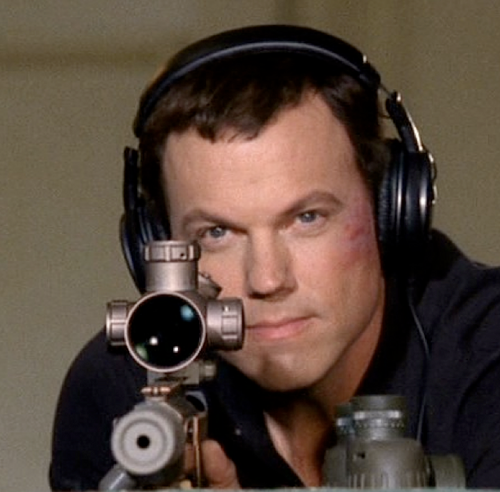
Hell, that made my day, and it’s not even 7:00AM yet!
UPDATE: And he did it!
…now Joe Huffman?
Apparently Joe’s blog is not available. The Boomershoot site is still up, as is Joehuffman.org, but not The View from North Central Idaho. WTF?
UPDATE: Aaaand now it’s back. Weird.
Detroit is North Korea … with the Unions holding the same pride of place as the North Korean Army—keep them happy and they keep the kleptocracy in power. No matter who else starves. — Tom Jones in a quote at Via Meadia
Worth the time to watch:
(h/t Jim Burnett, fellow pin-shooter)
…I may have to reconsider.
“If they were real Taliban, if they were people who burn down girls’ schools you know, and do honor rapes, threw acid in people’s faces, I’m not that upset about pissing on them, dead or alive.”
No, that’s about right. But I’m sure he said some other stuff I disagree wildly with.
The posts about the .700WTF and the .950JDJ drew a LOT of hits, so apparently this is a popular topic. On that last post, one commenter said:
Can we get a 1.000 OMG? Going once… going twice…
Which was followed by:
Screw round numbers.
Make it the 1.001 OMG just to break the barrier firmly.
Already been done, boys, in a rifle you actually fire from the shoulder, not off a bench. The 4-Bore double-rifle:
According to Wikipedia:
The name derives out of an old English practice of bore measurements in gunmaking, meaning a perfectly round pure lead ball that exactly fits the bore of the weapon would weigh 1/4 lb — that is, 0.25 lb (0.11 kg) (see gauge). The 4 bore was made to fire roundballs of 1/4 pound lead, or approximately 1750 grains (1750 gr.) and approximately 1-inch (25 mm) calibre (more precisely, 1.053-inch (26.7 mm), when shooting pure lead bullets). This varied greatly as in muzzle loader days shotgun gauges were custom made and often differed from the actual bore measurements. Commonly, 4 gauges were closer to .935-.955 calibre, pertaining to a 1400 gr. alloyed lead ball and closer to 5 gauge.
So it’s hard to say without actually examining a 4-bore, but it could indeed be 1″ or greater. Continuing:
The cartridge brass case was around 4 inches (100 mm) long, and contained three types of loads: light at 12 drams, 14 drams at regular, and 16 drams of powder at heavy load. (Note: 1 dram = 27.34375 grains in the avoirdupois system, since 256 drams = 7000 grains = 1 pound of powder. Shotgun shells are still rated in terms of the same archaic dram measurements, relative to their equivalence of smokeless powder load to a blackpowder load weighed in drams.) John “Pondoro” Taylor mentioned in his book African Rifles and Cartridges that the 12 drams (328 gr., 3/4 oz.) charge would propel the projectile at around 1,330 ft/s (410 m/s). A double barreled rifle that would fire such a calibre would weight around 22-24 lb bare, while the single-barreled version would be around 17-18 lb.
John Ross, the author of Unintended Consequences has one of these beasts. Here’s a sample ballistics table:
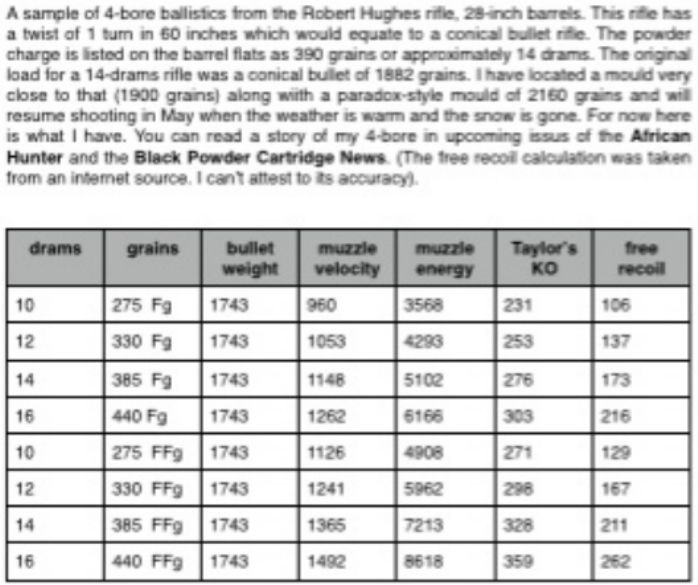
With a “heavy” load of 440 grains of black powder under a 1743 grain projectile, the free recoil energy of 262ft-lbs. is very much in the same class as the .950JDJ, only the JDJ rifles weigh between 50 and 110 pounds and are fired off a bench. The 4-bore doubles weigh about 25 pounds and are fired standing, from the shoulder.
OUCH.
Seen at Curmudgeonly & Skeptical, the Independence Day Quiz, a test of knowledge about American history and government. Rodger’s site says:
Supposedly 96% of all High School Seniors FAILED this test … AND if that’s not bad enough, 50+% of all individuals over 50 did too!!
I missed one.
I like to watch the Bravo series Inside the Actor’s Studio. Near the end of each show, host James Lipton asks his guests a list of 10 questions, the last of which is always “If Heaven exists, what would you like to hear God say when you arrive at the Pearly Gates?”
Sean Sorrentino just gave me the perfect answer:
When I reach the Pearly Gates, I want the first thing I will hear to be “Unload and show clear.”