Not Even A Mention of the EEEEEEEvil NRA!

Insty points today to an interesting New York Times piece, A Liberal Case for Gun Rights Helps Sway Judiciary. It’s interesting enough that I’m not going to fisk it so much as expand upon it:

In March, for the first time in the nation’s history, a federal appeals court struck down a gun control law on Second Amendment grounds. Only a few decades ago, the decision would have been unimaginable.

Only a few decades before that and that same decision would have been a foregone conclusion.

There used to be an almost complete scholarly and judicial consensus that the Second Amendment protects only a collective right of the states to maintain militias. That consensus no longer exists — thanks largely to the work over the last 20 years of several leading liberal law professors, who have come to embrace the view that the Second Amendment protects an individual right to own guns.

Err, no. There was a scholarly and judicial consensus that the Second Amendment protected only the rights of white men – perhaps the most blatant example of this attitude being exhibited in Florida’s 1941 Watson v. Stone decision, where one of the concurring judges wrote:

I know something of the history of this legislation. The original Act of 1893 was passed when there was a great influx of negro laborers in this State drawn here for the purpose of working in turpentine and lumber camps…. [T]he Act was passed for the purpose of disarming the negro laborers and to thereby reduce the unlawful homicides that were prevalent in turpentine and saw-mill camps and to give the white citizens in sparsely settled areas a better feeling of security. The statute was never intended to be applied to the white population…. [I]t is a safe guess to assume that more than 80% of the white men living in the rural sections of Florida have violated this statute…. [T]here has never been, within my knowledge, any effort to enforce the provisions of this statute as to white people, because it has been generally conceded to be in contravention of the Constitution and non-enforceable if contested.

This quote is excerpted from a Robert Cottrol and Raymond Diamond Chicago-Kent Law Review paper available here. A shorter version of this quote appears in the Amicus Curae brief filed on behalf of Parker et al. by the Congress of Racial Equality (CORE).

In those two decades, breakneck speed by the standards of constitutional law, they have helped to reshape the debate over gun rights in the United States. Their work culminated in the March decision, Parker v. District of Columbia, and it will doubtless play a major role should the case reach the United States Supreme Court.

Laurence H. Tribe, a law professor at Harvard, said he had come to believe that the Second Amendment protected an individual right.

“My conclusion came as something of a surprise to me, and an unwelcome surprise,” Professor Tribe said. “I have always supported as a matter of policy very comprehensive gun control.”

The first two editions of Professor Tribe’s influential treatise on constitutional law, in 1978 and 1988, endorsed the collective rights view. The latest, published in 2000, sets out his current interpretation.

Which the paper leaves out, but I will not since it’s one of my favorite quotes:

Perhaps the most accurate conclusion one can reach with any confidence is that the core meaning of the Second Amendment is a populist / republican / federalism one: Its central object is to arm ‘We the People’ so that ordinary citizens can participate in the collective defense of their community and their state. But it does so not through directly protecting a right on the part of states or other collectivities, assertable by them against the federal government, to arm the populace as they see fit. Rather the amendment achieves its central purpose by assuring that the federal government may not disarm individual citizens without some unusually strong justification consistent with the authority of the states to organize their own militias. That assurance in turn is provided through recognizing a right (admittedly of uncertain scope) on the part of individuals to possess and use firearms in the defense of themselves and their homes — not a right to hunt for game, quite clearly, and certainly not a right to employ firearms to commit aggressive acts against other persons — a right that directly limits action by Congress or by the Executive Branch and may well, in addition, be among the privileges or immunities of United States citizens protected by §1 of the Fourteenth Amendment against state or local government action.

It makes me feel good every time I read it – especially the part about the Fourteenth Amendment.

Several other leading liberal constitutional scholars, notably Akhil Reed Amar at Yale and Sanford Levinson at the University of Texas, are in broad agreement favoring an individual rights interpretation. Their work has in a remarkably short time upended the conventional understanding of the Second Amendment, and it set the stage for the Parker decision.

The earlier consensus, the law professors said in interviews, reflected received wisdom and political preferences rather than a serious consideration of the amendment’s text, history and place in the structure of the Constitution. “The standard liberal position,” Professor Levinson said, “is that the Second Amendment is basically just read out of the Constitution.”

It had to be, otherwise you couldn’t selectively disarm different groups.

The Second Amendment says, “A well regulated militia, being necessary to the security of a free state, the right of the people to keep and bear arms, shall not be infringed.” (Some transcriptions of the amendment omit the last comma.)

If only as a matter of consistency, Professor Levinson continued, liberals who favor expansive interpretations of other amendments in the Bill of Rights, like those protecting free speech and the rights of criminal defendants, should also embrace a broad reading of the Second Amendment. And just as the First Amendment’s protection of the right to free speech is not absolute, the professors say, the Second Amendment’s protection of the right to keep and bear arms may be limited by the government, though only for good reason.

Time for another of my favorite quotes, or part of one, this time from 9th Circuit Court Judge Alex Kozinski from his dissent to the decision to deny an en banc rehearing of California’s Silveira v. Lockyer “Assault Weapons Ban” case:

Judges know very well how to read the Constitution broadly when they are sympathetic to the right being asserted. We have held, without much ado, that “speech, or…the press” also means the Internet…and that “persons, houses, papers, and effects” also means public telephone booths….When a particular right comports especially well with our notions of good social policy, we build magnificent legal edifices on elliptical constitutional phrases – or even the white spaces between lines of constitutional text. But, as the panel amply demonstrates, when we’re none too keen on a particular constitutional guarantee, we can be equally ingenious in burying language that is incontrovertibly there.

It is wrong to use some constitutional provisions as springboards for major social change while treating others like senile relatives to be cooped up in a nursing home until they quit annoying us. As guardians of the Constitution, we must be consistent in interpreting its provisions. If we adopt a jurisprudence sympathetic to individual rights, we must give broad compass to all constitutional provisions that protect individuals from tyranny. If we take a more statist approach, we must give all such provisions narrow scope. Expanding some to gargantuan proportions while discarding others like a crumpled gum wrapper is not faithfully applying the Constitution; it’s using our power as federal judges to constitutionalize our personal preferences.

Amen.

The individual rights view is far from universally accepted. “The overwhelming weight of scholarly opinion supports the near-unanimous view of the federal courts that the constitutional right to be armed is linked to an organized militia,” said Dennis A. Henigan, director of the legal action project of the Brady Center to Prevent Gun Violence. “The exceptions attract attention precisely because they are so rare and unexpected.”

Scholars who agree with gun opponents and support the collective rights view say the professors on the other side may have been motivated more by a desire to be provocative than by simple intellectual honesty.

So say the intellectually dishonest…

“Contrarian positions get play,” Carl T. Bogus, a law professor at Roger Williams University, wrote in a 2000 study of Second Amendment scholarship. “Liberal professors supporting gun control draw yawns.”

If the full United States Court of Appeals for the District of Columbia Circuit does not step in and reverse the 2-to-1 panel decision striking down a law that forbids residents to keep handguns in their homes, the question of the meaning of the Second Amendment is almost certainly headed to the Supreme Court. The answer there is far from certain.

That too is a change. In 1992, Warren E. Burger, a former chief justice of the United States appointed by President Richard M. Nixon, expressed the prevailing view.

“The Second Amendment doesn’t guarantee the right to have firearms at all,” Mr. Burger said in a speech. In a 1991 interview, Mr. Burger called the individual rights view “one of the greatest pieces of fraud — I repeat the word “fraud” — on the American public by special interest groups that I have ever seen in my lifetime.”

Even as he spoke, though, the ground was shifting underneath him.

Here’s one of the things I find really irritating. Yes, Burger said what is attributed to him here, but no one seems to be willing to give any context or background on his comments. The interview referred to was for Parade magazine – the tabloid included in most Sunday newspapers. Here’s what else he said in an essay in that magazine:

Americans also have a right to defend their homes, and we need not challenge that. Nor does anyone seriously question that the Constitution protects the right of hunters to own and keep sporting guns for hunting game any more than anyone would challenge the right to own and keep fishing rods and other equipment for fishing — or to own automobiles.

Where, I must ask, does the Constitution say anything about defending ones home or hunting? And what makes Justice Burger the exclusive authority? He was one of nine Justices on the bench. If Samuel Alito John Roberts were to say in an interview that the Second Amendment definitely protects an individual right, does the fact that he holds the Chief Justice’s chair give him some power that the other Justices lack? Granted, Burger made his speech and gave his interview after he retired, but thankfully he never “constitutionalized his personal preferences” on this topic while he sat on the bench.

In 1989, in what most authorities say was the beginning of the modern era of mainstream Second Amendment scholarship, Professor Levinson published an article in The Yale Law Journal called “The Embarrassing Second Amendment.”

“The Levinson piece was very much a turning point,” said Mr. Henigan of the Brady Center. “He was a well-respected scholar, and he was associated with a liberal point of view politically.”

In an interview, Professor Levinson described himself as “an A.C.L.U.-type who has not ever even thought of owning a gun.”

And that piece is available all over the web. I highly recommend that you read it if you have not. It’s a very rare exhibit of intellectual honesty in print.

Robert A. Levy, a senior fellow at the Cato Institute, a libertarian group that supports gun rights, and a lawyer for the plaintiffs in the Parker case, said four factors accounted for the success of the suit. The first, Mr. Levy said, was “the shift in scholarship toward an individual rights view, particularly from liberals.”

He also cited empirical research questioning whether gun control laws cut down on crime; a 2001 decision from the federal appeals court in New Orleans that embraced the individual rights view even as it allowed a gun prosecution to go forward; and the Bush administration’s reversal of a longstanding Justice Department position under administrations of both political parties favoring the collective rights view.

Filing suit in the District of Columbia was a conscious decision, too, Mr. Levy said. The gun law there is one of the most restrictive in the nation, and questions about the applicability of the Second Amendment to state laws were avoided because the district is governed by federal law.

“We wanted to proceed very much like the N.A.A.C.P.,” Mr. Levy said, referring to that group’s methodical litigation strategy intended to do away with segregated schools.

Professor Bogus, a supporter of the collective rights view, said the Parker decision represented a milestone in that strategy. “This is the story of an enormously successful and dogged campaign to change the conventional view of the right to bear arms,” he said.

Correction: “conventional view” among members of the government – not the citizenry.

The text of the amendment is not a model of clarity, and arguments over its meaning tend to be concerned with whether the first part of the sentence limits the second. The history of its drafting and contemporary meaning provide support for both sides as well.

The Supreme Court has not decided a Second Amendment case since 1939. That ruling was, as Judge Stephen Reinhardt, a liberal judge on the federal appeals court in San Francisco acknowledged in 2002, “somewhat cryptic,” again allowing both sides to argue that Supreme Court precedent aided their interpretation of the amendment.

Still, nine federal appeals courts around the nation have adopted the collective rights view, opposing the notion that the amendment protects individual gun rights. The only exceptions are the Fifth Circuit, in New Orleans, and the District of Columbia Circuit. The Second Circuit, in New York, has not addressed the question.

Linda Singer, the District of Columbia’s attorney general, said the debate over the meaning of the amendment was not only an academic one.

“It’s truly a life-or-death question for us,” she said. “It’s not theoretical. We all remember very well when D.C. had the highest murder rate in the country, and we won’t go back there.”

What?!?! D.C. had the highest murder rate in the country with the ban in place! It traded off with Chicago several times. There’s no reason to assume that it can’t “win” that dubious position once again.

Here’s a bet I’m more than willing to make: End the ban. Allow residents of D.C. to possess firearms for their own defense again. At worst, criminal homicide in D.C. will remain unchanged. The rate will not go up.

The decision in Parker has been stayed while the full appeals court decides whether to rehear the case.

Should the case reach the Supreme Court, Professor Tribe said, “there’s a really quite decent chance that it will be affirmed.”

I certainly hope so. But if the D.C. Circuit court overturns, I fully expect SCOTUS to deny cert. and dodge the question for another few years.
Gun Banners Have to Use Emotion…

…because their arguments lose when facts and logic are used.

Hot Air reports that Michael Eisner wants to ban guns, and wants to do it by reaching the American public with emotional inspiration:

“I’ve always wanted to do position through story on the ridiculousness of having guns and automatic weapons in our society. And it’s been very much obviously in the news, sadly, sadly. But when you’re in a public company and you’re in Washington — I was just saying “Don’t fight the NRA” — or you’re in a big company where your major constituencies are middle Americans, and where you don’t own the company, you’re working for your shareholders, you’ve got to be very careful. And we pushed through same-sex health insurance, some very advanced things… But we never could do the kind of material that I can now do because nobody can tell me I can’t do it. So I think the solution is to get the public, in an emotional, story-driven way, behind the goal of an abolition of handguns and automatic weapons.

That’s how it worked in the UK, but first they had to greatly reduce the number of people who owned firearms through ever-more-restrictive acquisition and possession laws until the remaining gun owners had no political voice.

Not so here. And with the advent of the internet, we have access to each other, the opposition, and the organs of power. The Brady Campaign, for example, has learned this the hard way – finally instituting a registration scheme for commenters to their blog, but it doesn’t really help – it only helps keep out the nutters.

Joe Huffman has the best single-line logical refutation of gun-control – his “Just one question:”

Can you demonstrate just one time, one place, throughout all of human history, where restricting the access of handheld weapons to the average person made them safer?

In opposition to this, all Eisner and Company can do is play on the public’s emotion.

Sorry, Michael. It won’t work any more.

UPDATE: Jack Cluth of The People’s Republic of Seabrook seems to have fixated on me again. He links to this post with another emotion-ridden hand-wringing piece. My comment:

If we want to discuss mental illness, how about we discuss Jack Cluth’s denial, avoidance, and cognitive dissonance, not to mention “Bush Derangement Syndrome”?

“If one was so inclined, and I certainly am leaning in that direction, the blame for this massacre could well and fairly be placed squarely on the shoulders of Our Glorious and Benevolent Leader © . After all, he allowed the assault-weapons ban to expire.”

If you’ll recall, it’s the job of the legislature to write laws. The President only gets to veto or sign them. Bush said (and I believe him) that if a renewal had reached his desk, he’d have signed it. Either way, we’ll never know. Congress failed to do so. Blame Congress all you want, but you are not allowed your own set of facts.

“This argument is not about gun rights, nor should it be. No one is proposing the repeal of the Second Amendment.”

No? Salon’s Walter Shapiro is. He’s not alone. Just vastly outnumbered.

“The very obvious question, though, is why a weapon with a 15-round magazine is legal in the first place? Can an argument actually be made that this sort of thing is appropriate for “personal defense”? There really isn’t any excuse for a civilian to be in possession of a weapon with only one purpose: to kill people.”

This is one of my favorite arguments. The Glock 19 is perhaps the most popular sidearm of police departments around the country. When the “assault weapon ban” was in place, fifteen-round magazines were still being made, they just had “law enforcement use only” stamped on them. So, if the purpose of a fifteen-round magazine in a handgun has only one purpose – killing people – then why are our police departments so equipped? Why, indeed, are so many departments armed or arming with AR-15 rifles with 30-round magazines? Are there huge crowds somewhere that the police need to kill by “spray-firing from the hip”? I’m curious.

It’s your proposition, Jack – an “either/or” dichotomy. Either high-capacity magazines are exclusively for killing large numbers of people (and thus no one – even the police) need them, or you’re first premise is wrong.

Tell me, Jack: With no one attempting to stop Cho, what difference would it have made if he shot thirty times reloading only once, or if he had to change magazines twice? (Remember, ten round magazines were perfectly legal under the ban.) And how many is “enough”? When does the magazine capacity finally fall low enough that the “one purpose” of the firearm isn’t “to kill people”?

And, finally: “I’m sick to death of those who have spent the last few days opinionizing that, if only students and staff at Virginia Tech had been able to carry, this never would have happened.”

True to your nature, once you’ve picked a meme nothing will dissuade you from it. As I said in the previous peice, I haven’t read anywhere where people have declared that allowing concealed-carry on the VT campus would have prevented the attack. In fact, my precise statement, given in comment below was: “I do not now, nor ever have I advocated “a pistol on every hip.” In a free society, people get to choose, and most people (when free to choose) choose not to. That’s OK. But if 1% of the population on the campus of Virginia Tech had been armed, the death toll might have been lower.

“No matter what, it wouldn’t have been zero.”

Once again, you avoid addressing that statement, because it doesn’t fit your mental model. Like I said in the piece you linked to this time, when faced with actual facts, your arguments lose. Emotion is all you’ve got.

UPDATE, Case in point: Lawrence O’Donnell – completely wrong, but absolutely confident!

Credit Where It’s Due

Instapundit links to a John Stossel piece on the “Fear-Industrial Complex” at Human Events.

Newsrooms are full of English majors who acknowledge that they are not good at math, but still rush to make confident pronouncements about a global-warming “crisis” and the coming of bird flu.

Here’s another example. What do you think is more dangerous, a house with a pool or a house with a gun? When, for “20/20,” I asked some kids, all said the house with the gun is more dangerous. I’m sure their parents would agree. Yet a child is 100 times more likely to die in a swimming pool than in a gun accident.

Parents don’t know that partly because the media hate guns and gun accidents make bigger headlines. Ask yourself which incident would be more likely to be covered on TV.

Media exposure clouds our judgment about real-life odds. Of course, it doesn’t help that viewers are as ignorant about probability as reporters are.

I’m in complete agreement with Mr. Stossel on this point, and particularly when it comes to the firearm question, but credit where it’s due.

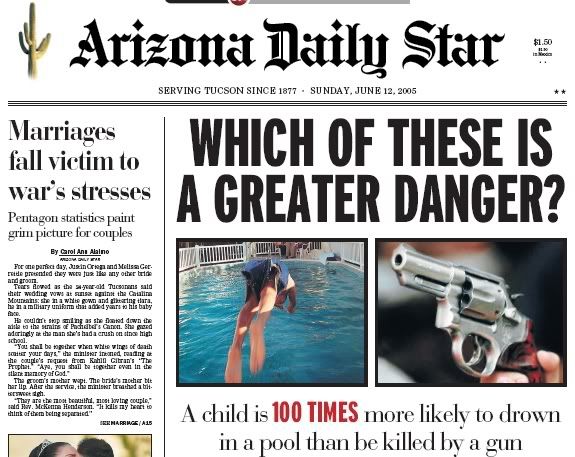
In June, 2005, after a string of drownings and near-drownings, my local morning paper the Arizona Daily (Red) Star – a reliably anti-gun paper – put this on the front page of the Sunday edition, above the fold:

I wrote about it then, and excerpted this from the story:

They’re pulled from backyard pools and bathtubs each year, tiny limp bodies, blue and not breathing.

A young life can vanish quickly under water. A survivor can endure a lifetime of disabilities. Either way, families are torn apart by an almost always preventable tragedy.

Standard summer companions in our desert climate, swimming pools can be deadlier for children than guns. A child is 100 times more likely to die in a swimming accident than in gunplay, writes Steven D. Levitt, University of Chicago economics professor and best-selling author.

Levitt analyzed child deaths from residential swimming pools and guns and found one child under 10 drowns annually for every 11,000 pools. By comparison, one child under 10 each year is killed by a gun for every 1 million guns, according to his research, outlined in a new book “Freakonomics: A Rogue Economist Explores the Hidden Side to Everything,” which he co-wrote with journalist Stephen J. Dubner.

It was a pretty fair article. The exception that proves the rule?

As Promised, Fisk #3 or: Next Up at the Plate, Erwin Chemerinsky!

Duke University Professor of Law and Political Science Erwin Chemerinsky has attempted another shrill, frantic refutation of last Friday’s Parker v. D.C. decision. Published in Wednesday’s Washington Post, it’s entitled A Well-Regulated Right to Bear Arms. Professor Chemerinsky is a regular guest on right-wing radio host and blogger Hugh Hewitt’s afternoon radio show along with Chapman University’s John Eastman. Each week they discuss the legal news and offer their opinions on what happens to be the case of the moment.

I’m fully convinced that Hugh chose Erwin for his radio guest for the same reason Fox News chose Alan Colmes for their nightly television show. Aside from his Leftism, Erwin has a voice suitable for the print media, just as Alan Colmes has a face for radio. But then, that’s just my personal opinion. A lot of people think Bob Dylan can sing.

Anyway, as a bit of background, I’ve posted a couple of times on one exchange between Chemerinsky and Eastman. On Wednesday, June 8, 2005 they discussed the appointment of Janice Rogers Brown to the D.C. Circuit Court of Appeals (please, please let the court re-hear Parker en banc. And let Judge Brown write the decision!) As the Geek with a .45 has noted, you’re going to hear the phrase “Contradicting 70 years of Constitutional Jurisprudence” a lot for the next few weeks or months. You heard it or its equivalent here first, 6/8/05 in this exchange:

John Eastman: You know, I mean, it’s just so preposterous, I don’t even know where to begin. The reason Chuck Schumer is so upset about this, is Justice Brown is the kind of judge who will, you know, adhere to the Constitution. And when the members of the legislature, even the exalted Chuck Schumer himself, want to take actions that is not authorized by the Constitution, she’ll be willing to stand up and do her duty, and strike it down. That’s not an arrogance, that’s what the judges are there for, to adhere to the Constitution, and not to let the legislature roll over them and do whatever they want. You know, it really is preposterous. We’ve turned this upside down. The judges that do exactly what they’re supposed to do are demonized, and those that take a powder and let the legislature get away with every abuse, every extension of power imaginable, are touted at the cocktail circuit.

Erwin Chemerinsky: I think what Senator Schumer is saying, and is absolutely right, is that Janice Rogers Brown’s repeated statements that she believes that the New Deal programs like social security are unconstitutional, is truly a radical view. That’s not a judge who wants to uphold the Constitution. That’s a judge who wants to shred the last eighty years of American Constitutional law. Janice Rogers Brown saying she believes that the Bill of Rights should not apply to the states, would undo the last seventy years of Constitutional law. That’s not a judge who wants to follow the law. That’s a judge who wants to make the law in her own radical, conservative views.

John Eastman: Hang on, here, because Erwin…there’s a wonderfully subtle change in your phraseology that demonstrates what’s going on here. You said she won’t follow the Constitution, and then you said it’s because she won’t follow the last seventy or eighty years of Constitutional law. What happened seventy or eighty years ago that changed the Constitution? There was not a single amendment at issue in the 1930’s that changed the Constitution. Some radical, federal programs were pushed through. Some radical judges, under pressure, finally signed on them, and the notion that we can’t question that unconstitutional action that occurred in the 1930’s, and somehow that defending that unconstitutionality is adherent to the rule of law, is rather extraordinary. There are scholars on left and right that have understood that what went on in the 1930’s was…had no basis in Constitutional law, or in the letter of the Constitution itself.

Yes, it’s “activism” to uphold the original meaning of the Constitution, but it’s not activism to make up law out of whole cloth, or rip a right out of the Constitution with one judicial decision. As I’ve said before, the Left isn’t afraid of “irreversible change.” They’re afraid of reversal of their changes. And, typically, they won’t come out and say that.

Professor Chemerinsky continues in the same vein in his op-ed. One more time, let us fisk:

In striking down the District of Columbia’s handgun ban last week, a federal appeals court raised the crucial constitutional question: What should be the degree of judicial deference to government regulation of firearms? The decision by the U.S. Court of Appeals for the D.C. Circuit interpreted the Second Amendment as bestowing on individuals a right to have guns.

Bzzzzzt! I’m sorry Erwin, but only two sentences into your op-ed and you’ve told a blatant lie already. Let’s go to the decision itself, shall we?

The wording of the operative clause also indicates that the right to keep and bear arms was not created by government, but rather preserved by it. Hence, the Amendment acknowledges “the right . . . to keep and bear Arms,” a right that pre-existed the Constitution like “the freedom of speech.” Because the right to arms existed prior to the formation of the new government, see Robertson v. Baldwin, 165 U.S. 275, 280 (1897) (describing the origin of the Bill of Rights in English law), the Second Amendment only guarantees that the right “shall not be infringed.”

(One legal citation removed for better readability.) Yes, Erwin, the Second Amendment doesn’t bestow anything. It protects what the Founders considered a natural right that existed prior to the establishment of the government formed under the Constitution – thus that right could not be the right of a political entity that did not exist prior to ratification of the Constitution and the Bill of Rights.

Strike one.

But even if this reasoning is accepted, and it is very much disputed, the Court of Appeals still should have upheld the law as being a reasonable way of achieving the government’s legitimate goal of decreasing gun violence.

(Emphasis mine.) The fact that Erwin could actually type those words demonstrates just how factually and morally bankrupt the anti-gun position is. “(A) reasonable way of achieving the government’s legitimate goal of decreasing gun violence”? In Washington D.C.???

Stipulated: The three laws challenged by the Parker suit effectively disarm one group and one group only – the law-abiding residents of and visitors to the District.

Stipulated: According to this site, the 1976 homicide rate in D.C. was 26.8/100,000 population (down a bit from 32.8 the previous year.) After passage of those gun restrictions, the homicide rate hovered about that level – going as high as 35.1 in 1981 and as low as 23.5 in 1985 (the only year it dropped below 26.8) before shooting up in 1988 to 59.5 and peaking in 1991 at 80.6. Along with the rest of the nation, D.C.’s violent crime rate dropped after that, but as of 2005 it was still 35.4/100,000.

Here’s a map of the D.C. metropolitan area:

Alexandria Virginia abuts Washington. According to the FBI in 2005 the homicide rate there was 2.3/100,000 population. Virginia is one of ten states that still allows open carry. I’m not suggesting cause and effect here, but I am pointing out that allowing citizens to own guns – even carry them in public – does not mean tremendous homicide rates. The point is, disarming the law-abiding citizens has had no beneficial effect on homicide rates in the District, and anyone with half a brain understands how unreasonable such a belief truly is.

But Erwin thinks such laws are “a reasonable way of achieving the government’s legitimate goal of decreasing gun violence.”

I’m sorry Erwin. Strike two.

Continuing:

There is a major debate among scholars and judges involving two competing views of the Second Amendment. One approach, adopted by the Supreme Court in 1939 and by most federal courts of appeals, sees the Second Amendment as preventing Congress from regulating firearms in a manner that would keep states from adequately protecting themselves.

This “collective rights” approach rejects the idea that the Second Amendment bestows on individuals a right to have guns. The alternative view, adopted by the D.C. Circuit on Friday, sees the Second Amendment as creating a right for individuals to have firearms.

Erwin, repeating and re-repeating a lie does not make that lie true.

Foul ball.

Each approach is consistent with the text of the Second Amendment, and each is supported by strong historical arguments about the original meaning of the provision. The Second Amendment says: “A well regulated Militia, being necessary to the security of a free State, the right of the people to keep and bear Arms, shall not be infringed.” Those who take the collective rights approach focus on the initial language of the provision, while those who take the individual rights approach focus on the latter language.

Ooooh, another foul. Not precisely, Erwin. The “collective rights” side demands that the prefatory clause completely encompass the right protected by the operative clause. The individual rights proponents understand that we are the militia. The fact that a “well-regulated” militia does not today exist ain’t our fault. But we know that citizens possessing their own firearms makes the possibility of the formation of a militia. Just ask the Algiers Point Militia, and those like them that form after disasters – natural and man-made – that result in a breakdown of official law enforcement and leave us exclusively to fend for ourselves.

We the People are the government, Erwin. The ones drawing a federal, state, or local government paycheck aren’t our masters, they’re our employees. And the sooner we get back to that understanding, the better off we’ll all be.

Each side of the debate marshals impressive historical arguments about what “militia” and “keep and bear arms” meant in the late 18th century. In the past few years, two other federal courts of appeals exhaustively reviewed this history, and one determined that the Framers intended the individual rights approach, while the other read history as supporting the collective rights approach.

That would be the Fifth Circuit, finding in 2001 for an individual right in U.S. v Emerson, and the Ninth Circuit in 2002’s Silveira v Lockyer. I’ve read both. If it weren’t so important, it would be quite amusing to reflect on the fact that the Ninth Circuit uses Silveira to attack Emerson. The court in Emerson performed a thorough “strict scrutiny” examination the law under question, but it first had to determine whether such a right existed in order to do so. “Strict scrutiny” is a test reserved “only when there exists a real and appreciable impact on, or a significant interference with the exercise of the fundamental right.” Most of the opponents of the Emerson decision protest that a strict scrutiny examination was not called for. After all, they argue, the right is not an individual one, so it can’t be a fundamental right. People like ACLU president Nadine Strossen who actually had the temerity to say “the fact that something is mentioned in the Constitution doesn’t necessarily mean that it is a fundamental civil liberty.”

Even though, you know, it’s the Second Amendment in the Bill of Rights.

The majority on the panel decided otherwise, and spent the better part of a 75 page decision (as did the D.C. Circuit court) studying the question in deep detail; an “original meaning” examination.

I think the fact that the right in question is #2 on the list might have had something to do with that.

But the fact remained that Emerson stood in strict opposition to the Ninth Circuit’s “collective rights” position first reached in its Hickman v Block decision of 1996. Here’s the Ninth’s exhaustively researched, deeply-considered, well thought-out reasoning behind their “collective rights” conclusion in Hickman:

We follow our sister circuits in holding that the Second Amendment is a right held by the states, and does not protect the possession of a weapon by a private citizen. We conclude that Hickman can show no legal injury, and therefore lacks standing to bring this action.

That’s it. That’s their whole argument. The judicial equivalent of “Go away, boy. You’re bothering me.”

I think they were embarrassed by the level of scholarship involved in Emerson, myself. In Silveira the Ninth Circuit pulled out all the stops in order to justify their Hickman decision. Silveira was a unanimous decision, but one of the three judges wrote a “special concurrence” in which he – well, you read it:

It is well established that, as a threshold matter, this court must determine whether the plaintiffs have standing to assert their claim…. The plaintiffs in this case are simply not entitled to standing and thus I cannot join the court’s discussion of the merits of their Second Amendment claims.

Here, the court claims that “[a]lthough in every case we are required to examine standing issues first,… here an examination of that question requires us as a first step to conduct a thorough analysis of the scope and purpose of the Second Amendment. Only after determining the amendment’s scope and purpose can we answer the question whether individuals, specifically the plaintiffs here, have standing to sue.” Respectfully, I disagree. Previously, this court decided the scope and purpose of the Second Amendment. We are bound by that precedent. In Hickman, this court announced that the Second Amendment guarantees a collective right, not an individual right.

(Legal references removed for clarity.) In essence the Ninth Circuit declared in Silveira that they had to do what they didn’t even bother to attempt in Hickman, but judge Magill proclaims that because they had already “announced” (interesting choice of words, there) that the Second Amendment didn’t protect an individual right – without such an analysis – such an analysis wasn’t necessary.

Isn’t this known as “circular reasoning”?

To top it all off, the Ninth Circuit decided another case that same year, Nordyke v King, and used Hickman and Silveira as precedent – Hickman 14 times, Silveira 28 times.

You think they’d have cited somebody in Hickman.

But a crack showed in the façade of the Ninth Circuit. Judge Gould concurred with the Nordyke opinion, but wrote in his special concurrence:

I join the court’s opinion, and write to elaborate that Hickman v. Block was wrongly decided, that the remarks in Silveira v. Lockyer about the “collective rights” theory of the Second Amendment are not persuasive, and that we would be better advised to embrace an “individual rights” view of the Second Amendment, as was adopted by the Fifth Circuit in United States v. Emerson consistent with United States v. Miller. We should recognize that individual citizens have a right to keep and bear arms, subject to reasonable restriction by the government. We should also revisit whether the requirements of the Second Amendment are incorporated into the Due Process Clause of the Fourteenth Amendment.

Our panel is bound by Hickman, and we cannot reach the merits of Nordyke‘s challenge to Second Amendment. But the holding of Hickman can be discarded by our court en banc or can be rejected by the Supreme Court if it decides to visit the issue of what substantive rights are safeguarded by the Second Amendment.

I write to express disagreement with the “collective rights view” advanced in Hickman and Silveira because I conclude that an “individual rights view” of the Second Amendment is most consistent with the Second Amendment’s language, structure, and purposes, as well as colonial experience and pre-adoption history.

(Again, my emphasis.) I’ve said it before, most recently in Game Over, Man

We depend upon the honor and intellectual honesty of the judges who make up the Justice system, yet it seems that those who are truly honest and honorable are outnumbered by those who are “willing to bury language that is incontrovertibly there.” The honest and honorable ones abide, under the rule of law, by precedent that is otherwise insupportable. The middling honest ones, the ones Justice Brandeis labled as “men of zeal, well-meaning but without understanding” “build magnificent legal edifices on elliptical constitutional phrases – or even the white spaces between lines of constitutional text.”

Judge Gould is apparently one of the (evidently few) intellectually honest and honorable.

And, of course, the appeal for an en banc rehearing was denied.

The Supreme Court denied cert, too.

Enough asides. Continuing:

The assumption in this debate, and one that the D.C. Circuit followed Friday, is that gun control laws are unconstitutional if the individual rights approach is followed. This assumption, though, has no basis in constitutional law. No rights are absolute. Even the First Amendment, which is written in the seemingly absolute language that Congress shall make “no law” abridging freedom of speech or religion, allows government regulation.

BZZZZZZT!!!! I’m sorry Erwin, but that’s strike THREE! Yer outtahere!

This is fear-mongering at its most blatant. “Oh no! There’ll be no more gun control laws! There’ll be armed felons in the streets carrying tactical nuclear weapons! The sky is falling, the sky is falling!”

The D.C. District court didn’t overturn U.S. v Miller, and the National Firearms Act is a gun control law. The court states explicitly:

Indeed, the right to keep and bear arms – which we have explained pre-existed, and therefore was preserved by, the Second Amendment – was subject to restrictions at common law. We take these to be the sort of reasonable regulations contemplated by the drafters of the Second Amendment. For instance, it is presumably reasonable “to prohibit the carrying of weapons when under the influence of intoxicating drink, or to a church, polling place, or public assembly, or in a manner calculated to inspire terror…” State v. Kerner. And as we have noted, the United States Supreme Court has observed that prohibiting the carrying of concealed weapons does not offend the Second Amendment. Similarly, the Court also appears to have held that convicted felons may be deprived of their right to keep and bear arms. These regulations promote the government’s interest in public safety consistent with our common law tradition. Just as importantly, however, they do not impair the core conduct upon which the right was premised.

You should slink off back under your rock now, Erwin you lying sack.

But you don’t:

The D.C. District Court ruled on the Constitutionality of the three laws at question.

Therefore, under the individual rights approach, there still is the question of what types of government regulations are appropriate.

Wait… Didn’t you just say that “(t)he assumption in this debate, and one that the D.C. Circuit followed Friday, is that gun control laws are unconstitutional if the individual rights approach is followed”??? Now you’re discussing “what types of government regulations are appropriate”?

Doesn’t bending yourself into a logical pretzel hurt?

But you’re still not finished:

For 70 years the Supreme Court has distinguished among constitutional claims in deciding how closely to scrutinize laws and how much to defer to legislatures. In instances where there is reason to distrust the government, such as for laws discriminating on the basis of race, “strict scrutiny” is used and the government can prevail only if its action is necessary to achieve a compelling purpose.

And we’ve got no reason to distrust the government about gun control? And there’s that “70 years” thing again. As John Eastman asked,

What happened seventy or eighty years ago that changed the Constitution? There was not a single amendment at issue in the 1930’s that changed the Constitution. Some radical, federal programs were pushed through. Some radical judges, under pressure, finally signed on them, and the notion that we can’t question that unconstitutional action that occurred in the 1930’s, and somehow that defending that unconstitutionality is adherent to the rule of law, is rather extraordinary.

This piece is long enough, but how many quotes do I need to drag out about the disarmament of citizens by government, you weasle? (Sorry Cowboy Blob and other ferret-lovers out there. It’s just an expression.)

But where there is little reason to doubt the legislatures’ choices, courts give great deference to the legislatures and uphold laws so long as they are reasonably related to a legitimate government purpose. For example, discrimination that is based on characteristics such as age, disability and sexual orientation need to meet only this more relaxed standard. Even rights enumerated in the Constitution, such as property rights, generally receive only this relaxed level of judicial review. For this reason, for 70 years, government regulation of the economy to protect employees and consumers has been upheld in the face of claims that it unduly restricts property rights.

Like Kelo v New London?

Oh, right. You were on the government’s side on that one, too, you statist fuckwit.

In other words, even if the D.C. Circuit is right in holding that the Second Amendment creates individual rights, that does not answer the question as to the level of scrutiny to be used in evaluating gun control laws. I believe that there is a strong argument that the regulation of guns should be treated the same as other regulation of property under modern constitutional law: The regulation should be allowed so long as it is rationally related to achieving a legitimate government purpose.

Again, Erwin, the Second Amendment doesn’t CREATE ANYTHING. It protects a pre-existing individual right to arms. Risking invocation of Godwin’s Law:

If you tell a lie big enough and keep repeating it, people will eventually come to believe it. The lie can be maintained only for such time as the State can shield the people from the political, economic and/or military consequences of the lie. It thus becomes vitally important for the State to use all of its powers to repress dissent, for the truth is the mortal enemy of the lie, and thus by extension, the truth is the greatest enemy of the State. – Joseph Goebbels

(I don’t know if that quote is Goebbels’ or not, but it is eminently accurate in this context, whoever said it.) Every argument you make is predicated on the lie that the Bill of Rights creates the rights it is designed to protect, and for that if no other reason your arguments fail.

Under this standard, there is no doubt that the D.C. gun law is constitutional.

Thank jeebus even you can admit that.

The city’s government was pursuing the legitimate goal of decreasing gun violence, and its means were certainly reasonable.

And repeating this lie doesn’t make it any more true either. No, Erwin, they were not reasonable. Disarming the law-abiding without the ability to protect them (and no government can protect everyone, all the time) is not reasonable. Ask Carolyn Warren, Joan Taliaferro and Miriam Douglas. They found out the hard way as have thousands, nay, millions of others. Nor have those means proven in any way effective. But that doesn’t seem to matter to you in the least, so long as the State acquires more power.

The Supreme Court will probably review the D.C. Circuit decision. Whether the court takes the individual or the collective rights approach, it should uphold the D.C. law and make clear that courts will defer to legislatures in their regulation of firearms.

I certainly hope the Supreme Court reviews the case, but I don’t expect it to. It’s dodged the question thus far. I don’t see it opening the mason jar of worms it canned and put on the shelf in 1939.

The best you can hope for, Erwin, is that an en banc rehearing of the case gets the decision reversed. That’s what I think is going to happen, Janice Rogers Brown or no Janice Rogers Brown. There are too few intellectually honest and honorable judges in our system.

UPDATE: Fellow gun-blogger and gun-rights absolutist Publicola also fisks Erwin, and has links and excerpts from other very interesting caselaw. I strongly recommend you read his Fisking Erwin.

Saul Cornell, AGAIN

or: “A Fisker’s Work is Never Done”

As I said in my previous piece, the gun control partisans are coming unglued. Next exhibit: Professor Saul Cornell, associate professor of history at Ohio State University, Director of the (Joyce Foundation-funded) Second Amendment Research Center of the John Glenn Institute at Ohio State, and a man with a very jabberwocky view on history, legal precedent, and the right to arms.

His latest: another op-ed, this time on the Parker v D.C. decision from last week. Yes, friends, it’s all a plot by the Vast Gunny Conspiracy.

Again, let us fisk:

Parker v. District of Columbia: Opening Volley or Just A Flash in the Pan?

Guest Blogger

Saul Cornell
Department of History,
Ohio State University

Note that he doesn’t point out his directorship of the “Second Amendment Research Center” here. He’s just a humble member of Ohio State’s History department. One would think for maximum “expert status” he’d be resting on those laurels. Perhaps Joyce Foundation funding is becoming radioactive?

The recent decision in Parker v. District of Columbia striking down the District of Columbia’s gun control law rests on a combination of bad law and even worse history. It also demonstrates the methodological weakness of originalism in its current form.

And Professor Cornell is going to cite us chapter and verse in refutation?

It is rather shocking to see a Federal Appeals Court misread established precedent in such a politically distorted fashion. The interpretation of U.S. v. Miller offered by the Appeals Court rests on a revisionist reading of the case manufactured by gun rights scholars.

Manufactured and revisionist in his “expert” opinion. Yet those gun rights scholars apparently managed to convince the foremost expert on American constitutional law, Laurence Tribe – professor of Law at Harvard, and author of the most widely used ConLaw textbook in law schools today, American Constitutional Law (3rd Edition.) In the first and second editions, Tribe relegated the 2nd Amendment to mere footnotes, but in the 3rd Edition (2000) he devotes several pages to it, concluding:

Perhaps the most accurate conclusion one can reach with any confidence is that the core meaning of the Second Amendment is a populist / republican / federalism one: Its central object is to arm ‘We the People’ so that ordinary citizens can participate in the collective defense of their community and their state. But it does so not through directly protecting a right on the part of states or other collectivities, assertable by them against the federal government, to arm the populace as they see fit. Rather the amendment achieves its central purpose by assuring that the federal government may not disarm individual citizens without some unusually strong justification consistent with the authority of the states to organize their own militias. That assurance in turn is provided through recognizing a right (admittedly of uncertain scope) on the part of individuals to possess and use firearms in the defense of themselves and their homes — not a right to hunt for game, quite clearly, and certainly not a right to employ firearms to commit aggressive acts against other persons — a right that directly limits action by Congress or by the Executive Branch and may well, in addition, be among the privileges or immunities of United States citizens protected by §1 of the Fourteenth Amendment against state or local government action.

This goes well beyond what the DC Appeals court found in Parker, but we’re supposed to take Cornell’s word – an historian – that these “gun rights scholars” have “manufactured” their case, not convincingly researched it and provided it for peer-review like any other legitimate scholars.

According to the revisionist reading of Miller, the Court only cared about the type of weapon at issue in the case. This reading casts aside more than seventy years of jurisprudence and is absurd.

Absurd? Then why doesn’t Professor Cornell quote the pertinent part of the decision to prove his point? I quoted it below, I’ll be more than happy to do it again:

In the absence of any evidence tending to show that possession or use of a ‘shotgun having a barrel of less than eighteen inches in length’ at this time has some reasonable relationship to the preservation or efficiency of a well regulated militia, we cannot say that the Second Amendment guarantees the right to keep and bear such an instrument. Certainly it is not within judicial notice that this weapon is any part of the ordinary military equipment or that its use could contribute to the common defense.

Note that the court does not do what the 9th Circuit Court of Appeals subsequently does; it does not read this as meaning that no one not a member of the militia has any right to arms. The government’s lawyers argued that position, but the Supreme Court did not decide the case on those grounds. They decided the case on the suitability of Miller’s shotgun as militia equipment. Period. They ajudicated on the type of weapon – however much Professor Cornell wishes to deny it. And a question: What amendment passed seventy years ago that overturned the understanding of the Second Amendment in Supreme Court jurisprudence up to that time?

All of the contemporary reports of Miller in the press and legal scholarship of the day treated the case as though it simply restated the overwhelmingly scholarly and legal consensus of the day that the Second Amendment was about the militia. If there was any reason to doubt this reading, then one need only look at the New York Times the day the case was reported. Judge McReynolds prefaced the decision by noting that “We construe the amendment as having relation to the military service and we are unable to say that a sawed-off shotgun has relation to the militia.” Clearly, the revisionist reading of Miller has no historical foundation.

Note what Justice McReynolds did not say: “We construe the amendment as having relation to the military service, and since Miller was not a member of any military organization, he had no right to possess a firearm.” “No historical foundation”? My muscular buttocks.

The use of Founding era sources in Parker is no less problematic. One of the issues discussed by the Court is the meaning of the phrase “keep and bear arms.” To support the dubious proposition that this phrase was typically used to describe both military and non-military uses of firearms, the Court turned to the Pennsylvania Anti-Federalist Dissent of the Minority. It is a remarkable version of originalism that would use a hastily drafted protest that was never copied by any other state nor emulated by any major writer during ratification as the basis for reconstructing the meaning of an important constitutional text. Indeed, the Dissenters were so far out of step with thinking within their own state that none of them won election to the First Congress that actually drafted the Bill of Rights. Indeed, the Dissent of the Minority was invoked and dismissed during the debate over the Bill of Rights as a text that symbolized the most radical Anti-Federalist demands. Madison did not even include it among various proposals he collected when he began formulating his own list of possible amendments. Yet, despite the overwhelmingly historical evidence that this text was not typical, nor ultimately influential, gun rights scholars and their allies on the DC Court of Appeals insist on using this text as though it were dispositive of the meaning of the Second Amendment. Rewriting the Second Amendment as if it were written by the Pennsylvania Minority take originalism in the direction of an alternate history science fiction fantasy.

Uh, Professor? You just completely blew off the entire discussion in Parker over who “the people” are in favor of dissing the court’s understanding of “keep and bear arms.” They show, with vigor, that “the people” in the Second Amendment are the same “people” in the First, Ninth, and Tenth Amendments. Not a collective. Individuals. And why is it that anti-gun scholars seem unable to understand the concept of the word “keep”? Even if the Second Amendment was specifically intended only for the purpose of having an armed “well-regulated militia,” what part of this portion of Miller don’t they understand?

The signification attributed to the term Militia appears from the debates in the Convention, the history and legislation of Colonies and States, and the writings of approved commentators. These show plainly enough that the Militia comprised all males physically capable of acting in concert for the common defense. ‘A body of citizens enrolled for military discipline.’ And further, that ordinarily when called for service these men were expected to appear bearing arms supplied by themselves and of the kind in common use at the time.

(My emphasis.) In order to bear arms “supplied by themselves and of the kind in common use at the time,” wouldn’t that mean that they had to keep them, at home, like the Swiss do today?

Who is it proposing “alternate history science fiction fantasy” here?

The Parker decision contains other historical errors that have been frequently repeated in gun rights scholarship. The Court falsely asserted there are no 19th century constitutional commentaries who favored the militia based reading of the Second Amendment. This would have shocked Joseph Story, the most influential commentator of the pre-Civil War era and Benjamin Oliver, one of the most influential popular constitutional writers of the antebellum era.

Stop right there. Let’s discuss Joseph Story for a moment. Here’s what Supreme Court Justice Joseph Story said in his 1833 Commentaries on the Constitution of the United States that’s been quoted so often:

The right of the citizens to keep and bear arms has justly been considered, as the palladium of the liberties of a republic; since it offers a strong moral check against the usurpation and arbitrary power of rulers; and will generally, even if these are successful in the first instance, enable the people to resist and triumph over them.

Here’s the entire quote in full context:

The next amendment is: “A well regulated militia being necessary to the security of a free state, the right of the people to keep and bear arms shall not be infringed.”

§ 1890. The importance of this article will scarcely be doubted by any persons, who have duly reflected upon the subject. The militia is the natural defence of a free country against sudden foreign invasions, domestic insurrections, and domestic usurpations of power by rulers. It is against sound policy for a free people to keep up large military establishments and standing armies in time of peace, both from the enormous expenses, with which they are attended, and the facile means, which they afford to ambitious and unprincipled rulers, to subvert the government, or trample upon the rights of the people. The right of the citizens to keep and bear arms has justly been considered, as the palladium of the liberties of a republic; since it offers a strong moral check against the usurpation and arbitrary power of rulers; and will generally, even if these are successful in the first instance, enable the people to resist and triumph over them.

And yet, though this truth would seem so clear, and the importance of a well regulated militia would seem so undeniable, it cannot be disguised, that among the American people there is a growing indifference to any system of militia discipline, and a strong disposition, from a sense of its burthens, to be rid of all regulations. How it is practicable to keep the people duly armed without some organization, it is difficult to see. There is certainly no small danger, that indifference may lead to disgust, and disgust to contempt; and thus gradually undermine all the protection intended by this clause of our national bill of rights.

Here Professor Cornell seems to argue that Story’s fear – an indifferent population avoiding its duty – means that the government has the power to pass laws disarming them.

Somehow I don’t think Justice Story would have gone along with that idea. Even if the populace does not subject itself to militia service, it is not a militia, according to Story, but citizens – that is, individuals – with a right to keep and bear arms that provides a check against “the usurpation and arbitrary power of rulers” which is “the palladium of liberty.”

Now, as to Benjamin Oliver, I’ve only been able to find one citation of any significant length to his take on the right to arms from his book The Rights of an American Citizen: with a Commentary on State Rights, and on the Constitution and Policy of the United States. (American Book Exchange has one copy at $275. I don’t think I’ll be adding that tome to my library any time soon.) That source is Michael Bellisiles, so you’ll forgive me if I suspect cherry picking on the part of that author, given his proven history of “selective quoting.” However, this is what Bellesiles says Oliver wrote:

As the early American political scholar Benjamin Oliver wrote in 1832, the “cowardly and disgraceful” act of carrying concealed weapons transformed what might have been a barroom brawl into a deadly encounter. The Second Amendment, which Oliver held relevant only to the militia system, offered nothing “to prevent congress or the legislatures of the different states from enacting laws to prevent citizens from always going armed.”

Bellesiles then insists that legislatures of the time were in full agreement with Oliver, passing laws against carrying weapons. Well, no. Against carrying concealed weapons. Carrying openly seems to have been accepted practice. And today states are allowed to pass laws regulating the carrying of concealed weapons. A few, like Arizona and Virginia, do not restrict (at least not by statute) the open carry of firearms to this day.

Oliver might have thought that it should be OK to restrict all carry, but the legislatures and courts of the time certainly did not.

Continuing:

It also would have shocked influential post Civil War commentators such as John Forrest Dillion(sic) and Joel Prentiss Bishop.

Then I’d appreciate some citations from them to that effect, with links. This is argumentum ad verecundiam – appeal to authority. Hey, I can throw names around too! How about Chief Justice Roger B. Taney and the six Supreme Court Justices that joined him in his Dred Scott decision of 1856? (At least I give a cite.)

One could go on for pages documenting the historical errors, logical missteps, and ideological distortions of the opinion in Parker.

Then I suggest you do so, because your side is going to need to flood the court with amicus briefs for the appeal.

It is too early to tell if this case will end up being reversed. If it does then Parker will have been little more than a flash in the pan. If the case is upheld than(sic) history will view Parker as the first volley in a full frontal assault on modern gun regulation.

Right. Modern gun regulation? Again I ask: What amendment got passed seventy years ago that rendered the Second Amendment null and void?

What is indisputable is that the Court’s analysis of history and precedent was driven by an activist ideology, not a genuine understanding of the original meaning of this provision of the Constitution.

That’s the topsy-turvey jabberwocky world of Saul Cornell. An attempt to perform a strict-scrutiny original-meaning analysis on the Second Amendment doesn’t find what he wants it to find, so it’s driven by “activist ideology,” but seventy years of bad precedent built upon a foundation of racism isn’t.

Sometimes I wish someone had the power to revive the Founders just so they could bitch-slap these people.

Up next: Erwin Chemerinsky’s WaPo piece A Well-Regulated Right to Bear Arms. But tomorrow. These things are too time-consuming.

Working Hard to Deliberately Mislead

Robert J. Spitzer, Distinguished Service Professor of Political Science at SUNY Cortland, has authored an op-ed on the History News Network website. Entitled Working Hard to Misconstrue the Second Amendment, it’s just one more example of the deliberate mendacity (that means “blatant lying,” but in polite language) practiced by gun-ban-control activists. These people present themselves as “experts” that we’re supposed to believe because they’re experts. They provide citations we’re supposed to take at face value supporting their positions, and not question whether they might be misleading us to further their own ends.

And most people would not question – or at least, they used to.

Then “fisking” came along.

Let us fisk.

In a startling case that may single-handedly revive interest in the Second Amendment’s “right to bear arms,” the U.S. Court of Appeals for the District of Columbia Circuit ruled 2-1 Friday that a D.C. law barring residents from keeping handguns in their homes violated citizens’ Second Amendment right to have guns, aside and apart from service in a militia. In carving out an “individual” right, the case of Parker v. District of Columbia proves that bad history makes for bad law.

Let’s see: “carving out an ‘individual’ right” – scare quotes around “individual.” And blaming “bad history” for the decision. Right. Moving on…

In its 58 page ruling, the two-member Parker majority contradicts nearly fifty other federal court rulings spanning seven decades, as well as four Supreme Court rulings, all of which support the straightforward proposition that the right to bear arms exists only in connection with citizen militia service.

Yes, there are seven decades of court rulings doing exactly what Spitzer says, but what amendment overturned the Second seventy years ago? I wasn’t aware of of one. So, if you actually study the history, what would you find? Spitzer doesn’t tell us.

For all of the dissembling by gun rights advocates, the amendment’s full wording is pretty clear: “A well regulated militia, being necessary to the security of a free state, the right of the people to keep and bear arms, shall not be infringed.”

Dissemble: “to give a false or misleading appearance to; conceal the truth or real nature of.” Pot? Meet kettle – as I am about to demonstrate in spades.

As Supreme Court Chief Justice Warren Burger once noted, the amendment “must be read as though the word ‘because’ was the opening word.”

And where did Chief Justice Berger say this? In an article he wrote for Parade magazine – that tabloid that gets put in your Sunday newspaper, four years after he retired from the bench. Here’s the entire quote in context:

We see that the need for a state militia was the predicate of the “right” guaranteed; in short, it was declared “necessary” in order to have a state military force to protect the security of the state. That Second Amendment clause must be read as though the word “because” was the opening word of the guarantee. Today, of course, the “state militia” serves a very different purpose. A huge national defense establishment has taken over the role of the militia of 200 years ago.

Some have exploited these ancient concerns, blurring sporting guns — rifles, shotguns and even machine pistols — with all firearms, including what are now called “Saturday night specials.” There is, of course, a great difference between sporting guns and handguns. Some regulation of handguns has long been accepted as imperative; laws relating to “concealed weapons” are common.

Burger here seems to be saying that “sporting arms” – weapons not particularly suited for militia service – are protected by the Second Amendment, but somehow handguns, especially cheap “Saturday night specials” are not. But the Parker decision was specifically about keeping a loaded firearm in ones own home – a condition flatly illegal in Washington, D.C. What does Burger have to say about that?

Americans also have a right to defend their homes, and we need not challenge that. Nor does anyone seriously question that the Constitution protects the right of hunters to own and keep sporting guns for hunting game any more than anyone would challenge the right to own and keep fishing rods and other equipment for fishing — or to own automobiles. To “keep and bear arms” for hunting today is essentially a recreational activity and not an imperative of survival, as it was 200 years ago

(Emphasis mine.) Now, I’ve read the Constitution thoroughly. Where other than the Second Amendment would you get the idea that it protects “the right of hunters to own and keep sporting guns for hunting game”? Even though the Second Amendment says not word one about hunting or sporting use?

Odd that Professor Spitzer left that out, isn’t it? Let’s continue:

Alone among federal rulings siding with the Parker majority is a 2001 case from the Fifth Circuit, U.S. v. Emerson, when for the first time a federal court embraced the “individualist” view.

Correct again. And how did they do it? By studying the actual history of the Second Amendment. I’ve read the decision. Most of Professor Spitzer’s audience has not.

Yet even this case offered little meat to supporters of the individualist view, since the Emerson court upheld Timothy Joe Emerson’s prosecution for violating a federal gun law (he was later convicted).

What did the decision actually say?

Although, as we have held, the Second Amendment does protect individual rights, that does not mean that those rights may never be made subject to any limited, narrowly tailored specific exceptions or restrictions for particular cases that are reasonable and not inconsistent with the right of Americans generally to individually keep and bear their private arms as historically understood in this country. Indeed, Emerson does not contend, and the district court did not hold, otherwise.

and

We agree with the district court that the Second Amendment protects the right of individuals to privately keep and bear their own firearms that are suitable as individual, personal weapons and are not of the general kind or type excluded by Miller, regardless of whether the particular individual is then actually a member of a militia. However, for the reasons stated, we also conclude that the predicate order in question here is sufficient, albeit likely minimally so, to support the deprivation, while it remains in effect, of the defendant’s Second Amendment rights. Accordingly, we reverse the district court’s dismissal of the indictment on Second Amendment grounds.

We remand the cause for further proceedings not inconsistent herewith.

The Fifth Circuit examined Emerson’s claim to a violation of his Second Amendment protection of his right to arms, studied the history of the Second Amendment, concluded that the right was an individual one, but – like every other individual right – subject to “limited, narrowly tailored specific exceptions or restrictions for particular cases,” and that Emerson had received due process “albeit likely minimally so,” so that his right had not been violated.

It was a pretty good decision, though the court (probably wisely) stayed far away from trying to define the exact scope of the Second Amendment.

Continuing:

Until Parker, Emerson had been ignored not only by the other circuits, but even by other Fifth Circuit courts.

Not so! The Ninth Circuit majority in Silveira v. Lockyer had some pretty harsh things to say about it, and it’s been mentioned in more than one of the dissents in that court both in Silveira and Nordyke v. King.

While accepting a militia basis for the Second Amendment, the Parker court concluded that the amendment also “protects an individual right to keep and bear arms . . . for such activities as hunting and self-defense,”

A position also taken by Chief Justice Warren Burger, no? Isn’t he an authority anymore?

with the latter encompassing “either private lawlessness or the depredations of a tyrannical government.” Parker‘s linchpin for this sweeping conclusion is its assertion that the reference to “the people” when read “intratextually” (that is, assuming it has the same meaning throughout the document) “leads us to conclude that the right in question is individual.”

Right. Since “the people” who have the right to assemble, petition for redress of grievances, have a protection against unreasonable search and seizure, etc, are, you know, individuals, but “the people” who have the right to keep and bear arms are states. It’s blindingly obvious.

If you’re a mendacious putz.

Since Americans had a “pre-existing right” to protect themselves and hunt, these activities must also have come under the umbrella for the Second Amendment, they assert. The problem with this assertion, aside from the fact that the Bill of Rights was the product of many hands, is that no evidence supports it.

Oh really? Stay tuned.

All of the debate in the First Congress concerning the right to bear arms dealt with military matters. Worse, Parker‘s claim conflates very different rights.

Individual self-defense was protected for centuries under the common law, just as modern criminal law recognizes legitimate personal self-defense. It had and has nothing whatever to do with the Second Amendment.

Except that the Second Amendment protects the instruments necessary to effect ones self-defense.

And the invocations of an armed citizenry struggling to overthrow a tyrannical government arose from natural rights, not from the Constitution or the Bill of Rights. When Americans fought to end British rule, they were not only fighting against the British, but for their own, indigenous American government. Once that struggle was won, Americans traded violent overthrow for peaceful change – through the ballot box, the jury box, and the petitioning of their new government for the redress of grievances.

Did we surrender our natural rights when we formed the United States? This is Professor Saul Cornell‘s rather interesting position. I don’t think so.

Professor Spitzer deliberately leaves out the box we’re both using – the soap box – and the last box on which our liberty stands: the cartridge box. The doomsday provision, as 9th Circuit judge Alex Kozinski put it, “one designed for those exceptionally rare circumstances where all other rights have failed – where the government refuses to stand for reelection and silences those who protest; where courts have lost the courage to oppose, or can find no one to enforce their decrees.”

What, that can’t happen here?

The notion that the Second Amendment somehow enshrines a right of revolution for Americans contradicts the very idea of peaceful governance. In fact, as the Constitution says, militias are to be used to “suppress insurrections,” not cause them. And the only attempt to include hunting in the federal Bill of Rights, arising from Pennsylvania, was defeated.

Well, at least Thomas Jefferson thought we should have a periodic rebellion just to keep our civil masters on their toes. Remember that “blood of patriots and tyrants” quote?

But here’s where the real mendacity comes to the fore:

More bothersome in this federal court ruling is its failure to address the pertinent case law. The Parker majority ignores three Supreme Court cases that address the meaning of the Second Amendment. In U.S. v. Cruikshank (1876), the Court concluded that “bearing arms for lawful purposes” was not what the Second Amendment was about.

Really? As Clayton Cramer notes in a comment to Professor Spitzer’s op-ed:

Cruikshank? The Supreme Court was looking for a way to end prosecution of Klansmen who had disarmed dozens of freedmen. (It was a lot easier to disarm the freedmen after murdering them.) Cruikshank not only found that the Second Amendment didn’t apply in this situation, but similarly with respect to the right to peaceably assemble.

Right. Another one of those rights of the state.

Oh, wait…

Clayton doesn’t quote the decision there, but I will:

The right there specified is that of “bearing arms for a lawful purpose.” This is not a right granted by the Constitution. Neither is it in any manner dependent upon that instrument for its existence. The second amendment declares that it shall not be infringed; but this, as has been seen, means no more than that it shall not be infringed by Congress.

(Emphasis mine.) Keep this wording in mind. That sounds remarkably like a “pre-existing right,” doesn’t it? The court just narrowly said that the Federal government couldn’t violate your (pre-existing) right to arms, but there was no protection against the state doing it.

All to legally justify the disarmament (and subsequent murder) of newly freed blacks. What a stellar decision to depend on.

More importantly, the Court stated flatly in Presser v. Illinois (1886) that the Second Amendment did not protect a citizen’s right to privately bear arms; instead, it protected the “keeping and bearing of arms” so that the government could not be deprived of “their rightful resource for maintaining the public security” or “disable the people from performing their duty” to the government.

On this, Clayton responds:

Presser? The Illinois government was using the National Guard to terrorize unionists, and they responded by forming their own military organization. What was prohibited was an armed body of men marching through the streets–the relevance to individuals being armed is pretty small. More importantly, the decision doesn’t say what Spitzer wasn’t(sic) it to say.

He then quotes the actual decision:

We think it clear that the sections under consideration, which only forbid bodies of men to associate together as military organizations, or to drill or parade with arms in cities [116 U.S. 252, 265] and towns unless authorized by law, do not infringe the right of the people to keep and bear arms. But a conclusive answer to the contention that this amendment prohibits the legislation in question lies in the fact that the amendment is a limitation only upon the power of congress and the national government, and not upon that of the state.

It is undoubtedly true that all citizens capable of bearing arms constitute the reserved military force or reserve militia of the United States as well as of the states, and, in view of this prerogative of the general government, as well as of its general powers, the states cannot, even laying the constitutional provision in question out of view, prohibit the people from keeping and bearing arms, so as to deprive the United States of their rightful resource for maintaining the public security, and disable the people from performing their duty to the general government.

This hardly jives with Professor Spitzer’s contention that the right to arms is somehow not an individual one, but one somehow of the states, does it? And what does Presser use for a precedent? Cruikshank. Parker could have quoted that line in bold to support their position, but D.C. isn’t a state, as the lone dissenter in Parker anguishes about.

Continuing:

And in 1894, the Court upheld a Texas law “prohibiting the carrying of dangerous weapons” in Miller v. Texas, turning aside a Second Amendment rights claim. Little wonder that these three cases went unmentioned.

Little wonder, indeed, since they support the Parker court far better than you’d admit. Clayton, again:

Miller v. Texas? The big problem with this case is that the Supreme Court did not claim that the right in question belonged to the states; they argued that it was a limitation only the federal government:

We have examined the record in vain, however, to find where the defendant was denied the benefit of any of these provisions, and, even if he were, it is well settled that the restrictions of these amendments operate only upon the federal power, and have no reference whatever to proceedings in state courts.

The precedent cited by the court in Miller v. Texas? Cruikshank. That’s circular reasoning on the part of Professor Spitzer, is it not?

But we’re not quite finished:

The Parker majority does devote considerable analysis to the most recent Supreme Court case on the Second Amendment, U.S. v. Miller (1939). Here again, the court labors to reformulate the meaning of a case that is perfectly clear.

Yes, it is. But I see it perfectly clearly in an entirely different way than Professor Spitzer does, and there are a whole lot of us (including the majority in Parker) who see it the same way.

As Judge Karen Henderson noted in her dissent in Parker, Miller declares that “the right of the people to keep and bear arms relates to those Militia whose continued vitality is required to safeguard the individual states.” Indeed, the Miller court stated flatly that the Second Amendment must be interpreted by its “obvious purpose to assure the continuation and render possible the effectiveness of such forces [militias] the declaration and guarantee of the Second Amendment were made.”

The Parker majority view, however, asserts that Miller protects only a “weapons-based” right focusing “only on what arms are protected by the Second Amendment,” because the Supreme Court upheld Miller’s conviction for carrying a sawed-off shotgun (a gangster weapon regulated by a 1934 federal law) across state lines, as possession of that weapon held no “reasonable relationship” to a militia. Parker‘s twisted logic is that the Second Amendment is about protecting weapons ownership if the weapon has military utility, from assault rifles and bazookas to tactical nuclear weapons. The absurdity of Parker‘s argument underscores its desperation to achieve its real goal: to overturn the Supreme Court’s Miller decision.

I’ve read Parker. I’ve read Miller. I’ve read so damned much caselaw I ought to have a JD diploma on my wall. The Supreme Court didn’t “uphold Miller’s conviction,” it reversed the lower court’s quashing of the indictment and remanded the case for trial. Miller was never convicted because he never appeared before a court again. His co-defendant Layton plead guilty. (Thanks for reminding me to mention that, Bob.)

The court in Miller heard the goverment’s argument that Miller was not a member of a militia and therefore had no right to any firearm, and declined to decide the case on those grounds. If they had, we wouldn’t be having this discussion. Instead they ruled on the narrow question of his weapon. The decision says this:

In the absence of any evidence tending to show that possession or use of a ‘shotgun having a barrel of less than eighteen inches in length’ at this time has some reasonable relationship to the preservation or efficiency of a well regulated militia, we cannot say that the Second Amendment guarantees the right to keep and bear such an instrument. Certainly it is not within judicial notice that this weapon is any part of the ordinary military equipment or that its use could contribute to the common defense.

(Emphasis mine.) Note two things: First, no defense was presented in Miller’s behalf, else it could have been demonstrated to the court that short-barrelled shotguns had a long history of military service. Nobody filed a brief on Miller’s behalf, no one stood in front of the court to plead his case. Second, the wording of that paragraph seems to me, and a lot of other people, to emphatically imply that had there been any evidence the Court would have had to find in Miller’s favor. The Second Amendment would have protected not a state’s right to arm its militia, but an individual’s right to keep and bear such a weapon.

Tactical nukes? Who’s twisting what, here?

Concluding:

Parker‘s bald judicial overreach abuses history and law to achieve a partisan political end – to paste into the Constitution a personal right to own guns. Its effort is an affront to the militia tradition, constitutional history, settled court precedent, and common sense.

Right. Seventy years of gun control history shows that the right to arms was first stripped from newly freed blacks, then others “not like us,” and now, finally, everybody; and it’s been done one slow step at a time by judicial overreach and abuse of history and law, ripping from the Constitution a personal right to own guns one thread at a time.

Parker just slapped a patch on the wound, and the gun control partisans are coming unglued.

UPDATE: Paul Helmke, master of mendacity for the Brady Center, has another perfect example of the deliberately misleading op-ed over at the Brady Blog. His commenters do a thorough job of pointing out his errors, though.

I wonder how much longer that outlet is going to allow comments? Some of them are scathingly funny.

ANOTHER UPDATE:

I just saw this. Apparently professor Spitzer reviewed Clayton Cramer’s new book Armed America (order your copy today!). Clayton comments:

I’ll be charitable and assume that Spitzer is working off a Brady Campaign summary of the 19th century Supreme Court precedents that he mentions, because if he actually had read them, it would be obvious that he’s suffering creeping Bellesilesism.

In other words, “practicing deliberate mendacity.”

Voices

Early on in the Zumbo incident, Tam typed these tremendously insightful words:

Ten years ago, had his statement survived the editorial process and made it into print, we would have seen a handful of cherry-picked letters on the “Letters to the Editor” page of Outdoor life, and things would have pretty much proceeded along at status quo ante. Not now. Not today.

Another case in point, a recent (unsigned, natch) op-ed in the Winston-Salem Journal attempting to rally anti-gunrights forces in the wake of the death of an officer by gunshot. I’ll post the op-ed here in its entirety, and restrain myself from fisking it as it so richly deserves, because I have another point to make in this post:

Gun Glut

The Feb. 23 shooting death of Sgt. Howard Plouff of the Winston-Salem Police Department should make two things clear: There are too many handguns in circulation, and these weapons must be more tightly regulated.

We say “should” instead of “will,” because many gun advocates will continue to trot out the same old argument – that handguns aren’t the problem, people are.

That rings especially hollow after a good police officer and family man has just been shot to death.

No doubt, people would keep on killing under tighter handgun regulations, but the number of killings would almost certainly drop.

All indications are that Plouff’s killer used a handgun, just as so many other killers have.

The guns are as readily available as they are easily concealable. The man police charged Tuesday with killing Plouff, Winston-Salem State University student Keith Antoine Carter, got five permits to own a handgun in the last year, and he got four of those permits in a single month, the Journal reported Thursday. Carter is, of course, presumed to be innocent unless proved guilty, but does any one person need that many handguns?

There were way too many handguns in civilian hands when Plouff was shot in the face trying to help control a large and panicked crowd outside the Red Rooster nightclub. He and other officers had responded to the club to help Forsyth County deputies who were working there off-duty.

The people who started fighting in the bar were definitely in the wrong, but the bouncer who fired a shot into the air in an apparent attempt to end the fighting may well have played a major role in aggravating the violence.

After police arrived, more shots were fired from the crowd.

Carter wasn’t charged until a few days after the crime, but shortly after the shooting police seized eight handguns from the area – that’s just the ones they were able to find – and charged three men with carrying a concealed weapon.

Those are misdemeanor charges. They should be felonies.

There should be tighter regulations limiting the number of handguns a person can buy in a single month. And there should be stricter law enforcement of existing regulations, especially to crack down on those ignorant enough to carry handguns into packed bars.

We’re all for the Second Amendment, especially as it pertains to sporting arms, whether for uses such as target practice or hunting.

OK, I can’t resist fisking this, the obligatory “sporting use” bone thrown to the generic gun owner to prove to them that they don’t really intend to confiscate anything.

Go ahead. Pull my other leg.

But that does not mean that there should be no restrictions; most people, for example, have no good reason to own an assault rifle that is designed to kill a number of people quickly.

And this state, and this country, must face the fact that tighter regulations are needed on handguns – for Howard Plouff and all the other victims.

So, we have a cop killed by a guy who owns not one, not two, but at least five handguns that he’s had for up to a year, that (in North Carolina) he’s got to get a permit to purchase. He takes one of these guns someplace they’re not allowed by law, and he shoots a cop. But somehow we’re to believe that more laws would have prevented this heinous crime when the (anonymous) author proclaims that the cause of the problem is “too many handguns in circulation.” Oh, and “assault rifles.”

Where have I heard that before?

But, as Tam pointed out, ten years ago at most we’d have seen a few cherry-picked letters to the editor – in a week or six.

Not anymore! The Winston-Salem Journal has an online feedback function. There are four pages of (apparently unedited) responses. At my count the tally is 28 in support of the right to arms, three (weakly) in support of the editorial or in opposition to one of the other 28 comments. Samples:

It’s truly sad that you are using the death of a valiant officer to advance an anti constitutional stance. If you read the Federalist Papers, you will see the 2nd amendment has nothing to do with hunting or target shooting and everything to do defending liberty from tyranny. If you nibble away the rights of self defense who will guard you rights to print your opinion. – Smith357

Ban this, ban that. Do you know there is almost a total ban on civilian ownership of all guns in the UK? Have you read the latest from them? There is a gun crisis in the UK right now. Seems the criminals don’t pay attention the the laws over there. They keep getting guns. Guess what, if you obey the law, you have no defense against them. If you did defend yourself, even with fists, you can be arrested and prosecuted for assaulting the criminal. That’s what you want here obviously…. – Use your head

I am sick and tired of the news media jumping on every tragedy to try to take away more of the citizens rights. No amount of laws would have saved this fine officer.I knew him personally and at one time I was his supervisor at the PD. I feel you are doing him a disservice by trying to take away one of the the rights that he so proudly upheld in enforcing the constitution of the U.S. Your rights to a free press maybe next if you don’t take care. – sick and tired

I noticed that there is no name associated with this article, so we must assume that this is the official stance of the Journal? As a local deputy, I would like to point out that it is already illegal to carry a firearm into a place that serves alcohol. More gun control laws do nothing but make more people criminals, and by definition, criminals break the law. Sorry, gun control laws do not control guns, they only serve to make more people criminals. – Disappointed Deputy

“We’re all for the Second Amendment, especially as it pertains to sporting arms, whether for uses such as target practice or hunting.” And I’m all for the 1st Ammendment, especially where it pertains to writing about sports and entertainment. Now, writing unapproved articles about politics or editorials, I think there should be some restrictions on what you can say to the masses, or at least some government oversight. – sss

Ahhhh, I feel so much better now. We’re finding our voices, and using them.

I can’t help but wonder what the Journal‘s editorial board is thinking about the feedback policy.

(There’s also a link on the page directly to Technorati so you can see who else is commenting on it. Nobody’s shown at this time, but I wonder if Technorati will pick up this piece?)

Apology Accepted, Mr. Zumbo

May I call you Jim?

The High Road has a copy of the letter Jim Zumbo sent to Alan Gottlieb of the Citizens Committee for the Right to Keep and Bear Arms. I’m going to reproduce it here (without permission.)

February 28, 2007

Mr. Alan Gottlieb, Chairman
Citizens Committee for the
Right to Keep and Bear Arms
12500 N.E. Tenth Place
Bellevue, WA 98005

Dear Alan:

They say that hindsight is always 20-20. In my case, hindsight has been a hard teacher, like the father teaching the son a lesson about life in the wood shed.

I was wrong when I recently suggested that wildlife agencies should ban semiautomatic firearms I erroneously called “assault rifles” for hunting. I insulted legions of my fellow gun owners in the process by calling them “terrorist rifles.” I can never apologize enough for having worn blinders when I should have been wearing bifocals.

But unlike those who would destroy the Second Amendment right to own a firearm – any firearm – I have learned from my embarrassing mistake. My error should not be used, as it has been in recent days by our common enemies, in an effort to dangerously erode our right to keep and bear arms.

I would hope instead to use this spotlight to address my hunting fraternity, many of whom shared my erroneous position. I am a hunter and like many others I had the wrong picture in mind. I associated these firearms with military action, and saw not hunting as I have known it, not the killing of a varmint, but the elimination of the entire colony. Nothing could be further from the truth, but I know from whence it comes. This ridiculous image, formed in the blink of an eye, exerts an unconscious effect on all decisions that follow. In seeking to protect our hunting rights by guarding how we are seen in the public eye, I lost sight of the larger picture; missed the forest for the trees.

My own lack of experience was no excuse for ignoring the fact that millions of Americans – people who would share a campfire or the shelter of their tent, and who have hurt nobody – own, hunt with and competitively shoot or collect the kinds of firearms I so easily dismissed.

I recently took a “crash course” on these firearms with Ted Nugent, to learn more about them and to educate myself. In the process, I learned about the very real threat that faces all American gun owners.

I’ve studied up on legislation now in Congress that would renew and dangerously expand a ban on many types of firearms. The bill, HR 1022 sponsored by New York Rep. Carolyn McCarthy, is written so broadly that it would outlaw numerous firearms and accessories, including a folding stock for a Ruger rifle. I understand that some of the language could ultimately take away my timeworn and cherished hunting rifles and shotguns as well as those of all American hunters.

The extremist supporters of HR 1022 don’t want to stop criminals. They want to invent new ones out of people like you and me with the simple stroke of a pen. They will do anything they can to make it impossible for more and more American citizens to legally own any firearm.

Realizing that what I wrote catered to this insidious attack on fellow gun owners has, one might say, “awakened a sleeping giant within me, and filled him with a terrible resolve.”

I made a mistake. But those who would use my remarks to further their despicable political agenda have made a bigger one. I hope to become their worst nightmare. I admit I was wrong. They insist they are right.

Enclosed, you will find a check that is intended to be used to fight and defeat HR 1022. I also hope it inspires other gun owners to “do as I do, not as I say.”

I’m putting my money where my mouth should have been, and where my heart and soul have always been. I know the Second Amendment isn’t about hunting and never has been. My blunder was in thinking that by working to protect precious hunting rights I was doing enough. I promise it will never happen again.

I don’t know what lies over the horizon for me. I am not ready for the rocking chair.

I’m going to devote every ounce of my energy to this battle. I will remind my fellow hunters that we are first, gun owners. Whether we like it or not, our former apathy and prejudices may place that which we love, hunting, in jeopardy. I will educate fellow outdoorsmen who mistakenly think like I talked, even if I have to visit every hunting camp and climb into every duck blind and deer stand in this country to get it done. I was wrong, and I’m going to make it right.

Sincerely,
Jim Zumbo

And another post that cinched the deal for me:

I want to confess something.

I’m a gun owner. In fact, I probably own more than most. I pride myself on the quality of my firearms and my skills using them. I spend every weekend, rain or shine, at the range. Defensive pistol, shotgun games, hunting, long range rifle, gun skool…you name it and I do it.

While I’m an NRA member, I don’t do activism. I don’t write letters. I don’t contribute money. I don’t call my congressman…in fact, I don’t even know how all that stuff works.

I just want to be left alone with my hobby. I don’t worry about what bills are proposed. I don’t keep track of what’s going on. Hell, I barely vote.

I don’t tell people what to do and I don’t expect to be told what to do. I just want to shoot.

I’ve been following this Zumbo mess since the beginning. I haven’t commented on it because I felt that everything that needed saying was already said. I also didn’t want to be quick to judge. Initially, I was mad just like everyone else. I’m a fairly forgiving person though, and I thought that if anyone could help him, it would be Ted.

Reading this letter, it’s obvious that Zumbo’s eyes have been opened. I forgive the guy. While what he did was blatantly wrong, I believe he has come around. I would share a campfire with him.

I can also appreciate people that act rather than talk. My donation to CCRKBA has been sent in.

Ed

This guy has over 1,100 posts on THR, but was in no way an activist. Regardless of what the Brady Bunch et al. does with this incident, the net result will be positive for the gun-rights side, I believe.

Historical Revisionism

(Or: Down the Memory Hole?)

I’ve been making the rounds of the internet, using Technorati and other tools to see what people on the other side are saying on about the Zumbo incident. Where comments are allowed, I’ve been putting in my 2¢. Well, I hit on a doozy. I left a comment. It started an exchange. But today that web page’s spam filter decided that I was a spammer and wouldn’t let me post. And this afternoon, my initial comment has vanished from the page!

Good thing I archived it, because I’m going to reproduce it here for posterity.

An American expat living in Korea runs a blog called The One With Aldacron. Apparently he’s a “bright” – one of the more militant versions of Athiest (big “A”), and, of course, a Lefty.

And, of course, an expert on firearms and the Constitution. His post, Moron of the Week #4 I will leave to you to read (unless, of course, he revises or pulls it, whereupon I’ll post a copy of it here), but hie thee yon and read it, then come back for the comment that mysteriously disappeared (but that he responds to in his first comment.)

Done? Good! Here’s what I said:

“It’s utterly insane to hunt prairie dogs, or any animal, with a weapon made for war.”

Do you have any idea how ignorant that statement is? Every single bolt-action rifle is based on a design specifically made for war.
The “assault rifles” used to hunt prairie dogs and other varmints are as far-removed from the military version of the M16 as a Remington 700 is from a ‘98 Mauser – though I imagine you’ll still find a lot of modified ‘98 Mausers in the deer woods each season.
I’ve been following the commentary on this story around the blogosphere and the one constant is the staggering ignorance of the people opining on a topic they know absolutely nothing about – but who still feel completely justified in inflicting that ignorance on the general population.
“Typical American Ignorance”? I suggest you look in a mirror.

Now, if you’d care to discuss the actual meaning of the Constitution, drop me a note. You might have a lot to learn that will surprise the hell out of you.

Go read the rest of the thread. I had to change my email address for the spam filter to accept my last comment. It may well be my last there. It needn’t be yours.

Edited to add: Dammit! He erased another comment that I didn’t archive. I guess I was making too much sense.