See David Hardy’s very important post on the ongoing fallout from the Zumbo incident, Falling for false flag operations.
This is something that all of us must combat.
The Smallest Minority on earth is the individual. Those who deny individual rights cannot claim to be defenders of minorities. – Ayn Rand
See David Hardy’s very important post on the ongoing fallout from the Zumbo incident, Falling for false flag operations.
This is something that all of us must combat.
Via Joe Huffman, a London Sunday Herald op-ed that I found quite surprising. I’m going to copy the whole thing here for archival purposes without comment. (Yes, I know. Unusual for me.)
Dunblane made us all think about gun control … so what went wrong?
By Ian BellALMOST 11 years now. Kids grow up, life changes, leaves rot on the branch, and all memories decay. Stuff happens. Almost 11 years ago, on the morning after, I told myself that I had sworn off the vampire habit. You know the sort of thing. Something vast and terrible and inexplicable happens. The journalist dusts down his purple prose and sets out, consciously and deliberately, to feel everyone’s pain. Inexcusable, really.
For example: they gave me a prize for Dunblane. To this day, I have never understood why I am the only person I know who finds the fact unsettling. WH Auden, born a century ago last week, said famously that poetry makes nothing happen. He should have tried journalism.
Facts: In mid-March of 1996 Thomas Hamilton, 43, warped, morally crippled, dead in his soul, certainly disgusting, the suicide-in-waiting who should have done us all a favour in the privacy of his own nightmare, went into the precincts of Dunblane primary, and into the gym class, with all his precious sex-toy handguns.
He killed 16 infants, then their teacher, then himself. He accomplished all this with four weapons, in three short minutes. Lots of official things – never adequately explained, for my money – had gone wrong before the event. Somehow that ceased to be the point. Half the world was staggered, but Scotland went into a state of near-clinical shock. The human ability even to begin to pretend to comprehend was defeated.
All over the country, people did irrational things, knowing them to be irrational. They turned up at schools, 100 miles from the scene, just to convince themselves that their own infants were safe. They called home from work, or called people at work, simply to prove that sanity still prevailed. Many could not face the idea of the working day. Strangers in the street, caught unawares by the news, were in tears. If you happen to be too young to remember, trust this: I’m not making it up.
Explanation and analysis, journalism’s default responses, were worse than pointless. Those rituals, too, seemed insulting. Joining the world’s media on the streets of Dunblane to ask people “how they felt” was worse than ghoulish: I refused that request. To their credit, nobody pressed the point. There was still the usual column to be written, however.
In fact, over the days and weeks that followed, there was more than one. I allowed myself two simple, possibly simplistic, strategies. First, I was not ever going to attempt to “explain” Hamilton: the bereaved deserved better. Secondly, in my small way, I was going to take on anyone who failed to support the banning of handguns.
There was a lot of American comment, predictably, and much of it abusive. The clichés appeared as if by return of post. “Guns don’t kill people,” they wrote. “People kill people.” So why – this struck me almost as the definition of self-evident – did Thomas Hamilton feel a need for four of the damnable things?
Then the Duke of Edinburgh, and the field sports people, and the target shooters entered the fray. The royal consort, with his usual sensitivity, expressed the view that things were getting out of hand, and that a more considered response was required. I can clobber royals in my sleep.
The most troubling questions came, instead, from those who answered my simplicities with one of their own. They didn’t oppose a ban, as such. They merely wanted to know why I was so sure that legislation would work.
That seemed obvious. It even seemed faintly stupid to think otherwise. No guns, no gun-killings. Remove the threat: wasn’t that one of the jobs of government?
Sceptics were more subtle than I allowed. What they meant was that it is easy to impose laws on the law-abiding. Criminals, by definition, don’t take much interest in well-meaning legislation. If they chose to arm themselves while the rest of society was, in effect, disarming, outraged newspaper commentators and their quick fixes might merely make matters worse.
I’m still not convinced, or not entirely. A rueful young man in Los Angeles told me once that his city boasted more cars than people, and more guns than cars. “Current population?” he added. “Eleven million, give or take.” To him, the notion of a country patrolled by unarmed police officers was a kind of fantastic dream. To him, equally, the fact that nice kids could lay hands on the family pistol – bought for “self-defence” – and die while simply messing around in the back yard was not an example to be envied, or copied.
“You know what guns do?” he asked. “They go off. You know what guns are for? To kill. That’s their purpose. Only the rhetoric is harmless.”
Back then, I believed every word. America had, and has, too many of the instruments that Thomas Hamilton found so alluring. Yet almost 11 years on, what do I read, and what do I say?
I read of three London teenagers murdered in the space of 11 days. I read of firearms “incidents” spreading like an epidemic across our cities. I read of Tony Blair holding a Downing Street summit on a crisis that seems – call me naive – a greater threat to many communities than any terrorism.
What I say then becomes obvious: my idea didn’t work. In fact, I begin to thread certain fears together, like links in a chain. Here’s one: if even London teenagers can provide themselves with the means to kill 15-year-old Billy Cox in his bedroom, guns have become commonplace, so commonplace that every would-be terrorist worth his salt must be armed to the teeth. Bans have failed utterly.
That’s a nightmare for another day, however. We can worry about what might happen after we think of what is actually happening.
David Cameron’s Tories argue the issue is societal, a problem of parenting and family breakdown. John Reid, home secretary, speaks of people “working together” for a gun-free world while he hints at new laws. Menzies Campbell, of the Liberals, says we need more and more effective policing.
Each of these opinions may have some value. I’d like to think so. Yet why do they sound like the words of men who have only the faintest idea of what life might be like in Harlesden or Moss Side? It is entirely proper to talk of youths who have become detached from society. You may, however, need to qualify the statement with a question: who is detached from whom?
A weapons fetish escalates for a fairly obvious reason. Many things may have changed since my working-class youth, but I am certain that one piece of logic persists. If he is armed, you had better be armed too. Knives become swords, swords become pistols. Status, respect and “security” follow. If you live. Having a father in the household, or access to a youth club, or hopes of a decent education can seem minor, by comparison, on a dark Saturday night.
Saying so solves nothing, obviously. Perhaps journalists, far less politicians, should make that confession now and then. We could all demand a better world – preferably by tomorrow lunchtime – but always bear our fallibility in mind. It goes back to the question I refused to attempt almost 11 years ago. If I could not explain Thomas Hamilton any more than I can explain the killers of Billy Cox, perhaps I have nothing useful to say about anyone’s desire to kill.
I can guess, for all that, that there is something unreasonable, even bizarre, about declaring a youth crisis if teenagers are simply as we have made them. It’s Tony Blair’s fault, if you like. It’s my doing, if you prefer. It’s schools, or a lack of discipline, or insufficient policing, or new sets of laws, or just society.
If that last word still means anything, however, then we are all, in fact, culpable. Who turned Thomas Hamilton into a beast? God isn’t talking. That leaves the rest of us. I cling, nevertheless, to one near-instinctive conclusion from 11 years ago. Guns breed guns. When they enter a society they multiply like a pestilence.
Let’s concede that all the bans have failed. That doesn’t mean we should also fail to ask a practical question. Britain has become a security state in recent years. Nobody strolls unmolested through customs these days. There are terrorist suspects, so they say, at every turn. So why, precisely, are handguns still getting into this country?
OK, one comment: Why are they getting into the country? Simple economics. Suppy and Demand. Same reason illicit drugs are getting in.
He doesn’t quite get it, but at least he’s finally asking the right questions.
As I noted in the first line of That Didn’t Take Long,
I’m unfamiliar with the MySpace page ostensibly run for or by the Brady Campaign, but they glommed on to Jim Zumbo’s article almost as rapidly as the gun community did.
I also noted in comments here and other places, that the author of that site seemed a little too stereotypical. In fact, at a post at Snowflakes in Hell I commented:
I’m not convinced that that MySpace page really is affiliated with the Brady Campaign. I can’t help but wonder if it’s run by someone trying to make the Brady Campaign look worse than it already does.
Later in that same post a Brady representative commented:
I can confirm that these statements were made by an impostor. I’m a spokesman for the Brady Campaign, and I know that none of us were involved in those postings. That’s not our statement, and it’s not our position.
Sebastian, you should have access to the email address I logged with WordPress, so you can verify that I am who I claim to be.
So the question remains: Is the MySpace poster serious, or is he just trying to make the Brady Bunch look bad?
The sad part is, it’s impossible to tell, really. Good job, Sebastian!
Michael S. Brown’s Sept. 2000 essay, The Radicalization of America’s Gun Culture. Excerpt:
Since the National Firearms Act was signed into law in 1934, the number of gun control laws at all levels of government have multiplied exponentially. So has the overall crime rate, which some argue is a direct result of gun control laws that discourage self-defense.
Although none of these laws reduced crime, each new law creates another way that a well intentioned gun owner can inadvertently end up in prison or ruined by legal costs. Some have been killed in raids by government agents. Much like laws passed to promote the failed war on drugs, each new gun law gives the police additional powers that threaten basic constitutional rights.
America’s lawful gun owners are painfully aware of these facts. Since gun laws don’t reduce crime, they wonder, what is the real purpose? This question has led to numerous theories that attempt to explain why the “ruling elite”, which includes the media and many politicians, would want to eliminate civilian gun ownership in America. American gun owners feel as if they are being slowly crushed. One writer recently described this decades-long campaign as a slow motion hate crime.
Frustration has been building in the gun culture for thirty years and has been accelerating with the faster pace of anti-gun attacks and the dramatic improvement in communications. Stories of outrageous persecution by government agencies now circulate like wildfire via the internet. Anti-gun bills introduced in any legislature are instantly made known to millions. Gun owners know the major players in the anti-gun lobby as well as they know the villains in their favorite movies.
Read the whole thing. It is quite relevant to the current situation.
I’m unfamiliar with the MySpace page ostensibly run for or by the Brady Campaign, but they glommed on to Jim Zumbo’s article almost as rapidly as the gun community did:
Even Remington’s top gun writer agrees on Assault Weapons
With important writers such as this on our side, it is clear that we have a cultural imperative to remove dangerous terrorist rifles from our streets, and our woods.
(Emphasis mine.) They then go on to reproduce the post in its entirety with this supplement:
PS from the Brady Campaign:
We’ve read his apology. Stop copying and pasting it. If we wanted to post it, it would have been included already. Thanks to a few individuals who attempted to spam-post it, comments are now moderated for this blog post. We will still post comments from all viewpoints, as we respect and cherish the first amendment, but you have only those who refused to respect our requests to thank when you have to wait for your comment to be approved.
He apologized? I’ve got to see if I can find that. In comments, the “BradyCampaign” insists:
His statement is obviously a forced and insincere retraction brought about by the financial pressure of the Gun Lobby. One only needs to observe the comments on his apology blog post to see how most gun owners do not agree with it.
Right. The gun lobby. That’d be the couple thousand of us who have written scathing rebukes and insisted A) that we would not subscribe to Outdoor Life, and B) not buy products from sponsors of Zumbo. That “lobby.”
You see, it’s only a “grass-roots movement” if it’s fully funded by George Soros and has a paid administrative staff.
P.S.: He did apologize:
Someone once said that to err is human. I just erred, and made without question, the biggest blunder in my 42 years of writing hunting articles.
My blog inflamed legions of people I love most….. hunters and shooters. Obviously, when I wrote that blog, I activated my mouth before engaging my brain.
Let me explain the circumstances surrounding that blog. I was hunting coyotes, and after the hunt was over and being beat up by 60 mph winds all day, I was discussing hunting with one of the young guides. I was tired and exhausted, and I should have gone to bed early. When the guide told me that there was a “huge” following of hunters who use AR 15’s and similar weapons to hunt prairies dogs, I was amazed. At that point I wrote the blog, and never thought it through.
Now then, you might not believe what I have to say, but I hope you do. How is it that Zumbo, who has been hunting for more than 50 years, is totally ignorant about these types of guns. I don’t know. I shot one once at a target last year, and thought it was cool, but I never considered using one for hunting. I had absolutely no idea how vast the numbers of folks are who use them.
I never intended to be devisive, and I certainly believe in United we Stand, Divided we Fall. I’ve been an NRA member for 40 years, have attended 8 national NRA conventions in the last 10 years, and I’m an advisory board member for the United States Sportsmen’s Alliance which actively fights anti-hunters and animal rights groups for hunter’s rights.
What really bothers me are some of the unpatriotic comments leveled at me. I fly the flag 365 days a year in my front yard. Last year, through an essay contest, I hosted a soldier wounded in Iraq to a free hunt in Botswana. This year, through another essay contest, I’m taking two more soldiers on a free moose and elk hunt.
When I started blogging, I was told to write my thoughts, expressing my own opinion. The offensive blog I wrote was MY opinion, and no one else’s. None of the companies that I deal with share that opinion, nor were they aware of what I had written until this firestorm started.
Believe it or not, I’m your best friend if you’re a hunter or shooter, though it might not seem that way. I simply screwed up. And, to show that I’m sincere about this, I just talked to Ted Nugent, who everyone knows, and is a Board member of the NRA. Ted is extremely active with charities concerning our wounded military, and though he’s known as a bowhunter, Ted has no problem with AR 15’s and similar firearms. My sincerity stems from the fact that Ted and I are planning a hunt using AR 15’s. I intend to learn all I can about them, and again, I’m sorry for inserting my foot in my mouth.
No, Jim, you expressed your true opinion.
The question remains, though, if you’ll educate yourself enough to alter that opinion.
“I had absolutely no idea how vast the numbers of folks are who use them.” That was obvious. “I never intended to be devisive, and I certainly believe in United we Stand, Divided we Fall. I’ve been an NRA member for 40 years, have attended 8 national NRA conventions in the last 10 years, and I’m an advisory board member for the United States Sportsmen’s Alliance which actively fights anti-hunters and animal rights groups for hunter’s rights.” Have you done anything to protect shooting ranges (for reasons other than sight-in weekend for the Fudds?) Fought any “assault weapon” legislation? I sincerely doubt it.
“Ted (Nugent) and I are planning a hunt using AR 15’s. I intend to learn all I can about them, and again, I’m sorry for inserting my foot in my mouth.” That’s more like it.
Blogging is an off-the-cuff thing. People can say things that they later regret, but if you’re a high-profile “name” in the community, the falls are a lot longer, and the landings a lot rougher.
ETA: Best comment from the new thread:
Coyote hunting trip – $1750.00
Single shot rifle – $300
Six-pack of beer after the hunt – $4.50
Drunken posting revealing your true feelings – PricelessSee that little light flashing on your dashboard? That’s the “Need New Job” signal.
Apology not accepted. You called me, a combat vet and proud gun owner, a terrorist.
Posted by: J.T. | February 18, 2007 at 04:31 PM
Let me check… Uh, yeah, he did. Only two corrections: I’d imagine one of Jimbo’s single-shots would price out at closer to $3k than $300, and I’m thinking single-malt rather than beer.
Once Again, It’s Not About Guns. It’s About Control.
And the hand-wringers can’t see the forest for the trees, just the way governments like it. Insty points to a Telegraph op-ed that persists in repeating the “Do it again, only harder“ mantra. At least they got the title right:
Gun laws that constrain the law-abiding
For James Andre Smartt-Ford, 16, Michael Dosunmu, 15, and Billy Cox, 15, the hand-wringing by police and politicians over the escalation of gun crime comes a little late: all three have been shot dead in south London over the past 10 days.
Public revulsion over such criminality is, shamingly, blunted by the fact that they appear to be victims of ethnic gang crime. Society at large sees it as “their” problem, not its own. Such a view is criminally complacent.
Don’t feel too bad. We do it here, too, which makes me even more certain that “gun control” isn’t about reducing crime. If its adherents were interested in reducing crime, they’d target the crime, not the tools.
We have, post-Dunblane, what are said to be the toughest gun control laws in the world. They have actually proved strikingly ineffectual.
You don’t say!
Gun crime has doubled since they were introduced. Young hoodlums are able to acquire handguns – either replica weapons that have been converted, or imports from eastern Europe – with ease. With no dedicated frontier police, our borders remain hopelessly porous. The only people currently incommoded by the firearms laws are legitimate holders of shotgun licences, who are subjected to the most onerous police checks.
All of which was predicted prior to: the ban on full-auto weapons (1937), the ban on semi-auto long guns (1988), and the ban on all handguns (1997) – none of which even slowed the rate of increase in gun crime noticeably. But they did disarm the law-abiding, which is just another reason we don’t believe the opposition when they tell us they aren’t out to take away our guns. This fact also shoots in the foot every mayor and every governor who blames “lax gun laws” in neighboring states for the high crime in their own inner cities – where gun control laws are nearly as strict as England’s. If an island can’t keep them out, nobody can.
To the realist, that means it’s time to pursue another vector. To the politician it means “Do it again, only harder!“
Even more disturbing is the insouciance with which guns are used. An 18-year-old Angolan refugee was sentenced to life this week for shooting dead a woman holding a baby at a christening party, in what was otherwise a “routine” robbery.
Seems a resonable sentence, no?
The truth is that the laws relating to possession of guns are nowhere near tough enough. Possessing a firearm carries a minimum sentence (ministers insist on calling it “mandatory”, but it is not) of five years. That means release, in normal circumstances, after 30 months.
Let me do the math here… (carry the six,…) Um, thirty months isn’t five years, it’s two and a half. Is this “new math”? No, it’s just the UK’s version of “criminal justice.” Continuing:
For those aged between 17 and 21, the minimum sentence is three years, which means release after just 18 months. Such piffling sanctions hardly amount to an effective deterrent to these young hoodlums. The police want the five-year minimum sentence extended to everyone over 17 and the Government should not hesitate to meet that request.
Don’t you mean “thirty-month minimum sentence”? After all, it’s not like a “life sentence” really means, you know, life. I wonder how long it will be before that Angolan refugee gets out to try again?
But more is required.
Of course! “Do it again, only HARDER!
In particular, the ludicrous inhibitions placed on the police when it comes to exercising powers of stop and search have to be lifted. So must the post-Macpherson burden of political correctness, which makes any police officer think twice before challenging a young black man on the street. There is a wider failure here.
Right! The police must be allowed to be more intrusive without fear of censure! Actually, it might be OK if they were just allowed to treat criminals like they get away with treating the law-abiding.
This Government came to power with high hopes of ameliorating the social crisis in Britain’s sink estates. These were “their people” and they would be rescued.
Isn’t that what they always promise? Remember Mencken:
The government consists of a gang of men exactly like you and me. They have, taking one with another, no special talent for the business of government; they have only a talent for getting and holding office. Their principal device to that end is to search out groups who pant and pine for something they can’t get and to promise to give it to them. Nine times out of ten that promise is worth nothing. The tenth time is made good by looting A to satisfy B. In other words, government is a broker in pillage, and every election is sort of an advance auction sale of stolen goods.
Or, graphically:

Amen.
But the fractured families, the inadequate schools, the crippling impact of welfarism, the appalling living conditions – all have stubbornly resisted New Labour’s lacklustre efforts.
(My emphasis.) Well, a little recognition of reality at last.
Conditions in many inner cities have actually worsened. And what a price we are paying.
But your solution? “Dedicated frontier police?” “Mandatory five-year (30 month) sentences”? Greater police powers? It’s just more of the same. Another Menckenism:
The whole aim of practical politics is to keep the populace alarmed (and hence clamorous to be led to safety) by menacing it with an endless series of hobgoblins, all of them imaginary.
Well, not all of them are imaginary. Some are real, and some of those are generated (or worsened) by government, but those that aren’t imaginary are too often blown out of proportion for just the reason Mencken mentioned. But government “leading people to safety”? That’s the promise – one that government cannot deliver on 24/7/365. Instead, it disarms its citizenry and does its dead-level best to convince them that they’re not qualified to defend themselves.
In the mean time, it offers images like this:
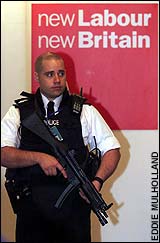
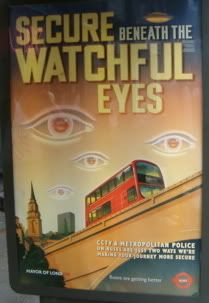
Doesn’t that make you feel safer? Hey, kids, let’s do the same thing here! After all, the (nowhere near) Million Moms chanted “England can do it, Australia can do it, we can too!”
Not on my watch.
“Gee, I Never Knew 110VAC was a Caliber.”
Hat tip to Xavier. I haven’t finished watching this yet, but that line had me rolling. A 13 year-old girl explains Canada’s gun registration system. Watch “Katey’s Firearm Facts”
[youtube https://www.youtube.com/watch?v=iJggEvIlsJ4&w=425&h=350]
Which “Gun Culture”?.
In relation to that piece from last Wednesday, I give you a post from Fodder at Ride Fast & Shoot Straight that illustrates the difference between the two “gun cultures.”
Yes, two. Although many people like Mayor Ann Thomas of Haverhill in the UK believe there is only one:
Mayor Ann Thomas said she was “absolutely shocked” at the spate of robberies in Haverhill, but felt it was part of a national increase in gun culture rather than a particular problem in the town itself.
Even England still has two gun cultures:
PUT down those golf clubs and go for your gun: shooting is fast becoming the social networking sport of choice.
A survey of 2,000 companies and 14,000 directors shows that shooting is soaring in popularity. A decade ago, toting a shotgun did not even feature among the most popular recreations listed by company directors. But the survey ranks shooting as the seventh most popular recreation, almost level with gardening.
Anyway, give Fodder’s post a look. It’s perfect visual accompaniment for clueless gun-phobes.
(Sorry about the lack of posting. Very busy, other distractions, etc. More stuff coming. Just maybe not today.)
Reader Steve Price out of Canada sent me a link to a press release about a new study performed by three researchers at Harvard’s School of Public Health. Among the three was our old friend David Hemenway. Steve asked me to fisk the report, but I emailed him back that Jeff at Alphecca had already done a pretty good job of that.
Now I see that Instapundit has commented:
I’m pretty sure that these guys would call anyone who accepted grants from the NRA bought-and-paid-for. But the Joyce Foundation is every bit as biased as the NRA, and has a history of paying for scholarship that would be treated as a scandal if it were engaged in by pro-gun folks.
I find much of the public health literature on guns to be highly biased and deeply untrustworthy. It starts with an agenda, rather obviously, and then constructs “research” to confirm it. In this it resembles far too much of the politicized social science we see today, which explains in part why people are far less persuaded by social science claims than they used to be.
He also links to a Jacob Sullum October 2003 Reason piece for a quote. He could just as well have referenced my three-part exchange with Dr. John D Kelly, IV from last week. Among other things, I cited the same National Academies of Science report, and its conclusion. (Then again, I’m not an accredited journalist like Sullum, but…)
Of course, nothing will affect true-believers like Dr. Kelly, but given the fact that gun owners and gun-rights supporters appear to have found their political voice, I’m relatively secure in believing that the damage such “studies” can do any more has been sharply reduced. Bias is now exposed, and having a doctorate no longer equates to the wearing of a mantle of disinterested impartiality. We know better, now.
or: “Go Away, Boy, You’re Bothering Me”
Via Alphecca, Hollis Wayne Fincher has been convicted of possession of an unregistered short-barreled shotgun and two unregistered machine-guns. (Read the comments!)
This is not unexpected. In fact, I’d have been shocked had he not been. Unfortunately, Arkansas is in the 8th Circuit, not the 5th. The 5th Circuit is the one that found (unlike most of the others) that the Second Amendment does protect an individual right to arms – though one of “uncertain scope.” Instead, the 8th Circuit has U.S. v. Nelsen as precedent – a 1988 case that used U.S. v Cruikshank as precedent. Here’s the pertinent quote from Cruikshank:
The right there specified is that of ‘bearing arms for a lawful purpose.’ This is not a right granted by the Constitution. Neither is it in any manner dependent upon that instrument for its existence. The second amendment declares that it shall not be infringed; but this, as has been seen, means no more than that it shall not be infringed by Congress. This is one of the amendments that has no other effect than to restrict the powers of the national government, leaving the people to look for their protection against any violation by their fellow-citizens of the rights it recognizes…”(My emphasis)
Cruikshank is the 1875 Supreme Court case declaring that the Second Amendment only protects the (pre-existing) right to arms from federal infringement. If the majority of the residents of your state wanted to disarm you (because, in this case, you happened to be black), well that was no business of the Feds!
U.S. v. Nelsen cites Cruikshank for the proposition that “The right there specified is that of ‘bearing arms for a lawful purpose.’ This is not a right granted by the Constitution.” Note that Nelson omits Cruikshank‘s additional language, changing the meaning entirely. Then Nelson was used as precedent in 1992’s U.S. v Hale, a very similar case where (if I recall correctly) the accused walked up to a police station, advised the officers present that he possessed several unregistered fully-automatic weapons and challenged them to arrest him so that he could attempt to fix – through the justice legal system – the travesty that has been building since U.S. v. Cruikshank. The BATF eventually got a warrant and went in to find that, indeed, Mr. Hale had several unregistered fully-automatic weapons. He went to trial.
He lost.
He appealed
He lost.
He appealed to the Supreme Court.
They denied certiorari.
Now Wayne Fincher has lost. And, I believe, he will continue to lose because of stare decisis,
Latin: “to stand by that which is decided.” The principal that the precedent decisions are to be followed by the courts.
To abide or adhere to decided cases. It is a general maxim that when a point has been settled by decision, it forms a precedent which is not afterwards to be departed from.
It is interesting to note that in the Hale decision there was a separate concurrence by Judge Beam, to wit:
I concur in the result reached in Judge John R. Gibson’s opinion in this matter. I agree completely with the portions dealing with Hale’s hearsay and confrontation contentions. I also agree that Hale’s possession of the particular weapons at issue in this case is not protected by the Second Amendment. I disagree, however, that Cases v. United States, 131 F.2d (1st Cir.1942); United States v. Warin, 530 F.2d (6th Cir.1976); United States v. Oakes, 564 F.2d 384 (10th Cir.1977) and United States v. Nelson, 859 F.2d 1318 (8th Cir.1988) properly interpret the Constitution or the Supreme Court’s holding in United States v. Miller, 307 U.S., 59 S.Ct. 816, 83 L.Ed. 1206 (1939) insofar as they say that Congress has the power to prohibit an individual from possessing any type of firearm, even when kept for lawful purposes. Judge Gibson’s opinion seems to adopt that premise and with that holding, I disagree. (Emphasis mine.)
Yet footnote 3 of the decision rebukes Judge Beam:
The concurrence flies in the face of stare decisis in arguing that this court did not properly interpret the Second Amendment or Miller in Nelsen, which is consistent with our earlier decisions in Cody and Decker. The concurrence would also flout uniform precedent from other circuits, particularly since Nelsen cites and relies on Oakes and Warin, and Cody on Cases. (Emphasis mine.)
In other words, it doesn’t matter. We’ve changed the law, and we’ll keep changing the law as it suits us. Cruikshank declares that Congress can’t infringe on the right to arms, but by the time we reach Hale in 1992, through stare decisis alone, Congress has that power. Because the courts say it does.
Which reminds me again of my favorite dissent ever written: Judge Alex Kozinski’s dissent to the 9th Circuit’s denial of an en banc rehearing of Silveira v Lockyer:
Judges know very well how to read the Constitution broadly when they are sympathetic to the right being asserted. We have held, without much ado, that “speech, or . . . the press” also means the Internet…and that “persons, houses, papers, and effects” also means public telephone booths….When a particular right comports especially well with our notions of good social policy, we build magnificent legal edifices on elliptical constitutional phrases – or even the white spaces between lines of constitutional text. But, as the panel amply demonstrates, when we’re none too keen on a particular constitutional guarantee, we can be equally ingenious in burying language that is incontrovertibly there.
It is wrong to use some constitutional provisions as springboards for major social change while treating others like senile relatives to be cooped up in a nursing home until they quit annoying us. As guardians of the Constitution, we must be consistent in interpreting its provisions. If we adopt a jurisprudence sympathetic to individual rights, we must give broad compass to all constitutional provisions that protect individuals from tyranny. If we take a more statist approach, we must give all such provisions narrow scope. Expanding some to gargantuan proportions while discarding others like a crumpled gum wrapper is not faithfully applying the Constitution; it’s using our power as federal judges to constitutionalize our personal preferences.
And Judge Kleinfeld’s dissent in that same decision was almost as good:
I respectfully dissent from our order denying rehearing en banc. In so doing, I am expressing agreement with my colleague Judge Gould’s special concurrence in Nordyke v. King, and with the Fifth Circuit’s opinion in United States v. Emerson, both taking the position that the Second Amendment secures an individual, and not collective, right to keep and bear arms.
The panel opinion holds that the Second Amendment “imposes no limitation on California’s [or any other state’s] ability to enact legislation regulating or prohibiting the possession or use of firearms” and “does not confer an individual right to own or possess arms.” The panel opinion erases the Second Amendment from our Constitution as effectively as it can, by holding that no individual even has standing to challenge any law restricting firearm possession or use. This means that an individual cannot even get a case into court to raise the question. The panel’s theory is that “the Second Amendment affords only a collective right,” an odd deviation from the individualist philosophy of our Founders. The panel strikes a novel blow in favor of states’ rights, opining that “the amendment was not adopted to afford rights to individuals with respect to private gun ownership or possession,” but was instead “adopted to ensure that effective state militias would be maintained, thus preserving the people’s right to bear arms.” It is not clear from the opinion whom the states would sue or what such a suit would claim were they to try to enforce this right. The panel’s protection of what it calls the “people’s right to bear arms” protects that “right” in the same fictional sense as the “people’s” rights are protected in a “people’s democratic republic.”
Our circuit law regarding the Second Amendment squarely conflicts with that of the Fifth Circuit. It is inconsistent with decisions of the Supreme Court that have construed the Second Amendment and phrases within it. Our circuit has effectively repealed the Second Amendment without the democratic protection of the amendment process, which Article V requires.
Those quotes are just excerpts. Read the whole thing. Both Kozinski and Kleinfeld understand that stare decisis only goes so far, and that the courts of this nation have eviscerated the Second Amendment.
And there is every indication that they will continue to do so. Opinions in favor of the original meaning of the Second Amendment will continue to be dissents, and the courts will not save us.
One final excerpt from Kozinski’s dissent in Lockyer:
My excellent colleagues have forgotten (the) bitter lessons of history. The prospect of tyranny may not grab the headlines the way vivid stories of gun crime routinely do. But few saw the Third Reich coming until it was too late. The Second Amendment is a doomsday provision, one designed for those exceptionally rare circumstances where all other rights have failed – where the government refuses to stand for reelection and silences those who protest; where courts have lost the courage to oppose, or can find no one to enforce their decrees. However improbable these contingencies may seem today, facing them unprepared is a mistake a free people get to make only once.