I Wonder if mAssachussetts Will Follow England’s Lead?

Stumbled across this story today:

Boston pays $3M in wrongful conviction

BOSTON – The city agreed to pay $3.2 million to a man whose wrongful conviction in the shooting of a police officer led the city to revamp its fingerprinting unit.

The settlement with Stephan Cowans, who was freed in January 2004 after more than six years in prison, equaled what’s believed to be the largest amount the city ever paid in a wrongful conviction case.

Cowans, 35, was sentenced to 35 to 50 years in the 1997 wounding of Sgt. Gregory Gallagher after the police department’s fingerprinting unit matched him to a print that the shooter left behind on a glass of water.

Cowans was exonerated by DNA evidence through the New England Innocence Project, and the fingerprinting unit was shut down. A report found that its officers lacked proper training and were unprepared to do complex analyses.

As part of the settlement, Cowans agreed to drop claims against the city, the Police Department and Gallagher, who had identified Cowans as the shooter, Boston city attorney William Sinnott said.

In March, the city agreed to pay $3.2 million to settle a lawsuit brought by Neil Miller, who served 10 years in prison after being convicted of raping a college student. DNA tests proved another man had committed the crime.

So, the City of Boston has to shell out $6.4 million for wrongful prosecution and imprisonments? Well hell, follow England’s lead, and charge those men for their room and board while in the slammer! If they gig them at the rate of $125 a night, you’re looking at $273,750 back from Mr. Cowans and $456,250 back from Mr. Miller! Of course, they could use the $685 a night rate…

Proportionality

OK, I do have something to say about the current Israel-Hezbolla conflict.

Today Glenn Reynolds has one of his typical posts, this one discussing the topic of “proportionality” on the part of Israel. He quotes law professor Kenneth Anderson:

Legal scholars who want to focus on the UN Charter as the sole source of legal authority for the use of force – and hence see any armed action by a party as having to be ‘proportionate’ pending some (typically mythological) intervention by the Security Council – tend to underplay that the Charter does not remove the customary law of self-defense, which does not require a “proportionate” response once belligerency is underway.

Obviously Professor Anderson doesn’t live in England. “Proportionality” is imbedded in their self-defense law – at least when they want it to be. In England, the mere intention to cause harm is an imprisonable offence. Said Judge Shirley Anwyl at the sentencing of Brett Osborne for stabbing Wayne Halling:

“By your plea you have accepted that you intended real serious injury. Your use of violence was not wholly unpremeditated in that you did equip yourself with at least one knife.”

Mr. Halling, hopped to the eyeballs on cocaine, and bleeding profusely from numerous cuts resulting from his smashing windows, had forced his way into Mr. Osborne’s home, where Mr. Osborne had several houseguests, including a pregnant woman whom Mr. Halling apparently mistook for his estranged girlfriend. Mr. Osborne, in fear for his safety and that of his guests, picked up a steak knife and stabbed Mr. Halling with it.

This was, apparently, “not proportional.” Judge Anwyl stated that she accepted that Halling could have been perceived to be “dangerous to others,” but:

With hindsight it is clear that Halling was presenting no real danger to anyone but himself.

I am reminded here of Col. Jeff Cooper’s famous response concerning aggression by attackers:

One bleeding-heart type asked me in a recent interview if I did not agree that “violence begets violence.” I told him that it is my earnest endeavor to see that it does. I would like very much to ensure—and in some cases I have—that any man who offers violence to his fellow citizen begets a whole lot more in return than he can enjoy.

There’s nothing “proportional” in that.

Nor should there be. Neither Israel nor Brett Osborne should be criticized for acting appropriately.

And We Thought the Kelo Decision Was Bad!.

Homes of the dead to be seized

Bereaved families could have the homes of dead relatives seized under new laws that allow the state to commandeer empty properties.

Local councils will be able to take control of inherited homes if they are left vacant for more than six months.

After that time the beneficiaries of a will risk seeing the house that has been left to them taken over and rented out as social housing.

The new rules, which could affect 250,000 homes in England, will come into force next month, according to details slipped out by Communities Secretary Ruth Kelly.

They state that those who leave a house or flat empty for six months risk losing control of it to the local council, which will have power to break in, alter or refurbish it, and let it out to tenants of the authority’s choice. The greatest impact is likely to fall on bereaved families.

Although actual ownership will remain with the family, the new law means that the home of a relative who has died may be taken over by the council just six months after the will has been put into effect.

Many families are likely to be debating how to deal with or share out the value of the home of a loved one for several months after a death. The risk of losing family property comes on top of the growing burden of inheritance tax and the highly controversial ‘means test’ system for long-term care of the elderly.

Tory housing spokesman Michael Gove said yesterday: “Seizing homes of the recently deceased is particularly disturbing. I doubt that state officials will always recognise the delays that can result from complex wills or appreciate the traumatic ordeal that families face with the task of clearing a home of personal possessions.” He added: “I fear this is a stealthy new form of inheritance tax.”

Housing experts called the confiscation of property ‘outrageous’. Robert Whelan of the Civitas think-tank said: “This runs right against the ancient common law principle of private property, which is as fundamental as habeas corpus.

“The right to private property is the Englishman’s right to his castle. This looks to me like the point where Labour has overstepped the mark into behaving more like a dictatorship than a democratic government.”

Mr Whelan added: “I think anybody whose property is seized under this law should go straight to court to see if a judge thinks it should stand.”

Henry Stuart, head of property at the City law firm Withers, said: “Many families decide to sell inherited property – but they often wait for the right time. For example, you do not sell a country cottage in November, you wait until the spring. But by then the local council could have put a tenant in.”

The right for councils to impose ‘Empty Dwelling Management Orders’ was included in a 2004 Housing Act pushed through by Deputy Prime Minister John Prescott.

Miss Kelly, his successor in charge of housing policy, published guidance on how the orders will work last Friday afternoon, without informing MPs or the media.

When the law was pushed through Parliament, it was said that target homes would be in crime-affected streets in inner cities. However, the details now made public show that the orders will apply to any home. The guidance on the new powers said: “The property does not have to be run down or uninhabitable. The fact it has not been lived in for more than six months may be enough to allow an EDMO to be made.”

Exceptions cover second and holiday homes and homes of those working ‘temporarily’ away. In the case of inherited property, exemption applies for six months after grant of probate. An EDMO can last for seven years, but owners can apply to get their house back earlier. No home can be seized if its owner can show it is ‘genuinely’ on the market.

The seizure of homes must also be approved by a Residential Property Tribunal. These are the panels that have until now been confined to settling disputes between private landlords and tenants.

Those who are the first to lose control of property to a council may also challenge the new law in the courts through the process of judicial review.

A spokesman for Miss Kelly’s department said: “The owner retains ownership rights and can dispose of their dwelling at any time or seek revocation of an order to enable sale or to otherwise secure occupation.”

Yes, England slides further towards bondage.

And the populace increasingly avoids involving itself in fighting crime, since the State has made it plain that they’re not qualified and will be punished for doing the State’s job:

Pensioner brutally attacked at seafront – yet no one came to his aid

When pensioner Derek Gull was targeted by two vicious muggers he was not walking through a tough housing estate or along some dark alley.

The 76-year-old was sitting on a bench in broad daylight on a busy sea front.

But as the thugs smashed a brick into his face and broke both his wrists as they tried to wrench his watch off his arm, not a single person stepped in to help.

The grandfather told yesterday how more than a dozen people carried on walking as he struggled against his attackers with blood streaming down his face.

He fought bravely to stop them taking the watch – which was a present from his wife on their golden wedding anniversary – and they eventually fled after pushing him down an 8ft embankment.

And as he staggered through the town covered in blood, still no-one stopped to help.

“I couldn’t see properly because my eyes were watering,” Mr Gull said yesterday as he recovered from his injuries at home.

“I was covered with blood from my nose. At least a dozen people walked past and did not bother to do anything, they just ignored me.

“It’s disgusting, my whole family is upset about it. I suppose people just don’t want to get involved any more, they don’t seem to care.

“But if I saw someone like that I would see if I could help, I wouldn’t just walk past and ignore it.”

Mr Gull’s ordeal earlier this month came just days after motorists ignored a girl of eight as she dragged herself to the pavement with a broken leg after being mowed down by a hit and run driver.

Cait Atkins was walking near her home in Aylesbury, Buckinghamshire, when she was run over. Up to 12 motorists drove past her without stopping to help.

Mr Gull, a retired electrician from Rainham, Essex, had been visiting Clacton-on-Sea on a day trip with his local working men’s club.

During the day, he separated from the others to visit a friend at the town’s bowling club.

As he walked back to meet the rest of the group in a restaurant he decided to sit on a bench for a while and watch some youngsters playing football on the beach.

“Suddenly I felt an arm come round from behind and grab me and a voice demanded that I hand over my watch,” the father of three said.

‘He would have had to kill me for the watch’

“It was a golden wedding anniversary present from my wife so he would have had to kill me to get it.

“Another arm came round and started tugging at the watch and trying to get it off. I clenched my fist so he couldn’t get it off me.

“Then he pulled my arm through the slats and twisted it until it broke.

“I heard him say to someone else “hit him” and the next thing I knew half a brick hit me in the face breaking my nose.

“There was blood everywhere and my eyes were watering, I couldn’t see a thing.”

Mr Gull, who is registered disabled as he suffers from curvature of the spine, managed to struggle to his feet and his attackers – aged in their late teens – pushed him down an 8ft bank onto a concrete path before fleeing.

“I got my faculties together and tried to make my way back to the restaurant but I was covered in blood and it was pouring out of my nose.

“I couldn’t see a thing because my eyes were watering so much.

“I must have passed about half a dozen people but no one asked me what had happened or offered to help me.

“At the time I was so upset that people just ignored me but looking back I suppose they just didn’t want to get involved or maybe they thought I was a drunk.

“If it was me though, I would have gone out of my way to help someone in that situation.”

Eventually Mr Gull met some members of his group who guided him back to the restaurant where he was cleaned up and the police were called.

After showing them where the incident took place he insisted on taking the hour and a half long journey back to Rainham with the working men’s club on the coach.

It was only when he got home that he agreed to go to hospital where he collapsed in casualty.

Doctors were so concerned about the amount of blood he had swallowed that they gave him a lung scan and he was kept in hospital for more than a week before being allowed back home on Wednesday. He is unable to drive his car or play his regular game of bowls.

Mr Gull, who served in the Army for two and a half years after joining in 1947, suggested bringing back national service to deal with antisocial youths.

“That would sort out all the young thugs of today. Like the old saying goes, you go in as a boy and come out as a man.”

Mr Gull’s 75-year-old wife, Violet, said she was pleased that her husband clung on the the gold Ellesse watch she had bought him.

She added: “He was very brave, but it’s disgusting that no-one helped him.

“I don’t know what the world is coming to.”

Essex Police are appealing for witnesses.

What’s the world coming to? Well, apparently it’s coming to shit.

Damn, it pains me to see what the Mother Country has become.

Hey! You Kids! Get Off the Planet!

(Blogging from work again. Left last night at 7:00PM, back again at 6:15AM.)

Physicist Stephen Hawking recently declared that humans must go into space if we want to survive as a species. I’m pretty much with him on that one. I’d hoped (since I grew up on Florida’s Space Coast during the race to the moon) that we’d already have colonies on the moon and a significant presence in space.

Two guys floating around Earth in a Greyhound Bus is not a “significant presence” in my book.

There are two hurdles that have to be overcome for this to happen, though. One: we have to have the will to do it. Two: we have to have the money. To some extent will equals money, but even if the ready cash was on hand, if you’re not willing to spend it on getting out of here, then it might as well not exist. Leaving the planet is expensive – or at least it will be until we develop technologies that reduce the cost.

Right now it costs (officially) about $5-10k to put one pound into low Earth orbit. The real cost, when you add in the expense of the support infrastructure behind a launch and ground support during a mission, is probably more on the order of $40-50k. Assuming your average buck-naked human being weighs 150Lb (obviously we’re not talking about your average American here) and you’re looking at between $1.5 and $75 million dollars just to put someone into a not-too-stable orbit around the Big Blue Marble. Getting to escape velocity costs a lot more. (The $1.5M price tag obviously ignores things like life-support.)

There are other ways to get into space. Glenn Reynolds thinks that a Space Elevator is a good idea, and the idea of a gigantic magnetic-induction catapult has been floating around for decades, but both are multi-billion dollar investments with engineering, safety, environmental, and materials problems of their own.

I’m not sure the United States has the political will to do the job. At this point, I’m not sure we have the political will to defeat the forces of Islamism. I’ve written before that it’s possible that China may be the country that first succeeds in colonizing off-planet. Dictatorships don’t have as much of a problem with “political will” as democratic forms do, and they can wring the money out of the rest of the world, so long as we keep buying from what are largely State-owned industries.

In the same speech, Hawking said,

We are getting closer to answering the age-old questions: Why are we here? Where did we come from?

That’s great, but I’m more interested in “Where are we going, and how will we get there?”

On England’s Continued Decline.

Read Theodore Dalrymple’s latest City Journal column, “It’s This Bad,” and try to convince yourself that what he describes is not coming here if the Left ever acquires control of the levers of power. Excerpts:

Returning briefly to England from France for a speaking engagement, I bought three of the major dailies to catch up on the latest developments in my native land. The impression they gave was of a country in the grip of a thoroughgoing moral frivolity. In a strange inversion of proper priorities, important matters are taken lightly and trivial ones taken seriously.

This is not the charming or uplifting frivolity of Feydeau’s farces or Oscar Wilde’s comedies; it is the frivolity of real decadence, bespeaking a profound failure of nerve bound to have disastrous consequences for the country’s quality of life. The newspapers portrayed frivolity without gaiety and earnestness without seriousness—a most unattractive combination.

The newspapers confirmed what I had long perceived before I left Britain: that the zeitgeist of the country is now one of sentimental moralizing combined with the utmost cynicism, where the government’s pretended concern for the public welfare coexists with the most elementary dereliction of duty. There is an absence of any kind of idealism that is a necessary precondition of probity, so that bad faith prevails almost everywhere. The government sees itself as an engineer of souls (to use the phrase so eloquently coined by Stalin with regard to writers who, of course, were expected to mold Homo Sovieticus by the power of their words). Government thus concerns itself with what people think, feel, and say—as well as with trying to change their freely chosen habits—rather than with performing its one inescapable duty: that of preserving the peace and ensuring that citizens may go about their lawful business in confidence and safety.

Read. Every. Damned. Word.

I am reminded once again of Kim du Toit’s explanation of why he and I and others comment on Albion’s decline:

(W)e Americans can’t help but be horribly fascinated by what’s happening to our British cousins.

I’m serious about this. The slight disturbances in the late 1770s and early 1810s notwithstanding, we Americans have always held our British cousins in the greatest esteem. No, that’s not strong enough. We love Britain, as much for our shared heritage and language as for the fact that when we’re traveling, it’s an enormous relief not to have to struggle with a map and a language guide.

I could fill these pages with news of similar atrocities happening anywhere in the world—the British Disease is by no means confined to Britain, as witnessed by car-burning being the recreational favorite of French teenagers—but, if I may be frank, I don’t give a rat’s ass what happens to France, to the French, or to any other country in the world for that matter.

But I care, deeply, about what’s happening in Britain nowadays, and if it seems any other way to my Brit Friends and Readers, then I humbly beg your forgiveness.

Dalrymple says much the same:

Therefore I have removed myself: not that I imagine things are much better, only slightly different, in France. But one does not feel the defects of a foreign country in quite the same lacerating way as the defects of one’s native land; they are more an object of amused, detached interest than of personal despair.

RCOB™

Glenn Reynolds linked to a Salon.com piece by Nina Burleigh:

“I cringed as my young son recited the Pledge of Allegiance. But who was I to question his innocent trust in a nation I long ago lost faith in?”

Who, indeed? Reader Wagner James Au, who sent the link, writes: “My question is, why do anti-war liberals get so offended when people question their patriotism, when they spend so much time questioning it themselves?”

I read her piece, Country Boy, and my response to it was, almost literally, a RCOB.

Ms. Burleigh and I have worldviews so divergent that we might as well be of different species. There is no common ground upon which we could even begin to attempt rapprochement. And what bothers me most of all is that I see the land that we both live in becoming more and more divided between people like her, and people like me.

Let me fisk, for it is about the only thing I can do to purge myself of the emotions her piece inspired in me:

Country Boy

I cringed as my young son recited the Pledge of Allegiance. But who was I to question his innocent trust in a nation I long ago lost faith in?

By Nina Burleigh

Apr. 17, 2006 | When people give directions to the upstate New York hamlet of Narrowsburg, they always refer to the big red brick schoolhouse at the stoplight. Narrowsburg Central Rural School has been on the hill on School Street since 1929, educating four generations of local children.

Hardly anybody in town remembers a time when the campus — with its white doors, sloping green lawn, and Stars and Stripes snapping in the breeze — was not there. But last year, bankrupted by local fiscal mismanagement and the woes of the post-9/11 New York state economy, the little school was shuttered. When the last student skipped out of its double doors in the summer of 2005, janitors moved in with packing tape and boxes from a nearby egg farm to empty the classrooms. Among the pupils left behind was my son, a member of the last kindergarten class.

Our family first arrived in Narrowsburg in 2000, as city people hunting for a cheap house. For barely $50,000 we were able to buy the “weekend house” we thought would complete our metropolitan existence.

“Metropolitan existences” apparently come, without question, with “weekend houses?”

But soon after we closed on the home, we moved to Paris, spurred by the serendipitous arrival of a book contract. When our European idyll ended after two years, and with tenants still subletting our city apartment, we moved into the Narrowsburg house. After growing accustomed to the French social system — with its cheap medicine, generous welfare, short workweek and plentiful child care — life back in depressed upstate New York felt especially harsh. We’d never planned to get involved in the life of the town, nor had it ever occurred to us that we might send our son to the Narrowsburg School. But suddenly we were upstate locals, with a real stake in the community.

So, France is idyllic? I guess the Burleigh family (assuming they all use a common last name, which I find highly unlikely) left France prior to the, shall we say, recent unpleasantness the French have experienced. Cheap medicine and generous welfare? Paid for by those who actually work during that short workweek? France has an unemployment rate of between 9 and 10% (depending on your source), but its rate for the 26-and-under crowd is in excess of 22%. I guess Nina didn’t have to go shopping for a job during her two-year idle, er idyll.

Nothing like being insulated from reality to put rose-colored glasses on one’s outlook, is there?

In the fall of 2004, we enrolled our son in kindergarten at the Narrowsburg School. The school’s reputation among our friends, other “second-home owners,” was not good. “Do they even have a curriculum?” sniffed one New York City professor who kept a weekend home nearby. Clearly, Narrowsburg School was not a traditional first step on the path to Harvard.

Coming from a New York City professor, my first reaction is that he felt the hicks wouldn’t introduce Marxism until the second grade.

As far as I could tell, though, no one besides us had ever set foot inside the building.

No one in her circle that is.

When my husband and I investigated, we were pleasantly surprised. The school had just been renovated and was clean, airy, cheerful. The nurse and the principal knew every one of the 121 children by name. Our son would be one of just 12 little white children in a sunny kindergarten class taught by an enthusiastic woman with eighteen years’ experience teaching five-year-olds.

Isn’t that special! “Twelve little white children!”

I’m sure she felt properly guilty about that.

Still, for the first few months, we felt uneasy. Eighty of Narrowsburg’s 319 adults are military veterans and at least 10 recent school graduates are serving in Iraq or on other bases overseas right now.

In other words, “These people are not like us!

The school’s defining philosophy was traditional and conservative, starting with a sit-down-in-your-seat brand of discipline, leavened with a rafter-shaking reverence for country and flag.

Imagine that! Requiring children to sit down in their seats! The Neaderthals!

Every day the students gathered in the gym for the “Morning Program,” open to parents, which began with the Pledge of Allegiance, followed by a patriotic song, and then discussion of a “word of the week.” During the first few weeks, the words of the week seemed suspiciously tied to a certain political persuasion: “Military,” “tour,” “nation” and “alliance” were among them.

No, indeed. These people are NOT LIKE US!

But it wasn’t until our boy came home with an invitation in his backpack to attend a “released time” Bible class that my husband and I panicked.

PANICKED. Her word.

She and her husband are panicked by an invitation to a BIBLE CLASS.

Now, I make no bones about being an atheist (small “A”), but panic? What about the great Liberal openness? The dedication to embracing diversity?

As long as, I suppose, the diverse don’t include, you know, actual Christians.

We called the ACLU and learned this was an entirely legal way for evangelicals to proselytize to children during school hours. What was against the law was sending the flier home in a kid’s backpack, implying school support. After our inquiry, the ACLU formally called the principal to complain. She apologized and promised never to allow it again. While we were never identified as the people who dropped the dime to the ACLU, there was clearly no one else in the school community who would have done so — and the principal never looked at us quite as warmly again.

And why should she? The Burleighs contacted the ACLU (which probably doesn’t have a Narrowsburg branch office) rather than the principal directly.

Another characteristic of the Left – having other people fight their battles for them.

Shortly afterward, another parent casually told me that she wanted to bring her daughter’s religious cartoon videos in to share with the class, but couldn’t because “some people” might object.

Here I’m not sure if the other parent was trying to pass a message, or hadn’t been informed by the Great Christian Cabal that the Burleighs were Satan incarnate yet.

When we later learned that the cheery kindergarten teacher belonged to one of the most conservative evangelical churches in the community, we were careful not to challenge anyone or to express any opinion about politics or religion, out of fear our son would be singled out.

You mean like Liberals do when they outnumber Conservatives?

That’s called “projection.”

Instead, to counteract any God-and-country indoctrination he received in school, we began our own informal in-home instruction about Bush, Iraq and Washington over the evening news.

The kid is FIVE YEARS OLD.

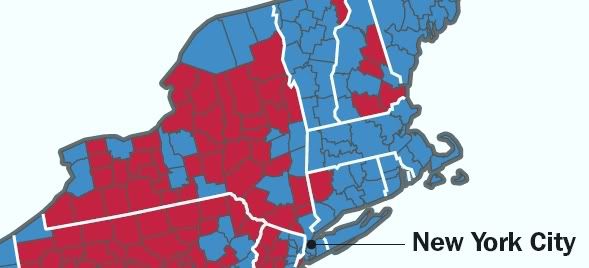
Politically, Narrowsburg is red dot in a blue state.

What planet is this woman from? According to this map (PDF) of the red vs. blue counties in the 2004 Presidential election, New York is well over half red.

A “red dot in a blue state” my aching sphincter.

But that, too, is a characteristic of the Left – what they perceive is reality. Don’t confuse ’em with the facts.

It is not named for any small-town frame of mind, but for the way the Delaware River narrows at the edge of town, then widens into a serene, lakelike eddy that at twilight mirrors the lights of town and the ranch-style houses on the flats. The towering pines along the river are nesting spots for bald eagles that soar year-round in pairs above Main Street and swoop down into the river to sink their talons into trout sighted from a hundred feet up. That year, driving to school every morning along the water, my son and I witnessed the wind gradually scrape away the bright foliage, snow fall, and the ground freeze. In the white, leafless months, we could see the entire span of the Delaware River valley from the car, a long arc of pastoral perfection.

If you knew nothing else of the world, if you were just 5 or 6 or 10 years old, and this place was your only America, you wouldn’t have any reason at all to question the Narrowsburg School’s Morning Program routine. Hand over heart, my son belted out the Pledge with gusto every morning and memorized and sang “The Star-Spangled Banner.” I never stopped resisting the urge to sit down in silent protest during the Pledge. But I also never failed to get choked up when they sang “America the Beautiful.”

“I never stopped resisting the urge to sit down in silent protest during the Pledge.”

They’re not anti-war – they’re the other side.

But it’s OK, because “America the Beautiful” makes her choke up.

Listening to their little voices, I felt guilty for being a non-believer. When I was 5 years old, in 1965, did I understand what my lefty parents were saying about the Kennedy assassination, Watts and dead-soldier counts?

Apparently not, but it was enough to warp you into the woman you are today!

Who was I to deprive my son, or his eleven kindergarten chums, of their faith in a nation capable of combining “good with brotherhood?” In a 5-year-old’s perfect world, perhaps such places should exist.

But you didn’t let that stop you from counteracting any God-and-country indoctrination he received in school, by beginning your own informal in-home instruction about Bush, Iraq and Washington over the evening news!

That November, at the school’s annual Veterans Day program, the children performed the trucker anthem “God Bless the USA” (one of the memorable lines is “Ain’t no doubt I love this la-aand, God bless the USA-ay!”), as their parents sang along. About a dozen local veterans — ancient men who had served in World War II, and men on the cusp of old age who had served in Korea and Vietnam — settled into folding chairs arranged beneath the flag. When the students were finished singing, the principal asked the veterans to stand and identify themselves. Watching from the audience, I wondered if anyone would speak of the disaster unfolding in Iraq (which was never a word of the week).

Wait for it…

No one did. The men rose and stated name, rank and theater. Finally, a burly, gray-bearded Vietnam veteran rose and said what no one else dared. After identifying himself, he choked out, “Kids, I just hope to God none of you ever have to experience what we went through.” Then he sat down, leaving a small pocket of shocked silence. No one applauded his effort at honesty. On the contrary, the hot gym air thickened with a tension that implicitly ostracized the man, and by extension — because we agreed with him — me and my husband.

No one repudiated the Iraq war. No one applauded the hope that these children be spared the need to go to war (or be spit on when they come back).

Not even the Burleighs.

That’s another characteristic of the Left – complete unfamiliarity with people who have served in the military.

I have relatives who served in WWII, Korea, and Vietnam. I work with Vietnam veterans. NO ONE I know who has ever been in combat has ever suggested that they thought it would be a wonderful, uplifting experience for the next generation.

War sucks. People die. Often horribly. But if you ask them whether what they did was worth it, they – almost to a man – say “yes.” No one hopes that the next generation will see war. Expressing that sentiment is universal, and in no way requires applause for validation.

A “small pocket of shocked silence”? I doubt it seriously. Oh, I’m sure she interpreted it that way, but that’s not what it was. It was silent agreement. But Burleigh does not understand Red New York. It’s an alien environment to her.

After all, these people are religious!

A month later, just before Christmas, my son and I drove together into New York City with bags of children’s clothes and shoes that he and his sister had outgrown. The Harlem unit of the National Guard was putting on a Christmas clothing drive for Iraqi children. On the way into the city, I tried to explain to my son what we were doing, and — as best I could — why. As we crossed the George Washington Bridge and the Manhattan skyline spread out below us, I began to give him a variation on the “Africans don’t have any food, finish your dinner” talk. I wanted him to understand how privileged he was to live in a place where bombs weren’t raining from the sky. It was a talk I’d tried to have before, but not one he’d ever paid much attention to until that day, trapped in the back seat of our car.

In simple language, I told my son that our president had started a war with a country called Iraq. I said that we were bombing cities and destroying buildings. And I explained that families just like ours now had no money or food because their parents didn’t have offices to go to anymore or bosses to pay them. “America did this?” my son asked, incredulous. “Yes, America,” I answered. He paused, a long silent pause, then burst out: “But Mommy, I love America! I want to hug America!”

Out of the mouths of babes…

A month after the Christmas outburst, the first rumors that all was not well with the school began circulating. Fiscal mismanagement, high fuel and retirement costs, and the depleted state economy had created a huge and unexpected cash shortfall for the tiny district. The parents at Narrowsburg School soon had a figure: It was going to cost just over $600,000 to keep their school open for another year. Chump change in Washington and New York City, but impossible to collect in a town where the median family income is barely $45,000.

But NYC denizens can afford to come to the town and drop $50k on a “weekend home.”

By late June 2005, the little school’s fate was sealed. To my surprise I found I was deeply sorry about it.

The patriot-ization of our son was thorough enough to survive the summer. He decorated his birthday cookies with red, white and blue sugar, and in his summer camp program, when doing arts and crafts, those were the colors of paint he favored. “I made the stars red, white and blue — like the flag!” he exclaimed, holding a paper mobile he’d strung together.

Now it has been almost a year since my son scampered down the steps of Narrowsburg Central Rural School for the last time. We’ve since returned to the city, driven back to urban life more by adult boredom than our children’s lack of educational opportunities. Our son is enrolled in a well-rated K-5 public school on Manhattan’s Upper West Side;

I’m sure it has a curriculum.

not surprisingly, the Pledge of Allegiance is no longer part of his morning routine. Come to think of it, and I could be wrong, I’ve never seen a flag on the premises.

Of course not. That would be provincial.

But no one should question their patriotism.

My husband and I realized, though, that Narrowsburg did more than mold our boy into a patriot. He can, it turns out — despite the warnings of other city parents — read at a level twice that of his new peers.

Amazing how that “sit-down-in-your-seat brand of discipline” contributes to, you know, LEARNING.

Since we returned to the city, he has learned how to ride a bike, long for an Xbox, practiced a few new swear words and, somehow, learned the meaning of “sexy.” He has pretty much stopped favoring red, white and blue.

The kid is what, six? And she considers learning “a few new swear words” and understanding the meaning of “sexy” to be positive. So too, no longer “favoring red, white, and blue.”

But don’t question her patriotism. She tears up at “American the Beautiful.”

How soon childish national pride is shed, I sometimes think now, and not a little wistfully.

Ah, yes. National pride is childish. No country is better than any other, and we mustn’t make judgments. (But America is always wrong)

Just don’t question her patriotism.

Only once it was gone did I realize that, after our initial discomfort, my husband and I had begun to see our son’s patriotism as a badge of innocence. His faith was a reminder to us that the reason we are devastated by the war in Iraq and the Bush presidency is that we too love America. We too want to believe in its potential for good and brotherhood.

BULLSHIT.

Love America? You don’t understand America. You denigrate America. You protest it, spit on it, defecate on it. It’s a foreign fucking country to you.

You want it to be FRANCE, with its idyllic cheap medicine, generous welfare, short workweek, plentiful child care, and expansive socialism.

That’s not America. Nor is it sustainable, as the French are unwilling to learn, but will.

Our family now visits the Narrowsburg house only on weekends and holidays. Sometimes we pass the stately red brick school building, so recently renovated with thermal windows and elevators for the disabled, a town landmark for 75 years. The flag still flies there, but the doors are padlocked and the windows are black.

But at least they don’t hold Bible study there anymore.

Ms. Burleigh, move back to France. We won’t miss you.

UPDATE: Burleigh gets hate mail. Like I said at the top of the post, Ms. Burleigh and I have worldviews so divergent that we might as well be of different species. There is no common ground upon which we could even begin to attempt rapprochement. Therefore I did not forward this piece to her. I knew in advance it would be useless.
Questions from the Audience?

In a comment to my second “Chocolate Rivers” post, commenter “homeboy” asked a number of good questions. Can’t learn if you don’t ask. However, instead of leaving the questions as an exercise for the student, I figured I’d go ahead and see if I could satisfy him.

1. With improvements in medical technology and access (cell phones), are comparisons with past homicide numbers meaningful?

Well, I guess we’d need to look at homicide rates and try to compare to wounding data. The wounding data is kind of hard to come by. Or, perhaps, homicide to attempted homicide, though that normally doesn’t break out by weapon. First, as far as homicide rates are concerned, there’s this chart for rates from 1900 through 2000:

that shows the rate varying widely. In 1993 the rate was 10.1 per hundred thousand population. In 2000 the rate was 6.1. In 2004 it was 5.5. Prior to 1910? Perhaps the data-gathering wasn’t up to the standards of today?

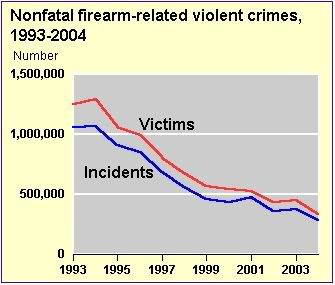
However, there’s this fascinating graph:

that shows that non-fatal firearm related crime has also been on a steep decline since 1993 – even though, according to that Clinton-era Whitehouse press release, almost two million new handguns enter circulation each year. And remember, a lot of those new guns are what the Violence Policy Center and its ilk term “Pocket Rockets”more powerful, higher capacity handguns:

Pocket rockets are a prime example of how the firearms industry has exploited increased lethality—greater killing power—over the last several decades to boost sales in its saturated markets.

But note something – the VPC states in that year 2000 report:

The industry has heavily promoted pocket rockets in connection with a wave of new or revised state laws that permit licensed persons to carry concealed firearms.

When did these “new or revised state laws” start? In 1987 with the passage of Florida’s “shall issue” law. In 1990 there were only 15 “shall-issue” states. In 1995 there were 27. In 2000 there were 30. After 1993, what does the homicide rate do? It declines. From 10.0 in 1990, to 8.7 in 1995 to 6.1 in 2000, to 5.5 in 2004, all while literally millions of these guns with supposedly “increased lethality – greater killing power” have entered the market. If the hypothesis is that “improvements in medical technology” are responsible for a decrease in homicide rates – the implication being that more people are getting shot, but surviving the experience – then that theory is shot to hell (pun intended) by this data.

Fewer people are getting shot. Fewer people are getting shot at. And there are more guns in private hands each and every year.

You’ll note that the chart in the VPC report:

ends in 1997. I guess they didn’t want to include data for 1998 and 1999, since it contradicted their premise, and the data since then continues to do so.

2. It seems more honest to compare attempted murder rates since the survival rate is much higher now; is there statistical data available, or can it be estimated?

Well, perhaps the survival rate is “much higher now,” but compared to when? The survival rate in 1950, or the survival rate in 1993? Or is the “increased lethality” of modern guns offsetting the advances in medical technology? I don’t know, but it appears that, at least since the mid-90’s, the actual incidences of gun violence have been declining – even though there are more and more guns in circulation, and – if you want to believe the VPC – those guns have “greater killing power.”

The fact of the matter is, violent crime is down – tremendously. Look at this chart:

From a peak in 1993 of 12.0 aggravated assaults per 100,000 population declined to 4.3 in 2004.

More guns have not meant more violent, more deadly crime. But that doesn’t stop the gun-grabbers from preaching the gospel of “more guns = more gun violence” every chance they get.

3. Is the data available to remove the suicide and domestic violence effects from the statistics used to claim that handguns in a home lead to higher homicide rates, and if so, what is the result?

Not that I’ve seen. Not that the National Academies of Science has seen either, according to their recent report. That data just doesn’t exist. Just for the record, I don’t believe that “handguns in the home” do lead to higher homicide rates.

4. Since we incarcerate at much higher rates than even 20 years ago, what effect is this having on who is committing the bulk of homicides?

Apparently not much. According to this graph:

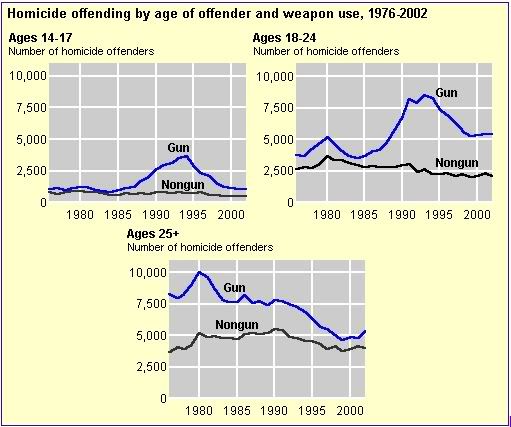
the decrease in homicide rates has been primarily a decrease in homicide by handgun, and according to this graph,

the spike in homicides was primarily committed by young men in the 18-24 age range. And their victims? The same age group:

This suggests to me at least that part of the reason that homicide rates have declined is that the criminally-inclined youth have done a bang-up job (so to speak) of killing themselves off. It’s not a matter of incarcerating them, it’s a matter of burying them.

5. If we’re incarcerating so many people, but we’re still having a problem with homicide, what is it we’re not doing right? Is there a high recindivism rate, or are new criminals arising to fill the some niche, or are we just incarcerating the wrong people?

Well, that’s if you consider a homicide rate of 5.5 per hundred-thousand “a problem.” We’re a violent society. The rate we have now is pretty damned low, historically. It’s down tremendously from a decade ago, but you couldn’t tell that by the rhetoric coming out of the gun-grabber, er, gun-control, um, gun-safety groups today. Certainly everyone would like to see it lower, but at what other cost to society? As you noted, we’ve already got a helluva lot of people in prison.

6. If it’s a high recidivism rate, is it because prison time insufficient deterent, or is the percentage of perpetrators actually punished too low to matter?

Could it be that prison (other than keeping violent criminals separated from the population) doesn’t actually deter? I don’t know.

7. How much of the homicide rate is caused by the “war on drugs” making narco-trafficing so lucrative?

Well, it would appear that the majority of homicides are related to drugs. Look at this graph:

This graph trends up, and mostly for “gang related” – read “inner-city drug wars.”

UPDATE, 1/27: Reader Earl Harding notes in a comment that the graph above is not saying what I’m attributing to it. He’s quite correct. My error. However, a little additional research and I found this:

In an analysis of New York City’s homicides in 1988, Paul Goldstein and his colleagues concluded that 74 percent of drug-related homicides were related to the black market drug trade and not drug use. For instance, the leading crack-related homicide cause was shown to be territorial disputes between rival dealers, and not crack-induced violence or violence (predatory thieving) to obtain money for crack purchases.

Small data point, but I think one that could be easily extrapolated. A Columbia University report stated:

In New York City, drug-related violence contributed to sharp increase in homicides beginning in 1985, peaking at a record rate in 1991. Estimates from police and injury surveillance systems suggest that over half the homicides in these years were drug related, often associated with drug market transactions. These record homicide rates led to intensive street-level law enforcement efforts beginning in 1987, resulting in unprecedented rates of drug arrests and sharp increases in the state prison population.

Still, that’s only New York.

The normally reliable GunCite reports:

  • Indianapolis/Marion County – Homicide review conducted from 1997 thru mid-1998. Victims and suspects were chronic offenders.
    Among homicide suspects:
    • 75% had either an adult or juvenile criminal record.
    • An average of 3.7 adult arrests.
    • Those with a prior record averaged 6 adult arrests and 5.5 juvenile arrests.

    Among homicide victims:

    • 63% had adult or juvenile criminal records.
    • An average of 4.6 adult arrests.
    • Those with a prior record averaged 8 adult arrests and 4.5 juvenile arrests.
    • For the 206 suspects and victims:
      • 1600 total arrests
      • 500 arrests for violent crimes
      • 800 convictions
    • 53% of homicide incidents were drug-related.
  • Minneapolis – Data was analyzed from January 1994 through May 1997. Nearly 45 percent of all homicides appeared to be gang related. More than 40 percent of gang members who were homicide victims or suspects had been on probation and 76.8 percent had arrest histories prior to the homicide incidents, with an average of 9.5 arrests. Suspects and arrestees had 7.4 prior arrests and victims had 7.5 prior arrests.

Draw your own conclusions.

End of Update.

8. What are the demographics of homicide victims and perpetrators; do we have an urban, suburban or rural problem; do we have a poverty problem; or is it a wide spread social problem; or is it predominately racial/predjudical problem; or is it largely caused by the drug war?

And here’s the question the gun-grabber organizations stay as far away from as they can possibly manage: who’s killing, and who’s dying? Look at these graphs, and pay particular attention to the scales:

It’s young, black, urban males. They make up the overwhelming majority of the victims and the perpetrators.

As I detailed in a post from 2003:

I have found the Centers for Disease Control WISQARS Fatal Injury Report tool quite helpful, so I’ll use it again. The latest data is for 2000, so let’s see what it says.

Total homicides: 16,765.
Total population: 275,264,999.
National homicide rate: 6.09/100,000 (Higher than the FBI’s 5.50)
Black homicide victims: 7,867 – Proportion: 46.9%, in agreement with FBI data.
Rate per 100,000: 22.28 – Considerably lower than the FBI says.
Other homicide victims: 8,898 – Proportion: 53.1%
Rate per 100,000: 3.7 – Again, considerably lower than the FBI says, but the ratio of 6:1 does agree with FBI numbers.

Now, if the U.S. had an overall homicide rate of 3.7/100,000 the total number of homicides in 2000 would have been 10,185. The total number of homicides for the black demographic: 1,306. A reduction of 6,561.

Another nice feature of the WISQUARS tool:

Number of firearm related homicides, all ages, all races, both sexes: 10,801
(36% of the total homicides – 5,964 people, were killed without a firearm, for a non-firearm homicide rate of 2.17/100,000.)
Number of black victims of homicide by firearm: 5,699 (53% of all homicide victims by firearm)
Number of black male victims between 15 and 35 years of age: 4,528 (79% of the total black victims of homicide by firearm, 42% of all victims)
Number of all other male victims between 15 and 35 years of age: 3,274 (30% of all homicide victims by firearm)
Number of black male victims between 15 and 35 that died by firearm: 4,343 (84% of the black male victims, 40% of the gunshot homicides.)
Number of all other male victims between 15 and 35 that died by firearm: 2,402 (73% of the white male victims – close enough to parity.)
And note, 62% of all gunshot homicide victims are males between 15 and 35 years of age.

The homicide by firearm rate for males between 15 and 35? Seventeen per hundred-thousand population.

So, does this prove anything? No. But it suggests, and pretty strongly. It suggests that the homicide by firearm problem is concentrated in a small, identifiable group. It suggests that homicide is heavily concentrated in the overall black demographic, and especially in young black men. And it suggests that instead of pursuing wholesale gun control laws that affect everybody, we ought to be pursuing policies that directly address that problem, because “gun control” doesn’t. And it isn’t a case of whites killing blacks, either. The fact is, it’s blacks killing other blacks in disproportionate numbers, and it’s largely restricted to urban (read “gang-related”) violence. See these Bureau of Justice Statistic charts showing the trends in homicide by race of offender and victim. Read this LA Times article to get some kind of feeling for the problem, or this USA Today piece. Money quote, from the second piece:

“Between 1976 and 1999, 94% of black murder victims were killed by other African-Americans. Nearly two-thirds of black homicides were drug related.”

Homicide is an epidemic in the young black male demographic. If it were a communicable disease, we’d be wearing ribbons and spending money on drug research. Instead we’re banning “assault weapons” and trying to pass licensing and registration laws that this very demographic is going to ignore. (See: England, gun bans, “Yardies”, etc.) And the public health organizations and independent groups are trying to treat firearms as if they were the disease vector.

(Hopefully, all those links still work.)

What I’ve never understood is that we know that the majority of homicide is concentrated in a very small, easily identifiable population, why are we trying to attack it by regulating guns? Instead, I’ve come to the conclusion that “gun control” isn’t about reducing crime. It’s about disarming the law-abiding populace.

I hope that helped answer your questions. Now, go and do some research for yourself.

(All graphs with the exception of the VPC one are from the Bureau of Justice Statistics web page.)

UPDATE: This post generated some commentary. A related post, with links, is here: Culture

The Seven Things Meme

Gunscribe over at From the Heartland has tagged me with the latest meme. So, here goes:

Seven things to do before I die

Build my ’67 Fastback big-block Mustang.

Build a true 1,000 yard-capable rifle.

And learn to shoot it well.

Shoot a perfect 40×40 in IHMSA competition (if I ever start shooting IHMSA again.)

Win the lottery (I can dream…)

Buy my dream house. (We remodeled this one because I couldn’t get the house I wanted. Yet.)

Write a book on my philosophy – just so I can get my mind around it all.

Seven things I cannot do

Stay off the internet.

Carry a tune worth a damn.

Sleep peacefully through an entire night.

Speak a foreign language. (Studied Spanish in college. That’s gone. Tried Japanese – gotta try again.)

Type fast enough to keep up with my thoughts. At least not accurately.

Get a pilot’s license. (Don’t think I’d pass a flight physical anyway.)

Read fast enough.

Seven things that attract me to my wife

She knows her priorities: Family first.

She’s fierce: about family, about loyalty, about honor, about everything.

Her sense of humor has warped to match mine – I can make her laugh.

Her laugh.

She thinks – and she’s not afraid to argue her beliefs –especially when they don’t agree with mine. (Post to follow illustrating this)

We understand each others space – and we need it. Both of us.

The way she…. No, can’t talk about that. (But WHOA!)

Seven things I say most often

This is Kevin, how may I help you? (To the customers.)

Let me drop everything and work on your problem. (To the salesmen.)

(Recently) It’s how much?

(Also recently) Put it on the card.

(Most especially recently) Aren’t we finished yet?

Sweet bleeding jebus. (Nod to Acidman for that one.)

Thank you. (Really. I say that a lot.)

Seven Books (or series) that I love

The General by S.M. Stirling and David Drake – consists of five books, The Forge, The Hammer, The Anvil, The Steel, The Sword. I read it about once a year.

Eric Flint’s 1632 and all of its ancillary works. Hell of an alternate universe he’s created there.

Lois McMaster Bujold’s Vorkosigan Saga – all of it. And pretty much anything else Lois writes.

The Science Fiction Hall of Fame, Vol. I. I first read this collection of classics from the Golden Age of SF when I was about thirteen. It absolutely hooked me on science fiction. Incredible collection of short stories. And it’s back in print, too.

Heinlein’s The Moon is a Harsh Mistress. I own everything by Heinlein except his last/first, posthumously published novel. The quality of his work faded a bit with his health, but The Moon is a Harsh Mistress helped mold my political outlook, and it’s a damned fine read to boot.

John D. MacDonald’s Travis McGee novels.

Robert B. Parker’s Spenser novels. These last two greatly influenced my personal philosophy.

And seven isn’t nearly enough to cover my favorites.

Seven Movies I watch Over and Over again

I don’t really do this, except when I stumble upon them on TV, but here’s a few:

Pretty much anything with John Wayne in it, but especially The Quiet Man, The Shootist, Big Jake, True Grit, and Rooster Cogburn.

Laurence of Arabia – as long as it’s shown in letterbox. Without commercial interruption.

Aliens – perhaps the best SF action flick ever.

Seven Suckers I want to infect

Steven Den Beste

Ravenwood

Doc Russia

Fran Porretto

Mike of Feces Flinging Monkey

C. Dodd Harris – Leave it as a comment, Dodd.

Ry Jones

Here’s the questions:

Seven things to do before I die
Seven things I cannot do
Seven things that attract me to (…)
Seven things I say most often
Seven books (or series) that I love
Seven movies I watch over and over again (or would if I had time)
Seven people I want to join in, too.

Speaking of Kelo, Who Needs It?.

Apparently not New Hampshire:

‘View Tax’ Triggers Revolt in Rural N.H.

By KATHARINE WEBSTER
Associated Press Writer

ORFORD, N.H.

The one-room cabin David Bischoff built in a cow pasture three years ago has no electricity, no running water, no phone service and no driveway. What it does have is a wide-open view of nearby hills and distant mountains – which makes it seven times more valuable than if it had no view, according to the latest townwide property assessment. He expects his property taxes to shoot up accordingly.

Bischoff and other Orford residents bitterly call that a “view tax,” and they are leading a revolt against it that has gained support in many rural towns in New Hampshire.

State officials say there is no such thing as a “view tax” – it is a “view factor,” (a turd, by any other name… – Ed.) and it has always been a part of property assessments. The only change is that views have become so valuable in some towns that assessors are giving them a separate line on appraisal records.

The change has stirred passions in Orford, a town of 1,040 that overlooks the Connecticut River and has views of neighboring Vermont and the White Mountains.

One big reason the reassessment has alarmed townspeople in Orford and beyond is that housing prices – and consequently property taxes – are shooting up in New England because of an influx of vacation-home buyers and retirees willing to pay top dollar for beautiful views.

The Orford Board of Selectmen, of which Bischoff is chairman, voted in September to set aside the revaluation by Avitar Associates of New England until the Legislature comes up with objective standards for valuing views.

Critics complain, for example, that some town assessors assign fixed dollar values to certain types of views, while others multiply a home’s base value by a “view factor.”

Avitar president Gary Roberge acknowledged that assessing views is partly subjective and said that is why there is an appeals process. But he said Orford’s revaluation was sound overall. “There’s been a huge change in property values in this area,” he said.

At a packed legislative hearing, Orford timberland owner Tom Thomson warned that unless the state acts, rising property taxes will force family farmers to sell to developers, permanently altering New Hampshire’s rural character.

“We’re going to drive the people off the land who have been living on it and working it for generations,” Thomson said. “It’s going to destroy our No. 1 industry: tourism.”

Guy Petell, director of property appraisals for the state, is sympathetic. But real estate ads and sales prove that properties with views fetch a premium, and it would be unfair to homeowners without views to ignore that, Petell said.

“A piece of land on a side of a hill that overlooks a 50-mile or 100- mile radius is going to be worth more than the same piece of land overlooking an industrial complex or a landfill,” he said.

In Bischoff’s case, the view added $140,000 to his property’s underlying value of $22,900. As a result, he expects his property taxes to jump from less than $500 last year to more than $3,000 this year.

Want their land? Tax them off of it! No need for eminent domain!

Sounds like New Hampshire is ripe for a Proposition 13 of its own.

Sounds like we all ought to be.

England, Gun Controllers, and the “Aggressive Edge”

Just a quick one, as this has been making the rounds of the gun blogs. It seems that the producers have chosen Daniel Craig as the next Bond; James Bond. IMDB’s bio says:

Daniel Craig was born in 1968 in Chester, England. He grew up in Liverpool, England and moved to London, England when he was 16. Here, he trained at the National Youth Theatre and graduated from the prestigious Guildhall School of Music and Drama (early 1990s). He made his film debut with The Power of One (1992) in 1992 as Sergeant Botha.

Quote from The Power of One attributed to the character of Sgt. Botha:

I was branded an idiot by everyone I knew!

How… poetic.

It seems that Mr. Craig is not likely to actually receive a “License to Kill” since he hates firearms:

New Bond: I hate guns
By This is London
25 October 2005

Daniel Craig will have a problem playing the new James Bond – because he hates guns.

The actor will wield 007’s famous Walther PPK in the movie Casino Royale.

But he revealed in OK! magazine: “I hate handguns. Handguns are used to shoot people and as long as they are around, people will shoot each other.

“That’s a simple fact. I’ve seen a bullet wound and it was a mess. It was on a shoot and it scared me. Bullets have a nasty habit of finding their target and that’s what’s scary about them.”

He should see what a shotgun can do.

However, this reminded me of an earlier piece I wrote, Americans, Gun Controllers, and the “Aggressive Edge” which discussed the making of – and the casting for – the movie Aliens:

The first (special feature) section on pre-production talked about the fact that the film was shot in England, mostly at Pinewood Studios, but this little bit piqued my interest:

Mary Selway, UK casting for Aliens:

“It was INCREDIBLY hard to do, because, um, James kept saying, ‘State of the art firepower. They’ve got to be incredibly, sort of on the cutting edge of American military…’

“So, what often happens here when American actors come to live in England, they become a bit Anglicized, and they don’t… they lose that really, sort of aggressive edge if you like, that this sort casting required.”

She said it, I didn’t.

Immediately after Ms. Selway’s piece:

Gale Anne Hurd – producer.

“I think we probably went through 3,000 people before we could even consider bringing anyone over from the United States.”

Hmmm… They went through 3,000 “Anglicized” people and couldn’t get enough aggressive ones?

I have to believe that there are more than 3,000 British actors they could have gone through, but I guess casting an American in the role of James Bond just wouldn’t have been cricket.

But at least then they could have found one that wasn’t a GFW.