The State Meme

Alabama / Alaska / Arizona / Arkansas / California / Colorado / Connecticut / Delaware / Florida / Georgia / Hawaii / Idaho / Illinois / Indiana / Iowa / Kansas / Kentucky / Louisiana / Maine / Maryland / Massachusetts / Michigan / Minnesota / Mississippi / Missouri / Montana / Nebraska / Nevada / New Hampshire / New Jersey / New Mexico / New York / North Carolina / North Dakota / Ohio / Oklahoma / Oregon / Pennsylvania / Rhode Island / South Carolina / South Dakota / Tennessee / Texas / Utah / Vermont / Virginia / Washington/ West Virginia / Wisconsin / Wyoming / Washington D.C. /

The state in red is where I live now. The ones in blue are where I have lived in the past. I included Massachussetts, but probably shouldn’t have. I had a layover in Boston once. I’ve travelled over the majority of the country, but not the Northeast, for some reason.

Damnyankees, probably.

There Comes a Point When You Have to Address Your Failures

Connie du Toit has written an uncomfortable piece that reminds me, once again, that it took us decades to get to where we are, and stopping the slide isn’t something we can accomplish overnight, if we can even accomplish it at all. Excerpt:

(In a California prison,) There were about 3,000 prisoners and about 800 guards. That’s a 2.66 to 1 ratio.

With a 2.66 to 1 ratio the guards are unable to stop people from killing each other and they can’t keep out contraband (weapons, drugs, etc.).

If we can’t keep people from killing each other in prison and controlling drug trafficking in THERE, how in the fcuk do we think we’re going to control (it) out HERE?

Another example of cognitive dissonance, where reality doesn’t match the ideal. And, I am also reminded of Heinlein’s Starship Troopers exposition on “History and Moral Philosophy,” particularly when it comes to crime and “juvenile delinquency” leading to adult criminality. By the time a violent teen reaches adulthood, as Connie points out, they’re unrecoverable. There is no rehabilitation. The most we’ve been able to do is lock them away from the people they would otherwise victimze, and then watch them victimize each other.

Theodore Dalrymple’s City Journal piece The Frivolity of Evil illustrates the result of decades of consequenceless behavior in England – casual, thoughtless, evil behavior. This is the petri dish in which the occupants of that prison are cultured.

Connie’s first recommendation:

We are going to have to start killing people. We’re going to have to start getting serious about culling the damn herd.

Now I’m not talking about killing people indiscriminately or blowing up government buildings in a Timothy McVeigh action. If you think that’s what we need to do, here’s a suggestion: Find a high bridge and jump off of it. If you think we’re at the point where we start mowing down each other in the streets or blowing up government buildings, I don’t want to know you. I want you to be struck by lightening or have a heart attack or something. Just go away and don’t ever come back—and don’t visit my site again either.

What I mean about killing people is that when prison guards are watching one gang attack another person on the quad, I don’t want them to get out mace or water canons anymore. In prisons like the one in that documentary, full of hardcore life-time criminals, I want them to shoot them when they act up.

The idea that a prisoner doesn’t feel he has anything to risk by committing a crime in prison means we have to give them something to risk. Since the only thing we have left to take from them is their life, well guesses what Batman, it’s time to start shooting them.

Rough, but she’s right. Actions have to have consequences, and the only consequence left when what you have is the equivalent of a rabid human is to put the rabid human down.

But unless we address “the frivolity of evil” that generates rabid humans, we’re not going to fix anything. And I have no clue how to reverse that problem. Especially when the majority of people don’t want to look at the problem, much less address it.

This is so Accurate (but not AUTHENTIC) it HURTS.


Stolen shamelessly from Free Market Fairy Tales. Read it and weep:

AMERICANS WITH NO ABILITIES ACT PASSES CONGRESS

May 23, 2005

WASHINGTON, DC (AP) – Congress approved sweeping legislation, which provides new benefits for many Americans. The Americans with No Abilities Act (AWNAA), signed into law by President John Kerry shortly after its passage, is being hailed as a major victory by advocates of the millions of Americans who lack any real skills or ambition.

“Roughly 50 percent of Americans do not possess the competence and drive necessary to carve out a meaningful role for themselves in society,” said Kerry, a longtime AWNA supporter. “This is why many of them voted for me. We can no longer stand by and allow People of Inability to be ridiculed and passed over.
With this legislation, employers will no longer be able to grant special favors to a small group of workers, simply because they do a better job, or have some idea of what they are doing”, said Kerry.

President Kerry pointed to the success of the US Postal Service, which has a long-standing policy of providing opportunity without regard to performance. Approximately 80 percent of postal employees lack job skills, making this agency the single largest US employer of Persons of Inability.

Private sector industries with good records of nondiscrimination against the Inept include retail sales (72%), the airline industry (68%),and home improvement “warehouse” stores (65%)

President Kerry has also set an example, personally selecting hundreds of non-able people for top government positions, including many cabinet-level jobs.

Under the Americans with No Abilities Act, more than 25 million “middle man” positions will be created, with important-sounding titles but little real responsibility, thus providing an illusory sense of purpose and performance.

Mandatory non-performance-based raises and promotions will be given, to guarantee upward mobility for even the most unremarkable employees. The legislation provides substantial tax breaks to corporations which maintain a significant level of Persons of Inability in top positions, and gives a tax credit to small and medium businesses that agree to hire one clueless worker for every two talented hires.

Finally, the AWNAA contains tough new measures to make it more difficult to discriminate against the non-able, banning discriminatory interview questions such as “Do you have any goals for the future?” or “Do you have any skills or experience which relate to this job?” and “Are you awake?”

“As a non-able person, I can’t be expected to keep up with people who have something going for them,” said Mary Lou Gertz, who lost her position as a lug-nut twister at the GM plant in Flint, MI due to her lack of notable job skills. “This new law should really help people like me.”

With the passage of this bill, Gertz and millions of other untalented citizens can finally see a light at the end of the tunnel. Said Kerry, “It is our duty as lawmakers to provide each and every American citizen, regardless of his or her adequacy, with some sort of space to take up in this great society which I lead.”

Damn, that’s just close enough to the truth to be scary.

UPDATE, 9/17: Apparently it’s not a joke. (Via Ravenwood) At least not in England:

‘Hard-working’ job ad banned to protect the lazy

A businesswoman has been banned from asking for ‘hard-working’ staff in a job ad because it discriminates against the lazy.

Beryl King was told by a Jobcentre that her advert for warehouse workers discriminated against people who were not industrious.

Beryl, 57, told the Daily Mirror: “I couldn’t believe my ears. Has our world gone mad?

“I’ve been running my business for 27 years and it’s getting harder to find people who want to do a fair day’s work for a fair day’s pay.

“How long before someone says you can’t pay people for working because it discriminates against those on benefit who are paid for not working?”

Beryl, who owns two job agencies in Totton, Hants, offered £5.42 ($9.71) an hour for “warehouse packers who must be hard-working and reliable”.

The Southampton Jobcentre is investigating. A spokesman said: “Words such as ‘hardworking’ can be accepted if used with a clear job description.”

Yes, Ms. King. The world has gone mad. Completely batshit.

Sorry ‘Bout the Light Posting

Life interferes. I’ve been working a lot, today was my IHMSA match day, birthday party for my niece, and my belated Father’s Day gift came in – the entire 14 episode DVD collection of the Fox Sci-Fi series Firefly.

Damn, this show is GOOD! I hadn’t heard about it before it had already been cancelled, but apparently the DVD’s have been selling well enough by word of mouth to inspire Fox to make a 2-hour movie. Maybe they’ll bring it back. Great Western Space Opera. Good writing, good acting, good special effects, neat guns. What more could you want?

Anyway, I’ll try to post something pithy tomorrow. Maybe Part III in the Brady CCW FAQ fisking.

WTF?

Kim, oh, Kim. And to think, I once respected your opinion.

Kim du Toit put up his flameworthy list of 25 People, Places Or Things That Are Popular, For No Apparent Reason

Here they are, with my comments:

1. Light beer

I don’t drink, so I’ll give this one a pass.

2. Chev Camaro

Chevy. It’s CHEVY. And I’m a FORD GUY, but I’d still like to have a 1970 SS396.

3. Apocalypse Now

Another pass. What the hell was that about?

4. Tofu

I’m not into it, but my wife, who is Japanese, loves the stuff. Hell, I love grits.

5. Bob Dylan

Here we are in complete agreement, though I do like Lay Lady Lay.

6. DisneyWorld

I grew up in Florida, and went to Disney World the year they opened, and several times after. I went there on my honeymoon. Try being a KID, Kim. It helps.

But I would like to machinegun It’s a Small World. And napalm the ruins.

7. Piercing of the private parts

I’m in full agreement on this one. Semi-precious boogers (nose piercings) are bad enough.

8. Candy with coconut in it

Mounds Bars RULE!.

9. Olive Garden restaurants

Salad and breadsticks. They need no other justification.

And have no other justification.

10. the NBA

Male ballet. We agree again.

11. Les Miz (the musical)

Haven’t seen it, don’t plan to.

12. California

An absolutely beautiful state. Too bad it’s occupied by Californians. As someone once said, in the middle of the night the country tilted, and everything loose rolled into California.

13. Unintended Consequences, by John Ross

It’s worth the read just for the history lesson in how civil liberties slip away while no one notices.

14. Windows operating systems

I’ve been using Windows since it came out. Beats Linux for the average user. And commercial software makers write A LOT of stuff for it, which is more than you can say about Apple.

15. the Rolling Stones

They’re still going to be on stage when they’re using walkers. They were once very good. Now they’re just good, but I give ’em points for longevity.

16. Any novel by John Grisham

I’ve liked almost all of them. What, you were expecting Tolstoy?

17. Margarine

Two words: “Soft Spread.”

18. Hawaii

Another beautiful place full of people disconnected from reality.

19. Lettuce

Iceberg. See “Olive Garden” above.

20. Sex In The City

Kim Cattral.

21. Buffalo wings

We’re in full agreement here.

22. New Orleans

Never been there, but any place where women flash their breasteses for some cheap-ass plastic beads is OK in my book.

23. Suntanning

I burn like Joan of Arc, so I understand his aversion, but toasty brown is much more appealing than pasty-white.

24. the “music” of AC/DC

Hell’s Bells. Back in Black. Highway to Hell. ‘Nuff said.

25. Tattoos

Unless you’re a sailor, I agree.

Two States, Two Mountain Lions

A mountain lion was shot and killed by state Wildlife officers on Sunday in a recreational area near Tucson. This is after a local park area nearby was closed for five weeks after two or more cougars were seen near trails there.

Another big cat was shot and killed by police officers in a residential subdivision in Palo Alto, California this morning. There’s video of the shooting.

The small, left-handed, female officer uses a tricked out bullet hose er, assault weapon, um, gun designed only for killing a large number of people in a short period, ah, semi-automatic carbine.

Which has the (LEO-only) collapsable stock, forward vertical handgrip, and EOTECH optical red-dot sight. And 30-round magazine. One shot. (Edited to add: I noticed she didn’t use the “more deadly” “spray-firing from the hip” mode that the pistol grip on the AR-15 “assault weapon” is designed for. Instead she used the “more deadly” aimed fire. I never have been able to figure out how both of those are “more deadly.”)

No information is available on what the Arizona Game & Fish officers used to dispatch the cat here.

Expect an outpouring of outrage from the bunnyhuggers. Expect no comment from Diane Feinstein over the use of the “bullet hose.”

Stream of Consciousness

It’s interesting (at least to me) the things that go “click!” in my head while I’m reading stuff. Things I come across throughout the day, or the week, or the month will ferment in the recesses of my psyche until they’re distilled into a thought. Or they just rot back there until flushed away…

Anyway, due in part to our recent sparring sessions, I spent some time this afternoon back over at Tim Lambert’s Deltoid where last week I took a Myers-Briggs Type Indicator test that told me I was an INTJ (Introverted iNtuitive Thinking Judging) personality type. I didn’t at that time follow the links to see what that was supposed to mean, but I did note that Tim’s type was INTP (Introverted iNtuitive Thinking Perceiving,) not far at all from mine. This evening I went back and followed the links and read this assessment of the INTJ personality type:

To outsiders, INTJs may appear to project an aura of “definiteness”, of self-confidence. This self-confidence, sometimes mistaken for simple arrogance by the less decisive, is actually of a very specific rather than a general nature; its source lies in the specialized knowledge systems that most INTJs start building at an early age. When it comes to their own areas of expertise — and INTJs can have several — they will be able to tell you almost immediately whether or not they can help you, and if so, how. INTJs know what they know, and perhaps still more importantly, they know what they don’t know.

INTJs are perfectionists, with a seemingly endless capacity for improving upon anything that takes their interest. What prevents them from becoming chronically bogged down in this pursuit of perfection is the pragmatism so characteristic of the type: INTJs apply (often ruthlessly) the criterion “Does it work?” to everything from their own research efforts to the prevailing social norms. (Guilty!) This in turn produces an unusual independence of mind, freeing the INTJ from the constraints of authority, convention, or sentiment for its own sake.

INTJs are known as the “Systems Builders” of the types, perhaps in part because they possess the unusual trait combination of imagination and reliability. Whatever system an INTJ happens to be working on is for them the equivalent of a moral cause to an INFJ; both perfectionism and disregard for authority may come into play, as INTJs can be unsparing of both themselves and the others on the project. Anyone considered to be “slacking,” including superiors, will lose their respect — and will generally be made aware of this; INTJs have also been known to take it upon themselves to implement critical decisions without consulting their supervisors or co-workers. On the other hand, they do tend to be scrupulous and even-handed about recognizing the individual contributions that have gone into a project, and have a gift for seizing opportunities which others might not even notice.

In the broadest terms, what INTJs “do” tends to be what they “know”. Typical INTJ career choices are in the sciences and engineering, (Guilty!) but they can be found wherever a combination of intellect and incisiveness are required (e.g., law, some areas of academia). INTJs can rise to management positions when they are willing to invest time in marketing their abilities as well as enhancing them, and (whether for the sake of ambition or the desire for privacy) many also find it useful to learn to simulate some degree of surface conformism in order to mask their inherent unconventionality.

Personal relationships, particularly romantic ones, can be the INTJ’s Achilles heel. While they are capable of caring deeply for others (usually a select few), and are willing to spend a great deal of time and effort on a relationship, the knowledge and self-confidence that make them so successful in other areas can suddenly abandon or mislead them in interpersonal situations.

This happens in part because many INTJs do not readily grasp the social rituals; for instance, they tend to have little patience and less understanding of such things as small talk and flirtation (which most types consider half the fun of a relationship). (Also guilty!) To complicate matters, INTJs are usually extremely private people, and can often be naturally impassive as well, which makes them easy to misread and misunderstand. Perhaps the most fundamental problem, however, is that INTJs really want people to make sense. (Absolutely, positively guilty!) This sometimes results in a peculiar naiveté, paralleling that of many Fs — only instead of expecting inexhaustible affection and empathy from a romantic relationship, the INTJ will expect inexhaustible reasonability and directness.

Probably the strongest INTJ assets in the interpersonal area are their intuitive abilities and their willingness to “work at” a relationship. Although as Ts they do not always have the kind of natural empathy that many Fs do, the Intuitive function can often act as a good substitute by synthesizing the probable meanings behind such things as tone of voice, turn of phrase, and facial expression. This ability can then be honed and directed by consistent, repeated efforts to understand and support those they care about, and those relationships which ultimately do become established with an INTJ tend to be characterized by their robustness, stability, and good communications.

I found this fascinating, because the actual personality test is laughably simple, but this description fits my personality to a tee. My wife emphatically agrees. She told me to frame the printout for future reference.

Then I read the personality profile for Tim, INTP:

INTPs are pensive, analytical folks. They may venture so deeply into thought as to seem detached, and often actually are oblivious to the world around them.

Precise about their descriptions, INTPs will often correct others (or be sorely tempted to) if the shade of meaning is a bit off. While annoying to the less concise, this fine discrimination ability gives INTPs so inclined a natural advantage as, for example, grammarians and linguists.

INTPs are relatively easy-going and amenable to most anything until their principles are violated, about which they may become outspoken and inflexible. They prefer to return, however, to a reserved albeit benign ambiance, not wishing to make spectacles of themselves.

A major concern for INTPs is the haunting sense of impending failure. They spend considerable time second-guessing themselves. The open-endedness (from Perceiving) conjoined with the need for competence (NT) is expressed in a sense that one’s conclusion may well be met by an equally plausible alternative solution, and that, after all, one may very well have overlooked some critical bit of data. An INTP arguing a point may very well be trying to convince himself as much as his opposition. In this way INTPs are markedly different from INTJs, who are much more confident in their competence and willing to act on their convictions.

Mathematics is a system where many INTPs love to play, similarly languages, computer systems–potentially any complex system. INTPs thrive on systems. Understanding, exploring, mastering, and manipulating systems can overtake the INTP’s conscious thought. This fascination for logical wholes and their inner workings is often expressed in a detachment from the environment, a concentration where time is forgotten and extraneous stimuli are held at bay. Accomplishing a task or goal with this knowledge is secondary.

INTPs and Logic — One of the tipoffs that a person is an INTP is her obsession with logical correctness. Errors are not often due to poor logic — apparent faux pas in reasoning are usually a result of overlooking details or of incorrect context.

(Portions in red are my emphasis.)

Tim is a professor of Computer Science and Engineering at the University of New South Wales, Australia.

Then, later this evening I was reading Megan McArdle (Jane Galt) concerning the Rice testimony before the witch hunt, err, 9/11 Commission, wherein Megan said:

The energy expended trying to blame this failure on someone–George Tenet, Louis Freeh, Condoleezza Rice, or whoever–goes beyond mere regular partisan bashing. It seems to me to express an underlying conviction that of course someone could have stopped this – it’s only a question of who. For the commission, especially, it’s an unacceptable answer; they simply cannot turn to a frightened American public and tell them that it’s really too bad, but we live in a scary world.

Not that this is any kind of earth-shattering revelation, but it struck me – once again – how it is that people justify civilian disarmament to themselves.

It’s somebody else’s responsibility to stop evil.

If one is detached from, and even oblivious to the world around them; if one is immersed in the theoretical without acknowledging what actually works versus what is ideal; then one can build a philosophy that justifies acknowledging a right to self-defense, but at the same time justifies complete civilian disarmament. That philosophy must deny that “we live in a scary world,” and it must rely on someone else to be responsible. In this case, some unknown person or persons in the employ of the government. The idea that it’s a scary world and that people in this world do evil things with intent is something that has to be avoided, because it runs contrary to the philosophy. The philosophy says that if everyone (save the government) is disarmed, then people will stop doing bad things. If you are attacked, the responsible party is not the attacker, it’s that ephemeral other who is responsible for your safety and failed to secure it.

It’s a wonderful theory, but it doesn’t match reality.

It doesn’t WORK in this scary world we live in.

On the other hand, from a pragmatist’s viewpoint (mine), recognizing the actual risk means acknowledging that my probability of being on the receiving end of a violent encounter is pretty damned low – but non-zero. I know what I know, and I’m acutely aware of what I don’t know. It also means acknowledging that the odds of a government official being present to protect me and mine is at the critical moment approaches even closer to zero, so I’d prefer the option of being armed – just in case. I therefore strongly object when others, who don’t seem to acknowledge that “we live in a scary world,” want to tell me I can’t because doing so is in violation of their philosophical world-construct.

I acknowledge their world-view. I just understand that it’s wrong.

I guess that appears as “simple arrogance to the less decisive,” eh?

“That Sumbitch Ain’t Been BORN”

Early last week I received two comments from a reader in Brazil who goes by the handle “tupiniquim.” One was in response to “You’re American if you Think You’re American,” and the other was to the piece “They Keep Making Better Fools.” In “Better Fools” I wrote:

I am an unabashed supporter of America. I truly believe that it’s the best of all possible places to live, and that our form of government is superior to all others ever practiced.

Tupiniquim responded:

You believe that your form of government is superior to all others because you, i’m sure, did never take a look at everything that’s happening out of USA. Take a look at Latin America, or Africa. Read Noam Chomsky. Read Allen Ginsberg. A lot of people out of your country is suffering with this “superior form of government”. Believe me, I really know what I’m talking about.

“You’re American…” was a response to this Steven Den Beste piece where Steven made some sweeping generalizations that I generally agree with. In response to this, Tupiniquim was a bit more verbose:

Well, despite the fact that I am a Brazilian and a Latin American, I don’t hate North Americans. I really think there are great people in USA, alive and dead, like Noam Chomsky, John Steinbeck or Allen Ginsberg. But, in USA, there are George Bush or McCarthy too. Great people live together with some tirans. What would Martin Luther King think about George Bush, the father and the son? Or about Collin Powell? Why do the country where was born the jazz, rock’n roll, beat generation, the “flower power”, the hip hop, is the same country where was born McCarthism, Ku Klux Klan and the crusade of “War against terrorism”? Excuse me, I don’t want to look offense, but I just can’t comprehend what’s the idea you all share. Steven Den Beste needs to write a book, but not compiling his essays. He needs to write a book explaining what is this one idea that all North Americans share.

I promised him a response. This is it.

First I’d like to say that, like most Americans, I’m not a student of our government’s actions in South America. What has gone on between our government and the various governments to our South hasn’t interested me a great deal, and is not in the forefront of the news up here. Perhaps it should be, but one of the failings we Americans are often accused of is that we’re uninterested in what goes on outside our borders. Guilty as charged, for the most part. I’m aware, however, that the U.S. government has supported some pretty vile regimes around the world in the Kissingerian “but they’re our bastards” foreign policy plan. I attribute this to our Cold War policy of “anything’s better than Communism.”

Well, perhaps for us, but certainly not for the people under the governments receiving our support.

Criticism of our behavior both in South America and around the rest of the world is valid – to a point. But the job of our government is to keep us safe, and the people we elect do that as they think best. I was both greatly heartened and somewhat troubled by President Bush’s recent speech to the British people when he said:

As recent history has shown, we cannot turn a blind eye to oppression just because the oppression is not in our own back yard. No longer should we think tyranny is benign because it is temporarily convenient. Tyranny is never benign to its victims and our great democracies should oppose tyranny wherever it is found.

Heartened, because this statement repudiates the “our bastards” policy, troubled because a real commitment to this policy will require the U.S. to intervene, and America has not been really interested in becoming the policemen of the world. It is not something we’ve done well, because, by and large, we really are uninterested in what goes on outside our borders, and we’ve been unwilling to spend the lives of our soldiers in efforts not perceived as directly related to our own safety and security. That may be changing. It remains to be seen.

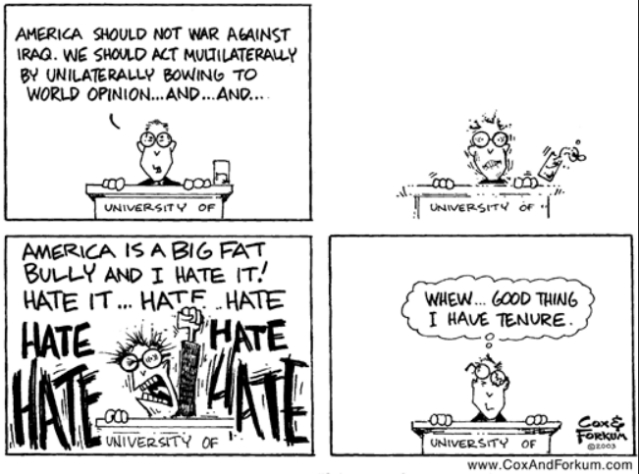
In response to Tupiniquim’s comment about reading Chomsky and Ginsberg, let me say this: Some criticism of the behavior of America is warranted. Chomsky goes way, way over the line. (I’ll admit right up front that I’ve never read Ginsberg, and have no plans to.) Cox & Forkum recently did a political cartoon (about another professor) that illustrates precisely what I think of Chomsky:

Here’s something for you to think about: Chomsky, in my opinion, isn’t an American in anything but legal citizenship. He belongs in Europe. But if he were there, and said things about those governments as he does here about ours, I doubt his voice would be tolerated, much less celebrated.

This brings us to the thing Tupiniquim doesn’t understand: What is the idea that all Americans share? (Well, he said “North Americans” but we know what he meant.)

So, what is “it”? “It” doesn’t fit on a bumpersticker. The idea we share won’t fit on a protest poster. It doesn’t fit on a T-shirt, and it isn’t a single thing. Let’s see if I can distill the idea down.

Let me start by saying that everybody who holds American citizenship doesn’t share the idea. We’re far too diverse for that. Many people born here never do understand it. Den Beste was making a generalization, and generalizations don’t hold up under a microscope. I’d also like to say that, while I believe the majority of Americans do understand it to a greater or lesser degree, there is a large and growing contingent in this country that not only doesn’t understand it, but rejects the idea outright. Go read Democraticunderground.com if you want to see some prime examples of this.

Our Declaration of Independence says:

We hold these Truths to be self-evident, that all Men are created equal, that they are endowed by their Creator with certain unalienable Rights, that among these are Life, Liberty and the Pursuit of Happiness — That to secure these Rights, Governments are instituted among Men, deriving their just Powers from the Consent of the Governed, that whenever any Form of Government becomes destructive of these Ends, it is the Right of the People to alter or to abolish it, and to institute new Government, laying its Foundation on such Principles, and organizing its Powers in such Form, as to them shall seem most likely to effect their Safety and Happiness. Prudence, indeed, will dictate that Governments long established should not be changed for light and transient Causes; and accordingly all Experience hath shewn, that Mankind are more disposed to suffer, while Evils are sufferable, than to right themselves by abolishing the Forms to which they are accustomed. But when a long Train of Abuses and Usurpations, pursuing invariably the same Object, evinces a Design to reduce them under absolute Despotism, it is their Right, it is their Duty, to throw off such Government, and to provide new Guards for their future Security.

The first line of the Declaration is one strongly definitive of an American ideal – equality of birth.

There is a story, a joke in some ways, an allegory in others, that dates way back. In it, a British Lord travels to the Frontier West, America in the 1800’s. His horse throws a shoe on the trail, so at the first little frontier town he comes to, he finds a blacksmith’s shop to have the shoe replaced. As he rides up, he sees a large, sweaty, filthy man hammering on a piece of red-hot iron. The Lord sits on his horse, waiting to be served, but the blacksmith doesn’t pay him any attention and continues to work his iron. Finally, the Lord, outraged to have been ignored this way by an obvious servant, dismounts, approaches the ‘smith, and taps the man on the shoulder with his riding crop.

“You, man!” he barks, “Who is your Master! I wish to have a word with him!”

The blacksmith turns, looks at the Englishman, spits a stream of tobacco juice on the point of the Lord’s boot and says,

That sumbitch ain’t been born.”

That’s one idea Americans share.

Another is that government should work for us, not us for it. (But Americans are not one monopolitical block. Just how government should work is something we’ve been fighting about since before the end of the Revolutionary War, so being an American is more than believing that we are not the servants of our government.) That, too, goes back to “That sumbitch ain’t been born” – just because someone draws a government paycheck does not make them our masters.

“Life, Liberty, and the Pursuit of Happiness.” That’s another thing Americans believe in, and that’s what draws people to this country – the liberty required to pursue happiness. In very much of the world, for a very long time, what you were allowed to do was constrained by your birth, and in many places today that’s still true. America is that place you could go where what you could do was constrained only by your own capabilities. The ideal is that we are born equal, but that we succeed on our individual merits – equality of opportunity, not outcome. And note, our Founders didn’t promise happiness, only the opportunity to pursue it. That’s also an opportunity to fail – the risk is ours to take. And we’ve been risk takers the likes of which the world has never seen before. Bill Whittle wrote:

Next time you look at the moon, challenge yourself to think of something: there are footprints up there. Footprints, and tire tracks. Also three used cars, and one golf ball.

Why are they there? Because we decided to go to the moon, that’s why. What a typically arrogant, unilateral, American conceit! Damn right it was, and that footprint – you know the picture – will still be there, unchanged, a million years from now. In ten million years, it might begin to soften a little around the edges. But in a billion years – a thousand million summers from this one – it will still be there, next to glistening pyramids of gold and aluminum junk decaying under the steady cosmic drizzle of micrometeorite hits.

That was liberty risking life in the pursuit of happiness. Trust me on this, I grew up during the race to the moon. My father was an engineer for IBM working on the Saturn V Instrument Unit. I know whereof I speak.

America is the place where you can dare to dream, and Americans all over the world, regardless of their legal citizenship, understand this too. Is America perfect in this regard? No, but no place is. However, where else but in America can a first-generation immigrant be elected Governor? Where else but in America can a college drop-out become the wealthiest man in the world? Where else but in America can you come get the finest education available? We’re not perfect, but I believe we’re the best that’s available.

And yes, we make mistakes, and those mistakes cause misery and death to some. But America is not the “Great Satan” – our mistakes are simply that, not deliberate efforts. No, we’re not perfect, but ask the people who lived in the former Soviet Union how they would grade their governments. Ask the victims of Nicolae Ceausecsu. Ask the Czechs after the Russian armor rolled in in 1968, and there are uncounted other examples. Ours is a difference in kind not just degree. Sometimes we make an error, and instead of admitting it, we compound it.

We’re human too. That’s something else Americans understand.

One more thing Americans understand (though fewer of us than I’d like) – government is not a panacea, it’s a necessary evil. It is seldom the answer to our problems, and it is often the cause of them. Americans have a love/hate relationship with government. We’re schizophrenic about it. We want it to do what we want, not what we ask it to do. We want it to take care of us, and we want it to leave us alone. We want it to do extravagant things, and we want to not pay for it. And we forget, constantly, that a government that can give us everything we want can also take everything we have. I said in “Better Fools” that I believed that “our form of government is superior to all others ever practiced.” I really do. But I also believe this rather sad comment made by someone:

The Constitution may not be the greatest work ever set to paper,
But it beats whatever it is the government is using these days.

I truly believe that our Constitutional Republic, as established by the Founders, was the best form of government ever conceived. It resulted in the greatest nation this world has yet seen. Not perfect, but unmatched in potential or performance when it comes to the individual and to the society. Its only failing is human nature. How do you make people want to stay free? How do you make them do the work necessary to ensure their freedom, when they can be so easily convinced to give it up in exchange for some promise of security? I don’t know the answer to that, and neither did the Founders. At least I’m in good company.

One last thing I’ll discuss here that Americans understand: “…whenever any Form of Government becomes destructive of these Ends, it is the Right of the People to alter or to abolish it, and to institute new Government, laying its Foundation on such Principles, and organizing its Powers in such Form, as to them shall seem most likely to effect their Safety and Happiness.” We believe that, even though we’ve propped up some despots and overthrown some others. Those of us who really believe it are often those who have the least say in what our government does. We’re the ones who want to be left alone by government instead of taken care of by it, and we’re the least likely to be elected officials or employees of the government. We also believe “that Governments long established should not be changed for light and transient Causes; and accordingly all Experience hath shewn, that Mankind are more disposed to suffer, while Evils are sufferable, than to right themselves by abolishing the Forms to which they are accustomed.” If your government is “destructive of these ends” it’s your job to alter or abolish it – even if it’s our government supporting the bastards. Yes, we’re schizophrenic that way, too. It’s another reason Europeans don’t understand us, and it goes right back to “that sumbitch ain’t been born” – our people often don’t do what our government tells us. Hell, our government often doesn’t bother to tell us because even they know it won’t do any good. When enough of us are pissed off, it listens. As a result we can and do things as a nation that our government has no control over, as the French economy experienced just recently.

In conclusion, let me address the questions of good & bad, King & McCarthy, jazz and the KKK et al. America hasn’t seen any real “tyrants” since we threw the Redcoats off our shores. McCarthy? Arguably crazy, but he wasn’t wrong about the infiltration of communists. Any parallel you draw between Bush (father or son) and McCarthy is one strained to incredulity. What, pray tell, is your problem with Colin Powell? The KKK is a small bunch of losers who feel that somebody has to be inferior to them, and their teeth have been pulled (no pun intended.) But this is America – like Chomsky, they have a constitutionally protected right to spew their venom, and we have a constitutionally protected right to ridicule them. America is a great country because it provides a marketplace where all ideas can be expressed to survive or fail on their merits. The KKK and Chomsky have small followings because their ideas fail in that marketplace. Repressing them would give them legitimacy they don’t deserve. That’s also why we don’t ban Mein Kampf. It deserves to be read, to remind us of what those ideas lead to. America is hardly the only place where bad ideas originate.

America is still the beacon of freedom to the rest of the world. The Land of Opportunity. As such, we are held to a high standard – one we occasionally fail. When we do, those who hate us, those who fear us, and those who simply don’t understand us point to those failures and declare that our leadership is illegitimate, our freedom is false and our promise of opportunity is a trick. They say we are evil.

And we ignore them, and go on.

We’re not perfect, but is there a nation superior to America in this world?

That sumbitch ain’t been born.
This is Why My House Has Guns, but NO BARS

(Third story on this page.)

SAN BERNARDINO, Calif. – Single mother Tina Marie Satterfield tried to make her home safe from crime, but she died early Monday, trapped inside the burning house by window security bars.

“She was like a mother to the other girls. She’d make them smile,” said Bob Monette, manager of the topless club Deja Vu. Satterfield, 24, danced there to support her daughter, Mia, Monette said.

Satterfield, two other Deja Vu dancers and three children died in a fire caused by smoking materials, fire officials said. Mia, 6, survived the fire.

“It wasn’t a party house. My sister just doesn’t like to be alone,” said Teresa Lundberg, Satterfield’s half-sister.

Lundberg recalled that Satterfield had installed the bars out of fear of neighborhood crime.