The recent brouhaha over concealed-carry brought up a point that I wanted to expand upon: Trust. The objection of those opposed to concealed-carry is: “I don’t TRUST you.” And, they protest, the reason permit seekers want the ability to carry legally is that they don’t trust anybody, either.
OK, fair enough. It is, at first blush, a reasonable conclusion to draw. But there’s a difference in the lack of trust in our two populations. My lack of trust is for the tiny percentage of the population that is willing to commit violent crime. I don’t think the chance that I will be faced with violence is particularly high, but I understand that it isn’t zero. Their lack of trust is in the ability of the average citizen to carry a weapon without doing something stupid or criminal. In short, they don’t trust anyone (other than a government employee) to be a danger only to those who would commit crime, often even including themselves.
Nor, in all honesty, is that an totally unfounded fear. As in this case, a shootout between a robber and a laundromat owner ended up in the death of a laundromat customer. The story doesn’t come out and say it, but it is implicit that he was shot by the store owner accidentally.
It’s not worth it, opponents say.
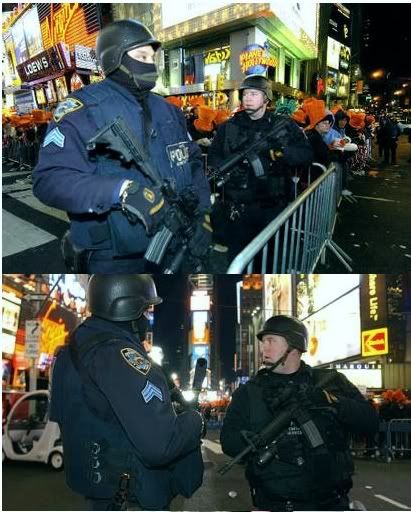
Then again, they seem willing to accept accidental shootings committed by government employees, like these two where teenagers were killed by police officers.
It is worth it, I reply. Both for government employees and the average citizen. And it’s worth it not only because concealed-carry allows people to exercise their right to self-defense, it’s worth it because it forces the public – in some small way – to recognize the fact that protection of themselves and their families is their responsibility too. This is an important fact to recognize, because once recognized it become incumbent upon the individual to address (or ignore) that responsibility. Once recognized, it requires consideration of one’s responsibilities to self and family, and to society. One can no longer claim ignorance or powerlessness.
Which is why, I think, many make a point of not recognizing that fact.
Although I brought up the concept of “cost-benefit analysis” in the comment thread at LeanLeft, I was in actuality baiting a hook – that wasn’t taken. Tgirsch called it correctly – neither side really is interested in a true cost-benefit analysis (well, he and I are apparently, but the organizations engaged in this fight seem not.) I was baiting a hook originally set by University of Texas Law Professor Sanford Levinson in his 1989 Yale Law Journal piece The Embarrassing Second Amendment:
There is one further problem of no small import: if one does accept the plausibility of any of the arguments on behalf of a strong reading of the Second Amendment, but, nevertheless, rejects them in the name of social prudence and the present-day consequences produced by finicky adherence to earlier understandings, why do we not apply such consequentialist criteria to each and every part of the Bill of Rights? As Ronald Dworkin has argued, what it means to take rights seriously is that one will honor them even when there is significant social cost in doing so. If protecting freedom of speech, the rights of criminal defendants, or any other part of the Bill of Rights were always (or even most of the time) clearly costless to the society as a whole, it would truly be impossible to understand why they would be as controversial as they are. The very fact that there are often significant costs—criminals going free, oppressed groups having to hear viciously racist speech and so on—helps to account for the observed fact that those who view themselves as defenders of the Bill of Rights are generally antagonistic to prudential arguments. Most often, one finds them embracing versions of textual, historical, or doctrinal argument that dismiss as almost crass and vulgar any insistence that times might have changed and made too “expensive” the continued adherence to a given view. “Cost-benefit” analysis, rightly or wrongly, has come to be viewed as a “conservative” weapon to attack liberal rights. Yet one finds that the tables are strikingly turned when the Second Amendment comes into play. Here it is “conservatives” who argue in effect that social costs are irrelevant and “liberals” who argue for a notion of the “living Constitution” and “changed circumstances” that would have the practical consequence of removing any real bite from the Second Amendment.
Professor Levinson’s argument is well illustrated in Judge Alex Kozinski’s eloquent dissent to the decision not to re-hear Silveira v. Lockyer:
Judges know very well how to read the Constitution broadly when they are sympathetic to the right being asserted. We have held, without much ado, that “speech, or . . . the press” also means the Internet, and that “persons, houses, papers, and effects” also means public telephone booths. When a particular right comports especially well with our notions of good social policy, we build magnificent legal edifices on elliptical constitutional phrases – or even the white spaces between lines of constitutional text. But, as the panel amply demonstrates, when we’re none too keen on a particular constitutional guarantee, we can be equally ingenious in burying language that is incontrovertibly there.
All in the name of “public safety.”
Gun control versus the right to arms isn’t really about guns, and it isn’t really about control as some have opined in bumper-stickers. At least those aren’t the underlying forces behind the battle. It’s about philosophy. It’s about morality. It’s about what it means to be a human being, and moreover, a citizen. Eric Raymond quoted historian J.G.A. Pocock in his excellent essay Ethics from the Barrel of a Gun:
“The bearing of arms is the essential medium through which the individual asserts both his social power and his participation in politics as a responsible moral being…”
This was Pocock’s description of the formative belief of the Founders in relation to the Second Amendment. Raymond says later:
The Founders had been successful armed revolutionaries. Every one of them had had repeated confrontation with life-or-death choices, in grave knowledge of the consequences of failure. They desired that the people of their infant nation should always cultivate that kind of ethical maturity, the keen sense of individual moral responsibility that they had personally learned from using lethal force in defense of their liberty.
Accordingly, firearms were prohibited only to those intended to be kept powerless and infantilized. American gun control has its origins in racist legislation designed to disarm slaves and black freedmen. The wording of that legislation repays study; it was designed not merely to deny blacks the political power of arms but to prevent them from aspiring to the dignity of free men.
The dignity of free men (and, as we would properly add today, free women). That is a phrase that bears thinking on. As the twentieth century draws to a close, it sounds archaic. Our discourse has nearly lost the concept that the health of the res publica is founded on private virtue. Too many of us contemplate a president who preaches “family values” and “responsibility” to the nation while committing adultery and perjury, and don’t see a contradiction.
But Thomas Jefferson’s question, posed in his inaugural address of 1801, still stings. If a man cannot be trusted with the government of himself, how can he be trusted with the government of others? And this is where history and politics circle back to ethics and psychology: because “the dignity of a free (wo)man” consists in being competent to govern one’s self, and in knowing, down to the core of one’s self, that one is so competent.
There it is: The question of TRUST.
“I don’t trust you,” said Barry, speaking not just for himself but for all those opposed to “liberalized” concealed-carry and the right to arms in general. Yet, as Jefferson asked, if you cannot trust us with the government of ourselves how can you trust us with the government of others? I’ll be more explicit: If you don’t trust your fellow citizens, how can you trust those few who have power over you? In short, what is it about drawing a government paycheck that engenders the unthinking, unconscious trust of the populace?
Bill Whittle in his essay FREEDOM wrote (more eloquently than I ever will):
This, to my mind, is the fundamental difference between the Europeans and the U.S.: We trust the people. We fought wars and lost untold husbands and brothers and sons because of this single most basic belief: Trust the people. Trust them with freedom. Trust them to spend their own money. Trust them to do the right thing. Trust them to defend themselves. To the degree that government can help, great – but TRUST THE PEOPLE.
—
Criminals, and criminal regimes ranging from The Brow-Ridged Hairy People That Live Among the Distant Mountains all the way through history to the Nazis and the Soviets, have and will conspire to take by force what they cannot produce on their own. These people must be stopped. The genius of the 2nd Amendment is that it realizes that these people could be anybody – including the U.S. Army. That is why this power, like the other powers, is vested in the people. Nowhere else in the world is this the case. You can make a solid argument that the United States is, by almost any measure, the most prosperous, successful nation in history. I’m not claiming this is because every American sleeps with a gun under the pillow – the vast majority do not. I do claim it is the result of a document that puts faith and trust in the people – trusts them with government, with freedom, and with the means of self-defense. You cannot remove that lynchpin of trust without collapsing the entire structure. Many observers of America never fully understand what we believe in our bones, namely, that the government doesn’t tell us what we can do – WE tell THOSE bastards just how far they can go.
Yet, those who oppose the right to carry, and those who oppose the right to arms in general don’t trust the people. They trust the government. They trust that the government will never become vicious and oppressive.
And many of these same people protest that Bushitler and Ashkkkroft are the new Fourth Reich.
Schizophrenia.
Whittle continues:
We can ban and confiscate and regulate to our hearts content, and we will undoubtedly save many, many innocent lives by doing so. All for the price of a little freedom.
I believe we should punish the perpetrators. I will not agree to restrict the freedoms of the vast numbers of people who abide by the concomitant responsibility and live lives of honesty and decency. And there is more than the physical restriction of freedoms: There is the slow erosion of self-reliance, self-confidence and self-determination among a nation. The more your government restricts your options, the more you psychologically look to government to keep you safe, fed, clothed, housed and sustained.
There is a word for people who are fed, clothed, housed and sustained fully by others, and that word is SLAVES.
Or, as one commenter accurately pointed out: CHILDREN.
I said in an earlier essay:
Why don’t we get rid of our guns? Because we’re not subjects, we’re citizens. The majority of Americans – still, somewhere deep inside, perhaps dimly – understand that we are sovereigns, that we are responsible, not government. Our collapsing schools have not yet broken us of this belief, though I don’t think it exists in many of our children anymore. For the majority of us who bother to vote, however, being told that we are not responsible enough, grates. We are not willing to yeild, yet, our right to self defense, and eventually self determination. Somehow, the majority of voters sense a threat to their sovereignty.
When polled, a majority of people say they want more effective gun control laws, but when the question come up on a ballot, the overwhelming response of those who vote is usually “Not THAT!”
We are not children. Our government was founded on the concept of TRUST THE PEOPLE – with the full understanding that some small percentage wasn’t worthy of that trust. I am heartened by the expanding number of states that have passed “lax” concealed-carry legislation as evidence that we have not yet taken Alexander Tytler’s next step from dependency into bondage, and with great hope that we have not proceeded too far from apathy into dependency.
I still trust We the People.