Please, Allow Me to Fisk…

Instapundit pointed to this USA Today piece on the political third-rail that gun control has become. I thought it was interesting, but (of course) I had some comments:

Gun-control debate gets muzzled

On the same day last month, five factory workers in Mississippi were shot and killed by a co-worker and five people in a family in Bakersfield, Calif., were killed by gunfire.

Not too long ago, dramatic slayings such as these would have created a new chapter in the national debate over gun control. There would have been angry speeches in Congress and new proposals to crack down on firearms.

But today, there is mostly silence.

That’s a point I made in an earlier essay.

Democrats, who believe that their calls for gun controls might have cost them the White House in 2000, are less willing to take on the gun lobby. Polls suggest that public fears about terrorism have helped mute the debate.

Meanwhile, the gun industry is racking up legislative wins. House Majority Leader Tom DeLay, R-Texas, says there are not enough votes in the House to renew Congress’ 1994 ban on certain assault weapons when it expires next year.

I certainly hope so. I was pissed off enough when it passed. I’d really be P.O.’d if Dubya signed the renewal.

And now, gun rights supporters are closing in on what probably would be their most enduring victory.

The Senate is close to passing a bill that would shield firearms manufacturers and dealers from civil lawsuits brought by victims of gun crimes. The measure, which the House passed 285-140 as 63 Democrats voted with the GOP majority, is an effort to shield the gun industry from the type of lawsuits that have been successful against tobacco and asbestos companies.

The popularity of the bill — it has 54 co-sponsors in the Senate, including several top Democrats — underscores the changed political dynamics of gun control. Senate Minority Whip Harry Reid, D-Nev., has signed on, and Senate Minority Leader Tom Daschle, D-S.D., might do so.

Which would be a pretty fair gauge of just how at-risk Daschle thinks his seat is.

The political divide over gun control has long cut geographically: Rural areas generally oppose greater controls on firearms, and urban areas generally favor them. Republicans usually oppose restrictions; Democrats usually back them. But Democrats in rural areas where hunting is a tradition have a tough time winning elections if they are seen by voters as anti-gun.

Let me interject something here: I know that the term “anti-gun” is just shorthand reporterese, but realistically the term successfully redefines the issue. It isn’t that the electorate thinks the politician is “anti-gun,” but that the electorate believes the politician wants to disarm law-abiding citizens. That isn’t anti-gun, that’s anti-citizen – and the electorate has generally known it. Since 911, a lot more of the electorate has woken to that fact.

That longtime party dilemma came into sharp focus after Democrat Al Gore, a supporter of gun controls, lost the key states of Arkansas, Tennessee and West Virginia en route to his narrow defeat in the 2000 presidential election. Some Democrats believe Gore’s stance on guns was to blame.

Some Republicans, Libertarians, and Independents thought so too.

Democrats became even more reticent after the terrorist attacks of Sept. 11, 2001, made improving security a national priority.

When Republican pollster David Winston asked Americans about plans to allow pilots to carry guns in the cockpit, he found that married women with children — traditionally the strongest voices favoring gun control — were among the biggest supporters.

“The soccer mom who wants to gets guns off the playgrounds through gun control is the same mom who wants pilots to be armed ” he said. “The dynamic has changed. . . . It’s putting it in the context of safety.”

And didn’t that shock their socks off! Hell, we’ve always put it in the context of safety. And for that matter so has our opposition. We say it increases your safety, they say it increases your risk. Looks like the soccer-mom contingent has made its choice.

Immunity legislation

Today, much of the conflict over gun control is focused on the litigation bill that is before Congress.

The bill would stop pending civil lawsuits and prevent future claims by victims of gun crimes against companies that sold, imported or manufactured the weapons used in such crimes. Similar legislation has been passed in 32 states. But opponents say the federal proposal is more sweeping and could prevent the firearms industry from being sued in almost any circumstance.

“I would say the breadth of the immunity granted is unprecedented,” says Dennis Henigan, legal counsel to the Brady Center to Prevent Gun Violence. “No other industry enjoys the kind of protection from legal actions that this bill would grant the gun industry.”

So sayeth the mouthpiece of the organization that promotes the book Every Handgun is Aimed at You: The Case for Banning Handguns by Josh Sugarman, executive director of the Violence Policy Center. What do you expect him to say?

The Brady Center, which is providing legal assistance in about two dozen lawsuits against the industry, says the bill would stop a lawsuit filed by relatives of those slain in a series of attacks that included the sniper shootings last fall in the Washington, D.C., area.

As well it should. The whole point of these lawsuits is to bankrupt the manufacturers since the gunban control groups have failed to shut them down legislatively.

Representatives of the firearms industry say legitimate businesses that sell guns legally should not be held responsible when the guns end up in criminals’ hands. They say the legislation before Congress is needed to protect gunmakers and dealers from bankruptcy, which has become a threat as the number of lawsuits against the industry increases.

Lawrence Keane, general counsel of the National Shooting Foundation, says gun dealers or manufacturers have not lost a case yet but have spent more than $100 million in legal fees defending themselves.

Now, it might be that my tinfoil hat is on a bit askew, but was it an innocent mistake to screw up Lawrence Keane’s position? He’s Vice President and general counsel for the National Shooting Sports Foundation. So, he represents sport shooters, not gang-bangers. OK?

“If a dealer sells a legal product to a consumer who has undergone a criminal background check and filled out the federally required forms, and (who) later gives that gun to someone else to commit a crime, that dealer should not be sued,” Keane says. Dealers or manufacturers who violate gun laws should be subject to lawsuits, he says. But Henigan counters that if the federal bill becomes law, the victims’ families in the sniper lawsuit would have to prove that the owner of the Bull’s Eye Shooter Supply in Tacoma, Wash., willfully violated gun laws involving the specific gun used in the slayings.

Well, HORRORS! Apparently Mr. Henigan believes that, simply because the owner of Bull’s Eye Shooter Supply should pay regardless of the facts.

That could be difficult to prove in court, Henigan says. The shop owner, Brian Borgelt, has claimed that the rifle allegedly used by John Allen Muhammad and Lee Boyd Malvo was shoplifted.

The facts are that Brian Borgelt ran a shoddy operation, that the BATF knew he ran a shoddy operation, but the BATF only recently yanked Mr. Borgelt’s license because of all the publicity. It would seem to me that the party that needs to be sued for not doing their job is the BATF, but we know how likely that is. According to a Seattle Times report, Lee Boyd Malvo confessed that he stole the gun from the gun shop. (Original story is not available on-line, but reference to it is in this one.) Yes, by all appearances, Bull’s Eye was badly run, but it’s the job of the BATF to control that – not stomp kittens. If Malvo had fingered Borgelt for selling the gun under the table, then there’d be grounds for a suit, and the “immunity” legislation wouldn’t save him.

But somebody please explain to me why (other than perceived deep pockets) Bushmaster is being sued? How is it their fault?

The bill to shield gunmakers and sellers from lawsuits was passed by the House in April, while much of the nation’s attention was focused on Iraq.

With the unspoken: “Those sneaky bastards!”

In the Senate, sponsors quickly signed on. Opponents, led by Sen. Dianne Feinstein, D-Calif., promise to filibuster the bill to try to prevent it from coming up for a vote. But sponsors need just six more votes, for a total of 60, to end a filibuster and force a vote.

Tobacco model

Litigation against the gun industry has come on the heels of lawsuits that cost tobacco companies billions of dollars in settlements.

From an industry that can support those kinds of losses. The gun industry in America is not so large, regardless of our love of guns. The tactic isn’t to milk the companies for everything they can, it’s to bleed them to death through lawsuit after lawsuit, regardless of the outcome. That’s why the legislation is necessary.

In 1998, Chicago, which had banned the sale of handguns, sued the firearms industry. The city claimed that the industry had created a public nuisance through sales patterns that allowed guns to be diverted to criminals. Within two years, 33 other cities and counties sued on similar grounds.

There is no count of the number of gun crime victims who have sued, but their claims include allegations of unsafe design and negligent distribution.

And they can still sue for unsafe design – but not if the gun goes off when the trigger is pulled. Negligent distribution? That one doesn’t fly anywhere.

So far, none of the lawsuits has been successful.

Gee, I wonder why?

Suits in New Orleans, Miami, Atlanta, Wilmington, Del., and Camden County, N.J., have been dismissed. Boston and Cincinnati voluntarily dropped their claims, in part because of cost.

And remember, they’re doing it on the taxpayer’s back. The gun industry isn’t.

About a dozen of the local lawsuits are still working their way through the courts. Henigan says he is heartened by several appellate decisions that have allowed suits in Ohio, Illinois and New Jersey to go to trial. But he believes that much of the pending litigation could be dismissed if Congress passes the immunity bill.

Even without the legislation, advocates of holding gunmakers and dealers liable for gun violence may have trouble convincing juries of it.

Peter Schuck, a Yale Law School professor, says gun litigation differs from tobacco litigation in key ways. Juries, he says, have little sympathy for cigarette companies, but they do for gunmakers.

Establishing liability on the part of the gun industry, he says, will be more difficult. “It is almost universally accepted that smoking causes lung cancer,” he says, but linking gunmakers and dealers to violence is more difficult to prove.

Perhaps because they can’t? And they know it?

Thirty-five States Now, and They’re STILL Predicting the Wild West?

MSNBC weighs in on Missouri’s renewed attempt to join the majority of the nation in “shall-issue” concealed-carry legislation. So of course we get to read things like this:

The bill’s champions say that allowing concealed weapons could make things safer because criminals would have second thoughts about holding up a store where other customers and maybe even the clerk are packing. Opponents, on the other hand, foresee a Wild West mentality and warn against the increased presence of firearms in the workplace.

Right. The “No Guns Allowed” signs do such a marvelous job of keeping crazed killers out.

“The fact that concealed weapons are currently outlawed in Missouri creates an incentive for businesses looking to expand or relocate in Missouri by increasing safety in the workplace,” said Kristi Wyatt, senior vice president for government relations.

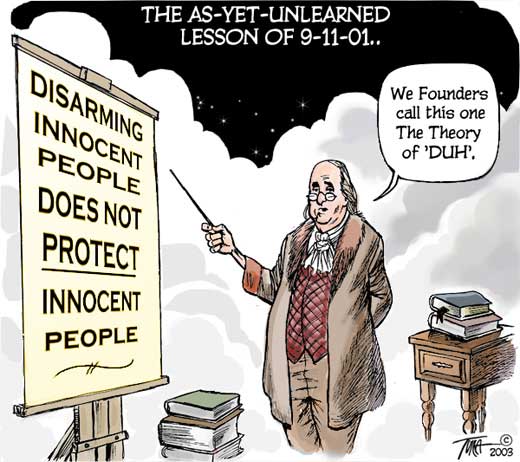
Riiiiight. How, exactly does not allowing law-abiding citizens to carry a firearm “increase workplace safety?” Time for another cartoon:

(Kevin Tuma) The article isn’t completely anti-gun, but I am constantly amazed by gun-bancontrol supporters repeated use of “Wild West” and “blood in the streets” arguments when it has been proved conclusively by over thirty other states that this never happens. See “Cognitive Dissonance” below.

JoinTogether Really is Shameless

In this bit of propaganda, JoinTogether promotes having the Consumer Safety Commission regulate “gun safety” because:

more than 20,000 Americans under age 20 (are) killed or injured each year by guns

Once again, what are the facts?

According to the Centers for Disease Control WISQARS tool, in 2000 there were 6,706 unintentional non-fatal gunshot injuries for people 19 years of age and younger, and 193 accidental gunshot fatalities for the same demographic.

That’s 6,899 accidental deaths and injuries for “children” under the age of 20. If you drop the age of the “children” to 18, the numbers are 5,232 and 174 respectively, for a total of 5,406. The rest of the deaths and injuries are intentional – and “gun safety” won’t affect those unless (as I’m sure they mean it) “gun safety” means “guns that won’t fire.”

The blurb also states:

The report found that up to one-third of unintentional shootings could be prevented by changing gun designs, or adding features such as devices that keep guns from firing when dropped or indicate when the gun is loaded.

Riiiight. One-third (2,922 approximately) could be prevented if all NEW guns had the features they suggest? What about all the OLD guns out there? This is simplistic in the extreme.

But then, that’s the strategy, isn’t it? Take the statistics, warp them to suit, and make simplistic attention-grabbing arguments. Then claim everyone who calls you on it as a heartless gun-lover who wants to see babies die.

This is the kind of crap that made me an activist.

“A Mistake a Free People Get to Make Only Once”

“May you live in interesting times.”

That fits. A lot happened in the last couple of weeks. Brian Borgelt, the owner of Bull’s Eye Shooter Supply in Tacoma, Washington, the gun shop from which Muhammed and Malvo “acquired” their Bushmaster AR-15, is finally getting his Federal Firearms License pulled for improperly tracking and losing records for over 200 firearms, while the GAO reported that the federal government has lost 824 firearms, some of which were full-auto weapons, and many of which were not properly reported or reported long after the loss. Canada’s gun registration deadline has passed with (a government estimated) 20% of rifles and shotguns remaining unregistered. Another workplace multiple shooting occurred. This time there were five dead and nine wounded at a Lockheed plant in Mississippi (not including the perp.) Three teenagers were arrested before they could carry out what certainly appears to be a premeditated killing spree. A grandmother, mother, and three children – all infants to toddlers – were shot to death in Bakersfield, California. (A quick Google news search on the word “shooting” brings up the normal long list of single-victim stories, as well.) The Supreme Court received the petition for a writ of certiorari in the Silveira v. Lockyer case. And the UN released its Small Arms Survey 2003 that detailed worldwide civilian gun ownership. That report proclaimed that there is a near 1:1 parity of guns and people in the United States.

America, it is often pointed out, has one of the highest firearm-related homicide rates in the world, and easily the most civilian-owned arms. Gun control supporters constantly decry the “number of guns” in America as being the, or at least a cause of our firearm-related mayhem. It is the point of the UN Small Arms Survey: the number of guns in civilian hands worldwide represents a threat to the health and safety of those civilians and their societies, and that governments should work to reduce the number and so reduce the threat.

And here’s a shocker – to some extent I agree with the basic premise that having a lot of guns around, indiscriminately, uncontrolled, does contribute to the volume of injury and death inflicted with firearms. It’s almost – almost – a tautology. Here in America if John Q. Wifebeater didn’t have a .357 revolver laying around, he might not be able to kill the Mrs. (or vice-versa) the next (and last) time they get into a knock-down, dragout fight. It’s possible that a distraught teenager in a moment of bleakness might not kill himself with his father’s shotgun if Daddy just didn’t have one. If no one kept a gun at home, there wouldn’t be twenty or so toddlers killed accidentally with them each year. If guns were less available, it’s possible that more armed robbers would be armed with crowbars and baseball bats rather than 9mm’s, and fewer convenience store clerks and cab drivers would end up shot.

Yes, America has a lot of guns and a lot of death and injury by them. I’ve been asked “How many people have to die before you realize that we need effective gun controls?!?”

And I’ve responded: “How many deaths will it take before you realize that gun control isn’t effective, and stop pushing for new gun control laws?”

Because that’s the question, isn’t it? We all realize that there’s a problem, but we’re divided by the proposed solution to that problem. And we’re really divided on just what that solution entails – because if you believe that “the number of guns” is the problem, then the only answer is to reduce (to some arbitrary “this is enough” level) or eliminate those guns. I’m willing to bet that the arbitrary “this is enough” level is roughly equivalent to zero. In order to eliminate those guns you’ve got two choices: render the Second Amendment meaningless in the minds of the citizens and in the courts of America, or find some way to legally give government the power to do what the Second Amendment prohibits – disarm America.

So far the legal process of making gun ownership by the law-abiding difficult in America has only been successful in a few places: Chicago, New York City, Washington D.C., Maryland, New Jersey, and some others. Generally, buying a gun legally still a fairly easy thing to do nationwide. (You’ll note that it hasn’t affected illegal acquisition in the least.) The second part, rendering the Second Amendment meaningless, has progressed somewhat better. At this time there is no legally recognized individual right to arms in the states of the 9th Circuit Court of Appeals, and to be honest, that right is only recognized – and weakly – in the 5th Circuit. The other circuits are largely mute on the question, but lean towards the 9th Circuit’s opinion. If the Supreme Court grants cert. on Silveira that question might finally get an answer. (And I’m not betting on just what that answer will be, either.)

However, I’ve made a blanket statement: “Gun control isn’t effective.” How can I claim that? Gun control works in other countries, doesn’t it? What about the 1934 National Firearms Act? Hasn’t that been effective? Gun rights proponents proudly proclaim that only one legally registered fully-automatic weapon has been used in a crime – and that by an off-duty police officer. Gun control proponents respond that this means that licensing and registration does work. Well, admittedly the use of NFA weapons is much less than, say, basic handguns, but how do you define “works?” In a discussion I had a while back on another site it was defined to me as “not hindering law abiding citizens from owning guns but making it more difficult for criminals to acquire guns.” My response to that was that the question of “hindering” was one of degree (as in “what, exactly, constitutes ‘infringing’ on a right?”), but that licensing and registration – in some countries – indeed did not significantly hinder the law abiding from owning guns, and that it did, indeed make it “more difficult” for criminals to acquire guns – but it didn’t make it effectively difficult. As an example, the “war on (some) drugs” does not prevent the law abiding from getting needed medications, but it doesn’t effectively prevent criminals from getting illicit drugs, does it? Harder, yes, but I think that scoring a tab of Ecstasy or a baggie of pot is probably only a little more involved than driving down to the neighborhood Walgreen’s if you’re inclined to use that stuff. And if you want to buy a gun while you’re at it, that probably isn’t any harder. You might even get a discount for doing both at once.

What I did note in that discussion, however, is that in many societies that had gun licensing and registration, the registry had been used for gun confiscation, and that I believed that they would be used that way here, as well. Nor am I alone in that belief. Charles T. Morgan, at the time Director of the Washington office of the ACLU said in Senate testimony in 1975 when asked about gun registration:

What the administation’s and Congressman McClory’s bills . . . call for is a whole new set of Federal records. . . .

I have not one doubt, even if I am in agreement with the National Rifle Association, that that kind of a record-keeping procedure is the first step to eventual confiscation under one administration or another.

Only one legally owned NFA firearm has been used in a crime, but it didn’t stop two gunmen from using at least three fully-automatic weapons during the North Hollywood bank robbery. It certainly hasn’t stopped criminals from sawing off shotgun barrels.

But let’s look at the NFA for a second. The primary effect of the 1934 National Firearms Act was the registration of fully-automatic weapons and the strict control of their transfer between law-abiding owners. On top of that, at the time the law was passed a truly draconian “tax” was assessed on each transfer of NFA restricted weapons – $200. In 1934 that was a lot of cash. The effect was to essentially stop the production of many otherwise legal NFA firearms for public consumption such as the Ithaca Auto & Burglar – because the guns themselves didn’t cost $200. Now, of course shotguns like these

are sold for about $400 plus, of course, the $200 transfer tax. Machine guns, on the other hand, have always been pretty pricey with the exception of a few really cheap models like the M3 “grease gun” and the Sterling. But throw $200 on top of the price, and the legal market for them shrinks. With a small legal demand, not too many hit the illicit market either. They weren’t there to steal, and there was a significant obstacle to straw-purchases: owner registration. So, in a sense, the NFA licensing and registration scheme “worked” – it made it harder for criminals to access NFA restricted weapons – but it obviously wasn’t effective at reducing gun crime. Criminals got the weapons they wanted, or just substituted different weapons. If someone really wants a fully-automatic weapon, he can get one – as evidenced by the North Hollywood shootout and other crimes. If someone really wants a short-barrelled shotgun, all it takes is a hacksaw. If someone really wants a suppressor, it just takes a decently equipped shop. Licensing and registration “works” at making it more difficult for criminals to get guns if you can stop or greatly reduce the influx of the weapons you’re trying to restrict. Once they’re in circulation, it’s too late. They don’t get registered, or they get stolen (or reported stolen). In a country with (according to the UN report) 238,000,000 to 276,000,000 guns, registration as a “gun control” measure is a forlorn hope. As a precursor to confiscation, however…

So, reducing the number of guns available to the public could reduce the “heat of the moment” type killings, and the accidental deaths by firearm, but it doesn’t really affect deliberate criminal useage. In fact, as evidenced by England, it might result in an increase in deliberate criminal use. It might prevent, say, the Lockheed slayings, but it won’t have much of a positive effect on the number of convenience stores robbed annually, and might even result in a negative effect when criminals realize they have little to fear from their targets.

The initial argument against semi-automatic “assault weapons” was that these were the “weapons of choice” of criminals, but the fact of the matter is, with well over 2 million (depending on your definition) “assault weapons” in circulation, the most popular firearms in criminals hands remains the handgun – and only the Violence Policy Center is willing to come out in favor of banning those. Now the argument against “assault weapons” is that they’re only good for killing a large number of people indiscriminately (which of course is why police forces across the country are equipping with them. Right?) But using that argument there is now a Federal “ban” on some “assault weapons” and there are some state and local “bans” on them as well. The “bans” just resulted in some redesigns and some workarounds, but the intent was clear – these weapons were no longer to be offered to the general public ostensibly in an effort to keep them out of the hands of people who would misuse them. The same holds true now for .50 BMG caliber rifles – efforts are afoot both locally and nationally to (at a minimum) include these weapons in the NFA restricted list. Demand for both has skyrocketed – if we think the government is going to ban them, we want them.

So, to date the path to civilian (some say “victim”) disarmament has been pursued through the “death-by-a-thousand-cuts” strategy, or, more aptly the “frog in a pot” analogy. This is illustrated well by the “assault weapons ban” that really isn’t. Charles Krauthammer made the true point of the law quite plain in his 1996 Washington Post op-ed “Disarm the Citizenry:”

It might be 50 years before the United States gets to where Britain is today. Passing a law like the assault weapons ban is a symbolic – purely symbolic – move in that direction. Its only real justification is not to reduce crime but to desensitize the public to the regulation of weapons in preparation for their ultimate confiscation.”

The gun control groups term it as the “next step” – as in “Gun DNA is the next step for New York as we continue to develop innovative crime fighting policies.” – so said New York Governor George E. Pataki in 2000. There’s always a “next step” because all the previous steps didn’t work to reduce crime or accidents – but they do work to make it more difficult to legally acquire and keep a firearm.

There is no doubt that there is a movement out there intent on disarming not only Americans, but civilians around the world, because the only “effective” gun control is gun elimination, and the only way to reduce the number of guns in civilian hands is to take them from us, or make us give them up. As with all things political, there is no single reason for this movement. There’s the tinfoil-hat bilderburg/zionist/mason/communist/skull-and-bones conspiracy-of-the-week, there’s the “we know what’s best for you” crowd (which can be rolled into the first group pretty easily), there are the people who have lost loved ones to gun violence, and there are the people who “care” but don’t tend to think much (the “useful idiots.”) And on the face of it, it seems pretty obvious to a lot of people that fewer guns would be a good thing, even to many gun owners. It seems pretty obvious to a lot of people that “assault weapons” have no place in our society. In fact, our gun control laws have, for years, been predicated on a “sporting use” philosophy – and even I will admit that there isn’t a lot of “sporting use” for a gun like an AK-47 or even my Mossberg 590.

This movement, however, has lost traction here in the last few years. More and more states have adopted “shall-issue” concealed-carry laws in the face of vociferous opposition from the gun control crowds. And, most telling, incidents like the Lockheed shooting and Columbine haven’t resulted in the kind of overwhelming outcry for more gun control that incidents like Port Arthur, Dunblane, and Erfurt elicit in other countries. A lot of people ask why that is? What is it about Americans that makes us ignore what is so obvious to others – that guns shouldn’t be in private hands, uncontrolled?

I think I have an answer to that. And to give you an example, I will quote, in its entirety, a letter recently submitted to Kim du Toit (and republished with his permission):

Your offhand comments about keep-and-bear supporters who do not, themselves, keep and bear hit a nerve.

I’ve seen the light, and I’m here to testify.

To those of you who grew up with guns, I expect that what I’m about to say will seem painfully obvious. But I came to class late, and what I learned there is still fresh and vibrant.

I thought, all my life, that I couldn’t own a gun safely, that no one could, really. Guns were dangerous and icky. Even after I realized that the Second Amendment was not quite the shriveled, antiquated appendix I’d been taught, for a couple of years or so I still wobbled around with the training-wheel comfort of believing that while not all gun owners were necessarily gap-toothed red-necked fascist militia whackos, I myself ought not to own firearms. I was too clumsy and careless, and guns were still dangerous and icky.

Just before 9/11 I woke up to how quickly my liberty was eroding, and in a fit of anger and defiance started saving for a handgun while training with rentals. (Thanks to Harry at Texas Shooters Range here in Houston.) When I actually bought one (to the horror and confusion of my friends and family), having it around the house, carrying it in my car, talking about it, showing it off, and of course shooting and maintaining it, taught me what I could not learn from books, magazines, classes, or even Usenet:

It taught me that freedom takes practice.

I thought I’d practiced. I’m as full of opinions as the next guy, and not shy about passing ’em out to anyone who’ll listen. I read banned books and underground comics. I’ve walked the picket lines and hung out with undesirables. A preacher’s kid, I pointedly don’t practice a religion. I’ve done stuff that Wasn’t Allowed.

But when I got a gun, I discovered it had all been safe, padded, wading-pool-with-floaties dabbling. After near on to fifty years, I finally started to grow up. If my Grands are any clue, I’ve still got twenty or thirty years to work on it, and get to be something like mature by the time I go senile.

It’s not just that rights are useless if they are not exercised, not even that rights must be used or be lost. It’s that exercising your rights, constantly, is what instructs you in how to be worthy of them.

Being armed goes far beyond simple self-protection against thugs or even tyrants — it’s an unequivocal and unmatched lesson that you are politically and morally sovereign; that you, and not the state, are responsible for your life and your fate. This absolute personal sovereignty is the founding stone of the Republic. “A well-regulated militia” (where the militia is “the whole people”) isn’t just “necessary to the security of a free state” because it provides a backup to (and defense against) the police and the army. More importantly, keeping and bearing arms trains sovereign citizens in the art of freedom, and accustoms us to our authority and duty.

As Eric S. Raymond wrote:

“To believe one is incompetent to bear arms is, therefore, to live in corroding and almost always needless fear of the self — in fact, to affirm oneself a moral coward. A state further from ‘the dignity of a free man’ would be rather hard to imagine. It is as a way of exorcising this demon, of reclaiming for ourselves the dignity and courage and ethical self-confidence of free (wo)men that the bearing of personal arms, is, ultimately, most important.”


Unless you have some specific impediment (and most impediments can be overcome), arm yourself. Find out who you really are. (Yes, there are many paths to self-knowledge. But this tests something you cannot access any other way. No one path goes everywhere.) You’ll probably discover you’re not all that bad. And if not, well…

Think of it as evolution in action.

THAT is what separates us from everybody else: the belief in personal sovereignty, as a citizen of this nation. In fact, there’s a guy out there who has a site dedicated to opposing the very idea of personal sovereignty. (It’s a very good site from an informational standpoint, although I disagree violently with his position.) Why don’t we get rid of our guns? Because we’re not subjects, we’re citizens. The majority of Americans – still, somewhere deep inside, perhaps dimly – understand that we are sovereigns, that we are responsible, not government. Our collapsing schools have not yet broken us of this belief, though I don’t think it exists in many of our children any more. For the majority of us who bother to vote, however, being told that we are not responsible enough, grates. We are not willing to yeild, yet, our right to self defense, and eventually self determination. Somehow, the majority of voters sense a threat to their sovereignty.

I find this encouraging as I watch Europe proceed in its formation of its union. I read as Steven Den Beste points out the disastrous path they are taking, and wonder what’s going to happen there if it all comes crashing down (as I believe it will.) That collapse would have worldwide repercussions. We don’t make a lot of things here any more. There really is a ‘global economy’ all connected together like a vast power grid, just waiting for a circuit failure somewhere to crash the system in whole or in part. And if such a collapse does occur, I believe the results will be very, very bad. I wonder what North Korea is going to do, and when or if China will make a grab for Taiwan. I wonder if Pakistan and India will throw nukes at each other some day. In short, I wonder if the wheels might come off the wagon without much warning, and leave the U.S. and the rest of the world in a really bad position. “Interesting times” indeed.

For all the mayhem guns in civilian hands have caused, guns in the exclusive control of governments have resulted in far more. “Assault weapons” may not have much of a “sporting purpose,” but the Second Amendment isn’t about “sport.” Judge Kozinski in his eloquent dissent to the denial of appeal for an en banc rehearing of Silveira explained it perfectly:

The majority falls prey to the delusion—popular in some circles – that ordinary people are too careless and stupid to own guns, and we would be far better off leaving all weapons in the hands of professionals on the government payroll. But the simple truth – born of experience – is that tyranny thrives best where government need not fear the wrath of an armed people.

All too many of the other great tragedies of history – Stalin’s atrocities, the killing fields of Cambodia, the Holocaust, to name but a few – were perpetrated by armed troops against unarmed populations. Many could well have been avoided or mitigated, had the perpetrators known their intended victims were equipped with a rifle and twenty bullets apiece, as the Militia Act required here. If a few hundred Jewish fighters in the Warsaw Ghetto could hold off the Wehrmacht for almost a month with only a handful of weapons, six million Jews armed with rifles could not so easily have been herded into cattle cars.

My excellent colleagues have forgotten these bitter lessons of history. The prospect of tyranny may not grab the headlines the way vivid stories of gun crime routinely do. But few saw the Third Reich coming until it was too late. The Second Amendment is a doomsday provision, one designed for those exceptionally rare circumstances where all other rights have failed – where the government refuses to stand for reelection and silences those who protest; where courts have lost the courage to oppose, or can find no one to enforce their decrees. However improbable these contingencies may seem today, facing them unprepared is a mistake a free people get to make only once.

Somehow, I think that we are almost alone in the world still understanding in our bones that tyranny isn’t something relegated to history, never to raise its ugly head again. And because we understand that, we’re willing to endure our daily mayhem and slaughter. It’s better to live with that, than to make the mistake we only get to make once.
“I Know, Let’s Make Guns REALLY Illegal!!”

Britain’s Evening Mail provides the following wrenching and earnest op-ed piece, Let’s end gun misery:

The anguished mothers of Birmingham’s New Year party victims will brief a powerful body of MPs on the problems of gun crime in Britain’s inner cities.

Six months to the fateful day their daughters were shot, Beverley Thomas and Marcia Shakespeare are to give evidence to the group.

Pals Charlene Ellis and Letisha Shakespeare were gunned down outside a city hair salon when gangsters opened fire on a crowd of partygoers.

Charlene’s twin Sophie and a fourth girl, Cheryl Shaw, were injured in the same incident.

What they don’t tell you is that the shooter used a submachine gun – illegal to possess in England since the 1930’s. But they’re available on the black market along with other goodies like hand grenades.

Now the mothers will tell politicians of the heart-rending and long-lasting impact gun crime has had on them and the community.

Perry Barr MP Khalid Mah-mood told the Evening Mail: “It has taken a lot for both these women to take such a public stand and we should applaud them for that.

“They are standing out, demanding justice and refusing to be silenced.

And apparently risking getting killed for speaking up, since the criminals don’t seem to fear the police very much.

“They are a credit to the community and we will be interested to hear their views on tackling the menace of guns and the gang culture that spawns such violence.

“Also, I want to hear about how they have coped over these past six months, especially with having to bring up young children as well.”

Their appearance comes a week after West Midlands Assistant Chief Constable Nicholas Tofiluk told the same Commons all-party parliamentary group how Birmingham’s image was being soured by gun crime.

He said: “A long-term issue that needs to be addressed is that in some parts of the city there is an emergent culture that sees guns as part of a lifestyle.

“These are issues the police alone cannot affect.” The MPs launched an inquiry following a nationwide “surge” in violence involving firearms over recent years.

Police on London’s Operation Trident, West Midlands’ Operation Ventara and Manchester Gang Strategy Unit have also given evidence.

Now, bear in mind that this is in a country where there are only about 600,000 legal shotgun owners and about 125,000 legal rifle owners, and ZERO legal handgun owners or submachine owners, or “assault rifle” owners outside the government. (The London police did recently upgun to the H&K G36 assault rifle.) And the legal ownership levels are declining each year.

But NOW there’s a SURGE of firearms involved violence. NOW there’s an “emergent gun culture.”

No, they killed the good “gun culture” and are left with the unfettered bad one.

What’s next, really really banning guns?

Let’s really end “gun misery” in England – teach people to defend themselves, and then let them carry and keep guns in the home. Nothing else seems to work. Banning sure as hell proved useless.

Another Opportunity for Free Enterprise and the Internet

JoinTogether.org continues to be an unending font of material for me. In this piece they report that More Newspapers Banning Gun Classifieds. This happened here in Tucson a couple of years ago. The result? UsedGunsTucson.com (currently defunct as of 2017), a web-based classified system for people buying and selling their firearms privately. At no cost, mind you. This guy runs the site on his own dime. And I’ve used it. It works quite well.

I hope others establish sites like this to replace their newspaper classifieds.

Eugene Volohk Fisks the “Guns in the Home = Risk” Meme

And well. In a National Review Online column today, Professor Volokh fisks a recent repeat of this nugget of half-truth that gets repeated as often as “thirteen kids a day” does.

What the University of Pennsylvania study found was a statistical correlation: Gun ownership is correlated with gun deaths. But that two things are correlated doesn’t prove that one causes the other. The sex-crime rate is correlated over time with the use of air conditioning, but not because air conditioning causes sex crime; rather, both rise during the summer months. Likewise, whether someone in your home has been to the hospital recently is correlated with death in your home, but not because hospital care tends to kill people (though sometimes it does). Rather, both hospital stays and deaths often have a common cause: serious illness.

Logically what they are practicing is the fallacy of post hoc, ergo propter hoc – “after this, therefore because of this” – and it doesn’t work that way, as he deftly illustrates. But here’s the money quote, and the thing I find so angering about “studies” of this type:

Unfortunately, this is how conventional wisdom is molded. A badly flawed study leads to an even more flawed New York Times article. Readers read it and say “Wow, it’s dangerous for me to own a gun” — or “Since guns endanger even their owners, there’s really no reason to keep them legal.” Precisely because the study seems so authoritative, so scientific, it’s likely to be influential, even when it’s misdesigned and misreported. And this is especially so when these flaws are repeated in study after study, as they have routinely been in the gun debate. Bad social science leads to bad legal policy.

Amen.

His piece concludes with a comment on the suggestion that medical professionals should make recommendations to their patients:

Finally, the study concludes with a recommendation to the medical profession: Physicians should “discuss with all patients” “the consequences of having access to guns.” But “discussions” are only helpful if the physician actually knows what he’s talking about. Many physicians have little personal knowledge about guns, and haven’t read the rebuttals to these studies. If they start spreading this erroneous information to their patients, the results won’t be good either for the patients or for the reputation of the medical profession.

They’re way ahead of the curve on this one, Professor. Just look below at my post “This is the Kind of Thing That REALLY IRRITATES ME!”

This is the Kind of Thing That REALLY IRRITATES ME

The organization Doctors Against Handgun Injury has produced a pamphlet that YOUR doctor can give you to help you recognize the dangers of keeping a firearm in your home. It’s an Adobe Acrobat PDF file, entitled Is Your Family Safe? It’s a two-page tri-fold, made up of little soundbite-sized blurbs of statistics and recommendations. Mixed in with a little reasonably good advice, is a lot of (I believe) intentionally misleading statistics, which I will illustrate here. I’m not going to quote the whole thing, just selected parts.

Why having a gun in the home is a problem

Well! Let’s just start off with a blatent assertion! We’re doctors, after all, and the only difference between a doctor and God is that God doesn’t believe he’s a doctor!

Having a gun in the home IS a problem? Not “may be” a problem? Not “can be” a problem? Not “is sometimes” a problem? Only “IS” a problem? When some 40% of households in this country have a firearm in them?

Next:

Doctors treat the victims of gun violence every day. We want to reduce the number of deaths and injuries and prevent you and your family from being a statistic.

• 16,599 Americans used a gun to commit suicide in 1999

While suicidal thoughts may be fairly constant, the decision to act on those thoughts is usually brief – often fading within just a few seconds or minutes. If a gun is available, that is enough time for thought to turn to action.

Ah, yes, the “guns are the cause of suicide” argument. Except they don’t tell you some other interesting information. Yes indeed, according to CDC statistics 16,599 Americans did kill themselves with firearms in 1999. Another 12,764 killed themselves by other means. The total number of suicides was 29,350, and the rate per 100,000 population was 10.66.

That puts the United States, with its 200,000,000+ firearms, over 65 MILLION of which are handguns firmly in the MIDDLE OF THE PACK for suicide internationally. If firearms actually cause suicide, then our population should have offed itself a few generations ago. Let’s look at some comparitives, shall we?

Japan, a nation with a population of about 126,600,000 in 1999, a little less than half our own, suffered 31,385 suicides – a rate of 24.8 per hundred thousand population. And there are essentially NO privately owned firearms in Japan. Even Japanese police officers leave their firearms at work when they go home. The Japanese kill themselves by asphyxiation (either by hanging or car exhaust) or by jumping off of buildings or in front of moving trains. To be fair, Japan’s suicide rates have skyrocketed with their recent economic downturn (it would appear that a bad economy represents a much higher risk of suicide than individual ownership of a firearm.) On average, the suicide rate in Japan has run at about 17 per 100,000. Considerably higher than the U.S. but not more than double.

But most people are aware of the high rate of suicide in Japan, and dismiss it as being “cultural.” Are they also aware, however, of the suicide rates in France? According to this CDC report from 1998, France had a suicide rate of 21 per 100,000. Leading method? Suffocation. France is followed closely by Denmark with a suicide rate of 18 per 100,000. Leading method? Pretty much evenly split between suffocation and poisoning.

According to this table, in 1997 of the eleven countries with the top per capita Gross National Products (the US ranks in the middle), the US has the second lowest suicide rate. Only the Netherlands was lower. See the chart:


Yup. All those guns CAUSE suicide. But the pamphlet reinforces this claim:

• 10,828 Americans died in firearm homicides in 1999

The presence of a gun in the home triples the risk of homicide and increases the risk of suicide fivefold.

The source of this assertion? “Suicide in the Home in Relation to Gun Ownership” from the New England Journal of Medicine, August 13, 1992. Primary author? Dr. Arthur Kellermann of Emory University, and staunch defender of thorougly discredited history professor Michael Bellisiles. They were, after all, both professors at Emory, and they are both apparently practicing deliberate mendacity when it comes to firearms statistics.

Dr. Kellermann is also the source of the “43 to 1” claim of guns in the home being more deadly to the occupants than to criminals. The organization Jews for the Preservation of Firearm Ownership (an admittedly biased group) produced this excellent piece: Disarming the Data Doctors: How to Debunk the “Public Health” Basis for “Gun Control” where it disassembled that “study.” Kellermann’s biased research resulted in Congress pulling $2.6 million from the CDC’s budget in 1997 – precisely the amount the CDC had spent on the National Centers for Injury Prevention and Control research into gun-related injury – because of blatant bias in their research. This article by Dr. Miguel Faria on that topic is worth the read. Dr. Faria is Editor-Emeritus of The Medical Sentinel of the American Association of Physicians and Surgeons, and a neurosurgeon. This piece entitled “Guns in the Medical Literature – A Failure of Peer Review” by Dr. Edgar A. Suter of the Doctors for Integrity in Research & Public Policy is also a good one.

Pardon me if I take Dr. Kellermann’s statistics with a grain pound of salt. I wish everyone would, but with government funding and backing from the CDC and journals such as the NEJM, his numbers are the ones repeated in citation after citation as “fact.”

Next:

• 824 Americans died from unintentional firearm incidents during 1999

THIS is the part that REALLY CHAPS MY ASS. Indeed, in 1999 the CDC reports that there were 824 unintentional firearms deaths in the U.S., but associated with this fact comes the line

Research shows that educational programs designed to teach children not to touch guns do not work. If kids find guns, they usually play with them. Such play can quickly turn deadly.

And right next to it, this picture of a toddler reaching into a dresser drawer:

Now, what are you to infer from this? That the overwhelming majority of those 824 accidental deaths were that of very young children, no? This is pure propaganda, and it’s propaganda that works, as illustrated by my favorite reference, Jean Hanff Korelitz’s Salon.com piece “What a few good women can do” from March of 2000:

And what about the more than 4,000 children who die in gun-related accidents each year? That’s 11 kids a day. And we’re not talking about crimes, or intentional shootings. We’re talking — or not talking enough — about accidents.

She believes not 824 little kids, but 4,000 die from gun accidents.

Let’s look at the facts, as unpleasant as they actually are. In 1999, as the piece says, 824 accidental deaths by gunshot were recorded. But how many of these were children? If you define it as I do as “under the age of 18” then the total number of “children” who died by accidental gunshot wound was 158. If you mean small children, such as the one in the picture – say, under the age of 10? 31. Not 4,000. Not 824. Thirty-one.

Compare that to the number of children under the age of 10 who died by drowning in 1999: 750. The number under the age of 10 who died in bicycle accidents? 81.

But we’re told endlessly that they’re no longer interested in gun-control any more, but now it’s gun-safety they pursue. I’m sorry, but guns are apparently safer than water or bicycles, at least for small children.

Next:

• Firearms are the second leading cause of death among adolescents and young adults

Guns kept in the home can threaten the health and safety of the family, especially if they are not stored securely.

Again, the intention to mislead. Firearms ARE the second leading cause of death among adolescents and young adults. Between the ages of 15 and 24, it isn’t accidental death, it’s homicide. “Safe storage” doesn’t have any effect on that. The third leading cause of death in that age group is suicide, and hopefully I’ve already covered that topic in sufficient detail.

But here’s something really interesting that will undoubtedly get me labled as a racist: Who makes up the overwhelming majority of the homicide victims? In 1999 a total of 4,998 young people between the ages of 15 and 24 (inclusive) died from homicide. Of those, 2,453 were black males – 49%. But black males between the ages of 15 and 24 (inclusive) represent only 7.6% of the population of the US of that age. Read that again – 7.6% of all Americans between the ages of 15 and 24 provide 49% of the victims of homicide by all methods for that age group.

Now, is it a “gun storage” problem, or is it something else?

Finally:

• For every time a gun in the home is used in self-defense, there are 22 criminal, unintentional or intentional self-inflicted shootings

The data suggest that the risks of a gun in the home, especially a handgun, outweigh any benefits.

Source? “Injuries and Deaths due to Firearms in the Home,” Journal of Trauma, 1998. Author? Dr. Kellermann again. You think they’d try and find someone else just to be a bit more broad, but you’ll notice in the pamphlet that they don’t tell you who the author is, just the prestigious journal the “statistic” was published in. This is toned down from his “43 times more likely” claim, but only barely.

Now I ask you, given the statistics provided by the CDC itself, do you think “guns in the home” are the problem?

(Extensive use of the CDC WISQARS tools were used to compile the data in this post.)

More Time Wasted When They Could be Doing Something USEFUL

JoinTogether has this little nugget about cops wasting valuable man- sorry, person-hours.

N.Y. Police Collect Forgotten Firearms

An initiative by the Onondaga County Sheriff’s Department in upstate New York encourages residents to search their attics, basements, and closets for long-forgotten firearms, the Syracuse Post Standard reported June 4.

“Family members who originally have owned the guns could have died and the relatives don’t have permits,” said sheriff’s department spokesman Sgt. John D’Eredita.

To prevent unwanted or forgotten guns from ending up on the streets, law-enforcement agencies are reading obituaries daily to match names with pistol permit holders.

Oh, yeah, I’m sure this is really effective at keeping guns off the streets. People are just waiting for their relatives to die so they can sell their firearms on the black market.

Jeebus.

In addition, the Department of Vital Statistics in Syracuse is including a form letter when it sends out death certificates to encourage surviving family members to contact the sheriff’s department if the deceased had weapons.

“I’ve had more than 500 turned in just in the past three years,” said Detective Ray Herrick of the pistol licensing bureau with the sheriff’s department. “In that same period of time, there’s been another 1,100 I’m trying to track down that belonged to people who have died.”

Wow! Five hundred recovered and a whopping 1,100 unaccounted for! In three years! Be still my beating heart! How about doing something about the drug dealers who do a side business out of the trunks of their cars? Think that might be a bit more effective? Or is Onondaga County kinda like Mayberry there, Deputy Fife Detective Herrik? Tell me, did anybody get compensated for this valuable property? Or did they just surrender it to the State, gratis? And is this all you do, or does it cut into the backlog of robbery, rape, and assault investigations you have on your hands? Hm?

Herrick said many of the guns being turned in are loaded, and many family members don’t even realize there are bullets inside.

Then don’t you think if sex-ed is so important, that gun safety might not be a bad thing to teach?

“It’s just crazy out there — guns under people’s beds, in bookcases, linen closets, attics, basements and sometimes there are guns people living there don’t even know about,” he said.

Yeah, that’s crazy alright. Everybody in the house ought to know what guns are there, and how to use them.

It’s no business of the government.

Interesting How Little Media Attention THIS Gets, Isn’t It?

Seen on several blogs, comes this bit of news: Alaska Gov. Frank Murkowski, New ‘No License Required’ CCW Law, and No permit needed to carry concealed guns.

It seems that we now have two states that have no requirement for a permit to carry concealed.

Did NBC, CBS, or ABC cover it? CNN? MSNBC? Fox News? The Yahoo! Gun Control Page?

No.

Just one little Associated Press story in the Anchorage Daily News, and coverage on the gun rights forums and on gun bloggers pages.

Interesting, no? Minnesota just goes through histrionics to pass permitted concealed carry, and it’s NATIONAL NEWS! Colorado makes gun regulation unform across the state, and it’s covered everywhere! But Alaska passes “Vermont Carry” and *YAWN*. Damn, isn’t anyone outraged? Even JoinTogether hasn’t had anything to say on this – yet.

Perhaps they’re hoping none of us in the flyover states will notice.

Oh, and doesn’t Minnesota make it 35 states with either no permit required or “shall-issue” concealed-carry?