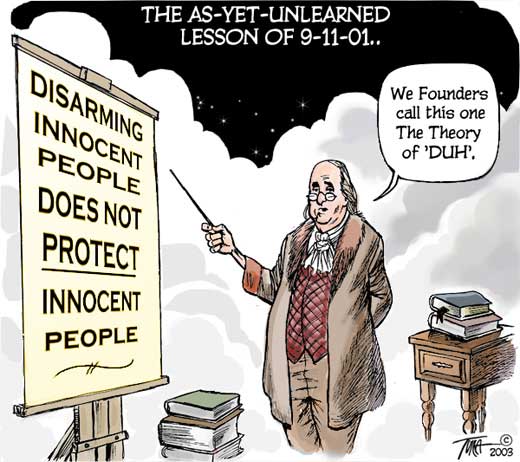
Spin, Spin, Spin

A couple of posts down is the story of Caroyln Lisle who shot an intruder in her Rancho Cordova home. Quoted in the story is one William Vizzard, described as “chair of the criminal justice department at California State University, Sacramento.” One commenter called him “a gun control flunky” and suggested Googling to prove it. So I did.

I found this interesting transcript from PBS’s Newshour from October 18, 2002 where Mr. Vizzard, described as an ex-employee of the BATF was one of the panel. The discussion was about “ballistic fingerprinting,” and was inspired by the fact that the DC snipers were active at that time.

This will be kinda long, but I’m going to fisk it.

RAY SUAREZ: The recent sniper attacks in the Washington, DC, area have revived a debate over a technology that helps authorities trace ammunition found at crime scenes. The technology is called ballistic fingerprinting, and it’s based on the idea that every gun leaves unique markings on its bullet casings.

Um, not quite so unique. Modern manufacturing methods and tooling mean that guns coming sequentially off a production line are very likely to have very similar tooling marks.

Gun makers would be required to register those fingerprints so a national database could be compiled. Until recently, crime labs relied solely on the human eye and a microscope to look at evidence from bullets, but now bullets, bullet fragments and shell casings are scanned into a computer and compared against thousands of other bullets or casings.

SPOKESMAN: When a barrel is produced or a firearm itself is produced, it’s made by other tools. The metal is formed and moved around, scraped away, and those imperfections of each of those tools in the manufacturing process have accidental characteristics it imparts on the gun. It’s still a needle in a haystack, but now we can get through the haystack faster. These comparisons from bullet to bullet are into tenths of seconds.

This assumes that there’s enough left of the bullet to allow identification. On top of that, the bullets being compared must also be of similar composition. For example, a .45 caliber 230 grain full metal jacket bullet made by Speer will have much different markings than a 185 grain hollowpoint bullet manufactured by Federal when fired from the same gun. Especially if the first was fired into a water barrel and the second recovered from a corpse after impacting a major bone. A computer probably wouldn’t be able to get a match. A human eyeball Mark I might. But the human eyeball takes a lot longer than tenths of a second.

RAY SUAREZ: Law enforcement officials back the idea of ballistic fingerprinting and so does the federal Bureau of Alcohol, tobacco and Firearms. Several lawmakers have called for legislation requiring gun makers to record the ballistic markings. The National Rifle Association and other gun rights advocates oppose legislation, saying the fingerprinting is an unproven science.

The Bush administration was also skeptical, saying earlier this week the technology might not be reliable and could infringe on privacy. But on Wednesday, Spokesman Ari Fleischer said the President does want to look into creating a national registry.

ARI FLEISCHER: The president wants this issue explored. And to that end, the Bureau of Alcohol, Tobacco and Firearms has been meeting, and met yesterday afternoon with White House staff to start to discuss the various issues: The technical issues, there are feasibility issues, the pros and cons about how this could possibly… may be effective, whether it could work or whether it would not be able to work.

Gee, thanks Mr. President.

RAY SUAREZ: While the national debate continues, two states, New York and Maryland, have already enacted laws requiring a ballistic fingerprinting for handguns.

Neither of which has yet to have a match that didn’t identify a crime gun already in their possession, contemporary with the crimes, and firing ammunition that matched that found at the crime scene.

We pick up the debate with Joe Vince, the former chief of the crime guns analysis branch of the Bureau of Alcohol, Tobacco and Firearms. He now has a consulting company in the Washington area. And William Vizzard, a former ATF agent, now chair of the division of criminal justice at California State University at Sacramento.

Well, since the speculation, Joe Vince began with the Washington area sniper, let’s take a look at how ballistic fingerprinting may have been useful in a case like this, in investigating a case like this?

JOE VINCE: In a case like this, Ray, this right now, the ballistic evidence is your best evidence. It’s almost your only evidence. So it provides a lead for law enforcement. And any time you’re working an investigation, law enforcement officials are looking for leads that take them to the next step.

You build your case incrementally. And for this, knowing that it was a .223 what type of firearm it could come from, is very useful.

RAY SUAREZ: But would you, if you had this database, have been able necessarily to narrow down what firearm?

Note, now, how Mr. Vince artfully dodges answering the question:

JOE VINCE: With a database like this, the possibilities multiply. And we have to remember that law enforcement today needs to rely on 21st century technology. In 1890, if you wanted to get in law enforcement, you received a badge, a gun and a club, and said go out there, enforce the law.

Well, that was towns of hundreds. Now we have metropolitan areas of millions. Law enforcement has to leverage technology in order to help them solve crimes — as the gentleman said on your earlier piece, to take the haystack and eliminate as much hay as you can to find the needle.

Simple question, wasn’t it? Would the technology help narrow down what firearm? Answer? Evasion, obfuscation, and haystacks. Is he called on this? Don’t be silly.

RAY SUAREZ: William Vizzard, would this have been a useful tool in this investigation?

WILLIAM VIZZARD: Well, it conceivably could be although — given the circumstances — an individual who apparently has planned these shootings in advance, it’s most likely not in the sense that we have about 200 to 250 million guns in circulation in the United States today.

And it’s possible for an individual simply to acquire one of those and use it, knowing that it’s not in the database. I mean, if we were to begin a database, for instance, today, or at whatever point Congress would cease debating it, presumably, it would start recording bullets and cartridge cases from that day forward.

Now one could of course try to collect the 250 million existing samples out there. But I don’t hear anybody really advocating that because the mechanics of simply trying to track down those guns and get some sort of record on them is extremely difficult. So Joe is certainly right about the technology; it’s extremely useful technology.

It’s proven very useful in a number of crimes involving suspect firearms and bullets or cartridge cases recovered from crime scenes. And had we been doing this from the 1930’s on, and of course in those days we didn’t have in way of cataloging it, we might have some utility at this point.

Hey! An actual answer! No wonder he’s no longer in the ATF.

RAY SUAREZ: But given the plans that are under consideration now this gun would have had to have been either used in a crime before or purchased and profiled at the time of purchase in order to get a hit in a database, is that right?

WILLIAM VIZZARD: It would have to be placed in the data base through scanning in either at time of manufacture or when it was picked up by the police.

Of course unlike fingerprints when you fingerprint an individual and they’re subsequently released and you have their fingerprints, in the case of guns, normally when police get their hands on a gun, they don’t release it and so it’s usually useful only for checking against previous crimes as opposed to building a database for future crimes.

This, too is factually accurate. So far I’m impressed.

RAY SUAREZ: I’m sorry, Joe Vince, go ahead.

JOE VINCE: Well, a good comparison is over 100 years ago when we started fingerprinting. We had no database and we were doing everything in a card file. However, we said this is a good tool to use and it has been extremely useful. Now we have a computerized AFA system; that’s a national system that has fingerprints computerized.

And we don’t only put bad people into that system of fingerprinting. Every man and woman who enters our armed services is fingerprinted. Schoolteachers are fingerprinted.

My wife is a schoolteacher; she’s in there. The reason for that in the military is to obviously check their background, check the teacher’s background but also, God forbid, if they were injured or killed in the line of duty, we could identify them.

This is the same thing we have to do. We have to take incremental steps now and build our database up so we have the same capability that we have with fingerprints.

Yet no one suggests that we fingerprint and DNA scan every single individual so we can pick criminals out of the population from crime scene evidence.

RAY SUAREZ: William Vizzard notes that there are some 250 million guns already out there. How long would it take until you had a database that was actually useful, a body of profiles that was large enough to be useful compared to the number that’s already out there?

And, once again, Mr. Vince dodges the very simple question: “How long?”

JOE VINCE: Well, I agree with Bill, there are a lot of firearms out there. But we have to take the next step. (And there is ALWAYS a “next step.”) I was in Palm Beach, Florida, last week and I talked to the sheriff’s office there. Six months ago they received the IBIS equipment and that has already linked seven or eight different homicides and shootings together that they did not know it was related.

So you can see, in a short period of time you can have some success. We have to start somewhere. Congress wisely already allocated the money. We’ve put the equipment everywhere in the United States. Now we have to effectively use it as a law enforcement tool.

Uh, Mr. Vince, you matched crime scene evidence. You did not identify the firearm or its possessor. And YOU DIDN’T ANSWER THE QUESTION.

RAY SUAREZ: Mr. Vizzard, you’ve used the fingerprints analogy. To carry it one step further, it’s pretty hard to change your fingerprints. Is it hard to change the so-called fingerprint that a firearm puts on a shell casing?

WILLIAM VIZZARD: It’s difficult. It’s more difficult than the opponents have characterized. Firearms are made of extremely hard steel and it takes a long time to wear them enough to significantly alter them. But they are capable of being altered, unlike fingerprints and DNA.

Not exactly true, Mr. Vizzard. For example, take two identical Glock model 17 handguns manufactured three years apart, both of which had been ballistically fingerprinted at manufacture. Run 10,000 rounds through gun #1. Then replace the barrel with a new one you can buy – without a background check, via mailorder. You won’t get a ballistic match on the bullet any more. You might be able to get a shell casing match, but after 10,000 rounds I’d imagine the breechface, the extractor, and the firing pin would be quite worn and the last two items might have been replaced. Add to that the fact that the hardness of the brass and the primer cup has a significant effect on the markings put on the case and you just decreased the possibility even more. Finally, swap the slides and barrels between gun #1 and gun #2. It’s the frame of the pistol that’s considered the “gun.” But it’s the slide and barrel that leave the ballistic markings. Your trail just went cold.

WILLIAM VIZZARD: I think the real issue probably here is that the devil is in the details. It’s a question of cost/benefit analysis, not a question of whether it would be desirable to have this data. I think it would be. I’m not an apologist for the NRA. I’m not morally opposed to the idea.

I simply think that if you consider the cost and the benefits, for instance, we aren’t currently, I believe, scanning into AFIS, any of the prints– any of the non-criminal prints that Joe mentioned, either at the state or the federal level. Some local agencies do.

We are taking DNA only on a very small number of samples from serious offenders. It varies from state to state, depending on what the state law is. We would probably solve far more crimes collecting DNA from everybody in the United States than we would from collecting ballistics from every gun manufactured, so I think you just have to weigh what’s the cost going to be, how is it going to work. (I stand corrected. Someone has suggested it.)

Is there going to be a chain of custody issue, which I haven’t heard anybody discuss; you can get a lead without a chain of custody issue, but if you want to actually make the comparison and you don’t recover the firearm, that’s going to be a problem.

So I don’t think it’s a case of it being a bad program in the sense that it’s evil. I think it’s just simply a very difficult program. And before you rush into it, you sit down and you figure the cost and you figure the benefits. And you say what would we do with the money if we didn’t spend it on this. That’s my only point.

And a good one it is.

RAY SUAREZ: Well, Joe Vince, how would it work? A lot of the firearms sold in the United States are made overseas. There are domestic makers and sellers as well. At what point in the life cycle of a gun would we check the markings that it puts in the firearm?

JOE VINCE: It would have to be when the firearm sold. Right now in Maryland and New York, they’re doing it with new handguns. And it really is not keeping a database of names. It refers back to a serial number of a gun and then back to the records of that dealer.

So the government really doesn’t have the information. But we do it in a way that’s very similar to the tracing of firearms that we do now for crime guns, which has also been very useful. But again I really think we have to look at integrating this, too with the various information systems we have in law enforcement.

Like, say a gun registration database? That would be the logical “next step” would it not?

JOE VINCE: The idea is that law enforcement collects enormous amounts of information. This is just one piece and DNA is another. But it’s getting knowledge from all that information. That’s what we have to look at. So it is integrating this so we can get those leads consistently and so that crimes like the sniper in Maryland can be swiftly apprehended.

RAY SUAREZ: How about that, Mr. Vizzard, the idea not being that it would provide absolute information, but when cross referenced, when overlaid with a lot of the other sources that police use, it might be useful?

WILLIAM VIZZARD: It would clearly be useful in some cases. My guess is that for sometime what you would get are rather poorly planned crimes, particularly among younger offenders who tend to acquire new guns more readily than older offenders.

I suspect– I really would question Joe’s characterization of collecting at the time of sale. Frankly collecting at the time of import or manufacture would make more sense. We’re talking about a lot of guns here and I envision ATF being back where they were when they used to put personnel at the distilleries — simply putting somebody at the factory and scanning the data in there, but without a national gun registration and licensing system, you’ve got real limits on the value. (Thank you for making my point, Mr. Vizzard.)

And of course that’s why the NRA gets so exercised by it. I’m as not offended by a licensing and registration system as they are. But without that information, private sales very often result in guns just simply being swallowed up and disappearing.

And we do oftentimes trace guns to individuals. We oftentimes lose the track, also. So I think you just have to again analyze the worth of the system as it relates to the specific kind of information you’re looking for. Nobody, I think at this point, can estimate the cost.

Every computer system ever built has turned out to be different than people expected and I realize we’re running the system on a small scale today. But if we start running on a much larger scale, we’ll probably gain some economy of scale and probably also run into problems we didn’t know we would have. All of those things have to be addressed.

Thus endeth the transcript.

All in all, I thought Mr. Vizzard was quite fair, and Mr. Vince was the typical official-line-spewing, job-justifying government flunky.

For further reading on the efficacy of a ballistic fingerprinting database for identifying firearms in the general population, I strongly recommend the initial ballistic fingerprinting study report to the California legislature, Feasibility of a California Ballistics Identification System , the follow-on AB1717 report – Technical Evaluation: Feasibility of a Ballistics Imaging Database for All New Handgun Sales, and the Maryland State Police Forensics Division IBIS report (a 2.5Mb scanned document in PDF format. Maryland never officially released this report as far as I can tell.)

When Vizzard said “Nobody, I think at this point, can estimate the cost” he wasn’t kidding. What he didn’t say was nobody can estimate the effectiveness, either. Without those two crucial bits of information, it’s damned hard to do a cost/benefit analysis, isn’t it?

UPDATE, 2/12: Reader Kevin P., who was the commenter that characterized William Vizzard as a “gun control flunky” has withdrawn that comment, and instead states: “I withdraw that term unreservedly and apologize to Mr. Vizzard should he ever read this.

“However, I will stand by the assertion that he is a gun control advocate. He is a rarity, an informed and knowledgeable gun control advocate, probably because of his career in the ATF. His performance in the PBS ballistic fingerprinting debate was fair and accurate – but it is something that should be expected and demanded of everyone.”

Yes, it should. Kevin P. also links to this quite interesting review of Mr. Vizzard’s book Shots in the Dark: The Policy, Politics, and Symbolism of Gun Control by Dave Kopel. Give it a read.

Thank you, Kevin. Stuff like this makes my day.

John Stossel, Iconoclast

John Stossel, ABC News’s token libertarian/conservative, will be on 20/20 tonight talking about the Ten Biggest Lies, Myths, and Outright Stupidities that Americans believe.

On the ABC website, Stossel says that Myth #3 is Guns are Bad

America is notorious for its culture of gun violence. Guns sometimes do cause terrible harm, and many kids are killed every year in gun accidents. But public service announcements and news stories make it seem as if the accidents kill thousands of kids every year.

According to the Centers for Disease Control and Prevention, however, fewer than 100 kids 15 and under are killed in gun accidents every year. Of course that’s horrible, and I understand why demonstrators say we need more gun control.

But guess what? The Centers for Disease Control recently completed a review of studies of various types of gun control: background checks, waiting periods, bans on certain guns and ammunition. It could not document that these rules have reduced violent crime.

The government wants to say things like the Brady Gun Control Law are making a difference, but they aren’t. Some maximum security felons I spoke to in New Jersey scoffed at measures like the Brady law. They said they’ll have no trouble getting guns if they want them.

A Justice Department study confirmed what the prisoners said. But get this: the felons say that the thing they fear the most is not the police, not time in prison, but, you, another American who might be armed.

It’s a reason many states are passing gun un-control. They’re allowing citizens to carry guns with them; it’s called concealed carry or right to carry. Some women say they’re comforted by these laws.

Many people are horrified at the idea of concealed carry laws, and predict mayhem if all states adopt these laws.

But surprise, 36 states already have concealed carry laws, and not one reported an upsurge in gun crime.

Stossel has a new book out, Give Me a Break, from which ABC’s web site has an excerpt from the opening chapter. But here’s the money quote:

In retrospect, I see that it probably helped me that I had taken no journalism courses.

I’ll say.

SWEET FREAKIN’ JEEBUS!

Via Keepandbeararms.com comes this LA Times op-ed in approval of guns! (Registration required, use Newslinks for both user and password. And captialize the “N”.) But I’m going to quote it and comment throughout:

Skeptic Gives Guns a Shot

The firearms issue looks a little different from behind the trigger.

Yes, it does. And author Diane Wagman illustrates this beautifully. Continuing:

Guns are bad. All my life, it’s been that simple. At my son’s preschool, if a child pointed a banana and said “bang,” he was admonished to “use the banana in a happier way.” As far as I was concerned, the 2nd Amendment gave us the right to protect ourselves against invading armies, not the right to buy a gun and keep it under our beds.

So what would make someone like me change my mind? I met this gun enthusiast. As research for my new novel, I asked him many questions, all the while voicing my disgust. My character might use a gun, but I never would. “Come to the range,” the gun guy said. “I’ll teach you to shoot.”

I expected a dungeon full of men missing teeth and wearing T-shirts decorated with Confederate flags. Instead, I found a sunny, wood-paneled lobby and guys who looked like lawyers on their lunch break.

Point 1: She bought the knuckle-dragging, single-digit IQ’d racist white male stereotype the anti-gun forces have been selling for decades, hook, line and sinker.

The man behind the counter was as pleasant as a grandfather from Central Casting. “What would it take for me to buy a gun?” I asked him. He explained the California laws, some of the most stringent in the country. I would have to wait 10 days ? the “cooling off” period. There would be federal and local background checks. I’d have to take a safety class. I’d have to buy a childproof lock. I couldn’t purchase an assault weapon. I couldn’t buy more than one handgun per month. Of course, he said, if I didn’t want to wait, I could drive 10 minutes and buy an Uzi illegally out of someone’s car.

Thank you, thank you, thank you sir. And thank you, Ms. Wagman, for repeating it.

When my guide arrived, he gave me a choice of handguns. I went with the .357 magnum – I recognized the name – and a traditional target with a red bull’s-eye. I couldn’t imagine shooting at one shaped like a man.

First lesson, respect your firearm. I got a little talk about how powerful it was. I learned how to hold it. To load it. And finally to fire it. It was terrifying. The gun was so heavy, I couldn’t keep it steady. It took both index fingers to pull the trigger, and then there was a flash of flame, a loud crack, a substantial kick. It was much harder than it looked in the movies.

Point 2: The only experience most people – especially most anti-gun people – have with firearms is in the popular media. And they are horribly, horribly misinformed because that source never gets it right.

I occasionally hit the target, but I also managed to obliterate the metal hanger that held it.

I have to admit: I loved it. I had a fantastic time. The power of that gun for me, a 5-foot, 3-inch woman, was immediately, shockingly seductive. The thrill when I hit the bull’s-eye (once) was as great as making a perfect tennis shot. I felt like I was playing a careful game of darts in a small, alcohol-free bar.

Point 3: Shooting is fun, and anti-gun people always find this amazing. Or fear it as a corrupting influence on “right-thinking” people.

Later, I was surprised to discover that some of my closest friends owned guns. People I never would have suspected confessed that their guns made them feel protected.

Point 4: Many, many people own guns. Far more than anti-gunners want to admit to themselves. After all, if the UN estimate is correct, there’s almost a 1:1 parity of firearms to population in this country, and that doesn’t mean 10% of the population owns ten guns each. (The pikers.)

Still, most of my friends thought handguns should be outlawed, completely, in every circumstance.

Point 5: Yet we’re told constantly by the organized anti-gun forces that they’re not interested in banning guns, only in regulating them. They’re only interested in gun safety. And they can’t imagine why we’re so paranoid as to think that the ultimate motive is the disarmament of the American public, “completely, in every circumstance.” We have to be brainwashed by the extremist NRA.

I no longer was so sure. I did some research – there are countless testimonials about guns saving someone’s life. I looked into shooting as a sport. I spoke to a woman who had found a wounded deer and shot it, ending its agony. I changed my mind: Guns aren’t bad.

Point 6: If you actually look at the facts with a fair, open mind, this is the conclusion any reasonable person will come to. And I applaud Ms. Wagman for making the effort.

Which leaves gun violence. At least in California, we don’t need more laws – we just need to enforce the ones we have. What else?

Here Ms. Wagman and I disagree – I don’t think California needs most of the laws it already has, but she’s new at this, so I’ll give her the benefit of the doubt.

The answer has to be education: teaching people to deal with anger, to solve problems, offering them brighter futures, but also Gun 101. Maybe if teenagers were given computer-generated pictures of their own bodies, post-gunshot wounds, it would help them understand the enormity of firing a weapon. Maybe if everyone spent an afternoon at the shooting range, forced to follow the rules, they would respect the power of a gun.

Point 7: Except that the anti-gun forces have done everything they can to ensure that the only exposure most kids from the cradle have to firearms is through the media that never gets it right. (See the preschool banana incident above) Or unsupervised; in criminal activity or in “playing” with the guns that she didn’t know that people like her friends owned. Yet these very same organizations are flying behind a banner of “gun safety.” The media teaches that either you’re shot dead, or “it’s only a (painless) flesh wound.” They’re taught that guns have incredible, attractive, nearly magical powers – and that they’re so evil they should never be touched. But they’re never taught the reality. After all, if they’re exposed to the truth they might become knuckle-dragging, single-digit IQ’d racists. You know: gun-nuts.

The anti-gun forces aren’t interested in “safety with guns” but “safety from guns.”

Now she sees, even if dimly, that down this path lies disaster.

I confess, I don’t know exactly how to solve the problem, but at least now I know I don’t know. Firing guns as a sport is great fun. Having a gun because it makes you feel safer seems understandable. Changing the way people behave? If you thought gun control was a distant dream – it could take centuries.

That’s the first step – admitting ignorance. Changing the way people behave? It only took us a few decades to get to where we are now, but…

Meanwhile, my 15-year-old has asked me to take him shooting. And I’ve agreed.

Ms. Wagman’s behavior has already changed, and for the better.

One at a time…

And a reminder: Don’t forget my invitation over there on the left side of the page.

Media Doublespeak?

I found this report of suicide-by-cop interesting:

Frankfort Man Shot by Police

A Frankfort man was fatally shot by police Tuesday after he pointed a rifle at an officer during a standoff.

The shooting ended a nearly five-hour-long standoff between Mark Bustamante, 28, 1205 Milroy St., and members of the Clinton County Emergency Response Team. Bustamante was fatally shot in the upper left chest at 1:20 a.m. today. He was pronounced dead shortly after at St. Vincent Frankfort Hospital.

A member of Kirklin Police Department fired a single shot from his .223-caliber rifle after Bustamante pointed an assault rifle at the officer. The policeman is now on administrative leave pending review by the firearms review board.

Now, there’s a chance that the “.223-caliber rifle” used by the officer was a bolt-action “sniper-gun,” but the overwhelming probability is that it was an AR-15 – an assault rifle itself. In fact, it’s even possible that it was an M-16, the real select-fire assault rifle, rather than the semi-auto AR-15. The article isn’t clear. Many departments are now issuing AR-15 rifles to their patrol officers rather than the traditional riot shotgun, and AR-15’s are common for SWAT teams these days. Fully-automatic M-16’s are available to police departments through the Federal government. I would be interested in knowing whether the officers on the scene were armed with “assault rifles.”

You know, guns that are only good for “killing and wounding as many people as possible at relatively short range as quickly as possible, without the need for carefully aimed fire.”

“Gun-Polluted” America?

Well here’s a lovely little editorial. From the Charleston, West Virginia Gazette comes this screed against guns. Let us fisk:

Unsafe

No hiding from guns

WHEN the West Virginia School Boards Association met last week at the Charleston Marriott, a panel discussion was held on a deadly topic: how to protect board meetings from attackers like the disturbed employee who brought a 75-shot AK-47 to a Kanawha County board session, plus buckets of gasoline, and wounded a teacher before he was subdued. (The assailant also had two pistols and a rifle in his pickup truck parked outside.)

The assembled school board members from around the state realized that dozens of Kanawha people might have been killed at the July 17 session. Only swift tackles by four brave administrators prevented a massacre. Ever since, armed police have been posted at Kanawha school board meetings, a $14,000 video surveillance system has been ordered, and electronic door locks are being considered.

Let’s see: instead of resigning themselves to be victims, four administrators decided to be a pack, not a herd, and defend themselves and others. They didn’t rely on “the authorities” to save them, they did it themselves – at great personal risk. BUT, you’ll note, they did it by physically attacking the perp because (obviously) none of the four defenders (or any of the other potential victims) was armed. What subsequent action did they take in order to protect themselves in the future? THEY EMPLOY AN ARMED GUARD. Nobody (apparently) bothered to get a concealed-carry permit, instead they HIRED OUT their protection. So if someone in the future wants to do what the original perp tried, all he has to do is cap THE GUARD. The herd will then be suitably cowed (no pun intended) and he can carry out whatever nefarious plan he wants.

At the statewide conference, lawyer Kimberly Croyle told the delegates that America suffers an average of 20 workplace murders per week, and 18,000 woundings. The worst death rate is among defenseless taxi drivers, she said, but plenty of other killings happen in offices and plants — usually committed by dismissed employees, angry clients or estranged husbands stalking their wives. Most of the slaughter is by guns.

Really? “Usually committed by dismissed employees, angry clients or estranged husbands”? I thought the overwhelming majority of “workplace murders” were robberies. I’d really like to see her source data for this.

It’s extremely difficult to predict which person will go on a murder rampage, she said. Therefore, all organizations should have “zero tolerance” for threats — and also have attack drills, like fire drills. Employees should rehearse how to barricade themselves safely and dial 911.

More “zero tolerance” idiocy, and more “don’t defend yourself – you’re not qualified” preaching from our self-appointed superiors.

Fellow lawyer John Teare gave school administrators some practical advice: When it’s necessary to discipline or fire a problem employee, try to avoid humiliating or enraging the worker. Use a gentle voice. Let the employee talk, without a dismissive brushoff. Do it at the end of the day, after other employees have gone, so the dismissee can remove personal possessions without being watched by fellow workers. At day’s end, he said, employees are weary and less likely to explode in anger.

This I can agree with. I have never understood why it was necessary to publicly humiliate someone if it’s necessary to fire them. Regardless of whether it will render them less likely to come back and shoot the place up, it takes very little effort to treat people as well as you can.

Our editor, one of the panelists, told the state delegates that workplace massacres are so rare and unpredictable that safeguards are dubious. For example, if the Kanawha school board had been shielded by metal detectors and armed guards, the killer could have pulled his pickup to the front curb and used his four guns to mow down people leaving the meeting. Likewise, it’s doubtful that detectors and guards would have deterred the psychotic students who invaded Columbine High School.

Holy shit, a voice of reason. And he’s an editor of the newspaper, no less!

However, Kanawha board member Bill Raglin replied that he worked many years in dangerous chemical plants, where strict safety practices prevented deadly spills.

Except “deadly spills” are accidents. “Strict safety practices” do nothing to prevent deliberate acts – and Mr. Raglin should certainly understand that. Apple? Meet orange.

Of course, Raglin is correct that intelligent security measures should be used. They may avert some murders. But the irrational nature of attacks — and the easy availability of deadly guns — mean that no Americans truly are safe.

“Easy availability” or not, the fact of the matter is no Americans are truly safe – and if you understand that fact then you understand that the government cannot protect you. YOU are responsible for your safety. But that’s not the mantra of this piece.

When a disturbed school employee can arm himself with a 75-shot assault weapon, two pistols and a rifle, planning to wipe out a school board meeting, who’s really safe? When deranged students can bring guns to school to kill teachers and fellow students, who’s safe?

When they can bring pipe bombs and cans of gasoline, who’s safe? When they can load a Ryder truck with fertilizer and diesel fuel (ANFO), who’s safe? When someone can drive a three-ton Cadillac through a crowd, who’s safe? When men armed with box cutters can hijack airliners and fly them into buildings WHO’S SAFE? Wake up. The world isn’t safe. Never has been.

Gun-polluted America has a murder rate much worse than nations that protect people by controlling illegal weapons.

And there are countries with strict gun control with murder rates far higher, too. (But those are “third-world” countries and don’t count – right?)

But America’s “right to bear arms” (Note the ubiquitous “scare quotes” – A “right to bear arms?” Oh, please. Don’t be gauche.) lobby is so strong that timid U.S. politicians won’t impose safeguards. Even if they did, it might require generations to cleanse the country of concealed pistols and other unlicensed murder instruments.

Note that the author completely ignores the possibility that “cleansing the country” of “unlicensed murder instruments” is IMPOSSIBLE – as has been AMPLY demonstrated by England’s experience. “Facts? Don’t confuse me with the facts. My mind’s made up! Guns are eeeeeevil!

Except, of course, when they’re in the hands of our proper masters.

Edited to add: And note the characterisation of “concealed pistols” as “murder weapons”. This completely disregards the fact that in every state where concealed carry is “shall issue” homicide rates have gone down. The people who have permits and carry are not homicidal. But this editorial paints them with the same bloody brush as the Columbine killers.

Agenda? What agenda?

Therefore, Americans are condemned to live with the daily risk of gun murders, and the rare risk of gun massacres.

Yup. And, as I pointed out before, we’re willing to live with that. It beats giving up our personal sovereignty and making the mistake a free people get to make only once.

(And, of course, the editorial is unsigned.)

“Never Have So Many Been So Wrong About So Much” for So Long

Apologies to Sec. Rumsfeld, but this guy is so stereotypical it’s almost a parody.

His name is Scott Bateman, and he’s a freelance cartoonist. Allow me to fisk his three most recent political cartoons:

Actually here Scott is illustrating two ignorances – the general public’s and his own. First, the majority of Americans believe that Saddam was in some way responsible for the 9/11 attacks, which is not true. But is the war on Iraq part of the War on Terror? Absolutely. I invite you to read (if you haven’t already) two excellent pieces: Our World-Historical Gamble by Lee Harrison, and Steven Den Beste’s outline on the cause of the War on Terror. Yes, Scott, the war in Iraq is part of the War on Terror.

Note also the typical liberal’s respect for the “little people” – those they want government to rigidly control for their own good.

A government run, of course, by caring, compassionate liberals who believe that everyone is equal. But they’re the “More Equal,” of course. The rest of us are obviously idiots.

Next we have this one:

Note the unselfconscious use of the word “quagmire.” The invasion of Afghanistan was supposed to be a quagmire. The 21-day assault on Iraq was supposed to be a quagmire. Neither was. Now that we’ve overthrown the Taliban, unseated Saddam, kicked the crap out of Al Qaeda, and prevented any follow-up terror attacks on American soil for two years, Mr. Bateman characterises this as “screwing up badly.” I don’t know what planet he’s living on, but apparently it isn’t this one. Unless he’s in France, of course.

If all you see is what the newspapers and national networks show, I can understand his pessimism, but reports from the people on the ground aren’t so one-sided. They see the people of Iraq overwhelmingly happy that we’ve freed them. LTCR (select) Smash has this anecdote. Sgt. Pontifex explains that California is not limited to the L.A. city limits, nor is Iraq limited to the Sunni Triangle. Then there are these four reports from Basra. There’s much, much more out there if you just take a little time and look.

The “real world,” Mr. Bateman?

Pot? Meet Kettle.

Finally, we have this, most recent piece:

Note that none of Mr. Bateman’s “interviewees” are apparently among the majority of “idiots” he decries in the first cartoon. No, in this case they’re exclusively limited to the moonbat minority.

The first says: “Everything’s just as it was before 9/11.” Really? 3,000 people aren’t dead? The twin towers are still standing? The Taliban still rules Afghanistan and still protects Bin Laden and Al Qaeda? Saddam and Sons still terrorize the Iraqis? We haven’t killed seven and captured five of Al Qaeda’s top 31 people? (That’s over a third.)

The second says: “We’ve thrown two countries into total chaos.” Is that a fact? Not according to what I’ve been reading. Of course, we have freed them from murderous totalitarian regimes, so I can see why the caring, compassionate liberal would be upset by that. (See “More Equal,” above.)

The third says: “The Bush Administration has failed miserably.” Afghanistan: nine weeks. Taliban: removed. Iraq – three weeks. Saddam: unseated. Uday and Qusay: Dead and Deader. Bin Laden: running for his life. Al Qaeda: severely damaged. Recent terror attacks on U.S. soil – zero.

This is “failing miserably?” No wonder nobody knows who the Democratic Presidential candidates are.

The fourth says: “I’d feel way safer if I could cower with Dick Cheney in that undisclosed location.”

No, you’d feel way safer if we’d just wrung our hands, tried to “understand why they hate us,” and attempted to buy the forgiveness of the Islamists. I’ve got news for you, Scott: You’re way safer today than you were two years ago. All the radical Islamists are trying to get into Iraq and Afghanistan to keep us from destroying their fantasy ideology.

You’re safer, but apparently not any brighter.

(Bateman’s a Kucinich supporter. Why am I not surprised?)

Please, Allow Me to Fisk…

Instapundit pointed to this USA Today piece on the political third-rail that gun control has become. I thought it was interesting, but (of course) I had some comments:

Gun-control debate gets muzzled

On the same day last month, five factory workers in Mississippi were shot and killed by a co-worker and five people in a family in Bakersfield, Calif., were killed by gunfire.

Not too long ago, dramatic slayings such as these would have created a new chapter in the national debate over gun control. There would have been angry speeches in Congress and new proposals to crack down on firearms.

But today, there is mostly silence.

That’s a point I made in an earlier essay.

Democrats, who believe that their calls for gun controls might have cost them the White House in 2000, are less willing to take on the gun lobby. Polls suggest that public fears about terrorism have helped mute the debate.

Meanwhile, the gun industry is racking up legislative wins. House Majority Leader Tom DeLay, R-Texas, says there are not enough votes in the House to renew Congress’ 1994 ban on certain assault weapons when it expires next year.

I certainly hope so. I was pissed off enough when it passed. I’d really be P.O.’d if Dubya signed the renewal.

And now, gun rights supporters are closing in on what probably would be their most enduring victory.

The Senate is close to passing a bill that would shield firearms manufacturers and dealers from civil lawsuits brought by victims of gun crimes. The measure, which the House passed 285-140 as 63 Democrats voted with the GOP majority, is an effort to shield the gun industry from the type of lawsuits that have been successful against tobacco and asbestos companies.

The popularity of the bill — it has 54 co-sponsors in the Senate, including several top Democrats — underscores the changed political dynamics of gun control. Senate Minority Whip Harry Reid, D-Nev., has signed on, and Senate Minority Leader Tom Daschle, D-S.D., might do so.

Which would be a pretty fair gauge of just how at-risk Daschle thinks his seat is.

The political divide over gun control has long cut geographically: Rural areas generally oppose greater controls on firearms, and urban areas generally favor them. Republicans usually oppose restrictions; Democrats usually back them. But Democrats in rural areas where hunting is a tradition have a tough time winning elections if they are seen by voters as anti-gun.

Let me interject something here: I know that the term “anti-gun” is just shorthand reporterese, but realistically the term successfully redefines the issue. It isn’t that the electorate thinks the politician is “anti-gun,” but that the electorate believes the politician wants to disarm law-abiding citizens. That isn’t anti-gun, that’s anti-citizen – and the electorate has generally known it. Since 911, a lot more of the electorate has woken to that fact.

That longtime party dilemma came into sharp focus after Democrat Al Gore, a supporter of gun controls, lost the key states of Arkansas, Tennessee and West Virginia en route to his narrow defeat in the 2000 presidential election. Some Democrats believe Gore’s stance on guns was to blame.

Some Republicans, Libertarians, and Independents thought so too.

Democrats became even more reticent after the terrorist attacks of Sept. 11, 2001, made improving security a national priority.

When Republican pollster David Winston asked Americans about plans to allow pilots to carry guns in the cockpit, he found that married women with children — traditionally the strongest voices favoring gun control — were among the biggest supporters.

“The soccer mom who wants to gets guns off the playgrounds through gun control is the same mom who wants pilots to be armed ” he said. “The dynamic has changed. . . . It’s putting it in the context of safety.”

And didn’t that shock their socks off! Hell, we’ve always put it in the context of safety. And for that matter so has our opposition. We say it increases your safety, they say it increases your risk. Looks like the soccer-mom contingent has made its choice.

Immunity legislation

Today, much of the conflict over gun control is focused on the litigation bill that is before Congress.

The bill would stop pending civil lawsuits and prevent future claims by victims of gun crimes against companies that sold, imported or manufactured the weapons used in such crimes. Similar legislation has been passed in 32 states. But opponents say the federal proposal is more sweeping and could prevent the firearms industry from being sued in almost any circumstance.

“I would say the breadth of the immunity granted is unprecedented,” says Dennis Henigan, legal counsel to the Brady Center to Prevent Gun Violence. “No other industry enjoys the kind of protection from legal actions that this bill would grant the gun industry.”

So sayeth the mouthpiece of the organization that promotes the book Every Handgun is Aimed at You: The Case for Banning Handguns by Josh Sugarman, executive director of the Violence Policy Center. What do you expect him to say?

The Brady Center, which is providing legal assistance in about two dozen lawsuits against the industry, says the bill would stop a lawsuit filed by relatives of those slain in a series of attacks that included the sniper shootings last fall in the Washington, D.C., area.

As well it should. The whole point of these lawsuits is to bankrupt the manufacturers since the gunban control groups have failed to shut them down legislatively.

Representatives of the firearms industry say legitimate businesses that sell guns legally should not be held responsible when the guns end up in criminals’ hands. They say the legislation before Congress is needed to protect gunmakers and dealers from bankruptcy, which has become a threat as the number of lawsuits against the industry increases.

Lawrence Keane, general counsel of the National Shooting Foundation, says gun dealers or manufacturers have not lost a case yet but have spent more than $100 million in legal fees defending themselves.

Now, it might be that my tinfoil hat is on a bit askew, but was it an innocent mistake to screw up Lawrence Keane’s position? He’s Vice President and general counsel for the National Shooting Sports Foundation. So, he represents sport shooters, not gang-bangers. OK?

“If a dealer sells a legal product to a consumer who has undergone a criminal background check and filled out the federally required forms, and (who) later gives that gun to someone else to commit a crime, that dealer should not be sued,” Keane says. Dealers or manufacturers who violate gun laws should be subject to lawsuits, he says. But Henigan counters that if the federal bill becomes law, the victims’ families in the sniper lawsuit would have to prove that the owner of the Bull’s Eye Shooter Supply in Tacoma, Wash., willfully violated gun laws involving the specific gun used in the slayings.

Well, HORRORS! Apparently Mr. Henigan believes that, simply because the owner of Bull’s Eye Shooter Supply should pay regardless of the facts.

That could be difficult to prove in court, Henigan says. The shop owner, Brian Borgelt, has claimed that the rifle allegedly used by John Allen Muhammad and Lee Boyd Malvo was shoplifted.

The facts are that Brian Borgelt ran a shoddy operation, that the BATF knew he ran a shoddy operation, but the BATF only recently yanked Mr. Borgelt’s license because of all the publicity. It would seem to me that the party that needs to be sued for not doing their job is the BATF, but we know how likely that is. According to a Seattle Times report, Lee Boyd Malvo confessed that he stole the gun from the gun shop. (Original story is not available on-line, but reference to it is in this one.) Yes, by all appearances, Bull’s Eye was badly run, but it’s the job of the BATF to control that – not stomp kittens. If Malvo had fingered Borgelt for selling the gun under the table, then there’d be grounds for a suit, and the “immunity” legislation wouldn’t save him.

But somebody please explain to me why (other than perceived deep pockets) Bushmaster is being sued? How is it their fault?

The bill to shield gunmakers and sellers from lawsuits was passed by the House in April, while much of the nation’s attention was focused on Iraq.

With the unspoken: “Those sneaky bastards!”

In the Senate, sponsors quickly signed on. Opponents, led by Sen. Dianne Feinstein, D-Calif., promise to filibuster the bill to try to prevent it from coming up for a vote. But sponsors need just six more votes, for a total of 60, to end a filibuster and force a vote.

Tobacco model

Litigation against the gun industry has come on the heels of lawsuits that cost tobacco companies billions of dollars in settlements.

From an industry that can support those kinds of losses. The gun industry in America is not so large, regardless of our love of guns. The tactic isn’t to milk the companies for everything they can, it’s to bleed them to death through lawsuit after lawsuit, regardless of the outcome. That’s why the legislation is necessary.

In 1998, Chicago, which had banned the sale of handguns, sued the firearms industry. The city claimed that the industry had created a public nuisance through sales patterns that allowed guns to be diverted to criminals. Within two years, 33 other cities and counties sued on similar grounds.

There is no count of the number of gun crime victims who have sued, but their claims include allegations of unsafe design and negligent distribution.

And they can still sue for unsafe design – but not if the gun goes off when the trigger is pulled. Negligent distribution? That one doesn’t fly anywhere.

So far, none of the lawsuits has been successful.

Gee, I wonder why?

Suits in New Orleans, Miami, Atlanta, Wilmington, Del., and Camden County, N.J., have been dismissed. Boston and Cincinnati voluntarily dropped their claims, in part because of cost.

And remember, they’re doing it on the taxpayer’s back. The gun industry isn’t.

About a dozen of the local lawsuits are still working their way through the courts. Henigan says he is heartened by several appellate decisions that have allowed suits in Ohio, Illinois and New Jersey to go to trial. But he believes that much of the pending litigation could be dismissed if Congress passes the immunity bill.

Even without the legislation, advocates of holding gunmakers and dealers liable for gun violence may have trouble convincing juries of it.

Peter Schuck, a Yale Law School professor, says gun litigation differs from tobacco litigation in key ways. Juries, he says, have little sympathy for cigarette companies, but they do for gunmakers.

Establishing liability on the part of the gun industry, he says, will be more difficult. “It is almost universally accepted that smoking causes lung cancer,” he says, but linking gunmakers and dealers to violence is more difficult to prove.

Perhaps because they can’t? And they know it?

Thirty-five States Now, and They’re STILL Predicting the Wild West?

MSNBC weighs in on Missouri’s renewed attempt to join the majority of the nation in “shall-issue” concealed-carry legislation. So of course we get to read things like this:

The bill’s champions say that allowing concealed weapons could make things safer because criminals would have second thoughts about holding up a store where other customers and maybe even the clerk are packing. Opponents, on the other hand, foresee a Wild West mentality and warn against the increased presence of firearms in the workplace.

Right. The “No Guns Allowed” signs do such a marvelous job of keeping crazed killers out.

“The fact that concealed weapons are currently outlawed in Missouri creates an incentive for businesses looking to expand or relocate in Missouri by increasing safety in the workplace,” said Kristi Wyatt, senior vice president for government relations.

Riiiiight. How, exactly does not allowing law-abiding citizens to carry a firearm “increase workplace safety?” Time for another cartoon:

(Kevin Tuma) The article isn’t completely anti-gun, but I am constantly amazed by gun-bancontrol supporters repeated use of “Wild West” and “blood in the streets” arguments when it has been proved conclusively by over thirty other states that this never happens. See “Cognitive Dissonance” below.

I’m 3-for-3!

Pickings must be slim.

The local lefty rag here in Tucson, the Tucson Weekly, is a fairly amusing paper I read every now and then just to see what the other side is up to. And, give them credit, they do a better job of bird-dogging the local government than either of the two local “mainstream” yellow-journals. They even print stuff by conservatives! (Well, one conservative, and he’s pretty close to where the right-wing raving lunatics meet the left-wing barking moonbats.)

What they do print, though, is letters to the editor, and I’m three-for-three now. The Weekly has a far-left columnist by the name of Renée Downing who publishes every other week or so, who wrote a column for the April 3 edition entitled “A Fine Line” that – to put it bluntly – pissed me off. So I wrote a letter to the editor. And they printed it, almost verbatim. They only edited it for length, and the cut was minor. If you want, you can read it here. (It’s entitled “Meet Renée Downing, Hateful Liberal” – I’m not responsible for the title. Scroll down, it’s the last one on the page.) That column drew fire from at least one other person. In the April 24 issue, see the letter entitled “Renée Downing’s Biggest Fan”.

The same week they published my first missive (and after the taking of Baghdad) Renée equivocated with her column, “In Search of Some Good Amusement” and I felt I ought to task her for it, so I wrote another submission. It was accepted. It’s in the May 8 issue, entitled “Yet More Love for Renée Downing” (next to last letter on the page).

Well, apparently the criticism got to old Renée, so in the June 12 issue she wrote a column entitled “I Can See Clearly Now” that, once again, inspired my pen keyboard. I was tempted to write a complete rebuttal column, but I knew they’d never print that, so I whipped out a short and pithy piece and wafted it through the ether to them Tuesday afternoon. They called me today and told me to expect to see it in a week or two.

In order to spare you the wait, (like you really care) here it is in its entirety now:

I see Ms. Downing’s been affected by the volume (and vitriol) of the mail responding to her op-eds. (“I Can See Clearly Now.”)

Alas, her conversion seems somehow…contrived.

The heart of the liberal still beats firmly in that breast. Yes, the caring and compassion of the true liberal still shines through like a beacon. There’s no fooling us. She cares deeply about everyone and everything around her. I mean, just read her words:

“I’m a female Republican so reading and listening aren’t really necessary for me.”

“…those soft, balding, white men who, even in middle age, must struggle every day with crippling mother issues.

Yes, by G_d, she does care about each and every one of us! She wants us to get everything that’s coming to us. Good and hard!

But on the off-chance that some of that criticism did crack the liberal shell, I sincerely invite her to join this soft, balding white man (who has no mother issues I’m aware of, crippling or otherwise) at the Tucson Rifle Club where I would be pleased to introduce her to some of the contents of my in-home arsenal so that she can free herself of the crippling fear that most liberals seem to have of firearms in the hands of law-abiding citizens. Any step forward is a positive one, I always say.

I cannot help but wonder if she’ll take me up on the offer….

“…they know [guns] are trouble and anytime there is one around, someone is going to get hurt.”

That quote from this San Francisco Bay Guardian column on the local chapter of the Pink Pistols who are trying to get San Francisco’s CCW permit process changed. According to the article there are only “five permits issued to non-law enforcement personnel in the city.” Five. And you can bet they’re either celebrities or government officials. Mere peons need not apply. And, of course, the header of the section on this push is entitled “Licensed to kill”.

Here’s the whole quote:

“This is an antigun city, and I’m proud to say that our District Attorney’s Office has the highest gun-prosecution rate of any county in the state,” District Attorney Terence Hallinan said. “San Franciscans don’t like guns; they know [guns] are trouble and anytime there is one around, someone is going to get hurt.”

Yeah, all those armed police officers sure are dangerous.

The article does get in this excellent zinger:

In California it’s up to the discretion of the chief law enforcement agency in each county to grant a CCW permit. Evidently Marin County is lenient about CCW permits, as it issued one to actor and resident Sean Penn, who recently made the news when his car was stolen, along with two of his handguns, when he was in Berkeley. It is no secret that Penn has been convicted of assault and domestic violence, a history that would normally disqualify any applicant from permission to carry a concealed weapon.

But he’s not a peon – he’s one of the priviledged class.

And, of course, there’s this inevitable question that comes up every time “shall-issue” is mentioned:

What would be the implications if more people were issued CCW permits in San Francisco? Would there be shoot-outs over parking spaces and taxis? Would queer bashing decrease but homicides by queers increase? Will there be a day when you’ll have to check your gun at the bar, like in San Francisco of 150 years ago?

At least the author answers that question – “Not likely” he says.