Our Economic Titanic

This is a harsh-your-mellow post of the Über-variety.  You are forewarned.

Every generation has its Chicken-Littles, foretelling gloom, doom and disaster if Something Isn’t Done RIGHT NOW about some crisis du jour.  Paul Ehrlich springs immediately to my mind, predicting from the depths of 1968 worldwide mass starvation by 1980 even if the world’s governments seized immediate dictatorial control over agriculture and human reproduction in his book The Population Bomb. Unapologetic more than forty years after his hyperbolic assertion that “The battle to feed all of humanity is over. In the 1970s hundreds of millions of people will starve to death in spite of any crash programs embarked upon now. At this late date nothing can prevent a substantial increase in the world death rate…”, Wikipedia reports that in 2009 Ehrlich and his co-author wife were proud of the book, stating:

The Ehrlichs stand by the basic ideas in the book, stating in 2009 that “perhaps the most serious flaw in The Bomb was that it was much too optimistic about the future(my emphasis) and believe that it achieved their goals because “it alerted people to the importance of environmental issues and brought human numbers into the debate on the human future.”

Nothing if not brazen.

Oh, and well, wrong.

Then there are the Cassandras who can see what’s coming down the pike that the rest of the public can’t seem to.  Their predictions aren’t as immediate, but can be every bit as doom-laden.

I’m not immune.  In the seven years I’ve been writing here, one ongoing theme has been “Tough History Coming,” a phrase from a Peggy Noonan op-ed that caused quite a stir when it was published in 2005. Many pooh-poohed this (normally Pollyannish) Noonan observation:

I think there is an unspoken subtext in our national political culture right now. In fact I think it’s a subtext to our society. I think that a lot of people are carrying around in their heads, unarticulated and even in some cases unnoticed, a sense that the wheels are coming off the trolley and the trolley off the tracks. That in some deep and fundamental way things have broken down and can’t be fixed, or won’t be fixed any time soon. That our pollsters are preoccupied with “right track” and “wrong track” but missing the number of people who think the answer to “How are things going in America?” is “Off the tracks and hurtling forward, toward an unknown destination.”

One commenter stated, “(E)very generation, feels like the ‘wheels are coming off’ in some sense.” To which Billy Beck, responded: “Every now and then, they’re right about it.” In fact, I quoted Billy again just the other day on the same subject.

“Man-caused disasters” of epic proportion are hardly limited to assaults on Mother Gaia. We puny humans can screw ourselves up in other ways as well. What we appear to be best at is socio-political self-savagery, followed by the interpersonal type, and America is hardly exempt.  In fact, we seem to be as exceptional at it as we’ve been at most everything we’ve tried.  Now we’re trying economic self-savagery again, and this time we appear to be intent on doing it harder.

Let’s look at the evidence.

The United States federal budget has, since 1968, been in the black only five years according to this Congressional Budget Office report (PDF): 1969, and 1998-2001. Those last four years the budget was black only because the Social Security surplus was used to buy our debt.  It’s always used to buy our debt (and the IOUs are put in AlGore’s “lockbox” and forgotten), but those five years the combination of overall revenue versus overall expenditure produced a bit of a surplus.

Over that 40-year period, the national debt climbed from $285.5 billion to $5.035 trillion, an increase of 1,763%. During that same period the expenditures of the federal government as a percentage of Gross Domestic Product hovered at about 20.6%, and tax revenue as a percentage of GDP hovered around 18.3%.

Think about that.  Take the GDP as a value of 100 units.  Our income was 18.3 units, our expenditures were 20.6 units.  Our expenditures were 112.6% of our income on average.  I don’t know about you, but I couldn’t run my personal finances for 40 years having to borrow the equivalent of 12.6% of my income each and every year, and never paying that debt down. Yes, I have a mortgage equivalent to a bit over 150% of my annual income, but I don’t pay it with my credit cards. My net debt has increased, but I at least understand that I have to pay it down, and so far I’ve been able to.

When Ross Perot ran for President in 1992, the national debt was in excess of $2.6 trillion, the deficit was in excess of $260 billion, Congress showed no intention of changing its spendthrift ways, and the executive showed no inclination to restrain them. Perot ran on a platform of fiscal responsibility and lost massively. Bill Clinton won the election, and say what you will about the man (and I have), deficits did decrease under his administration until there was actually more money coming in (if you include Social Security) than going out.

That changed abruptly. We were back to deficit spending where we’ve been ever since, and now we’re turbocharging it:
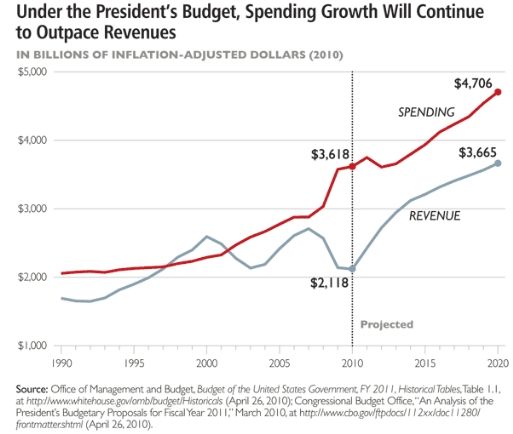
The data for this graph is from the Congressional Budget Office as well.  The projected spending, if our Congressweasels don’t step up to the plate, is pretty much set.  The projected revenue, on the other hand, is vaporware as far as I’m concerned.  Does it look anything like 18% of projected GDP to you?

And will our Congressweasels step up to the plate?  Why should they?  They’ve been kicking the can down the road for decades already.  Nobody wants to be the guy left without a chair when the music stops.

No, we keep hearing that we should “tax the rich.”  Well, we do tax the rich. No, really.  And it’s not enough to keep up with the spending.

And the Left keeps clamoring for more spending, and more taxes on “the rich.”

Iowahawk, in his inimitable way takes that concept to its logical conclusion.

I saw a bumper sticker the other day that made me want to drag the driver out of the car and beat him sensible with a Cluebat™. It said, “Hey, Conservatives: Medicare IS Socialized Medicine.”

Well, DUH. So is “Social Security.” What’s your point? They’re both failing, just like all “Socialized” programs do. Social Security?

“Social Security has been the most successful social program initiated by the federal government in the history of this country,” said Sen. Bernie Sanders, a Vermont independent Socialist and the (Senate Social Security) caucus’s leader. “We are getting very tired of hearing Republicans saying Social Security is collapsing.”

It’s not, and estimates are that its trust funds won’t be exhausted until 2037.

Trust fund? TRUST FUND?? The one that’s full of IOU’s from the National Treasury?

Fueling the new worry is a report this week from the nonpartisan Congressional Budget Office that suggests Social Security may be more of a drain on scarce resources – or in need of strengthening – than had been thought previously.

The CBO said that if interest were excluded, the system would run a deficit of $45 billion this year and a total of $547 billion from 2012 to 2021.

Medicare? Well, aside from the fact that Medicare doesn’t pay enough to make doctors want to accept it, it’s hemorrhaging money too. An estimated $100 billion a year through fraud alone. But there are bigger problems.

Medicare is already growing faster than Social Security, and it could become bigger and more expensive than Social Security in the next 25 years. It is also growing faster than the economy, and if that keeps up, Medicare could cause the national debt to swell up to more than two-thirds of the gross domestic product in just the next decade.

For years, experts have also warned that Medicare faces trillions of dollars in unfunded liabilities — meaning that it will have to pay trillions of dollars more than the amount of money that is coming in. In fact, last year, the Medicare trustees warned that the program was facing more than $36 trillion in unfunded obligations.

Even worse? Other payouts, in addition to Welfare and Social Security represent one-third of U.S. wages:

Even as the economy has recovered, social welfare benefits make up 35 percent of wages and salaries this year, up from 21 percent in 2000 and 10 percent in 1960, according to TrimTabs Investment Research using Bureau of Economic Analysis data.

And the public reaction?

Less than a quarter of Americans support making significant cuts to Social Security or Medicare to tackle the country’s mounting deficit, according to a new Wall Street Journal/NBC News poll, illustrating the challenge facing lawmakers who want voter buy-in to alter entitlement programs.

In the poll, Americans across all age groups and ideologies said by large margins that it was “unacceptable” to make significant cuts in entitlement programs in order to reduce the federal deficit. Even tea party supporters, by a nearly 2-to-1 margin, declared significant cuts to Social Security “unacceptable.”

Nick Gillespie of Reason says it: 3 Essential Facts About the Current Moment: We’re Out of Money, The Public Sector is Overpaid, & We Can’t Tax Our Way Out of This. Eric S. Raymond as well:

The political system I have been criticizing all my adult life is fast approaching the point of “no choices left”. And not just in the U.S., either; the same problems of political overcommitment and structural insolvency are playing out in advanced nations all over the planet.


Politics as we know it has had a structural problem for a long time; the self-destructive interest-group scramble that Mancur Olson identified in The Logic of Collective Action continually makes parasitic demands beyond the capacity of the underlying economy to supply, and the difference has to be papered over by massive government borrowing.

This is all very well until, as Margaret Thatcher put it about socialism, “you run out of other peoples’ money.” The system is reaching that point now. Bond investors are figuring out that the debt load has become impossible and are increasingly refusing to either purchase new debt or roll over existing paper. The muni and state-bond market in the U.S. is near-moribund, and the threat of sovereign debt default is tearing the Euro zone apart. U.S Treasuries increasingly look like Wile E. Coyote running in midair; they’ll keep selling only as long as nobody actually looks down…

Insolvency is no longer a sporadic problem, it’s become pervasive at all levels of government everywhere. This is why the recent brouhaha in Wisconsin was so surreal. The public-employee unions weren’t just rearranging the deck chairs on a sinking Titanic, they were fighting to preserve their right to bore more holes in the hull.

References to the Titanic are getting to be common:

In the James Cameron [*spit*] movie “Titanic,” there is this great scene that illustrates a point about our current economic situation.  The iceberg is struck.  Because of the glancing blow, the more primitive metallurgy that resulted in brittle steel of the hull, a long gash was ripped across three of the main watertight compartment sections of the front of the ship. With the first three main sections rapidly filling with water, the engineer/ship designer, played by Victor Garber, lays out the side view plans of the ship to show the captain that there is no doubt that the ship is going down and there is absolutely no way to stop it.  It may take an hour or so for the ship to disappear below the waves, but no amount of bilge pumping or anything else is going to stop the inevitable.

That’s what is happening with our economy.

There are a lot more.

The world is paying attention. After all, other governments are going broke, too, and fewer want to buy our debt.

I thought about filling this post with charts and graphs like the ones I started it with, but that’s not really necessary.  If you read this blog regularly, you’re probably part of that tiny fraction of the population that’s paying attention.  I’ve been working on this post for a while, collecting links and thinking.  You see, I’m in kind of an odd situation.  I’m an engineer, and the company I work for specializes in raping Gaia primary metals mining.  Yes, we design the plants that process the ores ripped from Gaia’s womb the earth.  Iron, copper, silver, gold, molybdenum, etc.

And we’re busy as hell.

So’s our competition. 

We’re hiring, they’re hiring, the mining companies are spending money improving processes, expanding facilities, and building entire new mines all over the world.

So long as demand (and prices) stays high, we’ll remain so.

But I keep thinking that we’re sailing on the Titanic, rearranging the deck chairs while the public sector unions crew are boring holes in the hull and the aging population passengers are ceasing to bail out the bilges, but instead doing the exact opposite.

As I watch Japan dig itself out from under the – literal – fallout of a massive earthquake and tsunami, I observe as Victor Davis Hanson does, The Fragility of Complex Societies.  Being an engineer, I do believe I understand the world in ways most other people never will.  I understand, for one thing:

Reality is the murder of a beautiful theory by a gang of ugly facts.

Theory and reality are only theoretically related.

In theory there is no difference between theory and practice.

In practice there is.

And I understand that when someone high up in the financial machinery of the government states:

“If we continue down on the path on which the fiscal authorities put us, we will become insolvent, the question is when,” Dallas Federal Reserve Bank President Richard Fisher said in a question and answer session after delivering a speech at the University of Frankfurt. “The short-term negotiations are very important, I look at this as a tipping point.”

then The End is (most probably) Near™.

How near? Well, I’m 49 now. Let’s just say that I’m more and more convinced that Dale of Mostly Cajun was more right that he probably thought when he said:

Retire? I will probably get killed in the early battles of the coming revolution.

But it won’t be a revolution, I don’t think.

It’ll involve face colanders, possibly.

Richard Fisher said he was confident in the Americans’ ability to take the right decisions and that the country would avoid insolvency.

I’m not.

I started this essay with the working title of “Apparatchiks and Entropy,” inspired by my Quote of the Day for February 15, which stated in part:

The ability to get ahead in an organization is simply another talent, like the ability to play chess, paint pictures, do coronary bypass operations or pick pockets. There are some people who are extraordinarily good at manipulating organizations to serve their own ends. The Russians, who have suffered under such people for centuries, have a name for them — apparatchiks. It was an observer of apparatchiks who coined the maxim, “The scum rises to the top.”

The apparatchiks are, in part, that third of the economy made up of Federal payouts. They are, in part, the public sector union members boring holes in the hull of our Titanic economy. They are, in part, the people waiting to receive the benefits they’ve been told they were paying for all their working lives, whose proceeds even now they believe sit in “lock boxes”and “trust funds.”  They are, in part, the people Peggy Noonan described:

I have a nagging sense, and think I have accurately observed, that many of these people have made a separate peace. That they’re living their lives and taking their pleasures and pursuing their agendas; that they’re going forward each day with the knowledge, which they hold more securely and with greater reason than nonelites, that the wheels are off the trolley and the trolley’s off the tracks, and with a conviction, a certainty, that there is nothing they can do about it.

I suspect that history, including great historical novelists of the future, will look back and see that many of our elites simply decided to enjoy their lives while they waited for the next chapter of trouble. And that they consciously, or unconsciously, took grim comfort in this thought: I got mine. Which is what the separate peace comes down to, “I got mine, you get yours.”

The apparatchiks have been manipulating organizations to serve their own ends, to “get theirs,” for so long now that the entropy is irreversible. The Titanic is sinking, and cannot be saved.

And I wonder what the future of my grandchildren is going to look like, because the Cassandric words of Donald Sensing still echo in my mind:

I predict that the Bush administration will be seen by freedom-wishing Americans a generation or two hence as the hinge on the cell door locking up our freedom. When my children are my age, they will not be free in any recognizably traditional American meaning of the word. I’d tell them to emigrate, but there’s nowhere left to go. I am left with nauseating near-conviction that I am a member of the last generation in the history of the world that is minimally truly free.

UPDATE: More cheery news with another Titanic reference.

UPDATE: Found this at Theo Spark:
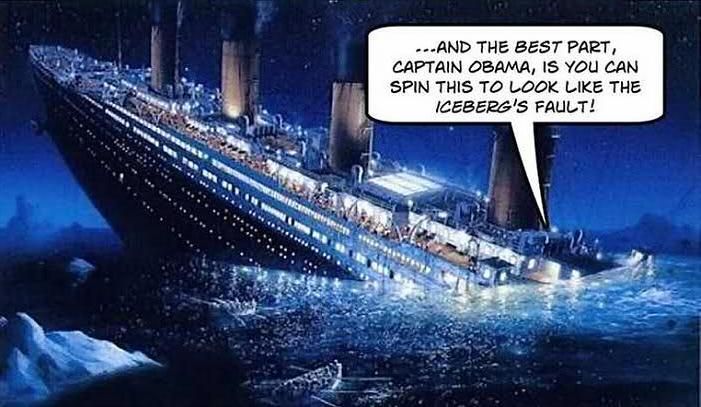
Self-inflicted

Yesterday’s QotD came from a comment left by the Geekwitha45 to a previous post.  That comment in its entirety goes:

The MSM isn’t broken.

It’s operating effectively, as designed and intended. Unfortunately, being a source of unbiased, deep information is not a design consideration.

What *is* broken is the electorate, which failed to detect that condition and correct for it.

This is why I no longer believe myself to have any duty of conscience to be chained to the outcomes of a broken electorate or electoral process.

Which sucks, because all I ever really wanted from my government was a vigorous defense of my natural rights, in a package that was safe enough to mostly ignore, instead of the ringside seats at the horror show.

Wheee.

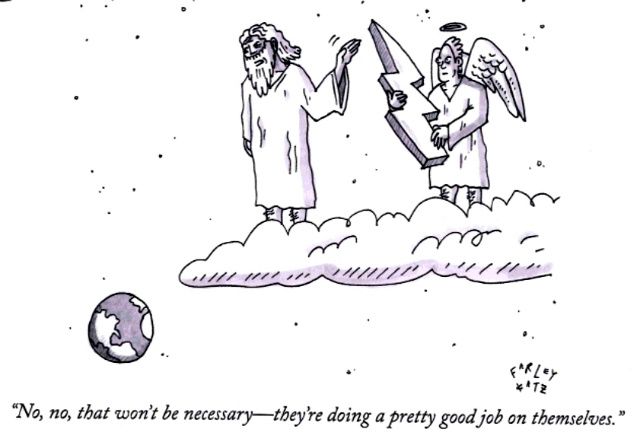
One of my co-workers has a cartoon-a-day calendar of New Yorker cartoons.  This one is from a few days ago:
I’ve got a few thousand words to say on this topic that I just can’t get written down.  I hate when that happens, but I thought I’d share the picture with you and prompt you for your thoughts.  Maybe you’ll break my damned dam free.

Quote of the Day – Billy Beck Edition

I keep saying it: the basic conflict in American politics is individualism vs. collectivism in all its pretense forms and manifestation. I keep saying it because no arrangements of coalition electoral politics will address this fundamental schism: as the necessary economic implications become real, so-called ‘democracy’ becomes impotent to manage coalition demands, all while the force of ‘law’ becomes more arbitrary at coalition demand.

I’ve been saying it for at least fifteen years: “The pace of this thing is picking up.”

I hate to keep saying it, because I know it’s no fun to hear it and it just wears my narrow white ass out to keep-ass saying it, but the real problem under all this is fucking enormous

I really don’t think it can be fixed before it really goes the way of the pear. We’re really in it. In our lifetimes.

Billy Beck, Two-FourWhat Really Happened

Quelle Suprise

111th Congress Added More Debt Than First 100 Congresses Combined: $10,429 Per Person in U.S.

The federal government has accumulated more new debt–$3.22 trillion ($3,220,103,625,307.29)—during the tenure of the 111th Congress than it did during the first 100 Congresses combined, according to official debt figures published by the U.S. Treasury.
That equals $10,429.64 in new debt for each and every one of the 308,745,538 people counted in the United States by the 2010 Census.
The total national debt of $13,858,529,371,601.09 (or $13.859 trillion), as recorded by the U.S. Treasury at the close of business on Dec. 22, now equals $44,886.57 for every man, woman and child in the United States.
In fact, the 111th Congress not only has set the record as the most debt-accumulating Congress in U.S. history, but also has out-stripped its nearest competitor, the 110th, by an astounding $1.262 trillion in new debt.

No pitchforks, no torches, not even any tar and feathers.

I am reminded once again of Thomas Jefferson’s letter to William Stephens Smith in which he said:

The people cannot be all, and always, well informed. The part which is wrong will be discontented, in proportion to the importance of the facts they misconceive. If they remain quiet under such misconceptions, it is lethargy, the forerunner of death to the public liberty. … What country before ever existed a century and half without a rebellion? And what country can preserve its liberties if their rulers are not warned from time to time that their people preserve the spirit of resistance? Let them take arms. The remedy is to set them right as to facts, pardon and pacify them. What signify a few lives lost in a century or two? The tree of liberty must be refreshed from time to time with the blood of patriots and tyrants. It is its natural manure.

We have lethargy even when we’re informed.

Quote of the Day – Tough History Coming Edition

From Daphne at Jaded Haven in Last Call:

Today’s stark refusal of the senate to heel in their most venal, basic impulses over the country’s dire need for prudent management during our current economic implosion, a feat they foolishly orchestrated in all of their glorious incompetence, tells me we’ve crossed the abyss into no man’s land.

The crisp suits we’ve elected to spend and manage our money don’t have a single ounce of respect for the work and sacrifice we provide to fund their sickening folly. Their disdain for the republic is manifest in every piece of statist legislation under consideration, their privileged contempt for our conscripted dollars evident in every spendthrift measure they pass.

I believe it’s finally time to start discussing alternatives to our present system. The republic of the founding fathers no longer exists.

It hasn’t for quite some time, Daphne.

If You Write for the Alt SF Weekly. . .

. . . does that mean you’re a conservative?

I strongly recommend to you a two week old SF Weekly story, Let It Bleed, that begins like this:

“Infinite” is not a word you expect to find in a report on municipal spending. It’s more of a science fiction–type term — Tremble, Earthling, before the infinite might of Galaxor! But there it was, in a recent report on San Francisco’s finances: Spending on the city’s employee retirement system in the past decade had grown at an “infinite” rate.

Naturally, that’s an exaggeration. If you do the math, the city’s retirement costs for employees in the past 10 years actually grew only 66,733 percent.

Still, you might call that a Galaxor-sized number.

In fiscal year 1999-2000, the city spent about $300,000 on its retirement system. In fiscal year 2009-10, it was $200.5 million. Benefits alone — not salaries, just benefits — for current and retired employees this year are budgeted at $993 million. Spending on retirees’ health care and pensions is conservatively projected to triple within five years.

And after that? Infinite.

Oh, and this:

San Francisco has known about this looming crisis for a decade — and gone out of its way to make things worse.

In fact, on those few occasions when somebody has tried to do something about it, city government has worked with unions to successfully sabotage those efforts. San Francisco may not be in as deep a hole as many cities, but it’s shoveling a lot harder.

Go. Read. And ask yourself how many other cities are in a similar bind, and what they’re going to do about it.

Tough history coming, indeed.

Learned Feudalism

On May 13, George Will delivered the keynote speech at the Cato Institute’s biennial Milton Friedman Prize dinner. You can listen to the podcast, or if you prefer, I’ve cleaned up the voice-recognition transcript that was, to put it mildly, “not 100% accurate” below. It’s a good speech, and after Tuesday, it’s even more relevant:

Someone once said that the Chicago Cubs are to the World Series as the Tenth Amendment is to constitutional law: of rare and inconsequential appearance. Thank you Ed for that generous introduction that proves that not all forms of inflation are painful. It put me in mind of the Renaissance Pope who used to travel about Rome being greeted by crowds with cries of the “Deus Est, Deus Est” – “Thou art God, Thou art God.” The Pope said “It’s a trifle strong, but really very pleasant.”

I want to thank all of the people in this room for making Cato and its work possible. And I want to thank a few million more people who in recent weeks have toiled to demonstrate in a timely manner why Cato is necessary – I refer of course to the people of Greece.

Milton Friedman, whose name we honor tonight, was honored often for his recondite and subtle scholarship. But it was complemented by a sturdy common sense much in fashion nowhere now. About forty years ago he found himself in an Asian country where the government was extremely eager to show off a public works project which was inordinately and excessively fond – it was digging a canal. They took Milton out to see this, and he was astonished because there were hordes of workers, but no heavy earth moving equipment. And he remarked upon this to his government guide, and the man said “Mr. Friedman, you don’t understand this is a jobs program. That’s why we only have men with shovels.” To which Friedman said, “Well, if it’s a jobs program why don’t they have spoons instead of shovels?”

The attempt to educate the world to the principles of rationality and liberty never ends. It began in earnest for a lot of us in 1962 with the publication of Capitalism and Freedom. In 1964, two years later, we got a demonstration of how urgent it was to have that book when Lyndon Johnson, campaigning for president said, “We’re in favor of a lot of things and we’re against mighty few.”

Well the man running against him at that time, 1964, was of course Barry Goldwater, who, to the superficial observer, seemed to lose because he only carried 44 states. When the final votes were tabulated sixteen years later however, it was clear that he had won. However it was a contingent victory. In 2007 per capita welfare state spending – per capita welfare state spending, adjusted for inflation – was 70% higher than it had been when Ronald Reagan was inaugurated 27 years earlier.

The trend continues and the trend is ominous.

Fifty-one days ago now, the President signed into law the Health Care Reform, the great lunge to complete the new deal project, and the Great Society project. The great lunge to make us more European. At exactly the moment that this is done the European Ponzi scheme of the social welfare state is being revealed for what it is. There’s a difference. We are not Europeans, we are not in Orwell’s phrase “a state-broken people.” We do not have a feudal background of subservience to the State. No, that is the project of the current administration. It can be boiled down to “Learned feudalism.”

It is a dependency agenda that I have been talking about ad nauseam. Two recent examples. When the government took over student loans, making that the case that now the two most important financial transactions of the average family – get a housing mortgage and a loan for college tuition – will now be transactions with the government, they included a provision in the student loan legislation that says there will be special forgiveness of student loans for those who go into work for the government or for non-profits. One-third of the recent stimulus was devoted to preserving Unionized public employees’ jobs in states and localities, and so it goes. The agenda is constant.

In 1965 with the Elementary and Secondary Education Act, the final dissolution in some ways of the sense of restraint on the part of the federal government, it was advertised as aid for the poorest of the poor. Ten years later, in 1975, 80% of all school districts were participating in this. It is a principle of liberal social legislation that a program for the poor is a poor program. The assumption is that middle class Americans will not support a program aimed only for the poor.

That is a theory refuted by the fact that the earned income tax credit, supported and expanded by Ronald Reagan, is extremely popular in this country. But it does reveal the fact that dependency is the agenda of the other side. It is the agenda to make more and more people dependent in more and more things on the government. We can now see today in the headlines from Europe where that leads. It leads to the streets of Athens where we had described by media as “anti-government mobs.”

The “anti-government mobs” were composed almost entirely of government employees.

The Greeks – the Greeks and the Europeans have said all along as they increase the weight of the state, in danger of suffocating the economy, “So far so good.” They kept saying, “So far so good.”

Reminds me of – everything does sooner or later – of baseball stories. True story. In 1951 Warren Spahn, on the way to becoming the winningest left handed pitcher in the history of baseball, was pitching for the then Boston Braves against the then New York Giants in the then Polo Grounds. And the Giants sent up to the plate a rookie who is 0-for-twelve. It’s clear this kid would never hit big league pitching, some kid named Willie Mays. Spahn stood out on the mound sixty feet six inches from home plate, threw the ball to Mays. Crushed it. First hit, first home run. After the game the sports writers went up to Spahn in the clubhouse, said “Spawny, what happened?” Spahn said, “Gentlemen, for the first sixty feet that was a hell of a pitch.”

It’s not good enough in baseball and it’s not good enough in governance either. Let me give you a sense, a framework to understand this extraordinarily interesting moment in which we live. I believe that today, as has been the case for 100 years and as will be the case for the foreseeable future, the American political argument is an argument between two Princetonians: James Madison of the class of 1771, and Thomas Woodrow Wilson of the class of 1879.

I firmly believe the most important decision taken anywhere in the twentieth century was the decision taken as to where to locate the Princeton graduate college.

President of Princeton Woodrow Wilson wanted it located down on the campus. Other people wanted to located where it in fact is, up on the golf course away from the campus. When Wilson lost that, he had one of his characteristic tantrums, went into politics and ruined the twentieth century.

I’m – I’m simplifying a bit.

Madison asserted that politics should take its bearings from nature, from human nature and the natural rights with which we are endowed that pre-exist government. Woodrow Wilson, like all people steeped in the nineteenth century discovery (or so they thought) that History is a proper noun with a capital “H,” that history has a mind and life of its own, he argued that human nature is as malleable and changeable as history itself, and that it is the job of the state to regulate and guide the evolution of human nature, and the changeable nature of the rights we are owed by the government that in his view dispensed rights.

Heraclitus famously said “You cannot step into the same river twice,” meaning that the river would change. The modern progressive believes that you can’t step into the same river twice because you change constantly. Well those of us of the Madisonian persuasion believe that we take our bearings from a certain constancy. Not from, well to coin a phrase “the evolving standards of decency that mark the progress of a maturing society.”

That has become, that phrase from Justice Brennan, has become the standard by which the constitution is turned into a “living document.” A constitution that no longer can constitute. A constitution has, as Justice Scalia said, an anti-evolution purpose. The very virtue of a constitution is that it is not changeable. It exists to prevent change, to embed certain rights so that they cannot easily be taken away.

Madison said rights pre-exist government. Wilson said government exists to dispense whatever agenda of rights suits its fancy, and to annihilate, regulate or attenuate or dilute those others. Madison said the rights we are owed are those that are necessary for the individual pursuit of happiness. Wilson and the progressives said the rights you deserve are those that will deliver material happiness to you and spare you the strain and terror of striving.

The result of this is now clear. We see in the rampant indebtedness of our country and the European countries what someone has called “a gluttonous feast on the flesh of the future.” We see the infantilization of publics that become inert and passive, waiting for the state to take care of them. One statistic: 50% of all Americans 55 years old or older have less than $50,000 in savings and investment.

The feast on the flesh of the future is what debt is. To get a sense of the size of our debt, in 1916, midway in Woodrow Wilson’s first term, the richest man in America John D. Rockefeller could have written a personal check and retired the National Debt. Today the richest man in America, Bill Gates, could write a personal check for all his worth and not pay two months interest on the National Debt. Five years from now interest debt service will consume half of all income taxes. Ten years from now the three main entitlements, Medicare, Medicaid and Social Security plus interest will consume 93% of all federal revenues. Twenty years from now debt service interest will be the largest item in the federal budget.

Calvin Coolidge, the last president with whom I fully agreed, once said that when you see a problem coming down the road at you, relax. Nine times out of ten it will go into the ditch before it gets to you. He was wrong about the one we now face. We are facing the most predictable financial crisis, most predictable social and political crisis of our time. And all the political class can do is practice what I call “the politics of assuming a ladder.” That’s an old famous story of two people walking down the road, one’s an economist the other’s a normal American, and they fall into a pit with very steep sides. The normal American at the bottom says “Good lord we can’t get out!” The economists said, “Not to worry, we’ll just assume a ladder.”

This seems to me what is the only approach they have to the Ponzi nature of our own welfare state. I think what it is time for us to understand, that the model that we share in a somewhat attenuated form so far with Europe simply cannot work. It is that on the one hand we should tax the rich, AKA the investing and job creating class, yet count on spending the revenues of investment and job creation. No one has explained to the political class that it is very dangerous to try to leap a chasm in two bounds.

We are now being told that a value-added tax is going to be required. Well, the value-added tax would help the political class to shower benefits on those who can vote for them while taxing people who can’t vote for them. The beauty of the value-added tax is that it taxes everybody but nobody quite notices it.

We are going to come now to a time when America’s going to have to revisit Madison’s Federalist Paper 45, and his statement “the powers delegated by the proposed Constitution to the federal government are few and defined.”

Few and defined.

The cost of not facing this fact of not enforcing the doctrine in some sense of enumerated powers, is that big government inevitably breeds bigger government. James Q. Wilson, one of the great social scientists in American history, put it this way: “Once politics was about only a few things. Today it is about nearly everything. Once the legitimacy barrier has fallen, political conflict takes a very different form. New programs need not await the advent of a crisis of extraordinary majority, because no program is any longer new. It is seen rather as an extension, a modification or an enlargement of something the government is already doing. Since there is virtually nothing the government has not tried to do, there is little that it cannot be asked to do.”

And so we have today’s death spiral of the welfare state: an ever larger government resting on an ever smaller tax base. Government impeding the creation of wealth in order to enforce the redistribution of it. We’re not fooling, however, the American people. The Wall Street Journal this morning announced with a sort of breathless surprise that about 80% of the American people disapprove of congress. Raising a fascinating question: who are the 20%?

It is a sign of national health that Americans still think about Washington the way they used to talk about the old Washington Senators baseball team, when the saying was “Washington: first in war, first in peace and last in the American League.” Back then they were run, the Senators were, by a man named Clark Griffith who said, “The fans like home runs, and we have assembled a pitching staff to please our fans.”

That is why the American people do not mind what they are instructed by their supposed betters to mind, that is the so-called problem of gridlock. Ladies and gentlemen gridlock is not an American problem, it is an American achievement. When James Madison and fifty-four other geniuses went to Philadelphia in the sweltering summer of 1787, they did not go there to design an efficient government, the idea would have horrified them. They wanted a safe government to which end they filled it with blocking mechanisms. Three branches of government. Two branches of the legislative branch. Veto. Veto override. Supermajorities. Judicial review. And yet I can think of nothing the American people have wanted intensely and protractedly that they did not eventually get.

The world understands. A world most of whose people live under governments they wish were capable of gridlock, that we always have more to fear from government speed than government tardiness. We are told that one must not be a party of “NO.” To “NO” I say an emphatic “YES!” For two reasons. The reason that almost all “improvements” make matters worse is that most new ideas are false. Second: the most beautiful five words in the English language are the first five words of the First Amendment: “Congress shall make no law.”

No law abridging freedom of speech, no law establishing religion, no law interfering with the right to assemble to petition for redress of grievance, and the bill of rights goes on in a litany, a tissue of “noes.” No unreasonable searches and seizures. No cruel and unusual punishments, and so it goes. The American people are, I think, healthier than they are given credit for. They have only one defect: We have nothing to fear right now but an insufficiency of fear itself. It is time for a wholesome fear of what people are trying to do.

We have few allies. We don’t have Hollywood. We don’t have academia. We don’t have the mainstream media. But we have two things: First we’ve arithmetic on our side. The numbers do not add up and cannot be made to do so. Second, we have the Cato Institute. People in this room are what the Keynesians call a multiplier. And for once they are right.

In Athens, the so called cradle of democracy, the Demos – a Greek word, “the people” – have been demonstrating in recent days the degradation that attends a people who become state-broken to a fault. Who become crippled by dependency and the infantilization that comes with it. Well, we shall see. I think America is organized around the very principle of individualism, which I can best illustrate with what I promise you is the last baseball story.

True story. Rogers Hornsby was at the plate, the greatest right-handed hitter in the history of baseball, and a rookie was on the mound who was quite reasonably petrified. The rookie threw three pitches that he thought were on the edge of the plate but the umpire said “Ball one, ball two, ball three.”

The rookie got flustered and shouted in at the umpire, “Those were strikes!” The umpire took off his mask, looked out at the rookie, and said “Young man, when you throw a strike, Mr. Hornsby will let you know.” Hornsby had become the standard of excellence. If he didn’t swing, it wasn’t a strike. We want a country in which everyone is encouraged to strive to be his own standard of excellence and have the freedom to pursue it. Now there are reasons for being downcast at the moment. Certain recent elections have not gone so well. Let me remind you something again going back to 1964. In 1964 the liberal candidate got 90% of the electoral votes. Eight years later the liberal candidate got 3% of the electoral votes.

This is a very changeable country.

I would recall the words to you of the first Republican president, who two years before he became president spoke at the Wisconsin state fair with terrible clouds of civil strife lowering over the country. Lincoln told his audience the story of the oriental despot who summoned his wise men, and assigned them to go away and come back when they had devised a statement to be carved in stone to be forever in view and forever true. They came back ‘ere long and the statement they had carved in stone was “This too shall pass away.”

“How consoling in times of grief,” said Lincoln. “How chastening in times of pride. And yet,” said Lincoln, “if we cultivate the moral world within us as prodigiously as we Americans cultivate the physical world around us, it need not be true.” Lincoln understood that freedom is the basis of values. It’s not the alternative to a values approach to politics. Freedom is the prerequisite for the moral dimension to flower.

Given freedom the American people will flower. Given the Cato Institute, the American people will have in time secured freedom. Thank you very much and thank you for your help to Cato.