In answer to this question at Quora: “What in public life would need to change in order for Democrats and Republicans to respect, listen to and trust each other more?“
Well, I’ve perused the (currently) 8 answers not collapsed, and I think you can see the problem if you step back and look:
What we have here isn’t (apologies to Strother Martin in Cool Hand Luke) “failure to communicate.” It’s two (or more) completely incompatible philosophies.
I’m old enough (55) to remember when the two sides were “the loyal opposition,” and both gave more than mere lip-service to the oath to “support and defend the Constitution of the United States,” but in recent years there’s been much less of that.
As Matthew James points out in his answer, most politicians – on both sides of the putative aisle – live by the philosophy of “Rule #1: Get Elected. Rule #2: Keep getting re-elected. Rule #3: Get elected to higher office. Rule #4: See Rule #1.” This is not new. Political commentator Henry Louis Mencken (1880–1956) noted some time back in the 1930’s:
A professional politician is a professionally dishonorable man. In order to get anywhere near high office he has to make so many compromises and submit to so many humiliations that he becomes indistinguishable from a streetwalker.
In today’s world, that quote goes equally well for female politicians.
Then there are the “ideological extremists.” As Barry Goldwater noted:
Extremism in the defense of liberty is no vice. And moderation in the pursuit of justice is no virtue.
What qualifies as “liberty” and “justice” have changed a bit since Barry’s day, however.
Having said all that, I have to admit that I don’t see a solution to the problem, because the problem isn’t our public officials – they’re a symptom. The problem is the electorate. While I don’t agree with Robert Catone, he does recognize that those public officials are there because we vote for them. As the joke goes, “I want to vote for the best candidate, but they never run!” I think if “None of the Above” was on the ballot he’d win by a landslide. Take, for example, Robert’s comment:
I totally lost respect for the Republicans when they told the President of the United States not to bother to nominate anybody for the Supreme Court vacancy. They actually had the huevos to tell the President not to do his sworn duty to nominate a candidate for the highest court in the land. Who the hell do they think they are?
Who did they think they were? The majority in the Senate – a Senate whose job it is to “advise and consent” on anyone the President might nominate. They knew he wasn’t going to accept their advice, and they weren’t going to consent to anyone he chose, so why bother with the charade? Apparently Robert doesn’t understand the system established by our Founders. George Will explained it in a really excellent speech once:
(T)he American people do not mind what they are instructed by their supposed betters to mind, that is the so-called problem of gridlock. Ladies and gentlemen gridlock is not an American problem, it is an American achievement. When James Madison and fifty-four other geniuses went to Philadelphia in the sweltering summer of 1787, they did not go there to design an efficient government, the idea would have horrified them. They wanted a safe government to which end they filled it with blocking mechanisms: Three branches of government. Two divisions of the legislative branch. Veto. Veto override. Supermajorities. Judicial review. And yet I can think of nothing the American people have wanted intensely and protractedly that they did not eventually get.
The world understands. A world most of whose people live under governments they wish were capable of gridlock, that we always have more to fear from government speed than government tardiness. We are told that one must not be a party of “NO.” To “NO” I say an emphatic “YES!” For two reasons. The reason that almost all “improvements” make matters worse is that most new ideas are false. Second: the most beautiful five words in the English language are the first five words of the First Amendment: “Congress shall make no law.”
No law abridging freedom of speech, no law establishing religion, no law interfering with the right to assemble to petition for redress of grievance, and the bill of rights goes on in a litany, a tissue of “noes.” No unreasonable searches and seizures. No cruel and unusual punishments, and so it goes. The American people are, I think, healthier than they are given credit for. They have only one defect: We have nothing to fear right now but an insufficiency of fear itself. It is time for a wholesome fear of what people are trying to do.
People such as those ideological extremists. Who are always the other guys.
No, the problem is 100+ years of a public education system that has produced generation after generation who don’t understand the political system under which we are supposed to be living, don’t understand the liberties and freedoms that were purchased at the cost of blood and lives and are never freely kept, people who have no understanding of basic economics and think government can “give” them things. People, in short, like this:
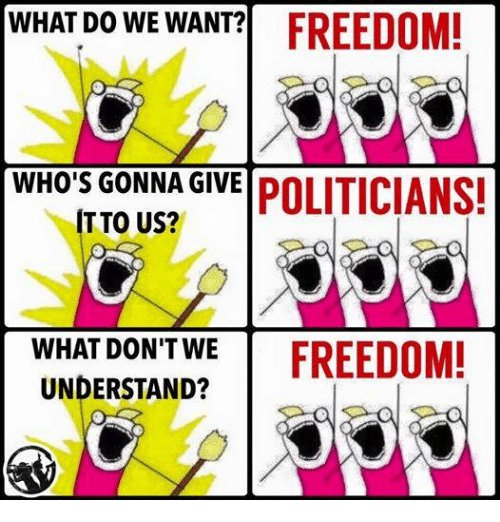
How do you fix THAT?